I have finished
Bleak House -- all 28 discs of the audio version, alternating with nearly 1000 pages of the print version. We're nearly finished with the eight-week readalong, and again, I'd like to thank
Amanda for organizing this -- it's nice to see so many participants. I know not everyone is as big a Dickens fan as I am, so I'm especially impressed with the bloggers that have stuck with it this far, considering the length. It's a big reading commitment, especially if you're not enjoying it. I did enjoy this just as much this time around as my previous read, and even more than my multiple viewings of the excellent BBC adaptation. If you're intrigued by the story but put off by the length of the book, please, do yourself a favor and watch this -- believe me, you will be hooked. It may even inspire you to attempt reading it.
I'm not even going to attempt to recap the plot thus far -- it would take too long and include far too many spoilers. I love
Bleak House because of the memorable characters, the fascinating, twisty plot, the great cliffhangers, and the brilliant way in which Dickens ties everything together while including social commentary, mystery, humor, tragedy, and romance. Seriously, this book has everything. It will remain one of my favorite books of all time. If I was going into outer space for a year and could only bring ten books with me, this would be one of them.
Like
Bleak House, most of Dickens' works are a commitment. They are long. His prose is flowery and sometimes challenging. His plots can be labyrinthine. Some of his characters (especially the women) can be irritating. I also find that he's elitist -- good characters, even if they are criminals, are usually nice looking and come to a happy end, and they are usually well-born, even if they are miserable orphans and don't realize they are From a Good Family. Many of the poor, unhappy characters are uneducated, unloved, and unattractive, and they suffer sad fates. Those that are not rarely rise above their station.
However, this does not deter me, because Dickens is really and truly worth it. I read my first Dickens work,
Great Expectations, back in college and then basically ignored his oeuvre until 2007, when I read
A Tale of Two Cities with an online classics group. It wasn't until I watched the BBC miniseries adaptation of
Bleak House that I was seriously hooked on Dickens. I've now read about half of his major works. I'm ranking them below in order of preference.
 |
| Gillian Anderson as Lady Dedlock |
1.
Bleak House. Still my favorite. Maybe it was the miniseries, but I am captivated by the tragic story of the Jarndyce court case. The lives of the Jarndyce heirs are intertwined with the heroine, Esther Summerson, as well as the mysterious Lady Dedlock. This book has everything -- romance, blackmail, murder, the brilliant Inspector Bucket (the first detective in English fiction!) and a host of side characters that are both grotesque and charming.
2.
Oliver Twist. The quintessential Dickens orphan. By now, the trope of the Poor Orphan is a little hackneyed, but little Oliver manages to survive the workhouse and a gang of thieves and still be sweet and saintly. Also one of Dickens' shorter works, so it's a great starting point for the Dickens novice.
3.
Great Expectations.
My first Dickens, read in my last semester of college. I took a fifth class, Introduction to Fiction, on a whim. I can't remember any of the other books we read except this one. I was sure I'd hate it but I was blown away, it was so enjoyable! It contains some of Dickens' most memorable characters -- Pip, the hero; his kindly but hapless stepbrother Joe, and his shrew of a sister.
4/5.
Little Dorrit and
David Copperfield -- tied for fourth place.
Copperfield started out so well, vying with
Bleak House for my favorite, but the middle gets really slow, and the story doesn't seem to go
anywhere. And David's True Love Dora is one of his most annoying ingenues EVER, so it slips in the ranking.
Little Dorrit has a lot of the colorful characters for which Dickens is famous, but somehow the story isn't quite as enchanting. Young Amy Dorrit was born and raised in the Marshalsea Prison, where her father has spent years imprisoned for debts. Dickens was pointing out the injustice of this vicious cycle. The hero, Arthur Clennam, is trying to help the Dorrits and falls in love with Amy.
6.
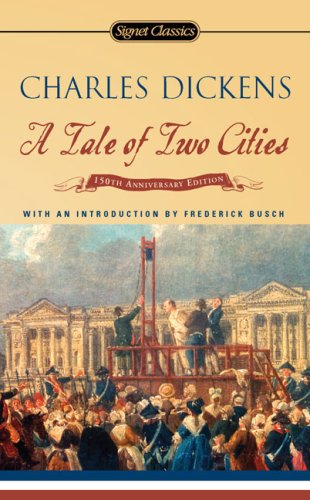
A Tale of Two Cities. This one gets big points for being fairly short, and also for having the BOTH the best first line and the best last line in a book EVER. Lots of great books have great first lines, but to have both is pretty impressive. Also, one of the best female villains, Madame DeFarge. However, points are taken away because, once again, Lucie Manette, the beautiful ingenue, is so boooring. Why is everyone so in love with her? Apparently Dickens believes that since she is young, innocent and pretty, no character development is therefore necessary. Snore.
7.
Nicholas Nickleby. Poor Nicholas has to get a teaching job at a terrible school to support his widowed mother and sister, and along the way he has some adventures. It was okay, but the characters didn't appeal to me nearly as much as those in
Bleak House,
Oliver Twist, or even
Great Expectations.
8/9.
Hard Times and
A Christmas Carol. Bleah. They're short, but I just don't see the appeal.
Hard Times is often read in schools because it's one of Dickens shortest works -- because he left out all the good stuff! Seriously, I cannot recall a single element of this book that I liked, or a single interesting character. It seems like Dickens had a novel all planned out and hadn't added any of the funny and/or grotesque side characters, but he was in a rush to publish something so he just handed it off to the publisher. A huge disappointment.
And
A Christmas Carol -- it's so popular, and I've seen so many adaptations -- there's even a Disney adaptation with Mickey Mouse and Scrooge McDuck. When I finally got around to reading it, I didn't see what the big deal was. I suppose I would have enjoyed it more if a TV version hadn't scared the crap out of me when I was about six or seven. (What was my mother thinking, letting me watch this? I was so scared of the Ghost of Christmas Future I slept under the bed for a week). I finally got around to reading it a few years ago and was seriously underwhelmed.
So, now that I'm nearly finished with
Bleak House I have to think about which Dickens to read next. My top choices are
Martin Chuzzlewith,
Dombey and Son, and
Our Mutual Friend. Bloggers, have you read any of these? Which one should I read next? I'd love to hear your comments and also your thoughts about other Dickens novels.