Last May I wrote this post in which I described my desire to complete reading all of William Shakespeare's plays in a year. At the time, I'd only read a dozen of the 37 plays definitively attributed to Shakespeare, and assumed I would easily finish the other 25 in a year. Riiiiiigght. It is now exactly 10 months later and I have only read another four plus I've just started the fifth.
I have realized that I really prefer watching Shakespeare's to reading them -- which I don't think is terrible, because, honestly, they were meant to be watched! I have been lucky enough to attend several performances since then, including two plays at the Blackfriars Playhouse at the American Shakespeare Center in Staunton, Virginia. And I'm going back in April! In exactly one month I'm going to Staunton for a two-play weekend: Romeo and Juliet and The Comedy of Errors.
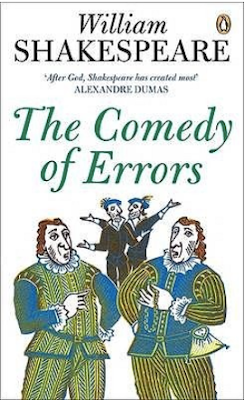
With that in mind, I decided to brush up my Shakespeare and give The Comedy of Errors another try on audio. I'd started listening a few months ago and just couldn't get into it, but I tried again, with an audio download from my library (I like the Arkangel Audiobook series). It's Shakespeare's shortest play and I easily finished listening to it in a day.
For those who don't know the plot, it's basically a slapstick farce about two sets of twins and a lot of mistaken identity. Possibly Shakespeare's earliest play, it's set in Ephesus, Greece (now modern-day Turkey). Egeon, a merchant, has been arrested and has one day to raise bail or be executed for the sin of being a Syracusan who dared set foot in Ephesus (due to some bad blood between the two places). The Duke of Ephesus asks why he has taken such a risk, and Egeon gives us some back story. Many years before, Ephesus had a wife and twin sons, plus another set of twin boys, born the same day as his own children, that he had bought as bonded servants from their impoverished mother. However, one of each set of twins, with his wife, had been separated from him in a shipwreck and never seen again. He raised his son Antipholus and the servant Dromio, who have since gone off seeking their lost brothers. Five years later Egeon is searching for them when he arrives in Ephesus.
The Duke takes pity on him and gives him one day to raise a thousand ducats or forfeit his life. Meanwhile, Antipholus and Dromio, both of Syracuse, have already arrived, not realizing that Egeon is looking for them, and more importantly, that both of their identical twins have been living there for years -- and are also named Antipholus and Dromio. (Apparently, the younger of each pair of twins remained with Egeon, and took his brother's name when they go out searching for their elder twins).
Since the older Antipholus and Dromio have lived for some time in Ephesus, they naturally have established relationships, including wives. Naturally this causes confusion and hilarity ensues when the second Antipholus and Dromio of Syracuse arrive. It's all very slapsticky and yet it never occurs to any of these people that there are two pairs of twins, including the pair that are literally looking for their lost twin brothers. And are they identically dressed? I'm extremely curious to know how this play is staged -- I'm guessing very few theater companies have been able to cast two actual pairs of twins in the principal roles. It was a little confusing the first time I tried to listen to the audio version -- you have to be able to remember which voice goes with which part but eventually I got it. I suspect it would be easier watching the play instead of just listening.
I did like the play but it really doesn't have that much depth to it. It's one of Shakespeare's earliest plays, and you really don't get much of the metaphors and themes of the later works. But it is a pretty fun read if you like slapstick and mistaken identities. I'm very much looking forward to my weekend in Staunton when I can see it performed live.
 |
| The Blackfriars Playhouse at the American Shakespeare Center in Staunton, VA |
This is my Pre-1800 Classic for the Back to the Classics Challenge; also my Turkish read for the European Reading Challenge.