Showing posts with label Victorian Challenge. Show all posts

Wednesday, August 2, 2017

The Semi-Attached Couple is like Jane Austen But With Extra Added Snark


As a longtime fan of Jane Austen, I'm always sad that she only completed six major works. There are far, far too many books claiming to be the heir to Jane Austen.  Somewhere in my bookish searches, I found The Semi-Attached Couple and The Semi-Detached House by Emily Eden, a Victorian writer who is largely unread these days. These two novellas are out of print but available for free online or inexpensively as used paperbacks, and are one of the closest things I've come to next-generation Jane Austen. 

My edition was published in one volume, and though the novels have similar names, they are unrelated. The Semi-Attached Couple concerns two neighboring families, the Douglases and the Eskdales. They had children about the same time, but as the children have grown, the families have grown apart, and Lady Eskdale, higher socially, has married her two daughters off before Mrs. Douglas, who is full of hilarious snide comments, much like Mrs. Bennet from Pride and Prejudice, only with a sharper tongue. 

In the beginning of the novel, the youngest and most beautiful Eskdale daughter Helen is about to be married to Lord Teviot, who is considered quite a catch. Helen is young and her expectations of marriage are different than those of her husband, which creates friction in their new marriage. He's jealous of her affection for her family. One thing leads to another and the marriage appears doomed. There are also side plots about unmarried friends and family and who's going to end up with whom. 

Also, soon after their honeymoon, her husband invites a large party to visit his estate, including the treacherous Lady Portmore. Here's an excerpt of a conversation between her and the newlywed Lord Teviot. Lady Portmore is trying to stir up trouble between Lord T and his bride: 

Lady P:  “Is that Helen's new horse she is riding?"

Lord T:  "No; Miss Forrester is on Selim."

[Lady P]:  "Well, I wonder Helen did not prefer your gift. I am sure that from sentiment I should never allow any human being but myself to ride a horse that had been given to me by the person I loved best in the world.

Lord T:   "That is an interesting and romantic idea; but as I shall probably have the honour of furnishing Lady Teviot's stud to the end of our days, it is not very likely that she will refuse to lend a horse to her friends when they come."

Lady P:  "Oh dear, no, that would be selfish; and you know how I hate selfishness. I often say there is nobody thinks so little of self as I do. Still I wonder Helen did not ride Selim."

Lord Teviot was silent.

Lady Portmore is everyone's best frenemy. She reminds me of a cross between Caroline Bingley from Pride and Prejudice and Mrs. Elton from Emma (with just a hint of Lady Catherine de Bourgh). There are a lot of similarities between these two novels and Jane Austen's works, and there's even a mention of P&P in a letter, from young Eliza Haywood asking permission from her mother to be allowed to read it. Clearly, Emily Eden was a fan of our Jane.

Naturally, all goes right in the end, with some good plot twists. I did wait a bit before reading the second novella, The Semi-Attached House, which I also enjoyed.  I was going to review both books in the same post but this has gotten longer than I expected so I'll save it for another day. These works don't have nearly the depth or the great writing as Jane Austen, but for plot, characters, and wit, they are just the thing if you are a Janeite or if you're looking for light Victorian read.

Saturday, June 10, 2017

A Roundup of Victorian Mini-Reviews

Or more precisely, a round up of mini-reviews of Victorian and Victorian-related works. (I like my title better). Anyway, I'm making really great progress on my Victorian Reading Challenge -- so far I've finished 16 of the 31 categories I want to complete and written reviews for nearly all of them. However, I've gotten behind on posts for the past few weeks and since three of them seem to go together, I thought I'd write up some mini-reviews and get on with it. 


Three Men on the Bummel by Jerome K. Jerome. This sequel to the beloved Three Men in a Boat has J and his friends George and Harris reunited for a summer bicycling tour through Germany. A good chunk of the book is devoted to the preparations for the trip (made more complicated by the wives and children of the three, who are not joining the party) and the usual funny asides when an incident reminds J of a funny story. Though not quite as fun as the original, this book has some great moments. It's pointless to describe them, so I'll just include one of my favorite passages. Sadly, the dog Montmorency isn't included in this story, but I had to include this bit which does include dogs.

This quote is a bit long, but it's one of my favorites from the whole book:
. . . in Germany most human faults and follies sink into comparative insignificance beside the enormity of walking on the grass.  Nowhere, and under no circumstances, may you at any time in Germany walk on the grass.  Grass in Germany is quite a fetish.  To put your foot on German grass would be as great a sacrilege as to dance a hornpipe on a Mohammedan’s praying-mat.  The very dogs respect German grass; no German dog would dream of putting a paw on it.  If you see a dog scampering across the grass in Germany, you may know for certain that it is the dog of some unholy foreigner.  

In England, when we want to keep dogs out of places, we put up wire netting, six feet high, supported by buttresses, and defended on the top by spikes.  In Germany, they put a notice-board in the middle of the place, “Hunden verboten,” and a dog that has German blood in its veins looks at that notice-board and walks away.  In a German park I have seen a gardener step gingerly with felt boots on to grass-plot, and removing therefrom a beetle, place it gravely but firmly on the gravel; which done, he stood sternly watching the beetle, to see that it did not try to get back on the grass; and the beetle, looking utterly ashamed of itself, walked hurriedly down the gutter, and turned up the path marked “Ausgang.”


As I'm currently living in Germany, I found this very amusing. Germany is a nation that takes rules and regulations extremely seriously. 
I'm counting this as my New To You Book by a Favorite Author.


Victoria: The Queen by Julia Baird. I was inspired to read this after finally watching the new Masterpiece production of Victoria, which had a lot of comments on one of my favorite non-book blogs, Frock Flicks, at which historical costume experts discuss (and sometimes destroy) historical film and TV adaptations. Yes, Lord Melbourne wasn't nearly as dishy as Rufus Sewell, but Queen Victoria was a little bit in love with him. Overall the book is well-written and engrossing, but I got a little bored with Victoria's life towards the end, but maybe there really wasn't that much to say; at that point I think the lives of her children are more interesting -- I recommend Victoria's Daughters by Jerrold M. Packer, which I reviewed a few years ago.

I'm counting this as my Book About Queen Victoria (fiction or non-fiction).


A Woman of No Importance by Oscar Wilde. Another drawing room comedy, but with more dramatic elements. Taking place over just a couple of days at a country house party, young George Arbuthnot has just landed a plum job with the worldly and sophisticated Lord Illingworth. His mother is dead set against him taking the job, because she has a Deep Dark Secret. The third play I've read by Wilde,  and though it has some witty moments, it's my least favorite so far. Here are a few of his trademark bons mots:

“One should never trust a woman who tells one her real age. A woman who would tell one that, would tell one anything.”

“After a good dinner one can forgive anybody, even one’s own relations.”

“To get into the best society, nowadays, one has either to feed people, amuse people, or shock people - that is all!”


I'm counting this as my Play or Book of Short Stories for the Victorian Reading Challenge.


Doctor Thorne by Anthony Trollope. Third in the Barchester Chronicles, it's the story of Mary Thorne, the relatively poor niece of a country village doctor, and Frank Gresham, eldest son of the local squire whose family is pressuring him to marry for money. I was looking for a good audiobook and realized I could get Doctor Thorne (probably my favorite Trollope novel) via digital download from my library; also, I got my hands on a copy of the Andrew Davies TV adaptation and wanted to refresh my memory before watching the DVD -- I hope that wasn't a mistake! Nevertheless, I loved it nearly as much as when I read it the first time -- I did get a little disgusted by the snobbery and hypocrisy of the Greshams and their wealthy cousins, the DeCourcys, who believe that family connections are everything until they need a massive infusion of cash. A great story, though.

I'm counting this as my Victorian Re-Read.

So -- four more Victorians crossed off the list, only 15 left to go!

Sunday, May 21, 2017

Over-the-Top Victorian Melodrama by Mary Elizabeth Braddon


Since I started seriously exploring Victorian literature, I've made some unexpectedly delightful discoveries. One of my favorite surprises was Mary Elizabeth Braddon, a Victorian writer who is best known for her Victorian sensation fiction. Author of more than 80 novels, she's best known for Lady Audley's Secret, which I read several years ago for the RIP Readalong. When I saw that the library had her debut novel available as an e-book, I couldn't wait to download it. 

First published in 1860 as Three Times Dead, Braddon reworked the novel and republished it in 1864 as The Trail of the Serpent. Basically, there are three intertwining plots. The first is the fate of Richard Marwood, a somewhat ne'er-do-well scamp who is trying to turn his life around, and is mistakenly accused of the brutal murder of his wealthy uncle. Following a verdict of not guilty by reason of insanity, he's sentenced to life in an asylum, while a sympathetic deaf police detective tries to prove his innocence and catch the real killer.

The second plot involves a psychopathic schoolteacher named Jabez North, who was fished out of the river as an orphaned baby. He believes he deserves better than working as a teacher in a second-rate boarding school and is merciless and diabolical. 

The final plot is a wealthy Spanish heiress, Valerie de Cevennes, who lives in Paris and is secretly married to a star opera singer. A manipulative adventurer named Raymond de Marolles manipulates and blackmails Valerie, forcing her to become his wife and control her fortune. Eventually, all the threads tie up together into one super-dramatic plot.  There are swoons and fevers and poisonings and dopplegangers, and of course, lots of Big Secrets and dramatic reveals. 


If this sounds really over top and melodramatic, well, it is. There's a lot of swooning and mustache-twirling, and I wouldn't call any of the characters well-developed. It's not so much a mystery of who the criminal is, but really how they did it and more importantly, will they get away with it? 

Nevertheless, the plot is really great and it's a fun, fast read. It's one of the earliest British detective novels, published a full eight years (in its first incarnation) than The Moonstone by Wilkie Collins. And it always pleases me to realize that women authors in the 19th century were just as prolific as some of the men (which then leads me to wonder why the male authors are studied as canon, yet many of the works by women have fallen out of print and are largely forgotten). This is the Victorian equivalent of a vacation read and I really enjoyed it.

I'm counting this as my 400+ pages novel for the Victorian Reading Challenge and as my Classic by a Woman author for the Back to the Classics Challenge

Tuesday, May 9, 2017

Mrs. Oliphant Is Just Getting Started With The Rector and The Doctor's Family


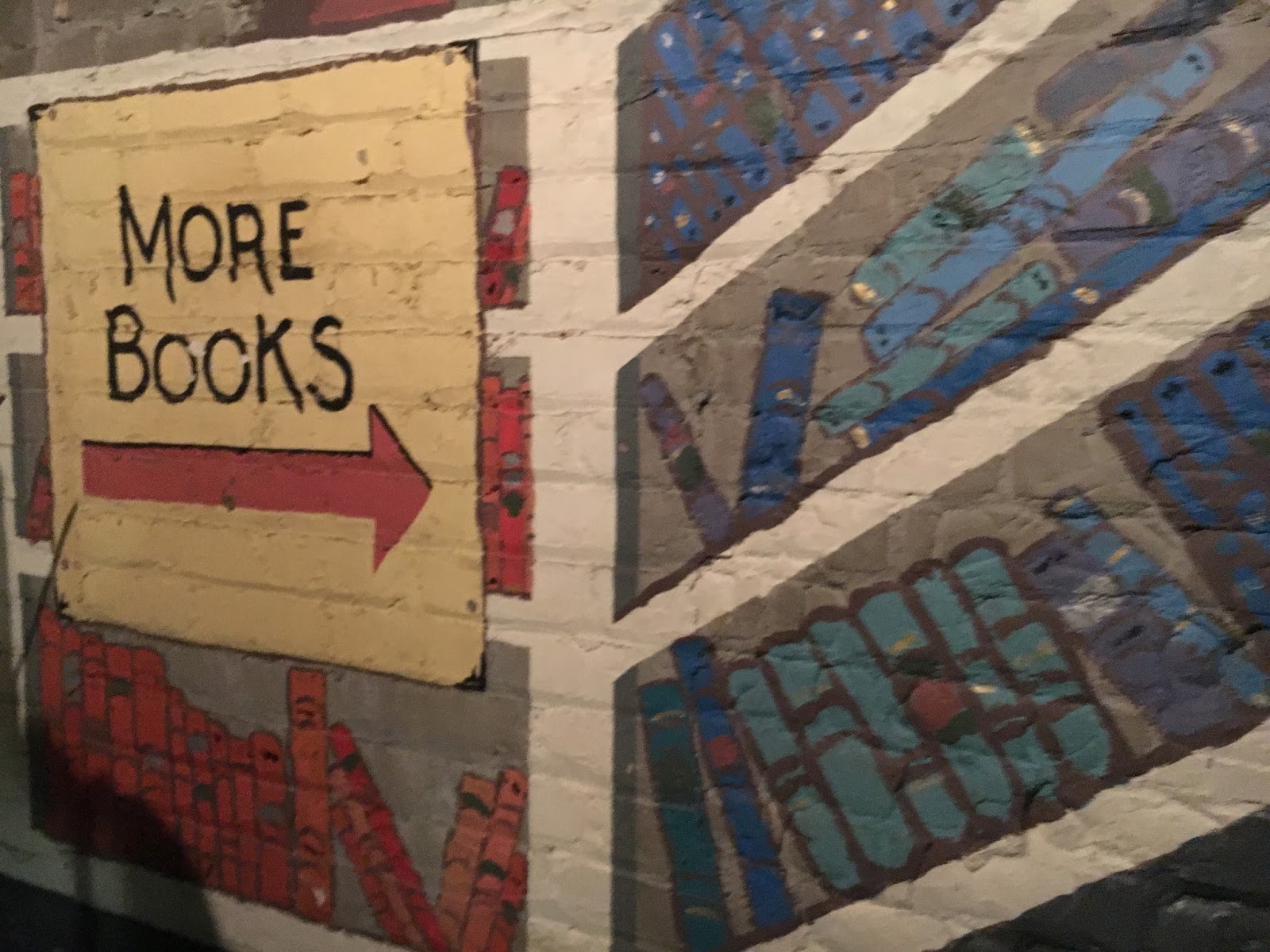
Snapped this stairwell mural discreetly. Shhhh.
Last year I went to Detroit for Spring Break to visit family (not nearly as exciting as Italy, it's true.) One of the highlights of the trip was a visit to John King Books, a former glove factory which is now a treasure-trove of used books on multiple levels. It's dim and dirty and you're not supposed to take photos. Don't tell.

I did, however, come home with a large stack of books, including some classic green Viragos:


The skinny little one in the middle is The Rector and The Doctor's Family by Margaret Oliphant, the Victorian writer who created the Chronicles of Carlingford. She's not much read nowadays but wrote about 120 books and was a best-selling author. A couple of years ago I read and loved Miss Marjoribanks which was described as very Jane Austen-ish, so when I saw this green Virago I bought it. 

Anyway, The Rector and The Doctor's Family are second and third  in the Chronicles of Carlingford, and they're so short that the combined edition is only 192 pages. I tucked it into my bag on a recent weekend trip because it was so small I could carry it around town without any trouble.

Originally published in 1863, the first novella, The Rector, is only 40 pages long, and it's really closer to a short story. It starts out with a young curate, Mr. Wentworth, visiting two sisters named Wodehouse -- a nod to Jane Austen, perhaps? There's a new rector in town, the middle-aged Reverend Morley Proctor, and naturally, conversation turns to whether he is a single or married man. The two miss Wodehouses are single, and the elder remarks that perhaps Reverend Proctor will someday marry her younger sister Lucy! Now, I'm not sure if she meant that Rev. Proctor is intended as the groom, or that he'd officiate at the ceremony, but young Lucy is about 18 and quite taken aback (as is Mr. Wentworth, who clearly has feelings for her). The elder Miss Wodehouse is 20 years Lucy's senior, and naturally there's speculation that she would be an excellent companion to Rev. Proctor. 

Now, I thought this was going to be a sweet story about Rev. Proctor choosing between the two sisters, but it isn't. Soon Rev. Proctor has a career crisis and can't decide if Carlingford is the place for him, and the story ends pretty quickly. I wasn't much impressed except for some very amusing parts with Mrs. Proctor, Morley's elderly mother, who is rather deaf and isn't shy about speaking her mind. I was a little perturbed that they implied how ancient she was when she's only 70, and Miss Wodehouse as rather elderly -- she's not quite 40! 


The second book in the volume, The Doctor's Family, is the far superior story. Dr. Edward Rider, a youngish single man, has started a practice in Carlingford and is tolerating an extended visit from his wastrel older brother Frederick, who seems to do nothing but lay about, read novels, and smoke. There's some implication that Edward had to leave a previous position because of something that Fred did, but it's never really explained. Edward's life seems sort of dull and hopeless until one day two strange women turn up, claiming to be Frederick's wife and sister-in-law, whom he abandoned in Australia -- with three small children! 

As soon as he gets over this surprise, Edwards discovers that Fred's wife Susan is whiny and self-absorbed, but her sister Nettie is forthright and assertive; also, young and pretty. Edward has never met anyone like her and is instantly smitten, but Nettie is only concerned about taking care of her sister's family, especially the children. Edward desperately tries to think of a way that he and Nettie can be happy together without the baggage of his family, but then a disaster occurs. I was really rooting for Nettie and and Edward to get together.

The second novella was far more interesting than the first, and I wasn't quite sure how it would all play out. The turn of events was pretty satisfactory, but Nettie's character seem to change dramatically. It does seem that some of the characters in the Carlingford series seem to repeat (Miss Marjoribanks is mentioned quite a lot, though I don't think she actually has any dialogue) so I'm hoping that if I read more of the series I'll find out a bit more about what happened to them. 

These novellas were entertaining, and the second was definitely an improvement over the first, though neither was nearly as good as Miss Marjoribanks. I do want to read more of the series and fill in the gaps about the Carlingford Characters. 

I'm counting this as my novella for the Victorian Reading Challenge

Thursday, May 4, 2017

Invisibility Is a Terrible Career Move

I love this cover, it's from a 1949 edition.
I'm not a huge science fiction fan but The Invisible Man by H. G. Wells is so short I thought I'd give it a whirl. I'd actually started it a few years ago and for some reason never read past the first couple of pages, which was a mistake. I recently found a downloadable audiobook from my library, and was amazed that I was absolutely gripped by it -- it reads like a thriller and I couldn't wait to find out how it was going to turn out.

The story starts with a mysterious stranger, covered in a coat, hat, scarves, and goggle-ish sunglasses, who arrives at a boarding house in Surrey, where he takes rooms. The landlady begins to wonder if her new tenant has had some terrible accident or is disfigured because she never sees his face or hands uncovered, and he never eats in front of anyone else. He has mysterious boxes and parcels delivered, and is working on something scientific. She finds him eccentric but ignores it, because he pays well and on time.

Eventually, people become suspicious, especially after a break-in at the local vicarage coincides with the stranger's inability to pay the rent on time. After a confrontation, the locals realize his secret and he's on the run. After some plot twists and turns, he finds refuge with an old schoolmate who coincidentally lives nearby (it's a Victorian story so there has to be at least one amazing coincidence, right?) Wells uses this meeting with the old classmate to give the Invisible Man a chance to explain the back story of how he became invisible, and we finally learn his name. 


Of course things take a turn for the worse and it becomes quite thrilling. Anyone who thinks Victorian novels are boring has clearly never read this book, because it's quite a page-turner. I think H. G. Wells was very clever to start the novel in the thick of the story, so you become intrigued by the mystery of the Invisible Man, and curious about his history. I was also really sympathetic towards the Invisible Man until I learned the back story; then it was all action and I couldn't wait to find out what happened next. I did listen to the entire thing on audio and found myself walking just a little longer so I could find out what happen next. I actually preferred it to the print version because the narrator was so good. (It was the OneClick Digital version narrated by Victoria Morgan, in case any one is wondering).

The first edition -- what a great cover!
I think I've now read all of Wells' most famous science fiction works except The Time Machine (I still haven't read that one because I was terrified by the Morlocks in the 1960 film version which I watched all alone as a child. I am still scarred by it.) This one is by far my favorite -- I found The Island of Doctor Moreau to be creepy and disturbing and War of the Worlds was a little boring in parts. This one was very engaging and I was only slightly bored by the technical explanation of how the Invisible Man actually became invisible, which is rather short and vague anyway. This was so good I may give The Time Machine a try after all. I also want to read Ann Veronica which is one of Wells' social satires. I've also read Kipps a few years ago and really liked it.

I'm counting this as my Book I've Started But Never Finished for the Victorian Reading Challenge.

Sunday, April 30, 2017

Charles Dickens Doesn't Think Much of Italy


A few years ago when I was especially enamored of Dickens, I bought nearly every one of his books I could get my hands on, including his lesser-known nonfiction. I'd been meaning to read Pictures from Italy for several years and since I recently took a vacation in Tuscany, it seemed like the perfect time to read it.

Well, yes and no. I was really hoping it would be a delightful travelogue, and it really isn't. To put it bluntly, it's not a very flattering portrait of Italy. Dickens seems rather fixated on darker, more grotesque aspects. Though he does love some of the historical sites like the Colosseum, he repeatedly describes the darker side of Italy, gleefully describing a tour of a fortress where people were tortured during the Inquisition; several descriptions of cemeteries with mass graves where poor people are buried, and I think there's even an execution. It's almost as if he's reveling in the squalor of the seamier side of Italy. Occasionally, he does describe the beautiful landscape and architecture, but over and over, it's pretty negative. Dickens wasn't too impressed with the Italian people either, mostly describing them as beggars or cheats. It's also pretty clear he didn't think much of Catholicism. 


Basically, I feel like Dickens was showing all his British readers how edgy and daring he was, showing the seamier side of traveling to a poorer country. Characters in Victorian novels often mention that they might move to the continent, where the living is cheaper, and it's also common for them to honeymoon in Italy or take the Grand Tour. It sounds very exciting to me as a 21st century Yank but there's nothing glamorous about this book. I found it to be mostly unflattering and often quite condescending, and it was disconcerting to read this while actually on holiday in Italy, where I had a wonderful time with excellent food and very nice people.
View of Florence from the Boboli Gardens. What's not to love, Dickens?
One wonders why he spent so much time in Italy if wasn't enjoying it! Unfortunately, I couldn't find my print copy with the annotations which I can only assume give more insight to this publication and its reception -- I think it must have been left behind during the big move last year (I ended up reading the electronic version, which was so much more convenient for traveling.) Dickens also published an account of his travels in America, American Notes for General Circulation. I can only imagine the reception it received across the pond, and I don't see myself rushing to track down a copy!

I'm counting this as my Italian read for the European Reading Challenge, and as my Dickens read for the Victorian Reading Challenge.

Thursday, April 20, 2017

Victorian Children Clearly Need Supervision


Also known as The Wouldbegoods by E. Nesbit. Inspired by Better Book Titles, I've decided to title my book reviews to better reflect what I really think about a book. (Also I feel like I need to liven up my reviews a little bit, as they've been feeling a bit stale lately. I may actually go back and retitle some of my previous posts). 

Anyway, The Wouldbegoods is essentially a turn-of-the-century version of Junie B. Jones with better writing -- children who do all the things that real children would like to do, but really know better (one hopes). Published in 1901, this book is full of what I would call Teachable Moments which are hilariously funny. The Bastable children from the delightful book The Story of the Treasure-Seekers have returned in another installment, this time in the country over the summer holidays. Since they can't stay out of trouble in London, the six children been sent to stay in the country with two other children Dennis and Daisy, supervised (in theory) by Albert-Next-Door's-Uncle, the writer, who seems to be so engrossed in his writing he pays little attention to eight children. The children have all vowed to be Good and create a Secret Society called The Wouldbegoods, for which they will do Good Deeds and Help People. Naturally, hilarity ensues because nothing ever goes as planned.

As always, Nesbit's writing as the voice of a child is spot-on:

You read in books about the pleasures of London, and about how people who live in the country long for the gay whirl of fashion in town because the country is so dull. I do not agree with this at all. In London, or at any rate Lewisham, nothing happens unless you make it happen; or if it happens it doesn’t happen to you, and you don’t know the people it does happen to. But in the country the most interesting events occur quite freely, and they seem to happen to you as much as to anyone else. Very often quite without your doing anything to help.

Clearly, Victorian children ran amuk with little or no supervision, and the adults are shocked -- shocked, I say! when they get into all kinds of trouble, much of it requiring vast expenditure to make right. (I suspect family's newfound fortunes from previous book are squandered to pay these bills). The results are often laugh-out-loud funny but also shocking to a modern adult -- there are chapters including stranger danger, a kidnapping, and a loaded firearm! After the first couple of episodes, you'd think that either the adults or the children would start to learn from their mistakes, but this is a book meant for children so nobody does (otherwise, it would make for a very dull story). But I enjoyed the heck out of it and found myself alternately snorting with laughter or yelling "Noooooo!" while reading. 


The Wouldbegoods is sadly out of print, but used copies are available and it's also in the public domain. I've now read six of Nesbit's books for children, and I've decided I really prefer those with little or no fantasy elements. I find the antics of children in our world much more amusing than those in fantasy lands. I also own a copy of Nesbit's book for adults, The Lark, which has been newly reprinted by the Furrowed Middlebrow imprint of Dean Street Press (readily available via Amazon and The Book Depository).  It's making quite a stir in the blogosphere, thanks to the Furrowed Middlebrow blog and also by Simon at Stuck in a Book. I hope it will be equally delightful. 

I'm counting this as my Children's Classic for the Victorian Reading Challenge. 

Thursday, April 13, 2017

The Prime Minister by Anthony Trollope


Also known as "Be careful what you wish for, because you might actually get it."

The fifth novel in the Pallisers series by Anthony Trollope, The Prime Minister is actually two overlapping stories: the first, about the Duke of Omnium, Plantagenet Palliser and his wife Lady Glencora, and his rise to power as the eponymous Prime Minister; the second, the romance between Emily Wharton, a sweet young thing from a Good Family (with a possible inheritance of about 20,000 pounds) and an up-and-coming financier named Ferdinand Lopez. Lopez is a friend of Emily's brother, the somewhat ne'er-do-well Everett, and nobody seems to trust him because although he was born and raised in England and was educated in English schools, nothing is known about his background. Is he an adventurer trying to get his hands on her money? Or is everyone else just racist and assuming the worst because -- wait for it -- he father was Portugese? Oh, the horror!

Ferdinand is wooing Emily pretty hard, despite the adoration of her childhood playmate Arthur Fletcher, whom everyone (including Arthur) assumed she would someday marry. Meanwhile, Planty Pall is named Prime Minister of a coalition government. It should be the pinnacle of his career, but he's not really good schmoozing and creating political alliances. He's a little thin-skinned and really just wants to do what's Best and what's Right, which (sadly) isn't necessarily what makes a good politician. His wife Glencora embraces her role as the PM's wife and spends masses of money to entertain, in London and at Gatherum Castle, their country estate (there are some pretty hilarious bits about the preparations at Gatherum that reminded me very much of Downton Abbey). 

Emily and Ferdinand's romance does not turn out how she expected; and Lady Glen has some disappointments -- she was so hoping to become a Great Lady, a Queen Bee of society with salons and parties. She even tries her hand at political influence, which backfires spectacularly. It all ends for the best but is definitely bittersweet.

I think Trollope did a great job intertwining the political and the domestic stories in this novel. Some of my favorite characters make appearances, including Phineas Finn, his wife Marie Goesler, Lizzie Eustace and even the Greshams from Doctor Thorne show up (though it's been so long since I read that novel, I didn't even connect them at first). Some of the politics did get a bit tedious for me but Lady Glen is one of my favorites. 

However, I did have a couple of issues with this book. Once again, Trollope has created an ingenue (Emily) that is just unrealistically self-sacrificing. It must be some kind of Victorian trope, because I really wanted her to grow a backbone and stand up for herself. She's one of these characters that doesn't believe she deserves happiness. I did want to jump into the book and give her a good talking-to.


Also, there are a lot of anti-Semitic slurs about Ferdinand Lopez. I don't even actually remember if there's any basis and he's actually Jewish or not, but either way, it was disturbing. I feel like Trollope was sending a message that Outsiders Are Bad -- given the current political climate, it made me particularly uncomfortable (though the idea of a coalition government was also mind-blowing -- I can't imagine that ever happening in the U.S.!)

Overall, I really did enjoy it. Trollope creates such vivid characters that I really got invested in them, despite their flaws (or lack of them). I've just bought the recently restored version of The Duke's Children that is finally available at an affordable price, and I'm looking forward to reading the final volume of the Pallisers.  I'll be a bit sad when I've finished the whole thing. 

Monday, March 27, 2017

Cousin Phillis by Elizabeth Gaskell


My cousin Phillis was like a rose that had come to full bloom on the sunny side of a lonely house, sheltered from storms. I have read in some book of poetry,—

A maid whom there were none to praise, And very few to love.

And somehow those lines always reminded me of Phillis; yet they were not true of her either. I never heard her praised; and out of her own household there were very few to love her; but though no one spoke out their approbation, she always did right in her parents' eyes out of her natural simple goodness and wisdom. 

I was happy to find this novella on audiobook available for digital download at my library. I thought I'd read nearly everything by Elizabeth Gaskell but apparently not! Published in 1864, this is one of Gaskell's lesser-known works and I think that's a shame, because I really enjoyed it.

The book's narrator, Paul Manning, is nineteen and working on the railways as an apprentice engineer. While on an assignment in Cheshire, he learns that he has cousins from his mother's side living nearby, and begins to visit them: the Reverend Holman, a pleasant clergyman-farmer; his devoted wife, and their daughter, Phillis, who is sixteen but is tall, pretty, and intelligent. They all become very fond of each other and are his surrogate home-away-from-home, spending weekends and holidays with the Holmans when it's too far to visit his own family back in Birmingham. 

Reverend Holman works hard as both a farmer and minister, and has a constant curiosity about the world that he's passed on to his daughter. Phillis is tall and beautiful, well out of Paul's league, but he loves her as his own sister. Eventually, Paul brings his best friend and railway supervisor, Edward Holdsworth, to meet the Holmans. Holdsworth is handsome, educated, and well-traveled, and as expected, a sort of love triangle ensues and there is heartbreak. 

This is a lovely, bittersweet novel, and Gaskell expertly describes life on the Holman farm which sounds absolutely idyllic, though it must have been isolating for a bright girl like Phillis. Gaskell also creates really well-defined characters that felt incredibly real, and several times I found myself yelling out loud at them. I also really liked that young Paul was the narrator -- I think she did a great job creating his voice.

My one quibble with the novella was the ending, which I found rather abrupt. Gaskell went into so much detail with the rest of the story that I was surprised how quickly it ended. I did a little research and according to Wikipedia, the novel was first published as a series in four parts and there were two more parts originally planned. I can't find any other sources to back this up but that would explain why it felt unfinished. It's also the work published just before Wives & Daughters, my favorite among her novels, and I think the writing style is quite similar compared to her earlier works which I find a bit harder to read. It's another side to her works which I really liked having read most of her major novels.