Showing posts with label children's classics. Show all posts

Tuesday, April 13, 2021

1936 Club: Anne of Windy Poplars by L. M. Montgomery


While searching for an appropriate book for the 1936 Club, I realized that Anne of Windy Poplars, fourth in the Anne of Green Gables series, was published that year. Six of the books in the series were published from 1908 to 1921, but later in her career, L. M. Montgomery went back and filled in the gaps before and after Anne's House of Dreams; (Anne of Ingleside was published in 1939.)

Anyway, it was an easy choice, especially after my previous read, which was good but a little depressing. I hadn't read any of the Anne books for a few years, so I quickly sped through Anne of Anne of the Island (volume 3) to get caught up with Anne in volume 4. I'm very glad I did because although I enjoyed the third book, I much preferred the fourth. (This post will contain very mild spoilers about Anne's career and love life, but nothing really shocking).

So, our beloved Anne Shirley, spunky orphan from Prince Edward Island, is now a graduate of Redmond College, and has a three-year job as principal of Summerside High School, also on Prince Edward Island. She's engaged to Gilbert Blythe, who is in medical school, and much of the book is Anne's lengthy letters to Gilbert (sadly, no letters from Gilbert to Anne are included). The story begins with Anne looking for lodgings in Summerside. Traditionally, the principal boards with Mrs. Tom Pringle, who has decided not to take lodgers. Anne finds a room boarding at a house delightfully named Windy Poplars, with two widows, Aunt Kate and Aunt Chatty, and Aunt Kate's curmudgeonly yet lovable cousin, Rebecca Dew, who is sort of a housemaid/milkmaid/Greek chorus. Windy Poplars is just the sort of charming, romantic house that would attract Anne, situated on a road called Spook's Lane, with a tower bedroom, across from a graveyard. 

Nice cover, but Anne is far too young -- 
she'd have her skirts down and her hair up if she were the school principal! 

The reason that Mrs. Pringle won't take Anne as a boarder becomes quickly apparent. The Pringles and "half-Pringles" are the dominant family in the area, and they run the show. Before even arriving, they're mad at Anne for having the gall to be hired as principal over one of their own clan, and they are determined to make her life difficult behind her back, though they appear to be kind to her in person, inviting her for dinners, etc. But they undermine her at the school at every turn, especially with the students who are insubordinate, refuse to do homework, play pranks on her at every turn. However, Anne manages to get the better of them when they attempt to sabotage the school play. 

Of course Anne wins them over eventually, with a bit of deus ex machina. (Which is fine).There are also other recurring characters, including Katherine, a prickly co-worker who was also angling for the job; and Elizabeth, a miserable child living next door who seems to have the worst guardians and the loneliest existence in the world. Naturally, Anne's inherent sunny disposition and cockeyed optimism change their lives. 

This volume isn't groundbreaking or particularly exciting as far as Anne's story goes (or in the greater annals of children's literature). Basically, it just seems amusing filler in the Anne chronicles before her marriage. Nothing really happens to Anne other than meeting interesting and eccentric characters in Summerside, or improving the lives of everyone around her. You could even read this as a stand-alone novel if you didn't know anything else about Anne Shirley -- I actually found it easier to read than the previous novel, Anne of the Island (due to the gap in my reading I'd forgotten a lot of the secondary characters and was a bit confused at times).


Still, the fun and quirky characters are what makes this book delightful, if a little too good to be true, sometimes. But it's Anne Shirley and who doesn't need a little unrealistic levity right about now? It's just the thing for a pandemic comfort read, and I will probably finish the rest of the series this year.

In this passage, Anne is taking a tour of the cemetery and getting a little local color from one of the residents: 

The MacTabbs were all handsome but you could never believe a word they said. There used to be a stone here for his Uncle Samuel, who was reported drowned at sea fifty years ago. When he turned up alive the family took the stone down. The man they bought it from wouldn't take it back, so Mrs. Samuel used it for a baking-board. Talk about a marble slab for mixing on! That old tombstone was just fine, she said. The MacTabb children were always bringing cookies to school with raised letters and figures on them. . . scraps of the epigraph. They gave them away real generous, but I never could bring myself to eat one. I'm peculiar that way. 

I'm quite sure I will remember this story the next time I'm rolling out cookie dough!

There are many, many editions out there, and while searching for cover images, I also found this:


Apparently Anne of Windy Poplars was adapted as a 1940 movie! It's not on DVD but you can find clips on YouTube. The full movie may be online somewhere but I wasn't able to find it. I did find a synopsis of the plot on Wikipedia which you can read here, it sounds absolutely terrible. Has anyone seen it? I'd love to know! 

 I'm counting this as my Children's Classic for the Back to the Classics Challenge. And thanks again to Simon and Kaggsy for hosting the 1936 Club! 

Sunday, January 10, 2021

Challenge Link-Up Post: Children's Classic


Please link your reviews for your Children's Classic here.  This is only for the Children's Classic category. Picture books do not count! If you do not have a blog, or somewhere public on the internet where you post book reviews, please write your mini-review/thoughts in the comments section.  If you like, you can include the name of your blog and/or the title of the book in your link, like this: "Karen K. @ Books and Chocolate (The Wizard of Oz)."
 

Thursday, January 18, 2018

Anne of Avonlea: Still Spunky and Red-Haired


I think I am the only woman raised in North America not to have grown up loving Anne Shirley. Somehow, I completely missed this book growing up -- I think I must have confused her with Heidi or Rebecca of Sunnybrook Farm, who always sounded so saccharine and sentimental. (If you are a fan of either, I apologize. Maybe I need to give them a try as well).

I finally got around to reading Anne of Green Gables by L. M. Montgomery about 10 years ago when my someone (possibly me) gave my then nine-year-old daughter a beautiful illustrated copy. I thought it would be fun for us to read the same book, and I also suggested it to my own mother, who'd never read it either. Well, I don't know if my daughter ever finished it, but Mom and I both did, and we loved it. (My mother went on to complete the entire series, though I don't know if she ever moved on to Emily of New Moon or any of Montgomery's other works.)

But I digress. When I decided to include the Children's Classic category in the Back to the Classics Challenge this year, I knew right away I wanted to read the next book in the Anne series. Anne of Avonlea picks up soon after the end of Anne of Green Gables (which I reread after Christmas to refresh my memory). Anne has returned to Avonlea after earning a teaching certificate, and starts a job at the village school. Though she's grown up and gets into less scrapes than the previous book, there are still funny moments, and more comic relief is provided by a grumpy new neighbor, Mr. Harrison, and six-year-old Davy Keith, one of a pair of twins adopted by Marilla after their mother, a distant cousin, has died. (The other twin, Dora, is so perfect that even Marilla admits the child has almost zero personality).


There's not so much an overarching plot as just episodes in her life over a couple of years, as she becomes confident as the teacher of unruly pupils, starts a village beautification society, and meets new and interesting characters as she wanders around Avonlea describing how beautiful and picturesque life is. (If you don't like rambling descriptions, this is not the book for you). There are tragic episodes and funny episodes, but I almost felt like this book was just filling space until the next book. Also, if you are looking for a budding romance for Anne and Gilbert Blythe, it's not here. Gilbert is teaching school in a neighboring town and he's barely mentioned. However [highlight for spoilers] they both go off to the same college in the following book, Anne of the Island. I'm pretty sure that's where their relationship really starts.

Anne of Avonlea is a pleasant, gentle read, and I can see why it's popular all over the world -- it's a very bucolic story where nothing very terrible happens to anyone, sort of an idealized vision of rural life in the early 20th century. It's been translated into many languages and I know it's very popular in Japan. I read a free digital download version and enjoyed looking at all the different cover images -- there are so many, good and bad, I think it's time I did another Awful Book Cover post.

I'm counting this as my Children's Classic for the Back to the Classics Challenge.

Tuesday, January 9, 2018

Challenge Link-Up Post: Children's Classic


Please link your reviews for your Children's Classic here.  This is only for the Children's Classic  category.  Short stories are fine, but it must be a complete volume. Young adult and picture books don't count!   If you do not have a blog, or somewhere public on the internet where you post book reviews, please write your mini-review/thoughts in the comments section.  If you like, you can include the name of your blog and/or the title of the book in your link, like this: "Karen K. @ Books and Chocolate (The Lion, the Witch, and the Wardrobe)." 


Thursday, April 20, 2017

Victorian Children Clearly Need Supervision


Also known as The Wouldbegoods by E. Nesbit. Inspired by Better Book Titles, I've decided to title my book reviews to better reflect what I really think about a book. (Also I feel like I need to liven up my reviews a little bit, as they've been feeling a bit stale lately. I may actually go back and retitle some of my previous posts). 

Anyway, The Wouldbegoods is essentially a turn-of-the-century version of Junie B. Jones with better writing -- children who do all the things that real children would like to do, but really know better (one hopes). Published in 1901, this book is full of what I would call Teachable Moments which are hilariously funny. The Bastable children from the delightful book The Story of the Treasure-Seekers have returned in another installment, this time in the country over the summer holidays. Since they can't stay out of trouble in London, the six children been sent to stay in the country with two other children Dennis and Daisy, supervised (in theory) by Albert-Next-Door's-Uncle, the writer, who seems to be so engrossed in his writing he pays little attention to eight children. The children have all vowed to be Good and create a Secret Society called The Wouldbegoods, for which they will do Good Deeds and Help People. Naturally, hilarity ensues because nothing ever goes as planned.

As always, Nesbit's writing as the voice of a child is spot-on:

You read in books about the pleasures of London, and about how people who live in the country long for the gay whirl of fashion in town because the country is so dull. I do not agree with this at all. In London, or at any rate Lewisham, nothing happens unless you make it happen; or if it happens it doesn’t happen to you, and you don’t know the people it does happen to. But in the country the most interesting events occur quite freely, and they seem to happen to you as much as to anyone else. Very often quite without your doing anything to help.

Clearly, Victorian children ran amuk with little or no supervision, and the adults are shocked -- shocked, I say! when they get into all kinds of trouble, much of it requiring vast expenditure to make right. (I suspect family's newfound fortunes from previous book are squandered to pay these bills). The results are often laugh-out-loud funny but also shocking to a modern adult -- there are chapters including stranger danger, a kidnapping, and a loaded firearm! After the first couple of episodes, you'd think that either the adults or the children would start to learn from their mistakes, but this is a book meant for children so nobody does (otherwise, it would make for a very dull story). But I enjoyed the heck out of it and found myself alternately snorting with laughter or yelling "Noooooo!" while reading. 


The Wouldbegoods is sadly out of print, but used copies are available and it's also in the public domain. I've now read six of Nesbit's books for children, and I've decided I really prefer those with little or no fantasy elements. I find the antics of children in our world much more amusing than those in fantasy lands. I also own a copy of Nesbit's book for adults, The Lark, which has been newly reprinted by the Furrowed Middlebrow imprint of Dean Street Press (readily available via Amazon and The Book Depository).  It's making quite a stir in the blogosphere, thanks to the Furrowed Middlebrow blog and also by Simon at Stuck in a Book. I hope it will be equally delightful. 

I'm counting this as my Children's Classic for the Victorian Reading Challenge. 

Saturday, February 27, 2016

The Phoenix and the Carpet by E. Nesbit


After finishing Journey to the Centre of the Earth, I was still in the mood for a some good adventures. I remembered a copy of The Phoenix and the Carpet by E. Nesbit that I'd picked up years ago at a library sale. How is it that I completely missed out on Nesbit in my youth? I suppose my hometown library just didn't have them. Well, I've now completed five of her books and loved all of them. This one ranks right up at the top of great classic children's fantasy, right up there with the Wizard of Oz books and the entire oeuvre of Roald Dahl.

Published in 1904, The Phoenix and the Carpet is the second in the series of that began with Five Children and It. Instead of a magical sand fairy, the a family five children find both a magic carpet and a magical bird, a legendary phoenix. By a series of mishaps (well, basically, they decide to try out fireworks inside the house) they have to get a new carpet for the nursery. Their parents buy a second-hand carpet which, when unrolled, is found to include a strangely glowing egg. The children attempt to return it, but no go. After the egg accidentally rolls into the fireplace, it hatches and out comes the phoenix, who explains that the carpet is also magic, and can give them three wishes a day.

If you're looking for serious high fantasy, this isn't it. Although the children are occasionally transported to faraway places, their adventures are pretty tame, though humorous. As in Five Children and It, the children quickly realize that wishes don't always work out quite like you plan. Of course it's a children's story, so most everything comes out right in the end, but Nesbit's chapters are cleverly plotted, so I really wasn't sure how everything was going to shake out. And the writing is both wry and witty, with a few sharp observations. It's both entertaining and funny as the kids get in and out of scrapes. My only quibble as that in some their adventures, they encounter "savages" who are quite obviously people of color, and the racism that tinges these episodes.

Cover of the new Puffin Classics edition

Overall, though, it was quite a delightful read, and tI'll probably include it among my favorite books of this year. I'm counting it as my Fantasy/Sci-Fi/Dystopian Classic for the Back to the Classics Challenge. 

Saturday, February 20, 2016

Journey to the Centre of the Earth by Jules Verne


Determined to knock off a few books from my own TBR shelves, I picked up Journey to the Centre of the Earth the other day. I'd just finished Armadale, after a month-long read, and just couldn't bear committing to another dense Victorian. Specifically, I picked this one up because it had an introduction by the late Diana Wynne Jones -- which is why I probably purchased it in the first place. It's one of the charming Puffin Classics editions packaged for children. (Ithink it was a buy one, get one special at Barnes & Noble.)


So, if you were wondering about the plot, it is exactly as the title states. After finding an ancient code tucked in an old book, Young Axel and his eccentric scientist uncle, Otto Liedenbrock, leave their comfortable home in Hamburg and attempt to explore the center of the world, via a volcano in Iceland. Axel nervously agrees to the crazy scheme, believing there's no way they will actually get that far.


But clearly, they do, and make astonishing discoveries along the way, with the help of an Icelandic guide named Hans. The first quarter of the book are pretty standard let's-go-on-a-trip with all the preparations, sea voyage, and encounters with a different culture. But eventually, they make their descent through an dormant volcano, Sneffels, (better known in Iceland as Snaeffelsjokull).


The actual Snaeffelsjokull in Iceland.

Things get pretty interesting after they descend into the a series of underground caverns, with dangers and discoveries and miraculous escapes (of course). Suffice to say it's all slightly ridiculous to the modern reader, but for its time, it must have been pretty fantastic. I'm not sure how this version compares to others (this one was translated in 1965 by Robert Baldick) but it was a quick, easy read. I do know that a lot of the translations in English made a lot of abridgments -- one audio version actually changes the names of the characters completely! But I mostly liked it, though in retrospect, the characters weren't very practical about planning and packing for the journey, and there's one part that's sort of racist which I found a little annoying. There's also a lot of geology and such that I will admit I mostly skimmed.

A couple of years ago I tried listening to an audiobook of 20,000 Leagues Under the Sea, but I eventually gave up on it -- after awhile I got bored and I remember it just seemed like a lot of lists of undersea flora and fauna. I did get a bit of that in Journey to the Centre of the Earth as well -- I know Verne did a lot of research and I can only guess that he wanted to pack everything in.  I'm afraid I did tend to skim over a lot of the scientific details of this book, especially the parts about calculating depth and suchlike. However, it has inspired me to consider visiting the Natural Bridge Caverns, which are just a short drive away.


Underground lake in Natural Bridge Caverns.
I had originally intended to count this as my Classic Science Fiction choice for the Back to the Classics Challenge, but I don't know that I'd necessarily call it sci-fi -- though one could call it that because of the speculative nature of their discoveries, I'm really more inclined to count it as my Adventure Classic -- really, most of the book is taken up with exploration and discoveries (though if someone else wants to count this as their Science Fiction Classic, that's fine with me).

Monday, January 26, 2015

Mary Poppins by P. L. Travers


"She knew very well that Mary Poppins never wasted time in being nice." 

Growing up, I missed an awful lot of the children's classics -- I read and loved the Narnia series, the Little House books, and the Boxcar children, but I never even read The Wizard of Oz series until I was in middle school (and I skipped the first book, assuming it was just like the movie.  I was quite wrong).  I am now officially adding Mary Poppins to the list of books I regret never reading while I was an actual child.

If you're not familiar with the plot, Mary Poppins is a mysterious, magical nanny that shows up and takes charge of the four Banks children after their Katie Nanna leaves on short notice.  She's not what you'd call warm and cuddly -- she's actually rather short and brusque with the children -- but when Mary is around, wonderful things happen.  The two elder children, Jane and Michael, have fantastic adventures with Mary, including a visit to the zoo at night when the animals are running the place; a tea party held whilst floating up near the ceiling; and a magical trip around the world.

Mary Poppins was never among my favorite Disney movies when I was a kid, and when my own children were born, I didn't enjoy it much more.  It was only after I saw Saving Mr. Banks that I had any read desire to read the book to see how it compares to the movie.  Well, it's far superior -- in fact, there's barely any resemblance to the movie at all, except the famous opening when she comes in with her carpet bag and slides up the bannister; and her evening out with Bert.  It's possible that other elements in the movie are taken from later books in the series, which I haven't read yet, but if you're a fan of the movie, you might be disappointed.  Mr. and Mrs. Banks are barely mentioned, and there are no chimney sweeps in sight.


I also did not realize that this book was revised by Travers back in 1981.  I'd been listening to the audio, and when I have a hard copy, I like to see my progress by comparing it to the print book.  So, I looked in my copy to check my place, and was VERY surprised to see that my current chapter, "Bad Tuesday" was QUITE different -- as in quite racist!

That particular chapter starts out with Michael getting out of the wrong side of bed.  Everything goes wrong all day and he's being very naughty.  They're out on a walk and spot a compass on the ground, and Mary Poppins uses it so they can travel around the world.  In the audio version, they go in all four points of the compass, and visit a polar bear, a macaw, and panda, and a dolphin, and it's quite delightful.  Apparently in the original version it's people, and the visit to Africa is particularly offensive.  But I'm glad to say that the revised version is much better.  

Though I do own a print copy of the book, I mostly listened an audio version, which I just loved.  The reader, Sophie Thompson is one of the most delightful audiobook narrators I've ever encountered.  (Yes, that's the Sophie Thompson who is the sister of Emma Thompson, who played Miss Bates in Emma and Mary Elliot in Persuasion).  She's just perfect for Mary Poppins -- Mary is very no-nonsense, the children are full of wonder, and her accents are spot-on.  I'm planning to read the entire Mary Poppins series, and when I do, I will imagine Sophie Thompson narrating all the rest of the books in my head.

I'm counting this book as my Children's Classic for the Back to the Classics Challenge.

Tuesday, June 25, 2013

The Children Who Lived in a Barn by Eleanor Graham


I've been hard at work on my Back to the Classics Challenge!  Recently I needed a fun, light read after some fairly heavy books.  This was a children's classic, a Persephone, and a book on my TBR shelf.  Plus it was nice and short, with some cute illustrations.

Though it's a British children's classic, I'd never heard of The Children Who Lived in a Barn until I started collecting Persephone books.  It's very much in the same vein as the American series The Boxcar Children, one of my childhood favorites. 

Anyway, here's the setup:  sometime in the 1930s, the Dunnet family of seven are living in rural England, though they've just moved into a small village and hardly know anyone.  The parents get a telegram that the grandmother, who's off somewhere in Switzerland, has taken ill.  Without much thought, the parents drop everything and literally fly away, leaving the kids to manage by themselves.  Then the parents mysteriously disappear, possibly in a plane crash over the Alps, and Susan, 13, and Robert, 11, must take charge of themselves and their younger siblings, twin brothers who are 9 and a little 7-year-old sister.  Their unscrupulous landlord evicts them, but a kind farmer offers to let them stay in the barn in exchange for helping out.

At first it seems like a childhood dream to be on their own, but it quickly becomes obvious how hard it is to keep a household running, especially with a limited budget.  Susan and Robert try to make do with odd jobs and a small amount of money allocated by the bank, but things are tight, especially after school starts.  Some local busybodies have decided they'll keep an eye on the children and are none too sympathetic, mostly more judgmental than helpful.  It's the local village folk who are kinder, especially when they see how hard the older children are trying.

The beautiful endpapers from the Persephone edition

The children even rig up something called a "hay box" to keep their food warm during the day, kind of a makeshift slow-cooker.  Here's an illustration of something similar:

The hay-box probably looked something like this.
Eventually, the situation becomes dire but all turns right in the end, as this is a children's book.  I really enjoyed this -- some of my favorite childhood books are those in which the adults are out of the picture and the children are forced to take charge, like the Narnia books and the Boxcar children.

I thought the only weak point is the explanation of what happened to the parents, which seemed extremely unlikely and tacked-on.  Their characters aren't terribly well-developed and they were more immature than Susan and Robert!  However, it was a delight to read and I really enjoyed it.  I have two other classic children's books published by Persephone, The Runaway by Anna Elizabeth Hart and The Young Pretenders by Edith Henrietta Fowler.  I haven't read either of them yet but I hope I'll like them as much as this one.  Has anyone else read this book?  What about other children's classics -- which are your favorites?

Tuesday, July 17, 2012

The Story of the Treasure Seekers by E. Nesbit


After my recent intense experience reading Zola, a children's classic was just the thing, especially since I'm still obsessed about the Victorian Celebration.  Originally, I'd planned on reading either The Water-Babies by Charles Kingsley or At the Back of the North Wind by George MacDonald.  Neither of them really grabbed me, but then I realized that The Story of the Treasure Seekers by E. Nesbit qualified as a Victorian!  One of Nesbit's earliest children's books, it was published in 1899, and so it still made the cutoff date.  And I just loved it.

I'd never heard of E. Nesbit when I was a child -- of course this was years before blogging and online library catalogs, and though my public library was pretty good, it's nowhere near what libraries are today.  After I started library school, I'd read a couple of Nesbit's fantasy stories and liked them well enough, but something about The Treasure Seekers just spoke to me -- I found it delightfully charming and really funny -- I kept reading bits out loud to my eleven-year-old daughter, and finally I just started reading her entire chapters.  

But I'm getting ahead of myself.  Told from the point of view of one of the children, this is the story of the six Bastable children:  Dora, Oswald, Dicky, the twins, Alice and Noel, and the youngest, Horation Octavius, also known as H. O.  Their mother has died fairly recently, and after her death, their father also fell ill and lost most of his wealth (it's unclear, but it sounds like his business partner made off with most of it)  This once genteel family is now scraping by; they've given up school and summer holidays and all the silver plate has been "sent off to get the dents removed, but never sent back" -- probably pawned or sold.  So, the children are full of plans to restore the family fortunes.  They brainstorm all sorts of ideas, such as digging for treasure, writing poetry for money, becoming bandits, and saving elderly people from danger, who will then reward them.  The book was originally published in serial form, and each chapter details a different adventure as the children try various schemes, (some of them definitely hare-brained) so it's easy to read in small snatches.  

I thought Nesbit did a fantastic job creating the characters of these six children -- they all had personalities, and what's best about them is that they're definitely flawed -- they argue and bicker amongst themselves, like real siblings, and they have flaws.  Some of their schemes are morally and legally questionable, and they usually learn their lessons from their bad behavior, but it's not at all preachy.  The adults were good too.  The children often wind up needing grownups to help them out, including "Albert-next-door's uncle" who never gets an actual name, but seems like a real hoot -- he's a writer, and if he'd been real, I'm sure he would have gotten a lot of good material from the Bastable children.  (Could this be E. Nesbit herself in disguise?)  

I also loved the wry humor -- here's one of my favorite bits:

I have often thought that if people who write books for children knew a little more, it would be better.  I shall not tell you anything about us except what I should like to know about if I was reading this story and you were writing it.  Albert's uncle says I ought to have put this in the preface, but I never read prefaces, and it is not much good writing things just for people to skip.  I wonder other authors have never thought of this.  

There are lots of funny little comments like this throughout the book.  The plot's pretty good, and I found the ending particularly satisfying.  I'll say no more since I never want to give anything away.  

I was also happy to read this one because I had an unread copy on the shelves -- I bought it last year at Books of Wonder, the celebrated children's bookstore in New York.  I only wish they'd had a hardcover copy -- it was the recent paperback copy pictured above, but it was on sale for only $5 so I couldn't pass it up.  Of course now I'll have to track down the two sequels, The Wouldbegoods and The Story of the New Treasure Seekers, neither of which are available at my library.  So I'll probably end up adding two more books to my shelves!  Has anyone read either of them?  Are they as good as the first one?  

Tuesday, June 26, 2012

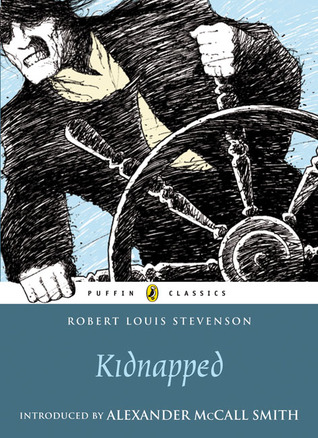
Kidnapped by Robert Louis Stevenson

This book kind of fell into my lap a couple of weeks ago at the library.  Although I was hoping to read a children's classic during the Victorian Celebration, this book was not on my original list -- I still have The Water Babies and At the Back of the North Wind waiting on the shelves.  However, I was shelving books at the library and I noticed this one, which had a really nice cover.  And since I had another copy at home, (though a different edition) I could kill two birds by reading a Victorian book and a book off my own shelves.

Anyhow.  This book is both a Victorian and a historical fiction.  Robert Louis Stevenson, a Victorian writer from Scotland, was writing about a character set in Scotland during the 1750s, after the Jacobite revolution.  The story begins with young David Balfour, the poor son of a teacher who is now an orphan after his father's death.  On the advice of the local minister, he travels on foot to meet his long-lost uncle, who was estranged from his father and is living like a miser in a great estate.  Instead of being pleased to see his long-lost nephew, curmudgeonly Ebenezer first tries to trick him into falling down a tower, then hustles him off onto a ship to be sold into slavery in the Colonies.  (I can't really count this as a spoiler, since the title of the book is, ahem, Kidnapped.)

However, things don't work out as Uncle Ebenezer plans.  The ship is full of nasty characters, but after hitting a small boat, they pick up the only survivor, a Scotsman named Alan Breck.  David allies with Alan and they have lots more adventures together while trying to prove David's birthright, including shipwreck, mistaken identity, and hiding from redcoats.  There's lots of tramping about in the woods, hiding under heather, and avoiding shots from muskets and whatnot.  There's also plenty of Scottish history and vocabulary thrown in.  Stevenson incorporates a lot of actual Scottish history and names of real people, but since everything I know about Scottish history comes from watching Braveheart and reading the Outlander series by Diana Gabaldon (which lost me after about the third or fourth volume), I was kind of lost during parts of it.

Still, I mostly enjoyed this book.  My favorite parts were the interaction between David and his new best friend Alan, who's a character of questionable morals but evidently with a heart of gold.  Parts of this story were reminiscent of one of those road-trip stories with two strangers thrown together.

Other than my lack of understanding of Scottish history, my main quibble with the book the ending, which was incredibly abrupt.  I realize this story was serialized, but it just seemed to stop.  I suppose Stevenson wanted readers to keep reading the sequel, Catriona, which I'd never even heard of (it's known as David Balfour here in the U.S.).

So.  I can see why it isn't as popular as the iconic Treasure Island, but still, an entertaining (if somewhat frustrating) story, but a nice swashbucker and a fun, quick Victorian read.

Saturday, October 3, 2009

The Enchanted Castle by E. Nesbit


I've never been a fan of the adult fantasy genre, but for some reason, I am still drawn to juvenile works. I adored fantasy books when I was a kid -- Roald Dahl, C. S. Lewis, Diana Wynne Jones, Madeline L'Engle, L. Frank Baum, I still love all of them. But somehow I have never found the appeal of adult fantasy unless it's somehow rooted in our world, like Anansi Boys (one of my all-time favorites.) Maybe it's only the child in me that has an imagination and can still appreciate it. I still love children's fantasy, new and old.

Sadly, somehow I managed to miss all the classic works of E. Nesbit. (And why are so many great, classic works of fantasy written by British writers? Or am I just a literary Anglophile?) The works of E. Nesbit is as beloved in England as the Wizard of Oz or The Wrinkle in Time series, yet I'd never heard of them until I was an adult.

This is the second Nesbit work I've read (the first was Five Children and It, which also has a decent movie adaptation). The Enchanted Castle, first published in 1907, is about three children, Gerald, Cathy, and Jimmy, who are forced to spend the entire summer holidays at Cathy's school because of contagious cousin at home. So, though not orphans, we have children running around unsupervised, getting into mischief with magic. They're out exploring one day and find a passageway that leads into a nearby manor home -- the eponymous castle -- and inside they find a sleeping girl whom they believe to be enchanted. She's really the housekeeper's niece, but they soon realize there is magic about, and hilarity ensues. People turn invisible, wishes are granted, statues come to life, and there's a subplot with long-lost lovers. Of course, it all turns out well in the end.

The interesting thing about Nesbit's books is that the magic always backfires -- basically, the children get their wishes, but it takes them awhile to figure out that sometimes what they wish for isn't what they really want. So in each adventure the children learn a little something, but not enough to keep them from messing about with magic. There's a lesson here, but it's not preachy.

I enjoyed this book, but I think it might be difficult for a child today -- Nesbit's writing style takes getting used to, and I think it might frustrate a child that's too impatient. Gore Vidal wrote an essay about Nesbit's work, and he thought that Nesbit wrote about children but not necessarily for children. [Vidal also wrote that "the librarians who dominate the "juvenile market" tend to be brisk tweedy ladies whose interests are mechanical rather than imaginative." Vidal wrote this essay in 1964, before I was born, and I'm guessing that was the last time a librarian wore tweed. Fellow librarians, please feel free to comment.]

Of course, Nesbit was writing a hundred years ago -- it's hard for me to guess what children liked a century ago, though it's my impression that they were treated more like small adults and were expected to grow up a whole lot quicker. Maybe they had longer attention spans, but they definitely had less choices when it came to children's lit.

Here's an example from chapter one:

Gerald could always make himself look interesting at a moment's notice, a very useful accomplishment in dealing with strange grown-ups. It was done by opening his grey eyes rather wide, allowing the corners of his mouth to droop, and assuming a gentle, pleading expression, resembling that of the late little Lord Fauntleroy -- who must, by the way, be quite old now, and an awful prig.

I think it's pretty funny and clever, but I don't know many eight- to eleven-year olds who would have the patience to read this book. My daughters are eight and twelve and [brag alert!] they're both extremely advanced readers. They did not have the patience for this book, even when I was reading it aloud and promised to skip ahead to the part with the magic ring. I'm glad I read this book, and I'm definitely going to read more Nesbit, but I think it would be a tough sell to the kids unless they're hardcore British fantasy lovers.