Showing posts with label Edwardian. Show all posts

Monday, February 21, 2022

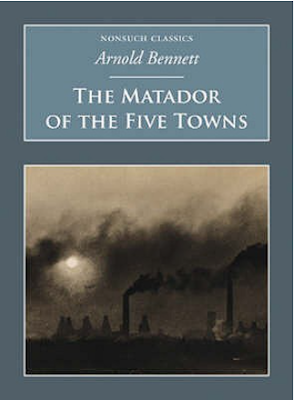
The Matador of the Five Towns by Arnold Bennett

Years ago while living in Texas I was at the Half-Price Books in San Antonio whereupon I found this bought this adorably wee little volume of short stories (6.5 x 5 inches/17 x 12.5 cm) by Arnold Bennett. I had just completed and loved his novel The Old Wives Tale so why not? Well, at least ten years and three moves later I finally gotten around to finishing it. One would think that a small volume of 22 short stories shouldn't take that long, but you know how it is.

If you haven't read Arnold Bennett, he seems to me a sort of transitional writer between the 19th and 20th centuries. This volume is copyrighted 1912, but many of the stories had a more Victorian feeling. Most of his stories are about working-class and middle-class people, just slices of life set in his fictional Five Towns which are modeled on the six Pottery towns in the Staffordshire area of Northern England. 

Once started, it still took me awhile to get into this book -- it's divided up between "Tragic" and "Frolic" with the majority in the latter category. The first stories is the eponymous "Matador of the Five Towns" and it's also the longest, which is probably why it seemed to take forever to get into. But once I started I found that I really enjoyed them, mostly the lighter comic "Frolic" stories. I won't go into each story into detail but just a few highlights:

"Catching the Train" -- a man and his brother are repeatedly thwarted on a train journey to a Very Important Destination which isn't revealed until the end. It's one of those trips where anything that can possibly go wrong, does so in the worst possible way. 

"The Blue Suit" -- a woman slyly manipulates her nephew's wardrobe choices while on a seaside holiday in Wales, with unexpected results.

"Hot Potatoes" -- the mother of a violin prodigy desperately tries to keep her son's hands warm for a concert on a cold day.

"The Long-Lost Uncle" -- a young man has an opportunity for romance after the sudden departure of his miserly uncle.

"Why the Clock Stopped" -- a pair of aging siblings have secrets from one another. 

I definitely preferred the lighter comic stories to the tragic (though they weren't so terribly tragic) and I found that many of them had delightful twist endings. They reminded me a bit of the short stories of Edith Wharton, a bit like O. Henry, and even a little like Trollope, so if you like any of these authors, you might enjoy exploring Arnold Bennett. This volume is also available on iBooks and on Project Gutenberg, as are most of Bennett's early works. To be honest, I actually ended up reading most of it on Gutenberg via my laptop because as cute as this volume was, the print was really tiny! (Plus I have become used to reading while I eat my lunch and it's so much easier while reading on a screen).

Overally I did enjoy this book and will definitely read more Arnold Bennett, I have a vintage copies of both Hilda Lessways and Buried Alive and would love to read both or either of them this year. 

This is my second book for the Back to the Classics Challenge, also counting this as my UK read for the European Reading Challenge

Thursday, April 15, 2021

1936 Club: The Other Day by Dorothy Whipple


I love books written in the inter-war period; I love memoirs; and I love the middlebrow author Dorothy Whipple, so One Fine Day checks off so many boxes for me! It is the perfect read for Kaggsy and Simon's 1936 Club. 


Born in 1893, in Blackburn, Lancashire, Whipple was the eldest child of what would be eventually a large family of seven children. She seemed to have a mostly idyllic childhood, though there would be heartaches. Young Dorothy especially loved the countryside and was fascinated by stories and folktales from a young age. 

. . . the tales Kate told us got mixed up with the tales I told myself, so I could not sort them out, and walking over the wet roads between the low black stone walls and looking out to the far splendid hills with the cloud-shadows going over, I felt a deep satisfaction that the world should be so full of tales, of things that had happened and were happening. Anything seemed possible in those days, and I should not have been at all surprised if a great antediluvian beast had appeared among the browsing cows in the field, or if Mistress Nutter had overtaken us on a broomstick.

However, schools for girls in the early part of the century were spotty, and Dorothy had some pretty horrific school experiences -- a particularly nasty math teacher was constantly berating her, and at one point she's accused of plagiarizing a short story she'd written, which is so infuriating! (Obviously, her talent for writing began at a young age, since the teachers didn't believe a child could have written such a good story.


Finally her father decided to send her to a convent school, which he announced casually at the dinner table. 

It was at meals that we mostly saw him. Vital changes in our young lives have been announced to the accompaniment of knives and forks clattering on plates, the gurgle of water being poured from glasses, and requests for more bread from unconcerned parties. While being helped to vegetables one's dearest hopes would fall between dish and plate never to be recovered, or on the other hand, one would be raised to the seventh heaven of delight by some promise made while waiting for the pudding to come in.

The news of Dorothy's new school came as shock but she grew to love it, though it was difficult as a Protestant in a school run by a Belgian order of nuns, with nearly all Catholic classmates. Naturally there are some funny and embarrassing school anecdotes. 

A 1950 paperback edition cover

The book really only includes Dorothy's childhood, up to the age of twelve when the family moves permanently to the countryside. Of course Whipple was only in her forties when she wrote the memoir, but I would have loved to learn more about her coming-of-age and her life as a writer. Before The Other Day, Whipple had written four novels and a book short stories, which doesn't include some of her most popular works. 


I've been a Whipple fan since I read The Priory, one of my very first Persephones, and it's thanks to Persephone that I have a pretty big collection of of her work, nearly every book in print and out of print. Nearly all of them are reprinted by Persephone, but not this one, and I'm sorry to say that copies are scarce and quite spendy when they do come on the market. I did pay rather a lot for this one, though not nearly as much as I've seen recently. I really do hope Persephone or one of the other publishers reprints this little gem! 

And thanks again to Kaggsy and Simon for organizing the 1936 reading week, it's been so lovely reading about all the wonderful books published that year. 

Saturday, January 16, 2021

Fraulein Schmidt and Mr. Anstruther by Elizabeth von Arnim

 Love this cover image, The Letter by Mary Cassatt (1890). 

Another book that's been on my radar forever. I love Elizabeth von Arnim and I've been saving this one for awhile -- I read two by von Arnim last year (Father and In the Mountains) and though I still own several unread, I'm trying to ration them out -- I know I'll be sad when I've completed them all.

Anyway. Published in 1907, Fraulein Schmidt and Mr. Anstruther is a departure for von Arnim -- it's an epistolary novel, told in letters spanning a little more than a year, from a young woman in Germany (the eponymous Rose-Marie Schmidt) to her sometime lover, Mr. Roger Anstruther. Roger, a young Englishman of 25, has spent the past year boarding with Fraulein Schmidt, her step-mother, and her father in the small town of Jena in eastern Germany. Herr Schmidt is a professor and makes very little money writing books that no one reads, so the family takes in English students for extra cash. Rose-Marie also has a small legacy from her mother, who died ten years ago. At 25 (the same age as Roger) she is considered a spinster. 

Nice period-appropriate image on this German edition

The first letter is sent from Rose-Marie to Roger shortly after he departs Germany, and reveals that on his last day, he has professed his love to Rose-Marie, and they are secretly betrothed -- secretly, because his father will never approve. Roger is from a Good English Family who have a long history, but little money. Rose-Marie is considered middle-class and therefore Not Good Enough, though her late mother was English. Roger is entering the Foreign Service and is therefore destined to marry someone with money, and preferably someone whose social standing will help advance his career. 

After a few months, [MILD SPOILER ALERT] Roger breaks off the engagement because, as predicted, he needs to marry someone with money. He then becomes betrothed to the perfect girl, but continues to write as a friend to Rose-Marie. The letters become more formal but it's pretty clear that they still care for one another -- but how much? Does Rose-Marie still love him? Can she forgive him, or has she moved on? Does he even deserve her? 

This cover art is from an 1883 painting by Renoir -- too early, but I get why they chose it. 

I liked this book but it wasn't what I expected; first of all, the letters are one-sided -- the reader only gets Rose-Marie's letters to Roger, not the other way around. There are 83 letters, some very long, some very short, so there are no chapter breaks, and some of the letters are just solid blocks of text which are a little difficult to read. However, I loved the character of Rose-Marie and I particularly enjoyed learning about her life in Germany. I could easily picture the little town of Jena, which is a real place about halfway between Frankfurt and Dresden, not far from the border of Czechia. It's about a four-hour drive from my village in the Rhineland, and I'm sorry I didn't read the book sooner so I could have made a weekend trip to visit the area and get a real look at it. 

Rose-Marie is a great character and you really get to know her through her letters. She's very smart and funny and has to put up with a lot, with her absent-minded father and her overbearing stepmother, not to mention all the village biddies who make cracks about her unmarried state. Parts of the book do veer into the philosophical which made my eyes glaze over a bit (lots of love for Goethe, not my favorite writer!) but I did get caught up in the plot and I was really rooting for Rose-Marie. I particularly loved this passage in which she describes how much reading means to her: 

Try to imagine yourself in my place. Come out of that gay world of yours where you are talking or being talked to all day long, and suppose yourself Rose-Marie Schmidt, alone in Jena, on a hill, with books. Suppose yourself for hours and hours every day of your life with nothing particular that you must do, that you have no shooting, no hunting, no newspapers, no novels. . . . Think of what writers are to me. . . . 

My one complaint is that it ends very abruptly, and the reader doesn't really learn what happens to Rose-Marie. I was rather gobsmacked about the ending -- I really wanted more resolution! However, I did really enjoy this book. I still have four unread books by Elizabeth von Arnim on my shelves and will probably read at least one more of her books this year, probably The Caravaners, which I'm planning to read (finally!) as my Travel or Journey Classic for the Back to the Classics Challenge.

I'm counting this as my German book for the European Reading Challenge

Monday, October 19, 2020

1956 Club: Madame Solario by Gladys Huntington, and some book covers

A first edition dust jacket. 
Those bare shoulders seem more 1950s than Edwardian.


I was really ambitious for Simon and Kaggsy's recent #1956 Club -- I had a stack of books published that year that I was determined to read, mostly from my own shelves. I did finish four of the five, though I only had time to blog about two of them. I had also started another, a Persephone called Madame Solario. However, it was a bit of a slow read and 493 pages long, I knew I wouldn't finish it during the specified period. But I finally finished it last week and thought I'd review it anyway. 

Published anonymously in 1956, Madame Solario is set in the fashionable resort town of Cadenabbia on Lake Como in northern Italy, in the summer of 1906. The book, which is divided into three parts, begins with the arrival of a young Englishman, Bernard Middleton, who is spending the summer on the continent before settling down in a banking career chosen for him by his family. He is supposed to meet friends who have been delayed, but decides to stay when he is drawn into the society of other expats vacationing in the same hotel. At first he is drawn to the beautiful young Ilona, whose heart is being broken by a Russian soldier, Kovanski. Bernard is disappointed by Ilona's sudden departure, but is soon enamored of the mysterious Madame Natalia Solario, a beautiful English woman with an absent husband. Her arrival turns the hotel into a bit of a turmoil. It seems there is some unfinished business with the jealously glowering Kovanski, and Bernard also learns of some scandals in Madame Solario's past. 

Beautiful endpapers in the Persephone edition


Bernard begins a tentative friendship with Madame Solario, but the viewpoint of the book shifts in the second part with the arrival of Madame Solario's brother, Eugene Harden, who is apparently the source of the mystery in his sister's past. The hotel guests become suspicious of their close relationship, and rumors begin to spread. Bernard is hardly mentioned and it's very focused on Natalia (nicknamed "Nelly" by her brother) and Eugene. A lot of it is just mostly conversations between the two, or rather, just long rants by Eugene. The third part then shifts the focus back to Bernard and the pace really picks up before a very dramatic finish that left me gobsmacked.

According to the Persephone website, reviews of the novel compared to it Henry James crossed with Ivy Compton-Burnett or with Daphne du Maurier. I haven't tackled much by James but I am a fan of his contemporary Edith Wharton, and this feels a bit like a Wharton novel to me -- dissatisfied upper-crust people in Italian resorts are definitely an Edith Wharton setting, though the malevolent brother isn't typical of her work. 

Those people . . . they have the superiority of owing their good fortune to something they themselves had nothing to do with. And that is the superiority I envy! To be born with a sort of super-self, for that's what rank is, a super-self that planes over frontiers -- to be born thinking one has the right to look down -- hasn't that got more charm than anything one can do for oneself? (pp 198-199)

I liked this book, though the middle section, the longest, dragged somewhat. I found the relationship between Natalia and her brother disturbing. I don't want to give anything away but after reading it I'm not surprised that the author was anonymous for a long time. And the ending was . . . wow. I really, really wish I knew someone else who had read this so I could discuss it with them. Not a typical Persephone at all, but definitely worth reading. 

And lots of interesting book covers! 

A first edition, not very exciting. 


A Polish edition


Nice cover on this French edition, I think it's my favorite of the bunch.


Trashy paperback cover! Looks very 1970s but internet searches say 1950s paperback edition. 


 A Penguin reprint from 1956. She looks more like Eliza Doolittle here --
the correct time period, but not glamorous enough.


A Spanish edition, meh


An Italian edition, nice photo of Lake Como on the cover.

In 2012 Madame Solario was adapted into a French movie, currently available for streaming on Amazon Prime. I haven't watched it yet but I'm curious to know how they'll adapt this 500 page novel into a 90 minute film. I imagine just cutting out Eugene's tirades will save a lot of time. 


There was even an entire book published on the mystery of the anonymous author. Sadly it's only available in French.  


I'm counting this as my book set in Italy for the European Reading Challenge

Friday, April 24, 2020

Crossriggs by Jane & Mary Findlater

Not a great cover image, but the only one I could find.

I don't know who I can credit for recommending Crossriggs -- I'm sure it was someone in the blogosphere, and I wish I knew so I can thank them. (Updated: it was Furrowed Middlebrow!) This book is exactly in my wheelhouse, including : 
  1. A Victorian(ish) time period 
  2. Set in Scotland
  3. A strong female protagonist 
Basically, a trifecta of all the things I love in a book. Published in 1908, Crossriggs is the story of Alexandra Horn, a woman in hear late twenties/early thrities, living with her father in the village of Crossriggs which is "about an hour's train ride from Edinborough. Besides the Horns, there are three or four other families of note around which the story is centered. Alexandra, known as Alex, has been living rather quietly with her father, an educated man with interesting and progressive ideas (but not much money) when her recently widowed sister Matilda arrives in tow from Canada with her five (!) children. The eldest daughter is 13, then there are three boys in a row, and finally a baby girl. 

Of course this throws the whole house into turmoil, but Alex and her father take it all in stride until they realize they will be more financially strapped than ever. Her father borrows some money from a close neighbor, Mr. Maitland, but Alex is aghast and vows to find a way to earn some ready cash. She begins by reading every day to a blind neighbor, the retired Admiral Cassilas, who is kind but somewhat gruff and snobbish. The admiral's only living relative is his grandson, Vanbrough, who has just finished school and is about twenty-one. 


A better image of the cover artwork. 
It's "Lady in Grey" (1859) by Daniel Macnee, National Galleries of Scotland

Young Van is bored staying at gloomy Foxe Hall with his grandfather, and the two don't always see eye to eye. He quickly strikes up a friendship with Alex and spends more and more time with the loud and boisterous Hope family. Eventually, his grandfather starts parading a succession of eligible young women around Van, and Alex's sister is pressuring her to accept the hand of James Reid, who is good steady but whom Alex finds dull. And Van is jealous of her friendship with their neighbor Mr. Maitland, who seems excessively fond of Alex, who is married with a sickly wife. Eventually this love triangle (or quadrangle?) comes to a head, and after a dramatic turn of events, there is a tragedy.

I really enjoyed this book -- it reminded me a bit of Jane Austen, but also a little bit of Anne of Green Gables. I really liked that Alex was trying to make her way in the world without just husband hunting -- she seemed like a new modern woman. The plot moved along nicely, and though it's almost 400 pages long, it seemed shorter, probably because the Virago edition had very wide margins. 

This book had some interesting plot twists. There was a lot of foreshadowing about the three men who seemed interested in Alex, so I had strong suspicions about how it would all end up -- and I was right about some of the events, but not the characters I was expecting, if that makes sense. And I was amused by Alex's father, who was a "fruitarian" -- basically, a vegetarian who made the family eat crazy things like nuttose, an early meat substitute developed in the late 1890s. They were also forced to eat carrots, of all things! Apparently this was a vegetable only fit for horses. 

Aside from some cringey racism, I liked this book very much, though the ending was a bit rushed. I did like how Alex's story was wrapped up, which was not how I expected. I would like to read more by the Findlater sisters, who wrote books individually and together. Sadly, I don't think any of their other books are readily available. Crossriggs is currently out of print, but there are used copies of the Virago Modern Classic edition available at a reasonable price online. And I've just discovered it's available as an audio on BBC Radio 4!  

I'm counting this as my Classic with a Place in the Title for the Back to the Classics Challenge and for my UK Classic for the European Reading Challenge

Sunday, February 26, 2017

The Pastor's Wife by Elizabeth von Arnim

Another beautiful Virago cover.
I thought it was Seurat but it's actually "La Couseuse" by Theo van Rysselberghe.
The other day I was looking for audiobooks set in other countries that I could download for the European Reading Challenge, and I came across one of my all-time favorites, The Enchanted April by Elizabeth von Arnim. I definitely want to read it again (or listen) but it occurred to me that Elizabeth von Arnim spent much of her life in Germany and set many of her books there, and that I could choose one of those toward both the European Reading Challenge. Also, many of them are available for free digital download -- another win-win!

I downloaded three or four of her books, and randomly chose The Pastor's Wife, published in 1914. Here's the setup: young Ingeborg Bullivant, aged 22, is alone in London, sent by her family to visit the dentist. Her father, a rather overbearing bishop, has given her ten pounds and insisted she has a bad tooth dealt with; Ingeborg has been miserable for days and unable to help her father. Though taken for granted at home, she is an indispensable, unpaid secretary for her father, chaperone for her beautiful young sister, and basically does everything for her mother, who doesn't seem to get up off the couch much.

The dentist solves Ingeborg's problem at once and all of a sudden she's alone in London (supposedly chaperoned by an aunt) with 10 pounds burning a hole in her pocket. On a whim, she signs up for a week's vacation tour to Lucerne, Switzerland, where she meets Robert Dremmel, the pastor of a rural German church. He promptly falls in love with her and after an unconventional proposal, they are engaged -- honestly, I think she's just too polite to turn him down. To the dismay of her family, she marries this unsuitable German and leaves home, where her new husband benignly ignores her and is obsessed with improving the soil for the local farmers. She really only gets his attention when she's producing babies. After several years of this stifling life, Ingeborg meets a visiting artist who is quite taken with her and tries to tempt her into running away with him to Italy.

I really enjoyed this book but parts of it were much darker than I expected. Some of the situations are quite funny and others are incredibly heartbreaking. All the men in Ingeborg's life take her for granted and assume they know what's best for her -- they think of Ingeborg only as how she can be useful to them, and not one iota of what she wants and needs. Von Arnim also had quite a bit to say about women and pregnancies in the Edwardian era -- there's a lot of discussion about procreation that I wasn't expecting. I would not be surprised if it wasn't rather shocking for the time period (much like my previous read, The Wreath by Sigrid Undset).

One thing I didn't like about this book was how naive Ingeborg was. I realize that she had a very sheltered upbringing as a bishop's daughter, and was then stuck in a small town as a pastor's wife, but she read books and newspapers, and would had some idea about the morals of the time. And the way the men in this book treated Ingeborg made me want to throw the book across the room.

I've now read three of Von Arnim's works of fiction, and I've noticed a recurring theme of women who are breaking the boundaries of conventions. In Love, the main character shocks everyone by having a love affair with a man young enough to be her son; in The Enchanted April, the four women break free and go off by themselves to rent an Italian villa for a month (not so shocking, really, but pretty gutsy for the time). Elizabeth Von Arnim was actually married to a German aristocrat and had a rather unhappy marriage. I don't know many details of her life but I do know some of her early works are semi-autobiographical and I wouldn't be surprised if Herr Dremmel was loosely based on her own husband.

I'm counting this as my German read for the European Reading Challenge. 

Tuesday, May 17, 2016

The Shuttle by Frances Hodgson Burnett


I've really had a hard time sticking to a book lately -- we have so much going on with our upcoming move, it's really hard for me to concentrate on anything -- it's definitely time for those non-challenging comfort reads. Luckily, the list of my unread Persephone books included The Shuttle by Frances Hodgson Burnett. I actually own a copy from 1907 just like the one picture above. I'd put off reading it because it's just over 500 pages long, but it's in the public domain and readily available for download on my smartphone. I started reading it in bits and pieces, and by the fourth or fifth chapter, I was completely hooked and couldn't stop reading it.

Basically, this is the story of a society marriage gone wrong, and the dramatic aftermath. Like Downton Abbey's Cora Crawley, Rosalie Vanderpoel is a wealthy heiress wooed by a titled Englishman in financial straits. Rosalie is young, tenderhearted, and impressionable, and she agrees to marry Nigel Anstruther though she doesn't realize quite how desperate he is. Her younger sister Betty, though a child of nine, sees right through him and dislikes him instantly.

Sadly, no one realizes what a good judge of character Betty is, and the marriage takes place. Once Rosalie reaches England, her husband becomes a very different person. He's furious that he can't control her money, so he becomes abusive and cuts Rosalie off from her family with little explanation.

Twelve years later, Betty is now a beautiful, intelligent, confident young woman, and she is determined to find out what really happened to Rosalie. With her father's blessing (and his virtually unlimited resources) she sails to England on a mission. On the boat over, she also has a chance encounter with a second-class passenger, James Salter. She is impressed by his forthrightness and strength of character (not to mention his good looks), but assumes she'll never see him again.

After finding her sister and young nephew in terrible circumstances, Betty takes matters into her own hands and is determined to put things right at their crumbling estate, with her diabolical brother-in-law, and finds true love along the way. It's a bit of a fairy tale, but what I really liked about this book is what a great character Betty is -- she doesn't wait around for a man to save her, she's frequently the one doing the saving. Of course the fact that she comes from a rich family makes it much easier, but I got the sense that this is a woman that would have done great things with or with out the money. She's a real go-getter.

I also loved reading how Betty took charge of improving the derelict estate. The book is a bit like a cross between Downton Abbey (but with an abusive Lord Grantham) and an episode of This Old British House. There are also some fun quirky side characters, like local villagers, the vicar Mr. Penzance, and a traveling American salesman named G. Selden. Frances Hodgson Burnett was born in England but spent much of her life in America, crossing the Atlantic numerous times, and her characters from both countries seem lovingly portrayed.

Burnett clearly loved England and you can also see hints of her future novel, The Secret Garden, when Betty Vanderpoel admires the beautiful countryside of Kent and plans improvements with the estate gardeners. Burnett rented Great Maytham Hall in Kent and the gardens inspired her. I haven't read The Secret Garden since I was a child so I think it's time for a re-read.

Great Maytham Hall garden
"One feels it so much in a garden," she said. "I have never lived in a garden of my own. This is not mine, but I have been living in it—with Kedgers [the gardener]. One is so close to Life in it—the stirring in the brown earth, the piercing through of green spears, that breaking of buds and pouring forth of scent! Why shouldn't one tremble, if one thinks? I have stood in a potting shed and watched Kedgers fill a shallow box with damp rich mould and scatter over it a thin layer of infinitesimal seeds; then he moistens them and carries them reverently to his altars in a greenhouse. The ledges in Kedgers' green-houses are altars. I think he offers prayers before them. Why not? I should. And when one comes to see them, the moist seeds are swelled to fulness, and when one comes again they are bursting. And the next time, tiny green things are curling outward. And, at last, there is a fairy forest of tiniest pale green stems and leaves. And one is standing close to the Secret of the World! And why should not one prostrate one's self, breathing softly—and touching one's awed forehead to the earth?"

I only have a few tiny quibbles with the novel -- as much as I loved Betty, she really doesn't seem to have any faults, and Sir Nigel Anstruthers is a bit of an over-the-top, mustachioed villain. Also, the ending was a little melodramatic for my taste. But overall, this was a very enjoyable read and it's one of my favorite reads so far this year. 

I'm counting this as my Classic by a Woman novelist for the Back to the Classics Challenge, and also for Reading England Challenge.

Saturday, February 27, 2016

The Phoenix and the Carpet by E. Nesbit


After finishing Journey to the Centre of the Earth, I was still in the mood for a some good adventures. I remembered a copy of The Phoenix and the Carpet by E. Nesbit that I'd picked up years ago at a library sale. How is it that I completely missed out on Nesbit in my youth? I suppose my hometown library just didn't have them. Well, I've now completed five of her books and loved all of them. This one ranks right up at the top of great classic children's fantasy, right up there with the Wizard of Oz books and the entire oeuvre of Roald Dahl.

Published in 1904, The Phoenix and the Carpet is the second in the series of that began with Five Children and It. Instead of a magical sand fairy, the a family five children find both a magic carpet and a magical bird, a legendary phoenix. By a series of mishaps (well, basically, they decide to try out fireworks inside the house) they have to get a new carpet for the nursery. Their parents buy a second-hand carpet which, when unrolled, is found to include a strangely glowing egg. The children attempt to return it, but no go. After the egg accidentally rolls into the fireplace, it hatches and out comes the phoenix, who explains that the carpet is also magic, and can give them three wishes a day.

If you're looking for serious high fantasy, this isn't it. Although the children are occasionally transported to faraway places, their adventures are pretty tame, though humorous. As in Five Children and It, the children quickly realize that wishes don't always work out quite like you plan. Of course it's a children's story, so most everything comes out right in the end, but Nesbit's chapters are cleverly plotted, so I really wasn't sure how everything was going to shake out. And the writing is both wry and witty, with a few sharp observations. It's both entertaining and funny as the kids get in and out of scrapes. My only quibble as that in some their adventures, they encounter "savages" who are quite obviously people of color, and the racism that tinges these episodes.

Cover of the new Puffin Classics edition

Overall, though, it was quite a delightful read, and tI'll probably include it among my favorite books of this year. I'm counting it as my Fantasy/Sci-Fi/Dystopian Classic for the Back to the Classics Challenge. 

Wednesday, October 28, 2015

The Good Soldier by Ford Madox Ford


I took this one off the shelf at the library the other day because it was my lunch break and -- gasp! -- I'd left my book at home. The horror! But The Good Soldier by Ford Madox Ford was a) on my Classics Club list and b) short, under 200 pages, so it seemed like a win-win. It's a very short book, and yet I could talk about it for hours. 

Essentially, this is the story of two Edwardian-era couples with extremely dysfunctional marriages.  Edward and Leonora Ashburnham, a British couple, meet an American couple, John and Florence Dodwell, at a German resort, and begin a friendship that lasts for years. The narrator, the hapless John, has no idea that his wife Florence has been carrying on an affair with Edward for years, until both Edward and Florence are both dead. In a rambling narrative, the reader gets the story of the couples' friendship and the subsequent affair, just as though one was sitting down having a series of drinks with John and he was recounting the tragic story in person (possibly on a veranda in the tropics, with an ocean view and some nice cocktails, or seated in deep leather chairs in a gentleman's club.)

What seems a straightforward, though tragic story is eventually revealed to include a lot of twists and turns, with lies and hypocrisy and characters you just want to shake or smack upside the head. The ending left me flabbergasted and full of questions, and I so wish that I had chosen this book to discuss back when I belonged to a face-to-face classic book discussion group a few years ago. 

This book was published 100 years ago, in 1915, and I imagine it was groundbreaking for its time, mostly because of the style of writing -- I wouldn't call it stream-of-consciousness, but it doesn't really follow a linear progression. It digresses and rambles, but it's still really insightful and beautifully written. The Ashburnhams are trapped in a loveless marriage, yet they are loathe to admit it or even consider divorce. The Dodwells are from old moneyed families from the northeastern U.S., but I imagine that's fairly similar in regards to the upright, "stiff upper lip" sort of attitude of most of these characters. 

As I was reading it, I immediately recalled another book that really stuck with me, Graham Greene's The End of the Affair, which I finished just a few weeks ago. I can definitely see how Ford must have influenced Greene -- the two books are almost companion pieces, with Greene's being the flip side, the adulterer instead of the cuckolded husband. The marriages of these characters are both tragic and heartbreaking, but at the same time, I felt like the characters mostly deserved what they got, in the end -- yet another case of fascinating train wrecks. 

Saturday, November 22, 2014

The Edwardians by Vita Sackville-West

I'm terribly, terribly behind with book reviews -- I actually read this book over the summer, and finally got around to finishing this, though I have little chance of completing this years TBR Pile Challenge. But anyway:  

The Edwardians begins with this author's note: 

 No character in this book is wholly fictitious.


Written in 1930, this is a book about the end of an era.  It begins in 1905 at a house party at Chevron, a massive estate owned by a fictional young Duke named, Sebastian, who is 19.  It ends six years later, on Coronation Day, June 22, 1911, after the death of Edward VII.  

Sebastian's mother, Lucy, has invited a variety of guests, including a famous explorer, Leonard Anquetil.  He observes the society matrons and other upper-crusties from an anthropological viewpoint.   Late at night, he and Sebastain scale the roof of the great house and Anquetil predicts what Sebastian's future will hold.  It's more than a page, but here's a small chunk of it:

My dear boy, your life was mapped out for you from the moment you were born.  You went to a preparatory school; you went to Eton; you are now at Oxford; you will go into the Guards, you will have various love-affairs, mostly with fashionable married women; you will frequent wealthy and fashionable houses; you will attend Court functions; you will wear a white-and-scarlet uniform -- and look very handsome in it too -- you will be flattered and persecuted by every mother in London . . . . 


Naturally, Anquetil is mostly correct.  There's a long digression into one of Sebastian's affairs, though interestingly told from the point of view of the lady in question.  Sebastian then gets involved with a very unexpected young lady.  Will Sebastian fulfill the destiny predicted by his friend Anquetil? 

Though I found some parts a bit slow, I enjoyed The Edwardians.  However, as I read it, I couldn't help thinking shortly, Europe would explode into the Great War and that Sebastian, then aged about 29, would surely go off to fight in the war.  Based on my recent reading of Singled Out by Virginia Nicholson, I know that there's a very high chance that a young many of Sebastian's era and social standing would die in battle, or be wounded or shell-shocked, thus ending the male line or rerouting it significantly (as was feared in Downton Abbey).  Of course, after the War many estates fell apart due to lack of funds, servants, and heirs, but that's a different story.  

Thursday, December 5, 2013

Kipps by H. G. Wells


Last year, when I was making up my TBR Pile Challenge selections, I picked several books that I had been dreading for one reason or another -- Lady Chatterley's Lover; The Good Soldier Svejk; Giants in the Earth; and, finally, Kipps by H. G. Wells.  As it turned out, the first three were much better than I expected, but Kipps kept getting pushed back to the bottom of the stack. 

Back in 2005, I began my quest to read more classics -- I realized how few I'd read.  Anyway, around that time I went to the St. Petersburg Festival of reading and got a bunch of books signed.  I mentioned to one author that I was trying to read more classics and she recommended Kipps, which I'd never heard of.  Oddly enough, though, I'd actually read another book by Wells back in college, Tono-Bungay, which hardly anyone else has read.  I did remember that I disliked Tono-Bungay; in fact, I really disliked the entire class, which was a modern British history class that everyone was dying to get into for some reason.  [Did I go to entire college of Anglophiles?  The professor was awful].  

Anyhow, I somehow ended up buying Kipps and then ignored it for about eight years.  Well, this was the year -- I was down to my last three unread books from the TBR Pile Challenge, and I packed Kipps into my carryon luggage for Thanksgiving vacation.  I thought if I finished all my other books, I would be forced to read this.  And it worked!!  Kipps turned out to be a hidden treasure, my favorite book by H. G. Wells so far.

Published in 1905, Kipps is a social satire, the story of the rise and fall of a young man, Arthur Kipps.  The story begins in the 1870s, when Arthur is a young boy and he is sent off to live with his aunt and uncle, who run a small draper's shop in a town called New Romney.  He doesn't know anything about his father, and has only vague memories of his mother.  When he's fourteen, he leaves school and is sent off to Folkestone to apprentice at a larger draper's shop.  After four years, a chance encounter one night leads to a series of events; the upshot is that Kipps finds out that someone is looking for him, because he's about to inherit a nice sum of money.  Kipps is an heir; the father he never knew died years ago in Australia, and his paternal grandfather was a gentleman and has left him twelve hundred a year. 

Overnight, Arthur's life changes.  He goes from being a common shop assistant to a well-to-do man, and he has a hard time adjusting to his new situation -- is he a commoner now, or a gentleman?  What about his old friends?  His aunt and uncle?  Arthur quickly finds a social-climbing fiancee and a new circle of friends, but doesn't quite know how to mix in Society.  I kept wondering if these new friends were real or whether they were just trying to bilk him out of his newfound fortune -- it reminded me of all these horror stories I hear about when people win the lottery and how it actually ruins their lives.  

There was one part in particular that really embodied Arthur's experience: he's in London, famished and trying to find a restaurant to have lunch.  He's too shy and embarrassed to go to an upscale restaurant -- to afraid to make a faux pas.  He decides to turn down a side street and go into the first working-class restaurant he sees.  He finds a fish and chip restaurant and is about to go in but realizes that now he's too well dressed, and won't fit in there either!  It's really sad.  

Naturally, Arthur's life isn't a fairy story, and as you'd expect, things take a bad turn.  But Kipps isn't so much about Arthur's financial situation as it is a social commentary, about class-consciousness, which is apparently far more rigid in England that it is in the U.S. -- I always read in books and see bits on British TV about people knowing their place.  (Don't get me wrong, we still have class-consciousness in America, but I think people just pretend it doesn't exist.  It does.  Plus racism is alive and well, but we don't need to go into that).  

Towards the end, I was eager to find out how Kipps' story would resolve.  I'm happy to report that it came as quite a surprise, but in a very satisfying way.  Arthur Kipps is a delightful character and I loved his story.  Another success from the TBR Pile Challenge!

Saturday, September 7, 2013

The Children's Book by A. S. Byatt


"Three or four families in an English village is the very thing to work on."  -- Jane Austen

It's probably quite unfair of me to begin this review by comparing it to another book.  I'm sure it was probably unwise for me to read The Children's Book almost immediately after reading and reviewing what appears to be a similar book, The Forgotten Garden by Kate Morton.  Honestly, it just worked out that way -- I'd actually started The Children's Book first, then realized I might not finish it in time to start The Forgotten Garden which was a book group selection.  (Since I run the book group, it would have been inexcusable for me to not to have finished it in time).  But as usual, I digress.

Anyhow, at first glance both of them are historical fiction, mostly set during the Victorian and Edwardian periods. Both of them heavily feature English fairytales, and have central characters who are female writers and storytellers, and include entire sections with examples of the aforementioned tales, which are original to the books.  Both of them are long -- The Forgotten Garden is just over 550 pages, and The Children's Book weighs in at 675.  But almost immediately, I realized they are actually vastly different.

I can only give the bare bones of the setup for The Children's Book, because there is so much packed into it.  It's the story of four loosely connected families in Kent and London, set around the Fabian and Arts and Crafts movements in England around of the turn of the 20th century.  The story follows the parents and children against the backdrop of the end of the Victorian Era, the Edwardian Era, and finishes during WWI.

The story begins in the South Kensington Museum, which will someday be known as the Victoria and Albert Museum.  Two young teenage boys, Julian Cain and Tom Wellwood, are watching a third boy sketching in the museum.  They discover the boy, Philip Warren, has been hiding out in the museum's basement, having escaped poverty and dire conditions of the pottery works in the Five Towns area.  Tom's mother is Olive Wellwood is a writer of fairy tales, who brought her son to the museum while she was consulting about her book with Julian's father, a curator at the museum.  Olive is not only a writer, she's a socially progressive do-gooder type, and she decides to take Philip under her wing.  She brings him home to her ramshackle farm in Kent, where he is exposed to artistic and socially conscious people who change his life, including the family of Benedict Fludd, a brilliant and eccentric potter.

Through Philip, the reader is introduced to a whole network of socially progressive people, artists, writers, craftspeople, and puppeteers who make up Olive's world, in England and on the Continent.  However, the novel is not so much about Philip -- we meet a whole generation of children who are growing up in a rather bohemian lifestyle.  The Children's Book basically a really great history lesson about English society as it transitions from the Victorian Era to the horrors of the Great War, with these families as a microcosm, if that makes any sense.

Where The Forgotten Garden is narrowly focused on one family's mystery, The Children's Book is about the upheaval of an entire generation from childhood to adulthood.  You could easily read The Forgotten Garden on a long flight, but The Children's Book took me well over a week of serious reading.  It is jam-packed with characters (seriously, I wish I'd made a chart when I started), fictional and real, plus history and commentary, which sadly, I think is to its detriment.

I loved learning about these families and their world, but Byatt packs so much into it, the narrative thread of the characters tends to get lost.  I could seriously have imagined this book split into two or even three volumes.  I loved learning about the Arts and Crafts movement, and the changing role of women, and the Suffragettes (to name but a few of the topics), but I felt like she was so into writing about the history that sometimes the characters were shoved aside.  Byatt often ends up telling us what the characters are doing and saying to get through the historical context, and less showing.  Some of the historical and political tangents were actually rather dry and sometimes preachy, and at the end, I wasn't even sure what happened to some of the most important characters.  I do wonder if she just ran out of steam or needed to finish on deadline.

I really enjoyed most of this book but I seriously think it could have used some editing.   Still, I'm sure it will make my list of Top Ten Reads of 2013.

Saturday, October 20, 2012

The Univited Guests by Sadie Jones


I am way behind on my historical fiction challenge, and since this is a book I think I've checked out from the library two or maybe three times and never had time to read, I thought it would be a fun break from from the classics I've been immersed in lately.  And of course, Downton Abbey is all over the blogosphere, even though I won't get to watch it on this side of the Atlantic until January.  So, a fairly short book about a country house party set in 1912 seemed like just the thing.

I thought this book would be like Downton Abbey, but as if Cora hadn't had any money to save the estate.  In one respect this is right, because the eldest daughter, Emerald, is the hope of the Torrington family -- if she can snare a wealthy husband, they'll be able to save the family home.  However, any resemblance to DA ends right there.  

I'll back up and give a better synopsis -- it's the weekend of Emerald Torrington's ninteenth birthday, but her stepfather is missing the party, since has to go off and try to borrow money to save the family's estate, Sterne.  It's to be a small party, just a couple of old friends, Patience Someone-or-Other, and her mother, and at the last minute, a handsome young landowner, John Buchanan, is given an invitation as well (since he has a LOT of money and is fond of Emerald).  It's a small shindig because the family can barely afford to pay for servants and coal, much less updating the house with electricity and modern plumbing.  

However, things begin to unravel.  Patience's mother begs off with influenza and sends her son Ernest instead, and meanwhile, a railway accident has sent dozens of survivors up to the estate with nowhere else to go until things are sorted out.  What started out as a quiet weekend party for six or seven people quickly spirals out of control, especially when one of the railway refugees turns out to be someone from  the family's past. 

This book had a lot of potential -- a historical book about a country house in England, one of my favorite settings, and some interesting and quirky characters.  Unfortunately, I thought the story itself began to spiral out of control.  I could spot some plot developments right away, and I thought the author got carried away with the quirkiness, bordering on absurdity.  One of my favorite blogs, Books as Food, described it as "Downton Abbey meets the Addams family," but to me the story just got silly, and towards the end I just started skimming pages to get through it.  And I thought the ending was just odd.

I still want to read more historicals this year -- I have quite a few on the TBR shelves and even though I've made barely any progress on my historicals challenge, I've nearly finished all the other so I might make of a go of it anyway. 

What about you, bloggers?  Read any good historical fiction lately?  Or is everyone sick of the Downton Abbey hype?  

Monday, April 9, 2012

The Fountain Overflows by Rebecca West


I'm very happy to have finished this book.  Not only is it a book off my own TBR shelves, it's also an NYRB Classic (of which I have a healthy stack, all unread) but I've seen it all around the blogosphere and it seems to be universally liked.  I did like it but it really wasn't what I expected at all.

The Fountain Overflows was described by someone as Jane Austen-ish, but I personally wouldn't make that comparison at all.  In a nutshell, it's the story of the Aubreys, a family living in genteel poverty in London around the turn of the century, told in the first person by Rose, one of the four children.  Their father, Mr. Piers Aubrey, is a brilliant writer, but he has trouble holding down jobs and managing the family's money; specifically, he has a weakness for the stock market and the family is forced to make a lot of sacrifices.  Their mother was once a brilliant pianist who gave up her career when she got married, and she's doing her best to train her children to be musicians as well.  Unfortunately only two of her children seem to have inherited her musical ability and the necessary discipline.  The oldest daughter, Cordelia, is convinced she's a talented violinist, but the rest of the family believe she's really a hack with no artistry, and they're always sneering at her.

There's really no plot to speak of in this book, it's basically the story of Rose's childhood, told in little vignettes about various incidents in her life.  Some of them are kind of mysterious or a little creepy -- there are a poltergeist, a possibly abusive husband, an accused murderess in the supporting cast -- but most of it is a little sad.  Their mother is obsessed with making them into good musicians, their father is brilliant but hopelessly irresponsible.  It's sort of like I Capture the Castle, which I love, and like the father in that book, I just want to shake him and tell him to snap out of it and take care of his family.

It is an entertaining story, though I did find it a rather dense read.  It's about 400 pages, yet in my edition, an NYRB classic, the margins are very narrow and the print is fairly small.  It's 17 chapters but they took awhile.  It was published in 1956, but the style of writing made it seem older, and I guess that made it a slower read as well.  It seemed to have been written around the turn of the century, not just set in that era.  I guess this would be a good candidate for the Slow Books Manifesto.

Anyway, here's a sample:

"Papa was always happy when he was engaged in certain activities.  Of these the one which gave him greatest pleasure was his lifelong wrestling match with money.  He was infatuated with it though he could not get on good terms with it.  He felt towards is as a man of his type might have felt towards a gipsy mistress, he loved it and hated it, he wanted hugely to possess it and then drove it away, so that he nearly perished of his need for it.  But he knew almost as great joy if he were conducting a campaign  against some social injustice, particularly if it were the rights of property that had been dealt with unjustly."


Maybe it's just me, but that seems much more like a Victorian novel or maybe Edwardian.  The writing was very good and I liked the characters, but it isn't a book I could rush through.  But I'm happy to have read it and look forward to reading West's The Return of the Soldier, which is another of my Classics Club selections.  This book also counts toward my TBR Pile Challenge, so I'm happy about that too.