Showing posts with label TBR Pile Challenge. Show all posts

Monday, March 21, 2022

The Mountain Lion by Jean Stafford: An NYRB Classic with a Dark Twist

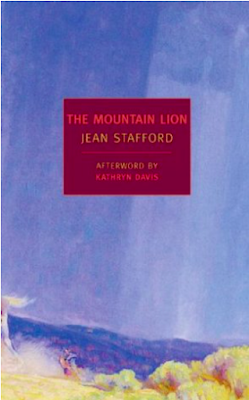
Detail of "The Shower" by William Herbert Dunton. 
The original is in the American Museum of Western Art in Denver, Colorado

The Mountain Lion is one of several unread NYRB Classics that have been accumulating on my TBR shelves. I've probably owned it for a good ten years and it seemed like a good choice for the TBR Pile Challenge. I try to mix up my reading with different genres and it seemed quite different than my previous read, plus it's short -- a good choice when I'm behind on my annual reading goal already! However, this book was nothing like I expected.

Published in 1947 but set about 20 years earlier, it is the story of a young brother and sister living in California, Ralph and Molly Fawcett. The book begins when Ralph, aged ten and Molly, eight, are anxiously awaiting the arrival of their Grandfather Kenyon, the stepfather of their widowed mother (so, technically, their step-grandfather). They live with their mother and two older sisters in a walnut grove in suburban Los Angeles, and their Grandfather's visit is the highlight of the year. Grandpa Kenyon is quite a character, a world traveler who owns various properties including a ranch in Colorado, managed by his son Claude, their mother's half-brother. 

Ralph in particular is stifled growing up among a lot of females, but ostensibly for their health, Ralph and Molly begin to spend extended trips on the ranch with Claude. Ralph's world changes as he leaves his repressed childhood in California to a heavenly freedom in Colorado, where he learns to ride and shoot and fish. 
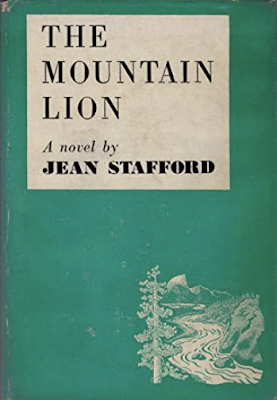
The original 1947 cover.
I love the illustration, like a reverse woodblock print. 


This seems like it could be a wonderful and ideal way to spend summers, but it's not ideal for Molly, who is precious, awkward, and bookish. It also takes a rather darker turn as they begin to grow older. What at first appears idyllic is actually not. Jean Stafford is masterful at describing life, both on the ranch and in California, but she doesn't leave out any details, including butchering animals and a really grotesque incident of self-harm. The characters are really well-drawn, but none of them are particularly likable; however, I absolutely had to keep reading to the ending which left me gobsmacked and very unsettled. My edition had a forward by Stafford with a major spoiler so I should have seen it coming -- I was still rather shocked but if you want to be completely surprised, I'd skip it.

Having read the forward, I had an overwhelming sense of dread. It actually reminded me a bit of the film The Power of the Dog, -- not so much the plot, but they're both Westerns set in the 1920s with dark undertones. I actually saw it the theater a few months ago and it's a great movie but it made me deeply uncomfortable because I knew something dreadful was going to happen. If that is the type of story that puts you off, I would probably not read The Mountain Lion. I gave it four stars on Goodreads (there is some racism besides the disturbing parts) but I don't think I would read it again. 
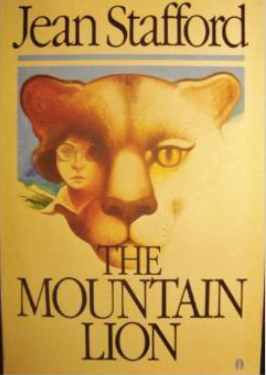
From the 1983 edition. This cover is SO 1980s!


Jean Stafford won the Pulitzer Prize in 1970 for her Collected Short Stories, and a couple of other novels. I'm not sure if they're as dark as The Mountain Lion but her writing is very good and at some point after I've recovered from this one I might look for them later.

This is my fifth book for the TBR Pile Challenge.

Friday, March 18, 2022

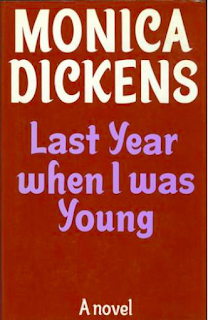
Last Year When I Was Young by Monica Dickens

Wow, this cover is TERRIBLE. 

I'm not going to spend too much time on this post, because to be perfectly honest, I don't think anyone will read it -- it's about a book from the 1970s that no one has heard of, by an author that hardly anyone reads anymore (despite her famous name) and it has one of the WORST COVERS OF ALL TIME. Seriously, who looked at that cover and thought, "This book will sell!" Did her editors secretly hate her? It is a mystery.

Anyway. I'm sure that I would never have picked up this book in a store, but this copy somehow ended up with the donations at my library about ten years ago.  As I was sorting through them I recognized Monica Dickens' name, and kept it aside for myself (these were books donated for the Friends of the Library sale, and employees got first crack at them. All books were $1 and I did pay for this). There was another Monica Dickens as well called One of the Family, whose plot I have instantly forgotten. 

I finally got around to reading this last week -- I added it to my TBR Pile Challenge list so that I would be inspired to read it. As it is just over 200 pages long and I'm way behind on my reading quota for the year, I thought I'd give it a try.

Published in 1974, Last Year When I Was Young is the story of Richard, a twentysomething private nurse who is working at the home of an elderly man who is fading fast. The family are all pretty awful except for a granddaughter named Fanny who turns up from Australia, where she'd been on an assignment for the BBC. Richard had a past love that ended tragically several years before and I knew instantly that Fanny was the new love interest. I predicted that the elderly client would pass away and leave all his money to Fanny, and she and Richard would end up together. I was wrong.

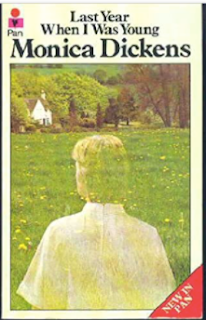
This cover is not much better

I expected the whole story to be about this particular assignment for Richard, but it ends rather abruptly and he moves on to other jobs. But over the course of a couple of years, he and Fanny drift in and out of each other's lives as Richard takes on private nursing assignments. Some are sad, some are amusing, but overall this book is just sort of melancholy, but it didn't end at all how I was expecting. In retrospect there were hints all along that made perfect sense as I read the final paragraphs. 

Like I was hoping, it was a pretty quick read, and I think I read it all one day (we had some unexpected bad weather and I was stuck inside the whole weekend). It was a fairly good read but I don't suppose this will be reprinted anytime soon -- it's very middlebrow but not really interesting enough to get picked up by Persephone or any of the other indie publishers who are reprinting unappreciated fiction right now. I don't read that many books from the 1970s and parts of it are very much of its time, i.e. a couple of pretty cringe-worthy racial slurs. 

An OK read but I suspect it will end up in the Little Free Library down the street. But it's one more book knocked off my TBR pile. 

Sunday, September 23, 2018

Poor Caroline by Winifred Holtby is Poorly Titled


I only have one book left to finish for the TBR Pile Challenge, a massive omnibus of short stories by Katherine Anne Porter. (I keep buying short story collections but find them really overwhelming and unwieldy to read in omnibus collections; also, I never know how to review them.) So I thought I would take the easy way out and read an alternate, Poor Caroline by Winifred Holtby, a mere 266 pages in paperback. However, it took me nearly three weeks to finish this book, compared to a mere five days to zip through the nearly 500 pages of South Riding, Holtby's most famous work.

Published in 1931, Poor Caroline is Winifred Holtby's fourth novel, and was an instant success. Unlike her other novels centered around life in Yorkshire, Poor Caroline is a satire set in London, and follows the lives of several people who become attached to the fictional Christian Cinema Company, devised to create "clean" British cinema for the masses (this is just before color films became popular; I can't remember if the films in question are talkies or not). 

Nevertheless. The corporation is basically started by a Caroline Denton-Smythe, a 70-ish spinster living in genteel poverty who has decided it his her lot in life to find causes. She is joined in this endeavor by Basil Reginald Anthony St. Denis, a dilettante war veteran and minor aristocrat; Joseph Isenbaum, Jewish businessman looking to get his young son enrolled at Eton; Hugh Macafee, a curmudgeonly film inventor; Eleanor de la Roux, a distant cousin from South Africa who's inherited a little nest egg. Other side characters include Caroline's vicar, Roger Mortimer, and Clifton Johnson, a somewhat shady scriptwriter. 

The book begins and ends with two cousins who have just returned from Caroline's funeral. The rest of the chapters alternate between the characters, giving the reader back story about how each of them become involved in the project. Every chapter ends with someone saying, "Poor Caroline," from whence the title came, but I think it's a terrible title. 

This book seemed to take forever -- I almost felt like the chapters were short stories, rather than a single narrative. It also didn't help that I kept putting the book down because I really wasn't that interested in the characters, or quite frankly, the idea of Christian cinema. (As a former librarian, I'm not a big fan of public censorship). Taking so long to read the book really made it hard to keep the characters straight, and I found Caroline herself to be really depressing -- my favorite characters were the South African cousin and the vicar. The cranky film scientist was interesting, but he was such a sexist jerk that I wanted to throw the book across the room. 

I so wanted to like this because I loved South Riding and really enjoyed the other Yorkshire novels.  Overall I think it was just OK -- maybe I just didn't get the satire. I just have one more of her novels unread, Mandoa, Mandoa! which is another satire, set in a fictional African country. I'm a little hesitant because I think I prefer the Yorkshire novels. Well, it's one more Virago crossed off the list. 

Saturday, July 7, 2018

Testament of Youth: War is Hell and Women Are Still Fighting For Equality


It took me more than a month, but I've finally completed Testament of Youth, Vera Brittain's classic memoir of World War I. I'd been meaning to read this book since about 2014, when it started showing up on lists of WWI reads. I put it on my TBR Pile Challenge List last year, but I kept putting off reading it until Jillian suggested a June readalong on Twitter. Sadly, I wasn't able to finish on schedule due to some travels to the UK, but I persevered and I'm glad to say that I have completed the 661 pages and am slightly exhausted.

The background: Vera Brittain was a student at Oxford when WWI broke out. Her brother Edward, sweetheart Roland, and two of their best friends all enlisted, and after a few months, Vera could not sit idly by and joined up as a VAD [Volunteer Aid Detachment], a volunteer nurse, and worked in France, Malta, and England until the end of the war, when she returned to Oxford, completing a degree in History, and became a teacher and eventually a lecturer, speaking all over the UK about pacifism and the League of Nations. The book begins with Vera's childhood in Buxton but mostly covers 1913 until about 1924. Testament of Youth was published in 1933 and is considered one of the classic WWI memoirs. Brittain also wrote novels and two more memoirs, Testament of Friendship (1940), about her relationship with classmate and best friend Winifred Holtby; and Testament of Experience (1957) -- both of which are much shorter.

I really enjoyed this book but it is long, with tiny print. I really loved reading about Brittain's life in Oxford and her friendship with Holtby and other writers (Dorothy Sayers was also an Oxford classmate). She had to fight her parents to attend Oxford, and even after the war and the suffrage movement, she was a feminist and struggled to have a career as a woman. It's so discouraging that women are still fighting for the same issues nearly 100 years later. Also terribly discouraging to hear how badly the young nurses were treated when they were volunteers, and how how inefficient some of the staffing and medical methods were. 

Of course, the sections about the war are absolutely heartbreaking. It's devastating to realize how many lives were destroyed on both sides, and how quickly Europe went back to an even bigger war just 20 years later. I cannot imagine living through a war like that as a civilian, much less as a nurse treating patients near a battlefield. 

Though there were a few sections that I did skim over (particularly some of the politics which I'm not as familiar with, especially at the end) the writing in this book is just wonderful and insightful. I copied at least ten passages that I would love to quote, but I've narrowed it to just a couple: 

What exhausts women in wartime is not the strenuous and unfamiliar tasks that fall upon them, nor even the hourly dread of death for husbands or lovers or brothers or sons; it is the incessant conflict between personal and national claims which wears out their energy and breaks their spirit. (p. 422- 423).

One had to go on living because it was less trouble than finding a way out, but the early ideals of the War were all shattered, trampled into the mud which covered the bodies of those with them I had shared them. What was the use of hypocritically seeking out exalted consolations for death, when I knew so well that there were none? (p. 446).


Only gradually did I realize that the War had condemned me to live to the end of my days in a world without confidence or security, a world in which every dear relationship would be fearfully cherished under the shadow of apprehension; in which love would seem threatened perpetually by death, and happiness appear a house without duration, built upon the shifting sands of chance. I might, perhaps, have it again, but never again should I hold it. (p. 470).

It did not seem, perhaps, as though we, the War generation, would be able to do all that we had once hoped for the actual rebuilding of civilisation. I understood now that the results of the War would last longer than ourselves; it was obvious, in Central Europe, that its consequences were deeper rooted, and farther reaching, than any of us, with our lack of experience, had believed just after it was over. . . . . Perhaps, after all, the best that we who were left could do was refuse to forget, and to teach our successors what we remembered in the hope that they, when their own day came, would have more power to change the state of the world than this bankrupt, shattered generation. (pp 645-646.)

I had been rather dreading this because of the length and subject, but I'm really glad I read it, so thanks to Jillian for suggesting it! I'm also inspired to read Testament of Friendship which I must track down, and to read the remaining Winifred Holtby novels that are on my TBR shelves (Poor Caroline and Mandoa, Mandoa!). I also have the TV adaptation saved on the DVR, but I might have to wait a bit to watch it -- I can't imagine how this has been adapted to film. Bloggers, have any of you seen it? Is it worth watching or should I just delete it? 

This is book #9 for the TBR Pile Challenge 2018

Sunday, March 25, 2018

Lucy Gayheart by Willa Cather is Beautiful and Tragic


After making up my list for the TBR Pile Challenge, I realized that quite a few of my selections were in the 500+ pages range. I was planning to read Testament of Youth in March for Women's History Month, but I'd just finished Wives and Daughters and was rather hesitant to start another 700 page behemoth right away. The answer was of course a nice short book -- Lucy Gayheart by Willa Cather. 

One of her later works, it's set at the turn of the century but actually written in 1935, and is her penultimate book. The story begins in the small town of Haverford, Nebraska, somewhere west of Lincoln. Young Lucy Gayheart is home for the holidays. She's 18 and is a talented pianist, and has been working in Chicago. The story begins as she's out skating with Harry Gordon, the most eligible young man in town. He fancies himself in love with Lucy, and plans on marrying her and making her his most prized possession, but unbeknown to him, Lucy has dreams and aspirations that don't include spending the rest of her life in a small town.

The moment she shut the door on the baggage man, she seemed to find herself again. Out there in Haverford she had scarcely been herself at all; she had been trying to feel and behave like someone else she no longer was; as children go on playing the old games to please their elders, after they have ceased to be children at heart.

After the holidays, Lucy returns to Chicago, where she teaches piano and finds another job as a part-time accompanist to a famous singer named Sebastian Clement. Lucy is dazzled by his talent, and eventually falls in love with him, despite a large age difference, and the fact that he is married. She's unsure if he returns her feelings, but Harry visits her from Nebraska for the Opera season and she's forced to make a decision between a secure future with Harry and her dreams of Sebastian and a musical career. 

There's a major plot twist about halfway through the story, and it appears that Lucy's dreams are shattered. The second half of the novella deals with Lucy's attempts to comes to terms with her past decisions, and with her future. 

I had expected this to be similar to her earlier book The Song of the Lark, which is about a young woman from Colorado who also moves to Chicago to study music, but they're actually quite different. It's been several years since I read it, but The Song of the Lark deals much more with a young artist dealing with a developing career and interacting with other people. I think Lucy Gayheart is much more about there personal relationships than about her career -- it's the personal aspects that drive the story, not her career aspirations. I would say they're two different possibilities of how a person's life could change. 

Some people's lives are affected by what happens to their person or their property; but for others fate is what happens to their feelings and their thoughts -- that and nothing more.


I actually enjoyed Lucy Gayheart much more than The Song of the Lark -- it's definitely one of her best works, though I wouldn't have minded if it were longer (I actually thought the final section was a bit rushed and would have liked to have seen a little more character development among some of the secondary characters). I did love all the descriptions of both Nebraska and Chicago, two places where I've lived and loved. I particularly enjoyed some of the mentions of Chicago -- there's a scene where Lucy and Harry visit the Art Institute, and Cather mentions the famous lions on the front steps, and the French Impressionists (which don't impress Harry much!). Parts of the book also reminded me a little of Ethan Frome, which is one of my all-time favorite books. 

This is my fifth book for the TBR Pile Challenge 2018, and I've now read all of Cather's works except the short stories and Alexander's Bridge, which is her first novel. 

Monday, March 12, 2018

Madame de Treymes and Three Novellas by Edith Wharton


It's been quite a while since I read anything by Edith Wharton. She's the author of some of my favorite novels, and I've read nearly all of her most popular works. When you get to the little-known works of a famous author, it's always something of a crapshoot -- are they less popular because they're simply overshadowed? Or is it because they're just not that good? My last two books by Wharton were The Glimpses of the Moon, which I loved, and Twilight Sleep, which was just okay. 

Madame de Treymes and Three Novellas includes four of Wharton's shorter works from various times in her career. I actually read these out of order, mostly because they were also available on iBooks and I read them in bits and pieces, mostly on my phone. It's kind of hard to review them all in one post, but I'll give it a go. 

Bunner Sisters is probably the most well-known of the novellas. Written in 1892 but unpublished until 1916, it's one of her few works not about upper-crust New York society. Spinster sisters Ann Eliza and Evelina are existing in near-poverty, working and living in a tiny shop where they make and sell hats, bonnets, and trimmings. Ann Eliza splurges and buys Evelina a clock for her birthday, and the two sisters both fall in love with the local clockmaker, the meek Mr. Herbert Ramy. What seems like a way out of poverty for at least one of them ends badly, of course. If you've ever read anything by Wharton you'll know her books rarely have happy endings. 


In Sanctuary, Kate Orme seems to have it all -- youth, beauty, position, and she's engaged to marry eligible bachelor Denis Peyton, who recently inherited a pot of money from his scandalous stepbrother. However, Kate learns the terrible secret behind the inheritance, and struggles to decide if she should marry someone with such a lack of character -- and if she does, will her children inherit their father's morals, or whether she her influence will be enough. This one was my least favorite. 

This cover is sort of creepy and really has nothing to do with the story.
The Touchstone is another story about a moral crisis. In this case, Stephen Glennard, a young lawyer, is in love but struggling financially. He wants to marry, but doesn't have enough to support a wife, and to keep the woman he loves from moving abroad with a rich relative, he struggles with a decision to publish some very personal letters written to him by a very popular writer who has since died. It seems like the right thing to do, but eventually he has a crisis of conscience.

Madame de Treymes is actually the shortest of the four, only about 80 pages, but I ended up reading it last. While in Paris, a wealthy American, John Durham, has reconnected with an old acquaintance, the former Fanny Frisbee, who had married a French nobleman but is now separated from him. Durham wants her to divorce her ne'er-do-well husband and marry him, but Fanny is certain his family would never permit the scandal of a divorce. Durham appeals to her sister-in-law, the eponymous Madame de Treymes, and doesn't know whether he can trust her to assist them in persuading the family to allow the divorce.

Overall, I enjoyed the novellas, but I'd forgotten that Wharton can be kind of wordy and very introspective, and her plots tend to move rather slowly. All the novellas have themes about decisions and moral crises, though Bunner Sisters seems rather the odd book out simply based on the class and financial circumstances of the subjects.

I still have three more books by Wharton unread on my shelves -- The Children, Hudson River Bracketed, and The Fruit of the Tree. I was thinking about reading one of them for the Back to the Classics Challenge. Bloggers, have you read any of them? Which do you recommend?

This is my fourth book for the TBR Pile Challenge 2018. Eight left to go!

Thursday, February 15, 2018

Miss Mole by E. H. Young: Not Exactly Mary Poppins for Grown-Ups


I am always envious when bloggers mention how they just happened to find a Persephone at a charity shop or a used bookstore. Other than the Persephone Classics, which don't have the distinctive dove-grey covers, they are is nearly impossible to find in the US, new or used. However, it's not unheard of to find Virago Modern Classics, both the lovely green-spined editions and the earlier Dial press editions with the black covers. There's a wonderful Half-Price Books location in Austin, Texas that is massive and I remember walking out with at least a half-dozen on one visit a couple of years ago. I also found quite a few at John King Books in Detroit back in 2016. 

One of my finds (from Austin, I think) was a black spine copy of Miss Mole (circa 1985). First published in 1930, Miss Mole won the James Tait Black Memorial Prize for Fiction and is considered her masterpiece. I was inspired to add this to my TBR Pile Challenge list after Rachel and Simon discussed it on their wonderful podcast Tea or Books? 

So, Miss Mole is set between the wars and is the story of Hannah Mole, a fortyish spinster who ekes out a living as a companion or housekeeper -- she has a sharp tongue and quirky spirit that sometimes get her into trouble. At the beginning of the novel she's returned after a long absence to the fictional town of Radstowe (which is a thinly disguised portrait of Bristol). Miss Mole is not getting along well with her current employer and after a few days in a boarding house, gets a new job via her cousin Lilla, who is from the wealthier side of the family and has some good contacts. Without revealing the family connection, Lilla recommends her for a job as a housekeeper of sorts for a rather stuffy, pompous minister named Robert Corder, whose wife has recently passed away. 

The household consists of Reverend Corder, a nonconformist; daughter Ethel, who's rather desperately looking for a man so she can escape the house; young Ruth, who is still in school and longing for a mother figure; and their sassy cousin Wilfred, who's attending medical school nearby. Wilfred's presence in the house is rather awkward and raises a few eyebrows, but his mother is wealthy and the Reverend can't risk offending her. A spinster housekeeper/chaperone is exactly what they need to keep the house respectable -- or so they think. Miss Mole moves in and simultaneously elevates their lives and yet turns things upside-down. She's comforting and yet slyly subversive, and Reverend Corder doesn't quite know if he should appreciate her or fear her, as Hannah is smarter than he is. Wilfred takes to her instantly, recognizing her sharp wit, and Ruth grows to love her. Eventually, though, there are whispers about Miss Mole's background which much be addressed, and we learn the real reason for her long absence from her hometown. 

The writing in this book was really great, very insightful, and the dialogue between the characters is especially sharp:

There was every reason why Ethel should have been an inefficient housekeeper, and every reason why Miss Mole should be a good one. At forty, all distracting desires, ambitions, hopes, and disappointments must have passed away, leaving the mind calm and satisfied with the affairs of every day, a state for which Ethel sometimes envied Miss Mole, more often pitied her. . . . They were all too young or too self-absorbed to understand that her life was as important to her as theirs to them and had the same possibilities of adventure and romance; that, with her, to accept the present as the pattern of the future would have been to die.

Mr. Blenkinsop was a solemn infant who asked for what he wanted and Robert Corder was a spoilt one who expected his needs to be divined.

"I often envy women," Robert Corder said. "They have useful and not exacting occupations for their hands, and no labor need be dreary."  Riiiiight.


Cover image from the Furrowed Middlebrow blog 
I loved this book but for such a short novel (288 pages) it took me a surprisingly long time to finish it. The writing style is a bit quirky, but it took me more than three weeks to complete. This puzzled me but I realized part of the reason could have been the edition. The print was quite small, and there are a lot of pages that are one solid paragraph, or nearly so, which I find off-putting (fun fact: there is a Gabriel Garcia Marques novel that is ONE SOLID PARAGRAPH WITHOUT CHAPTER BREAKS. It's The Autumn of the Patriarch, and I can tell you right now that I will never, ever read it.) Also, this book is 40 chapters, most of them quite short, so there were a lot of breaks. I wonder if that made me more likely to put the book down instead of plowing through it.

This is my first book by E. H. Young, and I also own two others in the Virago imprint, The Misses Mallet, her first novel, and Jenny Wren, which apparently has a sequel also published by Virago. I also want to read Chatterton Square, which was beloved by both Rachel and Simon in the Tea or Books? podcast. I'll have to buy it but I feel like I work through some more of my unread Viragos (25 at last count) before I buy another which could just end up collecting dust on the TBR shelves.

This is third book for my TBR Pile Challenge 2018

Thursday, February 8, 2018

Persephone Readathon: Lady Rose and Mrs. Memmary


I love it when I can combine online reading events like the Persephone Readathon with my annual reading challenges. This week was the perfect time to cross another book off my 2018 TBR Pile Challenge List -- Lady Rose and Mrs. Memmary. I actually had THREE Persephones on this list, plus one possible read on my Back to the Classics Challenge list. (The others were Heat Lightning, London War Notes, and Effi Briest). To be perfectly honest, Lady Rose won out because it was the shortest, and because it was owned-and-unread the longest. 

Basically, Lady Rose and Mrs. Memmary is a sort of a fairy tale about a little girl growing up in Victorian times on a massive Scottish estate called Keepsfield. Published in 1937, it starts out in the period between the wars when three tourists, two American and one British, stop to tour the empty house that belongs to Lady Rose, who has lived abroad for years. One of the tourists, a British woman, begins to engage the elderly housekeeper about the little girl who grew up there and begins to imagine what she was really like.

Even this cover looks a little twee.
This book starts out rather saccharine and almost twee. Lady Rose as a child was so annoyingly perfect I almost gave up -- in fact, I did try to read this a few years ago and was so put off I put the book down and it was gathering dust until this week. All the reviews implied it would get better, so I stuck with it. It does get better after Lady Rose goes off to boarding school, then her life takes some interesting turns when it appears it isn't such a fairy tale after all. 

Overall, this book was charming, but with a sad undercurrent about the position of women. It made some very good points about the choices women had in the late Victorian period -- but mostly didn't have, even the very wealthy and privileged. My basic impression is that the writing is a little flowery and there wasn't a whole lot of character development. Some parts actually felt more like broad outlines of a story than the finished product. There was some definite foreshadowing that I completely missed -- if you're clever you'll predict some of the plot twists. I wasn't especially observant at the time so I was pleasantly surprised by some of them.


The best bits are Lady Rose's appreciation for the beauty of Scotland, and for Keepsfield, the estate on which she's raised. In the preface, it's described as "a love letter to Scotland," which is absolutely correct -- Keepsfield and Scotland itself are the best-developed characters in this book. (This is nothing like Outlander, though there are very brief mentions of men in kilts. Just in case anyone was wondering). 

There are also some interesting descriptions of what it was like to come out in society in the Victorian era, and to be presented at court. However, there's a huge gap in time about Lady Rose's life after she leaves Keepsfield which I really wish had been more developed. I won't say any more because I don't want to spoil it for anyone.

Many people love this book. I enjoyed it, but I have to admit it's not my favorite Persephone. It was a charming, light read, and I could see it might be just the thing if you're having a bad day and need something escapist. It's a quick read and there are some quirky little illustrations. I think I read somewhere that it was a favorite of Queen Elizabeth's mother. 

The Persephone endpapers for Lady Rose and Mrs. Memmary
So -- Persephone fans, have you read this book? Did you enjoy it, or was it just a little too sweet? And which Persephone should I read next off my list -- Heat Lightning, Effi Briest, or London War Notes?

Tuesday, January 16, 2018

Christopher and Columbus by Elizabeth von Arnim: One Book Down, 99 to Go


Halfway through the first month of 2018, and I have completed exactly two books. That's it. If I plan on completing my goal of 100 books this year, I need to get cracking.

In my defense, I was traveling for a week right after Christmas (will post photos soon), and we had a houseguest for another week, which included more travel (day trips to Trier, Luxembourg, and Strasbourg). But now the weather is cold and windy, and it's a good time to hide in my burrow and read those stacks of books.

So. My first book of 2018 was Christopher and Columbus, a rather oddly titled humorous novel by Elizabeth von Arnim. It was the first book on my 2018 TBR Pile Challenge list, so that was a good place to start. And though it is a charming book, the only explorers are in the metaphorical sense.

Published in 1919, Christopher and Columbus is the story of 17-year-old twin sisters, Anna-Rose and Anna-Felicitas. It's set in the early part of WWI, and the twins, orphaned, half German and half English, are living rather uncomfortably in England with an aunt who loves them and an uncle who does not, in a town where the presence of anything remotely German is suspect. Though their mother was very English and they mostly grew up in England, they look German, sound German (a great many mentions of their inability to lose the German "R"); and have a German last name -- von Twinkler.

Not surprisingly, the unhappy uncle by marriage decides that the anti-German sentiment is too high, and the twins must go. He packs them off to America, which has not yet entered the war, with 200 pounds and letters of introduction to friends in Boston and California. On board ship, though they are traveling second-class, Anna-Rose and Anna-Felicitas find a savior and protector during a ship's emergency -- Mr. Twist, a thirtysomething bachelor without much hair but with lots of money. This sounds like it could become sordid very quickly, but in fact, Mr. Edward Twist is a kind and noble soul. Though he made pots of money inventing a dripless teapot, he is taking a break from driving an ambulance for the war effort, returning to America to visit his widowed mother.

Elizabeth von Arnim. Not Mr. Twist's mother.
Mr. Twist notices their vulnerability and takes the twins under his wing. He keeps a close eye on them the remainder of the trip, and tries to escort them to their new home in America. Things don't turn out as planned, and naturally the twins turn to him for help in an unfamiliar country. I wish I could say hilarity ensues, but not really. It's mostly charming and gently funny, but there's always an undercurrent of how vulnerable these girls are, how much anti-German prejudice exists, and obviously, the possibility that this tale could quickly become rather sordid. Indeed, many times there are hints and allegations that Mr. Twist is up to no good -- by other characters, not by the author (the only exception is Mrs. Twist, his manipulative mother, who decides that it is the twins that are up to no good. This is resolved in one of the book's most satisfying scenes).

Overall, I enjoyed this book, though I did find the twins a little twee. They didn't seem to have much character development other than their fondness for each other, and for their beautiful golden ringlets. Yes, it's the nineteen teens, but these girls felt more like 12 year olds than 17 year olds. Plus, there is the underlying ick factor of these 17 year old girls -- Mr. Twist may have had the noblest of intentions, but there are other men in the book who clearly do not. There's also some racism regarding people of color they meet along the way, all of whom are in service positions, particularly a Chinese cook. The book does make some very good points about the anti-German sentiment which is not as surprising given the anti-immigrant feeling in the world today.

Of course, everything turns out all right in the end. I've now read six of von Arnim's works, and would rate this about the middle of the pack. If you are a fan, you will probably enjoy this book, but I don't know if I'd recommend it as a first read if you've never read her before.

Saturday, November 11, 2017

TBR Pile Challenge 2018!


Every so often, I drift away from blogging -- sometimes it just ends up feeling like homework. And yet inevitably, something is so irresistible I'm drawn back in -- sometimes it's a book I'm just dying to share, or a challenge that sounds like too much fun to miss -- like Adam's TBR Pile Challenge, which has been on hiatus for two years. How can I possibly resist? It's nearly impossible -- especially since my owned-and-unread shelves are pretty much filled to bursting.

I moved overseas a year and a half ago and nearly all the books I brought I hadn't read, so in theory, the owned-and-unred list should be shrinking, right? Sadly, it is not. Curse the wonderfully efficient military library system and all the digital downloads! I'm getting close to my goal of 100 books completed for 2017, and yet less than ONE THIRD are from my own shelves!

So, I hope that this list of twelve books from my own TBR shelves (plus two alternates) will be completed during the 2018 calendar year. This time I want to read all women authors. Most of these books are from my Persephone and Virago shelves. 


Photo courtesy of my daughter, who has a fancy camera and knows how to use it.

In alphabetical order, by author:

1. Christopher and Columbus by Elizabeth von Arnim. Bought last year when I was on an EVA binge. Completed 1/10/18.

2. Testament of Youth by Vera Brittain. I've been meaning to read it since 2014, when it began showing up on WWI reading lists. Completed 7/6/18.

3. Lucy Gayheart by Willa Cather. I only have two unread works by Cather on the shelves. I chose this one over Alexander's Bridge, and I hope I made the right choice. Completed 3/24/18.

4. Lady Rose and Mrs. Memmary by Ruby Ferguson. Probably the Persephone I've had unread the longest. Completed 2/6/18.

5. The Willow Cabin by Pamela Frankau. A discovery at Half-Price books in Austin, TX, which had quite a few green Viragos. Completed 4/15/18.

6. The Long View by Elizabeth Jane Howard. Bought on a trip to London last year. I loved her Cazalet Chronicles and I've heard this one isn't quite as good, but I'm optimistic. Completed 8/15/18.

7. Heat Lightning by Helen Hull. A Persephone book by an American author. I don't know much about it other than it's set in Michigan which is my home state. Completed 6/3/18.


8. The Lacquer Lady by F. Tennyson Jesse. Another Virago find from Half-Price Books. I think I bought it the same time as The Willow Cabin. Completed 5/21/18.

9. London War Notes, 1939-1945 by Mollie Panter-Downes. Another Persephone, I was excited to buy this since I loved her short stories. Simon from Stuck in a Book raved about this and it was out of print for years (and very expensive) before Persephone reprinted it a couple of years ago. It's a collection of essays written for the New Yorker during the war. Completed 7/28/18.


10. The Collected Stories by Katherine Anne Porter. I'm a little intimidated by this one because it's very long -- also, I tried to read Porter's Ship of Fools last year and really disliked the characters. I think I paid $1 for it at the library sale so hopefully it won't end up on the to-be-donated pile.


11. Madame de Treymes and Three Novellas by Edith Wharton. I love Wharton and always keep an eye out for her books in the secondhand shops. I've owned this one for years and never gotten around to it. This one includes Bunner Sisters which I've heard is excellent. Completed 3/3/18.

12. Miss Mole by E. H. Young. One of the very first books published by the Virago imprint. I know many people love it and I've had a copy for years and I just keep putting it off. Completed 2/11/18.

Alternates:


Photo also taken by DaughterTM

Fenny by Lettice Cooper. Bought last year after reading and loving National Provincial for the 1938 Club.

Poor Caroline by Winifred Holtby. I bought nearly all her novels after reading South Riding. I think this is the last one I haven't read yet. Completed 9/21/18.

So -- some great women authors that I love, and some that I haven't read yet. Some novellas, short stories, and two non-fiction books. After looking at the pile, I realize that many of these books are near (or surpassing) the 500 page mark. I measured and it's thirteen inches high. Well, I don't mind lengthy books, as long as I'm enjoying it. Bloggers, have you read read anything on my list? Good choices or bad? And are you participating in the TBR Pile Challenge?

Tuesday, September 22, 2015

Tasting Pleasure: Confessions of a Wine Lover by Jancis Robinson


Of all the books on my TBR Pile Challenge, this is the one I was dreading most, because I've owned it for so long. It was published in 1999 and I think I've owned it since about that time, so, seriously, SIXTEEN YEARS. That means I've packed and unpacked this book at least six times as I've moved from house to house and state to state (I don't think this book made it overseas to Japan; I'm pretty sure I left it in storage). So I was kind of worried that this would be a complete dud and I'd been schlepping it around unnecessarily for the last 16 years or so. 

Years ago, when I was a professional restaurant cook (technically, I've never been a chef, just a cook, since I was never in charge) I also got really interested in wine, though I never had the time or resources to really pursue it. This was also around the time that The Food Network got started. At the beginning, some of the shows were extremely low-budget. One of my favorite shows was called Grape Expectations, starring wine experts Jancis Robinson and Frank Prial. They would sit around with a black backdrop discussing wines with a couple of guest reviewers. (There was also a young blonde woman who'd present the bottle of wine; she looked either terrified or absolutely stoned. I wish I could find a video of this on YouTube!)

However, a couple of years later I left the restaurant industry after my husband joined the military and we started a family; it's pretty hard to cook and appreciate a good meal and a nice bottle of wine with a small child, a tight budget, and a husband that has to be up every morning at 5 a.m. Anyway, I must have remembered Jancis Robinson's show when I bought the book, which I then put on the shelf and promptly ignored it for the next sixteen years.

Anyway, I finally got the nerve to take it off the TBR shelf, and I read it in bits and pieces over the last week. Basically, it's a memoir about how Robinson got started as a wine journalist, and some of her career highlights (well, up to the late 1990s, when it was published.) It's really not a book one can tear through, since it's chock-full of names of wines, famous wineries, and wine bigwigs. I find some non-fiction to be very slow reads, if they're packed full of facts and not much dialogue.

I did find this book to be mostly interesting, especially the parts about her breaking into journalism and how she just kind of fell into wine writing. However, there is so much information packed into this book, it's almost like she's name-dropping famous vintages, people and places into the narrative. There's a lot of stuff crammed into this book. I actually wish she had given more details about less events -- there's about thirty years of career packed into 330 pages of text. I really feel like some parts were just skimmed over. For example, Robinson is explaining how she and her husband bought a house in the south of France and they'd really needed a rest after making a film about the famous food writer Elizabeth David -- but that's basically it, not another word about the film, though David's name pops up here and there later in the book. What about the film? Why was it so stressful? Clearly, Robinson has a lot of great anecdotes, but it seems like she's rushing through everything. Also, I did find her writing a bit pretentious at times, and there are a lot of really long sentences.  

However, I was quite amazed that I remembered as much as I did about various wines and regions. I'm not a wine expert by any stretch of the imagination, but I do know the difference between a Burgundy and a Bordeaux, and I recognized many of the names of the most famous wines and labels (though I will probably never taste most of them). I mostly read it over my lunch hours at work when I was eating some really pathetic Chinese food or leftovers, and it was rather sad, really, reading about fabulous wine tastings at which people are sipping incredibly rare and valuable vintages; meanwhile, I was probably drinking a Diet Coke and eating a tuna sandwich. Oh well -- one can hardly sip vintage wine while on one's lunch break at the library; the administration does tend to frown on intoxication at work. 

The best parts for me were when Robinson writes in detail about one particular event, like near the end of the book when she describes eating dinner at director Francis Ford Coppola's winery in Napa Valley. It's more anecdotal and less name-dropping of famous vintages. She also mentioned Grape Expectations, which I found terribly amusing -- she didn't like the TV hostess either! (It was a network decision). 

It was really quite interesting and kind of revived my interest in wines -- I've already placed an inter-library loan for a DVD of her most recent wine series, though I'm mostly interested it it as a travelogue.  If I ever have time, I would love to visit the wine regions in California and Europe that Robinson writes about.And I'm very pleased that I finally finished one of the books I've owned the longest. 

Bloggers, which books have been on your TBR shelves the longest? Do they mostly turn out to be duds, or hidden treasures? And how is everyone doing on the 2015 TBR Pile Challenge? I only have three books left to go!

Thursday, May 28, 2015

The Spirit Catches You and You Fall Down by Anne Fadiman


I think the best thing about Adam's TBR Pile Challenge is that it inspires me to read those books that have been hanging around the bookshelves for far too long -- it's just wonderful to find treasures that I've been ignoring for far too long. The Spirit Catches You and You Fall Down is exactly that -- one of those books that I really regret putting off for so long.

This award winning book is the story of the clash of cultures between the immigrant Hmong refugee community in Merced, California, and the doctors treating a young Hmong girl, Lia Lee, who showed symptoms of severe epilepsy starting at three months of age. She was first diagnosed in 1981. Her parents were refugees from Laos who resettled in California after the Vietnam war. The Hmong people are an ethnic minority living who are originally from the mountainous region of Southeast Asia, including China, Vietnam, Cambodia, Laos, and Thailand, but they are fiercely independent and have never assimilated into any of those national cultures. Many Hmong people fought secretly for the CIA during the Vietnam War and for the Laotian Civil War in the 1970s. After fleeing to Thailand, the Lee family eventually settled in Merced, about two hours west of San Francisco, where there is a large population of Hmong refugees and their families. 

The book traces the cultural clash between Lia's family and their beliefs in traditional Hmong medicine and the American hospitals and staff, but it's also much more than that. There's a lot of background about the Hmong people and the wars in Southeast Asia, and most of the book is really about the cultural differences and how difficult it is for immigrants to adapt. It also makes a serious point about medical practitioners and cultural sensitivity. After I finished the novel, I went online to read more about Ms. Fadiman, and I found that this book is now required reading at Yale Medical school, and has had a strong influence in how medical professionals are now interacting with immigrant groups.

I found this book to be absolutely fascinating, extremely well-written and organized -- it's definitely one of my top reads of the year. I could hardly put it down and read it in just a few days, and I've been recommending it over and over to co-workers and library patrons. It would be a great selection for my non-fiction book group at the library, but unfortunately our system doesn't have enough copies -- maybe I'll have to persuade them to order some more so that we can put it on our reading list for next year. 

Tuesday, May 19, 2015

The Woman Warrior by Maxine Hong Kingston


The Woman Warrior is the seventh book I read from my 2015 TBR Pile Challenge. I chose it in honor of Asian-Pacific American Heritage month, and though I finished this book almost two weeks ago, I'm having a really hard time writing about it. 

Published in 1975, The Woman Warrior is Maxine Hong Kingston's memoir is the story of growing up as a child of Chinese immigrants, but it's not just about her -- it's really about the experiences of the women in her family, both in China and after arriving in the United States. It's a fairly short book, just over 200 pages, and is divided into five sections. Each of the sections is centered around a different woman in her family -- herself, her mother, and her aunts. The book is beautifully written, but mostly heartbreaking. The parts that really got to me were how badly women and girls were treated. The first chapter starts with story of an aunt, her father's sister, who got pregnant after her husband had left for America to make his fortune, and her shame was so terrible she threw herself and her newborn child into a well. Kingston doesn't even know her aunt's name -- the shame is so terrible that her name is never mentioned, and she is instructed never to speak of it to her father. 

There's also a chapter about her mother's sister, who came to the United States to confront the husband that had left her and a daughter behind in China years before; a chapter about her mother studying to be a doctor in China after her husband had gone to America; and a retelling of the Fa-Mulan woman warrior myth. Although it's considered a nonfiction memoir, there are definitely elements of fiction woven throughout. Like some of the earlier memoirs I posted about this year, I did wonder a bit how much was fact and how much was fiction. 

Not the edition I read, but I really like this cover from 1977.
Overall, I liked it, but it was a difficult read at times -- it becomes really painful sometimes to read how badly women are treated in many cultures. It's also tough to read about how difficult it is for the children of immigrants who are caught between two different cultures.