Showing posts with label TBR Pile Challenge 2022. Show all posts

Sunday, August 28, 2022

Bethel Merriday by Sinclair Lewis (with Bonus Bad Book Covers)

Original 1940 dust jacket cover

Like all artists -- all painters, all musicians, all poets, even some of those plodding recorders, the novelists -- actors are glorious children, with a child's unwearied delight in the same story over again, and the child's ability to make dragons grow in a suburban garden, but with an adult magic of crystallizing the daydreams into enduring life. 

In the summer of 2019 I took a little jaunt to Ellicott City, Maryland, officially known as The Cutest Little Town in the USA. It's really just a long winding street up a steep hill, lined on either side with quaint shops and restaurants, the perfect place to spend the day puttering about. At the bottom of the hill is a multi-level antique mall, which is a great place to look for obscure books. Needless to say I found several that intrigued me, one of which was Bethel Merriday by Sinclair Lewis. Famous for his satires Elmer Gantry, Babbitt, and Main Street, he actually published more than 30 novels. I'd never heard of Bethel Merriday and was intrigued. A quick online search described it as "the story of a young girl on the stage," and since I've become really interested in the theater the past few years I thought I'd give it a go. Plus it was a first American edition! (but sadly no dust jacket -- I've found an image of the original, plus there have been some hideously bad pulp covers on paperbacks, included for your amusement).
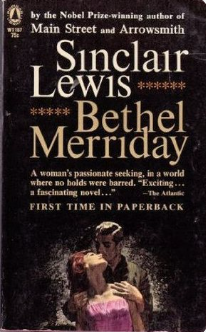
This 1960 paperback cover makes it look really steamy. It is not.

So. It starts with Bethel as a small child growing up in Connecticut, realizing that she loves to play-act. Eventually she goes off to a women's college and snags a few parts, and despite her family and friends trying to convince her to settle down and marry her home-town honey, she persuades her parents to do a sort of summer theater internship, where (for a fee) she gets a few small parts and does a lot of behind the scenes work in a small theater in a disused former church. Bethel then decides to try her luck on Broadway, and after several months of struggling, discovers that someone from the summer stock company is mounting a new touring production of Romeo and Juliet, with a shocking modern interpretation -- well, shocking in that the actors are all wearing modern clothes. She manages to finagle herself a job as a secretary to the producer/lead actor, the handsome and wealthy Andy Deacon, who is spending all his money on this endeavor. Bethel is also the understudy for Mrs. Boyle, a semi-famous actress who has accepted the part of Juliet for an astronomical sum.

The whole crew go on the road, bringing the Bard to small-town America. By now it's 1938 and the threat of war is looming, but there's very little mention of "the situation in Europe." It's really about the day-to-day struggles of this low-budget touring company and their attempts to at least break even, and the relationships that develop among the players. As the lead character, naturally young Bethel has her admirers -- I counted at least six proposals of marriage Bethel receives from various men in the book, and it might have been more.

 A very pulpy 1962 paperback edition, also laughably bad. 

I enjoyed reading about all the backstage drama and trouble that the company faced, which probably wouldn't be much different today, except they'd probably be in a giant motor coach instead of Pullman cars. (I love traveling by train and the idea of a sleeper car sounds delightful -- they still exist in the USA but they're quite expensive and train food isn't very good any more so I don't know if I'll ever try it). I liked Bethel and the other characters but the story is lacking the real satire that I expected after reading Main Street. I really didn't get a lot of character development, especially with Bethel, who is really a bit too perfect. I've seen other readers complain that the book mostly ignores the buildup of WWII -- the book was first published in 1940 and it is a bit odd, though Lewis had addressed the rise of facism in his 1935 work, It Can't Happen Here. Maybe he really wanted a break from the war and needed to write something escapist? I don't know enough about Lewis to speculate. 

There are three classes in the audience in a  city theater: those who can afford to go -- of whom some really like the play; those who want it thought they can afford to go -- they are too engaged in hoping they look like regular and expert theatergoers to have much attention left for the play itself; and the students up in the gallery, who love the play savagely or hate it volubly.

A Spanish edition from 1946. This one is actually quite pretty.

Bethel Merriday was a fairly quick read and pleasant diversion, if a bit predictable. I liked it though it's not particularly memorable. If you're not a theater lover or a big fan of coming-of-age stories, I don't know if you'd enjoy it. The writing is good and Lewis gets in some good zingers here and there, but I"m not surprised it's mostly fallen into obscurity. 

This is my eighth book for the TBR Pile Challenge.

Tuesday, July 26, 2022

Paris in July 2022: The Loved and Envied by Enid Bagnold


My fourth book for this years Paris in July is The Loved and Envied, a Virago reprint I've owned for several years (I can't even remember where I bought it -- it has the price in USD). Originally published in 1951, it's a novel for adults by Enid Bagnold, most famous for her children's book National Velvet (which I've never seen nor read).

Inspired by the life of Lady Diana Cooper, it's the story of aristocratic families living in Paris after WWII. Though their titles are French, some of the characters are actually British. Most of the action is centered around the beautiful and charismatic Lady Ruby Maclean. Now in her mid-fifties, she's has been happily married to Sir Gynt Maclean for many years, but has always had a large circle of admiring men who find her irresistible -- Sir Gynt first saw her while walking down the street and instantly fell in love with her at first sight. She's basically Helen of Troy and men will do anything for her, much to the chagrin of her only daughter Miranda, who has always been overshadowed by her mother.

Also in the Macleans social circle is Edouard, the elderlyVicomte de Bas-Pouilly and his mistress Rose; Alberti, the Duca de Roccafergolo, who rents a cottage on the Vicomte's estate; Rudi Holbein, a famous playwright; and his ex-wife Cora, an artist and great friend of Lady Ruby. 

The Virago reprint. The cover image is the portrait of Lady Diana Cooper by J. J. Shannon.

The story begins the opening night of Rudi's latest play, with most of the characters in attendance, and what follows over the next few weeks. It's another book in which not much happens, yet many things happen, largely character driven. Most of the characters are aging aristocrats and much of the story concerns aging and mortality, particularly the question of aging beauty. Lady Ruby is 53 and still all the men hover around her, even those young enough to be her sons. 

The original 1951 cover

The story jumps around quite a bit at the beginning giving back story to all the characters surrounding Lady Ruby and their relationships to her. The first half was almost like a set of short stories about them before they actually got to the main character. Honestly, I don't even remember much about her except the many descriptions of how beautiful she is and was, and that got a little tiresome. It's well written and I liked a lot of the characters, but I found everyone besides Lady Ruby to be far more interesting than she was and would have loved to read more about them and less about her. I particularly liked the back story of Cora Holbein and would happily have read an entire novel about her.

One thing I didn't particularly like was (yet again) some of the persistent racism and some homophobia. Ruby's daughter Miranda is living in Jamaica for part of the book and there are some unfortunate slurs. There's more than one gay character and at first I thought the book was surprisingly progressive, then another gay character showed up at the end and yikes some of it was pretty cringe-worthy. I suppose I shouldn't be surprised since it was published in the 1950s but I still hate it.

Though nearly all the story takes place in France, many of the characters are British so it doesn't feel especially French. It was an interesting look at aristocrats of the period but it isn't one of the best Viragos I've read so far.

This is my eighth book completed for the TBR Pile Challenge.

Tuesday, June 14, 2022

A Pin To See the Peepshow by F. Tennyson Jesse

In the history of the world it is only we -- we who are young now -- who are really going to know about life. 

I bought this Virago Modern Classic more than five years ago, after Simon and Rachel discussed it in the wonderful podcast Tea or Books? I was going to say "I can't believe I've waited so long to read this" but who am I kidding? I have more than 150 unread books and the pile never seems to grow any smaller. But I recently joined a Goodreads book group that discusses middlebrow books and it was their June pick! (The group has also caused me to buy more books, so I don't know if it's really a win. I'm really enjoying the books though).

It took me awhile to get started, but I zoomed through this book in only three days -- pretty good since it's just over 400 pages. It's one of several books inspired by the Thompson/Bywaters murder trial in the 1920s. I knew nothing about the case other than what I'd heard on the podcast several years ago, and I remembered none of it -- I couldn't even recall who the murder victim was though I had my suspicions. 

I really liked this book but I was surprised at how long it took to get to the actual crime, more than 300 pages. It's really a character study of a young lower-class woman growing up in the Edwardian/WWI period. The protagonist is renamed Julia Almond and the story begins when she's off to school, aged about 16. As one of the upper-level pupils, she's tasked one day with briefly overseeing some younger students, one of whom has a tiny peepshow, a sort of mini-diorama you peer into through a tiny hole. This peepshow acts as a metaphor for Julia's life -- over the next ten years she's observing what she wants and will never have, due to circumstances beyond her control.

I think this is the original dustjacket.
Nice illustration but it doesn't even give a hint about the story.


Julia soon leaves school and studies fashion drawing and French, which leads her to a minor job at a fashion house in London. She's a quick study is working her way up in the business when the Great War begins. People are spending money like there's no tomorrow (and for some, there won't be) and she makes fashionable friends and hopes for a better, more exciting life. 

However, her father dies suddenly leaving Julia and her mother without enough to live on, and they are forced to combine households with her uncle and his family, including a younger cousin Elsa. It's tight quarters and they're obliged to share a room, which overwhelms Julia, and she makes the rash decision to marry an older friend of her father's, Herbert Starling, just to get out of the house. Having had a taste of independence, Julia isn't satisfied as the compliant little wife by the hearth that Herbert has envisioned, and the marriage is doomed from the start. Julia isn't a particularly likable character, but I absolutely sympathized with her frustration and lack of choices for women in the time period, particularly middle-class women who were judged by a much higher standard than lower or upper-class women of that era.  A Pin To See the Peepshow was published in 1934, about twelve years after the murder, and I wonder if it was quite shocking for its time as it covers some topics that are still pretty divisive today.

This book is very character-driven and Jesse takes a long time on developing Julia. Most of the other characters are also well drawn. The murder portion of the book is really only the last 100 pages or so and did feel a bit rushed in parts. The author does spend a good bit of time on Julia's thoughts during and after her trial, and thankfully leaves out a scene at the end which is probably best left to the imagination. My Virago edition also includes an excellent epilogue by the writer who adapted it as a 1973 mini series. (There's also a new British Library Women Writers edition which includes an introduction by Simon!) I was hoping someone had uploaded it to YouTube or other streaming service but I haven't been able to find it. It starred Francesca Annis who I can perfectly imagine as Julia. 

This is book #7 for the TBR Pile Challenge.

Monday, May 30, 2022

The World My Wilderness by Rose Macaulay


No civilization had lasted for more than a few thousand years; this present one, called western culture, had had its day and was due for wreckage, due for drowning, while the next struggled inchoate in the womb of the ensuing chaos, till slowly it would take shape and have its day. That day was unimaginable; it would be what would be; but already the margins of the present broke crumbling and dissolved before the invading chaos that pressed on.  

Published in 1950, The World My Wilderness is Rose Macaulay's penultimate novel, just before her most famous work, The Towers of Trebizond. I'd been meaning to read this forever and was lucky enough to find a paperback Virago copy a couple of years ago, on the free book cart in the lobby of the Ramstein AFB library. I can spot a green Virago spine a mile away so naturally I snapped it up. 

Just after the end of World War II, British expat Helen Michel is living in the south of France, in a small town near the Pyrenees, with her 17-year-old daughter Barbary, and her young son, child of her second marriage to a Frenchman. Her husband Maurice, suspected by many as being a collaborater, has died under mysterious circumstances, and Helen is living a quiet existence in their house, Fraises, when her oldest son arrives from Cambridge. After a visit, he returns to London, taking his sister back to live with their British father and his new wife. Also joining them on the trip is Barbary's stepbrother Michel, now orphaned, to live with his uncle. Fifteen-year-old Michel and Barbaray have been running rather wild with the Maquis, French resistors. 

The original 1950 hardcover edition


Not surprisingly, the move to London does not suit Barbary very well. Theoretically she's studying art but is also continuing to be rather wild, exploring the bombed-out buildings with Michel and making some rather disreputable friends. Her father, a British peer, attempts to 'civilize' her -- or rather, her new stepmother Pamela does -- but Barbary can't be bothered to put on makeup or look like a lady, much less sit in boring drawing rooms. Things take a turn for the worse when Barbary accompanies the family on a trip to Scotland to visit an uncle, a psychiatrist who would like very much to analyze her. 

I liked this novel but for a short book, only about 250 pages, it was surprisingly slow. I expected to rush through it but it really isn't that sort of book. It's quite description-heavy and the characters are really well drawn. I was surprised that as early as 1950 an author recognized the psychological effect the war must have had on so many people, including the young, since I've always thought PTSD and wartime trauma was mostly ignored -- Barbary's British father and stepmother were clearly very stiff-upper-lip type of people. 

Really like this Dutch-language edition from 1968

Barbary in particular is a very interesting character, she's both old beyond her years and also extremely childlike. I was very worried that something terrible would happen to her wandering about bombed-out London buildings alone, (and it does) but not at all what I was expecting. I also think the name Barbary is a little heavy-handed but again, it was published in 1950 so maybe that was a subtle hint for its time. 

I also quite liked the twist ending which I was not expecting at all. Overall, a very enjoyable book and an excellent summer read. 

This is my sixth book for the TBR Pile Challenge.

Monday, March 21, 2022

The Mountain Lion by Jean Stafford: An NYRB Classic with a Dark Twist

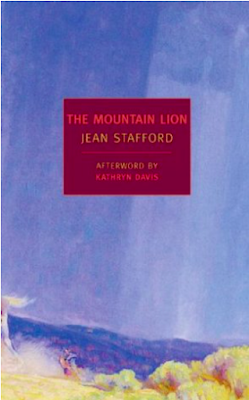
Detail of "The Shower" by William Herbert Dunton. 
The original is in the American Museum of Western Art in Denver, Colorado

The Mountain Lion is one of several unread NYRB Classics that have been accumulating on my TBR shelves. I've probably owned it for a good ten years and it seemed like a good choice for the TBR Pile Challenge. I try to mix up my reading with different genres and it seemed quite different than my previous read, plus it's short -- a good choice when I'm behind on my annual reading goal already! However, this book was nothing like I expected.

Published in 1947 but set about 20 years earlier, it is the story of a young brother and sister living in California, Ralph and Molly Fawcett. The book begins when Ralph, aged ten and Molly, eight, are anxiously awaiting the arrival of their Grandfather Kenyon, the stepfather of their widowed mother (so, technically, their step-grandfather). They live with their mother and two older sisters in a walnut grove in suburban Los Angeles, and their Grandfather's visit is the highlight of the year. Grandpa Kenyon is quite a character, a world traveler who owns various properties including a ranch in Colorado, managed by his son Claude, their mother's half-brother. 

Ralph in particular is stifled growing up among a lot of females, but ostensibly for their health, Ralph and Molly begin to spend extended trips on the ranch with Claude. Ralph's world changes as he leaves his repressed childhood in California to a heavenly freedom in Colorado, where he learns to ride and shoot and fish. 

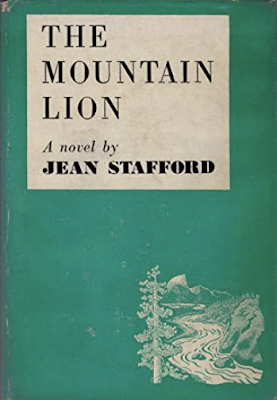
The original 1947 cover.
I love the illustration, like a reverse woodblock print. 


This seems like it could be a wonderful and ideal way to spend summers, but it's not ideal for Molly, who is precious, awkward, and bookish. It also takes a rather darker turn as they begin to grow older. What at first appears idyllic is actually not. Jean Stafford is masterful at describing life, both on the ranch and in California, but she doesn't leave out any details, including butchering animals and a really grotesque incident of self-harm. The characters are really well-drawn, but none of them are particularly likable; however, I absolutely had to keep reading to the ending which left me gobsmacked and very unsettled. My edition had a forward by Stafford with a major spoiler so I should have seen it coming -- I was still rather shocked but if you want to be completely surprised, I'd skip it.

Having read the forward, I had an overwhelming sense of dread. It actually reminded me a bit of the film The Power of the Dog, -- not so much the plot, but they're both Westerns set in the 1920s with dark undertones. I actually saw it the theater a few months ago and it's a great movie but it made me deeply uncomfortable because I knew something dreadful was going to happen. If that is the type of story that puts you off, I would probably not read The Mountain Lion. I gave it four stars on Goodreads (there is some racism besides the disturbing parts) but I don't think I would read it again. 

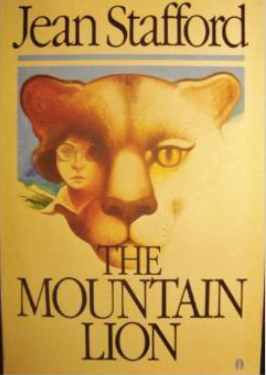
From the 1983 edition. This cover is SO 1980s!


Jean Stafford won the Pulitzer Prize in 1970 for her Collected Short Stories, and a couple of other novels. I'm not sure if they're as dark as The Mountain Lion but her writing is very good and at some point after I've recovered from this one I might look for them later.

This is my fifth book for the TBR Pile Challenge.

Friday, March 18, 2022

Last Year When I Was Young by Monica Dickens

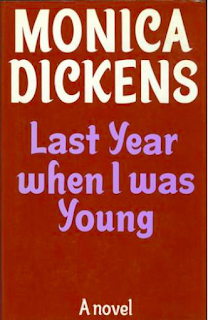
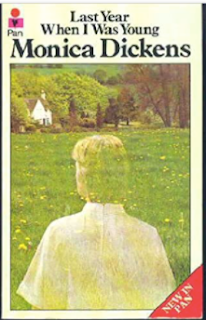
Wow, this cover is TERRIBLE. 

I'm not going to spend too much time on this post, because to be perfectly honest, I don't think anyone will read it -- it's about a book from the 1970s that no one has heard of, by an author that hardly anyone reads anymore (despite her famous name) and it has one of the WORST COVERS OF ALL TIME. Seriously, who looked at that cover and thought, "This book will sell!" Did her editors secretly hate her? It is a mystery.

Anyway. I'm sure that I would never have picked up this book in a store, but this copy somehow ended up with the donations at my library about ten years ago.  As I was sorting through them I recognized Monica Dickens' name, and kept it aside for myself (these were books donated for the Friends of the Library sale, and employees got first crack at them. All books were $1 and I did pay for this). There was another Monica Dickens as well called One of the Family, whose plot I have instantly forgotten. 

I finally got around to reading this last week -- I added it to my TBR Pile Challenge list so that I would be inspired to read it. As it is just over 200 pages long and I'm way behind on my reading quota for the year, I thought I'd give it a try.

Published in 1974, Last Year When I Was Young is the story of Richard, a twentysomething private nurse who is working at the home of an elderly man who is fading fast. The family are all pretty awful except for a granddaughter named Fanny who turns up from Australia, where she'd been on an assignment for the BBC. Richard had a past love that ended tragically several years before and I knew instantly that Fanny was the new love interest. I predicted that the elderly client would pass away and leave all his money to Fanny, and she and Richard would end up together. I was wrong.

This cover is not much better

I expected the whole story to be about this particular assignment for Richard, but it ends rather abruptly and he moves on to other jobs. But over the course of a couple of years, he and Fanny drift in and out of each other's lives as Richard takes on private nursing assignments. Some are sad, some are amusing, but overall this book is just sort of melancholy, but it didn't end at all how I was expecting. In retrospect there were hints all along that made perfect sense as I read the final paragraphs. 

Like I was hoping, it was a pretty quick read, and I think I read it all one day (we had some unexpected bad weather and I was stuck inside the whole weekend). It was a fairly good read but I don't suppose this will be reprinted anytime soon -- it's very middlebrow but not really interesting enough to get picked up by Persephone or any of the other indie publishers who are reprinting unappreciated fiction right now. I don't read that many books from the 1970s and parts of it are very much of its time, i.e. a couple of pretty cringe-worthy racial slurs. 

An OK read but I suspect it will end up in the Little Free Library down the street. But it's one more book knocked off my TBR pile. 

Friday, March 4, 2022

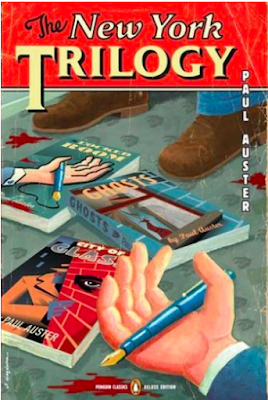
The New York Trilogy by Paul Auster: Metafiction Mysteries


Everyone knows that stories are imaginary. Whatever effect they might have on us, we know they are not true, even when they tell us truths more important than the ones we can find elsewhere. ("The Locked Room")

More than ten years ago I received a big box of 24 Penguin Deluxe Classics as a prize from the publisher. As of this year I still had four still unread so I added The New York Trilogy to my TBR Pile Challenge list. I brought it with me, appropriately, to a recent trip to New York, but this book was not what I expected at all. This is an odd book, and I don't even know if I can describe it accurately.

It's a collection of three novellas, originally published in 1985 and 19867. Each of the protagonists is either a private investigator, or someone who becomes caught up in an investigation. Ostensibly they are all detective novels, but they're hardly the mystery/detective fiction of Raymond Chandler or Dashiell Hammett.They all begin as traditional detective novels, but it quickly becomes apparent that they're all much more than that, as the narrators begin to question what they're doing and the nature of their existence within the investigations. 

In the first novella, "City of Glass" a mystery writer named Quinn who is between projects gets a series of mysterious phone calls for a "Paul Auster," asking for help. Out of boredom and curiosity, he decides to impersonate Auster and ends up taking on a case and descends into a Kafka-esque spiral. 

The second novella is titled "Ghosts," in which a private investigator named Blue is hired by the mysterious White to follow a man named Black and monitor him 24 hours a day. Eventually he starts to wonder who is observing who and what it all means. (All the characters are named after colors, shades of Reservoir Dogs.)

The final novella of the trilogy, "The Locked Room" is the story of a nameless young writer contacted by the beautiful wife of his childhood friend Fanshawe, who seems to have disappeared, leaving behind boxes crammed with his writings. She asks the narrator to fulfill her missing husband's request to try and get his writing published and he becomes obsessed with finding out what happened to his old friend while becoming more involved with the wife. 


I really liked these novellas but they were so much more than I expected. Instead of the hard-boiled detectives of the mid-century, the protagonists all begin to question their own existence and sometimes their own reality. They're all actually interconnected and it took me quite a while to figure out how they were related, other than being set in New York. (I had put the book down for a couple of weeks before the first and second novellas so that definitely made it harder.)

They're also quite different from writing style of the traditional detective novel. There are so many insightful and beautiful quotes adding little sticky notes so I wouldn't forget them. Some favorites: 

New York was the nowhere he had built around himself, and he realized he had no intention of ever leaving it again. (City of Glass)

For the first time in his experience of writing reports, he discovers that words do not necessarily work, that it is possible for them to obscure the things they are trying to say. (Ghosts)

He feels like a man who has been condemned to sit in a room and go on reading a book for the rest of his life. This is strange enough -- to be only half alive at best, seeing the world only through words, living only through the lives of others. But if the book were an interesting one, perhaps it wouldn't be so bad. He could get caught up in the story, so to speak, and little by little begin to forget himself. But this book offers him nothing. There is no story, no plot, no action -- nothing but a man sitting alone in a room and writing a book. (Ghosts)

Stories happen only to those who are able to tell them, someone once said. In the same way, perhaps, experiences present themselves only to those who are able to have them. (The Locked Room)

A man does not spend his time hiding from the world without making sure to cover his tracks. (The Locked Room)

We all want to be told stories, and we listen to them in the same way we did when we were young. We imagine the real story inside the words, and to do this we substitute ourselves for the person in the story, pretending that we can understand him because we understand ourselves. This is a deception. We exist for ourselves, perhaps, and at times we even have a glimmer of who we are, but in the end we can never be sure, and as our lives go on, we become more and more opaque to ourselves, more and more aware of our own incoherence. No one can cross the boundary into another -- for the simple reason that no one can gain access to himself. (The Locked Room)


That's a lot of quotes but they're all so good that I couldn't cut a single one. I'm not a huge fan of post-modern or meta-fiction but I can't stop thinking about this book. It did have some sexist tropes that I could have done without but I understand why Penguin added it to their Classics list, despite being published in the 1980s. If I had a mystery book group I would absolutely recommend this because there is a LOT in here to discuss. I'm not even sure I understand the ending. 

This is my third book for the TBR Pile Challenge and I'm really glad that it inspired me to finally read this novel. 

Saturday, January 29, 2022

The Peacock Spring by Rumer Godden (with bonus giveaway)

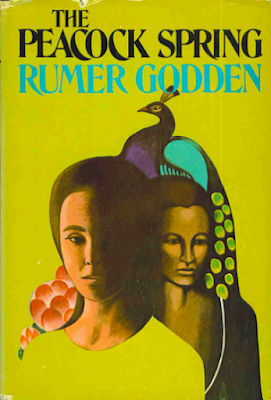
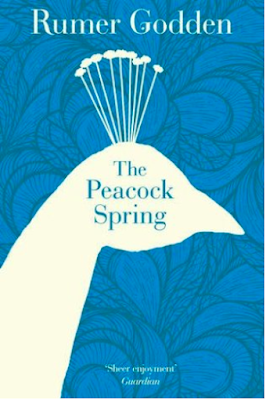
Cover of the 1975 edition, of which I now have 2 copies

As I read a lot of middlebrow fiction, Rumer Godden is a writer that's been on my reading radar forever. Last year I was browsing on the cart outside Alabaster Books in New York, a tiny used and rare bookstore that is often overshadowed by the much more famous Strand Bookstore on the opposite side of the block. I found a 1976 copy of Peacock Spring and paid the bargain price of $1. 

Then last weekend I was killing time in another used bookstore in Pittsburgh (touristy post to follow soon) while waiting for a rideshare. Lo and behold, I found another copy of Peacock Spring and started reading it as I waited. I felt guilty about spending so much time there so I felt compelled to buy the second copy (only $7) and read it that night and on the plane home the following day. That didn't work out exactly as planned but I did finish the book this week and HOO BOY.

Cover of the 2004 paperback edition.
A new copy can be yours via Amazon $632. Or $695. I did not omit the decimal point.  
(Or a good used copy for 16 cents.)

Set mainly in post-Independence India, this is the story of Una Gwithiam, the teenaged daughter of Sir Edward Gwithiam, a diplomat newly appointed to a post in Delhi. Una and her younger half-sister are at boarding school in the UK when the headmistress tells her that she and her sister Halcyon (nicknamed Hal) are to leave their school and join their father in India, for reasons unexplained. Hal is thrilled but Una, more studious, is not, especially after she meets her new governess, Alix Lamont, a half-caste Eurasian who seems under-qualified. Una had had hopes of entering Oxford or Cambridge but now it seems those are dashed. Miss Lamont seems more interested in taking them sightseeing and socializing, and Una is forced to attempt higher mathematics on her own. This leads to a meeting with Ravi, an attractive young gardener who promises to secretly help her study. Meanwhile, Una and Hal aren't getting along with their governess Miss Lamont who seems to have secrets of her own. 

Rumer Godden was born in the UK but grew up in what is now Bangladesh (then colonial India), and moved back and forth before and after both world wars, so she knew India really well. The descriptions of India and of colonial life are really interesting, the highlights of the book for me. The book began rather slowly and it took awhile for me to get into, but by the second half I sped through it to find out what would happen -- which was sort of predictable, if somewhat problematic. And I don't mean problematic because of racism or classicism, which are definitely addressed pretty well, but problematic because of the age difference between Una and Ravi. Una is only 15 when the book takes place and though they never specifically Ravi's age, he's at least seven or eight years older than her which is pretty icky. There are definitely some consent issues in this book which made me absolutely cringe and want to throw the book across the room. 

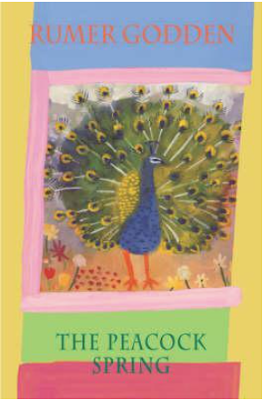
Cover of the 2013 edition. These do not cost $632.

I did, however, complete the book and I was not surprised at how it ended up. Overall it's interesting and I loved the descriptions of India, a country I've always wanted to visit, but it's definitely problematic. It was first published in 1975 but I'm not sure of the exact year in which it's set. There was a PBS Masterpiece adaptation in 1995 which set the story in 1959, but I don't remember it being specifically mentioned in the book, not that it really matters. 

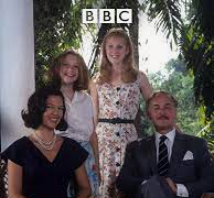
And I discovered the adaptation is streaming on Amazon Prime! I couldn't find any stills but here's an image from the website. Might have to check it out soon. 

That's a very young Hattie Morahan as Una, in her first TV role. 
I know her best as Elinor Dashwood in the 2008 adaptation of Sense & Sensibility

And now that I have two copies of the 1975 hardcover, I have an extra to share. (The $1 copy, not a $632). If anyone is interested in a free copy of this book, drop a comment below. If I have more than one person interested in the next week, I'll draw a name at random. Make sure you leave contact info so I can get a good mailing address! 

This is my second novel completed for the TBR Pile Challenge.

Wednesday, January 19, 2022

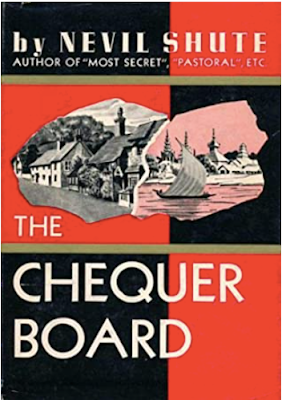
The Chequer Board by Nevil Shute

I am very behind with my reading already this year -- normally by this time I've read at least four or five books, if not more. I really needed a fast read to get me inspired, so I turned to one of my most reliable authors, Nevil Shute. I think this is the eighth book by Shute that I've read, and I've mostly enjoyed all of them. They might not be considered great literature, but he is a great storyteller, and normally I can hardly put his books down.

Published in 1947, The Chequer Board is the interweaving story of four WWII soldiers who are linked together after surviving a plane crash. They're all assigned to the same hospital ward and the most seriously injured, John Turner, suffers a very serious head wound, and his eyes are bandaged. While convalescing, the other three, previously unknown to Turner or each other, all read or talk to him, to help him recover. Several years after the war, Turner begins to have side effects from the head wound, and upon consultation, learns that shell fragments have been left behind in his brain, which are inoperable, and he has about a year left to live. 

Two of the three in the ward were also crash survivors, and the third was a Black American GI. One of the crash survivors was one of the pilots, who was very racist and snobbish to the Black American. The other three -- Turner, the American, Dave Lesaurier, and a third crash survivor -- are under guard together because they're awaiting court-martial, accused of various crimes. Turner has always wondered about the other three men in the ward with him, and decides to use the time left to try and track them down and see what happened to them. 

So, the story goes back in forth in time between the wartime experiences of the three men, and Turner's search for the them, which takes him all around England as far as Penzance, and all the way to Burma. (Another book about Cornwall! The universe is obviously telling me to go there).

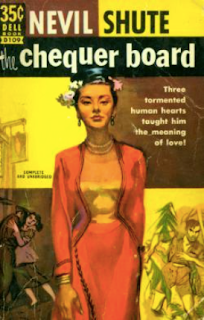
This pulp paperback cover is . .  . something

There's a lot about race relations and prejudices in this book, both with the racist pilot, Morgan -- who ends up living in Burma, to the chagrin of his mother (the reader can see where he got his prejudices) and also with the Black GI, Dave Lesurier. It was very interesting to me to see how Shute was trying to explore racism and race relations in the UK at the time, and I honestly can't imagine an American writer of that era attempting the same. Those two stories were my favorites in the book, though there are quite a few racial slurs repeated, including the N word, which is so infuriating. The story is trying really hard to make the point that white people need to get over it and look past color, but Shute kept throwing the word in, which was pretty frustrating. There's also some sexism which made me roll my eyes.

Overall though, the message about getting along is pretty strong, and there are some great characters and development. In particular I liked learning how the residents of a small town in Cornwall supported a group of Black GIs. I know racism is still a big issue in the UK but it was nice to see someone in the 1940s pointing out how the Black GIs were treated better in England than they were at home. 

I also really enjoyed reading about Burma, which I briefly visited years ago on a trip to Thailand. That section of the book was very reminiscent of A Town Called Alice, one of Shute's best-known books, though that one is set in Malaysia. There are at least seven or eight more books by Shute I still haven't read, and I look forward to reading them all.

This is my first book for the TBR Pile Challenge.

Wednesday, January 12, 2022

TBR Pile Challenge 2022


This might be the challenge that actually gets me blogging regularly again! I'm always trying to read books off my one shelves (only 33 in 2021 -- not great!) so learning that Adam is reviving his TBR Pile Challenge definitely piqued my interest. Basically the idea is to pick 12 books off your shelves that you've owned for at least a year, and read them (you are allowed two alternates). You then post about them on your blog, and at the end of the year, anyone who finishes is eligible for a drawing. The prize is a $50 gift card for . . . more books! I have attempted this challenge several years and actually won the prize a few years ago! 

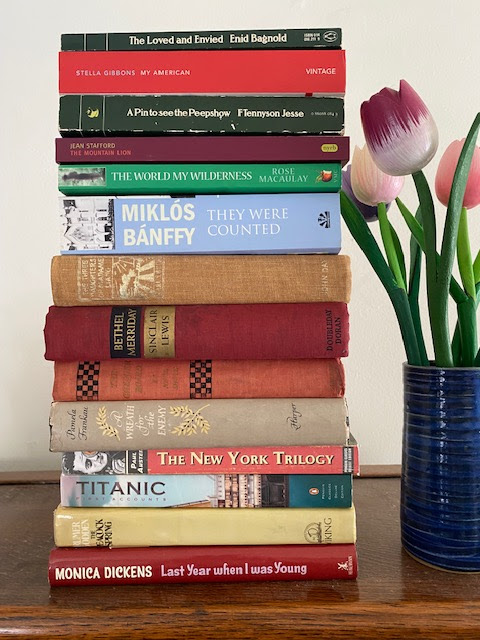
Here is my tentative pile for the challenge, a mix of books I've owned forever (more than ten years for some of them!) and some I acquired more recently, though none less than a year ago:


This is the pile in list format, alphabetically by author. Alternates are listed at the end.

Completed: 9/12

1. The New York Trilogy (1987) by Paul Auster. One of the last books unread from my Big Box of Penguins. Completed 3/3/22.

2. The Loved and Envied (1951) by Enid Bagnold. One of many unread Virago Modern Classics. Completed 7/24/22.

3. They Were Counted (1934) by Miklos Banffy. A big fat book in translation,  just the sort of book I love. 

4. Three Daughters of Madame Liang (1969) by Pearl S. Buck. A find from the basement bookstore at the Central Library in San Antonio. 

5. Last Year When I Was Young (1974) by Monica Dickens. Rescued from the annual library sale, back when I worked at the San Antonio Public Library, probably around 2012. Completed 3/12/22.

6. My American (1939) by Stella Gibbons. One of the Vintage Classics reprints bought when I visited London in 2017.

7. The Peacock Spring (1975) by Rumer Godden. Bought off the $2 cart outside Alabaster Books in New York. Completed 1/29/22.

8. The World My Wilderness (1950) by Rose Macauley. Found on the donation cart at the Ramstein AFB library. I recognized the green Virago spine and snapped it up. Completed 5/24/22.

9.  Titanic: First Accounts (2012) by Tim Maltin. Bought for its beautiful cover after I started buying Penguin Deluxe Classics. 

10. Bethel Merriday (1940) by Sinclair Lewis. Found with a pile of vintage books in an antique mall in Ellicott City, Maryland, the cutest little town in America. Completed 8/24/22.

11. The Chequer Board (1947) by Nevil Shute. Also bought at John King Books in 2018, after I discovered Nevil Shute. Completed 1/18/22.

12. The Mountain Lion (1947) by Jean Stafford. Another library sale find, an NYRB Classic. Completed 3/20/22.

Alternates:

A Wreath for the Enemy (1952) by Pamela Frankau

A Pin To See the Peepshow (1934) by F. Tennyson Jesse. Completed 6/13/22.

So, bloggers, have your read any of these? Which are must-reads, and which should I donate back to the library? And who else is signing up for the TBR Pile Challenge?