Showing posts with label Paris in July. Show all posts

Tuesday, July 26, 2022

Paris in July 2022: The Loved and Envied by Enid Bagnold


My fourth book for this years Paris in July is The Loved and Envied, a Virago reprint I've owned for several years (I can't even remember where I bought it -- it has the price in USD). Originally published in 1951, it's a novel for adults by Enid Bagnold, most famous for her children's book National Velvet (which I've never seen nor read).

Inspired by the life of Lady Diana Cooper, it's the story of aristocratic families living in Paris after WWII. Though their titles are French, some of the characters are actually British. Most of the action is centered around the beautiful and charismatic Lady Ruby Maclean. Now in her mid-fifties, she's has been happily married to Sir Gynt Maclean for many years, but has always had a large circle of admiring men who find her irresistible -- Sir Gynt first saw her while walking down the street and instantly fell in love with her at first sight. She's basically Helen of Troy and men will do anything for her, much to the chagrin of her only daughter Miranda, who has always been overshadowed by her mother.

Also in the Macleans social circle is Edouard, the elderlyVicomte de Bas-Pouilly and his mistress Rose; Alberti, the Duca de Roccafergolo, who rents a cottage on the Vicomte's estate; Rudi Holbein, a famous playwright; and his ex-wife Cora, an artist and great friend of Lady Ruby. 

The Virago reprint. The cover image is the portrait of Lady Diana Cooper by J. J. Shannon.

The story begins the opening night of Rudi's latest play, with most of the characters in attendance, and what follows over the next few weeks. It's another book in which not much happens, yet many things happen, largely character driven. Most of the characters are aging aristocrats and much of the story concerns aging and mortality, particularly the question of aging beauty. Lady Ruby is 53 and still all the men hover around her, even those young enough to be her sons. 

The original 1951 cover

The story jumps around quite a bit at the beginning giving back story to all the characters surrounding Lady Ruby and their relationships to her. The first half was almost like a set of short stories about them before they actually got to the main character. Honestly, I don't even remember much about her except the many descriptions of how beautiful she is and was, and that got a little tiresome. It's well written and I liked a lot of the characters, but I found everyone besides Lady Ruby to be far more interesting than she was and would have loved to read more about them and less about her. I particularly liked the back story of Cora Holbein and would happily have read an entire novel about her.

One thing I didn't particularly like was (yet again) some of the persistent racism and some homophobia. Ruby's daughter Miranda is living in Jamaica for part of the book and there are some unfortunate slurs. There's more than one gay character and at first I thought the book was surprisingly progressive, then another gay character showed up at the end and yikes some of it was pretty cringe-worthy. I suppose I shouldn't be surprised since it was published in the 1950s but I still hate it.

Though nearly all the story takes place in France, many of the characters are British so it doesn't feel especially French. It was an interesting look at aristocrats of the period but it isn't one of the best Viragos I've read so far.

This is my eighth book completed for the TBR Pile Challenge.

Wednesday, July 20, 2022

Paris In July: Renoir, My Father by Jean Renoir


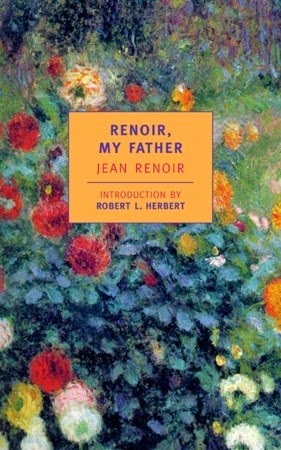
I am extremely pleased with myself for finally finishing this book! I bought it more than ten years ago on a visit to the Frick Museum in New York City, when I went to see an exhibit of Dutch masters. Apparently they didn't have anything else in the gift shop and but the pretty cover of this NYRB classic (it's a detail from Garden at the Rue Cortot, Montmartre painted in 1876, below. It's at the Carnegie Museum in Pittsburgh). 


So. I've owned this book forever and I know I've put it on my list of books to read for Paris in July multiple times. I finally cracked it open a couple of weeks ago and though it's not a fast read, I really enjoyed it. I love art and I'm fascinated by the lives of artists. I wouldn't say Renoir is my favorite Impressionist but I really gained a new appreciation of his work from reading this book. 

Originally published in 1958, it's a memoir by filmmaker Jean Renoir, Auguste Renoir's middle son. Jean was wounded during WWI and as he convalesced with his elderly father, who was already crippled with rheumatism, the younger Renoir spent a lot of time talking to his father about the artist's life. The book is a combination of a biography of his father's life and his own recollections growing up in Paris and various other parts of France. The family often spent summers in the countryside in various parts of France, particularly Essoys in Burgundy, where his mother Aline was born, and later in the south of France, near Nice (I was actually lucky enough to visit Nice a few years ago and was sadly unaware that there's a Renoir museum just 20 minutes away in Cagnes-sur-Mer, in his final home. I did get to visit the Chagall Museum and the Matisse Museum, so I really wouldn't complain but I wish I'd known!)


It's quite an interesting memoir about Renoir's life and how became and artist and met up with his fellow Impressionists. He's one of the most prolific of the group, with at least 4000 paintings to his record (and the book includes stories about other paintings that were lost or stolen which just made me aghast. Some were literally used to patch up holes in a leaky roof). 

There are also great stories about the other painters including one about his good friend Gustave Caillebotte, who named Renoir executor of his estate and personal art collection after his death. Apparently it was Caillebotte's wish that the collection be given to the Louvre who didn't want the whole collection and turned 2/3 of it away. The third that they kept was stored away in the Luxembourg Museum. After his widow's death they just went to various heirs and were mostly sold outside France. Well, France's loss is the world's gain, I suppose! 

I feel very fortunate to have been to Philadelphia last year where I saw the biggest single collection of Renoir's works at the Barnes Foundation, a total of 181! Barnes was a huge art collector and began amassing Impressionist works in the 1920s. His entire house was designed to showcase his collection and was eventually left to the city of Philadelphia as a private museum. The collection was eventually moved to a larger space in downtown Philadelphia which resembles the original house with the exact layout of the all the artworks. If you ever get the chance it's absolutely worth visiting! 

I'm also extremely fortunate to live only a short drive away from the Phillips Collection Museum in DC near Dupont Circle. One of the highlights of the collection is Renoir's Luncheon of the Boating Party. The last time I visited one of the docents told me that Phillips and Barnes were rival collectors. Phillips was annoyed that Barnes had the bigger collection of Renoirs but always bragged that he had the best one. 

Renoir's Luncheon of the Boating Party, 1881.
Renoir's future wife Aline is in the left hand corner with the little dog;
Renoir's friend and fellow Impressionist Gustave Caillebotte is on the lower left leaning back. 

I enjoyed visiting Renoir's world but the book is pretty dense and took a lot longer to finish than I expected -- I am rather behind on Paris in July reading list and also my Big Book Summer Reading Challenge! But this book was on both lists and I'm also counting this as my Classic Nonfiction for the Back to the Classics Challenge

Tuesday, July 5, 2022

Paris in July: The Martha series by Margery Sharp


I thought I'd start Paris in July with a short, fun book. Margery Sharp's Martha in Paris fit the bill perfectly -- only 166 pages and it was one more I could cross off my owned-and-unread pile. However, when I bought this at Strand Books several years ago I didn't realize it was second in a series. Naturally I would need to read them in order, so I had to track down the first book and buy that one too, though it's set in London, not Paris.


Published in 1957, The Eye of Love is the first book of the Martha series. Set in 1932, it begins with Martha's aunt, who was christened Dorothy Hogg but now goes by the name of Dolores Diver. Miss Diver, on the wrong side of 30 and fading, has just been left by her longtime lover Mr. Gibson, who is about to become engaged to the daughter of an associate, in order to preserve his failing furrier business. Times are hard and during the Depression, furs aren't selling well. Mr. Gibson and Miss Diver are despondent, but there's nothing to be done. He must leave his Spanish rose to marry an annoying woman he doesn't love. The least he can do is pay the lease on their love-nest through the end of the year, and give her all the contents which they've accumulated.

Miss Diver is also the guardian of her orphaned niece Martha, now ten years old and obsessed with drawing -- so much so that she basically eludes school and spends all her time sketching trees, stoves, and anything that catches her fancy. One day while sketching a tree she meets Mr. Phillips, who is looking for new lodgings, and he becomes their boarder, but soon suspects Miss Diver has some money and decides to make a play for her. 

I love this pulp novel cover - so dramatic! 


Meanwhile, Mr. Gibson has merged his business with the charming and steadfast Mr. Joyce, his future father-in-law, and they soon develop a deep friendship -- much more so than with his future wife Miranda. He cannot bear the thought of marrying her instead of Miss Diver but doesn't see any way around it. Coincidentally, Mr. Joyce, a lover of art, also encountered young Martha while sketching and sees that she has talent. Naturally all the stories converge, and without going into too much detail, I'll only say that it's witty and charming and has a very satisfactory ending. 


I really enjoyed it and was also enchanted by the sequel, Martha in Paris. The story has jumped forward and Martha is now eighteen. Mr. Joyce is now Martha's patron and decrees that she MUST study in Paris. Martha is still obsessed with her drawing and resists at first, but then sees the advantages and begins studying art while staying with a widow and her daughter. She's very focused and is oblivious to everything else -- in once instance, she doesn't even realize that while sketching in the Tuileries Gardens, the nice young Englishman named Eric sitting next to her is asking her out on a date. In a very amusing turn of events, she turns his invitation to Friday night dinner with his mother into an opportunity for a really good bath in their renovated English-style tub. 

This book is equally witty and charming and surprisingly feminist for its time (first published in 1962). Martha is portrayed as an artist completely focused on her work, but she actually struck me as someone who today might be considered on the autism spectrum. She's completely obsessed with drawing and art, and really bad at picking up at social cues. I'm no expert but if the book were published today I think readers would really speculate about that. 

This cover is just SO WRONG it's laughable. 
Martha wouldn't be caught dead in stockings and black pumps.
It's so bad I had to include it. 


My one tiny quibble about this book is that if the first book starts in 1932, the second would be set squarely in WWII and the French occupation of Paris. There is not a single mention of this and people are traveling back and forth over the Channel from England,so clearly, this book is set in an alternate universe in which the war never took place (but now I'm nitpicking).

I don't want to give away too many details for fear of spoilers, but Martha in Paris ends on such a cliffhanger I absolutely had to find out what happened next, and I found a online copy of the final novella, Martha, Eric and George online and read the whole thing in a couple of hours. If I gave any but the loosest setup it would absolutely spoil the plot of the second book. The third books picks up immediately after the end of the second, and after a couple of chapters, jumps forward ten years later with Martha as a successful artist who has to finally deal with the fallout of her actions in the end of the second novel. I loved the third novel as well as the first two but I do think it ended rather abruptly. 

I love this retro cover.


Like the second novel, it's also very feminist for its time (1964). Like Martha, author Margery Sharp was very successful and focused on her work. I also wonder if Martha's devotion to her work was a reflection of Sharp's own feelings about women working. I'm guessing some people will find Martha unsympathetic but if she'd been a man no one would have raised an eyebrow at her absolute dedication to her work and confidence in her talent. 

I've now read a dozen of Margery Sharp's books for adults (she also wrote the Rescuers children's series adapted into two animated Disney movies.) I've really enjoyed all of them and I'm happy to report many have been reprinted, including six recent paperback editions by the Furrowed Middlebrow imprint of Dean Street Press. The DSP editions are available on Kindle for around $3 or $4 US, a real bargain, and I'm sure I'll be downloading some of them soon. 

Saturday, July 2, 2022

Paris in July 2022


It's July already, the year is half over -- how did this happen? But for me July will always include the Paris in July reading challenge hosted by Thyme for Tea. I started participating in this event back in 2011 and I've posted my Francophile book reviews nearly every year since! 

As always, I'm trying to read mostly from my own shelves in my never-ending quest to empty the TBR shelves. Some of these can also count for the Back to the Classics and TBR Pile Challenges, and from my Classics Club List. I'm sure I won't finish all of them but reading goals are always good, right? 


First, the French books in translation: 

  • Claudine Married by Colette. The second novella in the Claudine omnibus; I'm sure I won't finish the entire series this month.
  • The Mystery of Henri Pick by David Foenkinos. Found this whilst browsing in the library and it looked interesting (and short!). 
  • Maman, What Are We Called Now? by Jacqueline Mesnil-Amar. 
  • Renoir, My Father by Jean Renoir
  • A Fine of Two Hundred Francs by Elsa Triolet
  • The Bright Side of Life by Emile Zola

Books originally written in English but set in France: 

  • The Loved and Envied by Enid Bagnold
  • Greengage Summer by Rumer Godden
  • Martha in Paris by Margery Sharp
  • The Golden Lion of Granpere by Anthony Trollope
  • Summer Will Show by Sylvia Townsend Warner
So - mostly fiction and fairly short books - more than half of them are under 300 pages and a couple are under 200! The longest is the Renoir biography (not counting the Claudine omnibus but all three of the remaining novellas are under 200 pages). I wonder if I could actually finish the entire list? 

Bloggers, have you read any of these? Which are your favorites and should be read first? And what else do you recommend for Paris in July?

Saturday, July 24, 2021

The Dogs and the Wolves by Irene Nemirovsky


The outside world was full of shapes and colors that were impossible to remember for ever, constantly lost, but seeking them out, pursuing them, was the most precious thing on earth.

"It's not my fault," she thought. "It's because I just can't forget certain faces once I've seen them, or certain houses, or certain sights. They're indifferent or fickle because they remember nothing. But I can't forget, I can't. It's a unique curse that makes me recall every feature, every word, every moment of joy or pain once they have struck me.


A couple of months ago I was looking for books set in the Ukraine for the European Reading Challenge, and I found The Dogs and the Wolves by Irene Nemirovsky. I've read several of her books and enjoyed them all, and this one sounded perfect -- Ukrainian writer, set in the Ukraine and Paris (so it also counts toward Paris in July); also the title fit one of the categories for the Back to the Classics Challenge. And it's just over 200 pages! It sounded like the perfect book.

Oddly enough, it was hard to track down, not a single copy in any library nearby; in fact, I don't think it's ever been reprinted in the US. I found a cheap used copy online and was looking forward to reading it. 


It's the story of four cousins: Ada Sinner; her first cousins, Ben and Lilla; and their distant cousin Harry. They're all around the same age and are born around the turn of the century in the Ukraine. Ada lives with her widowed father Israel and after her uncle dies, her widowed aunt and two of her cousins, Ben and Lilla, come to live with them. Harry, their distant cousin, is from a side of the family that is extremely rich, and they've never met him as he lives in the lower, wealthy part of town (they've seen him and his house from afar but never actually met). Their paths first cross during the pogrom when Ukrainian Jews were targeted by Russian soldiers. Ada and her cousin Ben are running from a mob when they manage to escape to their cousin's property and beg for help. 

The spoiled, cosseted Harry is aghast at the appearance of his cousins, who are poorly dressed and are bedraggled from their flight. Ada and Ben are swept away from their cousin, but are fed and introduced to an uncle, who eventually gives Ada's father some work. He becomes more prosperous and when the children are teenagers, he can afford to send them and their aunt to Paris just before World War I breaks out. Eventually, Ada learns that Harry is also in Paris. She's been fantasizing about him her entire life, and though Ben is in love with her, she's determined to find a way to meet Harry.

If this sounds like a lot for a 200 page book, well, it is. The plot was interesting, but I found it and most of the characters really undeveloped. Lilla basically disappears and I didn't get much sense of Harry's character at all -- it just seems like Ada is obsessed with him because he's rich. It almost seemed like a first draft rather than a finished novel. It was Nemirovsky's final published work, in 1940, just before the Nazis banned the publication of books by Jewish authors. (Nemirovsky was arrested in 1942 and deported to Auschwitz, where she died of typhus a month after arrival). 

What really disturbed me about the book, though, was not the under-developed plot and characters but was the shocking anti-Semitism. There are repeated stereotypings of Jews that made me aghast. I was not expecting it and I was gobsmacked. I haven't read all of her books yet but I've read quite a few and I don't remember any anti-Semitism in the others. Some of the writing was wonderful but this is not a book I really want to read again.

. . . she mustn't find more ways to feed a dream that was gradually becoming less, damaging, only half real, half imagination. As she grew up, she had become more and more distance from it, just as you forget a book you read and loved passionately when you were a child. You may still love it, but back then, you believed in it. Now you realize that it was nothing but poetry, fiction, an illusion, less than nothing. . . . 

I'm counting this as my Ukranian selection for the European Reading Challenge and as my Classic About an Animal for the Back to the Classics Challenge.

Tuesday, July 6, 2021

Paris in July 2021


It's back! Hosted by Tamara at Thyme for Tea, Paris is July is one of my favorite summer reading events. I have six possible reads this month, hopefully I'll get through at least three of them. Here's what's on the list:


The Complete Claudine by Colette. I read Colette's biography last summer and hope to finally finish the Claudine novels this year. 


Maman, What Are We Called Now? by Jacqueline Mesnil-Amar. Don't be too impressed, I won't be reading this in the original French! The only English-language edition is the Persephone which just has a plain grey cover. I really love the cover image on this French edition. 


The Dogs and the Wolves by Irene Nemirovsky. Takes place in both Paris and the Ukraine, so I can count it as my Ukranian read for the European Reading Challenge. (Also for my classic about an animal for the Back to the Classics Challenge!)


Renoir, My Father by Jean Renoir. Bought at the Frick Museum bookshop at least five years ago. I've really been obsessed with art lately, so I definitely plan on reading this one. 


Emile Zola by Alan Schom. I found a used hardcover edition last year on a visit to Second Story Books in Rockville, Maryland. I don't know if it's the best biography of Zola but it was a bargain and I couldn't resist it. 


The Bright Side of Life by Emile Zola. The twelfth novel in the Rougon-Macquart cycle. I've read 15 of the 20 novels, the end is in sight! (Then I guess I'll have to go back and read them all again, this time in order). 

So that's my reading list for this year's Paris in July! I'm also planning to watch lots of French movies and eat French pastries -- might try to make some homemade macarons! Bloggers, what are you reading this year for Paris in July? 

Tuesday, July 14, 2020

Paris in July: The Misunderstanding by Irene Nemirovsky


I've been hard at work reading two massive books for Paris in July, and as a quick break, I picked up The Misunderstanding by Irene Nemirovsky. Her first novel, just 164 pages long, was first published in 1926. It's the story of an affair between Yves Harteloup, a young war veteran, and Denise Jessaint, a bored rich woman, the wife of another war veteran whom Yves met while both were convalescing at a military hospital. 

The two meet at the end of the summer in the resort town of Hendaye, on the south east coast of France. Yves was raised wealthy but lost nearly all his money due to poor wartime investments by his financial advisors. He's found a job and has barely enough to hold on to his family apartment in Paris, and his one indulgence is his annual holiday, to the town he visited as a child. There Yves meets the beautiful Denise when her toddler throws sand on him as he dozes on the beach. 

After he realizes she's the wife of an old comrade, Yves is initially annoyed to have his idyllic trip interrupted by someone from his past; soon, however, he begins to feel a strong attraction to the beautiful Denise. After her husband goes to London, leaving her alone (well, with the child and nanny), he becomes obsessed with Denise, who married for convenience and money. Soon the attraction is returned, and the affair begins.


Things become complicated when Denise and her husband return to Paris, and Yves has to return to his humdrum job. Denise wants more and more from Yves, but can only see him for brief snatches of time; Yves becomes despondent when he realizes he'll never be able to keep up with her wealthy lifestyle, and falls deeper into debt. It's far from a fairytale romance 

It was a quick read, and I finished nearly the whole thing in a single sitting -- a big change from the doorstoppers I've been working on this summer. Neither Yves nor Denise are particularly likable characters, but the story is so realistic, and the writing is so good that I found myself sympathizing with both of them. It's astonishing to me that Nemirovsky wrote this when she was only 22 or 23. 

This was a perfect read for Paris in July -- I could imagine myself in the neighborhoods of Paris and I even looked up some of the streets and neighborhoods on Google Maps as I was reading. I really wish I was in Paris this summer but armchair traveling through literature will have to do! I've now read six of Nemirovsky's works and would like to read her entire oeuvre. There's also The Mirador, an imagining of her memoirs by her daughter, Elisabeth Gille, published by NYRB Classics, and a biography. Her life sounds fascinating and tragic. 

Saturday, July 4, 2020

The Twisted Sword: The Pentultimate Poldark Novel


I can't believe I'm on the 11th novel in this series, and I never blogged about it. I used to read a lot of historical novels, then I kind of got away from them when I got hooked on mid-century women's fiction. I only started reading the Poldark series after watching the PBS series when it first aired, the summer of 2015 when I was in Outlander withdrawal. I loved the first series which covers the first two novels, and promptly read the first ten books in less than a year. I'm not sure why I stopped there but suspect it had something to do with our big overseas move to Germany the summer of 2016. Our new library didn't have the last two novels, but on a trip to London that summer, I went to three different bookstores to find them -- and promptly left them gathering dust on the TBR shelves until now, prompted by my Big Book Summer Challenge

It is a little hard to get back into a series after a four-year reading gap (some of the supporting characters were a little fuzzy, but my edition thoughtfully included a family tree), but essentially, the book picks up pretty soon after the previous book, in the peace of 1815. Ross and Demelza's older children are grown and married, and Ross gets a summons to help out as an "observer" in France (and gets a baronetcy thrown in for good measure). Ross, Demelza, and the two youngest children head off to Paris, for what seems to be a good time, but that wacky Napoleon escapes from Elba and makes a triumphant return. [Bonus: this book also counts for Paris in July!]


This cover reminds me of a YA fantasy novel. 
Ross is on an assignment and gets separated from Demelza and the children, who flee to Brussels, where she meets up with her oldest son Jeremy and his new bride. Ross gets caught up in the war, so I had another perspective of the Battle of Waterloo, my second this year! But from the Coalition (Allied) side this time. My knowledge of French history is quite fuzzy and I didn't realize that Waterloo actually took place after Napoleon escaped from Elba, shame on me. There are a lot of descriptions of the horrors of war. I have been meaning to read La Debacle, Zola's masterful war novel, this summer, but maybe I'll put it off. 

Nice cover on this edition, I think it's the Polish translation


.
Sadly the war doesn't end well for everyone in the book. Meanwhile, back in Cornwall, the eldest Poldark daughter Clowance and her new husband are having money troubles, no thanks in part to George Warleggan. There are also some appearances by George's son Valentine; everyone's favorite doctor, Dwight Enys; and some local color with a pregnant housemaid who may or may not marry a local guy to give her baby a father. 

After a bit of confusion, I settled nicely into this 656 page chapter of the Poldark family, and ended up racing through it in less than a week. It's amazing how fast I started to remember details and characters (though a few are still a bit fuzzy and I've already requested the previous book from the library, so I can skim through it). Winston Graham was really good at creating the world of Cornwall from the time period. I loved most of the good characters and became outraged at the bad ones (George Warleggan has been carrying grudges against the Poldarks for how many years now?)

My only quibble was that the youngest daughter, Isabella Rose, is only THIRTEEN when the book starts and men are already courting her, ewww. I think Graham was setting up the story for the final book which is named after her. It's another 688 pages and I'm sure I will read it with enjoyment and more than a little sadness because the book series is ending. I've watched most of the TV series and unfortunately have gotten really bored with it, I didn't even finish the final season. Maybe I'll have to give it another try after I finish the final novel. I also own another long novel set in Cornwall called Penmarric and I'm looking forward to that one also.

How's everyone else doing with their summer reading? And can anyone recommend another great historical TV series and movies? 

Wednesday, June 17, 2020

Paris In July 2020


It's the summer, so that means Paris in July! Hosted by Thyme for Tea, it's an annual month-long celebration of all things French -- books, movies, films, and food. I haven't participated every year, but I've always enjoyed following along. This year, I'm hopefully going to knock a few books off my owned-and-unread shelves. Some of them also qualify for my Big Book Summer Challenge.


From top to bottom: 

Maman, What Are We Called Now? by Jacqueline Mesnil-Amar
The Misunderstanding by Irene Nemirovsky
La Debacle by Emile Zola
Renoir, My Father by Jean Renoir
The Complete Claudine by Colette
Secrets of the Flesh: A Life of Colette by Judith Thurman

That's six books, three of which are more than 500 pages long. My list includes fiction, a WWII diary, a memoir, and a biography. Of course I probably won't finish all of them but even half the list would be an accomplishment.


I also have some French language and French-themed films and TV series to watch:

Blind Date (Netflix)
The Bonfire of Destiny (Netflix)
Call My Agent! (Netflix)
Cezanne et Moi (Netflix)
A French Village (Hulu/Amazon Prime)
My Life as a Zucchini (Netflix)
Suite Francaise (No longer streaming on Netflix in the USA, but I have the DVD)
Twice Upon a Time (Netflix)


And if I get around to it I might try and make some macarons and eclairs as well!


Bloggers, which do you recommend? Or other books, movies, or TV shows about France? And what are you reading for Paris in July?

Wednesday, July 11, 2018

Paris in July 2018


Paris in July is back! Hosted by Thyme for Tea, it's a month long celebration of French culture -- books, movies, art, food, etc. This year I'm going to participate by:

Reading at least two of the following books:

  • Maman, What Are We Called Now? by Jacqueline Mesnil-Amar, a diary of wartime occupied France in WWII, published by Persephone;
  • In Confidence by Irene Nemirovsky, a collection of short stories;
  • The Misunderstanding by Irene Nemirovsky, her first published novel;
  • A Good Place to Hide by Peter Grose, another nonfiction account of wartime France. This one is about a small village in the Loire that hid more than 3000 Jews during the occupation.
  • The Bright Side of Life by Emile Zola, the latest in the Rougon-Macquart series to be newly republished by Oxford University Press, with a new translation -- I'm quite excited about this one since the nice folks at OUP just sent me a review copy!

Watching French movies, some new to me and one I've seen years ago:


  • La Femme Nikita, because my daughter loves action movies and it would be fun to watch it together;
  • Les Choristes, because I've heard it's heartwarming; 
  • Un Secret, because it's been in my Netflix queue forever; 
  • Journey's End, because I'm nearly finished with Testament of Youth and want to learn more about WWI;
  • Suite Francaise, because I loved the book and was finally able to track down a DVD -- I'm not sure why it was never released in the U.S. but I was able to find a region 2 copy. 

Cooking French pastries:


  • I haven't made eclairs in years and I keep saying I want to make them again. Or profiteroles. 
  • I'd also like to try to make Tarte Tatin. It was also a Signature Challenge on the Great British Bake Off and though I've never made rough puff pastry, it can't possibly be that difficult, can it? 

I'd also like to take at least one day trip to France. The town of Bitche is just about an hour away. I have family visiting and that would be fun to cross the border into another country, and there's a citadel way up on a hill that you can climb -- a good activity for children with a lot of energy.

Bloggers, are you participating in Paris in July? What are your plans? 

Monday, July 27, 2015

The Count of Monte Cristo by Alexandre Dumas


The Count of Monte Cristo is one of those really long classics that's been on my to-read list forever. I'd always been intimidated by the sheer length of it -- it's more than 1200 pages long! Originally, I had planned to read something by Zola for Paris in July, but then a couple of months ago I started listening to an audiobook called The Black Count by Tom Reiss, a biography of Alexandre Dumas' father, Alex Dumas. That story is pretty amazing. Alex Dumas was born the illegitimate son of a nobleman and a Caribbean slave yet became a General in the French Army. Dumas's father inspired his swashbuckling tales, and I couldn't help wishing I'd actually gotten around to read The Count of Monte Cristo and was worried about spoilers. So, I stopped listening to the audio and checked out Monte Cristo instead -- all 37 discs of the audiobook! It took me more than a month, but I finally finished it and I'm counting it as my Classic in Translation for the Back to the Classics Challenge


I'm sure most people already know the set-up of the story, so here's the short version: young Edmond Dantes, a French sailor, spends fourteen years imprisoned in the infamous Chateau d'If after being unjustly accused of treason. His three anonymous accusers are jealous of him for various reasons, and unfortunately, the prosecutor covers up the truth to hide his dirty little secret. Poor Edmond is the victim and they essentially lock him up and throw away the key. Naturally, he is despondent, and after four years of solitary confinement, he's ready to end his own life when he receives an unexpected visitor -- another prisoner accidentally tunnels into Edmond's cell.  


This mysterious prisoner is Abbe Faria, an Italian priest who becomes Edmond's friend, mentor, and father figure. Over the next ten years, he teaches Edmond languages and sciences and gives Edmond hope. He also gives Edmond the means to plot the perfect revenge on the four men who have ruined Edmond's life. It takes years, but Edmond eventually gets justice. 

This book is one of those great epic tales -- it has daring escapes, murders, duels, romance, villains, buried treasure, vengeance, and more. There are a lot of characters (which I sometimes confused -- why are two of the main characters named Morrel and Morcerf? Why are the names so similar? Maybe I missed something in translation). I was really impressed by how Dumas kept my interest in such a long and complicated story. I had a few quibbles with some of the amazing coincidences, but that's really just a product of its time. I was also a little bothered at the end with some of the fallout from Edmond's vengeance. Yes, he deserved justice, but at what price? 


The Count of Monte Cristo has been adapted and abridged many times, but it's really worth taking the time to read (or listen to) the original version. I listened to a lot of it on audio but also read parts of it in the excellent Penguin translation. The audiobook was good -- I will listen to pretty much anything narrated by John Lee. 

Overall, I really enjoyed this and I definitely want to read more books by Dumas. The Man in the Iron Mask is still on my Classics Club list, and I think I might also have the courage now to tackle another whopping French epic, Les Miserables, though I think I'll put it off for next summer. 

Tuesday, June 30, 2015

Paris in July 2015


It's almost time for Paris in July 2015!! If you're not familiar, it's an annual event hosted by Thyme for Tea. Bloggers are encouraged to explore all things French, including books, movies, food, music, etc. I already have a list of French Classics from my TBR Shelves (can count any of these as my Book in Translation for the Back to the Classics Challenge):


The Count of Monte Cristo by Alexandre Dumas (I'll probably combine this with an audiobook version since it's so long)
The Hunchback of Notre-Dame by Victor Hugo
La Debacle by Emile Zola
The Fortune of the Rougons by Emile Zola

Books set in France:

Julius by Daphne Du Maurier
The Glassblowers by Daphne du Maurier

Nonfiction books about France:


Renoir, My Father by Jean Renoir (from my TBR Pile Challenge list)
The Black Count by Tom Reiss
The Gastronomical Me by M. F. K. Fisher (can count this as a nonfiction classic for the Back to the Classics Challenge)

and possibly A Novel Bookstore by Laurence Cosse -- my daughter just read this and loved it.

So who else is signing up for Paris in July 2015? What are you planning to read?