Showing posts with label translation. Show all posts

Friday, July 9, 2021

We, the Drowned by Carsten Jensen


I've settled in nicely for Big Book Summer, and at one point last in June I was simultaneously reading THREE giant books between 600 and 900 pages long -- not the best strategy for finishing them in a timely manner. As per usual, one of them really grabbed me and the others were neglected. I plowed through We, the Drowned by Carsten Jensen, finishing it in only five days. 

Originally published in Danish, it's the fictionalized story  of several generations of a fishing town in southern Denmark called Marstal, spanning just about 100 years. The story begins in 1848 when several of the local sailors are enlisted in the navy to fight the German rebels who have decided they don't want to live under Danish rule any more. Though they bring fully armed ships to blast the German port, they're utterly routed and Laurids Masden, one of the Danes from Marstal, is literally blown into the sky. Miraculously, he survives and becomes a local celebrity, until the fame (among other issues) is too much for him, and he promptly takes to the seas and essentially disappears.

When his son Albert is old enough, he also becomes a sailor, and spends years searching for his long-lost father, spanning the globe. Eventually he returns to Marsden, but is plagued by terrible visions of friends and neighbors embroiled in war. 

War was like sailing. You could learn about clouds, wind direction, and currents, but the sea remained forever unpredictable. All you could do was adapt to it and try to return home alive.


I really enjoyed this book, with some quibbles. I loved all the sailing parts, as I'm fascinated by ships and sailing, and I love traveling anywhere by boat. I also really enjoyed all the historical and travel aspects. However, I was not thrilled with how the women in this book were portrayed -- that is, hardly at all, or as mothers or romantic interests for the male characters. And one of the female characters is so sexually and racially stereotyped it made me cringe (there's also more racism and racist stereotyping than I was expecting for a book written and published in the 21st century). 

Also, the structure of this book is sort of odd. It alternates between being told in the first and third person, and it's never quite clear who the first-person narrator is -- it's almost like the author couldn't decide and just stuck with it. 

Overall, though, I did really like it and got absorbed by the characters and storytelling. A great, sprawling book for armchair traveling if you can't travel anywhere, or a perfect beach or airplane read if you can. 

I'm counting this as my Danish selection for the European Reading Challenge; also counts for the Big Book Summer Challenge and the Chunkster Challenge.

Thursday, April 29, 2021

Zoladdiction 2021: La Debacle by Emile Zola

It's April and that means Fanda's annual Zoladdiction, a celebration of the life and works of Emile Zola (1840-1902). After putting it off for several years, this time I decided to tackle La Debacle, the pentultimate work in his Rougon-Macquart cycle. A story of fictional people in the Franco-Prussian war of 1870, it's considered one of the best war novels of all time, and was Zola's most popular novel when it was published in 1892.

I've been really daunted by this one because it's by far his longest, more than 500 pages, and honestly, I am not a fan of war novels. I'm very bad at following extended action scenes in novels, and I'm much more interested in the social aspects of wartime than of military strategy and maneuvers. I'm normally good at picturing descriptions of scenery and landscapes in my head as I read, but if there's any kind of action, my mind tends to wander. So I was not looking forward to 514 pages of battle scenes.


However, I persevered. The story begins in August of 1870. After the Second Empire declared war on Prussia, the French were pushed back over the borders of western France, in the Alsace-Lorraine region. The main characters of the story are Jean Macquart, who has rejoined the military as a corporal after the disastrous events of La Terre (The Earth); and the soldiers in his regiment, mostly Maurice, who is of a higher class, but is a less experienced soldier. At first Maurice is condescending to Jean, but eventually they become close friends after Jean looks out for him during the course of the war. 

As the story begins, the French had planned to march on Berlin and assert dominance over the Germans, but are quickly pushed back by the superior and more organized Prussian army. (The French were so confident of victory they only brought maps of Germany, and none of western France, leading to mass confusion). Much of the first quarter of the book consists of various regiments basically marching around France, not knowing exactly what's going on, and trying to find food and shelter from terrified and suspicious peasants and villagers. It's pretty much a disaster. 

Portrait of Zola, 1902, Felix Vallotton

We finally get to the actual battles in the second quarter of the book, with a lot of battle descriptions in the fields outside the towns, and the siege of the town of Bazeilles, home of Henriette Weiss, the twin sister of Maurice. After Maurice and Jean take a night's rest inside the Weiss home, the story begins to follow Henriette and her husband, and his employer Delaherche, the owner of a dye factory where the military sets up a temporary hospital. There's also another side character, another soldier in their company called Honore, whose heart was broken when his father wouldn't let him marry the girl he loved, Silvine. Silvine was devastated and has since had child by a Prussian jerk named Goliath, who then refused to marry her. However, Honore still loves her and ironically, Silvine and the child are now living at his father's farm as she has nowhere else to go.


For me the book really picked up when it was more character-driven. Zola is really good at creating realistic characters, and his depiction of how the war affected the civilian population was really good. Of course I'm always more interested in the social aspect than the military and political side. My mind did tend to wander when Zola was describing all the political events and military maneuvers as the war goes from bad to worse for the French, and the Prussians take over. 

The fighting doesn't stop, however, and Weiss ends up going back to Paris. Unbeknownst to all of them is the upcoming siege of Paris and the Paris commune! Things are going to get worse! The short version is that after a months-long siege of Paris by the Prussians, overthrow their own government and all hell breaks loose inside the city, culminating in a bloody week when more than 20,000 people died and much of the city burned to the ground. I've been to Paris several times and I am aghast that I had no idea that this happened.

Despite all the politics and warfare, I ended up really liking this book, though it's a lot to take. There is a LOT of violence and pretty detailed descriptions of deaths on the battlefront, executions, wartime hospitals (including amputations), disposing of bodies, and just general unpleasant things that happen in wartime. Might not be the best choice if you like to read and eat at the same time. 

The hardest parts for me to read were definitely the military actions and the history of the politics that were going on, culminating in the Paris commune. I was a history major but I haven't read that much academic history for a long time, and Zola crams in a lot of facts, names, dates, and places, and it was tough to keep everything straight. I absolutely understand why he had to include all of it, but it wasn't my favorite part of the book.  I read the Oxford World's Classics edition, pictured above, which includes a lot of resources in the endnotes, timelines, and maps, which were great. There's also a list of the characters, the first one I've seen in a Zola novel. 

Until I started reading this, I also didn't realize that much of the action takes place a fairly short distance from where I spent three years in Germany! There's a lot of mentions of cities and towns that I actually visited, like Strasbourg and Metz, which are a fairly easy drive from our house in the Rhineland. I'm quite sorry now that I didn't read this while I was living there -- I certainly would have paid closer attention while I was on day trips and maybe even tried to trace the route of the armies. (It makes sense why the U. S. military built an enormous base nearby for its strategic location.) And I visited Paris multiple times when we lived there, but not once did I visit Place Vendome and many of the other important sites mentioned. I guess I'll just have to go back someday! 

I'm counting this as my Classic in Translation for the Back to the Classics Challenge. Thanks again to Fanda for hosting Zoladdiction 2021 and inspiring me to finally read this book!

Wednesday, March 10, 2021

The Collected Stories of Stefan Zweig


He lived one of those lives that seem otiose because they are not linked to any community of interest, because all the riches stored in them by a thousand separate valuable experiences will pass when their last breath is drawn, without anyone to inherit them. -- A Summer Novella

Short story collections are tough for me to review, especially enormous volumes like this one -- normally I have to spread out the reading over several weeks or even months, and it's hard to remember all the stories to comment on them as a whole. But I loved The Collected Stories of Stefan Zweig so much that I sped through it in just over a week. They're so wonderfully written I simply could not stop reading this 700 page volume.

There are twenty-two stories in this volume, but the hardcover edition more than two inches thick and weighs in at two pounds! It's an unwieldy chunkster, to say the least, but luckily one of the nearby libraries had an ebook copy, so I could read it on my laptop and even on my phone. I made a goal of reading one short story every day, but I sped through them and sometimes read three or even four. Some of them are fairly short, and some are closer to novellas, like Amok and Twenty Four Hours in the Life of a Woman.

Stories are arranged chronologically by publication date. As I expected, most of them are set in Vienna and eastern Europe, but others are set in Renaissance Antwerp, Malaysia and Scotland. Like the stories of W. Somerset Maugham, several of them are framed as a story being retold to an anonymous narrator. I'm not going to going to go through all 22 stories, but here are some quick thoughts on a few of my favorites. 

Nice cover on this German edition.
Could it be Lake Como or Lake Geneva?

The Star Above the Forest
: A waiter falls in love with an unobtainable countess. One of the shortest stories, but heartbreaking, beautiful prose.

Wondrak: A heartbreaking story about a disfigured recluse living in the forest, and her desperate attempt to save her son from being conscripted to fight in WWI. Sadly, this story is unfinished so we'll never know how it ends. I wish this story were a full length-novel.

Conscription: Another story about a man struggling with the decision whether to obey his orders to fight in the war. In this case he's an artist living in Switzerland. 

Amok: Closer in length to a novella, it's riveting story of a man's confession to a stranger on a sea voyage. It reminded me very much of the stories of W. Somerset Maugham, possibly because of the colonial setting and the shocking ending (and, sadly, the anti-Asian racism, which disappointed me).

Letter From an Unknown Woman: Another novella, about a writer who receives an anonymous letter from a woman obsessed with him. 

The Invisible Collection: Melancholy story of an antique dealer visiting a longtime collector during the period of massive inflation in Germany.

Did He Do It?: A cautionary tale of overindulgent dog owners, with a horrifying ending. 

The Debt Paid Late: The most uplifting story in the collection, about a woman's chance encounter with a faded actor. 
Stefan Zweig

I'm both glad I finally got around to reading this, and annoyed with myself for waiting so long! I definitely want to read more Zweig. I've also read The Post-Office Girl and Chess Story, both of which I loved, and I still have Beware of Pity unread on my TBR shelves -- might save it for next year's European Reading Challenge! I'm also tempted to buy his Collected Novellas and some of his other works published by Pushkin Press. I had actually resolved not to buy any new books this year but I do have a birthday coming up in a few months!

I'm counting this as my Austrian read for the European Reading Challenge; also counts towards the Chunkster Challenge.

Sunday, January 10, 2021

Challenge Link-Up Post: Classic in Translation


Please link your reviews for your Classic in Translation here.  This is only for the Classic in Translation category.  These should all be classics that were originally written in a language other than your primary language; that is, if you are a native English speaker, it should be a classic written in another language other than English.  If you are not a native English speaker, it could be in English (or any other language, other than your primary language). If you want to read the book in its original language, that's fine too!


If you do not have a blog, or somewhere public on the internet where you post book reviews, please write your mini-review/thoughts in the comments section.  If you like, you can include the name of your blog and/or the title of the book in your link, like this: "Karen K. @ Books and Chocolate (One Hundred Years of Solitude)."


Saturday, August 8, 2020

The Eighth Life by Nino Haratischvilli


I first heard about The Eighth Life a few months ago, but I knew immediately that I wanted to read it. More than nine hundred pages about a family in Eastern Europe, over six generations? More than a hundred years of a family's history? A book in translation? Yes please, this is exactly the sort of book I love. But I'm not going to lie, this book, as you might expect, is A LOT. 

I should back up a bit and give as much summary as possible. The story begins with a prologue: Nizia, Stasia's great granddaughter, is living in Berlin and gets a frantic phone call from her mother. Nizia's niece Brilka, aged 12, has left her ballet group in Amsterdam and is on a train to Vienna, alone, on some kind of wild-goose chase. Nizia agrees to find her niece and bring her back to Tbilsi. The story then goes back more than a hundred years, to tell the history of six generations of the Jashi family, beginning with Stasia, a young Georgian dancer who is forced to give up her dreams of the Bolshoi Ballet and instead marries a dashing young officer in the early 20th century. Nizia narrates the story as though she's telling her family's history to Brilka. 

She remains with her family as he goes off on assignment, then they are separated by the Russian revolution. We learn about Stasia's beautiful sister Christine, who living a fabulous life in Tbilisi society until she attracts the attention of an important party leader; about Stasia's two children: Kostya, a promising Russian naval officer; and Kitty, a talented folk singer; Kostya's spoiled daughter Elene, the mother of narrator Nizia; and Nizia's sister Daria, a beautiful actress. Along the way there are world wars, revolutions, sieges, torture, heartbreak, murder, and terrible things happen to everyone along the way. There is also a magical chocolate recipe that is supposed to be some kind of curse but is really only a very minor part of the book (and I was really hoping for a recipe that never appeared.)

Haratischvilli interweaves real events and people (named and unnamed) in the book, so I learned a bit about Georgian and Russian history and geography. I do admit to skimming over some of the politics mentioned in the book. These characters experience a lot of tragedy and heartache -- honestly, I'm shocked that everyone in Georgia doesn't have PTSD or worse. I cannot even imagine living through even a fraction of what these characters have experienced. 

Great cover on this Turkish edition

Overall, I really liked this book and being able to spend so much time with the characters. There are a lot of great strong women in this family (though they seem to have terrible taste in men). I did prefer the first half of the book to the second -- the narrator, Nizia, is actually my least favorite character in the book. She does some things that seem really unbelievable and overly convenient to the plot. However, I was so absorbed in the family's story and all the other characters that I stayed along with it until the end. I was not disappointed, though I was hoping for more chocolate. 

The Eighth Life was first published in German in 2014, and finally translated into English in 2019. I love reading books in translation -- I know so many of my books are mid-century British and classics and I really want to expand a little bit. It is Women in Translation Month so this ties in nicely. It also ties in as my Georgian selection for the European Reading Challenge, and towards my Big Book Summer Challenge.

Saturday, June 6, 2020

Temptation by Janos Szekely

The cover artwork is a detail from The Morphinist by Janos Vazary (1930)

I'm trying really hard to refrain from buying books, but inevitably birthdays and other gift-giving holidays occur, so what can one do? My most recent bookish gift was Temptation by Janos Szekely, an NYRB reprint of a 1946 novel newly translated from the Hungarian. Normally new-to-me books get shoved to the bottom of the TBR pile, where they sit, contributing to my unread-book guilt. But I'd signed up for the European Reading Challenge and this one fit the bill perfectly. I read the first few pages and was instantly hooked. 

This is the story of Bela R., a young Hungarian peasant boy born into rural poverty in 1913, after his sixteen-year-old mother Anna has a one-night stand with a charismatic sailor during a church festival. At the end of the night the charming sailor disappears, leaving her alone to deal with an unwanted pregnancy. After little Bela is born, Anna goes to the city to work as a wet nurse, and later a maid, leaving him in the care of Rozi, a former prostitute who now runs a sort of foster home for illegitimate children. It's a tough upbringing because Rozi basically hands out food and favors to the kids based on how much their mothers can pay, and Anna is always struggling, so Bela is always hungry, for food as well as love and affection -- Bela is literally young, scrappy and hungry.


Bela grows up as a tough kid, but he's smart and longs to go to school. Rozi refuses, forcing him to stay home and work until Bela realizes she's breaking the law. The village schoolmaster sees that Bela is smart and gives him a lot of tough love. Eventually, Bela rejoins his mother in Budapest at the age of fourteen, where they live in a tenement shared with a prostitute, barely making ends meet. Here's a wonderful quote describing the first meal his mother cooks for him after they're finally reunited:


I started sweating, I ate so hard. My God what a szekelygulyas that was! Pools of soured cream floated on top, the soft tenderloin melted in my mouth, and the cabbage -- Lord, what cabbage! You could tell my mother had cooked it that morning, or perhaps even the night before, because only when you cook it twice can cabbage be that good. I was moved: for the rich, food only goes to their stomachs, but for the poor-- it goes to their hearts.


There are a lot of food descriptions in this book, which I always love. (Obviously, food's pretty important when you don't get enough of it.) Anna gets Bela a job as a bellboy in a fancy downtown hotel on the Danube. The first year or so he doesn't even make any money, as they work for tips only and he normally works in the elevator. Eventually, a chance encounter with a rich woman's dog changes his life, and he becomes the designated dog-walker and works his way up the ladder -- and into her bed. Bela also meets Patsy, a rich Hungarian-American girl vacationing in Budapest, and longs to leave Hungary and move to New York.
Love this cover from the British edition

Meanwhile, Bela's family is always on the verge of bankruptcy, staving off hunger and the greedy Hausmeister, the building superintendent who's constantly threatening the tenants with eviction. Bela is also struggling with his conscience about the favors he receives from his wealthy lover while he sees the poverty surrounding him. There are few options for the thousands of poor workers faced with unemployment in the late 1920s, and it's obvious to the reader how fascism begins to take hold, and the inevitable rise of the Nazi party. 

Here, peace was always more dangerous than war, because the bomb has yet to be invented that can do as much damage as poverty itself.


I loved this book. It's nearly 700 pages long and I raced through it in less than a week. I can't compare this to the original Hungarian, so I don't know if it's Szekely's original style or the translation, but I found this really easy to read, almost as if I was sitting in pub with Bela and he was telling me his life story. I found myself breathlessly awaiting the next page, laughing and crying with Bela, outraged at the injustices he faced and feeling his despair as he didn't know how to take care of his mother and find their next meal and pay the rent. I was aghast at the struggles he faced, and I only wish the story were longer. It ends when he's seventeen and I wish I knew what happened to him next. Bela's character was so real to me. According to Wikipedia this is a semi-autobiographical novel, though Szekely was born in 1901. He did leave Budapest as a young man and ended up as a screenwriter in Berlin, then moved to Hollywood in 1934, where he was eventually won for an Oscar for the 1940 film Arise, My Love. Sadly, Szekely only wrote two novels, and this is the only one translated into English. Temptation was also adapted into a Hungarian film in 1977, but I don't think it's available on DVD. 


I also loved reading about his life in Budapest. I was lucky enough to travel there for a long weekend a couple of years ago, but I never got around to posting any photos. This review is pretty long already, so hopefully I'll add some next week. Temptation is definitely one of my top reads this year and now I'm inspired to read more Hungarian fiction. Bloggers, do you have any recommendations? I still have We Were Counted by Miklos Banffy (checked out from the library more than three months ago, still unread); and I've also heard great things about Magda Szabo, several of her books are reprinted by NYRB Classics and are available as ebooks from my library.

I'm counting this as my Classic in Translation for the Back to the Classics Challenge and for my Hungarian selection for the European Reading Challenge.  It also counts toward the Big Book Summer Challenge. 

Thursday, January 9, 2020

Challenge Link-Up Post: Classic in Translation


Please link your reviews for your Classic in Translation here.  This is only for the Classic in Translation category.  These should all be classics that were originally written in a language other than your primary language; that is, if you are a native English speaker, it should be a classic written in another language other than English.  If you are not a native English speaker, it could be in English (or any other language, other than your primary language). If you want to read the book in its original language, that's fine too!

If you do not have a blog, or somewhere public on the internet where you post book reviews, please write your mini-review/thoughts in the comments section.  If you like, you can include the name of your blog and/or the title of the book in your link, like this: "Karen K. @ Books and Chocolate (War and Peace)."

Sunday, May 5, 2019

The Artificial Silk Girl: A 1930s German Train Wreck


Back-to-back train wrecks! I can't remember who blogged about it, but just a couple of weeks ago I saw that Penguin was re-issuing a new edition of The Artificial Silk Girl by Irmgard Keun. I'd never heard of it, but the description said it was a bestseller in 1931 and subsequently banned by the Nazis, so, naturally I was intrigued and ordered a copy from Amazon.de. And for once, I actually didn't wait around several years before I read it! (The fact that it is only 144 pages may have contributed somewhat.)

So here's the setup: young Doris is a young German woman living in the Rhineland, but longing for excitement. She's working as a typist and living with her mother and stepfather, but dreams of a career on the stage -- preferably in a big city. She manages to finagle her way onstage as an extra in a local play, and even gets a single spoken line. It looks like she actually might achieve her dream but then a bad decision catches up with her; she then steals a fur coat left on one of the theater seats by a neighbor (for whom she has a longstanding hatred) and leaves town on an overnight train to Berlin in a panic.  

Doris manages to crash at an old friend's apartment temporarily, but she can't get work papers because the police might be looking for her due to the theft. She's living hand to mouth, depending on sympathetic men she picks up in bars to buy her food and drinks. Basically, she's looking for a rich man to support her, she doesn't care if it's as a wife or a mistress. Things naturally don't work out as planned and she sinks lower and lower. Yep, another train wreck.


The blurb on the book jacket describes this book as "very funny and intensely moving," but I didn't find it a bit funny -- I just thought it was tragic and sad. I didn't care much for Doris but I did find her plight horrifying -- I remember what it was like when I was first on my own, struggling to pay the bills (though I never went hungry and was threatened by homelessness like Doris). I know there were a lot of desperate people in Germany after the war, and the cold and the Depression meant so many people were in dire straits. 

Though The Artificial Silk Girl wasn't exactly what I expected, it was an interesting perspective to read about, especially since Keun lived through it first-hand. She was born in 1905, so she was about the same age as Doris when she wrote this, and probably knew people very much like her. 

Some of the descriptions of The Artificial Silk Girl also mention that Keun was inspired by Anita Loos' Gentlemen Prefer Blondes to write her own story about a young woman trying to make it on her own, which inspired me to track down a copy of Loos' novella. The two books couldn't be more different and I'll be posting on that one shortly. I've also heard it's more like Christopher Isherwood's Berlin Stories, one of which was adapted for the stage as I Am a Camera -- which I read just a few months ago. Doris is definitely closer to Sally Bowles than Lorelei Lee. 


If you're interested in Berlin in the late 1920s and early 1930s I highly recommend the Babylon Berlin TV miniseries which was a huge success. It's more of a historical crime series but one of the characters reminds me a bit of Doris, and there are several scenes set in Berlin nightclubs, plus you definitely get the sense of desperation and the dark underbelly of Berlin society. The first two seasons are available in the U. S. on Netflix, and apparently there's a third in the works. (You can watch it either with the original German and English subtitles, or dubbed into English -- I much prefer the subtitles). It's based on a series of German books by Volker Kutscher, some which have been translated into English. I read the first volume last year but this is one of the few instances in which I actually preferred the TV adaptation to the book. 

I'm counting this as my Classic From A Place You've Lived for the Back to the Classics Challenge. 

Thursday, May 2, 2019

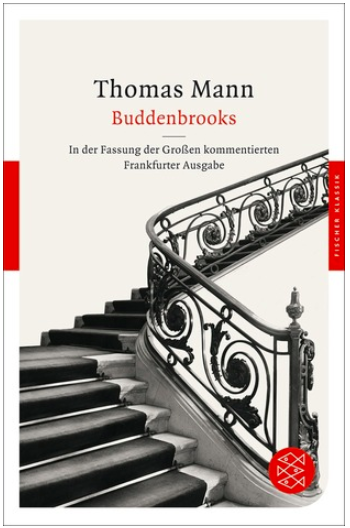
Buddenbrooks by Thomas Mann: A Family of German Trainwrecks


Having spent nearly three years in Germany, I thought it was time I really buckled down and tried to read some actual German literary classics. Published in 1901, Buddenbrooks is one of Thomas Mann's masterpieces and is inspired by the history of his own family.

The story begins in 1835, in a northern German city modeled after Mann's hometown of Lubeck. The Buddenbrook family is hosting a dinner party shortly after moving into their latest home, a large historic home sold by another merchant family whose fortunes have declined. We are introduced to the Buddenbrooks: Johann, a successful grain wholesaler (also known by his title, Consul), the older son of his father's second marriage. He and his wife Elisabeth have three children, Thomas, Christian, and Antonie, known as Tony. A second daughter will soon join the family, and there is a young ward, Klothilde, the child of a poor relation. Buddenbrooks traces the family over about 40 years, focusing on the three older children, tracing their successes and more often their failures throughout the 19th century.


It's quite a long book, divided into eleven parts (more than 700 pages in my edition). The first hundred pages or so were a bit slow, mostly just setting up the characters -- the entire first part is just the dinner party (told in great detail, including descriptions of the food). The three principals are fairly young and their story is mostly just about their education and misadventures. Things started to pick up for me in Part III when young Tony attracts an unwanted suitor called Herr Grunlich, a commercial agent from Hamburg. Tony only eighteen, but the family seems unfazed when this 32-year-old man starts hanging around their house. He doesn't seem discouraged even when Tony is openly rude to him, and to her dismay, offers her a proposal of marriage. Naturally, the family assumes Tony is too young to "know her own mind" and pressure her to accept, which made me want to throw something across the room.

What eventually follows is the first in a series of Bad Decisions by this family. It seems like they're doing the right thing at the time, but basically, all three of the elder children are on a slow, downward spiral, repeating mistakes over and over, both financially and in their personal lives. Essentially, they are a bunch of slow-moving trainwrecks. The plot of the storyline shifts back and forth, mainly concerned with Tony and her oldest brother Thomas, who has been groomed to take over the family business. (Younger brother Christian is a charming ne'er-do-well who makes occasional appearances to drag the family down even farther.)


I wouldn't have thought the story of a German merchant family would be so fascinating, but it absolutely was. After those first 100 pages I was completely hooked and could not stop reading it, and finished most of it in about three days. It's very much a long Victorian saga, as it's set up in multiple sections with mostly very short chapters. It absolutely felt as though it could have been serialized, though I believe it was published in a single volume. It also reminded me a bit of The Forsyte Saga by John Galsworthy.

I particularly enjoyed Mann's descriptions, especially of domestic life. Mann goes into surprising detail about the homes, decor, and fashions of the time, and there are a lot of descriptions of meals in this book. Here's a quote regarding a Sunday dinner attended by the suitor Herr Grunlich:

He ate mussel ragout, julienne soup, baked sole, roast veal with mashed potatoes and Brussels sprouts, maraschino pudding, and pumpernickel with Roquefort cheese -- and at each course he offered a new tribute appropriate to the delicacy. For example, raising his dessert spoon, he gazed at a statue woven into the wallpaper and said aloud to himself, "God forgive me, I can do no other; I've eaten a large serving, but this pudding is just too splendid. I simply must implore my hostess for a second helping. 

I suppose this is Mann's way of showing how bourgeois the family is, but I love food writing so that's one reason why I was hooked -- it's making me hungry just thinking about it. I did get really invested in the characters and would stop reading and yell at them when they made bad decisions. It will definitely be one of my top reads this year and now I can't wait to read Mann's other long saga, The Magic Mountain. Also, if you're looking for a copy, I highly recommend the 1993 edition translated by John E. Woods. I actually own a Vintage International copy that was translated back in 1924, but I didn't like it as much as the e-book version so ended up not reading my print copy at all.


I've also discovered that Buddenbrooks was adapted into a TV miniseries in 1979. Used copies are available on Amazon but they're really expensive, so hopefully I can get it from a library. It's available from Amazon.de for a mere 20 euros but I'm pretty sure that version doesn't have English subtitles.

I'm counting this as my Very Long Classic for the Back to the Classics Challenge.

Thursday, April 18, 2019

The Fortune of the Rougons: The Rougon-Macquart Origin Story


"A new dynasty is never founded without a struggle. Blood makes good manure. It will be a good thing for the Rougon family to be founded on a massacre, like many illustrious families." 

I had six unread Zola novels on my TBR shelves when Fanda announced her annual Zoladdiction readalong, and although I've been reading Zola for close to a decade, I still hadn't read the very first volume, The Fortune of the Rougons. 


Published in 1871 but set twenty years earlier, The Fortunes of the Rougons sets up the story of the three branches of the Rougon-Macquart family. The story begins on a cold December day in 1851, and a pair of teenage sweethearts meet in an abandoned lumber yard in the fictional town of Plassans (loosely modeled on the Provencal town of Aix). Silviere, aged 17, tells 13-year-old Miette that he is planning to join an uprising of Republicans who are resisting a coup d'etat by Napoleon III.

The book then jumps backward in time to describe the origins of the family: a young heiress, Adelaide Fouquet, inherited land from her insane father some years before, then shocked the town by marrying a peasant gardener, Rougon. A year later, she gave birth to a son, Pierre, but Rougon died soon after. The town was further scandalized when the young widow began an affair with a smuggler named Macquart, and though they never married, she bore two more children, Ursula and Antoine. So essentially the family is split along the three children: Pierre is the first of the bourgeois Rougons; the middle-class Mourets are Ursula's children by her marriage to a hatter; and the working-class Macquarts are the descendents of Antoine.


The eldest son, Pierre, manages to marry the daughter of an olive oil merchant, and when most of the action of the story takes place in 1851, he and his ambitious wife Felicite are trying to manipulate their way into the upper part of society and local politics. Felicite has a sort of salon in apartment, and her youngest son Pascal, a doctor, seems to stand in for Zola himself as he studies their Plassans cronies:

Pascal, to appease her, came and spent a few evenings in the yellow drawing room. He was much less bored than he feared. . . . [they] seemed like so many strange animals, which hitherto he had had no opportunity to study. He looked, with the fascination of a naturalist, at their grimacing faces, in which he discerned traces of their occupations and appetites. . . . At the time, he was greatly preoccupied with comparative natural history, applying to the human race the observations he had made on animals with regard to the workings of heredity. In the yellow drawing room, therefore, he was amused at the thought that he had accidentally wandered into a menagerie. He noted the similarities between the grotesque creatures he saw and certain animals he knew. The Marquis, with his leanness and sly look, reminded him very much of a long green grasshopper. Vuillet struck him as a pale, slimy toad. He was more indulgent towards Roudier and the Commander, a fat sheep and a toothless old mastiff. The fantastic Granoux, however, was a particular source of fascination. He spent a whole evening studying his facial angle. Whenever he heard him mutter some vague insult about bloodthirsty republicans, he expected him to moan like a calf; and he could never watch him rise from a chair without imagining that he was about to leave the room on all fours. (pp 88-89)

Pierre uses the political crisis after Napoleon's coup and the subsequent uprising to try and gain power in Plassans. Meanwhile, his illegitimate brother Antoine is trying to win back his portion of an inheritance he believes he is owed by Pierre. When we get back to young Silviere, it turns out he is a Mouret, the nephew of Antoine, who strongly influences his political beliefs. Poor Silviere gets tragically caught up in the resistance and with him young Miette; naturally, things don't end well.

I enjoyed this book, but I definitely enjoyed the sections of the family history and of the Macquarts better than the political and social machinations of the Rougons. Of the volumes I've read so far, I mostly prefer the stories based on the Macquarts. I'm not sure if it's because the Rougon stories tend to have more politics, which isn't my favorite subject, or because I think that the Macquart characters are just more vivid and interesting -- they're all a bunch of fascinating train wrecks.


Emile Zola

I normally don't read book series out of order, but back when I first started, many of the twenty volumes in the series didn't have recent English translations, and the original translations from the French done in Victorian times had significant cuts. Overall, twenty novels are generally chronological, but each book really stands on its own, and some of them are only very loosely connected. I'd read twelve of the series in no particular order when I finally read the first volume, and the other books in started to fit together in my mind like pieces of a jigsaw puzzle. (I was very grateful for the excellent family tree included in the book, though it does include dates of birth and death which are sort of spoiler.) I also found this great website, simply titled Rougon-Macquart Novels, with lots of background and information about the Rougon-Macquart series. It's great if you're having trouble keeping characters straight, how all the novels connect, or for me, the basic plots of the books I finished several years ago.

I've now completed thirteen of the twenty novels in the cycle, and look forward to completing the rest There's only one left in the series without a recent translation: the final novel, Doctor Pascal. But Oxford University Press has published new editions of almost every single Zola novel in the past ten or so years, so I'm confident a good translation is on the horizon.

I'm counting this as my Classic in Translation for the Back to the Classics Challenge, and for my book set in France for the European Reading Challenge.

Friday, January 25, 2019

The Wife by Sigrid Undset: Kristin Lavransdatter, Vol. II


Two years ago I read the first volume of the Kristin Lavransdatter trilogy (The Wreath) for the Back to the Classics Challenge, and I really enjoyed it.  I'd been meaning to complete the series so I decided on the second volume, The Wife, for this years' challenge. [Note: minor spoilers for the first volume are in this post].

The Wife covers about fifteen years, immediately following Kristin's marriage at the end of the first book, as Kristin and Erland adjust to married life, and Kristin begins managing Erland's estate, which has fallen into disrepair during his long absence. She bears his children and he becomes involved in political intrigues regarding the child king Magnus and his mother Ingebjorg, the Queen Regent, who are now ruling over Norway and Sweden. We also meet Erland's brother, a priest; and learn the fate of Kristin's parents and younger sister, as well as her former suitor, Simon. 

This volume was a little slower for me -- there was a lot more emphasis on religion and politics. The politics in particular were more difficult, as I found the names hard to keep straight. I thought about researching the history, but realized it mind end up spoiling the plot -- plus there's a third volume, so I decided to wait. I did read the introduction after I finished the book (which did have spoilers, so good thing I waited). There was a LOT of Norwegian history which was very condensed and I got even more confused. 

I did really enjoy learning about life in Medieval Norway. I love historical fiction, though I tend to read more about the 18th through the early 20th century. However, it did bother me how much Catholic guilt Kristin was suffering regarding the circumstances of her marriage, which seemed to recur over and over -- I get that the Church was incredibly influential, but it seemed like she was beating herself up about it constantly. 

The last third of the book has some political intrigue that seemed right out of Game of Thrones -- I could definitely picture this as an HBO series, though I suppose it's basically just been done, but with dragons. There was a plot twist with Erland's fate that I wasn't expecting. And now on to Volume III which covers the Black Death! I definitely won't wait as long between reading the last two volumes -- I had forgotten quite a few details in the gap between the first two.  

I'm counting this as my Classic by a Woman Author for the Back to the Classics Challenge. 

Tuesday, January 9, 2018

Challenge Link-Up Post: Classic in Translation


Please link your reviews for your Classic in Translation here.  This is only for the Classic in Translation category.  These should all be classics that were originally written in a language other than your primary language; that is, if you are a native English speaker, it should be a classic written in another language other than English.  If you are not a native English speaker, it could be in English (or any other language, other than your primary language). If you want to read the book in its original language, that's fine too!

If you do not have a blog, or somewhere public on the internet where you post book reviews, please write your mini-review/thoughts in the comments section.  If you like, you can include the name of your blog and/or the title of the book in your link, like this: "Karen K. @ Books and Chocolate (Madame Bovary)."

Thursday, March 16, 2017

The Wine of Solitude by Irene Nemirovsky


She loved studying and books, the way other people love wine for its power to make you forget. What else did she have? She in a deserted, silent house. The sound of her own footsteps in the empty rooms, the silence of the cold streets beyond the closed windows, the rain and snow, the early darkness, the green lamp beside her that burned throughout the long evenings and which she watched for hours on end until its light began to waver before her weary eyes; this was the setting for her life.

After her unpublished novel Suite Francaise was discovered in the early 2000s, many of Irene Nemirovsky's works were republished. I've read five of her books so far, and am so glad that they are getting the attention they deserve, because I've loved every one of them so far. My latest Nemirovsky read, The Wine of Solitude, is her most autobiographical work and was originally published in 1935. 

Born in the Ukraine in 1903, Helene Karol is a lonely child, ignored by her vain and shallow mother, and loved but dismissed by her absent father. After losing a job, he leaves the family for two years to manage a Siberian gold mine and winds up making a fortune in speculating. Gambling is his passion, whether it's the stock market or the roulette table. The only one who truly seems to love and care about her is her governess, Mademoiselle Rose. As Helene grows up, she sees how her father's gambling and her mother's infidelities are destroying them. She becomes a keen and sometimes reckless observer of the dynamic between her parents and her mother's younger cousin and lover, Max, who basically lives with them. 

She stopped, twiddled the pencil round in her hand and a cruel, shy smile spread across her face. It made her feel better to write these things down. No one paid any attention to her or cared about her. She could amuse herself in any way she pleased; she continued writing, barely pressing down on the pencil, but with a strange rapidity and dexterity she had never experienced before, an agility of thought that made her aware of what she was writing and what was taking shape in her mind simultaneously, so they suddenly coincided.

The family moves back and forth between Ukraine, France, Russia, then flee to Finland during the Russian Revolution. During the 1920s they return to Paris where things finally come to a tragic climax and Helene is forced to make a decision about her future. There are a lot of terrible mothers in Nemirovsky's works and if her childhood was anything like Helene's, I can understand why. 

This is book was both sad and beautifully written, and I really liked it. So far my favorites of her books are Suite Francaise and her excellent short story collection, Dimanche and Other Stories. I do want to read the rest of her works and fortunately most of them are available through Overdrive from my library's online catalog. There's also another short story collection that was published last year called In Confidence and it's available from Raglan Books, an independent publisher in Ireland and I've just ordered it. I was really trying to cut back on my book purchases this year but already I'm failing miserably.

I'm counting this as for my Classic in Translation for the Back to the Classics Challenge, and as my Ukrainian read for the European Reading Challenge.