Showing posts with label European Reading Challenge. Show all posts

Tuesday, January 25, 2022

European Reading Challenge 2022


Time for another European Reading Challenge signup! As always, my goal is as many books as possible from my own shelves. The list is always tricky for me since the vast majority of the books on my TBR shelves are British, and I never seem to make any progress on my own bookshelves. Some of these overlap with books from other challenges. 

Anyway, I'm signing up for the Five-Star (Deluxe Entourage) level. I have at least a dozen books from my own shelves I want to complete this year for the challenge: 


  • Austria: Night Falls on the City by Sarah Gainham
  • France: Renoir, My Father by Jean Renoir
  • Germany: Kasebier Takes Berlin by Gabriela Tergit
  • Ireland: Castle Richmond by Anthony Trollope
  • Italy: The Days of Abandonment by Elena Ferrante
  • Malta: The Sun in Scorpio by Margery Sharp
  • Monaco: The Gods Arrive by Edith Wharton
  • Netherlands: Amsterdam Stories by Nescio
  • Romania: They Were Counted by Miklos Banffy
  • Russia: Subtly Worded by Teffi
  • Sweden: Osebol by Marit Kapla
  • UK: The Half-Crown House by Helen Ashton

Is anyone else signing up for the European Reading Challenge? What are you reading? 

Friday, July 9, 2021

We, the Drowned by Carsten Jensen


I've settled in nicely for Big Book Summer, and at one point last in June I was simultaneously reading THREE giant books between 600 and 900 pages long -- not the best strategy for finishing them in a timely manner. As per usual, one of them really grabbed me and the others were neglected. I plowed through We, the Drowned by Carsten Jensen, finishing it in only five days. 

Originally published in Danish, it's the fictionalized story  of several generations of a fishing town in southern Denmark called Marstal, spanning just about 100 years. The story begins in 1848 when several of the local sailors are enlisted in the navy to fight the German rebels who have decided they don't want to live under Danish rule any more. Though they bring fully armed ships to blast the German port, they're utterly routed and Laurids Masden, one of the Danes from Marstal, is literally blown into the sky. Miraculously, he survives and becomes a local celebrity, until the fame (among other issues) is too much for him, and he promptly takes to the seas and essentially disappears.

When his son Albert is old enough, he also becomes a sailor, and spends years searching for his long-lost father, spanning the globe. Eventually he returns to Marsden, but is plagued by terrible visions of friends and neighbors embroiled in war. 

War was like sailing. You could learn about clouds, wind direction, and currents, but the sea remained forever unpredictable. All you could do was adapt to it and try to return home alive.


I really enjoyed this book, with some quibbles. I loved all the sailing parts, as I'm fascinated by ships and sailing, and I love traveling anywhere by boat. I also really enjoyed all the historical and travel aspects. However, I was not thrilled with how the women in this book were portrayed -- that is, hardly at all, or as mothers or romantic interests for the male characters. And one of the female characters is so sexually and racially stereotyped it made me cringe (there's also more racism and racist stereotyping than I was expecting for a book written and published in the 21st century). 

Also, the structure of this book is sort of odd. It alternates between being told in the first and third person, and it's never quite clear who the first-person narrator is -- it's almost like the author couldn't decide and just stuck with it. 

Overall, though, I did really like it and got absorbed by the characters and storytelling. A great, sprawling book for armchair traveling if you can't travel anywhere, or a perfect beach or airplane read if you can. 

I'm counting this as my Danish selection for the European Reading Challenge; also counts for the Big Book Summer Challenge and the Chunkster Challenge.

Wednesday, March 24, 2021

The Swiss Summer by Stella Gibbons


I love that Dean Street Press has re-published so many out-of-print women authors in their Furrowed Middlebrow imprint -- some of the more obscure books from my favorite authors are nearly impossible to find, and many of them are shockingly expensive! They recently released a whole slew of midcentury middlebrow books, which are delightful comfort reads. My latest was The Swiss Summer by Stella Gibbons, a prolific author best known for the hilarious Cold Comfort Farm. Though The Swiss Summer doesn't have quite the biting wit and satire of her best-known work, it's still a delight to read.

First published in 1951, it's the story of a group of English people spending the summer at Chateau Alpenrose, a chalet near Interlaken. The main character, a fortyish woman named Lucy Cottrell, meets Lady Dagleish, the owner of the chalet, while visiting her old friend, wife of the local vicar. The chalet was a gift of the Swiss government to her husband, a famous mountaineer. Lucy learns that Lady Dagleish is sending her paid companion, Freda, to spend the summer inventorying the contents of the chalet, and on a sudden whim, invites the envious Lucy to go accompany Freda for the summer. Delighted at the chance to leave dreary postwar London, Lucy eagerly accepts, and three weeks later finds herself in a picturesque chalet among breathtaking surroundings, with a woman she barely knows, and a curmudgeonly Swiss cook/caretaker, Utta.

I like to imagine the view looked something like this. 
 

Things go well at first, and Lucy enjoys helping Freda and exploring the nearby surroundings, breathing in the fresh mountain air. But the summer's plans take a detour with the arrival of Astra, Freda's nineteen year old daughter, who has left her job with wealthy family. She's gawky and awkward and doesn't know what to do with her life, but begins to form a friendship with the childless Lucy, who's always wanted a daughter. Things are further complicated when more visitors arrive -- the Price-Whartons, friends of Freda, with their snobbish daughter Kay, Astra's only friend. Meanwhile Lucy had already invited her outdoorsy godson Bertram, a forestry student, who brings his flatmate Peter.

Meanwhile, the cantankerous Utta resents all the visitors, especially Freda, whom she believes to have ulterior motives about the future of the chalet. Lady Dagleish has hinted in the past she'll remember Freda in her will, but she likes to amuse herself by manipulating people, and she eagerly awaits letters from Lucy to find out what's happening in Switzerland. Naturally it all plays out to a very interesting and sometimes unexpected ending. 


I really enjoyed this book -- it's a quick read and I finished it in just a couple of days. I did have an idea of how it would end, but not exactly how it would all play out, and Stella Gibbons also drops in a few bombshells about the future of some of the characters, making me wish she'd included an afterward or even a sequel about some of them. My only quibble with this book is it's sometimes really sexist -- the young men Bertram and Peter make some pronouncements about women's roles that are pretty cringey, though I'm sure it's not out of character for the early 1950s. But seventy years later it did make want to jump into the book and give them a piece of my mind. 

Nevertheless, this is a fun book with interesting characters and lovely descriptions of the mountains, and it would be a lovely vacation read, ideally while sitting a balcony overlooking the Swiss Alps. I hope to read more of the new Furrowed Middlebrow titles soon as possible.

I'm counting this as my Swiss selection for the European Reading Challenge.

Saturday, January 16, 2021

Fraulein Schmidt and Mr. Anstruther by Elizabeth von Arnim

 Love this cover image, The Letter by Mary Cassatt (1890). 

Another book that's been on my radar forever. I love Elizabeth von Arnim and I've been saving this one for awhile -- I read two by von Arnim last year (Father and In the Mountains) and though I still own several unread, I'm trying to ration them out -- I know I'll be sad when I've completed them all.

Anyway. Published in 1907, Fraulein Schmidt and Mr. Anstruther is a departure for von Arnim -- it's an epistolary novel, told in letters spanning a little more than a year, from a young woman in Germany (the eponymous Rose-Marie Schmidt) to her sometime lover, Mr. Roger Anstruther. Roger, a young Englishman of 25, has spent the past year boarding with Fraulein Schmidt, her step-mother, and her father in the small town of Jena in eastern Germany. Herr Schmidt is a professor and makes very little money writing books that no one reads, so the family takes in English students for extra cash. Rose-Marie also has a small legacy from her mother, who died ten years ago. At 25 (the same age as Roger) she is considered a spinster. 

Nice period-appropriate image on this German edition

The first letter is sent from Rose-Marie to Roger shortly after he departs Germany, and reveals that on his last day, he has professed his love to Rose-Marie, and they are secretly betrothed -- secretly, because his father will never approve. Roger is from a Good English Family who have a long history, but little money. Rose-Marie is considered middle-class and therefore Not Good Enough, though her late mother was English. Roger is entering the Foreign Service and is therefore destined to marry someone with money, and preferably someone whose social standing will help advance his career. 

After a few months, [MILD SPOILER ALERT] Roger breaks off the engagement because, as predicted, he needs to marry someone with money. He then becomes betrothed to the perfect girl, but continues to write as a friend to Rose-Marie. The letters become more formal but it's pretty clear that they still care for one another -- but how much? Does Rose-Marie still love him? Can she forgive him, or has she moved on? Does he even deserve her? 

This cover art is from an 1883 painting by Renoir -- too early, but I get why they chose it. 

I liked this book but it wasn't what I expected; first of all, the letters are one-sided -- the reader only gets Rose-Marie's letters to Roger, not the other way around. There are 83 letters, some very long, some very short, so there are no chapter breaks, and some of the letters are just solid blocks of text which are a little difficult to read. However, I loved the character of Rose-Marie and I particularly enjoyed learning about her life in Germany. I could easily picture the little town of Jena, which is a real place about halfway between Frankfurt and Dresden, not far from the border of Czechia. It's about a four-hour drive from my village in the Rhineland, and I'm sorry I didn't read the book sooner so I could have made a weekend trip to visit the area and get a real look at it. 

Rose-Marie is a great character and you really get to know her through her letters. She's very smart and funny and has to put up with a lot, with her absent-minded father and her overbearing stepmother, not to mention all the village biddies who make cracks about her unmarried state. Parts of the book do veer into the philosophical which made my eyes glaze over a bit (lots of love for Goethe, not my favorite writer!) but I did get caught up in the plot and I was really rooting for Rose-Marie. I particularly loved this passage in which she describes how much reading means to her: 

Try to imagine yourself in my place. Come out of that gay world of yours where you are talking or being talked to all day long, and suppose yourself Rose-Marie Schmidt, alone in Jena, on a hill, with books. Suppose yourself for hours and hours every day of your life with nothing particular that you must do, that you have no shooting, no hunting, no newspapers, no novels. . . . Think of what writers are to me. . . . 

My one complaint is that it ends very abruptly, and the reader doesn't really learn what happens to Rose-Marie. I was rather gobsmacked about the ending -- I really wanted more resolution! However, I did really enjoy this book. I still have four unread books by Elizabeth von Arnim on my shelves and will probably read at least one more of her books this year, probably The Caravaners, which I'm planning to read (finally!) as my Travel or Journey Classic for the Back to the Classics Challenge.

I'm counting this as my German book for the European Reading Challenge

Saturday, January 2, 2021

European Reading Challenge 2020: Completed!


Another challenge finished! I was hoping to make it to twelve countries, but I was never able to get past page 19 of my Russian book selection -- might have to keep it for 2021. But I visited eleven different countries for this challenge, and finished six books from my own shelves. Here's what I read, with links: 

Austria: The Exiles Return by Elisabeth de Waal
Belgium: The Professor by Charlotte Bronte
France: Les Miserables by Victor Hugo
Georgia: The Eighth Life by Nino Haratischvili
Germany: The Dancing Bear by Frances Faviell
Hungary: Temptation by Janos Szekely
Italy: Madame Solario by Gladys Huntington
Spain: Every Eye by Isobel English 
Switzerland: In the Mountains by Elizabeth von Arnim
UK: Crossriggs by Jane & Mary Findlater
Ukraine: The Misunderstanding by Irene Nemirovsky

I loved nearly all the books I read for this challenge, but if I had to choose favorites, I'd have to pick Temptation, Every Eye, and Crossriggs, with In the Mountains as an Honorable Mention. And The Eighth Life! (didn't I say it was a great year? Tough to choose!).  I'm definitely going to revisit some of my favorite countries in 2021 and hopefully some new ones as well -- in literature, since I can't go in person. 

Thanks again to Rose City Reader for hosting this challenge! I'm looking forward to my 2021 list.

Tuesday, December 29, 2020

The Professor by Charlotte Bronte; and some photos of Brussels


A couple of weeks ago I was looking for an audio book to listen to while walking the dog (I have Overdrive accounts with FOUR libraries so I can always find something good!). One of the libraries had an audio of The Professor, Charlotte Bronte's first novel. I'd hadn't been particularly interested because I wasn't thrilled with Villette, but I saw that the narrator was the brilliant Frederick Davidson (who brilliantly narrated Les Miserables and many other books) so I gave it a try -- and as it's set mostly in Brussels, I can count it for my Belgian read for the European Reading Challenge!

Posthumously published in 1857, The Professor was written before Jane Eyre and submitted and rejected by several publishers. It was published after her death with permission of her husband, and is based on experiences she had studying in Brussels in 1942. 

I had assumed that the eponymous Professor would be an old man, but in fact he is a young man named William Crimsworth. The book begins with him writing a letter to an old school friend, but that framing device is quickly abandoned and the story is then simply told in the first person. I guess it's basically a Bildungsroman, a story of a young person's coming of age. 

Crimsworth, an orphan, is about 20 when the story begins. His late mother was from a wealthy family, but was disowned when she fell in love with -- gasp! -- a tradesman, who is also dead. After his mother died, one of his relatives basically blackmails his uncle (his mother's brother) into paying for William's education at Eton. The same uncle then offers him a living if he'll agree to enter the church, and to marry one of his cousins. William declines. 


Obviously William then needs a job, and looks up his much older brother Edward, who took over their late father's mill. Before their father's death, the mill had failed and was sold, but Edward stayed in the business by marrying the new mill owner's daughter, and eventually took over. William writes to his brother and asks for a job, and Edward agrees, only since William has broken ties with their mother's family forever. William then travels North to a nameless town and takes a job as a clerk to his rather begrudging brother, who tells him upfront not to expect any special treatment. He only gives William the job because William can read French and German. William seems to be an upstanding citizen and model employee, which seems to infuriate Edward who is extremely jealous of William's education. 

A chance encounter with one of Edward's business associates, Hunsden, tips Edward into a rage and William quits. Hunsden then suggests William try his luck on the continent, and gives William a letter of introduction to someone in Brussels, who helps him find a job teaching English at a boy's school.

Eventually, William also takes on a part-time job teaching at an adjoining girls' school, where he develops a crush on the headmistress, Mademoiselle Reuter. She toys with his affections and eventually develops feelings for another one of the teachers, Mademoiselle Henri, who teaches lace-making but also begins to attend William's English classes. 

The Professor isn't a very long book for a Victorian, about 300 page depending on the edition. It's really a book in which not much happens, and it definitely feels like a first novel, or one that's unfinished. (I finished it about a week ago and already had to look up on Project Gutenberg to find out what happened in the end. Bronte seems to take a lot of time describing people's looks and their characters, but there isn't a whole lot of plot. Still, it's interesting to read one of her early works, and Frederick Davidson was a wonderful narrator, as always. I don't know if I'd recommend it if you're not a big fan of Victorians. 

And now for a few photos! When I lived in Germany, we were only a few hours' drive from Belgium, and made several trips to visit, mostly for weekends. It's a highly underrated country -- the scenery is pretty and the food is excellent. I visited Antwerp, Bruges, Brussels and Ghent on separate visits. They're all different and I loved them all. We went for a weekend in the fall of 2018, and had a lovely time. It's often overcast so it looks dreary in some of the photos, but it was great for a weekend.

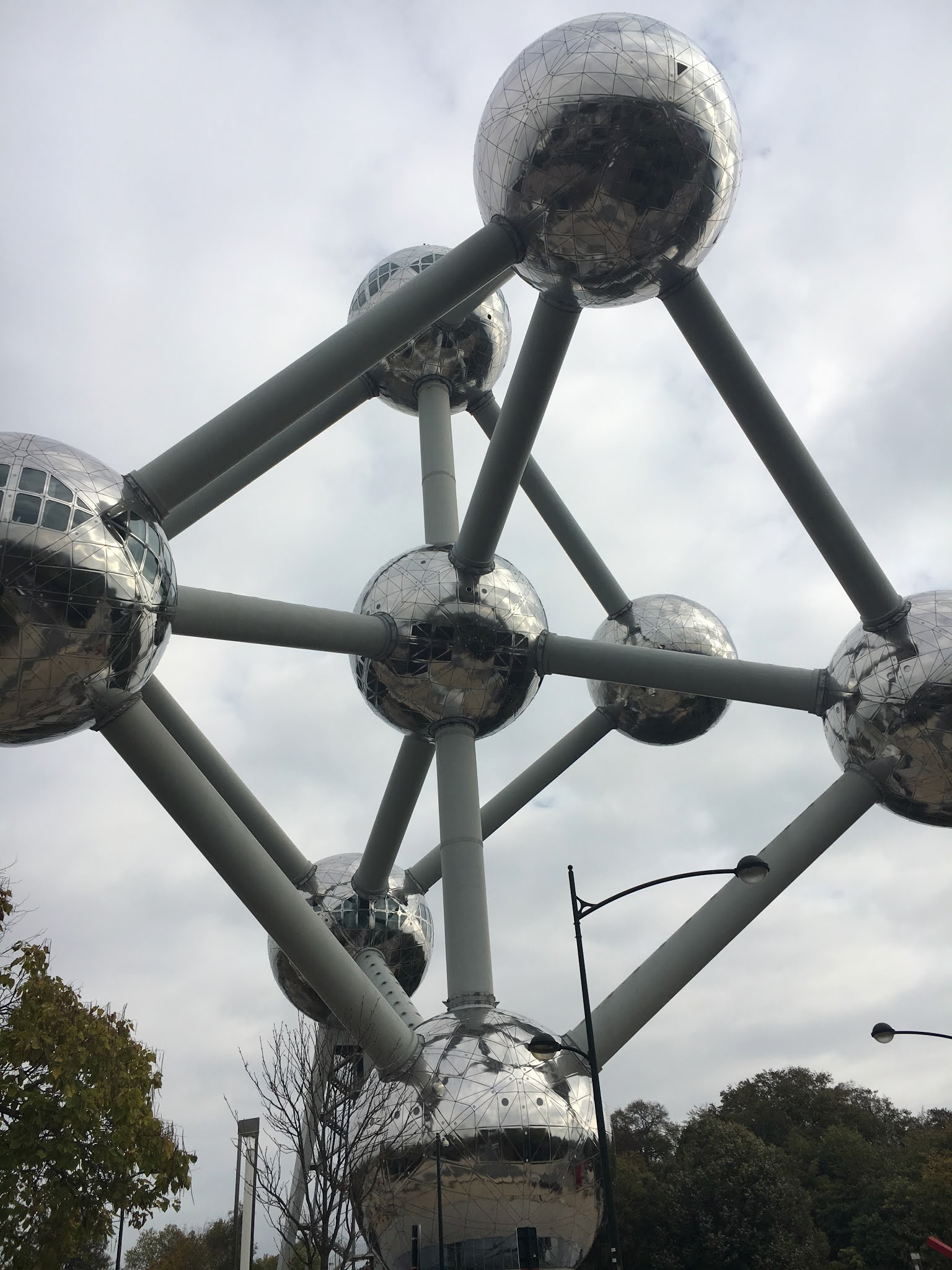
The first thing we did was visit the Atomium, left from the 1958 World's Fair. So mid-century! 


Right next to the Atomium is Mini Europe, and of course we bought a combined ticket. Lots of iconic European buildings, on a much smaller scale. Here's mini Pisa with the Atomium in the background. You can see mini Venice on the right.


Mini Houses of Parliment, complete with a fake Thames.


Love the detail of the mini Brexit protest! 


Of course we had to sample the local cuisine. Look at all those amazing waffles. 

Our hotel was a short walk to the Grand Place, the central Plaza of Brussels. 
Lots of beautiful architecture (and chocolate shops).


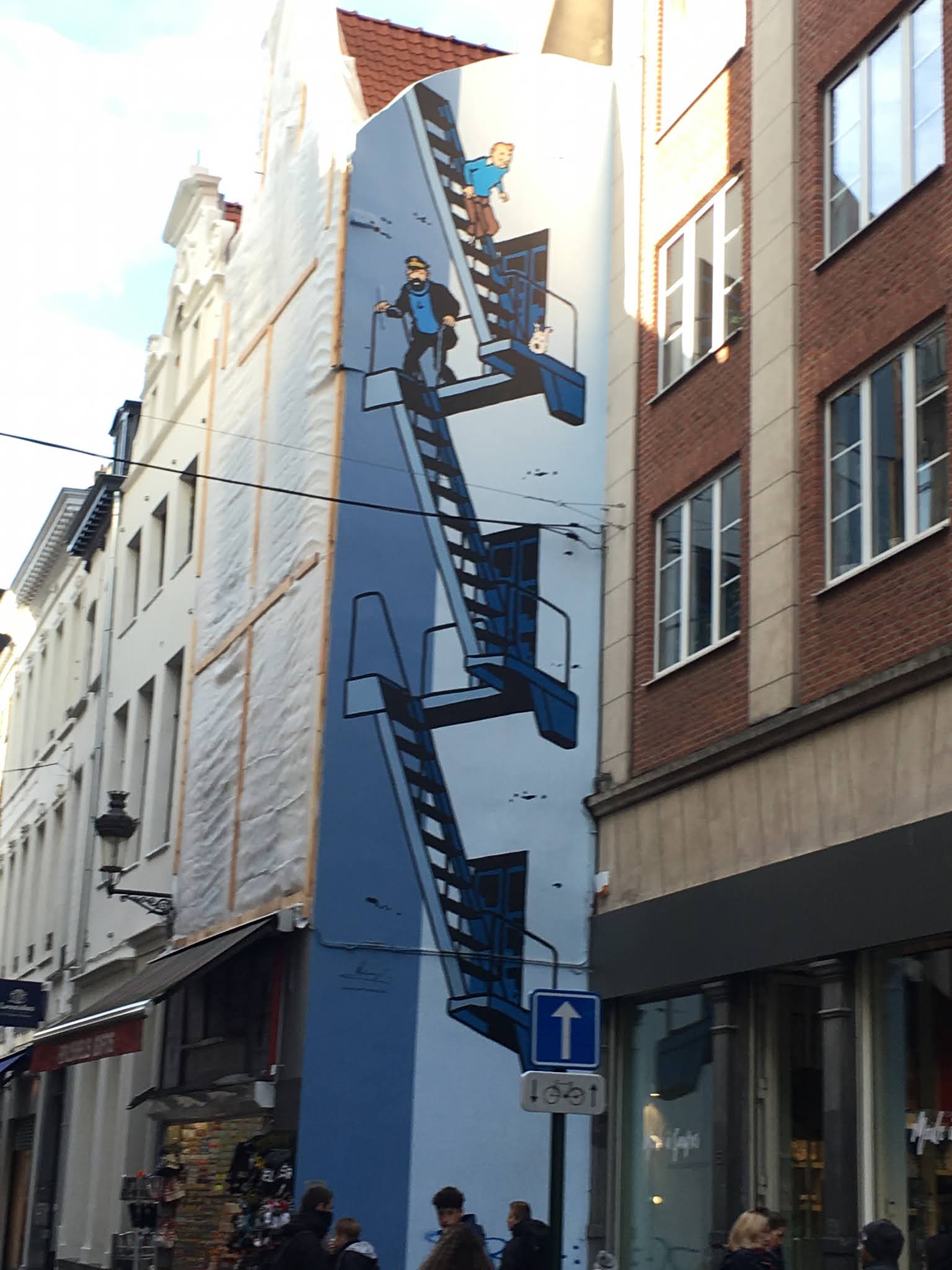
Walking past the square I spotted this amazing trompe l'oeil tribute to the iconic Tintin: 


I just loved the architecture in Brussels. 


It just blows my mind that this business was established 500 years before I was born.


Brussels also has some wonderful art museums. 
First we went to the Magritte Museum, lots of amazing surreal paintings.


Not surreal, just beautiful. 


Then we went to the Royal Museum of Fine Arts. I discovered that I absolutely love the works of Pieter Brueghel. Here's The Fall of the Rebel Angels from 1562. I can only imagine what the reaction to this must have been. 


Seriously, what's going on here?  


Lots of great Dutch and Flemish masters! 


I loved this anthropomorphic head of a woman. There's a matching painting with a man. No artist attributed, but it reminds me very much of the vegetable paintings by Arcimboldo.


Lots of beautiful later paintings as well. I always love finding new artwork I'd never heard of. 
This is Moonlit Sky by Adrien-Joseph Heymans, c. 1907.


Brussels also has beautiful Art Nouveau architecture. My last stop was the Horta Museum, a beautifully preserved Art Nouveau house designed by architecht Victor Horta (circa 1898). It's the two buildings on the right with the matching grillwork around the windows, to the right of the striped building. They only let in a few people at a time, even pre-COVID. Luckily the line wasn't long. 


They don't allow photography inside but you can see images of the interior here


I really like Belgium and would happily visit again. For next year's challenge I'm hoping to read something by an actual Belgian writer, possibly Georges Simenon who wrote the Maigret mysteries. I would love recommendations if anyone is a fan. 
I'm counting this as my Belgian read for the European Reading Challenge.

Monday, December 21, 2020

The Dancing Bear by Frances Faviell; and a trip to Berlin


I love the Furrowed Middlebrow reprints and though I prefer print books when I can get them, I've been tempted more and more often by the instant access to e-books. The entire Furrowed Middlebrow catalog are available on Kindle and some of them are included with Kindle Unlimited. There's a promotion right now, 99 cents a month for two months, so I couldn't pass it up and downloaded two books by Frances Faviell, The Dancing Bear and Chelsea Concerto. Not realizing that these were nonfiction, and sequential,  I started with The Dancing Bear, Faviell's memoir of her life in Berlin just after the end of World War II. (A Chelsea Concerto is her memoir of living in London during the Blitz, and I actually should have started there).

The book begins shortly after Faviell, an artist, and her little son John join her husband in the British sector. The book begins with a chance meeting with a German woman, Frau Maria Altmann, who is struggling with a cart of goods at a busy intersection. Faviell is in her car but stops to help, and seeing the Union Jack, the local police stop traffic and passersby assist the woman, who is waiting for her son Fritz. Frau Altmann refuses the offer of a ride, since it is forbidden, but Faviell insists after Frau Altmann faints on the street. 

This marks the beginning of a close friendship between the author and a struggling German family during the difficult first years of the British occupation and the reconstruction of Berlin in a divided Germany. Frau and Herr Altmann are trying their best to hang on to their pre-war life, though they have hardly any food or fuel in a terrible winter. Their oldest son Kurt was sent to fight in Russia and hasn't been heard from in years, though they refuse to admit his death; oldest daughter Ursula is supporting the family working as a black-marketer; frail Lilli is a dancer with the ballet; and the youngest, Fritz, is rebellious and sulky. 

Faviell does what she can to help the family (along with her faithful and tender-hearted driver, nicknamed Stampie), but there are so many needy people and sick children, she is sometimes overwhelmed. But it's clear she made a huge difference in the lives of the Altmanns and others. 

. . . these women clung, in spite of all the horrors they had undergone, to the conventional -- or was it that they thought their only safety lay in the resumption of the conventional pattern of life? 

I liked this book but parts of it were hard to read, especially with the cold snap we had last week -- I couldn't help imagining a frigid winter with no heat and little to eat, poor shoes -- it must have been a terrible time. I suppose it wasn't the best timing to read it now, but sometimes I find that books about the war make me grateful for what I have.  

I was lucky enough to visit Berlin for a long weekend in 2018. It was actually my second trip there -- back in the 1980s, I spent a few weeks in Europe with my sister and we stayed with a German friend of hers in West Berlin when it was still divided. We were even able to cross the border into East Berlin for a day, which was rather eerie and a little scary. It's incredible how much it has changed since then. We had a wonderful time on the last trip and I wish I could have seen more. We managed to pack a lot into three days. 


The famous Checkpoint Charlie.
I actually crossed into East Berlin at this very spot back in 1985. 

Leftover reminder of the DDR


The iconic Berlin TV Tower from 1969. 
Sadly we didn't have enough time to go up and admire the view.


Berlin Cathedral


View from below of the spiral staircase at the Berggruen Museum.
I think we visited four museums in one day, five altogether that weekend.


The Memorial to the Murdered Jews of Europe


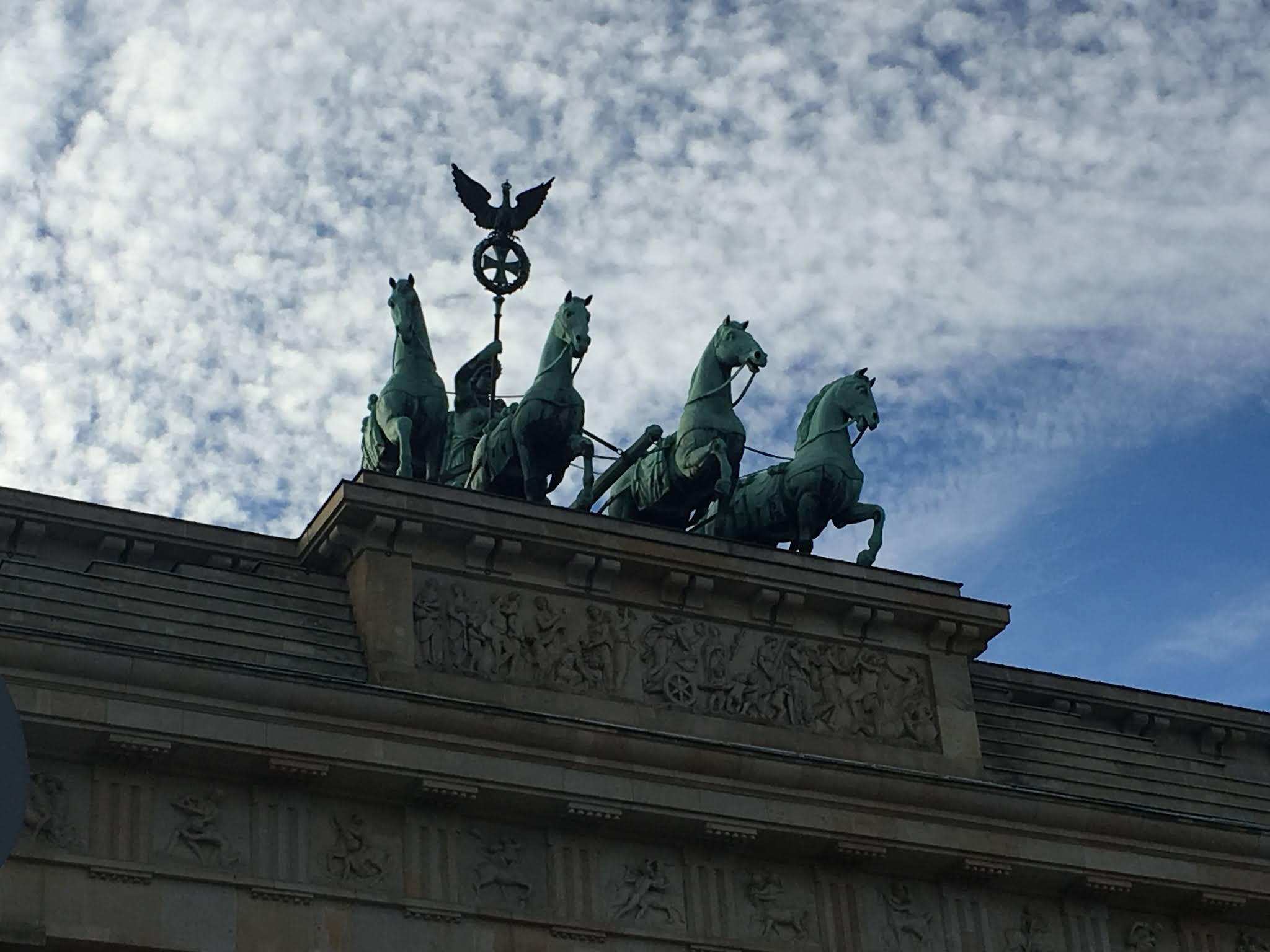
The Brandenburg Gate


A preserved section of the Berlin Wall, complete with graffiti, (obviously the Western side). 


I love finding decorative manhole covers. This one is like a tourist's guide.


I loved Berlin and wish I'd had more time there, it has so much history and culture. 

Parts of Faviell's book were a tough read, but I found it fascinating and hope to read more of her books soon. Next up for me will be A Chelsea Concerto, about her life in London during the war, then some of her fiction set in Germany. I'm signing up for a World War II reading challenge for next year so I'll definitely be reading some of them.

I'm counting this as my German book for the European Reading Challenge

Monday, October 19, 2020

1956 Club: Madame Solario by Gladys Huntington, and some book covers

A first edition dust jacket. 
Those bare shoulders seem more 1950s than Edwardian.


I was really ambitious for Simon and Kaggsy's recent #1956 Club -- I had a stack of books published that year that I was determined to read, mostly from my own shelves. I did finish four of the five, though I only had time to blog about two of them. I had also started another, a Persephone called Madame Solario. However, it was a bit of a slow read and 493 pages long, I knew I wouldn't finish it during the specified period. But I finally finished it last week and thought I'd review it anyway. 

Published anonymously in 1956, Madame Solario is set in the fashionable resort town of Cadenabbia on Lake Como in northern Italy, in the summer of 1906. The book, which is divided into three parts, begins with the arrival of a young Englishman, Bernard Middleton, who is spending the summer on the continent before settling down in a banking career chosen for him by his family. He is supposed to meet friends who have been delayed, but decides to stay when he is drawn into the society of other expats vacationing in the same hotel. At first he is drawn to the beautiful young Ilona, whose heart is being broken by a Russian soldier, Kovanski. Bernard is disappointed by Ilona's sudden departure, but is soon enamored of the mysterious Madame Natalia Solario, a beautiful English woman with an absent husband. Her arrival turns the hotel into a bit of a turmoil. It seems there is some unfinished business with the jealously glowering Kovanski, and Bernard also learns of some scandals in Madame Solario's past. 

Beautiful endpapers in the Persephone edition


Bernard begins a tentative friendship with Madame Solario, but the viewpoint of the book shifts in the second part with the arrival of Madame Solario's brother, Eugene Harden, who is apparently the source of the mystery in his sister's past. The hotel guests become suspicious of their close relationship, and rumors begin to spread. Bernard is hardly mentioned and it's very focused on Natalia (nicknamed "Nelly" by her brother) and Eugene. A lot of it is just mostly conversations between the two, or rather, just long rants by Eugene. The third part then shifts the focus back to Bernard and the pace really picks up before a very dramatic finish that left me gobsmacked.

According to the Persephone website, reviews of the novel compared to it Henry James crossed with Ivy Compton-Burnett or with Daphne du Maurier. I haven't tackled much by James but I am a fan of his contemporary Edith Wharton, and this feels a bit like a Wharton novel to me -- dissatisfied upper-crust people in Italian resorts are definitely an Edith Wharton setting, though the malevolent brother isn't typical of her work. 

Those people . . . they have the superiority of owing their good fortune to something they themselves had nothing to do with. And that is the superiority I envy! To be born with a sort of super-self, for that's what rank is, a super-self that planes over frontiers -- to be born thinking one has the right to look down -- hasn't that got more charm than anything one can do for oneself? (pp 198-199)

I liked this book, though the middle section, the longest, dragged somewhat. I found the relationship between Natalia and her brother disturbing. I don't want to give anything away but after reading it I'm not surprised that the author was anonymous for a long time. And the ending was . . . wow. I really, really wish I knew someone else who had read this so I could discuss it with them. Not a typical Persephone at all, but definitely worth reading. 

And lots of interesting book covers! 

A first edition, not very exciting. 


A Polish edition


Nice cover on this French edition, I think it's my favorite of the bunch.


Trashy paperback cover! Looks very 1970s but internet searches say 1950s paperback edition. 


 A Penguin reprint from 1956. She looks more like Eliza Doolittle here --
the correct time period, but not glamorous enough.


A Spanish edition, meh


An Italian edition, nice photo of Lake Como on the cover.

In 2012 Madame Solario was adapted into a French movie, currently available for streaming on Amazon Prime. I haven't watched it yet but I'm curious to know how they'll adapt this 500 page novel into a 90 minute film. I imagine just cutting out Eugene's tirades will save a lot of time. 


There was even an entire book published on the mystery of the anonymous author. Sadly it's only available in French.  


I'm counting this as my book set in Italy for the European Reading Challenge