Showing posts with label Germany. Show all posts

Saturday, January 16, 2021

Fraulein Schmidt and Mr. Anstruther by Elizabeth von Arnim

 Love this cover image, The Letter by Mary Cassatt (1890). 

Another book that's been on my radar forever. I love Elizabeth von Arnim and I've been saving this one for awhile -- I read two by von Arnim last year (Father and In the Mountains) and though I still own several unread, I'm trying to ration them out -- I know I'll be sad when I've completed them all.

Anyway. Published in 1907, Fraulein Schmidt and Mr. Anstruther is a departure for von Arnim -- it's an epistolary novel, told in letters spanning a little more than a year, from a young woman in Germany (the eponymous Rose-Marie Schmidt) to her sometime lover, Mr. Roger Anstruther. Roger, a young Englishman of 25, has spent the past year boarding with Fraulein Schmidt, her step-mother, and her father in the small town of Jena in eastern Germany. Herr Schmidt is a professor and makes very little money writing books that no one reads, so the family takes in English students for extra cash. Rose-Marie also has a small legacy from her mother, who died ten years ago. At 25 (the same age as Roger) she is considered a spinster. 

Nice period-appropriate image on this German edition

The first letter is sent from Rose-Marie to Roger shortly after he departs Germany, and reveals that on his last day, he has professed his love to Rose-Marie, and they are secretly betrothed -- secretly, because his father will never approve. Roger is from a Good English Family who have a long history, but little money. Rose-Marie is considered middle-class and therefore Not Good Enough, though her late mother was English. Roger is entering the Foreign Service and is therefore destined to marry someone with money, and preferably someone whose social standing will help advance his career. 

After a few months, [MILD SPOILER ALERT] Roger breaks off the engagement because, as predicted, he needs to marry someone with money. He then becomes betrothed to the perfect girl, but continues to write as a friend to Rose-Marie. The letters become more formal but it's pretty clear that they still care for one another -- but how much? Does Rose-Marie still love him? Can she forgive him, or has she moved on? Does he even deserve her? 

This cover art is from an 1883 painting by Renoir -- too early, but I get why they chose it. 

I liked this book but it wasn't what I expected; first of all, the letters are one-sided -- the reader only gets Rose-Marie's letters to Roger, not the other way around. There are 83 letters, some very long, some very short, so there are no chapter breaks, and some of the letters are just solid blocks of text which are a little difficult to read. However, I loved the character of Rose-Marie and I particularly enjoyed learning about her life in Germany. I could easily picture the little town of Jena, which is a real place about halfway between Frankfurt and Dresden, not far from the border of Czechia. It's about a four-hour drive from my village in the Rhineland, and I'm sorry I didn't read the book sooner so I could have made a weekend trip to visit the area and get a real look at it. 

Rose-Marie is a great character and you really get to know her through her letters. She's very smart and funny and has to put up with a lot, with her absent-minded father and her overbearing stepmother, not to mention all the village biddies who make cracks about her unmarried state. Parts of the book do veer into the philosophical which made my eyes glaze over a bit (lots of love for Goethe, not my favorite writer!) but I did get caught up in the plot and I was really rooting for Rose-Marie. I particularly loved this passage in which she describes how much reading means to her: 

Try to imagine yourself in my place. Come out of that gay world of yours where you are talking or being talked to all day long, and suppose yourself Rose-Marie Schmidt, alone in Jena, on a hill, with books. Suppose yourself for hours and hours every day of your life with nothing particular that you must do, that you have no shooting, no hunting, no newspapers, no novels. . . . Think of what writers are to me. . . . 

My one complaint is that it ends very abruptly, and the reader doesn't really learn what happens to Rose-Marie. I was rather gobsmacked about the ending -- I really wanted more resolution! However, I did really enjoy this book. I still have four unread books by Elizabeth von Arnim on my shelves and will probably read at least one more of her books this year, probably The Caravaners, which I'm planning to read (finally!) as my Travel or Journey Classic for the Back to the Classics Challenge.

I'm counting this as my German book for the European Reading Challenge

Monday, December 21, 2020

The Dancing Bear by Frances Faviell; and a trip to Berlin


I love the Furrowed Middlebrow reprints and though I prefer print books when I can get them, I've been tempted more and more often by the instant access to e-books. The entire Furrowed Middlebrow catalog are available on Kindle and some of them are included with Kindle Unlimited. There's a promotion right now, 99 cents a month for two months, so I couldn't pass it up and downloaded two books by Frances Faviell, The Dancing Bear and Chelsea Concerto. Not realizing that these were nonfiction, and sequential,  I started with The Dancing Bear, Faviell's memoir of her life in Berlin just after the end of World War II. (A Chelsea Concerto is her memoir of living in London during the Blitz, and I actually should have started there).

The book begins shortly after Faviell, an artist, and her little son John join her husband in the British sector. The book begins with a chance meeting with a German woman, Frau Maria Altmann, who is struggling with a cart of goods at a busy intersection. Faviell is in her car but stops to help, and seeing the Union Jack, the local police stop traffic and passersby assist the woman, who is waiting for her son Fritz. Frau Altmann refuses the offer of a ride, since it is forbidden, but Faviell insists after Frau Altmann faints on the street. 

This marks the beginning of a close friendship between the author and a struggling German family during the difficult first years of the British occupation and the reconstruction of Berlin in a divided Germany. Frau and Herr Altmann are trying their best to hang on to their pre-war life, though they have hardly any food or fuel in a terrible winter. Their oldest son Kurt was sent to fight in Russia and hasn't been heard from in years, though they refuse to admit his death; oldest daughter Ursula is supporting the family working as a black-marketer; frail Lilli is a dancer with the ballet; and the youngest, Fritz, is rebellious and sulky. 

Faviell does what she can to help the family (along with her faithful and tender-hearted driver, nicknamed Stampie), but there are so many needy people and sick children, she is sometimes overwhelmed. But it's clear she made a huge difference in the lives of the Altmanns and others. 

. . . these women clung, in spite of all the horrors they had undergone, to the conventional -- or was it that they thought their only safety lay in the resumption of the conventional pattern of life? 

I liked this book but parts of it were hard to read, especially with the cold snap we had last week -- I couldn't help imagining a frigid winter with no heat and little to eat, poor shoes -- it must have been a terrible time. I suppose it wasn't the best timing to read it now, but sometimes I find that books about the war make me grateful for what I have.  

I was lucky enough to visit Berlin for a long weekend in 2018. It was actually my second trip there -- back in the 1980s, I spent a few weeks in Europe with my sister and we stayed with a German friend of hers in West Berlin when it was still divided. We were even able to cross the border into East Berlin for a day, which was rather eerie and a little scary. It's incredible how much it has changed since then. We had a wonderful time on the last trip and I wish I could have seen more. We managed to pack a lot into three days. 


The famous Checkpoint Charlie.
I actually crossed into East Berlin at this very spot back in 1985. 

Leftover reminder of the DDR


The iconic Berlin TV Tower from 1969. 
Sadly we didn't have enough time to go up and admire the view.


Berlin Cathedral


View from below of the spiral staircase at the Berggruen Museum.
I think we visited four museums in one day, five altogether that weekend.


The Memorial to the Murdered Jews of Europe


The Brandenburg Gate


A preserved section of the Berlin Wall, complete with graffiti, (obviously the Western side). 


I love finding decorative manhole covers. This one is like a tourist's guide.


I loved Berlin and wish I'd had more time there, it has so much history and culture. 

Parts of Faviell's book were a tough read, but I found it fascinating and hope to read more of her books soon. Next up for me will be A Chelsea Concerto, about her life in London during the war, then some of her fiction set in Germany. I'm signing up for a World War II reading challenge for next year so I'll definitely be reading some of them.

I'm counting this as my German book for the European Reading Challenge

Sunday, May 5, 2019

The Artificial Silk Girl: A 1930s German Train Wreck


Back-to-back train wrecks! I can't remember who blogged about it, but just a couple of weeks ago I saw that Penguin was re-issuing a new edition of The Artificial Silk Girl by Irmgard Keun. I'd never heard of it, but the description said it was a bestseller in 1931 and subsequently banned by the Nazis, so, naturally I was intrigued and ordered a copy from Amazon.de. And for once, I actually didn't wait around several years before I read it! (The fact that it is only 144 pages may have contributed somewhat.)

So here's the setup: young Doris is a young German woman living in the Rhineland, but longing for excitement. She's working as a typist and living with her mother and stepfather, but dreams of a career on the stage -- preferably in a big city. She manages to finagle her way onstage as an extra in a local play, and even gets a single spoken line. It looks like she actually might achieve her dream but then a bad decision catches up with her; she then steals a fur coat left on one of the theater seats by a neighbor (for whom she has a longstanding hatred) and leaves town on an overnight train to Berlin in a panic.  

Doris manages to crash at an old friend's apartment temporarily, but she can't get work papers because the police might be looking for her due to the theft. She's living hand to mouth, depending on sympathetic men she picks up in bars to buy her food and drinks. Basically, she's looking for a rich man to support her, she doesn't care if it's as a wife or a mistress. Things naturally don't work out as planned and she sinks lower and lower. Yep, another train wreck.


The blurb on the book jacket describes this book as "very funny and intensely moving," but I didn't find it a bit funny -- I just thought it was tragic and sad. I didn't care much for Doris but I did find her plight horrifying -- I remember what it was like when I was first on my own, struggling to pay the bills (though I never went hungry and was threatened by homelessness like Doris). I know there were a lot of desperate people in Germany after the war, and the cold and the Depression meant so many people were in dire straits. 

Though The Artificial Silk Girl wasn't exactly what I expected, it was an interesting perspective to read about, especially since Keun lived through it first-hand. She was born in 1905, so she was about the same age as Doris when she wrote this, and probably knew people very much like her. 

Some of the descriptions of The Artificial Silk Girl also mention that Keun was inspired by Anita Loos' Gentlemen Prefer Blondes to write her own story about a young woman trying to make it on her own, which inspired me to track down a copy of Loos' novella. The two books couldn't be more different and I'll be posting on that one shortly. I've also heard it's more like Christopher Isherwood's Berlin Stories, one of which was adapted for the stage as I Am a Camera -- which I read just a few months ago. Doris is definitely closer to Sally Bowles than Lorelei Lee. 


If you're interested in Berlin in the late 1920s and early 1930s I highly recommend the Babylon Berlin TV miniseries which was a huge success. It's more of a historical crime series but one of the characters reminds me a bit of Doris, and there are several scenes set in Berlin nightclubs, plus you definitely get the sense of desperation and the dark underbelly of Berlin society. The first two seasons are available in the U. S. on Netflix, and apparently there's a third in the works. (You can watch it either with the original German and English subtitles, or dubbed into English -- I much prefer the subtitles). It's based on a series of German books by Volker Kutscher, some which have been translated into English. I read the first volume last year but this is one of the few instances in which I actually preferred the TV adaptation to the book. 

I'm counting this as my Classic From A Place You've Lived for the Back to the Classics Challenge

Thursday, May 2, 2019

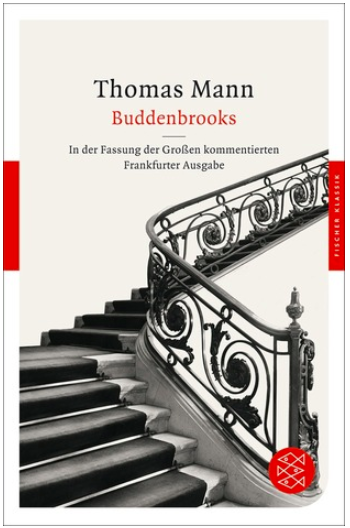
Buddenbrooks by Thomas Mann: A Family of German Trainwrecks


Having spent nearly three years in Germany, I thought it was time I really buckled down and tried to read some actual German literary classics. Published in 1901, Buddenbrooks is one of Thomas Mann's masterpieces and is inspired by the history of his own family.

The story begins in 1835, in a northern German city modeled after Mann's hometown of Lubeck. The Buddenbrook family is hosting a dinner party shortly after moving into their latest home, a large historic home sold by another merchant family whose fortunes have declined. We are introduced to the Buddenbrooks: Johann, a successful grain wholesaler (also known by his title, Consul), the older son of his father's second marriage. He and his wife Elisabeth have three children, Thomas, Christian, and Antonie, known as Tony. A second daughter will soon join the family, and there is a young ward, Klothilde, the child of a poor relation. Buddenbrooks traces the family over about 40 years, focusing on the three older children, tracing their successes and more often their failures throughout the 19th century.


It's quite a long book, divided into eleven parts (more than 700 pages in my edition). The first hundred pages or so were a bit slow, mostly just setting up the characters -- the entire first part is just the dinner party (told in great detail, including descriptions of the food). The three principals are fairly young and their story is mostly just about their education and misadventures. Things started to pick up for me in Part III when young Tony attracts an unwanted suitor called Herr Grunlich, a commercial agent from Hamburg. Tony only eighteen, but the family seems unfazed when this 32-year-old man starts hanging around their house. He doesn't seem discouraged even when Tony is openly rude to him, and to her dismay, offers her a proposal of marriage. Naturally, the family assumes Tony is too young to "know her own mind" and pressure her to accept, which made me want to throw something across the room.

What eventually follows is the first in a series of Bad Decisions by this family. It seems like they're doing the right thing at the time, but basically, all three of the elder children are on a slow, downward spiral, repeating mistakes over and over, both financially and in their personal lives. Essentially, they are a bunch of slow-moving trainwrecks. The plot of the storyline shifts back and forth, mainly concerned with Tony and her oldest brother Thomas, who has been groomed to take over the family business. (Younger brother Christian is a charming ne'er-do-well who makes occasional appearances to drag the family down even farther.)


I wouldn't have thought the story of a German merchant family would be so fascinating, but it absolutely was. After those first 100 pages I was completely hooked and could not stop reading it, and finished most of it in about three days. It's very much a long Victorian saga, as it's set up in multiple sections with mostly very short chapters. It absolutely felt as though it could have been serialized, though I believe it was published in a single volume. It also reminded me a bit of The Forsyte Saga by John Galsworthy.

I particularly enjoyed Mann's descriptions, especially of domestic life. Mann goes into surprising detail about the homes, decor, and fashions of the time, and there are a lot of descriptions of meals in this book. Here's a quote regarding a Sunday dinner attended by the suitor Herr Grunlich:

He ate mussel ragout, julienne soup, baked sole, roast veal with mashed potatoes and Brussels sprouts, maraschino pudding, and pumpernickel with Roquefort cheese -- and at each course he offered a new tribute appropriate to the delicacy. For example, raising his dessert spoon, he gazed at a statue woven into the wallpaper and said aloud to himself, "God forgive me, I can do no other; I've eaten a large serving, but this pudding is just too splendid. I simply must implore my hostess for a second helping. 

I suppose this is Mann's way of showing how bourgeois the family is, but I love food writing so that's one reason why I was hooked -- it's making me hungry just thinking about it. I did get really invested in the characters and would stop reading and yell at them when they made bad decisions. It will definitely be one of my top reads this year and now I can't wait to read Mann's other long saga, The Magic Mountain. Also, if you're looking for a copy, I highly recommend the 1993 edition translated by John E. Woods. I actually own a Vintage International copy that was translated back in 1924, but I didn't like it as much as the e-book version so ended up not reading my print copy at all.


I've also discovered that Buddenbrooks was adapted into a TV miniseries in 1979. Used copies are available on Amazon but they're really expensive, so hopefully I can get it from a library. It's available from Amazon.de for a mere 20 euros but I'm pretty sure that version doesn't have English subtitles.

I'm counting this as my Very Long Classic for the Back to the Classics Challenge.

Saturday, January 12, 2019

I Am a Camera by John Van Druten: Not Just Cabaret Without Music


In the past few years I've discovered how much I enjoy the theater. I do love movies, but there is something indescribable about seeing a live performance. I've been trying to see at least one play whenever I visit my daughter in New York, and since we've lived in Europe I've made a few trips to London, and I try to see shows on the West End as well (you can get half-price tickets the same day as a performance, and everything is first-rate). There is an excellent English-language theater in Frankfurt, which is just over an hour's drive away from me, and every season one of the four or five plays they perform is a musical. This year it's Cabaret, which I had never seen. I got tickets for myself and my daughter and we went to see it after Christmas. 

I also realized that my reading of classics is woefully lacking in plays, so I decided to add that category this year to the Back to the Classics Challenge. Written in 1951, I Am a Camera is the original play which was later adapted as the musical version of Cabaret. I was really quite surprised to see how much the musical differed from the original play (which was itself adapted from Christopher Isherwood's Goodbye to Berlin). 

The original play is in three acts, set in Berlin in 1930. All of the action takes place in a boarding house owned by Fraulein Schneider, in a room first rented by a struggling writer named Christopher Isherwood. The title of the play comes from the first line of the novel Christopher is trying to write:

I am a camera, with its shutter open, quite passive. Some day all of this will have to be developed, printed, fixed.

Isherwood takes English-language pupils to pay the rent, but since he's nearly broke he moves to a smaller room. Through one of his students, Fritz, he meets Sally Bowles, an English cabaret singer. She's looking for a new place to live and takes over his old room, and they become friends. 

Sally lives a rather fast life, and always seems to be hungover, struggling for money, and though she and Christopher never become romantically involved, he's always there for her. He observes the highs and lows of her life over the course of about a year, with the looming backdrop of growing anti-Semitism and the Nazi party. 


If you've seen the musical, you might be surprised at how it's changed from the original play. Some of the major plot points about Sally are there, but in the musical, she and Christopher become lovers. All the scenes in the original play take place in the boarding house -- there's nothing in the cabaret and in fact, Sally is hardly working as a singer at all. 


In the musical, the landlady has a sweet but probably doomed romance with one of the boarders, a Jewish fruit-seller, which isn't in the story at all -- she's actually anti-Semitic. There's also a sub-plot in the play about Christopher's student Fritz, and his love for a Jewish girl Natalia, the daughter of a department store owner; and there's an interesting plot twist about Sally in the third act. 


Despite the changes, I do feel like the musical captured the characters of Sally and Christopher, and their struggles and feelings of desperation in prewar Berlin. The growing threat of the Nazis and the rise of Fascism is equally present in both versions -- it's not exactly the focus of either story, but it's definitely an important factor. I really liked both versions -- the English Theater in Frankfurt is first-rate, and I'm hoping to see more plays there this year before I return back to the U.S. 


Here's the video preview of the production in Frankfurt. 

I was also very happy to find an online version of the script for I am a Camera through a website called Archive.org -- anyone can sign up for an free account and check out digital content, from libraries worldwide. I've just started using it but I've been able to get some items that I would normally have found through Inter-Library Loan, which is tough to get overseas. I highly recommend it if you have trouble finding rare items. 

Wednesday, March 14, 2018

Effi Briest: The German Emma Bovary, But Less Interesting


I had really high hopes for this book -- a classic book, in translation, and a German classic no less! I really want to read more German books in translation (of course I don't read the language well enough to read the originals.) Sadly, there just aren't that many German books translated into English -- I guess the proliferation of American and British books just makes it that much harder to get attention from the English-reading public.

Anyway. I had heard about this book years ago and this felt like the right time, as I'm now living in Germany and Persephone Books reprinted Effi Briest last year, though they don't often publish books written by men. I'd heard it was sort of a German version of Madame Bovary. Well, to be honest, it is and it isn't. This review includes spoilers, so stop now if you don't want to know what happens.

The book begins with Effi Briest, seventeen and unmarried, still very much a schoolgirl. She's basically playing in the yard one day when she receives a proposal of marriage from a civil servant, Geert Instettan, a man more than twice her age who was once in love with her mother.  No, that's not creepy AT ALL. (Of course he was about her mother's age and obviously too young, as Madame von Briest married a much older man).


Anyway, she's very young and he's basically middle-aged and serious. They move off to town on the Baltic coast (which actually sounds lovely) and after giving birth to a daughter, Effi becomes bored. Her head is turned by a military officer named Crampas and they have an affair, which is basically them going on rides and walks together in the dunes. Eventually, her husband is transferred to Berlin so the affair ends. Years later, Effi is visiting a spa for her health and her husband finds a bundle of letters from Crampas and the inevitable happens. Naturally it ends badly for Effi.

Somehow this book disappointed me. I suppose I was expecting it to be more like Emma Bovary, whom I found a fascinating train wreck, but this book just dragged. I don't know if it was the translation or the writing style, but it took me nearly a month to finish this book which is just over 300 pages. Effi was certainly a sympathetic character, but I really didn't get a sense of great passion for Crampas. It was all very matter-of-fact -- I was expecting more scandal or dramatic tension, I guess. Even the ending wasn't terribly dramatic. I haven't read much German literature but I do remember that the writings of Goethe caused such a sensation that young people were literally committing suicide after reading The Sorrows of Young Werther (which I did try to read a few years ago and just could not get through). 


I haven't given up on German literature yet -- I do have a copy of Thomas Mann's Buddenbrooks that looks interesting, though quite long. And recently I got completely hooked on the TV series Babylon Berlin which is set in 1929 -- I do love the time period between the wars, and I'm curious to learn more about the German perspective. It's based on a series of books and some of them have been translated into English, so I'll try to get my hands on a copy. (It's streaming in the U.S. on Netflix and it's really good, I highly recommend it). Can anyone recommend any other German books available in translation?

I'm counting this as my Classic By a New To Me Author for the Back to the Classics Challenge.

Sunday, February 26, 2017

The Pastor's Wife by Elizabeth von Arnim

Another beautiful Virago cover.
I thought it was Seurat but it's actually "La Couseuse" by Theo van Rysselberghe.
The other day I was looking for audiobooks set in other countries that I could download for the European Reading Challenge, and I came across one of my all-time favorites, The Enchanted April by Elizabeth von Arnim. I definitely want to read it again (or listen) but it occurred to me that Elizabeth von Arnim spent much of her life in Germany and set many of her books there, and that I could choose one of those toward both the European Reading Challenge. Also, many of them are available for free digital download -- another win-win!

I downloaded three or four of her books, and randomly chose The Pastor's Wife, published in 1914. Here's the setup: young Ingeborg Bullivant, aged 22, is alone in London, sent by her family to visit the dentist. Her father, a rather overbearing bishop, has given her ten pounds and insisted she has a bad tooth dealt with; Ingeborg has been miserable for days and unable to help her father. Though taken for granted at home, she is an indispensable, unpaid secretary for her father, chaperone for her beautiful young sister, and basically does everything for her mother, who doesn't seem to get up off the couch much.

The dentist solves Ingeborg's problem at once and all of a sudden she's alone in London (supposedly chaperoned by an aunt) with 10 pounds burning a hole in her pocket. On a whim, she signs up for a week's vacation tour to Lucerne, Switzerland, where she meets Robert Dremmel, the pastor of a rural German church. He promptly falls in love with her and after an unconventional proposal, they are engaged -- honestly, I think she's just too polite to turn him down. To the dismay of her family, she marries this unsuitable German and leaves home, where her new husband benignly ignores her and is obsessed with improving the soil for the local farmers. She really only gets his attention when she's producing babies. After several years of this stifling life, Ingeborg meets a visiting artist who is quite taken with her and tries to tempt her into running away with him to Italy.

I really enjoyed this book but parts of it were much darker than I expected. Some of the situations are quite funny and others are incredibly heartbreaking. All the men in Ingeborg's life take her for granted and assume they know what's best for her -- they think of Ingeborg only as how she can be useful to them, and not one iota of what she wants and needs. Von Arnim also had quite a bit to say about women and pregnancies in the Edwardian era -- there's a lot of discussion about procreation that I wasn't expecting. I would not be surprised if it wasn't rather shocking for the time period (much like my previous read, The Wreath by Sigrid Undset).

One thing I didn't like about this book was how naive Ingeborg was. I realize that she had a very sheltered upbringing as a bishop's daughter, and was then stuck in a small town as a pastor's wife, but she read books and newspapers, and would had some idea about the morals of the time. And the way the men in this book treated Ingeborg made me want to throw the book across the room.

I've now read three of Von Arnim's works of fiction, and I've noticed a recurring theme of women who are breaking the boundaries of conventions. In Love, the main character shocks everyone by having a love affair with a man young enough to be her son; in The Enchanted April, the four women break free and go off by themselves to rent an Italian villa for a month (not so shocking, really, but pretty gutsy for the time). Elizabeth Von Arnim was actually married to a German aristocrat and had a rather unhappy marriage. I don't know many details of her life but I do know some of her early works are semi-autobiographical and I wouldn't be surprised if Herr Dremmel was loosely based on her own husband.

I'm counting this as my German read for the European Reading Challenge. 

Wednesday, October 5, 2016

Grand Hotel by Vicki Baum


On my recent visit to London, I was fortunate enough to visit a whole slew of bookstores. I saw this brand-new edition of an NYRB Classic: Grand Hotel by Vicki Baum. It ticked off a lot of boxes for me:
  • Nice cover
  • Set in a hotel -- so lots of characters thrown together 
  • Woman writer
  • Translated into English -- I'm always trying to widen my literary perspective
  • Set in Germany
  • Between the wars -- one of my favorite time periods

So, basically, this was a no-brainer -- I had to buy it. It took a couple of chapters to get into it, but once I got started it was great. Set in 1929, it's the story of a different guests at the posh Grand Hotel in Berlin: the aging ballerina Grusinskaya, who is worried that she's losing her appeal; the sexy playboy Baron von Gaigern; the tragic Dr. Otterschlag, whose face was destroyed by a bomb during the Great War; Herrr Preysing, the director of a family firm who's desperate to secure a manufacturing bid; and the meek clerk Kringelein, who's worked for thanklessly for years for Preysing's firm. He recently had a terminal medical diagnosis and has decided to spend his last few weeks enjoying life. Some of the characters have a slight connection, like Preysing and Kringelein, but after a few days in the same hotel, their lives interconnect and are changed forever.  

I really enjoyed this book. I love how Baum intersected all the characters' lives, and I thought the plot was great and the ending well done; however, I think the strength of this book was the character development. I do love any book that has a variety of characters -- I'm particularly fond of books set on trains and sea voyage (I think it started with my love for Murder on the Orient Express.) In this book I was concerned at how many characters Baum, was going to introduce, but it was easy to keep them all straight. I do wish there had been a better ratio of female to male characters (there's also a beautiful young stenographer who shows up about halfway through the book) but Baum made a point with both of the women about the limited choices they had during the time period. 

I also found the writing to be very insightful. The whole book is full of great quotes that I kept marking with little scraps of paper as I read. Here's one of my favorites:

Then the doors closed throughout the hotel. Everyone locked himself in behind double doors and each was left alone with himself and his secrets.

And here's Dr. Otterschlag using hotel as a metaphor for life:

The whole hotel is only a rotten pub. It is exactly the same with the whole of life. . . . You arrive, stay for awhile, and go on again. Passing through. Isn't that it? . . . and what do you do in life? A hundred doors along one corridor and nobody knows a thing about his next-door neighbors. 

Originally published in German as Menschen im Hotel, this was an international best-seller and was adapted as a stage play and an Oscar winning movie in 1932, starring Greta Garbo, John Barrymore, and Joan Crawford -- it's the source of the famous Garbo line "I want to be alone." I've never seen it but it's available on Netflix so it's at the top of my DVD queue.

Greta Garbo and John Barrymore. She just wants to be left alone .
Vicki Baum wrote about 50 books altogether, some in German, some in English after she left Europe during WWII. As an Austrian Jew, her books were banned by the Nazis, so I'm counting this as my Banned or Censored Classic Book for the Back to the Classics Challenge

Thursday, March 24, 2016

Exciting News


So after nearly eight years in Texas, the military has decided that it's time for my family to relocate. . . (drumroll, please) and we're going to . . . . 

Germany!!!

Not my new house. It's Neuschwanstein Castle in Bavaria. 

We'll be moving sometime this summer, probably late June or early July -- only three months away. I'm going to do my best to keep up with blogging, but of course I have lots to do with sorting, packing, and putting our house up for sale. I hope everyone will understand if I'm not posting as much as usual. Of course we're sad to leave all our friends here in Texas, but I'm really excited to be moving to Europe -- especially because I lived in Germany on a summer exchange program back in high school.  

And what to do with all my books??? I have to decide how many to take with me -- unread books, or beloved favorites? A combination? And I have to decide if I should read as many library books as possible before I leave -- (the base library won't have nearly the selection as the millions of books here in our public library system) -- or read my own books so I don't have to pack them! 

I'm also trying to decide if I should read lots of shorter books and knock them off my TBR list, or try and read some of the big fat books because they're heavier and take longer. I'll have so much to do I suspect I won't be tackling any especially taxing books in the next few months -- probably a lot of easy comfort reads in the near future. Bloggers, what would you do? And which German authors do you recommend?