Showing posts with label Zoladdiction. Show all posts

Sunday, May 1, 2022

Zoladdiction 2022: His Excellency Eugene Rougon


To his father he owed his massive, square shoulders and heavy features; from his mother, the fearsome Felicite Rougon, who ruled over Plassans, he had inherited his strength of will, a desire for supremacy that scorned petty concerns and petty pleasures. He was without question the greatest of the Rougons.

Not one but TWO epic fails this week: I did not finish my Zola novel in time for Fanda's April Zoladdiction reading event, and I did not finish my selection for Classics Spin #29. In fact, I didn't even start my Spin selection. For both fails, I blame Zola. Sorry, Zola, but this book dragged so badly that it's squarely tied on the bottom Nana, the only one of his novels that I truly disliked.

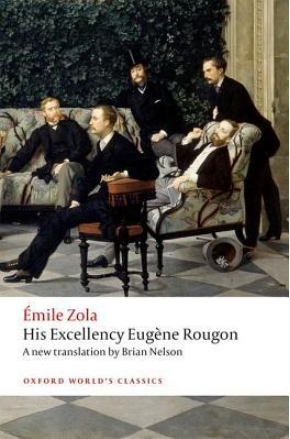
His Excellecy Eugene Rougon is the sixth novel in the Rougon-Maquart cycle, and it's fairly short at 333 pages so I thought I'd have no trouble reading it in a week. I've owned this book for a couple of years but had putting it off because it's a political novel, which is not my favorite genre. Sadly, I was correct to be hesitant because I could barely finish it.


Basically, it's the story of the fall and rise and fall and rise again of a politician, Eugene Rougon, who makes appearances in the first two books of the cycle, one of the original Rougons, the bourgeois, legitimate side of the family . The book begins when he has resigned his post in the ministry. As he's attempting to pack up or burn documents in his office, a parade of hangers-on traipse through his office. This is the circle of friends and frenemies and political allies who are most of the recurring characters in the story. Before he leaves office, many of them are still trying to get favors or score points. 

The rest of the novel is basically Rougon and the group scheming, gossiping and back-stabbing one another to achieve their own ends (or example, one character is desperately trying to get a train line re-routed so it's closer to his factory, which will then increase its value). Often Zola will begin a novel by throwing a lot of characters at the reader, and normally they sort themselves out and become distinctive to me, but I had a really hard time keeping all the characters straight in this one, because they were all sort of awful, and not even in an interesting way as in some of the other books in the series. 


Maybe this was the wrong time for this book. There are so many political scandals right now in real life I can hardly keep them straight, and reading about them in 19th century France is even harder since I don't really understand the context very well. After reading the introduction (which I always save for last because of spoilers), I realized that many of these characters are based on real people and there's a lot of satire involved which would have been obvious to contemporary leaders but was lost on me. I didn't particularly find Rougon to be a very well-developed character and I didn't much care for the other main character, a politically savvy schemer named Clorinde who is basically a female version of Rougon. At one point she suggests that they marry but Rougon points out that two such people in a marriage would be a disaster). 

He loved power for power's sake; free from any vain lust for wealth or honours. Crassly ignorant and utterly undistinguished in everything but the management of other men, it was only in his need to dominate others that achieved any kind of superiority. He loved the effort involved, and worshipped his own capability. . . . He believed only in himself; where others had arguments, Rougon had convictions; he subordinated everything to ceaseless self-aggrandizement.

My other issue with the book was that great sections of it are Zola telling the reader what characters do or have done instead of actually describing or showing it. The parts when there are actual activities and dialogue are much more interesting than the narrator passively explaining it. Towards the end of the book there's a chapter when people are actually doing something and it was the best part of the book, but I had to get through eleven or twelve chapters to actually get there, which was a real slog. And there's SO MUCH gossip! So much scheming, it's kind of exhausting. I guess that's politics though, so maybe this just was not the book for me, or maybe it's just not the right time. But this book is definitely at the bottom of the Zola ranking for me. There are only four more books in the series left that I haven't read and I certainly hope those are better, I'd hate to finish reading Zola with a whimper instead of a bang.

I'm counting this as my Classic in Translation for the Back to the Classics Challenge; and as my French selection for the European Reading Challenge. 


Thursday, April 29, 2021

Zoladdiction 2021: La Debacle by Emile Zola

It's April and that means Fanda's annual Zoladdiction, a celebration of the life and works of Emile Zola (1840-1902). After putting it off for several years, this time I decided to tackle La Debacle, the pentultimate work in his Rougon-Macquart cycle. A story of fictional people in the Franco-Prussian war of 1870, it's considered one of the best war novels of all time, and was Zola's most popular novel when it was published in 1892.

I've been really daunted by this one because it's by far his longest, more than 500 pages, and honestly, I am not a fan of war novels. I'm very bad at following extended action scenes in novels, and I'm much more interested in the social aspects of wartime than of military strategy and maneuvers. I'm normally good at picturing descriptions of scenery and landscapes in my head as I read, but if there's any kind of action, my mind tends to wander. So I was not looking forward to 514 pages of battle scenes.


However, I persevered. The story begins in August of 1870. After the Second Empire declared war on Prussia, the French were pushed back over the borders of western France, in the Alsace-Lorraine region. The main characters of the story are Jean Macquart, who has rejoined the military as a corporal after the disastrous events of La Terre (The Earth); and the soldiers in his regiment, mostly Maurice, who is of a higher class, but is a less experienced soldier. At first Maurice is condescending to Jean, but eventually they become close friends after Jean looks out for him during the course of the war. 

As the story begins, the French had planned to march on Berlin and assert dominance over the Germans, but are quickly pushed back by the superior and more organized Prussian army. (The French were so confident of victory they only brought maps of Germany, and none of western France, leading to mass confusion). Much of the first quarter of the book consists of various regiments basically marching around France, not knowing exactly what's going on, and trying to find food and shelter from terrified and suspicious peasants and villagers. It's pretty much a disaster. 

Portrait of Zola, 1902, Felix Vallotton

We finally get to the actual battles in the second quarter of the book, with a lot of battle descriptions in the fields outside the towns, and the siege of the town of Bazeilles, home of Henriette Weiss, the twin sister of Maurice. After Maurice and Jean take a night's rest inside the Weiss home, the story begins to follow Henriette and her husband, and his employer Delaherche, the owner of a dye factory where the military sets up a temporary hospital. There's also another side character, another soldier in their company called Honore, whose heart was broken when his father wouldn't let him marry the girl he loved, Silvine. Silvine was devastated and has since had child by a Prussian jerk named Goliath, who then refused to marry her. However, Honore still loves her and ironically, Silvine and the child are now living at his father's farm as she has nowhere else to go.


For me the book really picked up when it was more character-driven. Zola is really good at creating realistic characters, and his depiction of how the war affected the civilian population was really good. Of course I'm always more interested in the social aspect than the military and political side. My mind did tend to wander when Zola was describing all the political events and military maneuvers as the war goes from bad to worse for the French, and the Prussians take over. 

The fighting doesn't stop, however, and Weiss ends up going back to Paris. Unbeknownst to all of them is the upcoming siege of Paris and the Paris commune! Things are going to get worse! The short version is that after a months-long siege of Paris by the Prussians, overthrow their own government and all hell breaks loose inside the city, culminating in a bloody week when more than 20,000 people died and much of the city burned to the ground. I've been to Paris several times and I am aghast that I had no idea that this happened.

Despite all the politics and warfare, I ended up really liking this book, though it's a lot to take. There is a LOT of violence and pretty detailed descriptions of deaths on the battlefront, executions, wartime hospitals (including amputations), disposing of bodies, and just general unpleasant things that happen in wartime. Might not be the best choice if you like to read and eat at the same time. 

The hardest parts for me to read were definitely the military actions and the history of the politics that were going on, culminating in the Paris commune. I was a history major but I haven't read that much academic history for a long time, and Zola crams in a lot of facts, names, dates, and places, and it was tough to keep everything straight. I absolutely understand why he had to include all of it, but it wasn't my favorite part of the book.  I read the Oxford World's Classics edition, pictured above, which includes a lot of resources in the endnotes, timelines, and maps, which were great. There's also a list of the characters, the first one I've seen in a Zola novel. 

Until I started reading this, I also didn't realize that much of the action takes place a fairly short distance from where I spent three years in Germany! There's a lot of mentions of cities and towns that I actually visited, like Strasbourg and Metz, which are a fairly easy drive from our house in the Rhineland. I'm quite sorry now that I didn't read this while I was living there -- I certainly would have paid closer attention while I was on day trips and maybe even tried to trace the route of the armies. (It makes sense why the U. S. military built an enormous base nearby for its strategic location.) And I visited Paris multiple times when we lived there, but not once did I visit Place Vendome and many of the other important sites mentioned. I guess I'll just have to go back someday! 

I'm counting this as my Classic in Translation for the Back to the Classics Challenge. Thanks again to Fanda for hosting Zoladdiction 2021 and inspiring me to finally read this book!

Monday, April 20, 2020

#Zoladdiction 2020: The Sin of Abbe Mouret


It's April, and that means it's another edition of Fanda's Zoladdiction! Hosted by Fandaclassiclit, this is a month-long celebration of the life and work of Emile Zola, my favorite French writer. I've been reading Zola's novels for ten years, and I'm more than halfway through with his Rougon-Macquart cycle of twenty novels. This year I selected The Sin of Abbe Mouret, first published in 1875.


This is the fifth book in the series, and at just under 300 pages, it's also one of the shortest -- which is honestly why I chose it from the five Zola novels on my TBR list. I'm still recovering from Les Miserables and just could not face the 600 pages of La Debacle, another war novel. As such a short novel, there are few characters and the plot line is fairly simple. Abbe Serge Mouret, age 25, is the priest of a small parish of Les Artaud, a village in southern France, where he lives with his younger sister, Desiree, and an elderly housekeeper, La Teuse. Serge and Desiree are the two younger children of the Mouret family introduced in The Conquest of Plassans, the previous volume of the series (their older brother Octave moves off to Paris and reappears in books ten and eleven, Pot-Bouille and The Ladies' Paradise).

One spring day Abbe Mouret is out on an errand -- he must persuade a pregnant village girl to marry the baby's father. The girl's father is unwilling to give up unpaid labor, and most of the villagers seem nonplussed about the situation. On his way back to the parish, he runs into his uncle, Doctor Pascal (last seen in the first volume, The Fortunes of the Rougons.) The Doctor is on his way to check on a patient, Jeanbernat, the elderly caretaker of a vast abandoned estate known as Le Paradou (the Paradise). Jeanbernat lives in this isolated, ramshackle ruin with his niece Albine, who has become rather wild. 

It turns out Jeanbernat is just fine and not on death's door. but Abbe Mouret catches a glimpse of this idyllic garden paradise and the wild Albine. A few weeks later, Abbe Mouret falls ill from a terrible fever, and is sent to convalesce in the secluded estate. When he is recovering, he has no memory of his life as a priest, and soon he falls in love with Albine and with the gardens of Le Paradou -- basically, it's a 19th century Adam and Eve story, except that Adam is a priest. When Mouret remembers his life as priest, he wrestles with his conscience -- can he overcome his sin and return to his spritual ways as a priest? Or will he succumb to his earthly desires and run away with Albine? Zola isn't known for happy endings, so the outlook is not favorable.

Overall I liked this book, though it isn't my favorite in the series. Obviously, there's a lot of religion in this book, and the struggle between man's spirituality and man's human desires. Sex and religion are hot topics at any time, and the combination of the two is just somewhere I'm going to avoid. 

I will say that there are a lot of wonderful descriptions of the gardens of the Paradou, though if you are a gardener, you will realize that miraculously, many of these plants don't normally bloom at the same time, so suspend your disbelief. Or maybe it's a magical microclimate? It is meant to be an Eden, so I'll let it pass. 

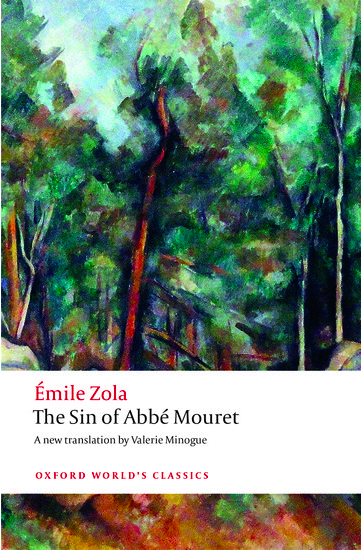
Forest Interior by Paul Cezanne, 1898-1899. Fine Arts Museums, San Francisco. The cover image above is a detail from this painting. Ironically, Cezanne and Zola were close friends until Zola used him as inspiration for his novel The Masterpiece. They never spoke again after that.

Mostly what I didn't like about this book was the way women were depicted, and the misogyny of one character in particular. There is another priest, Brother Archangias (an archangel?) who has such an overwhelming hatred of women he literally says they should all be strangled at birth. To him, all women are temptresses and sluts -- the only women he seems to tolerate is the housekeeper La Teuse -- and there are several scenes in which they are playing the card game War. Zola is pretty heavy-handed with the symbolism in this book, if you hadn't noticed already. I can't decide if Zola really feels this way about women or if he's satirizing the sexism of the church. 

The only female character that Zola depicts favorably is Serge's sister Desiree, but she's supposed to be simple-minded -- not stupid, but I wonder if she would now be classified as on the autism spectrum. She loves nothing more than her animals and treats them like her own children, though she doesn't seem to mind pigs being slaughtered. I'm not quite sure what to make of her. 

Desiree and the uncle, Doctor Pascal, are basically the only good characters in the novel. As in The Conquest of Plassans, Zola uses Doctor Pascal to give us his naturalist theories about the family: 

You, of course, you're a priest, you've done the right thing, it's a very happy state being a priest. It's completely taken you over, hasn't it, so you've really turned towards the good. You'd never have been happy doing anything else. Your relatives, who started out like you, have committed their villainies without finding any consequent satisfaction. . . . There's a logic to it, my boy. A priest completes the family. It was inevitable anyway. Our blood was bound to go that way in the end. . . . So much the better for you, you've been the luckiest. (p. 33)

Doctor Pascal is the subject of the final novel in the series, and I've just recently discovered that a new translation is scheduled to be published by Oxford World's Classics this fall. Of course it could delayed by current events, but I'm hopeful. Finally, the series will be complete in new translations! 

I'm counting this as my Classic with a Proper Name for the Back to the Classics Challenge and also for the Victorian Challenge