Showing posts with label coming-of-age. Show all posts

Sunday, August 28, 2022

Bethel Merriday by Sinclair Lewis (with Bonus Bad Book Covers)

Original 1940 dust jacket cover

Like all artists -- all painters, all musicians, all poets, even some of those plodding recorders, the novelists -- actors are glorious children, with a child's unwearied delight in the same story over again, and the child's ability to make dragons grow in a suburban garden, but with an adult magic of crystallizing the daydreams into enduring life. 

In the summer of 2019 I took a little jaunt to Ellicott City, Maryland, officially known as The Cutest Little Town in the USA. It's really just a long winding street up a steep hill, lined on either side with quaint shops and restaurants, the perfect place to spend the day puttering about. At the bottom of the hill is a multi-level antique mall, which is a great place to look for obscure books. Needless to say I found several that intrigued me, one of which was Bethel Merriday by Sinclair Lewis. Famous for his satires Elmer Gantry, Babbitt, and Main Street, he actually published more than 30 novels. I'd never heard of Bethel Merriday and was intrigued. A quick online search described it as "the story of a young girl on the stage," and since I've become really interested in the theater the past few years I thought I'd give it a go. Plus it was a first American edition! (but sadly no dust jacket -- I've found an image of the original, plus there have been some hideously bad pulp covers on paperbacks, included for your amusement).
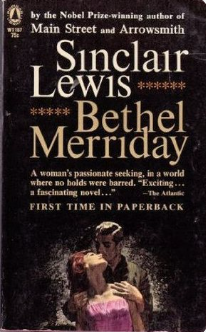
This 1960 paperback cover makes it look really steamy. It is not.

So. It starts with Bethel as a small child growing up in Connecticut, realizing that she loves to play-act. Eventually she goes off to a women's college and snags a few parts, and despite her family and friends trying to convince her to settle down and marry her home-town honey, she persuades her parents to do a sort of summer theater internship, where (for a fee) she gets a few small parts and does a lot of behind the scenes work in a small theater in a disused former church. Bethel then decides to try her luck on Broadway, and after several months of struggling, discovers that someone from the summer stock company is mounting a new touring production of Romeo and Juliet, with a shocking modern interpretation -- well, shocking in that the actors are all wearing modern clothes. She manages to finagle herself a job as a secretary to the producer/lead actor, the handsome and wealthy Andy Deacon, who is spending all his money on this endeavor. Bethel is also the understudy for Mrs. Boyle, a semi-famous actress who has accepted the part of Juliet for an astronomical sum.

The whole crew go on the road, bringing the Bard to small-town America. By now it's 1938 and the threat of war is looming, but there's very little mention of "the situation in Europe." It's really about the day-to-day struggles of this low-budget touring company and their attempts to at least break even, and the relationships that develop among the players. As the lead character, naturally young Bethel has her admirers -- I counted at least six proposals of marriage Bethel receives from various men in the book, and it might have been more.

 A very pulpy 1962 paperback edition, also laughably bad. 

I enjoyed reading about all the backstage drama and trouble that the company faced, which probably wouldn't be much different today, except they'd probably be in a giant motor coach instead of Pullman cars. (I love traveling by train and the idea of a sleeper car sounds delightful -- they still exist in the USA but they're quite expensive and train food isn't very good any more so I don't know if I'll ever try it). I liked Bethel and the other characters but the story is lacking the real satire that I expected after reading Main Street. I really didn't get a lot of character development, especially with Bethel, who is really a bit too perfect. I've seen other readers complain that the book mostly ignores the buildup of WWII -- the book was first published in 1940 and it is a bit odd, though Lewis had addressed the rise of facism in his 1935 work, It Can't Happen Here. Maybe he really wanted a break from the war and needed to write something escapist? I don't know enough about Lewis to speculate. 

There are three classes in the audience in a  city theater: those who can afford to go -- of whom some really like the play; those who want it thought they can afford to go -- they are too engaged in hoping they look like regular and expert theatergoers to have much attention left for the play itself; and the students up in the gallery, who love the play savagely or hate it volubly.

A Spanish edition from 1946. This one is actually quite pretty.

Bethel Merriday was a fairly quick read and pleasant diversion, if a bit predictable. I liked it though it's not particularly memorable. If you're not a theater lover or a big fan of coming-of-age stories, I don't know if you'd enjoy it. The writing is good and Lewis gets in some good zingers here and there, but I"m not surprised it's mostly fallen into obscurity. 

This is my eighth book for the TBR Pile Challenge.

Saturday, June 6, 2020

Temptation by Janos Szekely

The cover artwork is a detail from The Morphinist by Janos Vazary (1930)

I'm trying really hard to refrain from buying books, but inevitably birthdays and other gift-giving holidays occur, so what can one do? My most recent bookish gift was Temptation by Janos Szekely, an NYRB reprint of a 1946 novel newly translated from the Hungarian. Normally new-to-me books get shoved to the bottom of the TBR pile, where they sit, contributing to my unread-book guilt. But I'd signed up for the European Reading Challenge and this one fit the bill perfectly. I read the first few pages and was instantly hooked. 

This is the story of Bela R., a young Hungarian peasant boy born into rural poverty in 1913, after his sixteen-year-old mother Anna has a one-night stand with a charismatic sailor during a church festival. At the end of the night the charming sailor disappears, leaving her alone to deal with an unwanted pregnancy. After little Bela is born, Anna goes to the city to work as a wet nurse, and later a maid, leaving him in the care of Rozi, a former prostitute who now runs a sort of foster home for illegitimate children. It's a tough upbringing because Rozi basically hands out food and favors to the kids based on how much their mothers can pay, and Anna is always struggling, so Bela is always hungry, for food as well as love and affection -- Bela is literally young, scrappy and hungry.


Bela grows up as a tough kid, but he's smart and longs to go to school. Rozi refuses, forcing him to stay home and work until Bela realizes she's breaking the law. The village schoolmaster sees that Bela is smart and gives him a lot of tough love. Eventually, Bela rejoins his mother in Budapest at the age of fourteen, where they live in a tenement shared with a prostitute, barely making ends meet. Here's a wonderful quote describing the first meal his mother cooks for him after they're finally reunited:


I started sweating, I ate so hard. My God what a szekelygulyas that was! Pools of soured cream floated on top, the soft tenderloin melted in my mouth, and the cabbage -- Lord, what cabbage! You could tell my mother had cooked it that morning, or perhaps even the night before, because only when you cook it twice can cabbage be that good. I was moved: for the rich, food only goes to their stomachs, but for the poor-- it goes to their hearts.


There are a lot of food descriptions in this book, which I always love. (Obviously, food's pretty important when you don't get enough of it.) Anna gets Bela a job as a bellboy in a fancy downtown hotel on the Danube. The first year or so he doesn't even make any money, as they work for tips only and he normally works in the elevator. Eventually, a chance encounter with a rich woman's dog changes his life, and he becomes the designated dog-walker and works his way up the ladder -- and into her bed. Bela also meets Patsy, a rich Hungarian-American girl vacationing in Budapest, and longs to leave Hungary and move to New York.
Love this cover from the British edition

Meanwhile, Bela's family is always on the verge of bankruptcy, staving off hunger and the greedy Hausmeister, the building superintendent who's constantly threatening the tenants with eviction. Bela is also struggling with his conscience about the favors he receives from his wealthy lover while he sees the poverty surrounding him. There are few options for the thousands of poor workers faced with unemployment in the late 1920s, and it's obvious to the reader how fascism begins to take hold, and the inevitable rise of the Nazi party. 

Here, peace was always more dangerous than war, because the bomb has yet to be invented that can do as much damage as poverty itself.


I loved this book. It's nearly 700 pages long and I raced through it in less than a week. I can't compare this to the original Hungarian, so I don't know if it's Szekely's original style or the translation, but I found this really easy to read, almost as if I was sitting in pub with Bela and he was telling me his life story. I found myself breathlessly awaiting the next page, laughing and crying with Bela, outraged at the injustices he faced and feeling his despair as he didn't know how to take care of his mother and find their next meal and pay the rent. I was aghast at the struggles he faced, and I only wish the story were longer. It ends when he's seventeen and I wish I knew what happened to him next. Bela's character was so real to me. According to Wikipedia this is a semi-autobiographical novel, though Szekely was born in 1901. He did leave Budapest as a young man and ended up as a screenwriter in Berlin, then moved to Hollywood in 1934, where he was eventually won for an Oscar for the 1940 film Arise, My Love. Sadly, Szekely only wrote two novels, and this is the only one translated into English. Temptation was also adapted into a Hungarian film in 1977, but I don't think it's available on DVD. 


I also loved reading about his life in Budapest. I was lucky enough to travel there for a long weekend a couple of years ago, but I never got around to posting any photos. This review is pretty long already, so hopefully I'll add some next week. Temptation is definitely one of my top reads this year and now I'm inspired to read more Hungarian fiction. Bloggers, do you have any recommendations? I still have We Were Counted by Miklos Banffy (checked out from the library more than three months ago, still unread); and I've also heard great things about Magda Szabo, several of her books are reprinted by NYRB Classics and are available as ebooks from my library.

I'm counting this as my Classic in Translation for the Back to the Classics Challenge and for my Hungarian selection for the European Reading Challenge.  It also counts toward the Big Book Summer Challenge

Thursday, February 8, 2018

Persephone Readathon: Lady Rose and Mrs. Memmary


I love it when I can combine online reading events like the Persephone Readathon with my annual reading challenges. This week was the perfect time to cross another book off my 2018 TBR Pile Challenge List -- Lady Rose and Mrs. Memmary. I actually had THREE Persephones on this list, plus one possible read on my Back to the Classics Challenge list. (The others were Heat Lightning, London War Notes, and Effi Briest). To be perfectly honest, Lady Rose won out because it was the shortest, and because it was owned-and-unread the longest. 

Basically, Lady Rose and Mrs. Memmary is a sort of a fairy tale about a little girl growing up in Victorian times on a massive Scottish estate called Keepsfield. Published in 1937, it starts out in the period between the wars when three tourists, two American and one British, stop to tour the empty house that belongs to Lady Rose, who has lived abroad for years. One of the tourists, a British woman, begins to engage the elderly housekeeper about the little girl who grew up there and begins to imagine what she was really like.

Even this cover looks a little twee.
This book starts out rather saccharine and almost twee. Lady Rose as a child was so annoyingly perfect I almost gave up -- in fact, I did try to read this a few years ago and was so put off I put the book down and it was gathering dust until this week. All the reviews implied it would get better, so I stuck with it. It does get better after Lady Rose goes off to boarding school, then her life takes some interesting turns when it appears it isn't such a fairy tale after all. 

Overall, this book was charming, but with a sad undercurrent about the position of women. It made some very good points about the choices women had in the late Victorian period -- but mostly didn't have, even the very wealthy and privileged. My basic impression is that the writing is a little flowery and there wasn't a whole lot of character development. Some parts actually felt more like broad outlines of a story than the finished product. There was some definite foreshadowing that I completely missed -- if you're clever you'll predict some of the plot twists. I wasn't especially observant at the time so I was pleasantly surprised by some of them.


The best bits are Lady Rose's appreciation for the beauty of Scotland, and for Keepsfield, the estate on which she's raised. In the preface, it's described as "a love letter to Scotland," which is absolutely correct -- Keepsfield and Scotland itself are the best-developed characters in this book. (This is nothing like Outlander, though there are very brief mentions of men in kilts. Just in case anyone was wondering). 

There are also some interesting descriptions of what it was like to come out in society in the Victorian era, and to be presented at court. However, there's a huge gap in time about Lady Rose's life after she leaves Keepsfield which I really wish had been more developed. I won't say any more because I don't want to spoil it for anyone.

Many people love this book. I enjoyed it, but I have to admit it's not my favorite Persephone. It was a charming, light read, and I could see it might be just the thing if you're having a bad day and need something escapist. It's a quick read and there are some quirky little illustrations. I think I read somewhere that it was a favorite of Queen Elizabeth's mother. 

The Persephone endpapers for Lady Rose and Mrs. Memmary
So -- Persephone fans, have you read this book? Did you enjoy it, or was it just a little too sweet? And which Persephone should I read next off my list -- Heat Lightning, Effi Briest, or London War Notes?

Tuesday, April 11, 2017

The 1951 Club: School For Love by Olivia Manning


I purchased School For Love a couple of years ago after reading and loving Olivia Manning's Balkan trilogy. I also purchased the omnibus of her Levant Trilogy, but I hadn't gotten around to cracking either of them until I realized that School For Love was published in 1951 and I could use it for the 1951 Club hosted by Simon and Kaggsy!


Set in 1945, just after the war, it's a coming-of-age story about young Felix Lattimer. The story begins as Felix, aged about 14 or 15, is traveling alone from Baghdad to Jerusalem. Recently orphaned, he's been staying with family friends until a sort of relative named Miss Bohun has offered to take him. Miss Bohun is a spinster, probably in her late fifties or early sixties, and was the adopted older sister of Felix's late father, who was killed in Baghdad during the war. Felix's mother, who was loving but rather flighty has recently died of typhoid because she hadn't bothered to get her annual vaccination. Felix does have an uncle living in England, but due to heavy demand for soldiers demobilizing, he's low priority to get transport back to England and is therefore sent to live with Miss Bohun, who rents out rooms to refugees.

Felix has a bit of odd life with Miss Bohun. She's rather eccentric and heavily involved with some sort of evangelical church group called the Ever-Readies. She seems to charge Felix rather an awful lot of money for his expenses, yet she doesn't want him to turn on the heat in his room and they seem to exist on mashed beans. The other residents are a Polish widow and her son, who claims to be a count, and an aging artist living in the attic. Felix's favorite companion is a beautiful Siamese cat named Faro, his only source of love and affection.

Felix's days seem rather dreary until a new boarder, a young, beautiful widow named Mrs. Ellis moves in. She's rather glamorous and Miss Bohun had expected her to be a new companion until it becomes quite obvious that their personalities will never mesh and the whole dynamic is shaken. Felix becomes more and more attached to Mrs. Ellis and finally things come to a head between all the characters.

It's a short book, just under 200 pages, but Manning really creates vivid and realistic characters and I found myself really invested in them -- I wanted to throttle Miss Bohun and cook Felix a good meal, among other things. And the ending left me gobsmacked. I finished it and just sat there thinking about it. It was just brilliant.

I'm also counting this as my 20th Century Classic for the Back to the Classics Challenge.

Thursday, December 1, 2016

A Dance to the Music of Time: First Movement by Anthony Powell


So, a couple of months ago I signed up for the most recent Classics Club Spin, in which a random number is assigned to choose your next Classics Club read. I only had seven books on the list, so I thought it was a win-win. My selection was A Dance to the Music of Time (First Movement) by Anthony Powell. I was really looking forward to it, but sadly, it did not end up being the book I hoped.

First, I should point out that this is an omnibus, the first three volumes of a 12-volume cycle of short novels originally published in the early 1950s. Each volume is about 250 pages long. As it's such a long work, I started it in October, and I still haven't gotten much more than halfway through this book. However, I did write down some thoughts as I was reading, so I'll try to at least comment on my progress. 

The first volume, A Question of Upbringing, is the story of four young men at prep school. The narrator, Jenkins, tells us all about his two friends, Stringham and Templer (apparently in prep school no one is ever referred to by his first name; I only figured out Jenkins' first name was Nicholas because it's on the back of the book) and another slightly less privileged boy named Widmerpool, who appears to be somewhat tormented because he is of a slightly lower class -- his father works for the railways, ye gads! 

Basically, it's the mildly interesting antics of some incredibly privileged and entitled rich white boys. Jenkins doesn't seem too bad, but his friends are pretty much jerks. There's one episode in particular when they're cutting class and decide to divert attention by playing a nasty trick on a headmaster called La Bas. All the women in this novel are merely there to serve the men as mothers, sisters, or potential girlfriends. 

It was mildly interesting, though I didn't care much for any of the characters. Is this meant to be a satire about the future leaders of England? The (slightly) less-privileged Widmerpool seemed the best of the bunch so far, but I was somewhat underwhelmed. It was a pretty easy read and I finished it in less than a week, so I thought I would zoom through it. Alas, I hit a snag at the second volume. 

Volume II, A Buyer's Market takes place after the boys have left prep school, and quite frankly, it was a struggle. Much the action takes place over one night at a series of large parties, where Jenkins runs into a lot of his old school friends. I just found the whole thing tiresome, all these privileged young men who all seemed so entitled. None of the women in this part are well-developed characters, as they're just love interests or for the amusement of the men. There's also a reference to an African-American that is really offensive. I realize this book was written in the 1950s and is set in the 1930s, but based on the current political climate, I found it really distasteful.

I thought the second book sort of stalled near the middle. I generally avoid reading large omnibus editions as I find them very unwieldy (plus this one was numbered with the original page numbers, so it was difficult to see how far I'd got. It also didn't help that I didn't read it for long stretches and I lost track of the narrative thread and began to get some of the names mixed up, and there are a lot of minor characters introduced at large parties. I just really wasn't that interested in the characters any more, they seemed so spoiled. Maybe this is just the wrong book at the wrong time and I should give it another chance. Many people have commented how they loved this book but it's just leaving me cold and I may abandon it altogether.

Bloggers, have any of you actually finished this book, much less the entire series? Is it worth trying again later or should I just add it to the donation pile? Do you think there's such a thing as the wrong book for the wrong time?

Friday, December 18, 2015

One of Ours by Willa Cather

Willa Cather is mostly known for her novels set in the great prairies of middle America, and though I lived in Nebraska for three years, I didn't seriously start reading her novels until I moved far away to Florida and then Texas. In the past ten years, I've read nine of her novels, and it took me this long to read One of Ours,which won the Pulitzer Prize in 1923. It's both a prairie novel and a World War I novel. Mostly, it's about a young man who is searching for meaning in his life, and has to travel halfway around the world to find it.

The book starts about 1910, when Clyde Wheeler is a young man, splitting his time between his family's Nebraska farm and his education at a small religious college in Lincoln. He really wants to transfer to the University of Nebraska at Lincoln, but his parents fear that footballs and fraternities would be a bad influence; besides, they've decide he needs to work full-time on the farm. He loves his family, he loves the farm, but he wants more out of life. Over the next few years, things start to heat up in Europe, and he finally gets the chance to do something meaningful -- enlist in the army and fight in the Great War. Like The Professor's House, this could almost have been split into two different novels. 

For a war story, there isn't a whole lot of action, at least not until the very end. The first half of the book is mostly set in Nebraska, giving background and showing Clyde's disillusionment. A large chunk of the book details Clyde's journey overseas, especially the difficult sea voyage in which hundreds of his fellow soldiers fall ill (a significant percentage of soldiers died of disease, some before they actually saw any combat). When Clyde finally gets to France, there's a lot of vignettes about different people that he meets, soldiers and civilians, and how they impact his outlook on life. 

It's not what you'd call a fast-moving book with a lot of plot, but I loved the descriptions of farm life in Nebraska, and Clyde's character development. It's also inspired me to read more World War I literature -- I still own Birdsong, The Guns of August, and Testament of Youth, which I'm planning to read next year for the Back to the Classics Challenge.

Bloggers, what other World War I books do you recommend?

Friday, December 5, 2014

Norwegian Wood by Haruki Murakami


With less than a month until the end of Adam's 2014 TBR Pile Challenge, I still had three books left to finish.  I nearly gave up with more than 1000 combined pages to read by the end of December, but decided I there was still enough time to give it a final shot.  I chose Norwegian Wood as my first read because, quite honestly, it was the shortest of the three and I thought I could knock it out fairly quickly.

Norwegian Wood is a coming-of-age story about a young Japanese man, Toru Watanabe.  The story begins with a prologue of Toru in middle age as he suddenly relives a memory of an old girlfriend which is triggered by hearing the Beatles song "Norwegian Wood."  We flash back to the late 1960s, and learn about his troubled history with the beautiful and fragile Naoko, whom he'd originally met when Naoko was the girlfriend of Toru's childhood best friend Kizuki, who committed suicide when they were all 17.  Now in college, Toru and Naoko had rekindled their friendship after a chance meeting.  

The book follows the evolution of their friendship to the beginnings of a romance, but the course of true love never does run smoothly, and without spoiling too much, I'll just say that the couple is separated.  Toru is trying to hang on to his relationship with Naoka, but meanwhile he meets another girl Midori.  Toru is also influenced by an older student, Nagasawa, who is brilliant but something of a cold-hearted playboy, though he has a long-suffering girlfriend.   Basically, the story examines Toru's maturing as he struggles to reconcile his feelings for the two women and starts making decisions about how to live his life. 

Overall, I liked Norwegian Wood, but I can't really say I loved it.  I do think the writing was excellent and insightful, and I loved reading a the descriptions of Japan, especially about everyday life.  However, there were some aspects of the book that made me sort of uncomfortable, especially how the female characters were depicted. There's a lot of discussion about their sex lives which tended to go into way more detail than I needed to know, plus I think it was kind of sexist.  I understand that it's told from a young man's point of view and it is his coming-of-age story, but I really feel like the female characters were essentially a man's fantasy about what young women should be like.  I know it's a completely different culture and I shouldn't expect women of a different generation to fulfill my expectations, but it still bothered me.  

Norwegian Wood was incredibly popular in Japan and has sold millions of copies all over the world, and made the author into a literary superstar.  I bought this book more than 10 years ago, when I was living in Japan at Yokota Air Force Base, in Fussa-shi, a suburb of Tokyo.  I think I bought it because I wanted to learn more about Japanese culture, but I'm not sure why I never got around to reading it while I was there.  I really wish I had because there are a lot of mentions of places in and around Tokyo that I've actually visited, and quite a few that I wish I'd seen. I think I would have gotten a lot more out of the Japanese culture depicted if I'd read it while I was actually in Japan. 

I also really wish I knew someone else who'd read it so I could have a real discussion about it.  I do think this would be a really great book for a discussion -- this would be great for a read along, or a book group.  I haven't included too many details because I hate giving away too many plot details.  

I don't think Norwegian Wood will be one of my favorite reads of the year, but I'm very glad I read it and now I'm curious to read more by Murakami and possibly other Japanese writers.  I still have an unread copy of Snow Country by Yasunari Kawabata which is a Japanese classic that I hope to read next year.  

Sunday, August 24, 2014

Peyton Place by Grace Metalious


Scandalous!!

Grace Metalious blew the roof off the image of the quaint New England Town in her 1956 shocker Peyton Place. Ostensibly set in the late 1930s and early 1940s, but with more of a 1950s feel to it, Peyton Place is the story of three women: Constance McKenzie, a beautiful widow with a Deep Dark Secret; her 13-year old daughter Allison, a budding writer coming of age in a small town; and Allison's best friend, Selena Cross, a beautiful girl who is growing up in squalor on the wrong side of the tracks with her mother, half brother, and stepfather, the town's creepy drunk.  

Peyton Place covers all the dirty secrets of small town life, including murder, suicide, child abuse, incest, illegitimacy, and abortion It was groundbreaking for its time, though it's probably pretty tame compared to Fifty Shades of Grey.  

I'm a big fan of stories of life in small-town America, and this is like a really sordid version of Gilmore Girls, with much less witty repartee. There were lots of interesting and colorful side characters -- the upright and beloved town doctor, the uptight school teacher; the rich, unscrupulous mill owner and spoiled son; and the new principal who comes from the big city.  There are a whole slew of characters from various generations, all with their own back story.  Some times I did wish Metalious had included less characters and given the reader more about less people.

I found it to be quite the page turner -- I finished the entire book in a weekend, and I really enjoyed it.  I did have trouble keeping some of the characters straight, particularly the colorful old-timers who sat around at the diner and played poker with the doctor and the town newspaper editor.  Some of the threads were left unresolved; there's a whole plot thread about Allison's childhood sweetheart Norman and his creepy mother, who seems like an eerie precursor to Norman Bates, but we never really find out what happened to him; also, I didn't care for the ending, which seemed somewhat tacked on.  I would love to read an entire book about Allison and what happened to her after the events in the book ended.  There was a sequel, Return to Peyton Place, but I've read it isn't that good, so I may skip it and just imagine for myself how the character's lives would have continued.  

Now I want to read more books about small-town American life -- Main Street by Sinclair Lewis has been on my to-read list for ever; also, I want to read some more mid-Century fiction.  Another one on my to-read list is The Group by Mary McCarthy, which I've returned unread to the library three times at least!

Bloggers, which other books about small-town life do you recommend?  Which banned books do you love?  And has anyone ever seen the Peyton Place movie or TV adaptations? 

Saturday, July 20, 2013

My Name is Asher Lev by Chaim Potok


I wish I had the discipline (and the time) to review each and every book I read, as soon as I finish it.  I finished My Name is Asher Lev, back in June.  Other things, other books, other reviews just got in the way.  It is a bad idea to wait an entire month to review a book, but I'll give it a shot.  To the best of my recollection.

Anway -- Asher Lev was a gift from my good friend Amanda, who used to blog about books but now mostly blogs about other things.  I put this on my TBR 2013 Challenge list because I didn't want the entire list to be books by authors that had been dead for years and years (Potok did pass away in 2002, but he's pretty contemporary compared to the rest of this list).

So, Asher Lev is an artist, and he begins his story by telling the reader that he is most famous for creating a painting of a crucifixion, a blasphemy for an observant Jew.  He's not just an observant Jew -- Asher was raised an orthodox Jew, a Hasidic, very traditional and conservative.  Asher lives in New York and was born shortly after WWII, and it is the life's work of his father to help other Jews in Europe, so that they can practice their faith safely.  His mother is studying Russian to be able to help persecuted Jews in Russia.

However, young Asher has different ideas.  As long as he can remember, he's been obsessed with drawing and painting.  It's part of him, he can't stop doing it, much to the chagrin of his father, who believes that he's just wasting his time on frivolity -- Asher's father wants him to do something to glorify God and help other Jews.  Every day, Asher struggles with his need to create art against his family's wishes -- he wants to please his father, and win his love, but his art is a part of him.  This is the story of his coming of age, as a young man and an artist, and how he tries to reconcile the two.

I wasn't sure I wanted to read another book about an artist after my disappointment with The Masterpiece by Emile Zola, which I finished a couple of months ago.  In that book, the main character was so obsessed by his art he lets it ruin his life and the lives of the people around him.  This book is quite different.  Asher is really struggling to satisfy his need to create art and his need to please his family.  It's a really interesting character study.  I'd never read anything by Chaim Potok, but the writing was excellent and the characters interesting and well-developed.  I took a few art history classes in college but I really don't know much about modern art.  I don't think Asher is necessarily based on a particular artist, but I tried to imagine what his art might have looked like.  I was also quite pleased that I recognized most of the real artists and works of art mentioned in the book, like Chagall and Modigliani, and Picasso's Guernica.

La Mariee by Marc Chagall.  
I've also been very amused this summer as many high school students came to the reference desk at my library looking for this book!  Apparently it was on the summer reading list for a local high school -- the choice was My Name is Asher Lev or The Count of Monte Cristo!  I still haven't read Monte Cristo but now I can definitely recommend Asher Lev.

Monday, April 9, 2012

The Fountain Overflows by Rebecca West


I'm very happy to have finished this book.  Not only is it a book off my own TBR shelves, it's also an NYRB Classic (of which I have a healthy stack, all unread) but I've seen it all around the blogosphere and it seems to be universally liked.  I did like it but it really wasn't what I expected at all.

The Fountain Overflows was described by someone as Jane Austen-ish, but I personally wouldn't make that comparison at all.  In a nutshell, it's the story of the Aubreys, a family living in genteel poverty in London around the turn of the century, told in the first person by Rose, one of the four children.  Their father, Mr. Piers Aubrey, is a brilliant writer, but he has trouble holding down jobs and managing the family's money; specifically, he has a weakness for the stock market and the family is forced to make a lot of sacrifices.  Their mother was once a brilliant pianist who gave up her career when she got married, and she's doing her best to train her children to be musicians as well.  Unfortunately only two of her children seem to have inherited her musical ability and the necessary discipline.  The oldest daughter, Cordelia, is convinced she's a talented violinist, but the rest of the family believe she's really a hack with no artistry, and they're always sneering at her.

There's really no plot to speak of in this book, it's basically the story of Rose's childhood, told in little vignettes about various incidents in her life.  Some of them are kind of mysterious or a little creepy -- there are a poltergeist, a possibly abusive husband, an accused murderess in the supporting cast -- but most of it is a little sad.  Their mother is obsessed with making them into good musicians, their father is brilliant but hopelessly irresponsible.  It's sort of like I Capture the Castle, which I love, and like the father in that book, I just want to shake him and tell him to snap out of it and take care of his family.

It is an entertaining story, though I did find it a rather dense read.  It's about 400 pages, yet in my edition, an NYRB classic, the margins are very narrow and the print is fairly small.  It's 17 chapters but they took awhile.  It was published in 1956, but the style of writing made it seem older, and I guess that made it a slower read as well.  It seemed to have been written around the turn of the century, not just set in that era.  I guess this would be a good candidate for the Slow Books Manifesto.

Anyway, here's a sample:

"Papa was always happy when he was engaged in certain activities.  Of these the one which gave him greatest pleasure was his lifelong wrestling match with money.  He was infatuated with it though he could not get on good terms with it.  He felt towards is as a man of his type might have felt towards a gipsy mistress, he loved it and hated it, he wanted hugely to possess it and then drove it away, so that he nearly perished of his need for it.  But he knew almost as great joy if he were conducting a campaign  against some social injustice, particularly if it were the rights of property that had been dealt with unjustly."


Maybe it's just me, but that seems much more like a Victorian novel or maybe Edwardian.  The writing was very good and I liked the characters, but it isn't a book I could rush through.  But I'm happy to have read it and look forward to reading West's The Return of the Soldier, which is another of my Classics Club selections.  This book also counts toward my TBR Pile Challenge, so I'm happy about that too.  

Monday, February 20, 2012

The Stone Diaries; Or, My Book Group Failure

What if you had a book group and nobody came?  How depressing would that be?

Well, I can tell you from first-hand experience, because that's what happened to me last Thursday.  I had the second meeting of the library book group that I just started and nobody came.  Not one person.  I had tea, I had cookies, I had a Pulitzer prize-winning book to discuss, and nobody showed up.

The previous month, I had two people, and this was actually kind of cheating, because one of them also works at the library with me, and the other runs a group that I attended for several years (at the library branch where I used to volunteer).  Unfortunately, neither of them could attend, so I was really hoping for a random stranger, or just someone to come in and keep me from eating all those Pepperidge Farm cookies.

But nothing.  Nada. No one.  I waited twenty minutes, and as I waited, I started reading the next book selection for the Teen Time Book Group which I am also running.  (The book is The Monstrumologist by Rick Yancey, and it's really creepy.  And then I gave up and packed up my tea and cookies and went back to the reference desk.

Now, I know it's tough to start a book group from absolute zero, but I was hoping for at least ONE person.  Could it have been my book selection?  Book choices in library groups are tough, because if groups want to discuss the hot titles to draw in new members, you run the risk of choosing a book with about a zillion holds on it. I can't ask members to buy their own copies, because that sort of defeats the purpose, since it is a library activity, right?  And I have to choose the book about two months ahead to get it into the library's newsletter.  It's a vicious circle.

Maybe I chose the wrong book?  It was The Stone Diaries by Carol Shields, a 1995 Pulitzer Prize winner, and admittedly, I chose it because it was on my TBR shelf, and because the library owned enough copies -- that's another problem, if you wait too long to select a book, the library will start deleting the copies.

Anyway, here are my thoughts on The Stone Diaries.  It was okay.  That's all I can come up with at this point.  I didn't hate it, but I didn't love it.  Basically, it's the story of the life of Daisy Goodwill, from her birth in 1905 through her death sometime in the 1980s.  Her birth itself is pretty shocking, then there's her childhood, her move from western Canada to Indianapolis, her love affairs, friendships, career, etc.  Her old age and death are particularly poignant.

What's mildly interesting about this book is that her life story is almost entirely told through the perspective of other people, plus letters, diaries, and newspaper articles.  It's all various peoples' memories of her -- almost none of it is told from her perspective or with her as the subject.  There's a lot about all the people that surround her, her parents, in-laws, husbands, etc., but very little about her directly, so I guess the point is you're supposed to get a sense of what she was like from this second- or third-hand perspective.  It's an interesting approach, and I liked parts of it, but I wasn't that excited about it.  Maybe it was a bad choice for a book group that's just getting started. Honestly, I think it would have been great to discuss with my old library book group, because I know the people.  There's a lot to discuss in it about the role of women, etc.

Now I have totally rethink this book group thing. Anyone else start a book group from scratch? Any words of wisdom?  Do I need to have the people first, or pick the books first?  Any sure-fire book selections to draw people in?

If nothing else, at least I finished another title for my 2012 TBR Pile Challenge.  That's now three out of twelve, so I'm on track to finish at least one of my challenges this year.   How's everyone else doing with their challenges?

Monday, January 30, 2012

The Power of One by Bryce Courtenay


Sorry for not posting lately, I've worked the last seven days straight and even though I sit in front of a computer a large part of my day, I think the library administration would frown on writing my personal blog on the city's dime.  By the time I get home I have no desire to write anything.  But I have been reading!  In the past two weeks I finished not one but TWO books off my challenges list.  The first one was The Power of One by Bryce Courtenay, which came highly recommended by someone in a book group years ago.  I bought it at a bookstore in Orlando for the sheer purpose of getting my parking validated at a pricey shopping mall, which actually backfired -- they wouldn't validate and so I had yet another unread book on the shelf AND had to pay for parking anyway.  Hmpf.  

But I digress.  I'd heard this was a great book but all I knew was that it was about South Africa and boxing.  I find Africa fascinating but I am not a sports fan and I absolutely HATE boxing -- the idea of people beating each other up for FUN is repellent to me.  It's no wonder this book sat on the shelf unread for so long.  I finally sucked it up and picked up the book a couple of weeks ago, and to my surprise, I really, really liked it, boxing and all, though it's more than 500 pages long.

The setup:  a little boy nicknamed, aged 5, is sent off to boarding school in South Africa in the 1930s.  His mother has had some kind of a nervous breakdown and there's no father around, so they ship him off to school.  Unfortunately, he's the only English boy at the school of Boers.  (Did you know that the white South Africans hated each other as well as the black South Africans?  I had no idea.)  So, not only does this little boy have to suffer because he's a wee little thing who should be home with his family, he's horribly abused by all the nasty bigger kids for being different (and smarter).  The thought of sending a child under twelve away to school horrifies me, but FIVE?  What were they thinking???

Anyway, eventually his family move and he leaves the wretched school all alone on a very long train journey, where one of the porters keeps an eye on him for the trip.  Turns out this porter is an amazing boxer and takes the boy, who is now nicknamed Peekay under his wing and also to a boxing match.  This is a life-changing event for Peekay, who decides that someday he'll be the welterweight champion of the world, and no one will ever pick on him again.  

The rest of this book is a coming-of-age story about Peekay and how he comes to terms with all the bullies of the world, in school and life, as he goes through school and trains to be a boxer, with the backdrop of WWII and the beginnings of apartheid I learned a lot of things about Africa in this book, which I liked, and also about boxing, which, shockingly, I also liked.   Somehow Courtenay was able to describe the boxing training matches in a way that made it accessible and interesting even for a non-sporty person like me (I still haven't figured out the rules of American football).  Apparently boxing is sort of scientific, not just people beating on each other.  (It's sort of like in the new film versions of Sherlock Holmes when they slow the action down and explain Sherlock's thought processes, then show the speeded-up version, if that makes sense.)

Anyway.  I rather liked the boxing bits, and the school bits, plus there's lots of great stuff about the African country and how beautiful it is, and Peekay has a wonderful relationship with a music professor who is his neighbor and becomes a father figure to him, and that's lovely.  My one complaint about this book is that Peekay is just too perfect.  He becomes an amazing boxer.  He's brilliant.  Everyone loves him, especially all the black Africans.  He's not just good at everything, he's the best ever. (Except music, at which he is just pretty good).  He becomes this angelic figure up on a pedestal, and he's so perfect he started to annoy me.  Plus, the ending didn't work for me.  Without giving anything away, I'll just say that it didn't seem to fit in with the rest of the book.  

I am glad I read this book, it's definitely worth reading if you're interested in Africa or you like a good bildungsroman, or if you like sports (or even if you don't).  I'm happy to say that this book counts toward two of my challenges:  TBR Challenge 2012 and Chunkster Challenge 2012

Challenge progress:  TBR Challenge 1/12;  Chunkster Challenge: 2/6

Monday, December 6, 2010

Mariana by Monica Dickens

I first encountered this book at BookPeople in Austin, Texas (probably the world's best independent bookstore). One of the coolest things about this store is that it has an entire section just for classics.  Joy of joys! Well, whilst browsing several months ago, I came across this volume shelved next to (gasp!) books by Charles Dickens. Who was this upstart Dickens, with her book on the shelf next to my beloved Bleak House and Oliver Twist? Who had the nerve to call herself Dickens???

Um, actually, his great-granddaughter, that's who. And a darn good writer in her own right, though nothing like the wordy, flowery prose of the beloved (and sometimes reviled) Charles. After purchasing it, I soon realized it was the second book from the marvelous Persephone imprint -- I already owned Miss Pettigrew Lives for a Day, which was waiting patiently on my to-read shelf.

Sadly, Mariana languished on the shelves for several months until a few weeks ago when I needed something comforting during a nasty ear infection. And it was an excellent comfort read, but despite the beautiful cover, this isn't the chick lit I was expecting. The story begins with a young woman, Mary, who is alone in a country cottage during World War II. She's just heard on the wireless that a British ship has been sunk -- the ship on which her beloved husband is sailing. She is in a state of complete panic because there's a terrible storm and all the phone lines are down, and she can't even walk into the village to try and contact anyone. She is utterly alone in her terror and misery, with no company but a little dog until the following morning.

The book then begins to flash back to Mary's childhood. She's never known her father, who died in the Great War, but she spends idyllic summer's at the family home in the country, surrounded by her loving grandparents, aunt, uncles, and cousins. She has an incredible crush on her cousin Denys, her first great love. The book then follows Mary through her childhood, adolescence, and life as a young woman growing up in London with her mother, a dressmaker, and her hilarious uncle Gerald, a somewhat ne'er-do-well actor. Mary struggles in school, flunks out of drama college, and learns dressmaking in Paris. We also follow Mary's love life -- the prologue never gives the husband's name, so I breathlessly followed the story to figure out which of her men could be lost at sea.

This is a really nice coming-of-age-story set during the inter-war years, one of my very favorite periods. It's touching and sometimes absolutely hilarious -- Mary gets into some really amusing scrapes. Her time at drama school is particularly funny. This book is loosely based on Monica Dickens' life, and what I also find very interesting is that Mariana was first published in 1940 when she was only 24! She never set out to become a writer, but sort of fell into it -- her first published work is One Pair of Hands, which is the story of her life working as a domestic (after she'd been a debutante!). I was so intrigued by this, having worked as both a professional pastry cook and a writer, that I instantly requested One Pair of Hands from my library. (Review to follow soon).

For all you Persphone fans, and for those who are just intrigued, please do yourself a favor and find this book. It's one of the Persephone Classics that are readily available here in the US, so if you can't find it in your local bookstore, it's easy to find online.

Tuesday, August 31, 2010

The Go-Between by L. P. Hartley

"The past is a foreign country.  They do things differently there."  Another of the best first lines ever.  [I didn't include this book in that post, as I hadn't finished it yet.]  But another great line, and a great book.  But it just broke my heart.

This is the story of young Leo Colston, a twelve year old boy spending the summer holiday with a school friend on a country estate.  It's set in 1900, at the very end of the Victorian era.  As an adult in his sixties, Leo finds the journal he kept that summer, and he's reminiscing about this summer and how it changed his life.

Leo is at Brandham Hall, a country estate, as a companion to his school friend Marcus Maudsley.  Unfortunately, a few weeks into the summer, Marcus falls ill with the measles and is quarantined, so Leo has to amuse himself for several weeks; he and Marcus were the only children and all the other guests much older .  He's befriended by Marcus' older sister, Marian, a beautiful young lady of about 18, whom Leo worships.  The family hopes that she'll soon be engaged to Viscount Trimingham, from whom they are leasing the estate -- he's titled but low on cash, and the Maudsley family are rich but untitled.  So, a match between Marian and the Viscount would solve everything beautifully.  Of course, things don't go as planned.  Leo is befriended by Ted, one of the tenant farmers, and soon Leo is passing messages between Ted and Marian -- hence, the title.

This book has a lot to say about Victorian ideas of class and station, snobbery, and loyalty.  Leo's pretty middle-class, and he's a little out of his depth with all of these wealthy people.  He's very aware of the class differences.  He's also friendly with Ted but is very aware that he's not the same class, being just a farmer.  He realizes he's caught in the middle of something and is trying desperately to get out of it without offending anyone, especially Marian, on whom he has a tremendous crush.

What I liked best about this book was Hartley's ability to write in the voice of a child.  I've read other books in which the narrator is a child, and a lot of them just didn't ring true -- they seemed so precocious, and much older than their years.  For example, I'm thinking about Scout in To Kill a Mockingbird, one of my favorite books of all time.  I love this book, but Scout doesn't sound like any child I've ever known, and I have two girls of my own.  (Other than this, I think it's perfect).  I didn't get any hint of that in Hartley's novel.

My one complaint is [contains spoiler! highlight if you want to read this section] that Leo has no clue about sex -- which I find pretty unbelievable for a 13-year-old boy, especially one who attends a boy's school.  I am sure that some other schoolmate would have known something and talked about it!  Seriously.  There would have been boys with older siblings or who had been on a farm or something.Anyway, I just found that terribly unrealistic.  But still, it's a great book, beautifully written.  Hartley is also very skilled at descriptions -- I could absolutely imagine myself right there with Leo.   There's an detailed chapter about a cricket match between the villagers and the residents and guests up at Brandham Hall -- I don't know anything about cricket (or much about any other sports, for that matter) but Hartley made it both interesting and full of tension, just like a real sporting event.  It takes a talented writer to get me interested in sports, believe me!  And the ending -- well, I couldn't possibly spoil it, but it's pretty dramatic, I couldn't stop reading.  This is one of those great classics that I think is sadly unappreciated.


This review is also posted at Our Mutual Read.

Saturday, April 10, 2010

Bless Me, Ultima by Rudolfo Anaya

This is our library's annual selection for The Big Read -- an NEA-sponsored event in which an entire community reads the same book.  There are some great books on the list, and someday, I hope to read all of them.  (For a list, or more information about The Big Read, click here.)  I was really interested in reading this since I've read so little Latino fiction, plus I'm taking a Spanish class which has made me even more interested in Latino culture.  Unfortunately, though, this book somehow just didn't connect with me.

Here's the basic setup: Set in the 1940s, just before the end of WWII, a little boy named Antonio Marez lives in a rural community in New Mexico.  His parents are complete opposites:  his deeply religious mother is from a family of farmers who are very tied to the land; his father is a hard-drinking vaquero, a former cowboy and hates being tied down.  It's Antonio's three older brothers are off fighting the war in the Pacific, Antonio's mother and father are constantly arguing about which side of the family little Antonio takes after, and what he's going to do with his life. 

At the beginning of the story, Ultima, an elderly lady who is a curandera -- a sort of wise woman/herbalist/traditional healer -- is coming to live with their family.   Some people think Ultima is a kind of a witch, a bruja (see? those Spanish classes are helping!)  Antonio's mother is deeply religious, but somehow Ultima's presence in the home isn't at odds with her Catholicism.  Ultima has some sort of connection to Antonio, since she was the midwife who delivered him.   Having Ultima in the house is botth good and bad -- Antonio starts learning a lot Ultima's crafts and talents as a healer but at the same time she introduces a lot of traditional beliefs that make him begin to question his Catholic upbringing.  He's also starting the English-speaking school, so his whole world is changing.

There's a lot of conflict in this book -- Antonio is struggling to reconcile his Catholic beliefs with Ultima's traditions, and other traditional beliefs and superstitions.  One of Antonio's school friends also has a lot of Native American beliefs (though there aren't actually any Native American characters in the story).  There's all this conflict between the parents and their families, and then Antonio's brothers all come home from the war.  Having Ultima in the house also creates problems for him and his family because a lot of people think she's a witch. 

This book was an easy read, and mostly well written -- I particularly enjoyed all the vivid descriptions of rural New Mexico.  This book really has what book reviewers call "a sense of place."  But there were some things that I just didn't get, or didn't seem realistic.  First of all, this is constantly called a "coming-of-age story."  Huh?  This boy is six years old, and the story finishes when he's not even eight!!  I'm sure children grew up faster back then, but still, this story would have been a lot more believable to me if he had been twelve or even ten.  I was also really bothered because of all the pressure his mother was putting on him to become a priest -- he's a little boy!!  Maybe this is just a cultural thing that I can't relate to.  Also, I was surprised that so many of the characters in the book were devoutly Catholic, yet they still believed in witchcraft and traditional medicine.  I think this is common in some cultures, which sort of blend traditional beliefs with Christianity.

Anyway, there are some other mystical elements in the story that are never really explained.  I'm not sure if this book could be considered Magical Realism, like some books by Allende or Garcia Marquez, two authors whose books I have liked.   I know it's considered a groundbreaking book for Chicano literature -- Rudolfo Anaya was one of the first Latino writers widely published in America, and this book is routinely studied in high school and university classes.  This was an interesting book, and I'm glad I read it, but I'm not quite sure if I liked it.  If nothing else, it was good for a book group discussion.

Sunday, October 18, 2009

A Girl of the Limberlost


Since I'm always on the lookout for an overlooked classic, I was eager to read this book.  It came highly recommended by a friend (the same one who was shocked I'd never heard of E. Nesbit) and it was mentioned in the introduction of my new favorite, Daddy Long-Legs.  But again, it's not nearly as widely read as great coming-of-age stories like A Tree Grows in Brooklyn (which I also love). However, that suggests a question -- can it be considered a classic if it's not widely read?  And why isn't anyone reading it anymore?  In this case, I think there's a pretty good reason.  This book started out with such promise and ended so disappointingly -- with a whimper, you might say.

The setup:  set in the early 1900s, teenaged Elnora has grown up in the Indiana countryside, on the edge of the Limberlost Swamp -- a virtual nature preserve.  It's her first day of high school in the big city, and of course, she's dressed all wrong, has no friends, and no money for the books and tuition which she owes because she lives outside the district.  Her grumpy, distant mother is unsupportive, and had hoped Elnora would quickly be discouraged from such upstart notions and stay on the farm where she belongs, since there is no ready cash to pay for such foolishness.  Though her widowed mother owns acres of land with valuable trees, she's clinging to it, symbolizing her lost love for Elnora's dead father, who perished in the swamp when she was an infant.  They're so cash-poor they can't afford the taxes, much less school. 

But hark!  Elnora can pay her own way -- the Bird Lady, (a local botanist/collector of moths and other flora, fauna, and historic artifacts) will pay good money for the treasures that our heroine can collect from the swamp. So it looks like Elnora will spend the rest of the nearly 500 pages learning about life and love from her benevolent naturalist patroness, and somehow reconnect with her embittered mother, possibly learning more about the story of her lost father.  All will end well.  Right?

But sadly, this story sort of went downhill about halfway through. [WARNING: SPOILERS AHEAD!] Quite a few plot developments are just waaaay too convenient.  Elnora and her mother reconcile seemingly overnight, characters like the beloved neighbor couple and an orphan boy essentially disappear, and the second half of the book is dominated by a plot about Elnora's true love and his evil fiancee, which drags on forever.  Finally, Elnora is aided by some friendly characters who were mysteriously mentioned earlier but never explained.  When Elnora first starts collecting moths etc. for cash, she refers to someone called Freckles, without any explanation or backstory.  Later, the Bird Lady suddenly refers to someone called Swamp Angel.  Who the heck are these people?  It turns out A Girl of the Limberlost is actually a sequel to another book called -- wait for it -- Freckles. There is no mention of this previous volume on the book jacket, and none of the characters are included in the list that precedes the first chapter. Yet, [SPOILER!!!] Elnora suddenly takes off from Indiana, take a train ALONE to Michigan, and goes to meet these people -- complete strangers -- in chapter 23!!  Who, of course welcome her with open arms.  Riiiight.

It also really annoyed me that this is sort of two stories in one, a detailed story setting up Elnora and all the hardships she's going to overcome, then, without minimal transition, the book just jumps forward in time three years to set up the scenario in which she meets her true love Philip. Seriously, the book reads,

So the first year went, and the second and third were a repetition; but the fourth was different, for that was the close of the course, ending with graduation and all in attendant ceremonies and expenses.

Hold the phone, what happened in those three years?   Not one thing worth mentioning the rest of her high school career -- up until the point at which Elnora is valedictorian and a star musician.  How convenient!  It's as though the author had some really good ideas about the setup of the character, and a couple of major events in her life, but couldn't take the time to expand the rest of her life. Doesn't she have a single sweetheart in high school?  A nasty teacher?  Doesn't her character develop at all in those years, or the relationship with her mother?  And some foreshadowed events never take place -- in the beginning, there's a whole setup about how dangerous the Limberlost is at night, full of robbers, bandits, etc., and it appears in the first couple of chapters that Elnora's being stalked -- yet, there's no payoff as these characters and plot elements simply disappear.  Ooops!  Forgot about that, never mind. 

The ending of this book digressed so much that I stopped reading it with less than 20 pages to go.  Seriously, I put the book down and did not care how it ended.  I finally picked it up again last night so I could force myself to finish it --  frankly, I just didn't care any more, but I didn't see how I could post a review without actually finishing it.   And, sadly, the ending is just horrible, unbelievable and preachy. 

The final message of this book (which is about as subtle as a sledgehammer): "Everyone should be just like Elnora, who is perfect!"  I honestly don't think she had a single flaw.  In retrospect, I wonder how I made it through this book.  I did like the first half; I was really rooting for her, and it's not a difficult read.  I got through a lot of it on an airplane (it was just easier than rooting around in my carryon for another book) and in the shuttle to my hotel.

Would I have liked it when I was fourteen?  I guess parts of it are a little romantic, since Elnora is a sort of a Cinderella figure.  But aside from the structural flaws (which I probably wouldn't have noticed as a YA), the writing is pretty stilted, it's sentimental, and really preachy. I'm really not surprised nobody reads this book any more.