Showing posts with label book covers. Show all posts

Thursday, May 14, 2020

Lark Rise to Candleford; and my pastoral life in Germany


I finally tackled one of the books I've had on my owned-and-unread pile the longest -- Lark Rise to Candleford. I bought this more than ten years ago, around the time the TV series was first broadcast, but I've been putting it off forever, put off by the sheer size of it, and by the first couple of pages which are mostly descriptive. (It's also one of the books from my original Classics Club list that I never read). It's a little tough if the first page doesn't grab you. I had watched a bit of the TV series and enjoyed it, so I thought I should give it another go. 

For those who aren't familiar, Lark Rise is a fictionalized memoir of Flora Thompson's childhood in rural England, during the late Victorian period. It's classified as fiction but definitely reads like a memoir, and most libraries and bookstores shelve it in the fiction section. There isn't really any plot, it's really a lot of vignettes and memories of Thompson's childhood in Oxfordshire, and she places herself in the story as the main character, Laura, oldest child of a stonemason and his wife who live in a poor but comfortable house in the little hamlet of Lark Rise. It was originally published as three volumes, and I read the edition pictured above which includes all of them: Lark Rise [1939], Over to Candleford [1941], and Candleford Green [1943]. Since 1945 it's been available as an omnibus and there are many beautiful editions. 

A Penguin edition of the first volume.
My copy had woodcut illustrations similar to the one on the cover, 

though they're black and white


Each chapter has a theme, so it isn't told in a specifically linear fashion. It jumps around a bit, but it's easy enough to follow. There were chapters on May Day, hog butchering, school, churchgoing, and so on. Bits of it reminded me a bit of the Little House on the Prairie series, just in the descriptions of daily life in that era. Life was hard for Laura's family and the other families in Lark Rise, but she seems to have very happy memories. It's a really lovely portrait of rural life towards the end of the Victorian era, with hints of what's to come in the new century. 

It's fairly long book, more than 500 pages and 39 chapters. I finally got around to picking it up when I was looking for something soothing to read, and it fit the bill perfectly. Most of the chapters are short, and I thought I'd just read one or two a day, but I found myself turning to it more and more often in the past week. It is just the thing to read before bedtime, to crowd out all my other thoughts of world events. I can see why it was so popular when first published during WWII. 

After reading a few chapters I was wondering how they adapted it into a 40-episode TV series (I've only watched the first season so far). Eventually, though, I began to recognize characters from the series. Some of them have much more screen time than you'd expect from the book, and a couple of them have been combined into one family. They've definitely kept the spirit of the book in the series. It's a bit like Cranford in that the TV creators have taken the essence of the characters and place and extrapolated from there. If you're expecting it to be a novelization of the series, you'll be disappointed. For example, Dorcas, the postmistress, has nearly as much screen time in the TV series as Laura, but she doesn't show up in the book until more than halfway through. 

The beautiful Folio Society edition. I would love to take a look at this one. 


I really enjoyed this book, though it wasn't what I'd call a quick read, It's definitely a leisurely read, well suited to reading in bits in pieces, and it felt more like a memoir than a novel. In the past I've described books as 'nonfiction that reads like fiction' but this was the opposite. And if you love a sense of place, this is the book for you, with lovely descriptions of the countryside and just the slowness of everyday life. It made me want to move to a cottage and cook on an open fire. 

I'm a suburban kid and the idea of living in a village surrounded by countryside has always appealed to me. Our house in Germany was in a village, though nothing like Lark Rise, though we were at the end of a street on the edge of farmland and I could literally see cornfields and livestock right outside my door. I used to walk my dog through farmland and there were cows, horses, and chickens within a short distance, and in the spring, I'd take the scenic route to see if there were any lambs. I did enjoy how peaceful it was but there wasn't much to do close by, if you wanted to do more than a movie or basic shopping we had to drive pretty far. 

So here are a few photos of the countryside near my former house in the village of Steinwenden, a tiny village in the Rhineland-Pfalz, near Ramstein air base.
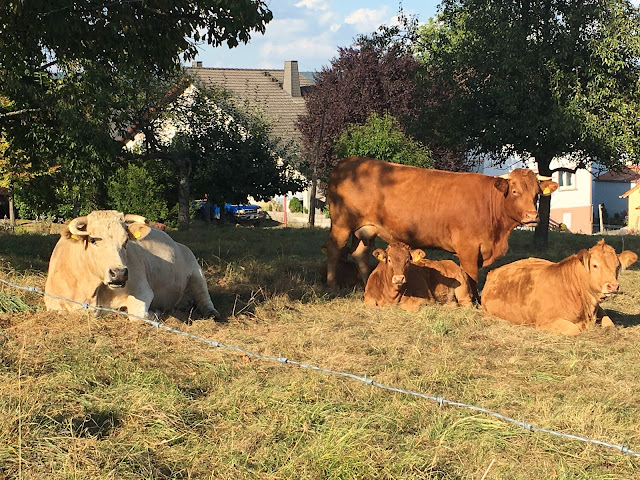

Just some cows in the neighborhood.


A field of canola. Every spring the countryside would be bright yellow. 


Pasture on the hill just behind our house, I could see these sheep from the second-story window. 

Sadly they weren't permanent residents, just visiting.  


In the summer this field was normally wheat or corn, 

but one summer it was all sunflowers and sweet peas, to help enrich the soil.


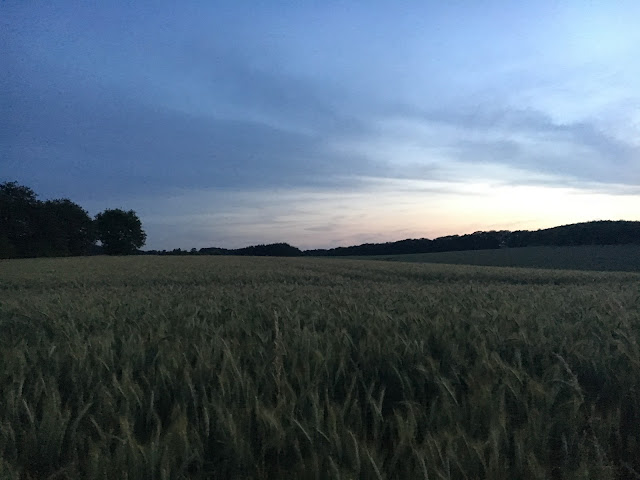
Sunset over the wheat field, just beyond my house. 


Hay all bundled up at the end of the season. I took this photo from my driveway. 


I loved the peace and quiet of the countryside but I was happy to move closer to a major city. Right now I'd be really happy to be on the edge of the farms, I'm sure it would be more relaxing right about now! Well, every place has its advantages. 

Bloggers, which are your favorite books about rural life? And does anyone else feel like moving out to the country about now? 

I'm counting this as my Adapted Classic for the Back to the Classics Challenge

Friday, July 20, 2018

Pomfret Towers: A Comfort Read Set in Downton Abbey (Plus a Bad Book Cover)

Nice cover on this Virago Modern Classic edition. It reminds me of a vintage travel poster. 

I started reading Angela Thirkell's Barsetshire series last fall, when I was in dire need of a comfort read. Beginning in 1933, Angela Mackail Thirkell (sister of Denis Mackail, who wrote the charming Greenery Street) wrote 29 novels set in the fictional county of Barsetshire, the same county as Trollope's novels. So far I've read five of the first six and have found all of them mostly delightful.  If the words "English country house party in the 1930s" pique your interest as they do mine, then this is quite possibly the book for you.

Pomfret Towers is #6 in the series and was published in 1938. The story begins with an invitation to a weekend house party. (I kept imagining it set in pre-war Highclere Castle AKA Downton Abbey, which I just visited in the UK; I'll post about it soon). The elderly Lord Pomfret is having a group for the weekend and is looking for some young people, so he invites Guy and Alice Barton, the young adult children of one of his tenants. Mr. Barton is a successful architect and his wife is a successful writer of historical novels. Guy works for his father and Alice, shy and delicate, is terrified of the idea of spending a weekend with a lot of smart and fashionable people. She warily accepts after Lord Pomfret tells her to bring along her friends Roddy and Sally Wicklow. Rowdy works for Lord Pomfret's agent, and Sally is a quintessential country girl who loves dogs and horses and is quite jolly. 

The house party gets under way and Alice is taken under the wing of the beautiful Phoebe Rivers, a sort of cousin to Lord Pomfret, who is visiting with her brother Julian, a rather spoiled artist-type, and their overbearing mother, Hermione, another novelist. Mrs. Rivers' primary purpose in the visit is to get Phoebe paired off with Lord Pomfret's heir apparent, Giles Foster. The house also party includes Mr. Johns, one of the partners of Mrs. Rivers' publishing firm, who is not convinced that the income from her books is worth the trouble of putting up with her. 

Most of the story is taken up with the possible pairings-off between the various young people and the chagrin of Mrs. Rivers when these silly youths don't follow her wishes. There are also some very funny bits about writers and publishers. Our omniscient narrator gives us some of Mr. Johns' more amusing thoughts, as well as Lady Pomfret's steadfast secretary Miss Merriman, in whom the unbearable Mrs. Rivers has met her match.

. . . [Mrs. Rivers] was forced to fall back on the interesting subject of herself and tell Miss Merriman how many signed photographs she gave away last year. If Miss Merriman had had real tact she would have asked whether Mrs. Rivers could possibly spare her one, but she merely remarked that she must get one of Mrs. Rivers' books from the library as soon as she had time to do some reading, and that Lady Pomfret had had Mrs. Rivers' last book on the [waiting] list ever since it came out but hadn't got it yet. Whether Miss Merriman knew how annoying this was to Mrs. Rivers, who have liked the libraries to buy enough copies for all the subscribers, we are not in a position to say. (p. 129)

I really enjoyed this book -- it was light and funny, if a bit predictable. It was pretty easy to guess who was going to end up with whom, though there were some amusing minor plot twists. Also, in previous Thirkell books there have been occasional racist remarks which made me uncomfortable (though I do realize anti-Semitism was pretty common among the middle and upper classes during that period); this book, thankfully, didn't have any that I remember. 

And now for some alternate book covers! 


This cover is from the 1980s. Is that supposed to be Deborah Kerr? Whoever she is, she looks far too old and glamorous unless she's supposed to be Mrs. Rivers. And what is that bizarre cord wrapped around her shoulder and bosom? is she being lassoed by the guy hiding in the bushes? It's all very strange.


I suppose this one is better, it's the Moyer-Bell edition from 2007. Their covers are generally good (though I have found some egregious typographical errors in the text). I don't know enough about fashion history to know if this dress is period-appropriate. I don't have this edition so I don't know the source of the cover image.


The original cover. I do love how it explains Thirkell is the "author of 'August Folly' and other delightful novels.' Even her own publisher thinks her books are delightful, so it must be true!

Anyway, of the five Thirkell novels I've read so far, this was definitely my favorite and I'm very much looking forward to the next 24 (!) books in the series. I already own about a dozen in Moyer-Bell editions that I picked up at Half-Price Books back in Texas, though there are a few volumes in the series which are difficult to find and can be pricey.

After considering, I have decided to count this as my Classic by a Woman Author -- Thirkell wrote this book eighty years ago and it's still in print, so I'm calling that a classic. That makes ten books read for the Back to the Classics challenge, only two left to go!

Sunday, January 21, 2018

Awful Book Covers: Anne of Avonlea

While searching for book covers for my previous post about Anne of Avonlea, I was impressed at how many different images appeared. (Of course it's in the public domain so anyone can reprint it.) There are a lot of really nice covers, but nearly as many terrible ones. Time for another edition of Awful Book Covers!  Most of them are digital editions -- I guess people just Google "Old-Fashioned Girl," and see what comes up. Bonus points if the image actually has red hair. 

Let the snark begin!

Anne of Avonlea: Under the Sea edition!
Apparently someone has confused Anne with Ariel. At least the hair is the correct color.


Anne of Avonlea: Bobblehead edition!


Seriously, her head is far too big for her body. 
I get that it's a children's edition (and retold from the original), 
but how is that going to attract any readers?


Anne of Avonlea: Crappy Photoshop edition!


Possibly the lamest cover ever. Note how the inset illustration doesn't even blend in with the 
background. And the title isn't even centered. 


Anne of Avonlea: Claudette Colbert edition! 


This is actually a fairly nice image, but apparently Anne has been time-traveling to the 1920s to go to the moving pictures. 

Actual photo of Claudette Colbert, about 1929.

Anne of Green Gables: Clara Bow Edition!


To be fair, it's Anne of Green Gables, not Anne of Avonlea, but it's so egregiously wrong I had to include it. Seriously, she looks like a red-haired flapper in a nightgown. 
SO WRONG.


Anne of Avonlea: High Society Edition!


It looks like Anne is attending opening night at the opera (which she would probably really enjoy).
Either that, or she's suddenly appeared in an Edith Wharton novel. I'd read that.


Anne of Avonlea: Ugly schoolroom edition!


This is actually the print copy I checked out from the library on base. 
It is so ugly I could hardly bear to open it, I mostly read the digital download.


Anne of Avonlea: Hogwarts Edition!


It looks like Anne is using her supernatural powers to set fire to the room. Just awful.


Anne of Avonlea: Outdoor Pajama Party edition!


To be fair, I think this is a German edition. But what the heck is she wearing? 
Anne never wears pink; also, it looks like a baggy velour Snuggie.


Anne of Avonlea: Regency Edition! 


Did Anne join the Jane Austen Society of North America? 
It looks like Anne is definitely cosplaying as Elizabeth Bennet.
I must have missed her at the last Annual General Meeting. It must be the black wig.


Anne of Avonlea: Deep Mourning Edition!

Who died? And her head is blending in with that enormous smudge on the wall. 
Clearly not at Marilla's house, she would never allow such a thing.


And finally, the absolute worst. . . . 

Anne of Avonlea: Mid-Century Edition!


Seriously. She looks like a distressed teenager from the 1950s WITH BROWN HAIR. 
Clearly, somebody didn't even read a description of the book.


Well, that was really fun. Which other books deserve Awful Book Cover posts? 

Tuesday, May 2, 2017

Top Ten Tuesday: Retro Book Covers

This week's Top Ten Tuesday is all about the book covers. One of my favorite themes the past few years have been retro-styled book covers. I've noticed that quite a few of them seem to reproductions of classic travel posters, or in a similar style. Here are some reprints from Virago by Winifred Holtby that I just love.


Then there's this one by Vita Sackville-West. I actually liked the cover more than the book.


And I am absolutely drooling over this new series of British Library Crime Classics. I want to buy all of them for the covers alone. I couldn't resist buying a couple of these on my recent vacation, though I've yet to read any of them yet. Not all of them are travel-themed but here are some highlights:


And how about these beautiful reprints of Angela Thirkell's Barsetshire series from Virago?


Not quite so travel-inspired, as I think they're all set in the same village, but they do have that lovely retro quality. I think these are modern illustrations but I still love them. I've picked up quite a few Thirkells at library sales and used book shops, though I've yet to read any of them (I want to finish the Pallisers and the Poldark novels before I start the twenty-nine books in Thirkell's series!) 

Most of my Thirkells are Moyer-Bell editions but it's tempting to buy all the Viragos! Which I suppose is their intent, isn't it? I think publishers are working harder to create beautiful books to collect, maybe to offset the ebook sales? Bloggers, what book covers can you just not resist? 

Sunday, August 10, 2014

The Blue Castle by L. M. Montgomery

Okay, quick survey. . .  what is the worst cover of a book you've read so far in 2014?

And how does it compare to this one:


Honestly, is this not the CHEESIEST book cover you've ever seen????  (Unless, of course, you are a regular reader of paperback romances, or the illustrator of this cover, in which case I apologize in case I've offended you. )

And my next question is this:  I know that book covers will attract readers to books, but have you ever been so put off by a book's cover that you actually refused to read it?  I ask this, because I bought this book more than six years ago after reading rave reviews by some of my favorite bloggers.  However, I could never bring myself to read it because I was too embarrassed.  Seriously!!

I finally decided I'd give it a try the other day -- I honestly wanted something from my TBR shelves that was short, and that was the complete opposite of Moby-Dick, which I had just finished, after six weeks of listening to the audio in the car.  I had also started reading a Zola novel which just wasn't doing anything for me.   

This is the story of Valancy Stirling, who lives somewhere in Canada with her mother and aunt, and is completely cowed and browbeaten by her entire extended family.  At twenty-nine, she is an old maid, and her family will never forget it.  When I  actually started reading it, I still didn't crack my lousy mass-market paperback -- I read the first chapter or so via the e-book version from Project Gutenberg Australia.  

I was pretty much hooked when I read this paragraph in Chapter I:

Aunt Wellington, of whom Valancy stood in abject awe, would tell her about Olive's new chiffon dress and Cecil's last devoted letter. Valancy would have to look as pleased and interested as if the dress and letter had been hers or else Aunt Wellington would be offended. And Valancy had long ago decided that she would rather offend God than Aunt Wellington, because God might forgive her but Aunt Wellington never would.

Things get very interesting when something absolutely life-changing happens to Valancy.  Without telling her family why, she decides to take matters into her own hands and live her life the way she wants, without giving a fig about what other people think.  This completely shocks her family and most of the population of her small town, and the reactions of her family members are pretty hilarious.  I don't want to give too much away, but this part of the book is full of wry observations and some laugh-out loud moments.

This book was written by L. M. Montgomery, the beloved writer of the Anne of Green Gables series.  I discovered Anne fairly late in life -- I never read it as a child because I somehow got it confused with Pollyanna, and I assumed Anne would be a sickly-sweet goody two-shoes.  I never read Heidi either.  Still haven't.  (If there are any Heidi and Pollyanna fans out there, please tell me if I should reconsider). The Blue Castle is Montgomery's only book meant for adults, and it does remind me a bit of what Anne would have been like as a grown-up, though I can't for a minute imagine her as browbeaten as Valancy is in the beginning of the book -- so, really, Valancy is like Anne after she takes charge of her own life.

Anyway, this book is funny and charming, and there's a nice little love story, though the ending is a bit unrealistic.  But it's a fun fast read, just over 200 pages in most editions.  It's a great summer read if you can get past the horrible cover.  Clearly, the publishers never actually read it, because the couple on the front look nothing like Valancy and the love interest.  I only wish I'd bought a later edition with this cover:


or even this one: 


(Also cheesy, but not nearly as bad as the first one.)

Or even this one:


This one's better, but to be fair, Valancy's mother and aunt would faint dead away before they let her near a window with this much skin showing.  And don't get me started on the makeup -- this book was published in 1926.   

Anyway -- what books repelled you before you even opened the covers?  And has anyone actually read Pollyanna and liked her, or does she make your teeth ache?  

Sunday, June 8, 2014

The Jungle by Upton Sinclair

Not the actual cover of the edition I read.
That one is just too disturbing.
Warning:  Do not read The Jungle, if you are like me and typically read books while while eating.  Period.  End of story.  It will put you off your lunch, seriously.  Possibly for a long time.

That is not to say that The Jungle is not worth reading.  It's one of those books that I've had on the TBR shelf for more than three years now, since I received the Big Box of Penguins from the nice people at Penguin Classics.   It is one of those books, also, that I didn't want to read so much as I wanted to have read it, if that makes any sense.

Anyway, this is the story of Jurgis Rudkis, a Lithiuanian immigrant who lives in Chicago in the early 1900s.  The book begins at his wedding to Ona.  It starts out with a big party, and basically, their lives go downhill from there.  Not only do they go into debt for this big wedding, they're barely eking out an existence working in the famous Chicago stockyards, in a neighborhood known as Packingtown, which is one of the nastiest, filthiest places in literature.  This book was written as an indictment of the terrible conditions in which poor people lived and worked at the time, especially immigrants, who came to America thinking they'd have all these great opportunities.  In fact, conditions were probably worse for them than back in the old country.  I've read a lot of immigrant stories, but this is probably the first one I can remember in which the immigrants should have stayed home.

Jurgis came to America with his father, his future bride, her stepmother Elzbieta, and various extended family members and children, including Marija, Ona's cousin.  Thing start out badly when they arrive  in the slums of Chicago's Packingtown, and get worse when they're tricked into spending their savings a terrible house.  They're working hard under horrible working conditions, but illnesses, layoffs, and bad weather create a situation that goes from bad to worse.  And I do mean seriously worse.  Have you read Germinal or The Grapes of Wrath?  Those books are cheerful compared to The Jungle, which has my vote for Most Depressing Book of All Time.

And Sinclair does not shy away from the messy details.  He goes into great detail about the horrible sanitation of the stockyards, the disease and filth and disgusting working conditions.  It's amazing to believe that anyone survived eating food that came out of there -- and even scarier to think of how it must have been to work there.  There was so much corruption, and so few rights for the workers, it's just shocking.

But this book isn't just about how bad the sanitation and working conditions of the stockyards; it's also about how few rights workers had, how companies took advantage of immigrants, and about the shocking corruption, both with the big corporations and in Chicago politics.  Having lived in Chicago for ten years, this sheds new light for me.  (I will never think of the name for the Chicago Bulls basketball team in quite the same way again). 

The edition that I actually read.  It's a really nice edition, except for the cover artwork.

It was an interesting book, yet horrifying.  I can't say I'd recommend it for the writing or character development; even the plot is not that great.  I'm quite sure this book is considered important for its impact than for its literary merit.  In a way, the terrible lives of these people in Packingtown are so over-the-top, it's unbelievable.  They were less human to me, more caricatures --  it's like Sinclair thought to himself while writing, how can get this get worse?  It really lacked the great writing of Steinbeck and the riveting characters of Zola; if you haven't read anything by Zola, he is the absolute master of creating people whose lives are on incredible downward spirals.  Also, the ending of the book is really unresolved -- it just ends with this big rant about Socialism, and we never find out what happens to Jurgis and the rest of the family.


So.  I'm very proud to have finally finished it -- that's five books off my TBR Pile Challenge for this year.  My goal was one book every month, so I'm a little behind, but not terribly.  I've already started reading The Sisters, a biography of the Mitfords, which I already know will be a really fun read.  I know I'm supposed to be starting Moby-Dick, but I really need a break to before starting another book I've been dreading.  How's everyone else doing on their TBR Pile Challenge?  Are they books you love, or just books you really wanted to have crossed off your list?  And are there any books even more depressing than The Jungle

Tuesday, March 18, 2014

My Upcoming Vacation

Who wants to guess where I'm going next week?

Here are a few literary clues:


Anyone????

Monday, February 10, 2014

Awful Book Covers: House of Mirth

Inspired by this hilarious post by Simon of Stuck in a Book, I've decided to showcase some bad book covers of my own choosing. Here are some supremely bad covers from one of my favorite novels, House of Mirth by Edith Wharton.  Let the snark begin!


House of Mirth:  Renaissance version!  
Because we all know that Lily Bart lived in 1605, not 1905.   


House of Mirth:  Bridal Shower edition!
The one where Lily Bart and her frenemies make gowns out of toilet paper.


House of Mirth: 18th Century edition. Laurence Selden is really rocking those breeches --
I especially love his golden capelet.  


House of Mirth: Cirque du Soleil edition!
Lily Bart visits Venice and gets her face painted at a street fair.


House of Mirth: Crazy Reptile Lady edition!
Apparently Lily would rather hang out in Italy with a little turtle instead of her society friends.
But her outfit is fabulous, though I can't figure out what time period that's supposed to be.  


House of Mirth: Jazz Age edition!  
I actually kind of like this cover, even though it's the wrong time period.  Too bad Lily didn't live in the 1920s.  But then she'd be in The Glimpses of the Moon instead. 


House of Mirth: No Girls Allowed edition!
It looks like she's about to run the gauntlet to get into their exclusive men's club. 
(And not a fun club with Bertie Wooster, either). 


House of Mirth: Diva Edition!  
Lily Bart starts a new career as an opera singer, and lives happily ever after.  Riiiight.


House of Mirth: YA Edition! 
That's the prequel when Lily was 13 and wandered around a mansion in her nightgown.


House of Mirth: Pre-Raphaelite edition!
(I think this may be the same girl who had nothing to wear but her wet sheet
 in Simon's Wuthering Heights cover.)


House of Mirth:  "Mr. Selfridge"edition!
Of course Mrs. Selfridge's dresses were much more fabulous.  
That is one seriously ugly dress.


House of Mirth: Ennui edition!
I love Penguin classics, but that girl looks bored beyond belief.


That was really fun -- which novel should I pick for my next edition of Awful Book Covers? 
And who else wants to play?