 |
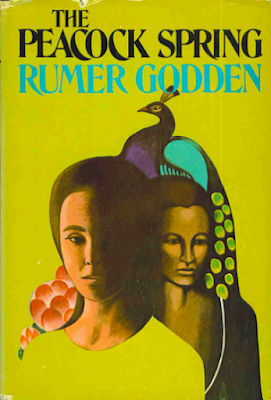
| Cover of the 1975 edition, of which I now have 2 copies |
As I read a lot of middlebrow fiction, Rumer Godden is a writer that's been on my reading radar forever. Last year I was browsing on the cart outside Alabaster Books in New York, a tiny used and rare bookstore that is often overshadowed by the much more famous Strand Bookstore on the opposite side of the block. I found a 1976 copy of Peacock Spring and paid the bargain price of $1.
Then last weekend I was killing time in another used bookstore in Pittsburgh (touristy post to follow soon) while waiting for a rideshare. Lo and behold, I found another copy of Peacock Spring and started reading it as I waited. I felt guilty about spending so much time there so I felt compelled to buy the second copy (only $7) and read it that night and on the plane home the following day. That didn't work out exactly as planned but I did finish the book this week and HOO BOY.
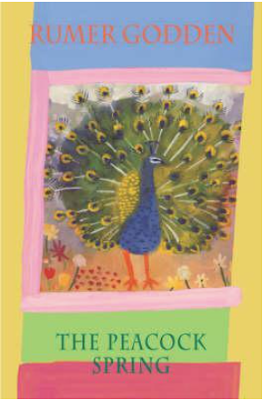 |
| Cover of the 2004 paperback edition. A new copy can be yours via Amazon $632. Or $695. I did not omit the decimal point. (Or a good used copy for 16 cents.) |
Set mainly in post-Independence India, this is the story of Una Gwithiam, the teenaged daughter of Sir Edward Gwithiam, a diplomat newly appointed to a post in Delhi. Una and her younger half-sister are at boarding school in the UK when the headmistress tells her that she and her sister Halcyon (nicknamed Hal) are to leave their school and join their father in India, for reasons unexplained. Hal is thrilled but Una, more studious, is not, especially after she meets her new governess, Alix Lamont, a half-caste Eurasian who seems under-qualified. Una had had hopes of entering Oxford or Cambridge but now it seems those are dashed. Miss Lamont seems more interested in taking them sightseeing and socializing, and Una is forced to attempt higher mathematics on her own. This leads to a meeting with Ravi, an attractive young gardener who promises to secretly help her study. Meanwhile, Una and Hal aren't getting along with their governess Miss Lamont who seems to have secrets of her own.
Rumer Godden was born in the UK but grew up in what is now Bangladesh (then colonial India), and moved back and forth before and after both world wars, so she knew India really well. The descriptions of India and of colonial life are really interesting, the highlights of the book for me. The book began rather slowly and it took awhile for me to get into, but by the second half I sped through it to find out what would happen -- which was sort of predictable, if somewhat problematic. And I don't mean problematic because of racism or classicism, which are definitely addressed pretty well, but problematic because of the age difference between Una and Ravi. Una is only 15 when the book takes place and though they never specifically Ravi's age, he's at least seven or eight years older than her which is pretty icky. There are definitely some consent issues in this book which made me absolutely cringe and want to throw the book across the room.
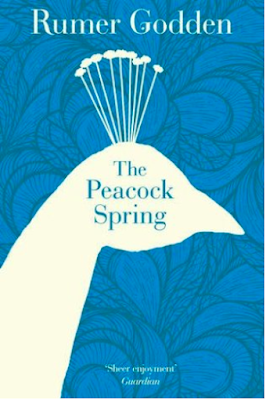 |
| Cover of the 2013 edition. These do not cost $632. |
I did, however, complete the book and I was not surprised at how it ended up. Overall it's interesting and I loved the descriptions of India, a country I've always wanted to visit, but it's definitely problematic. It was first published in 1975 but I'm not sure of the exact year in which it's set. There was a PBS Masterpiece adaptation in 1995 which set the story in 1959, but I don't remember it being specifically mentioned in the book, not that it really matters.
And I discovered the adaptation is streaming on Amazon Prime! I couldn't find any stills but here's an image from the website. Might have to check it out soon.
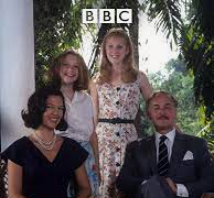 |
| That's a very young Hattie Morahan as Una, in her first TV role. I know her best as Elinor Dashwood in the 2008 adaptation of Sense & Sensibility |
And now that I have two copies of the 1975 hardcover, I have an extra to share. (The $1 copy, not a $632). If anyone is interested in a free copy of this book, drop a comment below. If I have more than one person interested in the next week, I'll draw a name at random. Make sure you leave contact info so I can get a good mailing address!
This is my second novel completed for the TBR Pile Challenge.