Showing posts with label Penguin. Show all posts

Friday, March 4, 2022

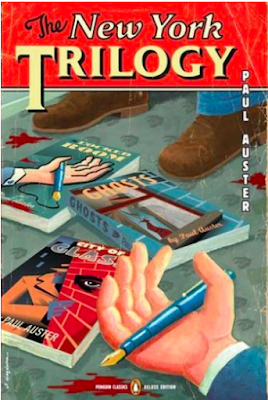
The New York Trilogy by Paul Auster: Metafiction Mysteries


Everyone knows that stories are imaginary. Whatever effect they might have on us, we know they are not true, even when they tell us truths more important than the ones we can find elsewhere. ("The Locked Room")

More than ten years ago I received a big box of 24 Penguin Deluxe Classics as a prize from the publisher. As of this year I still had four still unread so I added The New York Trilogy to my TBR Pile Challenge list. I brought it with me, appropriately, to a recent trip to New York, but this book was not what I expected at all. This is an odd book, and I don't even know if I can describe it accurately.

It's a collection of three novellas, originally published in 1985 and 19867. Each of the protagonists is either a private investigator, or someone who becomes caught up in an investigation. Ostensibly they are all detective novels, but they're hardly the mystery/detective fiction of Raymond Chandler or Dashiell Hammett.They all begin as traditional detective novels, but it quickly becomes apparent that they're all much more than that, as the narrators begin to question what they're doing and the nature of their existence within the investigations. 

In the first novella, "City of Glass" a mystery writer named Quinn who is between projects gets a series of mysterious phone calls for a "Paul Auster," asking for help. Out of boredom and curiosity, he decides to impersonate Auster and ends up taking on a case and descends into a Kafka-esque spiral. 

The second novella is titled "Ghosts," in which a private investigator named Blue is hired by the mysterious White to follow a man named Black and monitor him 24 hours a day. Eventually he starts to wonder who is observing who and what it all means. (All the characters are named after colors, shades of Reservoir Dogs.)

The final novella of the trilogy, "The Locked Room" is the story of a nameless young writer contacted by the beautiful wife of his childhood friend Fanshawe, who seems to have disappeared, leaving behind boxes crammed with his writings. She asks the narrator to fulfill her missing husband's request to try and get his writing published and he becomes obsessed with finding out what happened to his old friend while becoming more involved with the wife. 


I really liked these novellas but they were so much more than I expected. Instead of the hard-boiled detectives of the mid-century, the protagonists all begin to question their own existence and sometimes their own reality. They're all actually interconnected and it took me quite a while to figure out how they were related, other than being set in New York. (I had put the book down for a couple of weeks before the first and second novellas so that definitely made it harder.)

They're also quite different from writing style of the traditional detective novel. There are so many insightful and beautiful quotes adding little sticky notes so I wouldn't forget them. Some favorites: 

New York was the nowhere he had built around himself, and he realized he had no intention of ever leaving it again. (City of Glass)

For the first time in his experience of writing reports, he discovers that words do not necessarily work, that it is possible for them to obscure the things they are trying to say. (Ghosts)

He feels like a man who has been condemned to sit in a room and go on reading a book for the rest of his life. This is strange enough -- to be only half alive at best, seeing the world only through words, living only through the lives of others. But if the book were an interesting one, perhaps it wouldn't be so bad. He could get caught up in the story, so to speak, and little by little begin to forget himself. But this book offers him nothing. There is no story, no plot, no action -- nothing but a man sitting alone in a room and writing a book. (Ghosts)

Stories happen only to those who are able to tell them, someone once said. In the same way, perhaps, experiences present themselves only to those who are able to have them. (The Locked Room)

A man does not spend his time hiding from the world without making sure to cover his tracks. (The Locked Room)

We all want to be told stories, and we listen to them in the same way we did when we were young. We imagine the real story inside the words, and to do this we substitute ourselves for the person in the story, pretending that we can understand him because we understand ourselves. This is a deception. We exist for ourselves, perhaps, and at times we even have a glimmer of who we are, but in the end we can never be sure, and as our lives go on, we become more and more opaque to ourselves, more and more aware of our own incoherence. No one can cross the boundary into another -- for the simple reason that no one can gain access to himself. (The Locked Room)


That's a lot of quotes but they're all so good that I couldn't cut a single one. I'm not a huge fan of post-modern or meta-fiction but I can't stop thinking about this book. It did have some sexist tropes that I could have done without but I understand why Penguin added it to their Classics list, despite being published in the 1980s. If I had a mystery book group I would absolutely recommend this because there is a LOT in here to discuss. I'm not even sure I understand the ending. 

This is my third book for the TBR Pile Challenge and I'm really glad that it inspired me to finally read this novel. 

Wednesday, July 16, 2014

Moby-Dick by Herman Melville, Chapters 51 - 90


So, I'm up to Chapter 90 of Moby-Dick.  I really did mean to finish by July 15, but I'm pretty certain that's not going to happen.  I have made some real progress, and I hope to finish it in the next couple of weeks.

I'm very glad that this book is all in short chapters, because I don't know how much I could sit down and read straight through.  In all honestly, if I didn't have the audiobook in the car, I don't know if I would have gotten this far.

There's really not that much narrative at this point -- Ishmael and the boys are on the hunt, and there are far, far more asides than actual plot.  I understand this is probably ground-breaking and experimental, but I'm beginning to understand why this is a book that people either really love or really hate.  There's still not so much character development -- I understand that Ahab is on a quest for revenge against the white whale, but other than that, not much insight into his character, or Ishmael either.  He seems more like an omniscient more than anything else at this point.  Well, there are still about 45 chapter to go, so I suppose that part is upcoming.

What I'm really learning about so far is whales -- the differences between the different types, their anatomy, habits, you name it.  Ishmael (or Melville, I suppose) seems in awe of whales, almost reverent about them -- it's sort of shocking how much he seems to admire them, yet in the very next chapter, or even the next paragraph, will then go on describe how they're going to kill these magnificent creatures.  I'm learning much, much more about the butchering of whales than I would like.  So far, when it comes to Man vs. Whales, I'm firmly on Team Whale.  I'm not a vegetarian, I do eat all kinds of meat, but there's no way I could bring myself to ever eat whale, especially after reading this book.  Maybe I should start on a krill diet.


That being said, the writing is mostly excellent, but I'm finding the story kind of uneven overall -- some chapters are fascinating and others just bore me to tears.  Frank Muller's narration really does enhance the story.  I'm down to the last five discs, so I should finally finish it up in the next week or so.

Is anyone else still working on Moby-Dick?  How are you enjoying it?  

Sunday, June 8, 2014

The Jungle by Upton Sinclair

Not the actual cover of the edition I read.
That one is just too disturbing.
Warning:  Do not read The Jungle, if you are like me and typically read books while while eating.  Period.  End of story.  It will put you off your lunch, seriously.  Possibly for a long time.

That is not to say that The Jungle is not worth reading.  It's one of those books that I've had on the TBR shelf for more than three years now, since I received the Big Box of Penguins from the nice people at Penguin Classics.   It is one of those books, also, that I didn't want to read so much as I wanted to have read it, if that makes any sense.

Anyway, this is the story of Jurgis Rudkis, a Lithiuanian immigrant who lives in Chicago in the early 1900s.  The book begins at his wedding to Ona.  It starts out with a big party, and basically, their lives go downhill from there.  Not only do they go into debt for this big wedding, they're barely eking out an existence working in the famous Chicago stockyards, in a neighborhood known as Packingtown, which is one of the nastiest, filthiest places in literature.  This book was written as an indictment of the terrible conditions in which poor people lived and worked at the time, especially immigrants, who came to America thinking they'd have all these great opportunities.  In fact, conditions were probably worse for them than back in the old country.  I've read a lot of immigrant stories, but this is probably the first one I can remember in which the immigrants should have stayed home.

Jurgis came to America with his father, his future bride, her stepmother Elzbieta, and various extended family members and children, including Marija, Ona's cousin.  Thing start out badly when they arrive  in the slums of Chicago's Packingtown, and get worse when they're tricked into spending their savings a terrible house.  They're working hard under horrible working conditions, but illnesses, layoffs, and bad weather create a situation that goes from bad to worse.  And I do mean seriously worse.  Have you read Germinal or The Grapes of Wrath?  Those books are cheerful compared to The Jungle, which has my vote for Most Depressing Book of All Time.

And Sinclair does not shy away from the messy details.  He goes into great detail about the horrible sanitation of the stockyards, the disease and filth and disgusting working conditions.  It's amazing to believe that anyone survived eating food that came out of there -- and even scarier to think of how it must have been to work there.  There was so much corruption, and so few rights for the workers, it's just shocking.

But this book isn't just about how bad the sanitation and working conditions of the stockyards; it's also about how few rights workers had, how companies took advantage of immigrants, and about the shocking corruption, both with the big corporations and in Chicago politics.  Having lived in Chicago for ten years, this sheds new light for me.  (I will never think of the name for the Chicago Bulls basketball team in quite the same way again). 

The edition that I actually read.  It's a really nice edition, except for the cover artwork.

It was an interesting book, yet horrifying.  I can't say I'd recommend it for the writing or character development; even the plot is not that great.  I'm quite sure this book is considered important for its impact than for its literary merit.  In a way, the terrible lives of these people in Packingtown are so over-the-top, it's unbelievable.  They were less human to me, more caricatures --  it's like Sinclair thought to himself while writing, how can get this get worse?  It really lacked the great writing of Steinbeck and the riveting characters of Zola; if you haven't read anything by Zola, he is the absolute master of creating people whose lives are on incredible downward spirals.  Also, the ending of the book is really unresolved -- it just ends with this big rant about Socialism, and we never find out what happens to Jurgis and the rest of the family.


So.  I'm very proud to have finally finished it -- that's five books off my TBR Pile Challenge for this year.  My goal was one book every month, so I'm a little behind, but not terribly.  I've already started reading The Sisters, a biography of the Mitfords, which I already know will be a really fun read.  I know I'm supposed to be starting Moby-Dick, but I really need a break to before starting another book I've been dreading.  How's everyone else doing on their TBR Pile Challenge?  Are they books you love, or just books you really wanted to have crossed off your list?  And are there any books even more depressing than The Jungle

Tuesday, February 1, 2011

A Big Box of Penguin Classics!

My only New Year's Resolution was to curtail the amount of books I was adding to my to-read shelves by not purchasing any more books.  But gifts don't count, right?  Well, what about . . . prizes?  Because a couple of weeks ago I received an unexpected email from Penguin Books!  To my surprise and delight, this is what it said:

"Congratulations! Your predictions for the final list of 10 Essential Penguin Classics were closer than anyone else's (okay, full disclosure, you and another person tied, so we're awarding two grand prizes). Because of your Nostradamus-like powers of prediction, you've won a set of Penguin Classics Deluxe Editions."

!!!!!!!!!!!!!!!!!!!!!!!!!!!!!!!!!!!!!!!!!!!!!!!!!!!!!!!!!!!!!!!!!!!!!!!!!!!!!!!!!!!!!!!!!!!

I was gobsmacked!  Okay, I've won prizes before, but I don't think I've ever won anything that wasn't random or pure luck, like a giveaway from another book blogger, or a door prize.  Or bingo -- certainly nothing that involved actual skill or knowledge.  I've never even been able to guess how many jelly beans are in a jar (not that I'd even want them -- seriously, if isn't chocolate, why bother?).  But I digress.

Anyway -- today I received a box with TWENTY FOUR Graphics Deluxe Classics from Penguin books!  A twenty-three pound box!!  Here's a photo of what was inside, properly alphabetized by author:


If you can't read the titles very well, here's a list of what was in the box:
  1. Little Women by Louisa May Alcott*
  2. Fairy Tales by Hans Christian Andersen
  3. Pride and Prejudice by Jane Austen*
  4. The New York Trilogy by Paul Auster
  5. Jane Eyre by Charlotte Bronte*
  6. Wuthering Heights by Emily Bronte*
  7. The Canterbury Tales by Geoffrey Chaucer
  8. White Noise by Don DeLillo
  9. Great Expectations by Charles Dickens*
  10. The Scarlet Letter by Nathaniel Hawthorne*
  11. We Have Always Lived in the Castle by Shirley Jackson
  12. Metamorphosis and Other Stories by Franz Kafka
  13. Lady Chatterley's Lover by D. H. Lawrence
  14. Moby-Dick by Herman Melville
  15. The Portable Dorothy Parker by Dorothy Parker
  16. Gravity's Rainbow by Thomas Pynchon
  17. Frankenstein by Mary Shelley*
  18. The Jungle by Upton Sinclair
  19. The Acts of King Arthur and His Noble Knights by John Steinbeck
  20. Dracula by Bram Stoker*
  21. The Adventures of Huckleberry Finn by Mark Twain*
  22. Candide, or Optimism by Voltaire*
  23. Ethan Frome by Edith Wharton*
  24. The Picture of Dorian Gray by Oscar Wilde*
Update: Titles with asterisks are those I have read.

I've read quite a few classics but only half of these, so I've just added another 12 books to my owned-and-unread challenge.  I do own a few of these already, my other editions aren't nearly as nice!  I had originally thought I'd share some of these with friends, here in town and in the blogosphere, but these are so beautiful I don't know if I can part with any of them. They now have their own dedicated bookshelf.   

I'll start reading them soon and I'll be sure and post updates with my reviews.  Any suggestions where I should start?

And before I forget, thanks again to the generous folks at Penguin Classics, and congratulations to Jane at Reading, Writing, Working, Playing, the other winner of the sweepstakes!  Woo hoo!