Showing posts with label 2014. Show all posts

Thursday, January 1, 2015

Mount TBR Pile Challenge: Final Mountaineering Checkpoint


This year, I'm really proud of myself for completing SIXTY TWO books from my own shelves!!  Yes!  Since I finished 103 books, that brings me to 60% books read from my own shelves, not including rereads.  I've exceeded last year's goal of 50% books from my own shelves.  That brought me to my goal on the Mount TBR Pile Challenge, the Mt. Kilimanjaro level.

And now, here's my Year in Review According to Mount TBR.  I've made up my own statements to fit the books I blogged about this year.


Working at the library is better than being The Post-Office Girl.

Though sometimes I feel like I'm being Singled Out.

I'm pretty sure my husband always tells himself He Knew He Was Right

I wish my house were The Blue Castle

I looked in my refrigerator today and found Few Eggs and No Oranges

My back yard sometimes looks like: The Jungle


When I was younger, my favorite Beatles song was:  Norwegian Wood

Someday I'll look back and think these were: The Light Years

I think my college years were A Sentimental Education

If the were a real place, I'd love to visit: Mansfield Park

Or I'd fly to China and have a Peking Picnic

If I were on a road trip through India, I'd definitely invite Kim

If Kim asked me a question on a hot day, he might get a Dusty Answer


I'd love to take an ocean voyage, just not like the one in:Moby-Dick

And if it were a calm night, not too cloudy, I might catch a few of The Glimpses of the Moon

I'm glad I don't have to dress like The Edwardians

Also glad that my family is not as wacky as The Sisters: The Saga of the Mitford Family

Or as famous as Marie Antoinette.

If I could pick a literary friend from a book this year, I'd choose Miss Majoribanks; or maybe Rachel Ray;

I'd also love to meet Arsene Lupin, Gentleman Thief;

But definitely not Nana or Sapphira and the Slave Girl (well, actually, just not Sapphira; the slave girl sounded like a nice person!).

I'd be afraid to visit ancient Rome and meet I, Claudius -- but only if I were escorted by The Return of the Soldier!

This was a really fun blog post -- like literary Mad Libs, but in reverse!  I've already signed up for next year's challenge and I'm hoping to achieve the same goal of 60 or more books read from my own shelves -- I still have about 170 unread left!

Has anyone else signed up for this challenge?  Good luck!

Tuesday, December 30, 2014

TBR Pile Challenge 2014: Finished!


I didn't think I would complete it in time, but I finally finished!  I had to cram in three books in December, but I've officially completed Adam's 2014 TBR Pile Challenge.

Here's my original post, and here's what I read, with links to all of my reviews, in chronological order:

1.  The Light Years by Elizabeth Jane Howard.  Loved this!  First in a sprawling saga of an English family, before WWII and the years following.  I liked it so much I read three more volumes in the series. . . and of course I had to purchase the final volume which was recently published, thus adding another book to the TBR pile!  Completed 1/5/14.

2.  Miss Marjoribanks by Margaret Oliphant.  A delightful Victorian tale about a young single woman who likes arranging the lives of everyone around her, but not herself.  She was a nicer, less self-absorbed version of Jane Austen's Emma.  A winner!  Completed 2/1/14. 

3.  Dusty Answer by Rosamond Lehmann.  A coming-of-age story set between the wars about a girl in love with various cousins in the same family.  Good, but a bit slow.  Completed 2/16/14.

4.  Kim by Rudyard Kipling.  Not nearly as much action as I was expecting -- I thought it was an adventure classic, but I think it's more of a coming-of-age story.  Not bad, though. Completed 5/9/14.

5.  The Jungle by Upton Sinclair.  Not the best book I've ever read, but I understand the historical significance.  Parts of it were interesting, parts were just gross, and the ending befuddled me.  Also, the ugliest cover on a book I've read this year. Completed 6/7/14. 


6.  The Sisters: The Saga of the Mitford Family by Mary S. Lovell.  This book really was stranger than fiction -- a family of eccentric aristocratic sisters.  One was a Marxist; one became the Duchess of Devonshire; one married first the heir to the Guinness fortune, then left him for a Fascist who was the most hated man in England during WWII; and one was a Hitler groupie who shot herself when Britain declared war on Germany.  You can't make this stuff up!  It was one of my favorite reads of the year.  Completed 6/15/14.

7.  Peking Picnic by Ann Bridge.  A bit of a disappointment -- a bunch of rich expats in China go on a country excursion even though the locals are on the verge of an uprising.  Slower and less interesting than I expected. Completed 7/3/14.

8.   Singled Out by Victoria Nicholson.  A really interesting book about the millions of women who had no chance of marriage after WWI.  I'm always interested in social history and this one tied in nicely with the anniversary of WWI.  Completed 7/19/14. 


9.   The Edwardians by Vita-Sackville West.  Set just before WWI, this was a slow-moving story about  a young aristocrat during the end of an era.  Completed 8/31/14.

10.   Norwegian Wood by Haruki Murakami.  I loved reading about Japan but didn't much like how the female characters were depicted. Completed 12/5/14.

11.  I, Claudius by Robert Graves.  An interesting read, but a little slow -- very heavy on the historical details.  And those ancient Romans were CRAZY.  I'm looking forward to the classic PBS miniseries.  Completed 12/17/14.

12.  Sentimental Education by Gustave Flaubert.  Meh.  Not nearly as good as Madame Bovary, or most everything I've read by Zola.  Completed 12/29/14.


I also had two alternate reads lined up, which were reading failures.  I had great hopes for Appetite for Life:  The Biography of Julia Child, but I found the writing pretty dry.  Julia's story should have been fascinating -- she did undercover work during WWII, moved to France with her husband and became an amazing cook, then wrote a ground-breaking French cookbook for Americans -- why didn't I love this book?  I couldn't get past the first couple of chapters.  Maybe I should try again later, or just try a different biography -- I found a copy of Dearie: The Remarkable Life of Julia Child by Bob Spitz on the sale table at Barnes and Noble, so I'm hoping that one will be better.

I never much got into my other alternate read The River's Tale: A Year on the Mekong by Edward Gargan.  I didn't get much farther than one chapter, but I think 2015 will be a year of many nonfiction reads, so I'll give it another shot.

Overall, my favorites were The Light Years, Miss Marjoribanks, and The Sisters.  Now I'm looking forward to starting my 2015 TBR Pile Challenge!   Bloggers, how did you do with your 2014 challenges?  And who's signing up for the TBR Pile Challenge for next year?

Monday, December 29, 2014

Sentimental Education by Gustave Flaubert


This is the final book for my TBR Pile Challenge 2014, huzzah!!  I had three books to finish for this challenge in the month of December, more than 1000 pages.  I didn't know if I'd be able to manage it, but I did.

So.  Many readers are familiar with Flaubert's most famous novel, Madame Bovary.  I read it several years ago and just loved it.  However, I don't know a single person who's read any of his other novels.    I found Sentimental Education during the Borders clearance a few years ago, but never got around to reading it.  Compared to Madame Bovary, which has more than 125,000 ratings on Goodreads, there are less than 10,000 for Sentimental Education.  Was this a hidden gem, or just not nearly as good?

Well, 460 pages later, I had my answer:  meh, not nearly as good.  Inspired by events from Flaubert's own life, Sentimental Education is set in 1840s Paris and suburbs, and is the story of Frederic Moreau, a young law student who falls madly in love with a married woman he sees on a ferryboat.

Madame Arnoux is about 30, married to a boorish, philandering man with a tendency towards shady business practices.  Frederic strikes up a conversation with Monsieur Arnoux, then slowly cultivates a friendship, simply so he can get closer to his wife.  Along the way, Frederic gets caught up in the upheaval of French politics, and the 1848 revolution as he climbs up the social ladder and has multiple love affairs while never giving up on Madame Arnoux.

Overall, I found the story moved a lot more slowly than Madam Bovary.  It actually seemed like there were two stories going on -- the story of Frederic and his obsession with Madame Arnoux, and then the story of Frederic and his friends and how they reacted to the political changes, and ultimately, the revolution.  They almost seemed like two different books to me (possibly why it's 460 pages, compared to 329 pages for Madam Bovary which seemed like a more focused novel).  Everyone one of the characters was unpleasant, with the possible exception of Madame Arnoux, who I found to be really undeveloped.  She's Frederic's ideal woman, so her personality is essentially flawless.  She's really a minor character in most of the story.

I think I would have gotten more out of this book if I understood the history of 19th century France better.  My knowledge of French history after the 1789 revolution is shaky at best -- I know a bit about the Napoleonic wars from War and Peace, and I vaguely remembered that there was more than one Napoleon, but that's about it.  There's a lot of politics and cultural references in this book that are not really explained within the context of the novel -- I suppose that Flaubert assumed that readers would know what he was talking about.  

So, overall, this book was a disappointment, compared to most of the French novels I've read in the few years.  A few months ago I read Bel-Ami by Guy de Maupassant, another story of a young man climbing his way up the social ladder in Paris (set during the French colonial period a few years later).  The main character was also pretty awful, but I found that book much more engaging and interesting.  Unfortunately, I was in a bit of a blogging slump at the time, so I never got around to reviewing it.

At any rate,  I've finally completed my TBR Pile Challenge and knocked another book off my Classics Club List, and I have another book to donate to the Friends of the Library sale.

Sunday, December 21, 2014

Back to the Classics Challenge 2014: My Final Wrap-Up Post


Well, I've finally completed the Back to the Classics Challenge 2014!!  Here's what I read:

19th Century Classic:  Rachel Ray by Anthony Trollope.  Completed 8/7/14.
20th Century Classic:  The Return of the Soldier by Rebecca West.  Completed 2/6/14.
Classic By a Woman Author:  The Glimpses of the Moon by Edith Wharton.  Completed 1/18/14.
Classic in Translation: Nana by Emile Zola.  Completed 8/10/14.
Classic About War:  The Moon is Down by John Steinbeck.  Completed 5/19/14.
Classic by an Author That's New to Me: The Post-Office Girl by Stefan Zweig.  Completed 3/31/14.

Optional Categories:

American Classic: Moby-Dick by Herman Melville. Completed 7/27/14.
Classic Mystery, Suspense or Thriller Novel: The Leavenworth Case by Anna Katherine Green.  Completed 12/6/14.
Classic Historical Fiction:  Sapphira and the Slave Girl by Willa Cather.  Completed 1/22/14.
Classic Adapted into a Movie/TV Series:  He Knew He Was Right by Anthony Trollope.  Completed 3/3/14.
Movie/TV Series Adaptation Review: He Knew He Was Right.  Completed 5/24/14.

This was a fun challenge.  I'm really pleased that I read ten classics, most of which were from my own TBR shelves or from my Classics Club list.  I think my favorites were the two Trollopes, Rachel Ray and He Knew He Was Right; The Glimpses of the Moon, and The Post Office Girl.

My least favorite was probably Moby-Dick.  I'm glad I finished it, but I don't think I would have gotten through it if I hadn't listened to it on audio.  I don't have any plans to read any more books by Melville in the near future!  Nana was also a disappointment, compared to the other books I've read by Zola.  Other than those two, I really enjoyed all my choices.  I still have lots more Trollopes on the TBR shelves, plus some Wharton, and I also have a big fat edition of the Collected Stories of Stefan Zweig, so I'm looking forward to that.

And now I'm ready to start my Back to the Classics Challenge 2015!  Who's with me?

Thursday, December 18, 2014

I, Claudius by Robert Graves


If time travel ever becomes a reality, DO NOT travel back to ancient Rome -- unless you have a death wish, because according to this book, everyone in Rome is trying to kill everyone else.  I, Claudius is like the Sopranos, but with togas but no baked ziti (tomatoes didn't arrive until the 1500s).  First published in 1934, this is the story of Claudius, an unlikely Roman emperor who lived from 10 BC to 54 AD.   Claudius stuttered, walked with a limp, and was slightly deaf.  Not the first choice for an emperor, normally, but he basically escaped being assassinated like everyone else for that exact reason -- everyone treated him like an idiot, and he never seemed like a threat to anyone.  He kept his mouth shut and his ears open and managed to outlive most of his family, which is pretty amazing.

It's quite a fascinating read, but it took awhile -- I can only read about so many backstabbers (sometimes literally) and murderers and plotters, and then I have to take a break.   There was so much plotting and deception, I can't believe people carried on normal lives.  At one point, Claudius does mention that most of this craziness actually involved only several hundred people, and that four million Roman citizens were basically enjoying normal, productive lives -- it was just the senators and aristocracy and their wives that were all involved in this mayhem.

I liked this book but it took a lot longer than I expected.  It's 468 pages, which doesn't usually take me that long, but this book is not a fast read.  There's hardly any dialogue, and it's densely packed with historical facts and people, sometimes it just seemed like Roman history thinly disguised as fiction.  Graves does a lot of telling, and not showing.  I don't know if he was imitating the style of classical writers, but it did get a bit tiresome.


Bust of the actual Claudius from a museum in Naples, Italy.
It was also complicated because there are so many characters, I could hardly keep track of them all ; also, many of them share the same names; for example, Claudius starts out by referring to his father and grandfather, but he never mentions their first names because they're all named Tiberius Claudius something something.  I really wish I'd started a list of the characters and their relationships while I was reading it -- I definitely would have appreciated a family tree or appendix.

I really wish I'd gotten around to reading this last winter, before I actually visited Rome.  Sadly, I didn't have nearly enough time to see all the things I wanted, though the Colosseum was amazing, and we saw the Roman Forum and the Palatine Hill as well.  I missed the Circus Maxims and the Appian Way, but we drove under an aqueduct before we even checked into the hotel.  There are ruins EVERYWHERE.

There's the Colosseum, just smack in the middle of Rome.  No big deal.
I have already requested the 1976 BBC miniseries, one of the most popular ever show here in the States on PBS.  Nothing says holiday fun like murderous backstabbing Romans, right? 

Tuesday, December 16, 2014

The Leavenworth Case by Anna Katherine Green


This is my final book for the Back to the Classics Challenge!  I can't believe I took so long to finish it.  I  think I took so long to get to this category (mystery/suspense/thriller) because I had a hard time deciding which book to read.  The only book I own that qualifies is The Mystery of Edwin Drood by Charles Dickens.  I kept putting it off (I've gone off Dickens somewhat this year in favor of Trollope) but I finally got an audio copy from the library, and I just couldn't get into it.  (I'm not sure if it was the reader, or if it's because the main character kept referring to the girl he loves as Pussy.)

Instead, I decided to look for another author.  I thought about Agatha Christie, but I honestly think I've read every single one of her mysteries, except for the Tommy and Tuppence stories.  I was searching online for other classic mysteries and I discovered The Leavenworth Case by Anna Katherine Green, an early mystery published in 1878, a full nine years before Sherlock Holmes, and by a woman!  Naturally, I was intrigued.

Here's the setup:  Mr. Raymond (we never learn his first name), is the junior partner of a New York law firm.  One day, he is alone in the office, when a very agitated young man informs him that Mr. Leavenworth, a longtime client of the firm, has been found shot and killed in the library of his home.  In the absence of the other partners, Mr. Raymond agrees to go to the home and do whatever he can to help, and is therefore drawn into the mystery.  The body was found in a room locked from the outside, and a servant girl is missing.  Suspicion immediately falls upon Mr. Leavenworth's two beautiful nieces, cousins whom he adopted when their parents died years ago. Mary, the younger of the two, was Mr. Leavenworth's intended heir, but Mr. Raymond is immediately smitten with the other niece, Eleanor.

However, the evidence is rather bad for the two cousins.  There are scraps of burned paper found in the grate, a missing key, and most damning, the fact that Eleanor knew how to fire the very same pistol used to shoot her uncle.  Mr. Raymond is so convinced of the ladies' innocence that he begins working with Mr. Ebeneezer Gryce, a private detective, to get to the truth of the matter.

I was really hoping that this would be an amazing discovery for me, a brilliant book that nobody reads anymore.  But sadly, it was a really slow read for a mystery.  It's rather wordy and melodramatic, almost a cross between a mystery and a Victorian sensation novel.  There's not a lot of motivation or character development.  For example, it seems that Mr. Leavenworth chose Mary heir to his fortune when she was a child, simply because she was a blonde!  And Raymond mentions over and over that the two cousins are beautiful and charming, but that's pretty much it for their descriptions.  Most of the characters are fairly flat.  The most interesting characters were Mr. Gryce and his assistant, the mysterious "Q" who is a master of disguise.

However, I'm probably judging it too harshly by modern standards.  For its time, it was most likely groundbreaking.  It was very popular and Anna Katherine Green wrote a total of more than 40 books, including eight other books about Mr. Gryce.  She was one of the first to write a series of novels about a detective, and also wrote about female detectives.  It's not among the best detective stories I've ever read, but I think it's worth reading simply for its historical value.

Sunday, December 7, 2014

Reminder: Back to the Classics Challenge Ends Soon!


Hey, remember the Back to the Classics Challenge??  Well, there's still time to post your reviews and your wrap-up posts if you want to qualify for the drawing!!  I had a total of 132 people sign up (including myself) and so far, only seven people have submitted wrap-up posts to qualify.  If you're one of the other 131 people, and you've posted reviews of at least six classic books from the categories, it's not too late for you to write a short wrap-up post to be entered into the drawing for the prize giveaway, a $30 (US) gift card from Amazon.com or the Book Depository.  

The official challenge rules are here, but please keep in mind that I need to see a wrap-up post and don't forget that all books for this challenge must be 50 years old to qualify; therefore, any book published AFTER 1964 is ineligible for this challenge and WILL NOT COUNT.

If you didn't make the original sign up (the deadline was back in March), never fear, because the Back to the Classics Challenge 2015 is definitely on!!  I'll be posting details soon.  

So, how is everyone doing with the challenge?  I've finished ten of the eleven categories, and I'm nearly finished with my last book, a classic mystery.  (Though I'm not putting my own name into the drawing).   Please let me know in the comments section how you're doing -- if you finished, which books did you like best?  Worst?  If you didn't finish, how far did you get?  If nothing else, you'll have the satisfaction of knowing you knocked some of those classics off your TBR pile!  

Friday, December 5, 2014

Norwegian Wood by Haruki Murakami


With less than a month until the end of Adam's 2014 TBR Pile Challenge, I still had three books left to finish.  I nearly gave up with more than 1000 combined pages to read by the end of December, but decided I there was still enough time to give it a final shot.  I chose Norwegian Wood as my first read because, quite honestly, it was the shortest of the three and I thought I could knock it out fairly quickly.

Norwegian Wood is a coming-of-age story about a young Japanese man, Toru Watanabe.  The story begins with a prologue of Toru in middle age as he suddenly relives a memory of an old girlfriend which is triggered by hearing the Beatles song "Norwegian Wood."  We flash back to the late 1960s, and learn about his troubled history with the beautiful and fragile Naoko, whom he'd originally met when Naoko was the girlfriend of Toru's childhood best friend Kizuki, who committed suicide when they were all 17.  Now in college, Toru and Naoko had rekindled their friendship after a chance meeting.  

The book follows the evolution of their friendship to the beginnings of a romance, but the course of true love never does run smoothly, and without spoiling too much, I'll just say that the couple is separated.  Toru is trying to hang on to his relationship with Naoka, but meanwhile he meets another girl Midori.  Toru is also influenced by an older student, Nagasawa, who is brilliant but something of a cold-hearted playboy, though he has a long-suffering girlfriend.   Basically, the story examines Toru's maturing as he struggles to reconcile his feelings for the two women and starts making decisions about how to live his life. 

Overall, I liked Norwegian Wood, but I can't really say I loved it.  I do think the writing was excellent and insightful, and I loved reading a the descriptions of Japan, especially about everyday life.  However, there were some aspects of the book that made me sort of uncomfortable, especially how the female characters were depicted. There's a lot of discussion about their sex lives which tended to go into way more detail than I needed to know, plus I think it was kind of sexist.  I understand that it's told from a young man's point of view and it is his coming-of-age story, but I really feel like the female characters were essentially a man's fantasy about what young women should be like.  I know it's a completely different culture and I shouldn't expect women of a different generation to fulfill my expectations, but it still bothered me.  

Norwegian Wood was incredibly popular in Japan and has sold millions of copies all over the world, and made the author into a literary superstar.  I bought this book more than 10 years ago, when I was living in Japan at Yokota Air Force Base, in Fussa-shi, a suburb of Tokyo.  I think I bought it because I wanted to learn more about Japanese culture, but I'm not sure why I never got around to reading it while I was there.  I really wish I had because there are a lot of mentions of places in and around Tokyo that I've actually visited, and quite a few that I wish I'd seen. I think I would have gotten a lot more out of the Japanese culture depicted if I'd read it while I was actually in Japan. 

I also really wish I knew someone else who'd read it so I could have a real discussion about it.  I do think this would be a really great book for a discussion -- this would be great for a read along, or a book group.  I haven't included too many details because I hate giving away too many plot details.  

I don't think Norwegian Wood will be one of my favorite reads of the year, but I'm very glad I read it and now I'm curious to read more by Murakami and possibly other Japanese writers.  I still have an unread copy of Snow Country by Yasunari Kawabata which is a Japanese classic that I hope to read next year.  

Sunday, August 31, 2014

Austen in August: Mansfield Park


I know that many, many people in the blogosphere are writing about Mansfield Park this year, mostly because it's the bicentenary of its publication.  This is my second reading of the book, though technically, it's a listen, since I have the wonderful Naxos audiobook version narrated by the brilliant Juliet Stevenson (who played Mrs. Elton in the 1996 version of Emma).

If you don't know the set up, here's the short version:  Fanny Price is the poor cousin of the wealthy Bertrams who live in Mansfield Park.  She's the daughter of one of the three Ward sisters -- the one who made a crap marriage and is living in Portsmouth with a drunkard and a passel of kids.  One of her aunts married a wealthy landowner, Sir Thomas Bertram, and the other married a clergyman who got the living at the local parish.  This sister, known as Aunt Norris, gets the bright idea to take one of her sister's kids off her parents hands, though she actually pawns her off to her sister and wealthy brother in law -- brilliant!

So young Fanny comes to live in a strange house at the age of ten, and every one pretty much treats her like crap, except the second brother, Edmund, who's actually nice to her.  Things get interesting when Fanny turns 18 and Aunt Norris' husband dies.  The living is assigned to another clergyman, Dr. Grant, who brings his wife and is shortly followed by Mrs. Grant's half-sister and half-brother, Mary and Henry Crawford, who proceed to stir up all kinds of trouble with the Bertrams.  Henry flirts with both the daughters, Julia and Maria (who is engaged to a wealthy but boring guy), and Mary sets her sights on Edmund, to the chagrin of Fanny, who's secretly in love with him.  So, lots of love triangles in sight.

I hadn't actually read this in several years -- I actually tried listening to the audio last year, but I got so disgusted by the dishrag personality of Fanny Price I got bored and gave up halfway through.  I only gave it another go because I'm gearing up for the upcoming Annual General Meeting of the Jane Austen Society of North America (JASNA), which I'm attending in October.  This year the theme is Mansfield Park, so I though I'd better give Fanny and company another chance.  And I was very glad I did, because I liked it so much better this time around.


Frances O'Connor as Fanny and Alessandro Nivola as Henry Crawford.  

I was really inspired to try it again after reading this wonderful essay by Paula Byrne, author of Jane Austen:  A Life in Small Things.  Byrne points out that instead of an innocent girl going from the country to the big city and being corrupted, the Crawfords come to the country and corrupt everyone around them.  It's also Austen's sexiest novel.  Mary Crawford makes her infamous quip about "rears and vices;" also, there's a lot of symbolism when Henry is trying to corrupt cousin Maria.  So, I gave it another try, and was very glad that I did.  Yes, Fanny's a little wimpy, but she's really a product of her environment.  Nobody except Edmund has paid much attention to her, other than to treat her as a de facto servant, like Aunt Bertram or Aunt Norris, or to constantly put her in her place, like Julia and Maria -- and Aunt Norris, who spends the entire book trying to beat her down.


The lovely Penguin clothbound classic.  Those are the gold chains that Fanny wears to her first ball -- will she choose the one given to her by her cousin Edmund, or by Mary Crawford?

This time, I really enjoyed Austen's dry wit as she describes Aunt Norris' hypocrisy, the self-absorption of Aunt Bertram, and Edmund's starry-eyed adoration of Mary Crawford.  All the faults and foibles of the Bertram clan are filtered through the eyes of Fanny, the novel's moral center. Sure, sometimes she's a bit too wimpy for my taste, but all the other characters are so well developed I can give her a pass.  Lord Bertram is a lot nicer than I remembered, and Aunt Norris is by far one of the most delicious villains in English literature.  Henry Crawford is kind of charming yet sleazy, and I kept wanting to shake some sense into both Fanny and Edmund.  If I liked Fanny's character better, it would be one of my top novels by Austen.

And now I'm going to have to watch one or both of the Mansfield Park adaptations available on DVD.  Years ago, I fell in love with the story after watching Patricia Rozema's 1999 film adaptation (before I'd actually read the book).  After becoming a devout Janeite, I discovered that many people pooh-pooh this version though I can't see that the more recent 2007 version is any better.  I still think the casting in the 1999 version is spot-on, though Frances O'Connor plays Fanny as a little spunkier than she is in the book.  The casting of Billie Piper as Fanny in the 2007 BBC miniseries is just wrong, though Blake Ritson is pretty dishy as Edmund.   There's also a 1983 version which I've heard is just awful, though it stars Anna Massey, which intrigues me.  I actually own an entire box set of 1980s BBC adaptations of Jane Austen novels, but I've never gotten around to watching it.

So -- how does everyone else feel about Mansfield Park?  Like me, can you put up with Fanny because the rest of the novel is just great?  Do you love Mary Crawford and wish she was the heroine?    And has anyone seen the 1983 BBC version of Mansfield Park?

Sunday, August 24, 2014

Peyton Place by Grace Metalious


Scandalous!!

Grace Metalious blew the roof off the image of the quaint New England Town in her 1956 shocker Peyton Place. Ostensibly set in the late 1930s and early 1940s, but with more of a 1950s feel to it, Peyton Place is the story of three women: Constance McKenzie, a beautiful widow with a Deep Dark Secret; her 13-year old daughter Allison, a budding writer coming of age in a small town; and Allison's best friend, Selena Cross, a beautiful girl who is growing up in squalor on the wrong side of the tracks with her mother, half brother, and stepfather, the town's creepy drunk.  

Peyton Place covers all the dirty secrets of small town life, including murder, suicide, child abuse, incest, illegitimacy, and abortion It was groundbreaking for its time, though it's probably pretty tame compared to Fifty Shades of Grey.  

I'm a big fan of stories of life in small-town America, and this is like a really sordid version of Gilmore Girls, with much less witty repartee. There were lots of interesting and colorful side characters -- the upright and beloved town doctor, the uptight school teacher; the rich, unscrupulous mill owner and spoiled son; and the new principal who comes from the big city.  There are a whole slew of characters from various generations, all with their own back story.  Some times I did wish Metalious had included less characters and given the reader more about less people.

I found it to be quite the page turner -- I finished the entire book in a weekend, and I really enjoyed it.  I did have trouble keeping some of the characters straight, particularly the colorful old-timers who sat around at the diner and played poker with the doctor and the town newspaper editor.  Some of the threads were left unresolved; there's a whole plot thread about Allison's childhood sweetheart Norman and his creepy mother, who seems like an eerie precursor to Norman Bates, but we never really find out what happened to him; also, I didn't care for the ending, which seemed somewhat tacked on.  I would love to read an entire book about Allison and what happened to her after the events in the book ended.  There was a sequel, Return to Peyton Place, but I've read it isn't that good, so I may skip it and just imagine for myself how the character's lives would have continued.  

Now I want to read more books about small-town American life -- Main Street by Sinclair Lewis has been on my to-read list for ever; also, I want to read some more mid-Century fiction.  Another one on my to-read list is The Group by Mary McCarthy, which I've returned unread to the library three times at least!

Bloggers, which other books about small-town life do you recommend?  Which banned books do you love?  And has anyone ever seen the Peyton Place movie or TV adaptations? 

Tuesday, August 19, 2014

Rachel Ray by Anthony Trollope


Among the twenty books by Anthony Trollope that I own is Rachel Ray.  It's not one of his most famous books compared to the Barchester series, the Pallisers books, or even The Way We Live Now, which is a shame, because it is mostly delightful, with one quibble.  It is also blessedly short, just about 400 pages, compared to some of his 800 page chunksters.  

Rachel Ray is 18 and lives in Baselhurst with her widowed mother and her sister Dorothy, who is ten years older and also widowed.  Both widows were previously married to clergymen, and Dorothy is very devout and evangelical.  Trouble starts one night when she reports to her mother that she has seen her younger sister doing something scandalous . . . walking alone with a man!!!  Shocking!  

This young man is in fact Luke Rowan, who is a guest of the Tappitt family.  Rowan is the heir to a portion of the local brewery, and came to Baselhurst to try and work out an arrangement with Mr. Tappitt.  Mrs. Tappitt had great hopes that he would marry one of the three unwed Tappitt daughters, who are friends of Rachel.  Rachel was visiting her friend Cherry Tappitt, and was walking home when he overtook her and caused this minor scandal.  

Meanwhile, Mr. Rowan has all kinds of ideas about improving the brewery and the beer.  Mr. Tappitt thinks he is a young upstart, and Mrs. Tappitt is smarting because Luke had the nerve to fall in love with Rachel instead of one of her daughters.  Luke is a little hotheaded, and he Mr. Tappitt can't get along.  Meanwhile, there's a local election which causes the town to start taking sides, partly based on the whole Rowan/Tappitt feud, and poor Rachel is caught in the middle.  The story follows the courtship of Rachel and Luke, and is a social satire about gossip, hypocritical evangelicals, and local politics. 

I mostly enjoyed this book.  The characters are charming and interesting, and Trollope gets in some good digs, especially about the overly pious Dorothy and a suitor who is mostly interested in her money.  The only part of the novel I didn't enjoy was an aspect of the local election -- the current MP is challenged by a local businessman who is -- gasp -- a Jew.  He's not a bad character, but some unpleasant comments are made about him by other characters (mostly his political opponents) which made me uncomfortable.  I'm not sure if Trollope himself was anti-Semitic, or was just trying to make a point about people of this time period, but I really wish it hadn't been included.  But it's otherwise a nice portrait about life in a small town during Victorian period, and a very easy read.  

I'm counting this as my 19th Century Classic for the Back to the Classics Challenge.

Friday, August 15, 2014

Nana by Emile Zola


Well, I didn't think it could happen, but it did.  Zola has disappointed me, in a very big way.  Nana is the twelfth book by Zola that I've completed, and the tenth in his epic Rougon-Macquart cycle, and this is the one I've liked the least, by far.  It's also the one that took me the longest.  Usually I zip through a Zola novel in a week, sometimes just a couple of days, but this one just dragged for me -- it was more than a month from start to finish, because I just couldn't get into it.

Nana is one of Zola's most famous novels, but for those who are not familiar, it's the eponymous story of a courtesan and sometime actress named Nana who becomes the most talked-about, scandalous woman in Paris.  She's kind of like a cross between Helen of Troy, Madonna and Kim Kardashian.  Men are obsessed by her, and she drives many of her lovers to financial ruin, or even worse.  Nana is an addiction, a succubus -- men are trapped by her spell, and will stop at nothing to satisfy her every whim.

Overall, I found this to be a really sordid, depressing tale.  I've read a dozen novels by Zola so far, and believe me, he is the master of writing about awful people in unpleasant situations.  However, I think this is the first book where I didn't care about a single one of the characters at all.  Usually there's someone whose story both repels and fascinates me enough to keep reading, but this book took me more than a month to finish, I was so disinterested.  Usually I'll finish a Zola book in a few days, normally not more than a week.  Nana just dragged on and on.  I hated everyone, and I thought they all deserved what was coming to them.  (I would have given up, but I kept hoping it would get better, so I finally plowed through it.)

I was also really disappointed by the writing.  Most of the time Zola writes really tight plotlines; this one seemed all over the place, lacking in focus. It started out in a theater, where a new production of a play is about to premiere.  Nana is described as not being able to act or sing, but somehow, her presence is so electrifying, people can't stop watching her.  Then the story shifts to Nana's sideline as a prostitute -- she's still turning tricks on the side, since she can't support herself as an actress.  There are subsequent chapters about Nana's love affair with a count, and how she essentially ruins his life.  The only chapter I actually liked is one where Nana and her entourage attend the races at Longchamps, which was very interesting and well-written (I've had a soft spot for horse racing ever since I read all the Dick Francis mysteries years ago.)  Finally, the last chapter was just wretched.

Another thing that really bothered me was an unpleasant sub-plot about Nana and her love affair with an abusive boyfriend.  It was really painful to read, and it just didn't seem to fit the character.  Even though she's vile, Nana is mostly a strong personality, strong enough to dominate men and bend them to her will, yet this horrible actor slaps her around and she seems to enjoy it.  I'm no expert on women in abusive relationships, but it just didn't make sense to me.  Plus, there are constant references to Nana's genitalia, and how she's using her sexuality to control men -- I just got tired of reading about it.  Zola has written some books that were very shocking for their time, but this one must have been the epitome of the racy French novel.  I got the feeling that Zola was writing some of it just for shock value.

I should really go and research more about the background of this book to get more of the metaphors.  (I usually go back and read the introduction until after I've finished a book, since I hate spoilers.)  I've heard this book is really a scathing satire about the decline of Paris during the time period, but I just don't care enough to find out.  If this were my first experience reading Zola, I don't think I'd ever read another one of his books again, ever.  I still own copies of three other Zola novels -- The Dream, The Debacle, and Money, and I'm really hoping that they're better than this one.

I am counting this as my Classic in Translation for the Back to the Classics Challenge.

Tuesday, August 5, 2014

Moby-Dick: Final Thoughts


So, it's done.  I'm finished.  I've completed Moby-Dick -- that is, if you count listening to an audiobook the same as reading a book.  To be completely honest, I would say I read about 30% in combination of print and online, and the other 70% via audio.

Anyway, this book really was not what I expected at all.  I really thought there would be more action, more adventure.  I didn't expect non-stop action like Treasure Island or even The Three Musketeers, but I was expecting a little more adventure, for a whaling novel.  There was much more description about whales, and whaling, and butchering whales than I ever expected.

Maybe I would have liked it more if I owned this beautiful Penguin Clothbound Classic!

Overall, I really wish I understood this book better.  Listening to the audiobook certainly made it easier in some ways, especially because I could absorb a little at a time, but sometimes I felt like I was losing the narrative thread (such that it was) since I only listened to a few pages a day.  After a break, I want to read Why Read Moby-Dick? by Nathaniel Philbrick to see if that sheds some more light.  Parts of it were funny, and I really liked Queequeg -- I wish the book had had more about him.  I'm really not even sure what happened to him, though I have my suspicions.  I admired the writing, I appreciate the risks that Melville took, but I'm not sure that I can say I actually liked it.   And now I really want to go on an ocean voyage -- I'd love to go to Alaska now and do some whale watching! 

I'm glad I finished it, and I'm counting Moby-Dick as my American Classic for the Back to the Classics Challenge. 

Saturday, August 2, 2014

Singled Out by Virginia Nicholson


About one million British men were killed during WWI -- and another 2 million wounded, almost 35% of their total forces.  A disproportionately large percentage of these men were officers.  This "lost generation" was devastating, not only because of the lives lost and ruined.  After the war, approximately 2 million women were left single, with no prospects for husbands or children.  Singled Out by Virginia Nicholson is the story of how those women coped during an era when the ultimate goal of most women was to get married and have a family.

This book is fairly short, but packed with information.  It must have been absolutely terrible -- for some women, especially in the upper classes, the ratio of available women to men was something like ten to one.  A higher proportion of upper-class men enlisted and were killed in the war, and most upper-class women couldn't or wouldn't marry down the social scale.  Many of them had few prospects, other than becoming teachers and governesses, and maiden aunts, during a time when being a spinster was the ultimate shame.

Nicholson's book describes a variety of women, some who became famous, like writer Vita Sackville-West and archaeologist Gertrude Caton-Thompson.  Some of the women in the book were able to use this terrible situation to break down barriers and pursue other careers and dreams, such as becoming doctors, lawyers, and businesswomen.  Though it's probably a fraction of many of the women who were left single and childless, it's a very interesting look at how the era and their situation contributed to the changing role of women in the early part of the century.  

This book was very interesting and well-written, and I especially like how the author organized the works mentioned at the end of the book -- she quoted from so many novels and biographies, it was nice to have them organized so I can go back and find them again easily (and add them to my to-read list!)

I highly recommend this book, especially if you're interested in social history and about the aftermath of WWI.  It's particularly timely because of the upcoming anniversary of the Great War.  And another book I can check off my 2015 TBR Pile list! 

Wednesday, July 9, 2014

Arsene Lupin, Gentleman Thief by Maurice Leblanc


What is it about mysteries that makes them such perfect summertime reading?  I was looking for a fun, quick read for the holiday weekend, and I put Arsene Lupin, Gentleman-Thief into my carryon bag.  I could not have chosen a better book -- short stories are perfect vacation reads, especially when traveling (since one is so often interrupted by those pesky airport and in-flight announcements); also, this book had the added advantage of being on the TBR shelf and a book translated from French, so I can use it for the Paris in July event.

So.  Arsene Lupin is a dashing, debonair gentleman thief -- he steals from the rich (but doesn't give to the poor); first published in 1907, he's a bit like the French version of Sherlock Holmes -- but if Sherlock were the criminal mastermind, instead of the detective.

Arsene Lupin himself is a mix of James Bond, Robin Hood, and Hercule Poirot.  He's suave and sophisticated, the ladies all swoon over him, and he's so brilliant that he always outsmarts the police, especially his nemesis, the detective Ganimard.

This edition includes thirteen short stories, all of which were delightful, if not always strictly believable.  Lupin is a brilliant master of disguise, despite the fact that his photograph is published in newspapers, he's able to fool even the police; he always manages to escape the worst situations; and he's so brilliant he can steal the unstealable, and break into any building, no matter how impenetrable and well-guarded.  He can also solve the crimes of other perpetrators.  In short, he's rather over the top, but the stories are light-hearted and full of witty banter, so it's hard to take them too seriously and judge them too harshly. They're a really fun alternative to Sherlock Holmes, plus they're French, so what is not to like?

Monday, July 7, 2014

Peking Picnic by Ann Bridge


I chose Peking Picnic by Ann Bridge as one of my TBR Pile Challenge books this year because I'd bought a Capuchin Classics edition (pictured below) for next to nothing when Borders closed up a few years ago.  Some of the members of my online book group had raved about Illyrian Spring, one of Bridge's later works, which I read and enjoyed very much. I was really looking forward to this one.  However, this turned out to be another one of those books in which not much happens.

Ostensibly, it's a story set around 1930, about a bunch of European diplomats and hangers-on who take a weekend excursion from Peking (now known as Beijing) to a temple several miles away.  Though it's entitled Peking Picnic, it's not at all how I've ever had a picnic --  that is, sitting on a blanket on the ground and eating from a basket, fighting off ants and wasps, then packing it all up and going home the same day.  No, these people bring camp beds (what are these anyway?) and good china, loaded up on a bunch of donkeys by a bunch of servants who then serve them multiple fancy courses.  I suppose it's closer to what we would call camping for rich people also known as glamping.  I myself have never been on a picnic with multiple courses, such as the "broiled crayfish with Hollandaise. . . . grilled chicken a l'Americain (with Russian salad); and . . . macedoine of fruit with cream mousse, followed by coffee and liqueurs."  I suppose it's closer to camping Downton Abbey style, if all the characters were diplomats stationed in China.  

Anyway, there's really not a lot of action or plot in the book.  The main character is Laura Leroy, wife of one of the diplomats stationed in Peking.  One of her friends organizes a weekend excursion, which may or may not be cancelled because of a possible military coup.  Included in the party are her two nieces who are visiting from England, various young diplomats who may be falling in love with said nieces, and various wives and people from the diplomatic corps.  Basically, Mrs. Leroy does a lot of thinking and making sage pronouncements with people who are falling in and out of love.  

For three quarters of the book, hardly anything happens, though the writing is mostly beautiful. Here's a description of a temple the party visits:

The whole temple is full of the light gentle voice of water; the formality of stone and shrine and symbol is made gay with its shining freedom, brought in, like the blossoming tree, to worship within the holy places.  The Chinese do deeply love and honor the things of nature -- air, water, flowers and trees -- more deeply than almost any other people. 


Ann Bridge really captures the sense of place.  I've actually been to Beijing, and though it was about eighty years after the book is set, I can still get a glimpse of what it must have been like back in the 1920s and 1930s.  

Eventually, the party does come into conflict with Chinese bandits who are associated with one of the warlords who might be planning some kind of takeover -- the same warlords who initially put a damper on the excursion, to the chagrin of the hostess.  From this point, there's a lot happening in the story, though it does take more than 200 pages to get there. 

This book does give some insight to the viewpoint of British colonials of the period, who were unbelievably racist, and according to this book, completely obtuse.  If the biggest problem they have is that fighting warlords might interrupt your party plans, there's something a little bit wrong here.  I mostly liked the book, despite the slow pace, though I was really put off by the racism exhibited by the British regarding the Chinese and other Asian races -- there are a couple of condescending cracks about Filipinos as well.  So -- overall, a fairly interesting though slow read, and I've now finished seven of the twelve books on my TBR Pile Challenge, so I'm on track.  

Sunday, June 15, 2014

The Sisters: The Saga of the Mitford Family by Mary S. Lovell


Sometimes when I read books off my TBR Pile Challenge list, it's kind of a slog, and I wonder why I bothered keeping this book around.  However, more often than not, I've been so pleasantly surprised by a book I'm annoyed at myself for waiting so long to read it.  The Sisters: The Saga of the Mitford Family is the second type of book -- a sheer delight and one that I couldn't stop reading.  

I'd never heard of the Mitfords until I watched the BBC adaptation of Love in a Cold Climate around 2006.  I was so enchanted by the story that I quickly bought the book (a combined volume with The Pursuit of Love.)  I loved them both so I was delighted to find The Sisters, which I promptly put on my to-read shelf and then ignored, though I moved it from house to house.  I'm really glad I finally read it -- it's both a chatty tell-all and a fascinating biography of a the intertwining lives of six sisters from an eccentric aristocratic English family.  

This is one of those stories that is truly stranger than fiction.  The eldest sister, Nancy, became a bestselling author; the third sister Diana was a reowned Society beauty who married an heir to the Guinness fortune and then left him for Oswald Mosley, a right-wing politician who became an infamous Fascist (both were imprisoned without trial for three years during WWII); another sister, Unity, was one of Hitler's groupies and was rumoured to have been his lover.  The next-to-last sister, Jessica (nicknamed "Decca") eloped with a distant cousin Edmond Romilly, a nephew by marriage to Winston Churchill.  Romilly had fought against fascism in Spain and they were both Marxists.  The youngest sister, Deborah, became Duchess of Devonshire.  So, you can just imagine that this book is just packed with interesting characters and history, mostly set during my favorite period, the inter-war years in England.  I will note that there's quite a focus on Unity's friendship with Hitler, which is really quite creepy.  There's also a lot of discussion as to whether or not some of the sisters were anti-Semitic. I know that this wasn't uncommon among the upper-class British at the time, but it sometimes makes for some uncomfortable reading. 

All of the sisters (with the possible exception of Pamela, the second sister) were real characters, and they were all smart and witty -- sadly, they had very little formal education (some of the sisters never forgave their parents for denying them higher education).  Most of them had writing talent, and besides Nancy, Decca and Deborah also published books -- Deborah published a memoir called Wait For Me! back in 2010.  

I really enjoyed this book -- it's just chatty and gossipy enough to be fun, and includes enough history and politics to be informative, without getting bogged down in too much politics and jargon.  And I was surprised that I never had any trouble distinguishing between all six of them -- they had such distinct personalities.  I only had a few quibbles with the book -- there's not much about the second sister, Pamela, for one thing; also, I did have trouble keeping track of all the many houses the families lived in -- a map would have been incredibly useful, to go along with the family tree and extensive endnotes.  

Overall, though, it's a great biography and I'm very interest to read more of Lovell's books.  She also wrote a biography of Beryl Markham called Straight on Till Morning; The Churchills: In Love and War, plus several others.   The book has really piqued my interest about the Mitfords.  My TBR shelves still include  Hons and Rebels, Decca's memoir; Nancy's book Wigs on the Green, a satire about the fascist sister Unity; and a 700-page volume of Decca's letters.  Hopefully I'll get to some of them before the end of the year.  And now I'm halfway through my TBR Pile Challenge -- I've finished six books in six months, so I'm right on track. 

Sunday, June 8, 2014

The Jungle by Upton Sinclair

Not the actual cover of the edition I read.
That one is just too disturbing.
Warning:  Do not read The Jungle, if you are like me and typically read books while while eating.  Period.  End of story.  It will put you off your lunch, seriously.  Possibly for a long time.

That is not to say that The Jungle is not worth reading.  It's one of those books that I've had on the TBR shelf for more than three years now, since I received the Big Box of Penguins from the nice people at Penguin Classics.   It is one of those books, also, that I didn't want to read so much as I wanted to have read it, if that makes any sense.

Anyway, this is the story of Jurgis Rudkis, a Lithiuanian immigrant who lives in Chicago in the early 1900s.  The book begins at his wedding to Ona.  It starts out with a big party, and basically, their lives go downhill from there.  Not only do they go into debt for this big wedding, they're barely eking out an existence working in the famous Chicago stockyards, in a neighborhood known as Packingtown, which is one of the nastiest, filthiest places in literature.  This book was written as an indictment of the terrible conditions in which poor people lived and worked at the time, especially immigrants, who came to America thinking they'd have all these great opportunities.  In fact, conditions were probably worse for them than back in the old country.  I've read a lot of immigrant stories, but this is probably the first one I can remember in which the immigrants should have stayed home.

Jurgis came to America with his father, his future bride, her stepmother Elzbieta, and various extended family members and children, including Marija, Ona's cousin.  Thing start out badly when they arrive  in the slums of Chicago's Packingtown, and get worse when they're tricked into spending their savings a terrible house.  They're working hard under horrible working conditions, but illnesses, layoffs, and bad weather create a situation that goes from bad to worse.  And I do mean seriously worse.  Have you read Germinal or The Grapes of Wrath?  Those books are cheerful compared to The Jungle, which has my vote for Most Depressing Book of All Time.

And Sinclair does not shy away from the messy details.  He goes into great detail about the horrible sanitation of the stockyards, the disease and filth and disgusting working conditions.  It's amazing to believe that anyone survived eating food that came out of there -- and even scarier to think of how it must have been to work there.  There was so much corruption, and so few rights for the workers, it's just shocking.

But this book isn't just about how bad the sanitation and working conditions of the stockyards; it's also about how few rights workers had, how companies took advantage of immigrants, and about the shocking corruption, both with the big corporations and in Chicago politics.  Having lived in Chicago for ten years, this sheds new light for me.  (I will never think of the name for the Chicago Bulls basketball team in quite the same way again). 

The edition that I actually read.  It's a really nice edition, except for the cover artwork.

It was an interesting book, yet horrifying.  I can't say I'd recommend it for the writing or character development; even the plot is not that great.  I'm quite sure this book is considered important for its impact than for its literary merit.  In a way, the terrible lives of these people in Packingtown are so over-the-top, it's unbelievable.  They were less human to me, more caricatures --  it's like Sinclair thought to himself while writing, how can get this get worse?  It really lacked the great writing of Steinbeck and the riveting characters of Zola; if you haven't read anything by Zola, he is the absolute master of creating people whose lives are on incredible downward spirals.  Also, the ending of the book is really unresolved -- it just ends with this big rant about Socialism, and we never find out what happens to Jurgis and the rest of the family.


So.  I'm very proud to have finally finished it -- that's five books off my TBR Pile Challenge for this year.  My goal was one book every month, so I'm a little behind, but not terribly.  I've already started reading The Sisters, a biography of the Mitfords, which I already know will be a really fun read.  I know I'm supposed to be starting Moby-Dick, but I really need a break to before starting another book I've been dreading.  How's everyone else doing on their TBR Pile Challenge?  Are they books you love, or just books you really wanted to have crossed off your list?  And are there any books even more depressing than The Jungle

Wednesday, June 4, 2014

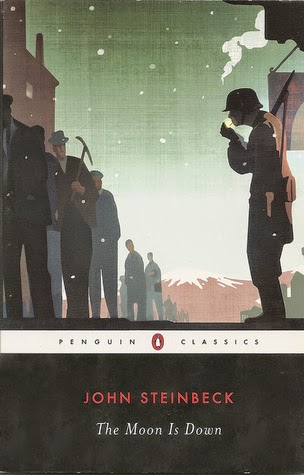
The Moon is Down by John Steinbeck


I hadn't read anything by John Steinbeck in ages -- looking back, it's been nearly two years since I finished East of Eden.  I mostly love Steinbeck, but I think his work is a little uneven -- I tend to love the longer works but the shorter works are hit or miss.  I loved Travels with Charley and Cannery Row, but I never felt the love for Of Mice and Men.  The Pearl was just so tragic, and I couldn't even get through The Red Pony.  

Recently I'd just finished Kim, which took me a really long time for such a short book.  I wanted a short classic to cross off my list, and something totally opposite from Kipling -- Steinbeck was just the thing, and I could count it as my Classic about War for the Back to the Classics Challenge.  The Moon is Down is extremely short, just over 100 pages.  I probably could have read the whole thing in one sitting.


Published in 1942, this novella is the story of an anonymous town that's suddenly overrun by an invading army.  The names are vaguely American but the setting seems Scandinavian -- it's an coastal town with a coal mine, and it's terribly cold and snowy.  The invaders, who are obviously Nazis but are never specified as such, 

The cast of characters is small -- a few officers from the invading army; the Mayor; the town's doctor; and a few townspeople.  Basically, this is a fable about how an invading army assumed it would be easy to take over a town by surprise, with little opposition, and how they underestimated the will of the people.  Steinbeck wrote this novella during WWII, as a piece of propaganda to encourage resistance against the Nazis.  It was quickly translated into a multitude of languages, and almost as quickly banned by the Nazis.   


I found this story particularly interesting because it was written and published while the war was still going on -- I think the perspective must be quite different than writing a book in hindsight, when the author knows the outcome of the war.  

I liked the story, though it's short and there isn't a huge amount of characters or character development.  Parts of the book are a little preachy.  I found the introduction (which I always read after I've finished a book) especially interesting, as it gave a lot of historical perspective about how the book was received and reviewed.   Apparently, there was a lot of backlash against Steinbeck because he made the invading characters somewhat sympathetic -- at least, not completely evil.  They were believable as people who could have had some good characteristics, although they were on the wrong side.  

The introduction also gave a lot of insight as to how this book was received in other countries -- although it was blasted by Americans, it was very well received by Norway and many other countries, in Europe and farther abroad as well.  

Overall, a good quick read, though not my favorite Steinbeck.  I still want to read Sweet Thursday, the sequel to Cannery Row, which I loved, so maybe I'll choose that for my American Classic for the Back to the Classics Challenge. 

Bloggers, what's your favorite book by Steinbeck?  And how is everyone coming along with the Back to the Classics Challenge?  This takes me up to 7/11 -- I'm more than halfway done!