Showing posts with label WWII. Show all posts

Wednesday, January 19, 2022

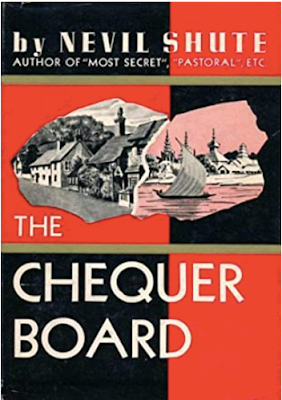
The Chequer Board by Nevil Shute

I am very behind with my reading already this year -- normally by this time I've read at least four or five books, if not more. I really needed a fast read to get me inspired, so I turned to one of my most reliable authors, Nevil Shute. I think this is the eighth book by Shute that I've read, and I've mostly enjoyed all of them. They might not be considered great literature, but he is a great storyteller, and normally I can hardly put his books down.

Published in 1947, The Chequer Board is the interweaving story of four WWII soldiers who are linked together after surviving a plane crash. They're all assigned to the same hospital ward and the most seriously injured, John Turner, suffers a very serious head wound, and his eyes are bandaged. While convalescing, the other three, previously unknown to Turner or each other, all read or talk to him, to help him recover. Several years after the war, Turner begins to have side effects from the head wound, and upon consultation, learns that shell fragments have been left behind in his brain, which are inoperable, and he has about a year left to live. 

Two of the three in the ward were also crash survivors, and the third was a Black American GI. One of the crash survivors was one of the pilots, who was very racist and snobbish to the Black American. The other three -- Turner, the American, Dave Lesaurier, and a third crash survivor -- are under guard together because they're awaiting court-martial, accused of various crimes. Turner has always wondered about the other three men in the ward with him, and decides to use the time left to try and track them down and see what happened to them. 

So, the story goes back in forth in time between the wartime experiences of the three men, and Turner's search for the them, which takes him all around England as far as Penzance, and all the way to Burma. (Another book about Cornwall! The universe is obviously telling me to go there).
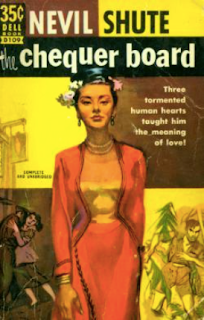
This pulp paperback cover is . .  . something

There's a lot about race relations and prejudices in this book, both with the racist pilot, Morgan -- who ends up living in Burma, to the chagrin of his mother (the reader can see where he got his prejudices) and also with the Black GI, Dave Lesurier. It was very interesting to me to see how Shute was trying to explore racism and race relations in the UK at the time, and I honestly can't imagine an American writer of that era attempting the same. Those two stories were my favorites in the book, though there are quite a few racial slurs repeated, including the N word, which is so infuriating. The story is trying really hard to make the point that white people need to get over it and look past color, but Shute kept throwing the word in, which was pretty frustrating. There's also some sexism which made me roll my eyes.

Overall though, the message about getting along is pretty strong, and there are some great characters and development. In particular I liked learning how the residents of a small town in Cornwall supported a group of Black GIs. I know racism is still a big issue in the UK but it was nice to see someone in the 1940s pointing out how the Black GIs were treated better in England than they were at home. 

I also really enjoyed reading about Burma, which I briefly visited years ago on a trip to Thailand. That section of the book was very reminiscent of A Town Called Alice, one of Shute's best-known books, though that one is set in Malaysia. There are at least seven or eight more books by Shute I still haven't read, and I look forward to reading them all.

This is my first book for the TBR Pile Challenge.

Friday, July 9, 2021

We, the Drowned by Carsten Jensen


I've settled in nicely for Big Book Summer, and at one point last in June I was simultaneously reading THREE giant books between 600 and 900 pages long -- not the best strategy for finishing them in a timely manner. As per usual, one of them really grabbed me and the others were neglected. I plowed through We, the Drowned by Carsten Jensen, finishing it in only five days. 

Originally published in Danish, it's the fictionalized story  of several generations of a fishing town in southern Denmark called Marstal, spanning just about 100 years. The story begins in 1848 when several of the local sailors are enlisted in the navy to fight the German rebels who have decided they don't want to live under Danish rule any more. Though they bring fully armed ships to blast the German port, they're utterly routed and Laurids Masden, one of the Danes from Marstal, is literally blown into the sky. Miraculously, he survives and becomes a local celebrity, until the fame (among other issues) is too much for him, and he promptly takes to the seas and essentially disappears.

When his son Albert is old enough, he also becomes a sailor, and spends years searching for his long-lost father, spanning the globe. Eventually he returns to Marsden, but is plagued by terrible visions of friends and neighbors embroiled in war. 

War was like sailing. You could learn about clouds, wind direction, and currents, but the sea remained forever unpredictable. All you could do was adapt to it and try to return home alive.


I really enjoyed this book, with some quibbles. I loved all the sailing parts, as I'm fascinated by ships and sailing, and I love traveling anywhere by boat. I also really enjoyed all the historical and travel aspects. However, I was not thrilled with how the women in this book were portrayed -- that is, hardly at all, or as mothers or romantic interests for the male characters. And one of the female characters is so sexually and racially stereotyped it made me cringe (there's also more racism and racist stereotyping than I was expecting for a book written and published in the 21st century). 

Also, the structure of this book is sort of odd. It alternates between being told in the first and third person, and it's never quite clear who the first-person narrator is -- it's almost like the author couldn't decide and just stuck with it. 

Overall, though, I did really like it and got absorbed by the characters and storytelling. A great, sprawling book for armchair traveling if you can't travel anywhere, or a perfect beach or airplane read if you can. 

I'm counting this as my Danish selection for the European Reading Challenge; also counts for the Big Book Summer Challenge and the Chunkster Challenge.

Saturday, May 22, 2021

Chatterton Square by E. H. Young


He pitied widows, but he mistrusted them.  They knew too much.  As free as unmarried women, they were fully armed; this was an unfair advantage, and when it was combined with beauty, an air of well-being, a gaiety which, in a woman over forty had an unsuitable hit of mischief in it, he felt that . . . all manhood was insulted . . . But he knew how to protect himself.

I bought Chatterton Square back in 2017 after Simon raved about it on his wonderful Tea or Books? podcast, and it would probably still be languishing on my bookshelves if my book group hadn't chosen it for their May read. (Yes, I did selfishly suggest it because I've been wanting to read it for so long!). I'm not a huge fan of Zoom but I do love that I'm finally able to see members of this group face-to-face, especially since many of them live in the UK. The group meets this afternoon to discuss it but I wanted to knock out a post of my own independent thoughts. 

This is another lovely Virago book in which not much seems to happen, but also a lot of things are happening. Chatterton Square by E. H. Young is the story of two families, the Frasers and the Blacketts, who live in the eponymous Chatterton Square in Radstowe, a thinly disguised version of Bristol. The Frasers are a single-parent household headed up by the beautiful Rosamund, and her five children. It's never said exactly how old the children are but the eldest Felix is just qualifying to be a lawyer, and the youngest two, Sandra and Paul, are still in school, so I'm guessing they're in their early teens. In the middle are James, a university student, and Chloe, who has finished school and is working in a dress shop. Their father, Fergus, is some sort of writer and has been absent from the house for several years, having absconded to somewhere on the Continent.

The household is completed by Miss Agnes Spanner, Rosamund's childhood friend and a spinster of many years. Rosamund grew up in the house and Agnes was the daughter of her father's business partner. After her parent's death she moves in next door to the Blacketts, headed up by Herbert Blackett, one of the best-drawn and most annoying men I have ever encountered in literature, a self-absorbed, snobbish, judgmental narcissist, and never have I wanted to much to jump into a book and verbally slap someone. The Blackett household also includes his long-suffering wife Bertha,who seems sweet but downtrodden, and his three daughters, one of whom, Flora, takes after him exactly. 


The original cover c.1947

Mr. Blackett sneers and belittles the Frasers to his own family at every opportunity, though he's secretly attracted to the free-spirited Rosamund. He also looks down on Mrs. Blackett's cousin Piers, a disfigured war veteran who has bought farm nearby and comes into town to sell vegetables. Blackett has always disliked Piers, ever since he returned from the war on the eve of his marriage to Mrs. Blackett, when he realized his bride cared more for her cousin but would never back out of her wedding; sadly, she realized on her honeymoon that she was trapped in marriage to a pompous ass. A friendship has struck up between Piers and Rosamund, which is another reason to dislike them both.

Meanwhile, their are potential relationships brewing between the children. James Fraser and Flora Blackett are students at the same university and have developed a mild flirtation, and middle daughter Rhoda has begun borrowing books from Miss Spanner. All of this is taking place under the cloud of potential war, which Mr. Blackett insists will never happen. As the book was published in 1947, contemporary readers, like ourselves, feel the tension since we know the inevitable is coming, which ratchets up the tension in the book. 

Cover of the new BLWW series reprint

I loved this book, though it took longer than I expected -- normally I can zip through a novel in just a few of days, but this was a fairly dense read. There's a lot that's implied and unsaid, especially about current events in the novel, and I often found myself rereading passages to figure out what was going on. It was also a bit frustrating because there is a lot that is unresolved -- if you want your endings neat and tidy, you won't like the end of this book, but since it's set on the eve of WWII, it would be unrealistic to expect anything else. 

What I loved most about this book is the characters and their interactions. As much as I dislike Mr. Blackett and his daughter Flora, they are beautifully developed villains, and I also how his wife Bertha began to grow and change. I also loved his middle daughter Rhoda who is my favorite character in the book. 

This is the third book I've read by E. H. Young -- I loved both Miss Mole and The Misses Mallett. I have three more of her books unread on the TBR shelves and had intended to read Jenny Wren for the Back to the Classics Challenge; however, I may put it off a bit more and try to ration out my E. H. Young books as long as possible (I also own the sequel, The Curate's Wife, and William.) I'm so happy that I finally finished this and am so looking forward to our discussion because I'm sure everyone will have a LOT of opinions about it! 

Thursday, January 7, 2021

Two More Reading Challenges: WWII Reading Challenge and Chunkster Challenge

Two more great challenges for 2021! I'd love to read one per month from each of these lists  which are books from my own TBR shelves. And of course some of them cross over and count for other challenges including my own Back to the Classics Challenge -- a win-win!

World War II Reading Challenge. Hosted by Becky's Book Reviews, it includes fiction and non-fiction, and basically includes any books written about or during the WWII era -- the war itself, leading up to the war, and the direct aftermath. Lots of choices from my TBR shelves! I don't have a lot of historical fiction but I definitely have quite a few books published during the era, and several nonfiction books I've been meaning to read. 

Non-Fiction:
Our Hidden Lives by Simon Garfield
Long Live Great Bardfield by Tirzah Garwood
A Good Place to Hide by Peter Grose
Maman, What Are We Called Now? by Jacqueline Mesnil-Amar
Millions Like Us by Virginia Nicholson
Fashion on the Ration by Julie Summers
Our Uninvited Guests by Julie Summers

Fiction:
A House in the Country by Ruth Adam
A Footman For the Peacock by Rachel Ferguson
The Bachelor by Stella Gibbon
Westwood by Stella Gibbon
Chloe Marr by A. A. Milne
The Chequer Board by Nevil Shute
Ordeal by Nevil Shute (UK title: What Happened to the Corbetts)
The Foolish Gentlewoman by Margery Sharp
Growing Up by Angela Thirkell
The Headmistress by Angela Thirkell
Marling Hall by Angela Thirkell
Miss Bunting by Angela Thirkell
Peace Breaks Out by Angela Thirkell
Love Among the Ruins by Angela Thirkell

Chunkster Challenge 2021. Hosted by Impressions in Ink, it's any book more than 450 pages. I still have my unfinished list from the Big Book Summer Challenge, and if I can read one from this list every month, it would cut my stack nearly in half.
Here's what's left. Some of them could count for other challenges, as noted. 

Nonfiction:
Our Hidden Lives: The Remarkable Diaries of Postwar Britain by Simon Garfield (544 pp)  (WWII Challenge)
Long Live Great Bardfield by Tirzah Garwood (495 pp) (WWII Challenge)
Trollope by Victoria Glendinning (551 pp)
Slipstream: A Memoir by Elizabeth Jane Howard (528 pp)
A London Family, 1870-1900 by Molly Hughes (600 pp)
Edith Wharton by Hermione Lee (869 pp)
Decca: The Letters of Jessica Mitford (744 pp)
Charles Dickens by Michael Slater (696 pp)

Novels: 
T. Tembarom by Frances Hodgson Burnett (518 pp)
The Complete Claudine by Collette (656 pp) (European Reading Challenge)
Painting the Darkness by Robert Goddard (608 pp)
Green Dolphin Street by Elizabeth Goudge (571 pp) (Also counts for Back to the Classics)
Bella Poldark by Winston Graham (688 pp) 
Penmarric by Susan Howatch (735 pp)
The Little Ottleys by Ada Leverson (543 pp)
The Macdermots of Ballycloran by Anthony Trollope (731 pp) (Classics Club)
Ralph the Heir by Anthony Trollope (770 pp) (Classics Club)
Marcella by Mrs. Humphrey Ward (560 pp) (Back to the Classics)
Hudson River Bracketed by Edith Wharton (547 pp) (Classics Club)
La Debacle by Emile Zola (536 pp) (Back to the Classics, European Reading Challenge)

Short Stories:
The Canterbury Tales retold by Peter Ackroyd (464 pp) (Back to the Classics)
Sketches by Boz by Charles Dickens (635 pp) (Back to the Classics)
The World Over: The Collected Stories of W. Somerset Maugham, Vol. II (681 pp)
The Portable Dorothy Parker (626 pp) (Classics Club, Back to the Classics)
The Collected Stories of Katherine Anne Porter (495 pp)
The Complete Stories of Evelyn Waugh (640 pp)
The Collected Stories of Edith Wharton (640 pp)
The Most of P. G. Wodehouse (701 pp)
The Collected Stories of Stephan Zweig (720 pp) (European Reading Challenge)

WWII/Postwar Era Fiction
Mr. Skeffington by Elizabeth von Arnim
Tea is So Intoxicating by Mary Essex
Green Dolphin Street by Elizabeth Goudge 
English Climate: Wartime Stories by Sylvia Townsend Warner


Sketches by Boz by Charles Dickens (680 pp)

So, quite a few choices! I could even try to read separate books for each challenge, without crossing over -- which would be another 24 books from the TBR shelves completed! Bloggers, which do you recommend from these lists? 

Monday, December 21, 2020

The Dancing Bear by Frances Faviell; and a trip to Berlin


I love the Furrowed Middlebrow reprints and though I prefer print books when I can get them, I've been tempted more and more often by the instant access to e-books. The entire Furrowed Middlebrow catalog are available on Kindle and some of them are included with Kindle Unlimited. There's a promotion right now, 99 cents a month for two months, so I couldn't pass it up and downloaded two books by Frances Faviell, The Dancing Bear and Chelsea Concerto. Not realizing that these were nonfiction, and sequential,  I started with The Dancing Bear, Faviell's memoir of her life in Berlin just after the end of World War II. (A Chelsea Concerto is her memoir of living in London during the Blitz, and I actually should have started there).

The book begins shortly after Faviell, an artist, and her little son John join her husband in the British sector. The book begins with a chance meeting with a German woman, Frau Maria Altmann, who is struggling with a cart of goods at a busy intersection. Faviell is in her car but stops to help, and seeing the Union Jack, the local police stop traffic and passersby assist the woman, who is waiting for her son Fritz. Frau Altmann refuses the offer of a ride, since it is forbidden, but Faviell insists after Frau Altmann faints on the street. 

This marks the beginning of a close friendship between the author and a struggling German family during the difficult first years of the British occupation and the reconstruction of Berlin in a divided Germany. Frau and Herr Altmann are trying their best to hang on to their pre-war life, though they have hardly any food or fuel in a terrible winter. Their oldest son Kurt was sent to fight in Russia and hasn't been heard from in years, though they refuse to admit his death; oldest daughter Ursula is supporting the family working as a black-marketer; frail Lilli is a dancer with the ballet; and the youngest, Fritz, is rebellious and sulky. 

Faviell does what she can to help the family (along with her faithful and tender-hearted driver, nicknamed Stampie), but there are so many needy people and sick children, she is sometimes overwhelmed. But it's clear she made a huge difference in the lives of the Altmanns and others. 

. . . these women clung, in spite of all the horrors they had undergone, to the conventional -- or was it that they thought their only safety lay in the resumption of the conventional pattern of life? 

I liked this book but parts of it were hard to read, especially with the cold snap we had last week -- I couldn't help imagining a frigid winter with no heat and little to eat, poor shoes -- it must have been a terrible time. I suppose it wasn't the best timing to read it now, but sometimes I find that books about the war make me grateful for what I have.  

I was lucky enough to visit Berlin for a long weekend in 2018. It was actually my second trip there -- back in the 1980s, I spent a few weeks in Europe with my sister and we stayed with a German friend of hers in West Berlin when it was still divided. We were even able to cross the border into East Berlin for a day, which was rather eerie and a little scary. It's incredible how much it has changed since then. We had a wonderful time on the last trip and I wish I could have seen more. We managed to pack a lot into three days. 


The famous Checkpoint Charlie.
I actually crossed into East Berlin at this very spot back in 1985. 

Leftover reminder of the DDR


The iconic Berlin TV Tower from 1969. 
Sadly we didn't have enough time to go up and admire the view.


Berlin Cathedral


View from below of the spiral staircase at the Berggruen Museum.
I think we visited four museums in one day, five altogether that weekend.


The Memorial to the Murdered Jews of Europe


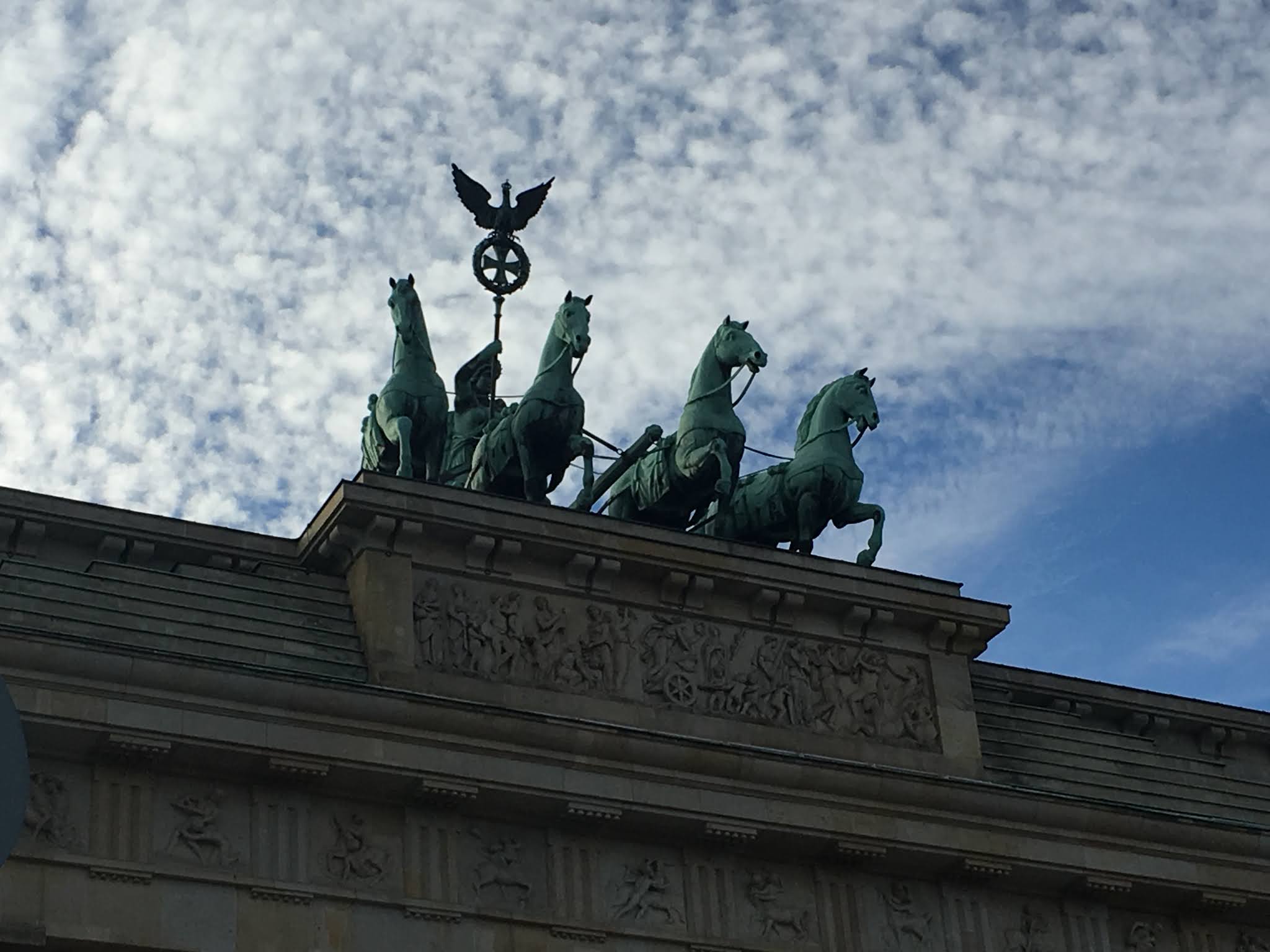
The Brandenburg Gate


A preserved section of the Berlin Wall, complete with graffiti, (obviously the Western side). 


I love finding decorative manhole covers. This one is like a tourist's guide.


I loved Berlin and wish I'd had more time there, it has so much history and culture. 

Parts of Faviell's book were a tough read, but I found it fascinating and hope to read more of her books soon. Next up for me will be A Chelsea Concerto, about her life in London during the war, then some of her fiction set in Germany. I'm signing up for a World War II reading challenge for next year so I'll definitely be reading some of them.

I'm counting this as my German book for the European Reading Challenge. 

Saturday, August 8, 2020

The Eighth Life by Nino Haratischvilli


I first heard about The Eighth Life a few months ago, but I knew immediately that I wanted to read it. More than nine hundred pages about a family in Eastern Europe, over six generations? More than a hundred years of a family's history? A book in translation? Yes please, this is exactly the sort of book I love. But I'm not going to lie, this book, as you might expect, is A LOT. 

I should back up a bit and give as much summary as possible. The story begins with a prologue: Nizia, Stasia's great granddaughter, is living in Berlin and gets a frantic phone call from her mother. Nizia's niece Brilka, aged 12, has left her ballet group in Amsterdam and is on a train to Vienna, alone, on some kind of wild-goose chase. Nizia agrees to find her niece and bring her back to Tbilsi. The story then goes back more than a hundred years, to tell the history of six generations of the Jashi family, beginning with Stasia, a young Georgian dancer who is forced to give up her dreams of the Bolshoi Ballet and instead marries a dashing young officer in the early 20th century. Nizia narrates the story as though she's telling her family's history to Brilka. 

She remains with her family as he goes off on assignment, then they are separated by the Russian revolution. We learn about Stasia's beautiful sister Christine, who living a fabulous life in Tbilisi society until she attracts the attention of an important party leader; about Stasia's two children: Kostya, a promising Russian naval officer; and Kitty, a talented folk singer; Kostya's spoiled daughter Elene, the mother of narrator Nizia; and Nizia's sister Daria, a beautiful actress. Along the way there are world wars, revolutions, sieges, torture, heartbreak, murder, and terrible things happen to everyone along the way. There is also a magical chocolate recipe that is supposed to be some kind of curse but is really only a very minor part of the book (and I was really hoping for a recipe that never appeared.)

Haratischvilli interweaves real events and people (named and unnamed) in the book, so I learned a bit about Georgian and Russian history and geography. I do admit to skimming over some of the politics mentioned in the book. These characters experience a lot of tragedy and heartache -- honestly, I'm shocked that everyone in Georgia doesn't have PTSD or worse. I cannot even imagine living through even a fraction of what these characters have experienced. 

Great cover on this Turkish edition

Overall, I really liked this book and being able to spend so much time with the characters. There are a lot of great strong women in this family (though they seem to have terrible taste in men). I did prefer the first half of the book to the second -- the narrator, Nizia, is actually my least favorite character in the book. She does some things that seem really unbelievable and overly convenient to the plot. However, I was so absorbed in the family's story and all the other characters that I stayed along with it until the end. I was not disappointed, though I was hoping for more chocolate. 

The Eighth Life was first published in German in 2014, and finally translated into English in 2019. I love reading books in translation -- I know so many of my books are mid-century British and classics and I really want to expand a little bit. It is Women in Translation Month so this ties in nicely. It also ties in as my Georgian selection for the European Reading Challenge, and towards my Big Book Summer Challenge.

Friday, January 10, 2020

Pied Piper by Nevil Shute


I started reading Nevil Shute last year because I intended to review one of his books for the 2019 Back to the Classics Challenge. I started with one of his most famous works, A Town Like Alice. Though I never got around to writing a post, I enjoyed it so much I read two more of his books before the end of the year. Though he's most famous now for his books set in Australia, Shute started writing in the 1920s, and more than half his novels were written before he moved there in 1950. 

Published in 1942, Pied Piper is set in 1940. It begins a framing device: an anonymous narrator meets an elderly man one night after dining in his London club. They are forced to stay during an air raid, and the older man relates his tale of a recent escape from the Nazi invasion of France, just after the fall of Dunkirk.

The protagonist, John Howard, is a widower, bereft after the loss of his only son, an RAF pilot. He's unable to help with the war effort due to health issues, and in early spring of 1940, has cabin fever and decides to go on a fishing holiday in France, in a small town near the Swiss border, near the Jura mountains. Howard had hoped to have no reminders of the war, which seems very far away, and is mildly annoyed to find British tourists staying at the same small hotel. Young Sheila and Robbie are on holiday but normally attend school in Geneva, where their father is working for the League of Nations. Gradually Howard befriends the family, and after the fall of Dunkirk, decides it's best to go home to England. The children's parents are alarmed at the speed of the invasion, and beg him to take the children with him back to England, to stay with relatives. 


It seems like a relatively easy task to take a train to Dijon and then to Paris, but Howard underestimates the difficulty of traveling with children, and the rapid escalation of the invasion. The younger child, Sheila, becomes feverish and the party is forced to spend the night in a hotel. Trains stop running, luggage goes missing, and Howard is forced to keep finding alternate routes to get back to England. Meanwhile, thousands of people are attempting to evacuate before the arrival of the Nazis. The small party begins to increase as more and more children join Howard and he attempts to get them all to safety. 

I really liked this book. I do love reading about the lives of ordinary people during the wars. This is also a survival story, which I always enjoy. I liked how Howard comes out of his shell when he makes it his life's purpose to protect the children. I also enjoyed following their route across France as they zigzag toward safety to try and elude the Nazis. There were also some good side characters that helped them. It's always nice to read about the kindness of strangers. 

This was also a really fast read, I think I finished the whole thing in one day. It also reminded me a bit of A Town Called Alice, which also includes wartime refugees on a march, trying to survive, though that one is set in Malaya. I definitely want to read more works by Shute, though some of them are a bit obscure. They're a bit tricky to find in libraries but there are many inexpensive used copies from online retailers.  

I'm counting this as my 20th Century Classic for the Back to the Classics challenge.

Monday, March 11, 2019

Fenny by Lettice Cooper: An Expat Living in Italy


I bought Fenny almost three years ago, after reading and loving Lettice Cooper's National Provincial. I never got around to reading it until last week when I was going on a short jaunt to Dubrovnik -- I do try to bring books on holiday that have a local connection. I couldn't find anything on my shelves set in the Balkans or on the Adriatic, so I decided a book set in Italy would have to do.

Set in the 1930s through the 1940s, Fenny is the story of an Ellen Fenwick, an English schoolteacher who gives up her job at a girls' school to take a temporary post as governess to a little English girl living in Tuscany. The story begins in 1933 when Fenny arrives in Italy to begin her new post at the Villa Meridiana, a house loaned to the Mr. and Mrs. Rivers. The husband travels back and forth from his work in London, so most of the time it's just Ellen, nicknamed Fenny, with her charge Juliet and her mother Madeleine, the daughter of a famous stage actress. They tend to socialize with the Warners, another ex-pat family, and Fenny finds herself much thrown together with Daniel, tutor to Warner's the oldest child. It seems like an obvious romantic interlude but things take a very unexpected turn. The rest of the book details Fenny's life until the late 1940s, and how it is entwined with members of the two families, before and after the war.

Though it's primarily a domestic story, Fenny does include the rise of fascism and WWII, and how expats were affected. The book is divided into four parts, and the second part jumps forward about three years, just before the war; then to 1945, as the war is ending; and finally 1949.


The Tuscan countryside, near Siena.


I really enjoyed this book but I think I would have liked it even better without the time jumps -- I really wanted to know more about Fenny's story, especially during the war. Also, I feel like some of the side characters' outcomes were only mentioned as afterthoughts. I know there seem to be a lot of books where characters miraculously show up years later, and it's completely realistic that people disappear from your life entirely, but still, it felt a little unresolved. Of course it would have made for a much longer book but I'm quite sure I would have enjoyed that! National Provincial is about 600 pages but I was thoroughly engrossed.

I do want to read more of Lettice Cooper's work, but I don't know a thing about any of her other novels except National Provincial and The New House, both Persephone reprints I loved. Most of her novels seem to have plenty of used copies available online, except for one called Desirable Residence, copies of which start at around $35 US, and have price listings upwards of $200! However, there seem to be library copies available through WorldCat, so I'll have to wait and check it out via ILL after I return to the U.S.

I'm counting this as my book set in Italy for the Reading Europe Challenge. 

Saturday, July 28, 2018

London War Notes by Mollie Panter-Downes


It's taken me more than two months, but I've finally finished London War Notes, my tenth book for the TBR Pile Challenge 2018. First published in book format in 1971, this is a collection of essays written biweekly for the New Yorker during World War Two. It remained sadly out of print for many years until Persephone books republished it in 2014. I'm quite fascinated by the war years, particularly the war at home, so I was sure this would be right up my alley. Only the length had discouraged me since I bought it four years ago and I thought this would be a good time to get to it. 

Of course these essays discuss a lot of what's going on in London and the surrounding area during the war, especially the bombings, there's definitely a lot more history about the battles and the politics that were going on. There has been so much written about the war (go into any Barnes and Noble bookstore and you will be amazed at how many nonfiction books there are about WWII), but so much of what's published is centered around Europe, I'd forgotten how critical the battles in North Africa and the Far East were, especially places like Burma and Singapore. So much of what Americans associate with WW2 in Asia is centered around Japan -- I didn't really realize how significant the loss of Burma and the rubber plantations was to the war effort and everyday life in Britain. I did have to stop a number of times and look up historical events mentioned in the book that would have been common knowledge at the time of publication.

The other thing that really struck me about this book was the overwhelming sense of anxiety. As an American growing up in the late 20th and 21st century, I cannot imagine living with the thought that you could be bombed at any moment, to be evacuated from your home, or to have to endure rationing for food, clothing, and fuel. It's a little easier to read knowing that the war would be won, but it must have seemed like it was dragging out forever -- and of course rationing didn't end for a long time afterward. I've been a little disappointed being unable to buy Warburton's crumpets the past few weeks because of the CO2 shortage, boo hoo.

Detail from the endpapers of the Persephone edition
I do, however, think that I can relate to the sense of anxiety. Every day when I wake up and look at the news, I keep waiting for the worst, and wonder how much longer it will get worse before it gets better. I know a lot of Americans are feeling similar anxiety. I'm sure it's worse for people actually living in the U. S.

I'm very glad I read it, but this is the slowest I've read any book for this challenge, in this year or previous years. I suppose was a mistake to be reading this 459 page nonfiction book about World War Two at the same time I was reading a 661 page memoir about World War One (Testament of Youth). You think? I did in fact take a long break from London War Notes in June. I thought that it would be easy to pick it up again halfway, but I was wrong -- I really feel like I lost momentum. 

And now for a lighter anecdote! Reading this book also reminded me of one of my visit to the Churchill War Rooms during one of my visits to London. It's part of the Imperial War Museum and is really fascinating -- the underground bunker where Churchill and others lived, worked, and slept during the war. It is quite fascinating and there were a lot of interesting displays. Of course one has to walk through the gift shop on the way out and this was one of my favorite purchases:


Yes, these are two-handed oven mitts with a wartime propaganda slogan. I got it as part of a set with a matching apron (also available as a tea towel). There were a lot of fun postcards and prints with wartime slogans. Here's another of my favorites:


It's really worth visiting if you're in London and have any interest in wartime history. There's also an online shop here if you just want the oven mitts or the poster version.

So -- that's book #10 for my TBR Pile Challenge 2018! I'm making good progress and hopefully I'll complete the last two AND my two alternate reads this year! How is everyone else doing with their TBR piles? 

Monday, May 7, 2018

Classics Spin # 17: One Fine Day by Mollie Panter-Downes


So I'm nearly a week behind with Classics Spin #17, but better late than never. My spin pick was One Fine Day by Mollie Panter-Downes, a slim novella of a mere 184 pages. One would think it would be easy enough to finish this book in time --I was so confident that I could zoom through this book in a day that I literally left it to the last minute. Of course, I was wrong.

It's a short book, but not one that I would recommend rushing. As the title suggests, it's a single day in the life of Laura Marshall, who lives in Wealding, a fictional English village in Sussex. It's shortly after the end of the war, and her husband Stephen commutes by train to his job in the city; daughter Victoria, about 9 or 10, is off to school and then visiting a friend afterward for tea.

Laura goes about her early summer day, filled with the normal tasks of cleaning, cooking, shopping and errands. The family live in a big house that once had several servants, but now must make do with a part-time daily charwoman and elderly gardener. Her tasks that day include asking a local youth to help out with the gardening maintenance, and putting an advertisement in the local paper for a cook.

The reader really gets a feeling of what life was like in the aftermath of the war. The book was published in 1947 and it's very obvious that WWII is still very fresh, with rationing, queueing, and German POWs still working on local farms. Laura picks a basket of gooseberries for her husband's work assistant who lives in London; there are mentions of the sudden availability of oranges, and daughter Victoria longs to live on a farm where milk and cream are there for the taking.


It seems like any ordinary day, it's really a microcosm of how life was changing in England, neatly encapsulated in less than 200 pages. Much of the story is also focused on how life was before the war and how it will never be the same due to changes in class and social structure. Laura and her family are faced with the impossibility of finding help, as all the working-class people are no longer interested in service. Laura's snobby mother can't understand why her daughter has to -- gasp -- do housework! but the local squire's wife has faced reality and is moving off her crumbling estate to smaller housing and has given over her mansion to the National Trust. The young man asked for gardening help has no interest in sticking around the little poky village, and is ready to move on to bigger and better things.

Overall, this book is just beautifully written, too good to zip through in a single sitting.

How hot it was! The midday heat was rising to a head, like milk to the boil, singing in a clotted hum of bees, of crickets among the sorrel and daisies, of gnats dancing above the cresses tugged all one way by the trickle of water running under the hedge. An old woman came out with a pail, hobbling across the lane to the tap dripping among the moss. She had lived to see men flying overhead like birds; to stand among the hollyhocks watching bombs spluttering across the stars to kill a family forty miles away; to turn a switch and hear the great voice from Westminster correcting her kitchen clock. 


I loved this book and it was the perfect read for a beautiful spring day. I read a good chunk of it on Saturday afternoon sitting outside in the Japanese garden in Kaiserslautern. I didn't take any photos this time but here's one of my favorites from last year.


Mollie Panter-Downes worked for years as a correspondent for the New Yorker magazine and as a short story writer; sadly, she really didn't write many novels. However, I've read and enjoyed both of her short story collections published by Persephone, and I also own London War Notes, a collection of her wartime columns which was thankfully republished (also by Persephone) because the previous edition from the 1970s was terribly expensive.  It's on my TBR Pile Challenge list so I'm hoping to get to it before the end of the summer.

Sunday, April 15, 2018

The Willow Cabin by Pamela Frankau: A WWII Love Triangle

I really like the cover of this paperback -- it's Table Devant Une Fenetre
(Table Under a Window) by Henri Le Sidaner.
I really cannot resist going into a used bookstore -- for the past few years I've been really disappointed by most of the newer fiction and I always find myself much more satisfied with backlist titles, especially from the mid-century. It's always really nice to scan the shelves at a used bookstore and see a green-spined Virago Modern Classic, which I would normally snatch up immediately. A few years ago I was lucky and found quite a pile of VMCs at John King Books in Detroit, and one of my finds was The Willow Cabin by Pamela Frankau.

Published in 1949, this is the story of a young actress named Caroline Seward and her love affair with a surgeon, Michael Knowle, from the late 1930s until after the war. Caroline has a promising future on the stage until she meets Michael, who is separated from his wife Mercedes, an artist and set designer. Caroline struggles whether to give up her career and devote her life to Michael, and the complicated relationship between Michael and Mercedes casts a shadow over their relationship, before and during the war.

I mostly liked this book though it did take some time to get into it. I thought it was going to have a lot more about Caroline's theater career, but it's really mostly about her relationship with Michael with some sub-plots about the peripheral characters, like Caroline's childhood friend June; Vera, Mercedes' former secretary who becomes obsessed with finding her former employer during the war; and the Aynsteys, American friends of Michael and Mercedes who eventually tie all the characters together. I liked all the secondary characters and thought they were really well drawn. 

The book is divided into three sections: before, during, and after the war. I think the best section by far was set during the war, when Michael is working as a military surgeon and Caroline has signed up to do her bit. I'm really fascinated by how WWII affected people still in England, much more than battle scenes and that sort of thing. I also really like that this book was written pretty close to the end of the war -- it must have been very fresh in Frankau's mind and as much as I love historical fiction, I think it would be really difficult to recreate it if you haven't experienced it.

I also think the writing in The Willow Cabin was really good. Just after I finished it I started reading a novel for my upcoming book discussion group, a fairly recent historical novel about three women in WWII. I couldn't even get through the first 50 pages because I think it was utter crap, the writing was really weak and the characters so poorly developed I put the book aside in disgust. 

Anyway, here's a bit I found really poignant and insightful: 

He could see nothing ahead for any of them, the tight little circle of temporarily-favoured persons to whom all this was important. "It is the last spring; the guillotine is coming down. And after that it won't matter who loves and who is unloved; we are for the dark." How foolish not to be happy now, when there was so little time left. (p.75)

It's short, but I really feel like it captures the essence of what people must have been feeling when it was so obvious another massive war was inevitable. 

There were several plot twists in this book that I wasn't expecting, but unfortunately the VMC edition has a massive spoiler for a big plot element in the description on the back. (If you're interested in reading this, I would advise against reading the back cover and the desciption on Goodreads). My least favorite part of the book was the aftermath of the war, when the setting shifts to America. I don't want to go into any more detail for fear of spoiling it for anyone else. 

Overall I really did like this and I've heard other good things about Frankau's novels. Apparently she was quite a prolific novelist and published more than 30 works from the end of the 1920s until her death in 1967. A Wreath for the Enemy is her best-known novel and is also a Virago Modern Classic. I'll definitely look for it after I've made some more progress on the TBR shelves. 

This is my sixth book this year for the TBR Pile Challenge 2018 -- I'm halfway through my list!

Monday, June 26, 2017

London Belongs to Me is Incredibly Long But Worth It


I love a big fat book. I love to sink into the story and get completely engrossed in the characters. I also love British books, and books set during World War II. I especially love books about the War at Home -- I'm far more interested about how the war affected people's everyday lives than battles and military maneuvers. In short, Norman Collins' London Belongs to Me basically ticks off every box for my literary love. It took me almost a month to finish it since I was reading other books as well, but I loved every minute of it.

First published in 1945, this story starts in 1938 and spans about two years in the lives of the residents of #10, Dulcimer Street, in Kennington, London, a working-class neighborhood south of the Thames river (not to be confused with the much posher Kensington). The story begins just before Christmas, when one of the residents, Mr. Jossor, leaves his last day of work at an accounting firm upon his retirement and returns home to his flat. Mr. Josser lives with his wife and adult daughter Doris, who's ready to fly the nest and share a flat with another girl, much to her mother's chagrin. Other residents of the building include Connie, a failed middle-aged actress who's barely scraping by as a coat-check girl; the adenoidal Mr. Puddy, who can hardly hold down a job as a night watchman and is hoarding canned goods for the onset of war; Mrs. Boon and her son Percy, a mechanic who's tempted by a life of crime; the widowed landlady Mrs. Vizzard; and the mysterious new lodger Mr. Squales.

This is a novel in which for most of the characters, not much happens and yet everything happens. Over 738 pages, we follow the lives of the residents as they fall in and out of love, find jobs, have dreams and aspirations, and sometimes even land in jail. They're a disparate group but ultimately, they're like a family. I love books in which a lot of personalities are thrown together and this is exactly that sort of group. It reminded me a little bit of Patrick Hamilton's The Slaves of Solitude which I read and loved a few years ago.

This book is long and sprawling, with very thin pages and tiny print, yet I was sorry that it ended. The writing isn't particularly flowery or descriptive, but Collins made me feel as though I were right there, living in the same building, and all the characters were incredibly real. There's a short epilogue that takes place at Christmas 1940 which gives a quick update, but I can only imagine what happened to all the characters during and after the war. I wish there were a sequel, but sadly, there isn't. However, thanks to Rachel at Book Snob (who raved about this book), I discovered that it was made into a film which you can watch online at YouTube (though I cannot imagine how they condensed this doorstopper into a film less than two hours long.)

Collins also wrote several other books and I've already got Bond Street Story which is also available from Penguin, though it's surprisingly expensive for a paperback (luckily I received a copy as a Mother's Day gift). It's also quite long, but not as long as London Belongs to Me. This book is my idea of perfect summer reading and I'm sure it will be on my list of favorites at the end of the year.