Showing posts with label novella. Show all posts

Thursday, April 21, 2022

1954 Club: Who Was Changed and Who Was Dead by Barbara Comyns


Within a few weeks funerals were to become a common occurrence in that village; but at this time they were rather scarce and looked forward to eagerly.

I've read several books by Barbara Comyns and was delighted to find out one of them had been published in 1954 -- perfect for Simon and Kaggsy's 1954 Club event. Even better, I found out my local library had a copy of this book, a weirdly twisted take on village country life. 


Set in Warwickshire during the early part of the 20th century, the story begins with a flood so high that ducks are swimming through the windows of the Wildweed family home, a large household consisting of Ebin Wildweed; this three children, Emma, Dennis, and Hattie; the matriarch, Ebin's cantankerous mother; and two servants, sisters Norah and Eunice. The banks of the nearby river have overflowed into the house and caused havoc throughout the surrounding villages.

The ducks swam through the drawing-room windows. The weight of water had forced the windows open; so the ducks swam in. Round the room they sailed quacking their approval; then they sailed out again to explore the wonderful new world that had come in the night.


It's the beginning of June and the floodwaters soon subside. What follows that summer is slightly sordid and increasingly unsettling; quirky and eccentric behavior among the village residents turns dark, violent, and tragic. I should probably give more details about the plot but I don't think I can without giving too much away.

This book was a quick read, less than 200 pages in a smallish paperback format. I could have probably read it in one sitting, but I did have to take breaks because I found it a little creepy. I've read six of Comyn's books and they've all been darkly quirky in a similar way. 


Some of her other novels have recently been reprinted by Turnpike Books and also by Daunt books; I've already ordered one of them, Mr. Fox. A couple of her works are nearly impossible to find, hopefully the reprints will find an audience and the others will follow. 

Thanks again to Simon and Kaggsy for organizing this reading event! I'm hoping to read two or even three more novels so fingers crossed I'll get them finished and posted in time. 

Saturday, July 24, 2021

The Dogs and the Wolves by Irene Nemirovsky


The outside world was full of shapes and colors that were impossible to remember for ever, constantly lost, but seeking them out, pursuing them, was the most precious thing on earth.

"It's not my fault," she thought. "It's because I just can't forget certain faces once I've seen them, or certain houses, or certain sights. They're indifferent or fickle because they remember nothing. But I can't forget, I can't. It's a unique curse that makes me recall every feature, every word, every moment of joy or pain once they have struck me.


A couple of months ago I was looking for books set in the Ukraine for the European Reading Challenge, and I found The Dogs and the Wolves by Irene Nemirovsky. I've read several of her books and enjoyed them all, and this one sounded perfect -- Ukrainian writer, set in the Ukraine and Paris (so it also counts toward Paris in July); also the title fit one of the categories for the Back to the Classics Challenge. And it's just over 200 pages! It sounded like the perfect book.

Oddly enough, it was hard to track down, not a single copy in any library nearby; in fact, I don't think it's ever been reprinted in the US. I found a cheap used copy online and was looking forward to reading it. 


It's the story of four cousins: Ada Sinner; her first cousins, Ben and Lilla; and their distant cousin Harry. They're all around the same age and are born around the turn of the century in the Ukraine. Ada lives with her widowed father Israel and after her uncle dies, her widowed aunt and two of her cousins, Ben and Lilla, come to live with them. Harry, their distant cousin, is from a side of the family that is extremely rich, and they've never met him as he lives in the lower, wealthy part of town (they've seen him and his house from afar but never actually met). Their paths first cross during the pogrom when Ukrainian Jews were targeted by Russian soldiers. Ada and her cousin Ben are running from a mob when they manage to escape to their cousin's property and beg for help. 

The spoiled, cosseted Harry is aghast at the appearance of his cousins, who are poorly dressed and are bedraggled from their flight. Ada and Ben are swept away from their cousin, but are fed and introduced to an uncle, who eventually gives Ada's father some work. He becomes more prosperous and when the children are teenagers, he can afford to send them and their aunt to Paris just before World War I breaks out. Eventually, Ada learns that Harry is also in Paris. She's been fantasizing about him her entire life, and though Ben is in love with her, she's determined to find a way to meet Harry.

If this sounds like a lot for a 200 page book, well, it is. The plot was interesting, but I found it and most of the characters really undeveloped. Lilla basically disappears and I didn't get much sense of Harry's character at all -- it just seems like Ada is obsessed with him because he's rich. It almost seemed like a first draft rather than a finished novel. It was Nemirovsky's final published work, in 1940, just before the Nazis banned the publication of books by Jewish authors. (Nemirovsky was arrested in 1942 and deported to Auschwitz, where she died of typhus a month after arrival). 

What really disturbed me about the book, though, was not the under-developed plot and characters but was the shocking anti-Semitism. There are repeated stereotypings of Jews that made me aghast. I was not expecting it and I was gobsmacked. I haven't read all of her books yet but I've read quite a few and I don't remember any anti-Semitism in the others. Some of the writing was wonderful but this is not a book I really want to read again.

. . . she mustn't find more ways to feed a dream that was gradually becoming less, damaging, only half real, half imagination. As she grew up, she had become more and more distance from it, just as you forget a book you read and loved passionately when you were a child. You may still love it, but back then, you believed in it. Now you realize that it was nothing but poetry, fiction, an illusion, less than nothing. . . . 

I'm counting this as my Ukranian selection for the European Reading Challenge and as my Classic About an Animal for the Back to the Classics Challenge.

Thursday, February 11, 2021

The Short Reign of Pippin IV by John Steinbeck: A Little Mid-Century Satire


I was stuck in two very long books last week (that I wasn't particularly enjoying) and in desperation, I took one of the shortest books off of my owned-and-unread shelves: The Short Reign of Pippin IV by John Steinbeck, a vintage hardcover of only 164 pages, most likely purchased at one of the library sales. I've loved mostly everything by Steinbeck so far and it was very short, so I thought this might be just the thing to get me out of my reading funk.

Published in 1957, Pippin is Steinbeck's only work of political satire. Pippin Heristal, aged 54, is living a comfortable if somewhat dull existence in Paris with his wife and daughter. He has a lease on an apartment (oddly enough, in the mews of the French President), and he doesn't really work but has a small but adequate income from a vineyard, spending most of his time as a well-respected though amateur astronomer. 

During a week-long meteor shower that keeps him up all night and sleeping all day, Pippin is blissfully unaware of a government crisis. The multiple parties are in an uproar and one desperate politician suggests a return to the monarchy. After much in-fighting, it is decided that the living descendant of Charlemagne should be the rightful King of France -- the eponymous Pippin. 

Politicians have decided that since it's worked for the UK for so many years, it would be good for tourism and distract the public so they can get on with the business of governing. Much to his chagrin, Pippin is forced to move in to Versailles and go through with a coronation. Meanwhile, his bohemian daughter Clotilde has taken up with a Tod, young American tourist, heir to a vast chicken-farming fortune. 

Pippin hates the role instantly and is desperate to get out of the drafty palace and its hangers-on, and back to his beloved telescope. He finds solace and advice from some colorful side characters -- his uncle Charles, an antique dealer of dubious morals; and Sister Hyacinthe, his wife's old schoolmate, a former chorus girl who took the veil after retirement. He also finds comfort and insight from young Tod, who makes a mean Martini and is terribly insightful for one so young. 

This was a pleasant diversion, though there was more politics that I really wanted right now. I enjoyed the characters and there were some amusing bits, but the plot's not terribly strong. I finished it only a week ago and I've already forgotten the ending. I'm not terribly surprised that this one isn't as popular as the other Steinbeck novellas, it seems sort of dated. 

I'm counting this as my Classic Humor or Satire for the Back to the Classics Challenge and as my French selection for the European Reading Challenge

Thursday, October 8, 2020

#1956 Club: Every Eye by Isobel English; and some bonus photos of Spain


I had a lot of choices this year for Simon and Kaggsy's 1956 Reading Club -- three from my own shelves, plus a Persephone I'd never gotten around to reading, and even a P. G. Wodehouse available from the library (you have to love those prolific authors!) I've got one halfway done on audio and decided to tackle the Persphone, simply because it was the shortest and I'd be guaranteed to finish it in time.

I don't know why I'd put off reading Every Eye by Isobel English for so long -- it's very short, set in Spain, and a Persephone mid-century book by a woman author, all things I normally love. It was also available in another edition from the library for free (a definite plus since international shipping has risen sky-high recently). I was very pleasantly rewarded by how much I liked this book, possibly one of my favorite reads this year.

The eighteenth book published by Persephone, it's only 144 pages in their edition and 155 in mine (pictured below), in a tiny little book not more than five by seven inches. But what is in the book is powerful and beautifully written. It's the story of Hatty Latterly, who at 37 is taking a delayed honeymoon to Ibiza with her younger husband. The book alternates between their journey from London to the Balearic island, via multiple boats and trains -- and her memories of an aunt by marriage who has recently died. It is through this Aunt Cynthia that Hatty meets her first love Jasper Lomax, a much older man who had known her uncle and late father, and Cynthia is also the reason that Hatty has selected Ibiza for her honeymoon. 

Aunt Cynthia didn't enter Hatty's life until she was 14, when she began a relationship with Hatty's Uncle Otway, her closest male relative after the death of her father. Eventually she marries Hatty's uncle, and when Hatty is about 20 she meets Lomax at a party hosted by her aunt. They begin a friendship which becomes something more (and to modern readers, something pretty icky). Eventually the relationship ends and we also learn, in flashback, the story of Hatty meeting her husband. In the last paragraph of the book there is a twist ending that made me want to go back to the beginning and read the entire book all over again. 

However, the story is much more than this. It's fully of beautiful observations about human nature, about traveling, and family dynamics and relationships. The writing is really beautiful. I'm generally a fast reader and I have the terrible habit of speeding through passages to find out what happens next. This book is short and I took my time so I could really enjoy the quality of the writing. I really wish it had been longer so I could have spent more time with Hatty. 

There must be a great emptying of the mind when one is about to start on a long journey. It is no good clinging to the shreds of last night's anxiety, nor to its comforts; everything must be fresh and completely hared at the edges to withstand the future movement and buffeting. 

I loved this quote, it really is the essence of the feeling of travel. In the book, there is a lot of travel description, all of it wonderful. Hatty and her husband take a train from London, a ferry to France, another train to Paris, where they spend a day before taking another very long train journey south to Barcelona, where they get on another boat to Ibiza. I did a lot of traveling the last few years while I lived in Germany so much of this really resonated with me. Though I was lucky enough to get cheap flights most of the time, I love train travel, and I would take another boat trip someday though heaven knows when it will be safe.

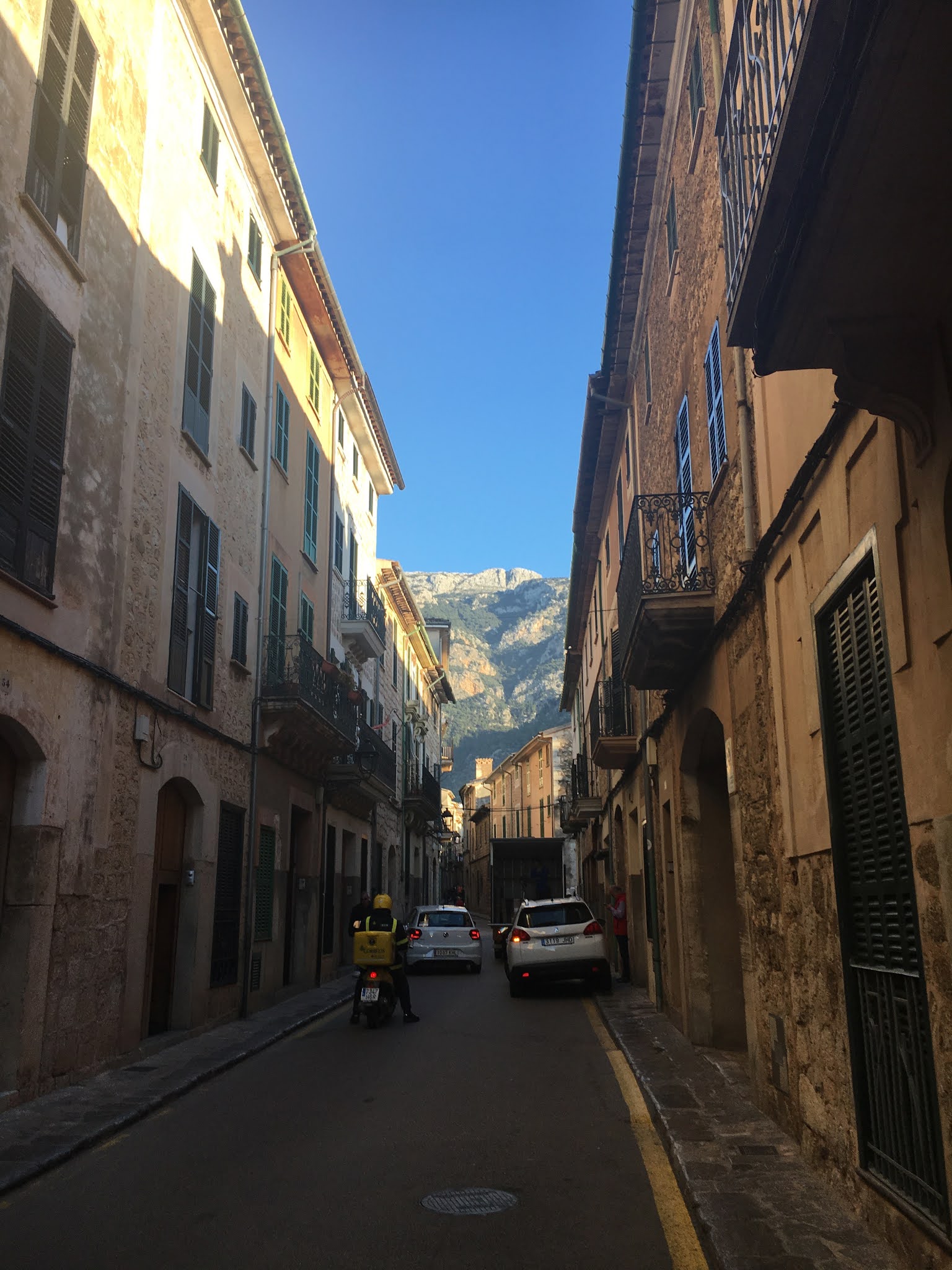
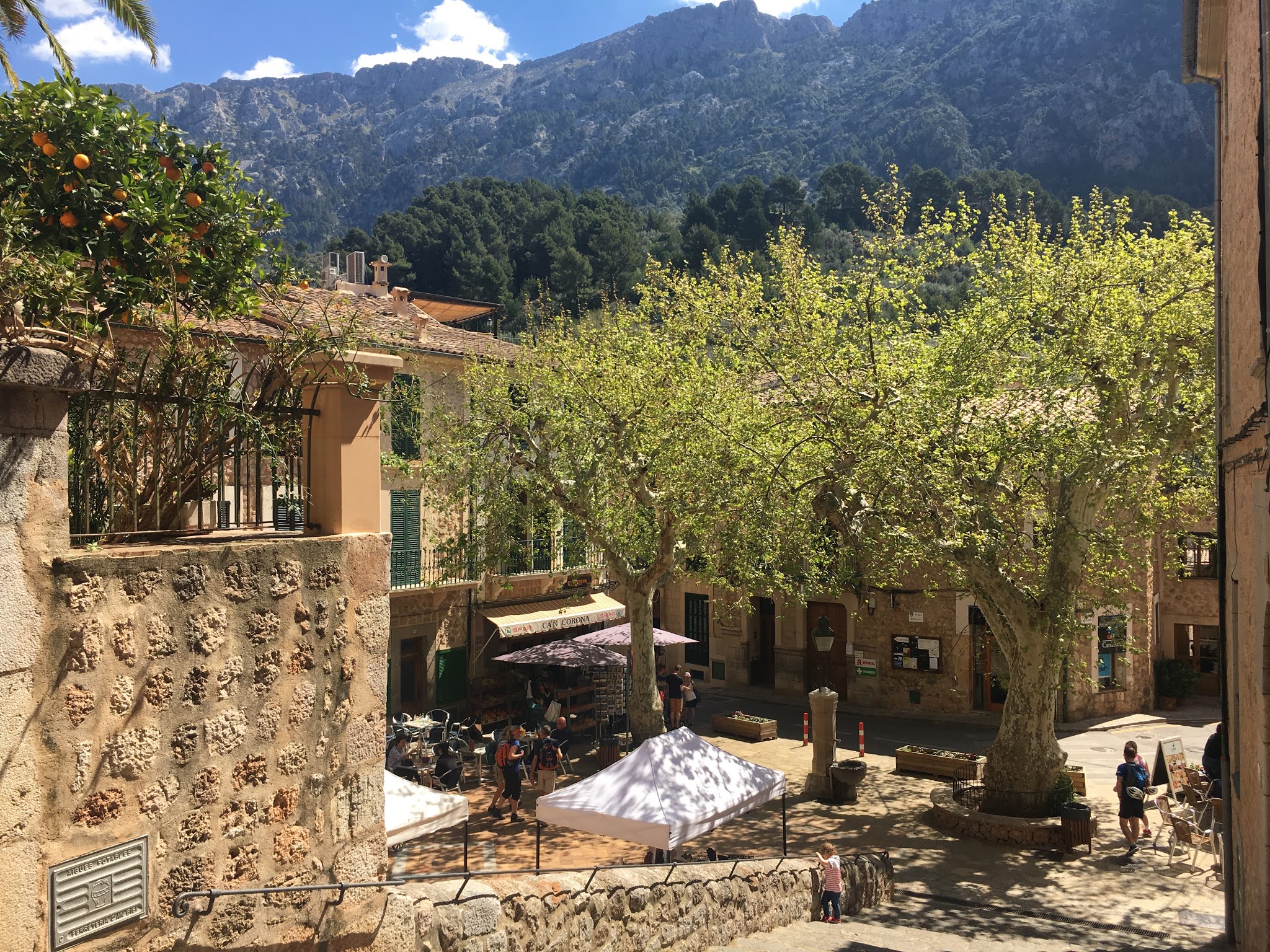
I was lucky enough to visit Spain three times while I lived in Germany, and though I didn't make it to Ibiza, I did spend a week in Mallorca, which is the largest of Spain's Balearic islands (fun fact: Spain's second most popular tourist destination). I spent a couple of days in Palma, the capital city, before heading to the little town of Sóller on the island's west coast. We took a historic wooden train, which was delightful, and stayed in a wonderful B&B. It's a pretty little town and we could walk or take the tram to the Port of Sóller. It was April, and though it wasn't quite warm enough to swim the days were beautiful and sunny enough to sit on the beach, and there were lemons growing everywhere. 

The vintage narrow-gauge train from Palma to Sóller. It's more than 100 years old. There's also a vintage tram from Sóller to the Port. 

View of the mountain from the street, our B&B was on the left, restored from 1902. 


I loved the grillwork on all the buildings. I think this was opposite our hotel room. 


View from the tram stop towards the square in Sóller.

View from the walk from our B&B to the port.

Port de Sóller

I also made a day trip to the town of Deiá, a pretty town in the mountains with beautiful views. It was also the home of the writer Robert Graves who moved there in 1929 and lived there until his death. The house is now a museum, and you can visit the house and surrounding garden for a small fee. It was a bit of a walk outside the town but was worth seeing. 

View from the walk to Robert Graves' home, that's Deiá in the distance. I love the terraced hills.

Robert Graves' home

Robert Graves' study

Another day I walked a few miles through some lemon groves to the town of Fornalutx. It was beautiful and tranquil and then I had a glass of wine and some tapas while sitting in the square, watching bicyclists whizzing by on the mountain roads. 

View along the walk to Fornaluxt

There were lemon and orange trees everywhere.
There were signs posted all over for local marmalade and I'm sorry I didn't buy any. 

I was so tempted to reach through the fence and pick one of these lemons! 

I made a slight detour on the walk which turned into a hike and I went the back way into town.
Great view though.


I loved this reading girl on a terrace. That would be me, everyday, if I lived there!

Lots of stairs in Fornaluxt! 

The square in Fornaluxt. I sat at one of the restaurants on the right and had a snack.


Mallorca is know somewhat for being a party island but I skipped all that and just enjoyed the stunning scenery. It was beautiful and relaxing and I would love so much to go back to Spain someday. 

Thanks again to Kaggsy and Simon for hosting this event! I hope to read at least one more book published in 1956, and hopefully more in the coming weeks. 

I'm also counting this as my book set in Spain for the European Reading Challenge

Tuesday, July 14, 2020

Paris in July: The Misunderstanding by Irene Nemirovsky


I've been hard at work reading two massive books for Paris in July, and as a quick break, I picked up The Misunderstanding by Irene Nemirovsky. Her first novel, just 164 pages long, was first published in 1926. It's the story of an affair between Yves Harteloup, a young war veteran, and Denise Jessaint, a bored rich woman, the wife of another war veteran whom Yves met while both were convalescing at a military hospital. 

The two meet at the end of the summer in the resort town of Hendaye, on the south east coast of France. Yves was raised wealthy but lost nearly all his money due to poor wartime investments by his financial advisors. He's found a job and has barely enough to hold on to his family apartment in Paris, and his one indulgence is his annual holiday, to the town he visited as a child. There Yves meets the beautiful Denise when her toddler throws sand on him as he dozes on the beach. 

After he realizes she's the wife of an old comrade, Yves is initially annoyed to have his idyllic trip interrupted by someone from his past; soon, however, he begins to feel a strong attraction to the beautiful Denise. After her husband goes to London, leaving her alone (well, with the child and nanny), he becomes obsessed with Denise, who married for convenience and money. Soon the attraction is returned, and the affair begins.


Things become complicated when Denise and her husband return to Paris, and Yves has to return to his humdrum job. Denise wants more and more from Yves, but can only see him for brief snatches of time; Yves becomes despondent when he realizes he'll never be able to keep up with her wealthy lifestyle, and falls deeper into debt. It's far from a fairytale romance 

It was a quick read, and I finished nearly the whole thing in a single sitting -- a big change from the doorstoppers I've been working on this summer. Neither Yves nor Denise are particularly likable characters, but the story is so realistic, and the writing is so good that I found myself sympathizing with both of them. It's astonishing to me that Nemirovsky wrote this when she was only 22 or 23. 

This was a perfect read for Paris in July -- I could imagine myself in the neighborhoods of Paris and I even looked up some of the streets and neighborhoods on Google Maps as I was reading. I really wish I was in Paris this summer but armchair traveling through literature will have to do! I've now read six of Nemirovsky's works and would like to read her entire oeuvre. There's also The Mirador, an imagining of her memoirs by her daughter, Elisabeth Gille, published by NYRB Classics, and a biography. Her life sounds fascinating and tragic. 

Friday, April 17, 2020

#1920 Club: In the Mountains by Elizabeth von Arnim


I always love when Simon and Kaggsy host one of their year-themed reading clubs -- it's so interesting to see the range of different books published in a given year. This round they've gone for the centenary celebration of 1920. It was tougher than I thought to find a book I hadn't read, but I realized that In the Mountains, one of Elizabeth von Arnim lesser-known works, was published that year. It's really a novella, though it's out of print in English it's available online through Gutenberg.org and iBooks.

Set in 1919, this epistolary novel is the diary of an anonymous Englishwoman who has returned to her summer home in the Swiss Alps, after an absence of five years due to WWI. She retreats to her cozy home to rest and recuperate after the trauma of the war. She is trying to get back to some sense of normalcy and in the beginning she does little more than sit and contemplate. She does have two servants, Antoine and Mrs. Antoine, a caretaker and housekeeper. Some of the most amusing bits are the narrator dealing with the minutia of life. There's a part about Antoine's acquisition of livestock which I really enjoyed. 

Out of print in English, but I love the cover of this Italian edition.

The silence and solitude is therapeutic for the narrator but after a while she longs for human contact, and I found this passage to be particularly timely:

I suppose, however, for most people complete freedom is too lonely a thing, therefore the absence should only be just long enough to make room for one to see clear again. Just a little withdrawal every now and then, just a little, so as to get a good view once more of those dear qualities we first loved, so as to be able to see that they're still there, still shining. (August 4)

Eventually, the author has some random house guests, two English sisters she who literally stumble their way into her yard, looking for a pension, and quite quickly, she invites them to stay. I liked this as it reminded me a bit of the four women sharing the villa in Enchanted April. I didn't expect it, but this book had quite a few parallels with the self-distancing we're all experiencing:

Yet the days are packed. Mine, at any rate, are. Packed tight with an immense monotony.
Every day we do exactly the same things: breakfast, read aloud; lunch, read aloud; tea, go for a walk; supper, read aloud; exhaustion; bed. How quick and short it is to write down, and how endless to live. At meals we talk, and on the walk we talk, or rather we say things. At meals the things we say are about food, and on the walk they are about mountains. The rest of the time we don't talk, because of the reading aloud. That fills up every gap; that muzzles all conversation. (August 25)
(This is essentially my life right now, except we don't read aloud, we're reading silently or watching TV. Or on our phones, sadly).

The sisters, two widows named Mrs. Barnes and Mrs. Jewks, then become the focus of the novel. Mrs. Barnes, the elder, is very buttoned-up about their family history and situation so close to the end of the war, and I could see parallels with some of the current racism in our country. But the best part of the novel was the witty dialogue and lovely descriptions of life in the Alps. I did get to visit the Alps when I was in Germany, once on a day trip to Interlaken, and another on a trip to Innsbruck, Austria. I didn't actually visit any chalets but the scenery was stunning. 


Near Wengen, Switzerland


View from the top of Grindelwald in the Swiss Alps 


After a bit of a slow start, I really enjoyed this novel and finished most of it in one sitting. It really picked up after Mrs. Barnes and Mrs. Jewks arrived, and though it doesn't quite have the charm of The Enchanted April, I could see hints of that book which was published only two years later. My only quibble with In the Mountains is that we never really learn that much about the narrator -- aside from never learning her name, we know very little about her family history, her life, or what happened to her in the war. We learn about one significant wartime loss, but that's it. What was her role in the war? Did she lose a husband or sweetheart? She never says. I wonder if she is supposed to represent an everywoman, or that the she is so neutral so that the reader can more easily identify with her. In the Mountains is considered one of von Arnim's lesser novels but I'm very glad I read it. Thanks to again to Simon and Kaggsy for hosting this event, I'm looking forward to the next one!

I'm counting this as my Classic with Nature in the Title for the Back to the Classics Challenge, and as my book set in Switzerland for the European Reading Challenge

Thursday, January 30, 2020

The Time Machine by H. G. Wells


I was racking my brain to think of a novel for the Journeys and Travels category for the Victorian Reading Challenge when I thought of The Time Machine by H. G. Wells -- seriously, what could be a more fantastic journey than traveling through time? Though I'm not much of a science fiction reader, I really enjoyed my last foray into H. G. Wells, The Invisible Man. I'd been putting off this one because I saw the 1960 film adaptation as a child and it scared the bejeezus out of me. 

Published in 1895, the story is narrated by an anonymous man who meets a mysterious scientist at his gentleman's club. As a group of men are sitting around waxing philosophically, a scientist, known only as the Time Traveller, describes his theory of time travel. Of course they scoff at his ideas, but accept his invitation to see the machine. The narrator and a few other men accept an invitation for the following week, but when they arrive at the Time Traveller's home, their host is absent. They begin dinner without him and are shocked at his dusty, haggard appearance when he finally arrives. Gulping his food like a starving man, he recounts a fantastic tale of traveling thousands of years into the future, to a world now populated not by humans but by the peaceful, beautiful Eloi. Things seem idyllic until the Traveller realizes things are much darker and more dangerous than he realized at first, and he is soon fighting for his own existence. 


After a slow start, I raced through the book, which was much better than I expected, and rather different than the film version that I remember from years ago. It's short, only about 100 pages in most editions, and can easily be read in a single sitting. (I actually read most of it off my phone which I downloaded for free on iBooks). What surprised me most was how much Wells emphasized the environment and the future of mankind, so far ahead of his time. He also made some serious points about class warfare, which comes to an extreme in the book. 

It's quite a page-turner and I loved the ending, which I found very poignant, and I'm very glad that I finally got around to reading it. I don't know if I dare watch the 1960 film version again, or even the 2002 adaptation starring Guy Pearce. The effects in the first version are probably pretty cheesey to modern viewers, but I'm very squeamish about horror movies. I'm pretty sure the newer version is even scarier. I'm not a huge sci-fi person but I know it's iconic. 

And just for fun, here's a clip from a very funny episode of Big Bang Theory, in which Sheldon has a bad dream about time travel after purchasing a movie prop time machine. There's a bit of a spoiler in it, so don't watch it if you don't know the big twist from the novel. 


I'm counting this as my Genre Classic for the Back to the Classics Challenge, and as my Journeys and Travels novel for the Victorian Reading Challenge.

Sunday, May 5, 2019

The Artificial Silk Girl: A 1930s German Train Wreck


Back-to-back train wrecks! I can't remember who blogged about it, but just a couple of weeks ago I saw that Penguin was re-issuing a new edition of The Artificial Silk Girl by Irmgard Keun. I'd never heard of it, but the description said it was a bestseller in 1931 and subsequently banned by the Nazis, so, naturally I was intrigued and ordered a copy from Amazon.de. And for once, I actually didn't wait around several years before I read it! (The fact that it is only 144 pages may have contributed somewhat.)

So here's the setup: young Doris is a young German woman living in the Rhineland, but longing for excitement. She's working as a typist and living with her mother and stepfather, but dreams of a career on the stage -- preferably in a big city. She manages to finagle her way onstage as an extra in a local play, and even gets a single spoken line. It looks like she actually might achieve her dream but then a bad decision catches up with her; she then steals a fur coat left on one of the theater seats by a neighbor (for whom she has a longstanding hatred) and leaves town on an overnight train to Berlin in a panic.  

Doris manages to crash at an old friend's apartment temporarily, but she can't get work papers because the police might be looking for her due to the theft. She's living hand to mouth, depending on sympathetic men she picks up in bars to buy her food and drinks. Basically, she's looking for a rich man to support her, she doesn't care if it's as a wife or a mistress. Things naturally don't work out as planned and she sinks lower and lower. Yep, another train wreck.


The blurb on the book jacket describes this book as "very funny and intensely moving," but I didn't find it a bit funny -- I just thought it was tragic and sad. I didn't care much for Doris but I did find her plight horrifying -- I remember what it was like when I was first on my own, struggling to pay the bills (though I never went hungry and was threatened by homelessness like Doris). I know there were a lot of desperate people in Germany after the war, and the cold and the Depression meant so many people were in dire straits. 

Though The Artificial Silk Girl wasn't exactly what I expected, it was an interesting perspective to read about, especially since Keun lived through it first-hand. She was born in 1905, so she was about the same age as Doris when she wrote this, and probably knew people very much like her. 

Some of the descriptions of The Artificial Silk Girl also mention that Keun was inspired by Anita Loos' Gentlemen Prefer Blondes to write her own story about a young woman trying to make it on her own, which inspired me to track down a copy of Loos' novella. The two books couldn't be more different and I'll be posting on that one shortly. I've also heard it's more like Christopher Isherwood's Berlin Stories, one of which was adapted for the stage as I Am a Camera -- which I read just a few months ago. Doris is definitely closer to Sally Bowles than Lorelei Lee. 


If you're interested in Berlin in the late 1920s and early 1930s I highly recommend the Babylon Berlin TV miniseries which was a huge success. It's more of a historical crime series but one of the characters reminds me a bit of Doris, and there are several scenes set in Berlin nightclubs, plus you definitely get the sense of desperation and the dark underbelly of Berlin society. The first two seasons are available in the U. S. on Netflix, and apparently there's a third in the works. (You can watch it either with the original German and English subtitles, or dubbed into English -- I much prefer the subtitles). It's based on a series of German books by Volker Kutscher, some which have been translated into English. I read the first volume last year but this is one of the few instances in which I actually preferred the TV adaptation to the book. 

I'm counting this as my Classic From A Place You've Lived for the Back to the Classics Challenge

Thursday, January 10, 2019

Alexander's Bridge: For the Hard-Core Willa Cather Fan


Last year I waited until the bitter end to complete my own reading challenge, and I am determined that I'll read way ahead this year for the Back to the Classics Challenge. I have thrown myself headfirst into my TBR piles this year and have already completed three books for the two challenges for which I've signed up (BTCC and the TBR Pile Challenge). 

Published in 1912, Alexander's Bridge by Willa Cather is her first novel, and the last of hers for me to complete (except for the short stories). It is the story of Bartley Alexander, a successful American engineer, famous for creating unbuildable bridges. The story begins in Boston, where an old schoolmate Lucius Wilson has come to visit. Wilson meets Alexander's beautiful and gracious wife Winifred, and learns all about Alexander's success and how they met while he was building a famous bridge in Canada, his first big break. 

Soon after, Alexander travels to London for work, where he is reunited with an old flame, an Irish actress named Hilda Burgoyne. They had been madly in love years ago, but Alexander broke things off when he met and married Winifred. Hilda has now become very successful and she and Alexander keep meeting. One thing leads to another and soon they're having an affair which lasts off and on for several years, as Alexander travels back and forth between London and America, working on various jobs. The bridges that he builds are a metaphor for his struggles to connect his two lives. He loves both women and can't bear the thought of living without either of them. 

The book started out a little slowly but picked up when Alexander went to London and met up with Hilda. I think I appreciated it more because I've been to London a few times since moving overseas, and have been able to go to some of the theaters in the West End, so I could really picture that part of the story. The plot is very simple, but I didn't find the characters as compelling as in some of her later novels like Lucy Gayheart which I read last year. (Of course it's Cather's first novel and so it's not surprising.) I did find some of the writing beautiful and insightful. 

This was a very quick read -- I literally read this entire book in one sitting on an airplane (and it was a fairly short flight). It's not my favorite by Willa Cather but if you're a fan of her work, it's worth reading. 

I'm counting this as my Classic Novella for the Back to the Classics Challenge. 

Wednesday, August 8, 2018

Kept in the Dark by Anthony Trollope: Victorian Masculinity is Fragile


Another Trollope novel! Another terrible cover!

My Facebook Trollope group is hosting a read-along of Kept in the Dark, another of Trollope's novellas. As I had an unread copy on the shelves, and it was quite short, I thought this was as good a time as any participate -- and I was hopeful that it wouldn't be nearly as dire as Jude the Obscure. Published in 1882 shortly before his death, it is the story of a young woman named Cecilia Holt and the conflict that arises when her new husband discovers that she was previously engaged to another man.

So, young Cecilia is first engaged to Sir Francis Geraldine, a man nearly twice her age. He is the uncle of her friend, whose father is the local vicar (having read Jane Austen, I immediately recognized the pattern -- older brother gets the title, second son often joins the church). Cecilia and Sir Francis are much thrown together when she visits her friend, and as Cecilia is beautiful and has some money, and Sir Francis is a baronet, it is no surprise when an engagement follows. However, as the wedding date draws closer, she has doubts about his character and breaks off the engagement. Sir Francis has a title, but he is no gentlemen, and is in fact a gambler and something of a scoundrel. His pride is hurt after Cecilia throws him over, so starts to spread around the story that he, in fact, jilted her. Cecilia does not care to dignify this rumor, and simply leaves Essex for the continent until it all blows over.

After about a year, she meets George Western, another older man, who has no title but does have a good character. One thing leads to another and Mr. Western confesses to her that he himself had been jilted. Naturally this would have been the obvious time for Cecilia to reveal her previous engagement, but Mr. Western says his fiancee left him for a younger man -- Sir Francis' cousin, Captain Geraldine. Gotta love those amazing coincidences in Victorian literature.


Eventually, Cecilia accepts a proposal from Mr. Western, but never reveals her previous engagement, even after they marry. She just keeps putting it off for a better time, which never arises -- until Sir Francis turns up like a bad penny. Of course things get worse from there. Mr. Western begins to imagine all kinds of terrible scenarios, and his jealousy gets the better of him.

At first I thought this book was going to be something like my previous Trollope read, An Old Man's Lovein fact, it's closer to He Knew He Was Right, which also has an overly jealous husband. It also reminded me strongly of Thomas Hardy's A Pair of Blue Eyes, in which another Victorian gentleman can't get over the fact the woman he loves had been in love with someone else before him.  I get that women were supposed to be virgins back in the day, but it's a bit much to expect that they've never had any love interests at all. It's bad enough with the men often being ten to twenty years older than the women, which you see over and over again. (I'm beginning to wonder how accurate this really was in the 18th century, or if it's just the fantasy of the male writers.)


I'm not saying Cecilia is blameless -- it would have been a lot easier if she'd told him before she got engaged (then of course there would be no story). But I could understand how it would be harder and harder to reveal this to her fiancee. Also, Western's overreaction is way over the top and I really wanted to give him a good talking-to. Based on this book, I'm not quite sure if Trollope supported women's rights or not..

Overall, I did enjoy it, and there are some interesting characters -- Sir Francis is an excellent villain, and Cecilia has a frenemy named Francesca Altifiorla who is really self-centered and manipulative. Given Trollope's penchant for descriptive character names, I suspected that "Altifiorla" was Italian for "old flower," but alas, it is not.  Still, an enjoyable quick read, just over 200 pages. Though it's one of Trollope's lesser works, it would be a good introduction for someone who isn't ready to tackle one of his 800 page doorstoppers.

And I've now completed thirty novels by Trollope -- only seventeen left to go!

Wednesday, June 13, 2018

An Old Man's Love by Anthony Trollope: Not Actually As Creepy As the Cover Images

I'm not into the May-December romance thing but he looks much older than 50.

My recent track record with Trollope's shorter novels hasn't been great (I haven't forgotten Linda Tressel) but my library had a free digital download of An Old Man's Love on audio and I needed something to listen to, so I decided to give him another shot. This is Trollope's last completed novel; it's listed as published in 1884, though he died in 1882. (I'm not sure if the 1884 date is a serialization or posthumous publication of the complete novel). It's another of his short works, about 250 pages, and it didn't take long to listen to the entire book on audio.

Basically, this is a love triangle between young Mary Lawrie, an orphan (naturally) of about 25; her benefactor, the 50ish Mr. Whittlestaff; and her absent lover, John Gordon. As the novel begins, Mr. Whittlestaff is informed that the wife of his late friend Mr. Lawrie has died, leaving young Mary (her stepdaughter) penniless. He takes it upon himself to give Mary a home at his small Hampshire estate, Croker's Hall. Mr. Whittlestaff isn't wealthy but he has a quiet and comfortable life and is happy to have Mary in the household, rather than force her to make her way in the world as a governess. 

Eventually, he begins to develop romantic feelings for Mary, though he's old enough to be her father. Mr. Whittlestaff proposes marriage, and Mary is fond of him and grateful for all he has done for her. She confesses that she was in love with a dashing young man named John Gordon; however, her stepmother sent him packing because he had no money, though he was well-born and hardworking. It's been three years and she hasn't heard from John, so after struggling with her feelings, she accepts Whittlestaff's proposal. Wouldn't you know it, John Gordon, having made a fortune in the diamond mines of South Africa, shows up looking for her the very next day after she accepts. Who could imagine the coincidence??

Thus the dilemma ensues. Should Mr. Whittlestaff hold Mary to her promise to accept his proposal? What does Mary owe Mr. Whittlestaff? And will his housekeeper Mrs. Baggett ever shut up? 

As one of the shorter novels, the plot isn't very complex, but the writing was good and there were some amusing side characters. The housekeeper Mrs. Baggett has a parallel plot with an estranged drunkard husband who shows up after years in absentia, demanding financial support to continue his gin habit. She moans and wails and rolls her eyes and doesn't think Mary is good enough for Mr. Whittlestaff, yet can't abide the thought of Mary turning him down. She wants Mary to accept him to make him happy, but at the same time Mrs. Bagette doesn't want Mary to become mistress of the household and threatens to leave. It's enough to make your head spin.

There's also a delightful and garrulous vicar, the newly engaged Mr. Montagu Blake, an old schoolmate of John Gordon who decides to play cupid and encourage the match between Gordon and Mary Lawrie. This leads to the world's most awkward dinner party ever. 

Some of the characters in this book made me guffaw, snort, and yell out loud in response. I've heard that the quality of Trollope's writing declined in his later years but I really enjoyed this book, with one small quibble -- there are several racist comments about the workers in the South African diamond mines which made me really uncomfortable. I realize this was written well over 100 years ago, but it does make me disappointed in Trollope.

And now on to the bad book covers! I do realize that age 50 in the 1880s was considered old, but the image on the paperback version looks like a man in this 70s, at the very least. 


And what about this cover? It's pretty bad. 


This one isn't much better:


And while I was searching for the original Overdrive image I found this one, 
which left me speechless:


I literally have no words for this. I don't even want to imagine what they were thinking.