Showing posts with label Trollope. Show all posts

Sunday, March 13, 2022

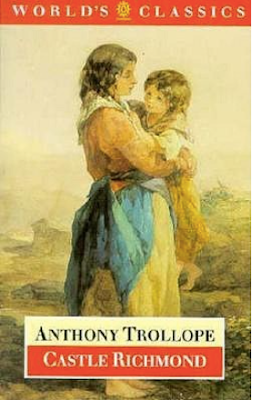
Castle Richmond by Anthony Trollope


It is impossible that these volumes should be graced by any hero, for the story does not admit of one. But if there were to be a hero, Herbert Fitzgerald would be the man. 

A Victorian novel by Anthony Trollope, set in Ireland? This book could not be any more in my wheelhouse. For the Back to the Classics Challenge I needed a book from the 19th Century and I still had five unread Trollopes on my TBR shelve. Two of them were set in Ireland so that seemed like an obvious choice for March.

Trollope spent nearly twenty years in Ireland working for the post office, and began his writing career there. His first two novels are set in Ireland, and were written during the Great Famine. Castle Richmond, his third novel set in Ireland, was published in 1860, but is set several years earlier. It does use the Great Famine as a plot point, but much less so than I was expecting. 

Basically, it's the story of a love triangle between two cousins of the landed gentry, Owen and Herbert Fitzgerald, and the girl they both love, Clara Desmond, the beautiful but poor daughter of Countess Desmond, a young widow whose marriage was less than happy. There's also a complicated plot about the inheritance of Castle Richmond, the seat of the wealthy Fitzgerald family. But I'm getting ahead of myself. 

Owen Fitzgerald is the young squire of Hap House in County Cork -- technically gentry, but the poorer branch of the Fitzgerald family, and untitled. He is handsome and dashing, and befriends the young Earl of Desmond, acting as a sort of older brother. They go hunting and fishing and whatnot, and Owen also notices the young Earl's older sister, Clara, who is about sixteen. Eventually he declares his love for her, and she returns his feelings. However, her young widowed mother, who is not yet forty, quashes all her hopes -- Owen is too poor and lacks a title, so she refuses to acknowledge any engagement and forbids Clara to see or write to Owen. (The reader is also aware that the young Countess is also crushing on Owen and secretly wanted him for herself). 

About a year Clara is befriended by two of Owen's distant cousins, Mary and Emmeline Fitzgerald, from the wealthier portion of the Fitzgeralds -- the family living at Castle Richmond. She spends time with them and is much thrown together with their brother Herbert, the heir and future Baronet. He's younger and more bookish than his dashing cousin Owen, who considers him a prig. It would seem that Clara and Herbert would be a perfect match -- she's beautiful and he's rich, and they're both gentry. But that would make for a very short novel, so there must be complications -- which arrive with some nasty characters from London, Mr. Matthew Mollett and his son Abraham, who have come to County Cork to stir up trouble for the wealthy Fitzgeralds.

Before marrying Lord Fitzgerald of Castle Richmond, his beautiful wife Lady Fitzgerald had made an unfortunate marriage with a ne'er-do-well named Talbot who deserted her and her child and ran off to Paris, where he was supposedly killed in a fight over a gambling debt. Eventually, she met and married Lord Fitzgerald. Now the Molletts have arrived with the intent of blackmailing the Fitzgeralds, claiming that Lady Fitzgerald's husband is still alive and that her children are illegitimate. . . making Owen Fitzgerald the rightful heir of Castle Richmond and the title. 

I liked this novel, though the love triangle and the blackmail plot lines are the strongest. But these characters are basically wealthy Protestant landowners. There's actually not that much in the story about Ireland and the famine -- that's mostly a peripheral plot point only in how it affects the main characters. As landlords, the Fitzgeralds are trying to help the starving population, and there's some infighting between the Catholic and Protestant clergy about how to best help everyone which is pretty infuriating, but that's not a large part of the story. 

I also found Clara to be a very undeveloped character -- both of these men are in love with her, but she's mostly a flat character, just very pretty and sweet. She gets a little character development writing letters to both of the men in love with her, but not much. She's not as annoying as some of Dickens' ingenues, but not nearly as interesting as some of the women in Trollope's later novels. 

Overall I did enjoy the novel and sped through the 500 pages in just about a week. I'm getting down to the last few unread books by Anthony Trollope. I can proudly say that I've now finished 38 (!) of his 47 novels. When I've finished them all I'm sure I'll be sad but I guess I'll just have to start reading them all over again!

This is my 19th Century Classic for the Back to the Classics Challenge, and my Irish read for the European Reading Challenge.

Sunday, June 14, 2020

John Caldigate: Trollope goes to Australia!

Not a great cover image, but the only OUP edition I could find online.
Strangely, my copy has a different cover.


'People who read no books are always fools to those who do read.'

Last week was particularly stressful -- the news is so dire and it only seems to get worse -- so it was time to turn to one of my favorite comfort authors, Anthony Trollope. I still have several of his novels unread on the shelves, and three of them were long enough to qualify for my Big Book Summer Challenge. I chose the shortest of the lot, John Caldigate, because the eponymous character travels to Australia, and it sounded like some nice armchair travel since I won't be going anywhere for a while.

Published in 1979, John Caldigate is one of Trollope's lesser-known works, and a standalone novel. It's the story of young Mr. Caldigate, heir to the estate of Folking in Cambridgeshire. His mother and sisters died years ago, but sadly, John's father was mourning and distant while he was a boy, so he mostly grew up on his cousin's estate. Now in his early 20s, John has left Cambridge, and is saddled with numerous gambling debts. The estate is entailed upon him, but his father has decided to disinherit him in favor of a cousin, and John takes a buyout from his father, pays off the debt, and books passage Australia with a classmate, Dick Shand, where they hope to make their fortune in the gold mines. While meeting with his father's banker Mr. Bolton, John spies his teenaged daughter Hester, and is struck by her beauty.

Anthony Trollope


Before his boat sails, John goes to say goodbye to his cousins, where his aunt pressures him to marry his oldest cousin Julia. John refuses to get himself engaged, and hightails it to the boat with his friend Dick, where they travel second-class, despite being gentlemen. On the voyage, John strikes up a friendship with a pretty actress, a widow known as Mrs. Smith. It's a long voyage and tongues start wagging, and it seems like everyone on board is aghast, including the ship's captain, and they all try to warn him off, but John is undeterred and declares himself engaged to her.

John and Dick stake a claim and start looking for gold, and after a detailed description of gold mining, he makes a trip back to Melbourne to look up Mrs. Smith. Then the story jumps forward in time several years. John is back in England, having made a fortune of £60,000. His father has missed him dreadfully and John pays off the mortgage on the estate, reinstating himself as heir. And now it's time to find himself a wife. John never forgot the beautiful Hester Bolton, now 20, and begins to court her, to the chagrin of her mother, a religious fanatic. She opposes the marriage from the beginning, but she can't stop it. All seems well until about a year later when some unsavory characters from Australia arrive, and John's world is turned upside down as he faces extortion and bigamy charges. 

I assumed this would be the standard Trollope comfort read, but elements of the plot went dark pretty quickly; particularly, Trollope's depiction of Mrs. Bolton's religious mania, (much of which I skimmed over). After John is charged with bigamy, the Boltons do something really despicable to Hester, which I would have found unforgivable. I was also distressed by some of John's relatives, especially his Aunt Polly who tries to snare him into marriage with his oldest cousin Julia. Some of Hester's relatives are pretty awful as well. 


I did enjoy Trollope's description of the sea voyage to Australia and the courtroom and trial details. There's also a pivotal side character who is a postal employee which I found delightful. Trollope worked as a postal employee for more than 20 years, so he must have really enjoyed including his detailed knowledge of stamps and postmarks into one of his novels. (Fun fact: Trollope invented the British post-box). 

This was a fast read, and a solid Trollope story. He doesn't get nearly the love of Dickens or Hardy, and of John Caldigate is definitely one of his more obscure novels -- there are hardly any editions and very few cover images. However, while searching online, I discovered that in 2015 John Caldigate was adapted into a graphic novel called Dispossession, by Simon Grennan. As far as I know, it's the only Trollope novel adapted, and it's an interesting choice because it's such an obscure novel. And I'm curious about how he condensed a 600 page Victorian chunkster into less than 100 pages. 


So -- one more Big Fat Book crossed off my summer reading list, and I've now read 34 of his 47 novels! Only 13 left to go -- I'll be sad when I'm done. I guess I'll just have to go back to the beginning and start again!

Saturday, September 15, 2018

Is He Popenjoy? Is the Strangest Title of Any Trollope Novel


Apparently, 2018 is my Year of Trollope. I've now completed five of his works this calendar year (though to be honest, four of them were really quite short). The longest thus far was Is He Popenjoy? which also has the honor of Oddest Book Title of the Year; also, the honor of Most Irritating Title to Type Because It's Constantly Autocorrected to Popinjay, which is not the same thing at all. (I have since learned that Popinjay is a kind of Scottish archery game.) Popenjoy was chosen for a readalong by my Facebook Trollope group, and though the group read was scheduled for late September through November, I started it early and was so involved in the story I sped through the 655 pages in a week. 

So. The Popenjoy referred to in the title is not a thing, but a title -- specifically, the title of the heir apparent to the Marquis of Brotherton, a fictional aristocrat. When the novel begins, the current Marquis, fortyish and unmarried, has been residing in Italy for some years, and is estranged from his family: his mother, the Dowager; his four sisters, three of whom are unmarried; and his youngest sibling and only brother, Lord George Germain. Lord George is young and good-looking (if somewhat serious), but cash-poor, as he basically lives off the management of the estate while his brother has all the capital. George is aware that if his brother ever returns, he will have essentially nothing. However, the slim chance exists that the Marquis may never marry, and that George might eventually become the Marquis. Therefore, any future son could be the heir to the estate, Manor Cross.

Lord George is desperately in love with a Miss De Baron, but as neither of them has any money, she rejects his proposal of marriage early in the first chapter, marrying a wealthy older man instead. Lord George is brokenhearted, but eventually, is persuaded to consider another potential bride -- young Mary Lovelace, daughter of the Dean of Brotherton. Mary's father is from humble origins but worked his way up through the Church hierarchy -- and though Mary is young and pretty, she has the added attraction of 30,000 pounds, inherited from her late mother's father, who made a fortune in candles. 

Mary is just nineteen and Lord George is thirty-three, but the marriage takes place, with some stipulations: the couple will have a House in Town (aka London) and spend four months of the year there, paid for with the Dean's money. The Dean feels that since Mary has spent virtually her entire life in the country, she deserves a little society for at least part of the year instead of being shut up in the Brotherton Estate, Manor House, with George's older sisters -- who are rather petty and judgmental. And the season spent in London is where the trouble begins. Mary doesn't know a soul in London and makes a new frenemy of the former Miss De Baron, who is now Mrs. Houghton. Mrs. Houghton likes Mary but has an ulterior motive -- she thinks Mary needs taking down a peg or two for the sin of marrying Lord George only a year or so after she herself rejected him.  (Apparently it was the duty of Lord George to pine away for her forever). Mrs. Houghton introduces Mary to her cousin, the dashing Captain Jack De Baron, who loves to dance and ride and shoot pool, all things that Mary's husband does not. 

Things are further complicated by an announcement from Italy that the Marquis is getting married to an Italian woman, quickly followed another announcement that the marriage has taken place, and has quickly produced a son. Naturally, this sped-up timeline raises some eyebrows, particularly with the Dean, who has a vested interest in any future grandson becoming a future Marquis. Eventually the Marquis shows up with his Italian bride and sickly son, though they're mostly kept hidden away from view. 

I love this cover, from an inexpensive "yellow back" edition from about 1881.
It's from a collection at the Philadelphia Athaneaum.

So, most of the plot centers around tension between the newly married George and Mary, due to the interlopers (honorable or dishonorable); and between the Dean, George, and his brother, about the legitimacy of this little boy, known to all as Popenjoy, though presumably he has an actual first name, though it's never mentioned. (I only learned the Marquis' given name is Augustus in one of the final chapters, so presumably, the little boy is named after his father). There's tension between George and his brother, who's never had much interest in the family in England; tension between the Dean, who is pressing the case with his own lawyers, and George, who would rather let it lie; and tension between the Dean and the Marquis himself, who is a really unpleasant git. 

There are also some fox hunting scenes (of course) and a weird sub-plot about women's rights activists which, frankly, did nothing much to advance the plot. But this was starting to be a subject of discussion in the 1870s when the book was written, so I guess Trollope was trying to be timely. There's a German and an American activist, both women, and I'm not sure if Trollope was poking fun at these two countries, or to women who have the nerve to want rights. He does make the point that there is a double standard regarding the reputation of women after some unpleasant gossip about Mary and Captain De Baron starts circulating. 

This isn't one of Trollope's most complex novels, but I really enjoyed it. The plot about the jealous husband has been repeated a couple of times in other Trollope novels (specifically Kept in the Dark and He Knew He Was Right) but I suppose it's tough not to repeat yourself if you've written 47 novels. The question of Popenjoy's legitimacy was inspired by the Titchborne case that fascinated the public when it came to trial in 1871.

This is the 32nd work I've read by Trollope -- 31 novels and his autobiography! That leaves only 16 novels left. I'll be sad when I've finished them all, I guess I'll just have to start reading them all over again!

Wednesday, August 8, 2018

Kept in the Dark by Anthony Trollope: Victorian Masculinity is Fragile


Another Trollope novel! Another terrible cover!

My Facebook Trollope group is hosting a read-along of Kept in the Dark, another of Trollope's novellas. As I had an unread copy on the shelves, and it was quite short, I thought this was as good a time as any participate -- and I was hopeful that it wouldn't be nearly as dire as Jude the Obscure. Published in 1882 shortly before his death, it is the story of a young woman named Cecilia Holt and the conflict that arises when her new husband discovers that she was previously engaged to another man.

So, young Cecilia is first engaged to Sir Francis Geraldine, a man nearly twice her age. He is the uncle of her friend, whose father is the local vicar (having read Jane Austen, I immediately recognized the pattern -- older brother gets the title, second son often joins the church). Cecilia and Sir Francis are much thrown together when she visits her friend, and as Cecilia is beautiful and has some money, and Sir Francis is a baronet, it is no surprise when an engagement follows. However, as the wedding date draws closer, she has doubts about his character and breaks off the engagement. Sir Francis has a title, but he is no gentlemen, and is in fact a gambler and something of a scoundrel. His pride is hurt after Cecilia throws him over, so starts to spread around the story that he, in fact, jilted her. Cecilia does not care to dignify this rumor, and simply leaves Essex for the continent until it all blows over.

After about a year, she meets George Western, another older man, who has no title but does have a good character. One thing leads to another and Mr. Western confesses to her that he himself had been jilted. Naturally this would have been the obvious time for Cecilia to reveal her previous engagement, but Mr. Western says his fiancee left him for a younger man -- Sir Francis' cousin, Captain Geraldine. Gotta love those amazing coincidences in Victorian literature.


Eventually, Cecilia accepts a proposal from Mr. Western, but never reveals her previous engagement, even after they marry. She just keeps putting it off for a better time, which never arises -- until Sir Francis turns up like a bad penny. Of course things get worse from there. Mr. Western begins to imagine all kinds of terrible scenarios, and his jealousy gets the better of him.

At first I thought this book was going to be something like my previous Trollope read, An Old Man's Lovein fact, it's closer to He Knew He Was Right, which also has an overly jealous husband. It also reminded me strongly of Thomas Hardy's A Pair of Blue Eyes, in which another Victorian gentleman can't get over the fact the woman he loves had been in love with someone else before him.  I get that women were supposed to be virgins back in the day, but it's a bit much to expect that they've never had any love interests at all. It's bad enough with the men often being ten to twenty years older than the women, which you see over and over again. (I'm beginning to wonder how accurate this really was in the 18th century, or if it's just the fantasy of the male writers.)


I'm not saying Cecilia is blameless -- it would have been a lot easier if she'd told him before she got engaged (then of course there would be no story). But I could understand how it would be harder and harder to reveal this to her fiancee. Also, Western's overreaction is way over the top and I really wanted to give him a good talking-to. Based on this book, I'm not quite sure if Trollope supported women's rights or not..

Overall, I did enjoy it, and there are some interesting characters -- Sir Francis is an excellent villain, and Cecilia has a frenemy named Francesca Altifiorla who is really self-centered and manipulative. Given Trollope's penchant for descriptive character names, I suspected that "Altifiorla" was Italian for "old flower," but alas, it is not.  Still, an enjoyable quick read, just over 200 pages. Though it's one of Trollope's lesser works, it would be a good introduction for someone who isn't ready to tackle one of his 800 page doorstoppers.

And I've now completed thirty novels by Trollope -- only seventeen left to go!

Wednesday, June 13, 2018

An Old Man's Love by Anthony Trollope: Not Actually As Creepy As the Cover Images

I'm not into the May-December romance thing but he looks much older than 50.

My recent track record with Trollope's shorter novels hasn't been great (I haven't forgotten Linda Tressel) but my library had a free digital download of An Old Man's Love on audio and I needed something to listen to, so I decided to give him another shot. This is Trollope's last completed novel; it's listed as published in 1884, though he died in 1882. (I'm not sure if the 1884 date is a serialization or posthumous publication of the complete novel). It's another of his short works, about 250 pages, and it didn't take long to listen to the entire book on audio.

Basically, this is a love triangle between young Mary Lawrie, an orphan (naturally) of about 25; her benefactor, the 50ish Mr. Whittlestaff; and her absent lover, John Gordon. As the novel begins, Mr. Whittlestaff is informed that the wife of his late friend Mr. Lawrie has died, leaving young Mary (her stepdaughter) penniless. He takes it upon himself to give Mary a home at his small Hampshire estate, Croker's Hall. Mr. Whittlestaff isn't wealthy but he has a quiet and comfortable life and is happy to have Mary in the household, rather than force her to make her way in the world as a governess. 

Eventually, he begins to develop romantic feelings for Mary, though he's old enough to be her father. Mr. Whittlestaff proposes marriage, and Mary is fond of him and grateful for all he has done for her. She confesses that she was in love with a dashing young man named John Gordon; however, her stepmother sent him packing because he had no money, though he was well-born and hardworking. It's been three years and she hasn't heard from John, so after struggling with her feelings, she accepts Whittlestaff's proposal. Wouldn't you know it, John Gordon, having made a fortune in the diamond mines of South Africa, shows up looking for her the very next day after she accepts. Who could imagine the coincidence??

Thus the dilemma ensues. Should Mr. Whittlestaff hold Mary to her promise to accept his proposal? What does Mary owe Mr. Whittlestaff? And will his housekeeper Mrs. Baggett ever shut up? 

As one of the shorter novels, the plot isn't very complex, but the writing was good and there were some amusing side characters. The housekeeper Mrs. Baggett has a parallel plot with an estranged drunkard husband who shows up after years in absentia, demanding financial support to continue his gin habit. She moans and wails and rolls her eyes and doesn't think Mary is good enough for Mr. Whittlestaff, yet can't abide the thought of Mary turning him down. She wants Mary to accept him to make him happy, but at the same time Mrs. Bagette doesn't want Mary to become mistress of the household and threatens to leave. It's enough to make your head spin.

There's also a delightful and garrulous vicar, the newly engaged Mr. Montagu Blake, an old schoolmate of John Gordon who decides to play cupid and encourage the match between Gordon and Mary Lawrie. This leads to the world's most awkward dinner party ever. 

Some of the characters in this book made me guffaw, snort, and yell out loud in response. I've heard that the quality of Trollope's writing declined in his later years but I really enjoyed this book, with one small quibble -- there are several racist comments about the workers in the South African diamond mines which made me really uncomfortable. I realize this was written well over 100 years ago, but it does make me disappointed in Trollope.

And now on to the bad book covers! I do realize that age 50 in the 1880s was considered old, but the image on the paperback version looks like a man in this 70s, at the very least. 


And what about this cover? It's pretty bad. 


This one isn't much better:


And while I was searching for the original Overdrive image I found this one, 
which left me speechless:


I literally have no words for this. I don't even want to imagine what they were thinking.

Thursday, May 3, 2018

Nina Balatka and Linda Tressel: Anthony Trollope Finally Disappoints

Sorry for the poor image quality.
Not a lot of editions of this book.
For a reason.
It was bound to happen eventually: my favorite, most trusted, most reliable author has disappointed me. And not just with a book I found mediocre -- a book that made me so annoyed, so frustrated I nearly threw the book across the room. The culprit? Nina Balatka and Linda Tressel, two short novels published in one volume by one of very favorite authors of all time, Anthony Trollope. Harrumph.

This wasn't even my top choice of Trollope novels to read, but I chose them simply because they were short, and because they're the only two of Trollope's works not set in England. Nina Balatka is set in Prague (which I was lucky enough to visit last year); and Linda Tressel is set just down the road (well, 3 1/2 hours) in Nuremberg.

So. Nina Balatka is the story of a young woman in Prague who is in love (gasp!) with a Jewish man, to the horror of her family. Her mother has long since died and her aged father has fallen on hard times, and signed over the ownership of his house to the Trendellsohns, the family of his former business partner. Nina's father is ill so she has been dealing with the Trendellsohns, particularly the son, Anton. One thing has led to another and they fall in love, to the displeasure of both families. Nina's cousin Ziska Zamenoy is in love with her, and his mother is dead set against her marrying a Jew. She vows to do everything within her power to split them up, planting seeds of doubt in the minds of the two lovers. The big issue is that Anton never actually received the deed to the Balatka house, which is rightfully his.

This was not Trollope's best work. I thought the dialogue and writing seemed rather stilted, quite unlike Trollope's easy style, and the plot seemed to go over and over the same points repeatedly -- interfaith marriages are hard! Relatives are manipulative! It was like Trollope was beating a literary horse to death; also, there was one character in particular who was so saintly as to be unrealistic. It took me nearly a month to read this 200 page novella because it really wasn't that interesting -- I actually started it at the end of April and it just didn't grab me.


On the other hand, I zipped through Linda Tressel in just over 24 hours.  Right away, this novella held my interest -- the writing was much better and faster-paced. Aha, I thought, now this is the Trollope I know and love. Young Linda Tressel, about 20, was orphaned at a young age and is under the care of her aunt, her mother's sister. They live together in Nuremberg, Germany, in the house left to Linda by her father. To make ends meet they have a lodger, the 50-something Peter Stenimarc, who works for the burgermeisters. Linda's Aunt Charlotte is very religious, a strict Calvinist who basically has sucked all the enjoyment out of Linda's life. She's not allowed to have any friends, dance, read novels, and heaven forbid she should have a suitor or make any kind of decision for herself. 

Aunt Charlotte has decided that Linda needs a stabilizing influence and that she should marry Mr. Stenimarc, who is old enough to be Linda's father. Mr. Stenimarc is flattered by the suggestion and begins to think that young Linda would be lucky to have him. He's very interested in controlling pretty young Linda -- and her property! He and her aunt decide They Know Best and pressure Linda to accept his hand in marriage, even though she's horrified. 

Meanwhile, there's a young man named Ludovic, a distant cousin of Peter's, who is also in love with Linda, but it turns out he may be disreputable -- or is this just what Charlotte and Peter say to keep him away from Linda? It seems like Linda has only a faithful servant to turn to, and there were some pretty surprising developments. The plot in this novel moved along much quicker than Nina Balatka, but I kept wanting to shout at her to grow a spine and tell Aunt Charlotte where to shove it (it's very hard for me as a 21st-century feminist to see people try to control women's decisions, even when they are fictional). Aunt Charlotte was masterful at using guilt to pressure Linda. And then PLOT TWIST [highlight for spoilers] after resisting Charlotte and Peter for months, Linda finally walks out and takes a train and a boat to Cologne to some distant relatives BUT CATCHES COLD ON THE BOAT. AND DIES. THANKS, TROLLOPE!!!!


I was so angry I can't stop thinking about this. It is a terrible thing when one's literary hero falls short. I'm taking it very personally. Anthony, I know you've been dead for 136 years, but seriously, how could you do this to me? I admit, after reading 28 of Trollope's novels (and his autobiography), I've been kind of spoiled because the quality is so high -- there have only been a couple so far that have been just meh -- all but one of them (Sir Harry Hotspur of Humblethwaite) have had at least parts that I really enjoyed. I did mostly like Linda Tressel but the ending made me so mad, I don't know if I want to read any more Trollope for a while.

Trollope, you hurt my soul.

Saturday, June 10, 2017

A Roundup of Victorian Mini-Reviews

Or more precisely, a round up of mini-reviews of Victorian and Victorian-related works. (I like my title better). Anyway, I'm making really great progress on my Victorian Reading Challenge -- so far I've finished 16 of the 31 categories I want to complete and written reviews for nearly all of them. However, I've gotten behind on posts for the past few weeks and since three of them seem to go together, I thought I'd write up some mini-reviews and get on with it. 


Three Men on the Bummel by Jerome K. Jerome. This sequel to the beloved Three Men in a Boat has J and his friends George and Harris reunited for a summer bicycling tour through Germany. A good chunk of the book is devoted to the preparations for the trip (made more complicated by the wives and children of the three, who are not joining the party) and the usual funny asides when an incident reminds J of a funny story. Though not quite as fun as the original, this book has some great moments. It's pointless to describe them, so I'll just include one of my favorite passages. Sadly, the dog Montmorency isn't included in this story, but I had to include this bit which does include dogs.

This quote is a bit long, but it's one of my favorites from the whole book:
. . . in Germany most human faults and follies sink into comparative insignificance beside the enormity of walking on the grass.  Nowhere, and under no circumstances, may you at any time in Germany walk on the grass.  Grass in Germany is quite a fetish.  To put your foot on German grass would be as great a sacrilege as to dance a hornpipe on a Mohammedan’s praying-mat.  The very dogs respect German grass; no German dog would dream of putting a paw on it.  If you see a dog scampering across the grass in Germany, you may know for certain that it is the dog of some unholy foreigner.  

In England, when we want to keep dogs out of places, we put up wire netting, six feet high, supported by buttresses, and defended on the top by spikes.  In Germany, they put a notice-board in the middle of the place, “Hunden verboten,” and a dog that has German blood in its veins looks at that notice-board and walks away.  In a German park I have seen a gardener step gingerly with felt boots on to grass-plot, and removing therefrom a beetle, place it gravely but firmly on the gravel; which done, he stood sternly watching the beetle, to see that it did not try to get back on the grass; and the beetle, looking utterly ashamed of itself, walked hurriedly down the gutter, and turned up the path marked “Ausgang.”


As I'm currently living in Germany, I found this very amusing. Germany is a nation that takes rules and regulations extremely seriously. 
I'm counting this as my New To You Book by a Favorite Author.


Victoria: The Queen by Julia Baird. I was inspired to read this after finally watching the new Masterpiece production of Victoria, which had a lot of comments on one of my favorite non-book blogs, Frock Flicks, at which historical costume experts discuss (and sometimes destroy) historical film and TV adaptations. Yes, Lord Melbourne wasn't nearly as dishy as Rufus Sewell, but Queen Victoria was a little bit in love with him. Overall the book is well-written and engrossing, but I got a little bored with Victoria's life towards the end, but maybe there really wasn't that much to say; at that point I think the lives of her children are more interesting -- I recommend Victoria's Daughters by Jerrold M. Packer, which I reviewed a few years ago.

I'm counting this as my Book About Queen Victoria (fiction or non-fiction).


A Woman of No Importance by Oscar Wilde. Another drawing room comedy, but with more dramatic elements. Taking place over just a couple of days at a country house party, young George Arbuthnot has just landed a plum job with the worldly and sophisticated Lord Illingworth. His mother is dead set against him taking the job, because she has a Deep Dark Secret. The third play I've read by Wilde,  and though it has some witty moments, it's my least favorite so far. Here are a few of his trademark bons mots:

“One should never trust a woman who tells one her real age. A woman who would tell one that, would tell one anything.”

“After a good dinner one can forgive anybody, even one’s own relations.”

“To get into the best society, nowadays, one has either to feed people, amuse people, or shock people - that is all!”


I'm counting this as my Play or Book of Short Stories for the Victorian Reading Challenge.


Doctor Thorne by Anthony Trollope. Third in the Barchester Chronicles, it's the story of Mary Thorne, the relatively poor niece of a country village doctor, and Frank Gresham, eldest son of the local squire whose family is pressuring him to marry for money. I was looking for a good audiobook and realized I could get Doctor Thorne (probably my favorite Trollope novel) via digital download from my library; also, I got my hands on a copy of the Andrew Davies TV adaptation and wanted to refresh my memory before watching the DVD -- I hope that wasn't a mistake! Nevertheless, I loved it nearly as much as when I read it the first time -- I did get a little disgusted by the snobbery and hypocrisy of the Greshams and their wealthy cousins, the DeCourcys, who believe that family connections are everything until they need a massive infusion of cash. A great story, though.

I'm counting this as my Victorian Re-Read.

So -- four more Victorians crossed off the list, only 15 left to go!

Thursday, April 13, 2017

The Prime Minister by Anthony Trollope


Also known as "Be careful what you wish for, because you might actually get it."

The fifth novel in the Pallisers series by Anthony Trollope, The Prime Minister is actually two overlapping stories: the first, about the Duke of Omnium, Plantagenet Palliser and his wife Lady Glencora, and his rise to power as the eponymous Prime Minister; the second, the romance between Emily Wharton, a sweet young thing from a Good Family (with a possible inheritance of about 20,000 pounds) and an up-and-coming financier named Ferdinand Lopez. Lopez is a friend of Emily's brother, the somewhat ne'er-do-well Everett, and nobody seems to trust him because although he was born and raised in England and was educated in English schools, nothing is known about his background. Is he an adventurer trying to get his hands on her money? Or is everyone else just racist and assuming the worst because -- wait for it -- he father was Portugese? Oh, the horror!

Ferdinand is wooing Emily pretty hard, despite the adoration of her childhood playmate Arthur Fletcher, whom everyone (including Arthur) assumed she would someday marry. Meanwhile, Planty Pall is named Prime Minister of a coalition government. It should be the pinnacle of his career, but he's not really good schmoozing and creating political alliances. He's a little thin-skinned and really just wants to do what's Best and what's Right, which (sadly) isn't necessarily what makes a good politician. His wife Glencora embraces her role as the PM's wife and spends masses of money to entertain, in London and at Gatherum Castle, their country estate (there are some pretty hilarious bits about the preparations at Gatherum that reminded me very much of Downton Abbey). 

Emily and Ferdinand's romance does not turn out how she expected; and Lady Glen has some disappointments -- she was so hoping to become a Great Lady, a Queen Bee of society with salons and parties. She even tries her hand at political influence, which backfires spectacularly. It all ends for the best but is definitely bittersweet.

I think Trollope did a great job intertwining the political and the domestic stories in this novel. Some of my favorite characters make appearances, including Phineas Finn, his wife Marie Goesler, Lizzie Eustace and even the Greshams from Doctor Thorne show up (though it's been so long since I read that novel, I didn't even connect them at first). Some of the politics did get a bit tedious for me but Lady Glen is one of my favorites. 

However, I did have a couple of issues with this book. Once again, Trollope has created an ingenue (Emily) that is just unrealistically self-sacrificing. It must be some kind of Victorian trope, because I really wanted her to grow a backbone and stand up for herself. She's one of these characters that doesn't believe she deserves happiness. I did want to jump into the book and give her a good talking-to.


Also, there are a lot of anti-Semitic slurs about Ferdinand Lopez. I don't even actually remember if there's any basis and he's actually Jewish or not, but either way, it was disturbing. I feel like Trollope was sending a message that Outsiders Are Bad -- given the current political climate, it made me particularly uncomfortable (though the idea of a coalition government was also mind-blowing -- I can't imagine that ever happening in the U.S.!)

Overall, I really did enjoy it. Trollope creates such vivid characters that I really got invested in them, despite their flaws (or lack of them). I've just bought the recently restored version of The Duke's Children that is finally available at an affordable price, and I'm looking forward to reading the final volume of the Pallisers.  I'll be a bit sad when I've finished the whole thing. 

Thursday, February 16, 2017

The Claverings by Anthony Trollope


I cannot believe that The Claverings is the 25TH BOOK I've read by Anthony Trollope! (24 novels so far, plus his Autobiography.) When I started reading Trollope back in 2008, I never imagined I would read and love so many of his novels. Granted, some are better than others, but there are only a few so far that I didn't love or really enjoy.

And The Claverings is definitely near the top of the list -- it's been described as one of his best novels and sadly, I think it gets overlooked compared to the Barsetshire and Palliser novels, and his more famous stand-alone novels like The Way We Live Now (The Claverings has a mere 361 ratings on Goodreads, compared to Barchester Towers which has more than 10,000!). But it is a nearly perfect novel -- a great love triangle, some villainous characters, a couple of angelic young women in need of husbands, comic relief -- it has everything wonderful and comforting I have come to expect in a Trollope novel. 

But I suppose I should give some information about the plot. At the beginning of the novel, Harry Clavering is a young man from the poorer branch of a titled family (his father was the second son of the aristocratic Clavering family; his uncle has died and his cousin, Hugh, is Lord Clavering, head of the family. Harry's father, like so many second sons, joined the clergy and holds the living at rectory).  Harry is in love with his cousin Hugh's sister-in-law, the beautiful Julia Brabizon. But there's no money, so Julia marries an older rich man, Lord Onger, instead, breaking Harry's heart.

About a year later, Harry has decided he doesn't want to follow in his father's footsteps in the clergy and decides to become an engineer instead. He joins a family business and falls in love with the youngest and brightest daughter, Florence. She's not a great beauty like Julia but is bright, steadfast and true and will make Harry very happy, and they become engaged. Harry would like to get married soon but Florence puts him off until they can afford it. . . aaand there's trouble in paradise, because Lady Julia Onger is back in the picture as a beautiful, wealthy widow whose abusive and alcoholic husband has luckily died quickly, though not before stirring up trouble with Julia's reputation. Now Harry faces a quandary -- should he throw over the charming and faithful Florence for the love of his life? Does Julia still have feelings for him, as well as her 7000 pounds and a life interest Onger Park, her late husband's estate? 

This is classic Trollope, and I enjoyed every minute of it. Florence is sweet but not saccharine and pointless like so many Victorian ingenues; Harry's sister also has a doomed love affair with a poor curate; and there's comic relief with Lord Hugh's feckless younger brother Archie who'd love to get his hands on Julia's fortune. There's also a sleazy European Count Pateroff who's wooing Julia, and his shady sister Sophie who pretends to be Julia's best friend. 

Even though the ending was predictable, I loved this book. It's one of his domestic novels, so no politics like the Pallisers novels, which might put some people off; and though Harry's father is a vicar, there's not a lot of religious hierarchy which I sometimes find confusing. This would be a great introduction for someone who wants to try Trollope but doesn't want to start a six-book series, or someone who's daunted by a whopping 800-page triple-decker like The Way We Live Now.  

Bloggers, have any of you read The Claverings? And what are your favorite Trollope novels?

Friday, March 11, 2016

Phineas Redux by Anthony Trollope


I'm really trying to read only books from my own shelves, and I know in my head it would be so much faster if I read all the short books so that the unread number would be smaller. But sometimes, I just get a craving for a big fat Victorian triple-decker that will just totally absorb me. And that's when it's time for some Trollope. 

I originally picked Phineas Redux because the audio was available on audio download free from my library -- it's a three-week checkout, but seriously, in a city of a million people, who else besides me would want to read it? I wanted a good classic on audio for dog walking, and I figured I could stretch it out for awhile. Well, I got completely hooked on the story and zoomed through it in just a couple of weeks. I was so pleasantly surprised, because this book is just brilliant. I knew the Pallisers were supposed to be as great as the Barchester Chronicles, but of the four books I've read in the series, this one is by far my favorite. It has satire, romance, politics, intrigue, and lots of my favorite characters from previous novels in the series. 

I should back up a little. Phineas Finn, the eponymous Irish politician from the second Palliser novel, is back in London after several years out of public life. At the end of Phineas Finn, he left Parliament, went back to Ireland, and married his childhood sweetheart Mary. She tragically died shortly after their marriage, leaving him childless, and he is approached by some MPs to see if he wouldn't consider attempting to try for a seat in a  borough which could be won without much trouble or financial output. Phineas has a little money and no family left, so he has nothing to lose. 

Of course, he's thrown back into society with three of his old paramours -- Lady Viola, now happily married to Lord Chiltern; her sister-in-law, Lady Laura, who is separated from her husband, the cantankerous George Kennedy; and Madame Max Goesler, the rich widow who proposed to Phineas and offered to support his political aspirations. (Madame Goesler very nearly became a Duchess when the elderly Duke of Omnium proposed to her, but she turned him down, since she could very well have been the mother to the next Duke, thereby ousting the heir apparent, Plantagenet Palliser. She sensitively turned him down rather then incur the wrath of of her friend Lady Glencora, Palliser's wife). Following all this so far? This is just the setup!


At first, I thought this was a pretty standard Trollope. There are love triangles, and proposals, and broken engagements, plus the aforementioned political machinations. (There's also the reappearance of the devious Lady Eustace from The Eustace Diamonds, who has a small but pivotal role.  However, just about halfway through, there's a pretty significant plot twist, and what I thought was a minor quarrel turns into a murder, and much of the book is taken up with the trial and its aftermath.  Although I suspected it would all turn out alright in the end, it was still riveting.

One thing I really love about Trollope is how great his female characters are -- unlike Dickens, who tends to write females as either brainless ingenues or comic older women. In this book alone, there are no less than six strong females with fully realized characterization. Of course, most of them had already been introduced in the previous books, but the female characters are the heart and soul of his books. Lady Glencora, Madame Goesler, and even the detestable Lizzie Eustace are all worth reading about. I just love that about Trollope -- the women get just as much time in the books as the men, or nearly so. (I wish some graduate student would do a study about this!)

My only quibble with the novel is that I'm really starting to see an anti-Semitic bias in Trollope that makes me uncomfortable. There's a character who is painted as an absolute villain who is Jewish, and there are some pretty derogatory remarks made about him. Also, one character is terribly jealous of Madame Max Goesler, who is a foreigner, and there are a couple of nasty jabs from her rival as well. I remember a minor Jewish character from Rachel Ray that had some anti-Semitic remarks about him, but at the time I read it, I was unsure if Trollope was satirizing anti-Semites or was one himself. I'm starting to think it was Trollope. I understand this is just a reflection of the times, but still, it's disappointing because I love Trollope's books so much. Even Charles Dickens responded to public pressure about Fagin and wrote a much more sympathetic character in Our Mutual Friend.


I also wish I had read it a little closer to Phineas Finn -- it had been almost a year, and some of the details from the first book were a little fuzzy. I suppose chronologically it comes after The Eustace Diamonds, but I certainly don't want to wait an entire year to read the final two books in the series!

I'm counting this as my 19th Century Classic for the Back to the Classics Challenge. I'm also thinking about reading more Trollope for the other Back to the Classics categories -- I do have some unread volumes of his short stories, and I also have a couple more Trollopes that might qualify for the Classic With a Place in the Title category.

Has anyone else read the Palliser novels? Which are your favorites? How's everyone else doing with the Back to the Classics Challenge? 

Saturday, May 9, 2015

The Eustace Diamonds by Anthony Trollope


The Eustace Diamonds is the third novel in Anthony Trollope's Pallisers series. This is the 19th novel by Trollope that I've read so far, and it's one of my favorites.  Basically, much of the plot revolves around Lady Elizabeth Eustace and her diamonds -- and whether they actually belong to her. Lady Elizabeth Eustace, nee Greystock, is a young, beautiful woman of good family, but not much fortune. She marries well, to Lord Florian Eustace, who has a fortune, a title, and good family, but unfortunately, poor health. Lizzie knows all this and uses it to her advantage; poor Florian doesn't realize he's married a sly mercenary until it's too late. He dies young with a pregnant widow, and relatives who are very unhappy with this interloper who is permanently attached to the family.

The diamonds in question are a necklace worth about 10,000 pounds, about $750,000 in today's money. Lizzie claims that her husband gave them to her before he died, as a gift, but Eustace lawyers disagree, saying they're part of the estate, and must be passed down to his son and heir. (Lizzie has also received a life interest in an estate in Scotland and an annual income of 4000 pounds, so she's not hurting).  She decides she needs a man to help her fight the nasty lawyers, and waffles between her cousin, Frank Greystock, a poor lawyer and MP; and Lord Fawn, a financially struggling aristocrat (and a former suitor of Violet Effingham from Phineas Finn, the previous Palliser novel). Lord Fawn pops the question first, but quickly tries to back out of the engagement when he hears about Lizzie's legal troubles. Lizzie then makes a play for Frank, but he's already engaged to Lizzie's childhood pal, Lucy Morris -- who also happens to live with Lord Fawn's mother, as governess to his youngest sisters. Following all this so far?

Lizzie then tries to twist Frank around her little finger and get him to fight all her battles, both against the lawyers and Lord Fawn. She also wants to play the great lady and host guests at her Scottish castle and go fox hunting, so we have the requisite Trollope scenes where they're all riding to the hounds. Trollope makes it all sound very exciting, except of course for the poor fox. There are also love triangles, some appearances by Palliser regulars Lady Glencora and the Duke of Omnium.

Compared to Phineas Finn, there's much less politics and much more domestic intrigue. About halfway through this book I thought it was going to be standard Trollope, but then there was a major plot twist I wasn't expecting at all -- and then it twisted around again. And then again! This book really had me on my toes, and I finished the second half of the book in just a few days. Lizzie Eustace is so sly and manipulative, I wanted to jump into the book and throttle her -- she definitely reminded me of Becky Sharp from Vanity Fair. The parts of this book with the legal wrangling over the ownership of the diamonds also reminded me a bit of Jarndyce v. Jarndyce from Charles Dickens' masterpiece, Bleak House


This is a fairly long Trollope, but I really think it's one of his best. It's the third book in the Pallisers series, but Lady Glencora and the other characters from the previous two books are really quite minor to the plot, so I think one could easily start reading the series with this book. I'm really glad I jumped right into this book after finishing the second book in the series, and I'd really love to finish the last three volumes of the series this year. Plus, this is one of the books from my Classics Club, so I'm happy to cross it off my list.