Showing posts with label Victorian. Show all posts

Sunday, March 13, 2022

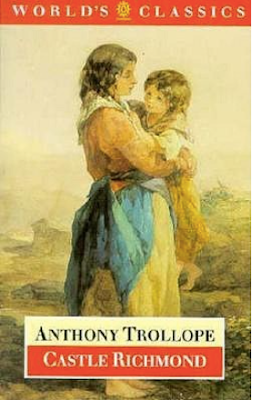
Castle Richmond by Anthony Trollope


It is impossible that these volumes should be graced by any hero, for the story does not admit of one. But if there were to be a hero, Herbert Fitzgerald would be the man. 

A Victorian novel by Anthony Trollope, set in Ireland? This book could not be any more in my wheelhouse. For the Back to the Classics Challenge I needed a book from the 19th Century and I still had five unread Trollopes on my TBR shelve. Two of them were set in Ireland so that seemed like an obvious choice for March.

Trollope spent nearly twenty years in Ireland working for the post office, and began his writing career there. His first two novels are set in Ireland, and were written during the Great Famine. Castle Richmond, his third novel set in Ireland, was published in 1860, but is set several years earlier. It does use the Great Famine as a plot point, but much less so than I was expecting. 

Basically, it's the story of a love triangle between two cousins of the landed gentry, Owen and Herbert Fitzgerald, and the girl they both love, Clara Desmond, the beautiful but poor daughter of Countess Desmond, a young widow whose marriage was less than happy. There's also a complicated plot about the inheritance of Castle Richmond, the seat of the wealthy Fitzgerald family. But I'm getting ahead of myself. 

Owen Fitzgerald is the young squire of Hap House in County Cork -- technically gentry, but the poorer branch of the Fitzgerald family, and untitled. He is handsome and dashing, and befriends the young Earl of Desmond, acting as a sort of older brother. They go hunting and fishing and whatnot, and Owen also notices the young Earl's older sister, Clara, who is about sixteen. Eventually he declares his love for her, and she returns his feelings. However, her young widowed mother, who is not yet forty, quashes all her hopes -- Owen is too poor and lacks a title, so she refuses to acknowledge any engagement and forbids Clara to see or write to Owen. (The reader is also aware that the young Countess is also crushing on Owen and secretly wanted him for herself). 

About a year Clara is befriended by two of Owen's distant cousins, Mary and Emmeline Fitzgerald, from the wealthier portion of the Fitzgeralds -- the family living at Castle Richmond. She spends time with them and is much thrown together with their brother Herbert, the heir and future Baronet. He's younger and more bookish than his dashing cousin Owen, who considers him a prig. It would seem that Clara and Herbert would be a perfect match -- she's beautiful and he's rich, and they're both gentry. But that would make for a very short novel, so there must be complications -- which arrive with some nasty characters from London, Mr. Matthew Mollett and his son Abraham, who have come to County Cork to stir up trouble for the wealthy Fitzgeralds.

Before marrying Lord Fitzgerald of Castle Richmond, his beautiful wife Lady Fitzgerald had made an unfortunate marriage with a ne'er-do-well named Talbot who deserted her and her child and ran off to Paris, where he was supposedly killed in a fight over a gambling debt. Eventually, she met and married Lord Fitzgerald. Now the Molletts have arrived with the intent of blackmailing the Fitzgeralds, claiming that Lady Fitzgerald's husband is still alive and that her children are illegitimate. . . making Owen Fitzgerald the rightful heir of Castle Richmond and the title. 

I liked this novel, though the love triangle and the blackmail plot lines are the strongest. But these characters are basically wealthy Protestant landowners. There's actually not that much in the story about Ireland and the famine -- that's mostly a peripheral plot point only in how it affects the main characters. As landlords, the Fitzgeralds are trying to help the starving population, and there's some infighting between the Catholic and Protestant clergy about how to best help everyone which is pretty infuriating, but that's not a large part of the story. 

I also found Clara to be a very undeveloped character -- both of these men are in love with her, but she's mostly a flat character, just very pretty and sweet. She gets a little character development writing letters to both of the men in love with her, but not much. She's not as annoying as some of Dickens' ingenues, but not nearly as interesting as some of the women in Trollope's later novels. 

Overall I did enjoy the novel and sped through the 500 pages in just about a week. I'm getting down to the last few unread books by Anthony Trollope. I can proudly say that I've now finished 38 (!) of his 47 novels. When I've finished them all I'm sure I'll be sad but I guess I'll just have to start reading them all over again!

This is my 19th Century Classic for the Back to the Classics Challenge, and my Irish read for the European Reading Challenge.

Sunday, February 28, 2021

The Real Charlotte by Edith Somerville and Martin Ross


It's been more than ten years since I became a hard-core fan of the Victorian novel, and since then I've read most of the male authors which are the typical literary canon. Now I've moved on to the more obscure works, many of which are written by women. The Real Charlotte has not one but two Victorian women as authors: Edith Somerville and Florence Violet Martin (who wrote under the male pseudonym of Martin Ross).

Published in 1894, The Real Charlotte is not so much the story of Charlotte Mullen, a fortyish Irish spinster, as it is about her young cousin, Francie Fitzgerald. Aged 19, Francie is a beautiful orphan who has come to live with her cousin after the death of an elderly relative, whose dying wish was that Charlotte take care of her. Francie had been living with Dublin with relatives who have recently fallen on hard times, so she's been sent to live with Charlotte in the country, at Tally Ho Lodge.


Beautiful and flirtations, Francie attracts the attention of several men: Christopher Dysart, oldest son of the local gentry; Gerald Hawkins, a British army officer stationed in town; and also Roderick Lambert, agent to the Dysart estate, and an old family friend. Lambert claims to have only a friendly interest in Francie, since he's 15 years older and married to a wealthy widow, but it becomes obvious that he's jealous of Francie's friendships with other men. 

Francie raises eyebrows around town by spending too much time with the dashing and equally flirtatious Hawkins, and the pair are often unchaperoned for questionable amounts of time. Charlotte is angling to get Francie engaged to Christopher Dysart, who is kind but rather too interested in books and photography for Francie's taste. But the social-climbing and ambitious Charlotte has ulterior motives for the match, and will use her friendship with Lambert to get what she wants. Meanwhile, there are garden parties, picnics, and some sailing accidents, plus some pretty obvious foreshadowing, until everything comes to a dramatic and rather abrupt conclusion. 


I tried reading this a year ago and really couldn't get into it, but I thought I'd take a look and see if it would be a good pick for my March reading because of the Irish setting. The first couple of chapters are a bit disjointed but once Francie arrived at Tally Ho Lodge the story really took off and I could hardly stop reading it, finishing it in only three days. (Which isn't really that impressive, it's less than 400 pages, and a lot of short chapters). I was really curious to see how this was going to end up and why the book was named after Charlotte, since most of the time it seems like Francie is the central character. 

Oddly enough, several characters and plot points reminded me of Jane Austen -- I don't know if I've been reading too much Jane, or if these have become rather stock characters. Hawkins definitely reminded me of a both Wickham and Willoughby, and Lambert seemed an awful lot like Knightley from Emma, though a lot less benevolent, not to mention married. There's a even a plot point that seems straight out of Mansfield Park

Edith Somerville (left) and Violet Florence Martin (right)

My other quibble was about how the Irish are depicted. Naturally the gentry are English, and look down on anyone local, or with an Irish accent, and many of the characters speak in dialect, particularly servants and the working class. I don't know much about the authors other than they were cousins and wrote about 14 books together before Martin's death in 1915. Somerville continued to write under their joint names. The Real Charlotte is considered their masterpiece, but today they may be better known for the Irish R. M. series of books adapted into the 1980s TV series. The Real Charlotte was also adapted for TV in 1990, but no copies in the library means I'll have to keep a lookout for a copy online. 


I'm counting this as my Classic by a Woman Author for the Back to the Classics Challenge; and as my Irish selection for the European Reading Challenge.

Thursday, February 18, 2021

The Doctor's Wife by Mary Elizabeth Braddon: A Victorian Trainwreck


Victorian sensation is my kind of escapist fiction -- normally chock-full of over-the-top swooning, scandal, mistaken identities, dubious women, and rascally men. The Doctor's Wife by Mary Elizabeth Braddon is oddly lacking in the most dramatic elements -- and yet it is one of my favorites of the genre so far.

Published in 1864, the story begins with the short history of George Gilbert, a young surgeon, son of one of two local doctors in Graybridge-on-the-Wayverne, a fictional town in the fictional county of Midlandshire. He is expected to take over for his elderly father someday, and though a local brewer's daughter has been making eyes at him, he's not interested. While visiting an old school friend on a whirlwind week in London, he meets Isabel Sleaford, daughter of his mate's landlady, and his life is forever changed. 

Isabel is seventeen, dreamy and romantic, and lives for the novels and poetry that fill up her time when she isn't helping her stepmother take care of her multiple half-siblings, their boarders, and her unscrupulous father. George is instantly smitten with lovely Isabel, unlike any girl he'd ever met. I instantly adored young Smith, who was christened Sam but has changed his name to the more literary Sigismund. Clearly, he's a stand-in for Braddon herself, and the novel is full of delightful references to the writer's process.

Perhaps there never was a wider difference between two people than that which existed between Isabel Sleaford and her mother's boarder. Sigsimund wrote romantic fictions by wholesale, and yet was as unromantic as the prosiest butcher that ever entered a cattle-market. He sold his imagination, and Isabel lived upon hers. To him romance was something which must be woven into the form most likely to suit the popular demand. He slapped his heroes into marketable shape, as coolly as a butterman slaps a pat of butter into the semblance of a swan or a crown, in accordance with the requirements of his customers. But poor Isabel's heroes were impalpable tyrants, and ruled her life. She wanted to be like her books; she wanted to be a heroine -- unhappy, perhaps, and dying early.

Great cover on this yellowback edition.

But the acquaintance is cut short when the Sleaford family literally disappear in the middle of the night to escape creditors -- George and his friend Smith, a budding novelist, are lucky to escape without losing their own luggage. George is disappointed to cut the acquaintance with Isabel short, and a year later, he's thrilled to get a letter from Smith saying Isabel is now settled nearby, working as a governess for a distant relative. George wastes no time meeting with her and pops the question ASAP.

Sadly, though, Isabel realizes on her honeymoon that she's made a mistake -- George is far to pragmatic and thrifty for a dreamy, romantic girl. She is quickly bored to death in the country with little to do and doesn't get on well in local society, who are scandalized that George didn't marry a local girl.

He had married this girl because she was unlike other women; and now that she was his own property, he set himself conscientiously to work to smooth her into the most ordinary semblance of every-day womanhood, by means of that moral flat-iron called common sense.

A few months later Isabel is thrilled to meet a real Byronic hero -- the dark and handsome Roland Lansdell, heir to Mordred Priory, recently returned to the neighborhood from the Continent. He is everything that Isabel has ever dreamed of -- dark, handsome, moody, and a poet! He's handsome, bored, and rich, she's beautiful, bored and married -- what could possibly go wrong? 

Naturally, what follows is a trainwreck for everyone -- a bit like an English Madame Bovary, but if Emma Bovary were more sympathetic. I knew it wouldn't end well, but what was interesting for me was how Braddon got to the end of the story -- there were some twists and turns that I wasn't expecting and took me completely by surprise. There were less of the inevitable dramatic tropes one normally finds in Victorian sensation novels, and I've since learned that Braddon was determined to write a more literary novel. 

I really enjoyed The Doctor's Wife and I'd rank it as one of Braddon's best -- different than Lady Audley's Secret, but good in its own way. It was a bit closer to early Thomas Hardy than Wilkie Collins. I was really sympathetic to all the main characters and found some of the side characters really endearing, especially Smith who gives the reader such wonderful insights into the mind of the writer: 

Portrait of M. E. Braddon by William Powell Frith, 1865

And if I were a young lady," continued Mr. Smith, speaking with some slight hesitation, and glancing furtively at Isabel's face,—"if I were a young lady, and had a kind of romantic fancy for a person I ought not to care about, I'll tell you what I'd do with him,—I'd put him into a novel, Izzie, and work him out in three volumes; and if I wasn't heartily sick of him by the time I got to the last chapter, nothing on earth would cure me."

I'm counting this as my 19th Century Classic for the Back to the Classics Challenge; also counts for the Victorian Reading Challenge.

Monday, February 15, 2021

Victorian Reading Challenge 2021

It's never too late to sign up for another challenge, is it? Once again, I'm signing up for the Victorian Reading Challenge at Becky's Book Reviews. Last year my Victorian reading was surprisingly low -- only ten altogether, including two rereads, two neo-Victorians, and two non-fiction. Hopefully this challenge will increase my Victorian reading this year. 

There are two participation levels. I'm signing up for the advanced level, four to six books over eleven months. There are themes every month and I'm sure I can find books to fit most of them. Ideally I'd love to read mostly books from my own shelves. I still have more than a dozen unread Victorians, below.


Here are the monthly themes:

January/Feb: Adaptations: Any book that's been adapted to movies or TV, or that should be adapted. (Will probably skip this one as I'm running out of time.)

February/March: Love & Marriage: The Doctor's Wife by Mary Elizabeth Braddon -- I've already finished this one, review to follow this week!

March/April: Journeys and Travels: Something by Isabella Bird, a renowned Victorian woman traveler. Or The Bertrams by Anthony Trollope. He also wrote some travel nonfiction, so that's a possibility too.

April/May: Second Chances. Give a book or an author a second chance. Something by Mrs. Oliphant, or The Real Charlotte. Might also read one of Trollope's Irish novels.

May/June: Favorite Author, New-To-Me Book. Again, Mrs. Oliphant, Trollope, or Hardy.

June/July: Nonfiction: Period Piece by Gwen Raverat, or A London Family by Molly Hughes.

July/August: Names as Titles: Marcella by Mrs. Humphrey Ward, or one of several books by Trollope: Ralph the HeirThe MacDermots of Ballycloran; The Kellys and the O'Kellys; Harry Heathcote of Gangoil. 

August/September: Back to School: something you were assigned at school, or think should be assigned. I wasn't a lit major so the only Victorian novels I read in school were Great Expectations, Jane Eyre, and The Mill on the Floss. I loathed The Mill on the Floss so maybe I should give it another go and see if I appreciate it more as an adult? 

September/October: Crime or True Crime: Lots of great true crime stories about the Victorian period! I have at least seven or eight on my TBR list. Maybe Murder in the First-Class Carriage by Kate Colquhoun or Murder by the Book by Claire Harman.

October/November: Home and Family: East Lynne by Mrs. Henry Wood; The Clever Woman of the Family by Charlotte Yonge; or A London Family. 

November/December: Comfort Reads: A London Family or Trollope.

Super-Bonus Theme: Bearded Victorians. I suppose this means read anything by a bearded Victorian?

Charles Dickens

Wilkie Collins

Anthony Trollope

So - those are my possible reads. Any suggestions for other Victorians? And which author has the best beard? 

Wednesday, January 13, 2021

The New Magdalen by Wilkie Collins


On January 1 I dove right into Back to the Classics Challenge with a new-to-me Victorian sensation novel, The New Magdalen by Wilkie Collins. Despite being a Collins fan I hadn't heard of it until it was recently reprinted by Persephone Books which immediately placed it on my reading radar.

One of Collins' shorter novels, it's the story of Mercy Merrick, an otherwise saintly and perfect Victorian lady who through no fault of her own, has a checkered past -- she was once forced to work as a prostitute. Having since left prostitution through a women's Refuge, she's now working as a nurse in France. The story begins in a small cottage where she is nursing French soldiers, under attack from the advancing German army (the book was published in 1873 so this must be the Franco-Prussian War). There is another woman in the house, Grace Roseberry. a lady by birth but in reduced circumstances. Grace had been in Rome with her father, who traveled from Canada for his health, but ended up dying there. Grace had been en route to England, for a job as a lady's companion, when she was caught up in the war and trapped on the frontier. She has nothing but her papers, and even the clothes on her back belong to Mercy Merrick, as her own dress is drying by the fire in the next room.

Also adapted as a silent film in 1912! 

To pass the time while the women fear the advancing German army, Mercy tells Grace of her own sad history as a fallen woman. Then the unthinkable happens -- a shell hits the cottage, and Grace is killed. Mercy is evacuated with an English journalist, and on a sudden impulse, she grabs Grace's dress and all her papers, and assumes her identity. She sees this as a final chance for a better life, and Grace is beyond help, so no harm done there. 

Fast-forward several months, back in England. The newly renamed Grace is ensconced as the beloved companion of the steely but kind Lady Janet Roy, a wealthy and childless woman, and engaged to Horace Holmcroft, the journalist who -- coincidentally! -- is the son of one of Lady Janet's oldest friends. Horace has naturally fallen in love with the beautiful and perfect Grace, and his connection to Lady Janet is but the first of several amazing coincidences. Although Grace has had several idyllic months as Lady Janet's companion -- practically her adopted daughter -- her world will soon be turned upside down when her identity is called into question, and the truth of her sad and checkered past comes to light. 


I enjoyed this novel. It's a pretty standard Victorian sensation, with amazing coincidences, intrigue, swooning, scandals -- the usual. What's different about this one is the fairly serious subject matter of prostitution and forgiveness. Wilkie Collins points out the hypocrisy of the upper classes who are all talk and no action when it comes to Christian values. He does go over the top with the character of Merry who has literally no faults -- except for the prostitution, which literally is not her fault, as she explains in great detail. Collins also points out how few choices there were for Victorian women, particularly poor women. 

I did find the plot a little predictable and it was a little one-note -- it's only about 400 pages, short for a Victorian, so there's no room for sub-plots. It also seemed to have an abrupt finish, but there's an epilogue which explains what ultimately happens to Mercy, in the form of letters which are actually rather amusing. This would definitely be a good introduction to anyone interested in Victorian sensation novels who is put off by some of the triple-decker doorstoppers like The Woman in White or Man and Wife

I'm counting this as my New Classic by a Favorite Author Category for the Back to the Classics Challenge; and as my British selection for the European Reading Challenge

Tuesday, December 29, 2020

The Professor by Charlotte Bronte; and some photos of Brussels


A couple of weeks ago I was looking for an audio book to listen to while walking the dog (I have Overdrive accounts with FOUR libraries so I can always find something good!). One of the libraries had an audio of The Professor, Charlotte Bronte's first novel. I'd hadn't been particularly interested because I wasn't thrilled with Villette, but I saw that the narrator was the brilliant Frederick Davidson (who brilliantly narrated Les Miserables and many other books) so I gave it a try -- and as it's set mostly in Brussels, I can count it for my Belgian read for the European Reading Challenge!

Posthumously published in 1857, The Professor was written before Jane Eyre and submitted and rejected by several publishers. It was published after her death with permission of her husband, and is based on experiences she had studying in Brussels in 1942. 

I had assumed that the eponymous Professor would be an old man, but in fact he is a young man named William Crimsworth. The book begins with him writing a letter to an old school friend, but that framing device is quickly abandoned and the story is then simply told in the first person. I guess it's basically a Bildungsroman, a story of a young person's coming of age. 

Crimsworth, an orphan, is about 20 when the story begins. His late mother was from a wealthy family, but was disowned when she fell in love with -- gasp! -- a tradesman, who is also dead. After his mother died, one of his relatives basically blackmails his uncle (his mother's brother) into paying for William's education at Eton. The same uncle then offers him a living if he'll agree to enter the church, and to marry one of his cousins. William declines. 


Obviously William then needs a job, and looks up his much older brother Edward, who took over their late father's mill. Before their father's death, the mill had failed and was sold, but Edward stayed in the business by marrying the new mill owner's daughter, and eventually took over. William writes to his brother and asks for a job, and Edward agrees, only since William has broken ties with their mother's family forever. William then travels North to a nameless town and takes a job as a clerk to his rather begrudging brother, who tells him upfront not to expect any special treatment. He only gives William the job because William can read French and German. William seems to be an upstanding citizen and model employee, which seems to infuriate Edward who is extremely jealous of William's education. 

A chance encounter with one of Edward's business associates, Hunsden, tips Edward into a rage and William quits. Hunsden then suggests William try his luck on the continent, and gives William a letter of introduction to someone in Brussels, who helps him find a job teaching English at a boy's school.

Eventually, William also takes on a part-time job teaching at an adjoining girls' school, where he develops a crush on the headmistress, Mademoiselle Reuter. She toys with his affections and eventually develops feelings for another one of the teachers, Mademoiselle Henri, who teaches lace-making but also begins to attend William's English classes. 

The Professor isn't a very long book for a Victorian, about 300 page depending on the edition. It's really a book in which not much happens, and it definitely feels like a first novel, or one that's unfinished. (I finished it about a week ago and already had to look up on Project Gutenberg to find out what happened in the end. Bronte seems to take a lot of time describing people's looks and their characters, but there isn't a whole lot of plot. Still, it's interesting to read one of her early works, and Frederick Davidson was a wonderful narrator, as always. I don't know if I'd recommend it if you're not a big fan of Victorians. 

And now for a few photos! When I lived in Germany, we were only a few hours' drive from Belgium, and made several trips to visit, mostly for weekends. It's a highly underrated country -- the scenery is pretty and the food is excellent. I visited Antwerp, Bruges, Brussels and Ghent on separate visits. They're all different and I loved them all. We went for a weekend in the fall of 2018, and had a lovely time. It's often overcast so it looks dreary in some of the photos, but it was great for a weekend.

The first thing we did was visit the Atomium, left from the 1958 World's Fair. So mid-century! 


Right next to the Atomium is Mini Europe, and of course we bought a combined ticket. Lots of iconic European buildings, on a much smaller scale. Here's mini Pisa with the Atomium in the background. You can see mini Venice on the right.


Mini Houses of Parliment, complete with a fake Thames.


Love the detail of the mini Brexit protest! 


Of course we had to sample the local cuisine. Look at all those amazing waffles. 

Our hotel was a short walk to the Grand Place, the central Plaza of Brussels. 
Lots of beautiful architecture (and chocolate shops).


Walking past the square I spotted this amazing trompe l'oeil tribute to the iconic Tintin: 


I just loved the architecture in Brussels. 


It just blows my mind that this business was established 500 years before I was born.


Brussels also has some wonderful art museums. 
First we went to the Magritte Museum, lots of amazing surreal paintings.


Not surreal, just beautiful. 


Then we went to the Royal Museum of Fine Arts. I discovered that I absolutely love the works of Pieter Brueghel. Here's The Fall of the Rebel Angels from 1562. I can only imagine what the reaction to this must have been. 


Seriously, what's going on here?  


Lots of great Dutch and Flemish masters! 


I loved this anthropomorphic head of a woman. There's a matching painting with a man. No artist attributed, but it reminds me very much of the vegetable paintings by Arcimboldo.


Lots of beautiful later paintings as well. I always love finding new artwork I'd never heard of. 
This is Moonlit Sky by Adrien-Joseph Heymans, c. 1907.


Brussels also has beautiful Art Nouveau architecture. My last stop was the Horta Museum, a beautifully preserved Art Nouveau house designed by architecht Victor Horta (circa 1898). It's the two buildings on the right with the matching grillwork around the windows, to the right of the striped building. They only let in a few people at a time, even pre-COVID. Luckily the line wasn't long. 


They don't allow photography inside but you can see images of the interior here


I really like Belgium and would happily visit again. For next year's challenge I'm hoping to read something by an actual Belgian writer, possibly Georges Simenon who wrote the Maigret mysteries. I would love recommendations if anyone is a fan. 

I'm counting this as my Belgian read for the European Reading Challenge.

Sunday, June 14, 2020

John Caldigate: Trollope goes to Australia!

Not a great cover image, but the only OUP edition I could find online.
Strangely, my copy has a different cover.


'People who read no books are always fools to those who do read.'

Last week was particularly stressful -- the news is so dire and it only seems to get worse -- so it was time to turn to one of my favorite comfort authors, Anthony Trollope. I still have several of his novels unread on the shelves, and three of them were long enough to qualify for my Big Book Summer Challenge. I chose the shortest of the lot, John Caldigate, because the eponymous character travels to Australia, and it sounded like some nice armchair travel since I won't be going anywhere for a while.

Published in 1979, John Caldigate is one of Trollope's lesser-known works, and a standalone novel. It's the story of young Mr. Caldigate, heir to the estate of Folking in Cambridgeshire. His mother and sisters died years ago, but sadly, John's father was mourning and distant while he was a boy, so he mostly grew up on his cousin's estate. Now in his early 20s, John has left Cambridge, and is saddled with numerous gambling debts. The estate is entailed upon him, but his father has decided to disinherit him in favor of a cousin, and John takes a buyout from his father, pays off the debt, and books passage Australia with a classmate, Dick Shand, where they hope to make their fortune in the gold mines. While meeting with his father's banker Mr. Bolton, John spies his teenaged daughter Hester, and is struck by her beauty.

Anthony Trollope


Before his boat sails, John goes to say goodbye to his cousins, where his aunt pressures him to marry his oldest cousin Julia. John refuses to get himself engaged, and hightails it to the boat with his friend Dick, where they travel second-class, despite being gentlemen. On the voyage, John strikes up a friendship with a pretty actress, a widow known as Mrs. Smith. It's a long voyage and tongues start wagging, and it seems like everyone on board is aghast, including the ship's captain, and they all try to warn him off, but John is undeterred and declares himself engaged to her.

John and Dick stake a claim and start looking for gold, and after a detailed description of gold mining, he makes a trip back to Melbourne to look up Mrs. Smith. Then the story jumps forward in time several years. John is back in England, having made a fortune of £60,000. His father has missed him dreadfully and John pays off the mortgage on the estate, reinstating himself as heir. And now it's time to find himself a wife. John never forgot the beautiful Hester Bolton, now 20, and begins to court her, to the chagrin of her mother, a religious fanatic. She opposes the marriage from the beginning, but she can't stop it. All seems well until about a year later when some unsavory characters from Australia arrive, and John's world is turned upside down as he faces extortion and bigamy charges. 

I assumed this would be the standard Trollope comfort read, but elements of the plot went dark pretty quickly; particularly, Trollope's depiction of Mrs. Bolton's religious mania, (much of which I skimmed over). After John is charged with bigamy, the Boltons do something really despicable to Hester, which I would have found unforgivable. I was also distressed by some of John's relatives, especially his Aunt Polly who tries to snare him into marriage with his oldest cousin Julia. Some of Hester's relatives are pretty awful as well. 


I did enjoy Trollope's description of the sea voyage to Australia and the courtroom and trial details. There's also a pivotal side character who is a postal employee which I found delightful. Trollope worked as a postal employee for more than 20 years, so he must have really enjoyed including his detailed knowledge of stamps and postmarks into one of his novels. (Fun fact: Trollope invented the British post-box). 

This was a fast read, and a solid Trollope story. He doesn't get nearly the love of Dickens or Hardy, and of John Caldigate is definitely one of his more obscure novels -- there are hardly any editions and very few cover images. However, while searching online, I discovered that in 2015 John Caldigate was adapted into a graphic novel called Dispossession, by Simon Grennan. As far as I know, it's the only Trollope novel adapted, and it's an interesting choice because it's such an obscure novel. And I'm curious about how he condensed a 600 page Victorian chunkster into less than 100 pages. 


So -- one more Big Fat Book crossed off my summer reading list, and I've now read 34 of his 47 novels! Only 13 left to go -- I'll be sad when I'm done. I guess I'll just have to go back to the beginning and start again!

Thursday, May 21, 2020

Hester: A Novel of Contemporary Life by Mrs. Oliphant


I counted the other day and I still have more than thirty unread Virago Modern Classics on my TBR shelves (though technically, some of them are not VMC editions). I'm desperately trying to take control of the TBR shelves, so Margaret Oliphant's Hester: A Novel of Contemporary Life was my pick for the May/June prompt of the Victorian Reading Challenge (long titles or sub-titles). 

First published in 1883, this is the story of two strong women in the fictional town of Redborough. The Vernon family name is synonymous with banking and stability, and in the beginning of the novel, a scandal erupts about 30 years prior -- John Vernon, head of the bank and the grandson of the founder of the Vernon family bank, has fled the country, and rumors are flying around town that there's about to be a run on the bank (if you've ever seen It's A Wonderful Life, you know exactly what this means: word is out that the bank doesn't have the funds and is about to collapse, so everyone rushes to the bank to get out their money before it's gone). 

Mr. Rule, the chief clerk, goes to Mr. Vernon's home in desperation, and he's nowhere to be found. His young and flighty wife insists that he'll be back soon, and offers the clerk all the money she has in the house, about 20 pounds. Instead, Mr. Rule does the unthinkable -- he approaches Mr. Vernon's cousin Catherine, a spinster, who is a shareholder but has naturally never been involved. Catherine is naturally concerned and with her funds and brains, she saves the bank, restoring the family name, and thus the town's revered and powerful benefactor. 

The story then jumps forward to the 1880s, and John Vernon's widow (known as Mrs. John), is returning to Redborough after the death of her husband. Mrs. John moved Abroad and joined her husband after she was forced to give up her beautiful home in the wake of the banking scandal, and she hadn't returned since. Now living in genteel poverty, she returns to the scene with her teenaged daughter Hester, who was born much later and knows nothing about this embarrassing episode or her father's role in it. She and her mother move into the Vernonry, a great old house that Catherine Vernon had converted into multiple dwellings, normally offered to impoverished relatives. All of them are living off Catherine's generosity, but most of them are bitterly resentful and disparage her whenever they can. 

Unfortunately, young Hester gets off on the wrong foot with Catherine, who calls on her mother late on the first evening of their arrival. Hester doesn't realize how important a benefactress Catherine is, and is rather rude and protective of her mother, and from this day forward, she and Catherine don't care much for one another. Catherine finds Hester standoffish, and Hester is influenced by the cutting remarks about Catherine by her neighbors, who are a kind of Greek chorus of frenemies. The only neighbors who seem thankful and benevolent are Captain and Mrs. Morgan, who related to Catherine's later mother, and are not technically Vernons. 

Things in Redborough are fairly uneventful until Hester turns nineteen and blossoms into a lovely young woman, attracting the notice of two of her distant cousins, who have been chosen by Catherine to succeed her in running the bank -- the dull but handsome Harry, and the hardworking Edward, handpicked by Catherine as her surrogate son and heir. Harry is in love with Hester, but she's not interested, and Edward is attracted to her but can't risk incurring the wrath of Catherine, who has never liked Hester. Meanwhile, the Morgan's grandson Roland arrives, on the lookout for new investors in his stockbroking business, and Edward thinks this may be his chance to finally become independent of Catherine.


I really liked this novel -- it's fairly long, almost 500 pages, but I really got invested in the plot and the characters. I got so caught up in the story I finished it in only four days. A couple of the characters reminded me a bit of Jane Austen -- Roland's sister Emma shows up, desperate for a husband, and I found her somewhat like Lucy Steele from Sense and Sensibility, though she's not nearly as malicious.  It was nice to have a Victorian novel with strong women characters. Margaret Oliphant clearly had some ideas about working women, and expresses them through Hester's frustration:

"I thought you hated Catherine Vernon," Roland cried.
"I never said so," cried Hester; and then, after a pause, "but if I did, what does that matter? I should like to do what she did. Something of one's own free will—something that no one can tell you or require you to do—which is not even your duty bound down upon you. Something voluntary, even dangerous——" She paused again, with a smile[Pg 7] and a blush at her own vehemence, and shook her head. "That is exactly what I shall never have it in my power to do."
"I hope not, indeed, if it is dangerous," said Roland, with all that eyes could say to make the words eloquent. "Pardon me; but don't you think that is far less than what you have in your power? You can make others do: you can inspire . . .  and reward. That is a little highflown, perhaps. But there is nothing a man might not do, with you to encourage him. You make me wish to be a hero."
He laughed, but Hester did not laugh. She gave him a keen look, in which there was a touch of disdain. "Do you really think," she said, "that the charm of inspiring, as you call it, is what any reasonable creature would prefer to be doing? To make somebody else a hero rather than be a hero yourself? Women would need to be disinterested indeed if they like that best. I don't see it. Besides, we are not in the days of chivalry. What could you be inspired to do—make better bargains on your Stock Exchange?"

Margaret Oliphant was one of the most prolific Victorian authors,  probably the most prolific women author of the era. She published her first novel in 1849, when she was just 21, and published more than 120 novels, supporting her family after her husband's death in 1852. Like many Victorian women authors, only a few of them are still in printthough there are quite a few on ebook, and many are free through Project Gutenberg. I've now read six of her novels so far -- Hester; The Mystery of Mrs. Blencarrow, I've read three of her Carlingford Chronicles, Miss Marjoribanks and The Rector and The Doctor's Family, two novellas in one volume. Virago Modern Classics reprinted the rest of the series and I'm tempted to track those down as well. 

Friday, April 24, 2020

Crossriggs by Jane & Mary Findlater

Not a great cover image, but the only one I could find.

I don't know who I can credit for recommending Crossriggs -- I'm sure it was someone in the blogosphere, and I wish I knew so I can thank them. (Updated: it was Furrowed Middlebrow!) This book is exactly in my wheelhouse, including : 
  1. A Victorian(ish) time period 
  2. Set in Scotland
  3. A strong female protagonist 
Basically, a trifecta of all the things I love in a book. Published in 1908, Crossriggs is the story of Alexandra Horn, a woman in hear late twenties/early thrities, living with her father in the village of Crossriggs which is "about an hour's train ride from Edinborough. Besides the Horns, there are three or four other families of note around which the story is centered. Alexandra, known as Alex, has been living rather quietly with her father, an educated man with interesting and progressive ideas (but not much money) when her recently widowed sister Matilda arrives in tow from Canada with her five (!) children. The eldest daughter is 13, then there are three boys in a row, and finally a baby girl. 

Of course this throws the whole house into turmoil, but Alex and her father take it all in stride until they realize they will be more financially strapped than ever. Her father borrows some money from a close neighbor, Mr. Maitland, but Alex is aghast and vows to find a way to earn some ready cash. She begins by reading every day to a blind neighbor, the retired Admiral Cassilas, who is kind but somewhat gruff and snobbish. The admiral's only living relative is his grandson, Vanbrough, who has just finished school and is about twenty-one. 


A better image of the cover artwork. 
It's "Lady in Grey" (1859) by Daniel Macnee, National Galleries of Scotland

Young Van is bored staying at gloomy Foxe Hall with his grandfather, and the two don't always see eye to eye. He quickly strikes up a friendship with Alex and spends more and more time with the loud and boisterous Hope family. Eventually, his grandfather starts parading a succession of eligible young women around Van, and Alex's sister is pressuring her to accept the hand of James Reid, who is good steady but whom Alex finds dull. And Van is jealous of her friendship with their neighbor Mr. Maitland, who seems excessively fond of Alex, who is married with a sickly wife. Eventually this love triangle (or quadrangle?) comes to a head, and after a dramatic turn of events, there is a tragedy.

I really enjoyed this book -- it reminded me a bit of Jane Austen, but also a little bit of Anne of Green Gables. I really liked that Alex was trying to make her way in the world without just husband hunting -- she seemed like a new modern woman. The plot moved along nicely, and though it's almost 400 pages long, it seemed shorter, probably because the Virago edition had very wide margins. 

This book had some interesting plot twists. There was a lot of foreshadowing about the three men who seemed interested in Alex, so I had strong suspicions about how it would all end up -- and I was right about some of the events, but not the characters I was expecting, if that makes sense. And I was amused by Alex's father, who was a "fruitarian" -- basically, a vegetarian who made the family eat crazy things like nuttose, an early meat substitute developed in the late 1890s. They were also forced to eat carrots, of all things! Apparently this was a vegetable only fit for horses. 

Aside from some cringey racism, I liked this book very much, though the ending was a bit rushed. I did like how Alex's story was wrapped up, which was not how I expected. I would like to read more by the Findlater sisters, who wrote books individually and together. Sadly, I don't think any of their other books are readily available. Crossriggs is currently out of print, but there are used copies of the Virago Modern Classic edition available at a reasonable price online. And I've just discovered it's available as an audio on BBC Radio 4!  

I'm counting this as my Classic with a Place in the Title for the Back to the Classics Challenge and for my UK Classic for the European Reading Challenge