Showing posts with label Back to the Classics 2020. Show all posts

Tuesday, January 5, 2021

Back to the Classics 2020: The Winner


And the winner is. . . . 


Reese won a $40 gift card from Amazon.com! (I know it was posted as $30, but let's be honest, 2020 was a rough year and we all need a little more joy, right? Plus, inflation). So, congratulations, Reese! And many thanks and congratulations to everyone who participated in this challenge -- 83 people signed up, and 34 people completed the challenge. 

We're all winners because we got to share the joy of books and each one of us crossed some classic books off our to-read lists!. I hope everyone enjoyed all the new books and authors they discovered. Also, I hope all everyone has signed up for the 2021 Back to the Classics Challenge, I can't wait to see what everyone else is reading! 

Later this week I'll add the link-up posts so you can add your reviews and see what everyone else is reading. Thanks again to everyone for participating. I hope everyone is having a good new year with lots of wonderful books to read. 

Tuesday, December 15, 2020

Back to the Classics 2020: Final Wrap-Up


I've finished! After abandoning my own challenge last year, I persisted and successfully completed all twelve categories in 2020. Some were from my original list, some were not. Here's what I read, with links to my reviews:

Only 7/12 from my own shelves this year, the rest were library or free e-books.


1. 19th Century Classic: Man and Wife by Wilkie Collins. Completed 2/16/20.

2. 20th Century Classic: Pied Piper by Nevil Shute. Completed 1/10/20.

3. Classic by a Woman: So Big by Edna Ferber. Completed 1/12/20.

4. Classic in Translation: Temptation by Janos Szekely. Completed 6/5/20.

5. Classic by a POC Author: The Street by Ann Petry. Completed 12/5/20.

6. Genre Classic: The Time Machine by H. G. Wells. Completed 1/27/20.

7. Name in the Title: The Sin of Abbe Mouret by Emile Zola. Completed 4/14/20.

8. Place in the Title: Crossriggs by Jane and Mary Findlater. Completed 4/28/20.

9. Nature in the Title: In the Mountains by Elizabeth von Arnim. Completed 4/16/20.

10. Classic About a Family: Father by Elizabeth von Arnim. Completed 2/27/20.

11. Abandoned Classic: Les Miserables by Victor Hugo. Completed 4/5/20.

12. Adapted Classic: Lark Rise to Candleford by Flora Thompson. Completed 5/14/20.

Seven of them were from my own shelves (pictured above), which is pretty good, though I'm aiming higher next year -- for next year's Back to the Classics Challenge, I'm going to try and read at least ten out of the twelve categories from my own unread books. 

I chose really well this year -- I really enjoyed nearly all of my challenge selections, not a dud in the bunch. Of the twelve, I think my absolute favorites were Temptation, Pied Piper, and Father. I also thought The Street was brilliant. My least favorites were probably The Sin of Abbe Mouret, just because of the misogyny, and Les Miserables, because let's be honest, it really could have used some editing. 

So there's more than two weeks left to complete the challenge -- you only need six books! And if you don't have time this year, why not sign up for next year's challenge? 

Sunday, December 13, 2020

The Street by Ann Petry


Streets like the one she lived on were no accident. They were the North's lynch mobs, she thought bitterly; the method used to keep Negroes in their place. And she began thinking of Pop unable to get a job; of Jim slowly disintegrating because he, too, couldn't get a job, and of the subsequent wreck of their marriage; of Bub left to his own devices after school. From the time she was born, she had been hemmed into an ever-narrowing space, until now she was very nearly walled in and the wall had been built up brick by brick by eager white hands.

I have often referred to books as Fascinating Trainwrecks -- about people who make one bad decision after another, rushing headlong towards disaster. They are often horrible people, yet so well written that I cannot stop reading (think Anna Karenina, and most of Zola). 

And then we have characters like Lutie Johnson in The Street by Ann Petry. Lutie, a young Black woman in the 1940s, works hard, scrapes, and saves, and does everything she's been taught to do to get ahead in life -- and she just can't catch a break. 

Set in Harlem during WWII, The Street is the story of Lutie Johnson, a young single mother living just trying to make a living for herself and her eight-year-old son, Bub. Bub's father left Lutie after months of her living in Connecticut, working as a cleaner for a rich white family. She only saw Bub and her husband once a month, if that, and sent them all her wages. The separation, and her husband's inability to find a job, was the death toll for their marriage, and Lutie needs to find a new place to live since she can't keep living with her father and his girlfriend, who are a bad influence on young Bub. 

This cover is sooo 1970s.  

The story begins with Lutie examing a dark fifth-floor walkup apartment that she can afford -- with a creepy landlord named Jones. Right away I knew he was trouble, he made me SO uncomfortable. I'd actually started reading this in the summer but Jones gave me such a bad feeling I stopped for several months. I'm glad I got the courage to keep reading about Lutie, because her story is so compelling. 

We learn the back story of her marriage and separation, and how she manages to land a civil service job. But Lutie is desperate to move to a better apartment, in a better neighborhood, away from Jones and some of the other sketchy residents of the building, like the Mrs. Hedges, the Madam on the first floor who watches everyone coming and going, and keeps offering to introduce Lutie to men who would appreciate her friendship, so to speak.

Things finally seem to be looking up for Lutie when she starts singing to herself one night in a crowded bar, where she's gone for a much-needed break and a beer. A good-looking but slightly sketchy-looking man named Boots asks her to audition to sing with his band. Lutie thinks this could be her break, but naturally, things don't work out as she hopes -- the conclusion takes a pretty shocking twist. 

The Street is Lutie's story, but it also interweaves the back stories of Boots, Mrs. Hedges, Jones, and some of the other characters. It's a tragic tale that really couldn't have turned out any other way, and it's not very optimistic for anyone who isn't white. It was published almost eighty years ago, but it feels very contemporary in the writing style, and it's a fast, absorbing read. 

 A 1954 edition

This book had been on my periphery for a few years, but I'd never really heard that much about it or about Ann Petry. It became a bestseller, and The Street was the first book by a Black woman to sell more than a million copies. Nevertheless, there are less than 8,000 ratings for it on Goodreads -- compared to more than 250,000 for Their Eyes Were Watching God and 150,000 for Invisible Man. I don't know why this doesn't get the attention it deserves. Parts of the story must have been shocking when it was published in 1946, but Bigger Thomas in Native Son is worse, an actual trainwreck. Lutie does everything she can to pull herself out of a bad situation, and it still all goes wrong. It was so frustrating to read how she could not catch a break and had so little say in her own situation, by society and by individual people working against her.  

The trouble was with her. She had built up a fantastic structure made from the soft, nebulous cloudy stuff of dreams. There hadn't been a solid, practical brick in it, not even a foundation. She had built it up of air and vapor and moved right in. So of course it had collapsed. It had never existed anywhere but in her own mind. 

The Street is a masterful tale of the unfairness of life for women of color in the mid-century. And for many women just like Lutie, things haven't gotten much better. 

I'm counting this as my BIPOC classic for the Back to the Classics Challenge.

Saturday, September 19, 2020

Back to the Classics 2020: Final Wrap-Up Posts


Have you finished the Back to the Classics Challenge? Congratulations! This is where you'll link up to your Challenge Wrap-Up Post, after you've completed a minimum of six different categories from the original challenge post. This post is only for Challenge Wrap-Up Posts. If you do not have a blog, or anywhere you post publicly, please write up your post-challenge thoughts/suggestions/etc in the comments section below. Please read the directions carefully. 

By linking or commenting here, you are declaring that you have completed the challenge; that each book reviewed fits the correct definition of the category, and was published before 1970 (except for posthumous publications); and that your reviews for each category are linked to the correct post. If I cannot find links to your reviews, I cannot give you credit and thus enter you into the drawing. THIS is where I will look at the end of the year and randomly choose the winner for the bookish prize. 


Please remember to indicate the following within THIS POST, linked below, or in the comments section below if you do not have your own blog:


1. Which book corresponds to each category;

2. The number of entries you have earned for the prize drawing; 
3. Links to your reviews. 

If you do NOT include links to your original reviews IN THIS POST, I CANNOT ENTER YOU INTO THE DRAWING.


Remember:

  • If you've completed six categories and you get one entry.
  • Complete nine categories, and you get two entries.
  • Complete all twelve categories, and your name is entered into the drawing three times!

VERY IMPORTANT: 
Please be sure and include some kind of contact for me within your final wrap-up post. This year, I will be contacting the winner privately BEFORE posting their name publicly on this blog. If I cannot contact you, I cannot award your prize. If there is no contact on your blog post, please email me at karenlibrarian13 [at] yahoo [dot] com.

I can also message the winner via Goodreads, so if you are posting reviews via your Goodreads account, I can contact you that way also.

Saturday, June 6, 2020

Temptation by Janos Szekely

The cover artwork is a detail from The Morphinist by Janos Vazary (1930)

I'm trying really hard to refrain from buying books, but inevitably birthdays and other gift-giving holidays occur, so what can one do? My most recent bookish gift was Temptation by Janos Szekely, an NYRB reprint of a 1946 novel newly translated from the Hungarian. Normally new-to-me books get shoved to the bottom of the TBR pile, where they sit, contributing to my unread-book guilt. But I'd signed up for the European Reading Challenge and this one fit the bill perfectly. I read the first few pages and was instantly hooked. 

This is the story of Bela R., a young Hungarian peasant boy born into rural poverty in 1913, after his sixteen-year-old mother Anna has a one-night stand with a charismatic sailor during a church festival. At the end of the night the charming sailor disappears, leaving her alone to deal with an unwanted pregnancy. After little Bela is born, Anna goes to the city to work as a wet nurse, and later a maid, leaving him in the care of Rozi, a former prostitute who now runs a sort of foster home for illegitimate children. It's a tough upbringing because Rozi basically hands out food and favors to the kids based on how much their mothers can pay, and Anna is always struggling, so Bela is always hungry, for food as well as love and affection -- Bela is literally young, scrappy and hungry.


Bela grows up as a tough kid, but he's smart and longs to go to school. Rozi refuses, forcing him to stay home and work until Bela realizes she's breaking the law. The village schoolmaster sees that Bela is smart and gives him a lot of tough love. Eventually, Bela rejoins his mother in Budapest at the age of fourteen, where they live in a tenement shared with a prostitute, barely making ends meet. Here's a wonderful quote describing the first meal his mother cooks for him after they're finally reunited:


I started sweating, I ate so hard. My God what a szekelygulyas that was! Pools of soured cream floated on top, the soft tenderloin melted in my mouth, and the cabbage -- Lord, what cabbage! You could tell my mother had cooked it that morning, or perhaps even the night before, because only when you cook it twice can cabbage be that good. I was moved: for the rich, food only goes to their stomachs, but for the poor-- it goes to their hearts.


There are a lot of food descriptions in this book, which I always love. (Obviously, food's pretty important when you don't get enough of it.) Anna gets Bela a job as a bellboy in a fancy downtown hotel on the Danube. The first year or so he doesn't even make any money, as they work for tips only and he normally works in the elevator. Eventually, a chance encounter with a rich woman's dog changes his life, and he becomes the designated dog-walker and works his way up the ladder -- and into her bed. Bela also meets Patsy, a rich Hungarian-American girl vacationing in Budapest, and longs to leave Hungary and move to New York.
Love this cover from the British edition

Meanwhile, Bela's family is always on the verge of bankruptcy, staving off hunger and the greedy Hausmeister, the building superintendent who's constantly threatening the tenants with eviction. Bela is also struggling with his conscience about the favors he receives from his wealthy lover while he sees the poverty surrounding him. There are few options for the thousands of poor workers faced with unemployment in the late 1920s, and it's obvious to the reader how fascism begins to take hold, and the inevitable rise of the Nazi party. 

Here, peace was always more dangerous than war, because the bomb has yet to be invented that can do as much damage as poverty itself.


I loved this book. It's nearly 700 pages long and I raced through it in less than a week. I can't compare this to the original Hungarian, so I don't know if it's Szekely's original style or the translation, but I found this really easy to read, almost as if I was sitting in pub with Bela and he was telling me his life story. I found myself breathlessly awaiting the next page, laughing and crying with Bela, outraged at the injustices he faced and feeling his despair as he didn't know how to take care of his mother and find their next meal and pay the rent. I was aghast at the struggles he faced, and I only wish the story were longer. It ends when he's seventeen and I wish I knew what happened to him next. Bela's character was so real to me. According to Wikipedia this is a semi-autobiographical novel, though Szekely was born in 1901. He did leave Budapest as a young man and ended up as a screenwriter in Berlin, then moved to Hollywood in 1934, where he was eventually won for an Oscar for the 1940 film Arise, My Love. Sadly, Szekely only wrote two novels, and this is the only one translated into English. Temptation was also adapted into a Hungarian film in 1977, but I don't think it's available on DVD. 


I also loved reading about his life in Budapest. I was lucky enough to travel there for a long weekend a couple of years ago, but I never got around to posting any photos. This review is pretty long already, so hopefully I'll add some next week. Temptation is definitely one of my top reads this year and now I'm inspired to read more Hungarian fiction. Bloggers, do you have any recommendations? I still have We Were Counted by Miklos Banffy (checked out from the library more than three months ago, still unread); and I've also heard great things about Magda Szabo, several of her books are reprinted by NYRB Classics and are available as ebooks from my library.

I'm counting this as my Classic in Translation for the Back to the Classics Challenge and for my Hungarian selection for the European Reading Challenge.  It also counts toward the Big Book Summer Challenge

Thursday, May 14, 2020

Lark Rise to Candleford; and my pastoral life in Germany


I finally tackled one of the books I've had on my owned-and-unread pile the longest -- Lark Rise to Candleford. I bought this more than ten years ago, around the time the TV series was first broadcast, but I've been putting it off forever, put off by the sheer size of it, and by the first couple of pages which are mostly descriptive. (It's also one of the books from my original Classics Club list that I never read). It's a little tough if the first page doesn't grab you. I had watched a bit of the TV series and enjoyed it, so I thought I should give it another go. 

For those who aren't familiar, Lark Rise is a fictionalized memoir of Flora Thompson's childhood in rural England, during the late Victorian period. It's classified as fiction but definitely reads like a memoir, and most libraries and bookstores shelve it in the fiction section. There isn't really any plot, it's really a lot of vignettes and memories of Thompson's childhood in Oxfordshire, and she places herself in the story as the main character, Laura, oldest child of a stonemason and his wife who live in a poor but comfortable house in the little hamlet of Lark Rise. It was originally published as three volumes, and I read the edition pictured above which includes all of them: Lark Rise [1939], Over to Candleford [1941], and Candleford Green [1943]. Since 1945 it's been available as an omnibus and there are many beautiful editions. 

A Penguin edition of the first volume.
My copy had woodcut illustrations similar to the one on the cover, 

though they're black and white


Each chapter has a theme, so it isn't told in a specifically linear fashion. It jumps around a bit, but it's easy enough to follow. There were chapters on May Day, hog butchering, school, churchgoing, and so on. Bits of it reminded me a bit of the Little House on the Prairie series, just in the descriptions of daily life in that era. Life was hard for Laura's family and the other families in Lark Rise, but she seems to have very happy memories. It's a really lovely portrait of rural life towards the end of the Victorian era, with hints of what's to come in the new century. 

It's fairly long book, more than 500 pages and 39 chapters. I finally got around to picking it up when I was looking for something soothing to read, and it fit the bill perfectly. Most of the chapters are short, and I thought I'd just read one or two a day, but I found myself turning to it more and more often in the past week. It is just the thing to read before bedtime, to crowd out all my other thoughts of world events. I can see why it was so popular when first published during WWII. 

After reading a few chapters I was wondering how they adapted it into a 40-episode TV series (I've only watched the first season so far). Eventually, though, I began to recognize characters from the series. Some of them have much more screen time than you'd expect from the book, and a couple of them have been combined into one family. They've definitely kept the spirit of the book in the series. It's a bit like Cranford in that the TV creators have taken the essence of the characters and place and extrapolated from there. If you're expecting it to be a novelization of the series, you'll be disappointed. For example, Dorcas, the postmistress, has nearly as much screen time in the TV series as Laura, but she doesn't show up in the book until more than halfway through. 

The beautiful Folio Society edition. I would love to take a look at this one. 


I really enjoyed this book, though it wasn't what I'd call a quick read, It's definitely a leisurely read, well suited to reading in bits in pieces, and it felt more like a memoir than a novel. In the past I've described books as 'nonfiction that reads like fiction' but this was the opposite. And if you love a sense of place, this is the book for you, with lovely descriptions of the countryside and just the slowness of everyday life. It made me want to move to a cottage and cook on an open fire. 

I'm a suburban kid and the idea of living in a village surrounded by countryside has always appealed to me. Our house in Germany was in a village, though nothing like Lark Rise, though we were at the end of a street on the edge of farmland and I could literally see cornfields and livestock right outside my door. I used to walk my dog through farmland and there were cows, horses, and chickens within a short distance, and in the spring, I'd take the scenic route to see if there were any lambs. I did enjoy how peaceful it was but there wasn't much to do close by, if you wanted to do more than a movie or basic shopping we had to drive pretty far. 

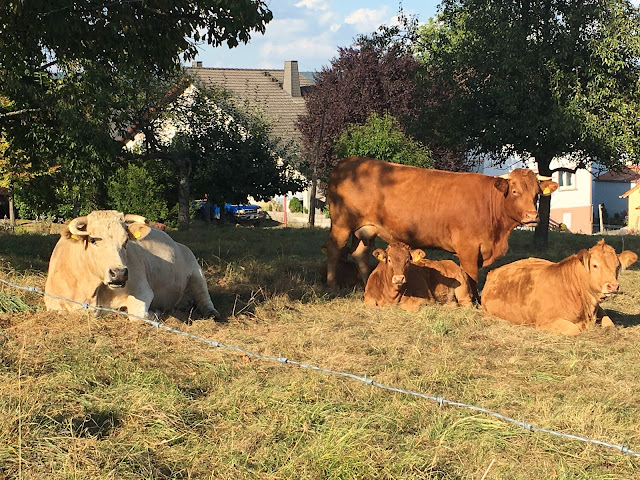
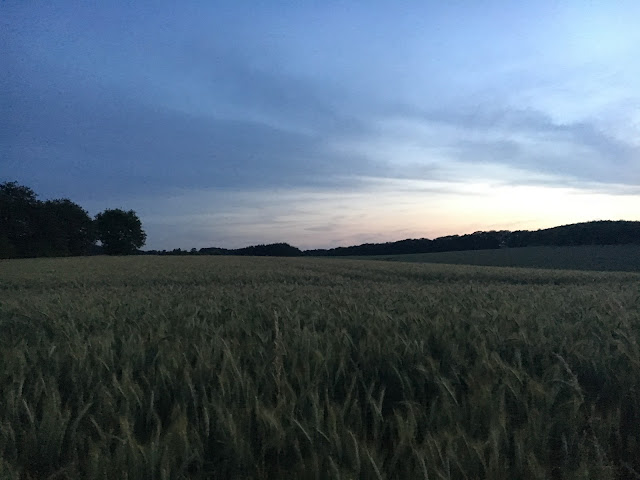
So here are a few photos of the countryside near my former house in the village of Steinwenden, a tiny village in the Rhineland-Pfalz, near Ramstein air base.


Just some cows in the neighborhood.


A field of canola. Every spring the countryside would be bright yellow. 


Pasture on the hill just behind our house, I could see these sheep from the second-story window. 

Sadly they weren't permanent residents, just visiting.  


In the summer this field was normally wheat or corn, 

but one summer it was all sunflowers and sweet peas, to help enrich the soil.


Sunset over the wheat field, just beyond my house. 


Hay all bundled up at the end of the season. I took this photo from my driveway. 


I loved the peace and quiet of the countryside but I was happy to move closer to a major city. Right now I'd be really happy to be on the edge of the farms, I'm sure it would be more relaxing right about now! Well, every place has its advantages. 

Bloggers, which are your favorite books about rural life? And does anyone else feel like moving out to the country about now? 

I'm counting this as my Adapted Classic for the Back to the Classics Challenge

Friday, April 24, 2020

Crossriggs by Jane & Mary Findlater

Not a great cover image, but the only one I could find.

I don't know who I can credit for recommending Crossriggs -- I'm sure it was someone in the blogosphere, and I wish I knew so I can thank them. (Updated: it was Furrowed Middlebrow!) This book is exactly in my wheelhouse, including : 
  1. A Victorian(ish) time period 
  2. Set in Scotland
  3. A strong female protagonist 
Basically, a trifecta of all the things I love in a book. Published in 1908, Crossriggs is the story of Alexandra Horn, a woman in hear late twenties/early thrities, living with her father in the village of Crossriggs which is "about an hour's train ride from Edinborough. Besides the Horns, there are three or four other families of note around which the story is centered. Alexandra, known as Alex, has been living rather quietly with her father, an educated man with interesting and progressive ideas (but not much money) when her recently widowed sister Matilda arrives in tow from Canada with her five (!) children. The eldest daughter is 13, then there are three boys in a row, and finally a baby girl. 

Of course this throws the whole house into turmoil, but Alex and her father take it all in stride until they realize they will be more financially strapped than ever. Her father borrows some money from a close neighbor, Mr. Maitland, but Alex is aghast and vows to find a way to earn some ready cash. She begins by reading every day to a blind neighbor, the retired Admiral Cassilas, who is kind but somewhat gruff and snobbish. The admiral's only living relative is his grandson, Vanbrough, who has just finished school and is about twenty-one. 


A better image of the cover artwork. 
It's "Lady in Grey" (1859) by Daniel Macnee, National Galleries of Scotland

Young Van is bored staying at gloomy Foxe Hall with his grandfather, and the two don't always see eye to eye. He quickly strikes up a friendship with Alex and spends more and more time with the loud and boisterous Hope family. Eventually, his grandfather starts parading a succession of eligible young women around Van, and Alex's sister is pressuring her to accept the hand of James Reid, who is good steady but whom Alex finds dull. And Van is jealous of her friendship with their neighbor Mr. Maitland, who seems excessively fond of Alex, who is married with a sickly wife. Eventually this love triangle (or quadrangle?) comes to a head, and after a dramatic turn of events, there is a tragedy.

I really enjoyed this book -- it reminded me a bit of Jane Austen, but also a little bit of Anne of Green Gables. I really liked that Alex was trying to make her way in the world without just husband hunting -- she seemed like a new modern woman. The plot moved along nicely, and though it's almost 400 pages long, it seemed shorter, probably because the Virago edition had very wide margins. 

This book had some interesting plot twists. There was a lot of foreshadowing about the three men who seemed interested in Alex, so I had strong suspicions about how it would all end up -- and I was right about some of the events, but not the characters I was expecting, if that makes sense. And I was amused by Alex's father, who was a "fruitarian" -- basically, a vegetarian who made the family eat crazy things like nuttose, an early meat substitute developed in the late 1890s. They were also forced to eat carrots, of all things! Apparently this was a vegetable only fit for horses. 

Aside from some cringey racism, I liked this book very much, though the ending was a bit rushed. I did like how Alex's story was wrapped up, which was not how I expected. I would like to read more by the Findlater sisters, who wrote books individually and together. Sadly, I don't think any of their other books are readily available. Crossriggs is currently out of print, but there are used copies of the Virago Modern Classic edition available at a reasonable price online. And I've just discovered it's available as an audio on BBC Radio 4!  

I'm counting this as my Classic with a Place in the Title for the Back to the Classics Challenge and for my UK Classic for the European Reading Challenge

Friday, April 17, 2020

#1920 Club: In the Mountains by Elizabeth von Arnim


I always love when Simon and Kaggsy host one of their year-themed reading clubs -- it's so interesting to see the range of different books published in a given year. This round they've gone for the centenary celebration of 1920. It was tougher than I thought to find a book I hadn't read, but I realized that In the Mountains, one of Elizabeth von Arnim lesser-known works, was published that year. It's really a novella, though it's out of print in English it's available online through Gutenberg.org and iBooks.

Set in 1919, this epistolary novel is the diary of an anonymous Englishwoman who has returned to her summer home in the Swiss Alps, after an absence of five years due to WWI. She retreats to her cozy home to rest and recuperate after the trauma of the war. She is trying to get back to some sense of normalcy and in the beginning she does little more than sit and contemplate. She does have two servants, Antoine and Mrs. Antoine, a caretaker and housekeeper. Some of the most amusing bits are the narrator dealing with the minutia of life. There's a part about Antoine's acquisition of livestock which I really enjoyed. 

Out of print in English, but I love the cover of this Italian edition.

The silence and solitude is therapeutic for the narrator but after a while she longs for human contact, and I found this passage to be particularly timely:

I suppose, however, for most people complete freedom is too lonely a thing, therefore the absence should only be just long enough to make room for one to see clear again. Just a little withdrawal every now and then, just a little, so as to get a good view once more of those dear qualities we first loved, so as to be able to see that they're still there, still shining. (August 4)

Eventually, the author has some random house guests, two English sisters she who literally stumble their way into her yard, looking for a pension, and quite quickly, she invites them to stay. I liked this as it reminded me a bit of the four women sharing the villa in Enchanted April. I didn't expect it, but this book had quite a few parallels with the self-distancing we're all experiencing:

Yet the days are packed. Mine, at any rate, are. Packed tight with an immense monotony.
Every day we do exactly the same things: breakfast, read aloud; lunch, read aloud; tea, go for a walk; supper, read aloud; exhaustion; bed. How quick and short it is to write down, and how endless to live. At meals we talk, and on the walk we talk, or rather we say things. At meals the things we say are about food, and on the walk they are about mountains. The rest of the time we don't talk, because of the reading aloud. That fills up every gap; that muzzles all conversation. (August 25)
(This is essentially my life right now, except we don't read aloud, we're reading silently or watching TV. Or on our phones, sadly).

The sisters, two widows named Mrs. Barnes and Mrs. Jewks, then become the focus of the novel. Mrs. Barnes, the elder, is very buttoned-up about their family history and situation so close to the end of the war, and I could see parallels with some of the current racism in our country. But the best part of the novel was the witty dialogue and lovely descriptions of life in the Alps. I did get to visit the Alps when I was in Germany, once on a day trip to Interlaken, and another on a trip to Innsbruck, Austria. I didn't actually visit any chalets but the scenery was stunning. 


Near Wengen, Switzerland


View from the top of Grindelwald in the Swiss Alps 


After a bit of a slow start, I really enjoyed this novel and finished most of it in one sitting. It really picked up after Mrs. Barnes and Mrs. Jewks arrived, and though it doesn't quite have the charm of The Enchanted April, I could see hints of that book which was published only two years later. My only quibble with In the Mountains is that we never really learn that much about the narrator -- aside from never learning her name, we know very little about her family history, her life, or what happened to her in the war. We learn about one significant wartime loss, but that's it. What was her role in the war? Did she lose a husband or sweetheart? She never says. I wonder if she is supposed to represent an everywoman, or that the she is so neutral so that the reader can more easily identify with her. In the Mountains is considered one of von Arnim's lesser novels but I'm very glad I read it. Thanks to again to Simon and Kaggsy for hosting this event, I'm looking forward to the next one!

I'm counting this as my Classic with Nature in the Title for the Back to the Classics Challenge, and as my book set in Switzerland for the European Reading Challenge

Wednesday, April 8, 2020

Les Miserables, Books 3-5, and the West End Musical


It took me two months, but I've finally finished Les Miserables, Victor Hugo's sprawling masterwork. Originally I had planned on posting after each of the five books within the novel, but the last month has been difficult for me, as I'm sure it has been for everyone else. I've had a hard time concentrating and often can barely make it through a short story a day. I ended up listening to quite a bit of the book on audio while walking the dog. The audiobook is split into 56 parts, almost 58 hours of listening time. And of course I'm hardly driving anywhere nowadays, so it took even longer.


So. The third book introduces the character of Marius, a young lawyer who is the son of Pontmercy, a retired army colonel who was badly wounded at the Battle of Waterloo, which takes up an enormous long section in Book Two. At the very end of the battle, deserters are scavenging the bodies of the dead for valuables, and one of them discovers a survivor, whom he pulls from the bottom of a pile and ostensibly saves. The deserter is of course the shady Thenardier who ends up adopting the hapless Cosette; the survivor is Pontmercy, the father of Marius. There's a lot of back story about Marius' maternal grandfather and his estrangement with Pontmercy. Eventually, Marius grows up, learns about his father, leaves his grandfather's house to live in a garret, falls in love with Cosette, Thenardier finds Jean Valjean who then disappears with Cosette; Marius joins the uprising of June 1832; is wounded then saved by Jean Valjean (of course!) by dragging him through the sewers of Paris.


I really should have split this posting into three, but I'll just give my final thoughts. Overall I liked it and was glad I stuck with it, but wow, this book is a commitment. There are some very long passages which are essays about history, politics, religion, etc, and some of them are pretty dry. They're often turned into long soliloquies by characters. I had wondered how the heck this 1260 page behemoth was adapted into a six-hour mini series, much less a feature film or stage musical about three hours long. Obviously, they cut a lot, starting with these passages. It's a great plot, despite the amazing coincidences, and I'm sure I would have gotten more out of it if I'd studied it as a work or literature or even followed the blog postings and podcasts in great detail. Honestly, I cannot imagine a book like this being published today -- editors would be trying to make cuts everywhere. I do think some of the character development is a little sketchy.


So, now a bit about the West End production. A couple of years ago when I still lived in Germany, I took a trip to London to finally meet some of the people from one of my online book groups. I decided to make a long weekend out of it, and planned in some West End shows, tours, and museums -- that trip was packed. I don't normally plan out a detailed itinerary, but on that trip there was so much I wanted to do, I actually made a spreadsheet. There was an opening for the last night of the trip, and I settled on Les Miserables because it's such an iconic show -- it's been running almost continuously since 1985 with more than 14,000 performances to date. However, I didn't have enough time to read the book first, and I didn't want to watch the movie version, so I went to see with only vague memories of the plot.


I enjoyed the show but I hadn't realized that it's a sung-through musical, meaning that there's hardly any dialogue, like a traditional musical -- there's far more singing so it's closer to an opera. The show was completely sold out, and it was quite long, nearly three hours. I did appreciate the quality of the singing and the sets and costumes, but at the time, I don't think I understood why people are so in love with the show. In retrospect, I really wish I had read the book first, I think I would have gotten more out of it, though, obviously, a lot of the plot was cut. As I was reading I realized how abridged it was! Now I'd really like to see it again, but apparently the Queen's Theater in the West End closed for several months for renovations (reopened as the Sondheim Theater), and now the show is different, closer to the touring show version. There was quite a hullabaloo among the fans, especially because the set is also different -- there was a revolving stage which is now gone. So I'm glad I got to see the previous version.


Anthony Perkins as Javert in the 1978 miniseries
I still haven't seen any of the TV or film adaptations since I was a child -- the version I saw starred Anthony Perkins as Javert which is still available on DVD, so I might have to track it down. I do have the most recent miniseries adaptation checked out from the library and I guess I'll have time to watch it now that the library is closed until further notice -- that is, if I can tear myself away from the Scandinavian murder mysteries streaming on Netflix.

UPDATED: While researching images for this blog post I found an interview with Andrew Davies who did the most recent six-hour TV adaptation. Davies said he'd been to see the West End musical and hated it, calling the performers "second- or third-rate." I found that so offensive -- I've been to quite a few West End performances and NEVER seen anything less than first rate singers and actors. Even if I didn't care for the story or the staging, the performers are always top-notch. Does he have any idea how hard it is to do eight shows a week for months? Now I'm rather put off him and don't know if I want to watch his miniseries after all (and I reeeallly hated Sanditon, but that's another whole blog post.)

What's everyone else reading and watching now that we're all hunkered down? Is anyone else making progress with those classics we've been putting off forever, or is everyone just craving comfort reads?


I'm counting this as my Abandoned Classic for the Back to the Classics Challenge (I'm halfway through!); the Second Chances category for the Victorian Reading Challenge; and as my French classic for the European Reading Challenge

Saturday, March 7, 2020

Father by Elizabeth von Arnim

The Italian cover. Great photo, but wrong era, it's off by about 50 years.

"There came a moment, she imagined, in the lives of most unmarried daughters, and perhaps in other people's too, when they must either bolt or go permanently under." 

It's funny how some authors are so strongly identified by a single work, when they often have lots of other books which are largely ignored. I feel like Elizabeth von Arnim is one of those authors.  She's so well know for her delightful novel Enchanted April, yet so many of her other books are hardly discussed and mostly out of print.

Author Elizabeth von Arnim
One of those novels is Father, published in 1931. It's sadly fallen out of print, like many of her novels (except in Italian -- most of her books seem to be in print int Italy -- because of Enchanted April ? Of course I'm only guessing.)

Anyway, I've now read nine of her books and Father is near the top of my rankings, by far one of my favorites. Set between the wars, it's the story of Jennifer Dodge, the thirty-three year old spinster daughter of a famous writer. On her mother's deathbed some 12 years before, Jennifer promises to look after her father. Inevitably, she give up her youth and possibilities of any of her own hopes and dreams, devoting herself to Father so that his work is not disturbed.

The only image I could find of an English-language edition

All this changes when Father comes home one day and announces that he has remarried -- to Netta, a nineteen-year-old beauty, a girl young enough to be his granddaughter. Naturally, Jennifer is stunned -- then elated! With a new wife, surely she will be in the way? Now she can escape and have a chance at her own life. Though her father never paid her a cent for her hard work, Jennifer has a tiny income of her from her late mother, and decides to find a tiny cottage where she can garden and live happily in the country.

Minnie, the cook, suggests her home county of Sussex, and Minnie's copy of the local church paper provides two possibilities. After has Father whisked Netta off on a Norwegian honeymoon, Jennifer gets on a train to explore two cottages owned by neighboring vicarages. The first attempt is a disaster, and at the second, the spinster sister of the vicar agrees to rent Rose Cottage to Jennifer, simply out of spite to her brother, with whom she's just had a tiff.

Great cover, but it doesn't represent the characters AT ALL.
These people are far too glamorous and sophisticated.

Alice Ollier, the vicar's sister, quickly regrets her decision when it occurs to her that is distinctly possible that her brother James might fall in love with Jennifer! There's almost a bit of screwball comedy involved as Jennifer begins to settle into Rose Cottage and Alice attempts to thwart her. What would happen to 40ish Alice if James brings home a bride? Meanwhile, Jennifer's idea of a peaceful existence is frustrated by the sudden appearance of the child bride Netta -- apparently there's trouble in paradise. Jennifer's father is also none too pleased at her decision to -- gasp -- want a life of her own! The nerve!

Parts of this are quite funny, but there's an undercurrent of sadness in this novel, as it's mostly centered on men's expectations of the women in their lives, and people trying to manipulate one another. The character of the father in particular made me want to jump into the book and throttle him -- I have rarely read such a well-drawn, frustrating character. He is absolutely self-centered and self-absorbed. And I wanted to give Alice a good talking-to as well.

A French-language edition.
She looks like a dutiful daughter, but about 20 years too early.
This is clearly Edwardian.

I chose this book off my stack because I thought the title would make it a perfect fit for the Classic About a Family category in the Back to the Classics Challenge. It didn't turn out to be quite what I expected -- it is about families, but it's just as much as about the Olliers as it is the Dodges. I hope I'm not giving the impression that I didn't like this novel, because I really liked it, and it will probably be one of my top reads of the year.

I'm counting this as my Classic About a Family for the Back to the Classics Challenge