Showing posts with label Classics Club. Show all posts

Saturday, September 5, 2020

Imperial Palace by Arnold Bennett: Upstairs and Downstairs in a London Hotel


He knew the exact number of guests staying in the hotel that night; but their secrets, misfortunes, anxieties, hopes, despairs, tragedies, he did not know. And he would have liked to know every one of them, to drench himself in the invisible fluid of mortal things. He was depressed. He wanted sympathy, and to be sympathetic, to merge into humanity. But he was alone. He had no close friend, no lovely mistress -- save the Imperial Palace. The Palace was his life. And what was the Palace, the majestic and brilliant offspring of his creative imagination and of his organising brain? It had been everything. Now, for the moment, it was naught.

Imperial Palace by Arnold Bennett has been on my TBR pile for about 10 years, since I found a copy for $1 at the library's used Book Cellar. I was really hoping it would be the book assigned by the latest Classics Club Spin, I thought I'd try and tackle it anyway as part of my Big Book Summer reading challenge.

Set in the late 1920s, it's approximately a year in the life of two hotel employees at the eponymous hotel, a swank London establishment (based on the luxurious Savoy hotel). The manager, Evelyn Orcham, is in his late forties and has devoted his life to the hospitality business, working his way up from the bottom. He's now at the top of his profession, the most respected hotel manager in London. The other main character is Violet Powler, a young manager from the hotel's laundry division, who Orcham promotes to floor housekeeper and begins to fast-track her career to bigger and better things in the hotel. 

Their stories are intertwined with the arrival of the blustering Sir Henry Savott (baronet) and his impulsive daughter Gracie, one of the Bright Young Things of the London set, known for her fast cars and eccentric ways. It's mostly set in the hotel and supporting establishments, and follows their lives amid the day-to-day workings of the hotel, including difficult guests, a merger, a massive holiday celebration, love affairs, jealousy, gossipy employees, and potential scandals. It's a bit like Downton Abbey, only set in a 1920s hotel instead of a country house. (It also reminded me of Norman Collins' Bond Street Story, which I also loved). 

The lobby of the famous Savoy Hotel in London, inspiration for the Imperial Palace.
It is so posh I was afraid to go inside.


And the story is long, nearly 800 pages. It's not a difficult read, but I found myself reading it fairly slowly, spreading it out over several weeks. There are a lot of short chapters, like a Victorian novel, so there were plenty of stopping points; also, I really didn't want it to end. For the most part, I really enjoyed the characters, and I loved being in their world. I had a particular interest in this novel because years ago, I was employed at a large hotel in Chicago, where I worked in the kitchens as a pastry cook for almost two years. Of course I didn't see nearly all the minutiae of housekeeping and guests, but I learned a lot about how much work is involved in running a large operation, keeping all the departments coordinated and the logistics of large events. In the kitchens alone we had to deal with catering, ordering, stocking, room service, stewarding, and so on. A hotel is like a giant machine and all the parts fit together, and I am always fascinated by how much work goes into coordinating everything. Based on my own experience, Bennett must have had first-hand knowledge of how a hotel was run because that aspect of the book seemed really authentic. (Bennett also wrote about hotels in the much shorter novella The Grand Babylon Hotel, and briefly in The Old Wives' Tale). 

That being said, this novel was published in 1930 and there are some racist and sexist bits that made me roll my eyes. The hotel manager Orcham doesn't seem to think much of women's intelligence unless they are useful to him, and both the main characters are pretty xenophobic -- there are actual Italian and French employees, the horror! And I was pretty sure I knew how the book would end up, but there was one outcome that I did not like one bit, it was so sexist. 

Overall, though, I really did enjoy this book and it will probably be one of my favorites for the year. 

Saturday, August 1, 2020

Classics Spin #24


I only have 21 books left on my second Classics Club list! That made it pretty easy to make my list for the upcoming Classics Spin: to participate, you list 20 books from your Classics Club List, and on August 9, we'll be assigned a random number that will select the book for it. The book is to be read by September 30 -- two whole months! Plenty of time in case it's a big long book. 

All but one are from my own shelves, so there's a good chance I'll knock off another of my owned-and-unread pile (ever growing, sigh). I've put them in order alphabetically by title this time to make things more interesting. 

  1. Beware of Pity by Stephan Zweig
  2. The Bright Side of Life by Emile Zola
  3. The Caravaners by Elizabeth von Arnim
  4. Crime and Punishment by Fyodor Dostoevsky
  5. La Debacle by Emile Zola
  6. A Few Green Leaves by Barbara Pym
  7. Imperial Palace by Arnold Bennett
  8. Invitation to the Waltz by Rosamond Lehmann
  9. Jenny Wren by E. H. Young
  10. The Little Ottleys by Ada Leverson
  11. Mandoa, Mandoa! by Winifred Holtby
  12. My American by Stella Gibbons
  13. Noli Me Tangere by Jose Rizal
  14. A Pin to See the Peepshow by F. Tennyson Jesse
  15. The Portable Dorothy Parker by Dorothy Parker
  16. Ralph the Heir by Anthony Trollope
  17. Roughing It by Mark Twain
  18. Troy Chimneys by Margaret Kennedy
  19. Westwood by Stella Gibbons
  20. The World My Wilderness by Rose Macauley

The only ones I'm dreading are Crime and Punishment (it sounds so dire) and La Debacle (a war novel), I'm really in the mood for lighter reads. Roughing It might also be a bit of a slog. 

I've heard good things about Troy Chimneys and The World My Wilderness, and I've been meaning to read Jenny Wren what seems like forever! And how have I not read A Few Green Leaves by Barbara Pym? She's one of my favorite writers, and it's the only one of her novels I haven't read yet.

Bloggers, are you signing up for the next Classics Club Spin? What do you want to read most from your lists?

UPDATE: The Classics Spin has assigned us #18. So I'll be reading Troy Chimneys by Margaret Kennedy. I'm looking forward to it and who knows, maybe I'll try to read even more from my list in the next two months before I post on my spin pick on September 30. 

Thursday, May 14, 2020

Lark Rise to Candleford; and my pastoral life in Germany


I finally tackled one of the books I've had on my owned-and-unread pile the longest -- Lark Rise to Candleford. I bought this more than ten years ago, around the time the TV series was first broadcast, but I've been putting it off forever, put off by the sheer size of it, and by the first couple of pages which are mostly descriptive. (It's also one of the books from my original Classics Club list that I never read). It's a little tough if the first page doesn't grab you. I had watched a bit of the TV series and enjoyed it, so I thought I should give it another go. 

For those who aren't familiar, Lark Rise is a fictionalized memoir of Flora Thompson's childhood in rural England, during the late Victorian period. It's classified as fiction but definitely reads like a memoir, and most libraries and bookstores shelve it in the fiction section. There isn't really any plot, it's really a lot of vignettes and memories of Thompson's childhood in Oxfordshire, and she places herself in the story as the main character, Laura, oldest child of a stonemason and his wife who live in a poor but comfortable house in the little hamlet of Lark Rise. It was originally published as three volumes, and I read the edition pictured above which includes all of them: Lark Rise [1939], Over to Candleford [1941], and Candleford Green [1943]. Since 1945 it's been available as an omnibus and there are many beautiful editions. 

A Penguin edition of the first volume.
My copy had woodcut illustrations similar to the one on the cover, 

though they're black and white


Each chapter has a theme, so it isn't told in a specifically linear fashion. It jumps around a bit, but it's easy enough to follow. There were chapters on May Day, hog butchering, school, churchgoing, and so on. Bits of it reminded me a bit of the Little House on the Prairie series, just in the descriptions of daily life in that era. Life was hard for Laura's family and the other families in Lark Rise, but she seems to have very happy memories. It's a really lovely portrait of rural life towards the end of the Victorian era, with hints of what's to come in the new century. 

It's fairly long book, more than 500 pages and 39 chapters. I finally got around to picking it up when I was looking for something soothing to read, and it fit the bill perfectly. Most of the chapters are short, and I thought I'd just read one or two a day, but I found myself turning to it more and more often in the past week. It is just the thing to read before bedtime, to crowd out all my other thoughts of world events. I can see why it was so popular when first published during WWII. 

After reading a few chapters I was wondering how they adapted it into a 40-episode TV series (I've only watched the first season so far). Eventually, though, I began to recognize characters from the series. Some of them have much more screen time than you'd expect from the book, and a couple of them have been combined into one family. They've definitely kept the spirit of the book in the series. It's a bit like Cranford in that the TV creators have taken the essence of the characters and place and extrapolated from there. If you're expecting it to be a novelization of the series, you'll be disappointed. For example, Dorcas, the postmistress, has nearly as much screen time in the TV series as Laura, but she doesn't show up in the book until more than halfway through. 

The beautiful Folio Society edition. I would love to take a look at this one. 


I really enjoyed this book, though it wasn't what I'd call a quick read, It's definitely a leisurely read, well suited to reading in bits in pieces, and it felt more like a memoir than a novel. In the past I've described books as 'nonfiction that reads like fiction' but this was the opposite. And if you love a sense of place, this is the book for you, with lovely descriptions of the countryside and just the slowness of everyday life. It made me want to move to a cottage and cook on an open fire. 

I'm a suburban kid and the idea of living in a village surrounded by countryside has always appealed to me. Our house in Germany was in a village, though nothing like Lark Rise, though we were at the end of a street on the edge of farmland and I could literally see cornfields and livestock right outside my door. I used to walk my dog through farmland and there were cows, horses, and chickens within a short distance, and in the spring, I'd take the scenic route to see if there were any lambs. I did enjoy how peaceful it was but there wasn't much to do close by, if you wanted to do more than a movie or basic shopping we had to drive pretty far. 

So here are a few photos of the countryside near my former house in the village of Steinwenden, a tiny village in the Rhineland-Pfalz, near Ramstein air base.


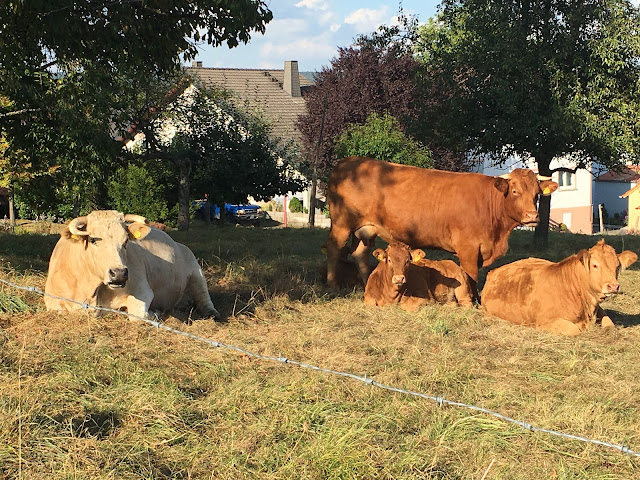
Just some cows in the neighborhood.


A field of canola. Every spring the countryside would be bright yellow. 


Pasture on the hill just behind our house, I could see these sheep from the second-story window. 

Sadly they weren't permanent residents, just visiting.  


In the summer this field was normally wheat or corn, 

but one summer it was all sunflowers and sweet peas, to help enrich the soil.


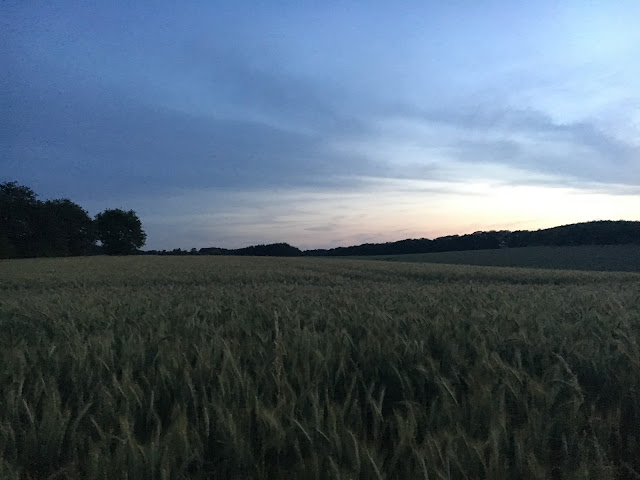
Sunset over the wheat field, just beyond my house. 


Hay all bundled up at the end of the season. I took this photo from my driveway. 


I loved the peace and quiet of the countryside but I was happy to move closer to a major city. Right now I'd be really happy to be on the edge of the farms, I'm sure it would be more relaxing right about now! Well, every place has its advantages. 

Bloggers, which are your favorite books about rural life? And does anyone else feel like moving out to the country about now? 

I'm counting this as my Adapted Classic for the Back to the Classics Challenge. 

Friday, August 31, 2018

Classics Spin #18: Whisky Galore: More Scottish than Outlander


I was delighted by the most recent Classics Club Spin selection. I had been actually hoping to visit Scotland this summer (after my trip to London to see Hamilton) but since we decided to visit Jane Austen country, reading Whisky Galore by Compton Mackenzie would have to suffice for my Scotland fix. It includes so many of my favorite bookish requirements: Mid-century -- Check! Scotland location -- check! Quirky characters -- check! I am sorry to say most of what I know about Scotland comes from reading and watching Outlander (which I realize was written by an American). This has a lot more drinking and a lot less kilts and steamy Scotsmen -- and no time-travel.

The setup: loosely based on actual events of the 1940s, this comic novel is set during WWII and is the story of the residents of Little Todday and Great Todday, two fictional islands in the Outer Hebrides. Of course there is rationing due to the war, but what hits everyone hardest is the lack of whisky -- as the story begins there hasn't been any Scotch for weeks, and everyone is rationed to one beer every other day. They are all miserable.  

The tale opens with the return of Sergeant Odd, a forty-something English solider who had been previously assigned to the island, and fallen in love with a local girl, Peggy Macroon, before he shipped off to Africa. He's ready to get married but her father keeps putting off the wedding. The locals tell him they can't possibly host a reiteach, a traditional Gaelic engagement party, when there's no whisky to be had. The first third of the book mostly deals with Odd visiting various locals so the reader is introduced to the various quirky locals. 

Finally, a miracle occurs -- a steamer called the Cabinet Minster is wrecked on a reef between the two islands, and it seems like manna from heaven when the locals realize the hold was filled with 15,000 cases of premium whisky bound for the United States (apparently much of the whisky has been diverted to sell to America to pay for the war effort -- it's not clear if the Americans have entered the war yet). The shipping company writes off the loss and the residents get busy salvaging what they can before the excise men arrive, and the engagement party is back on.

Hilarity ensues when the resident self-important gentry, Captain Wagget, decides that everyone is flaunting the law (and enjoying themselves), so he tries to get the police and military involved. There are also some really funny bits with the local school master, George Campbell, whose domineering mother is trying to prevent his engagement. 

I really enjoyed this book. I do think it started out a bit slow, and I had a little trouble with Gaelic references and some of the dialect written phonetically into the dialogue. It's not what I'd describe as a rip-roaring yarn but more of a simmer -- perhaps I would have enjoyed it more if I'd been sipping a wee dram myself while I'd been reading it! It was definitely worth sticking with. I feel like I got a real flavor of the islands, so to speak, and I enjoyed all the colorful characters. I really wish now that I had been able to visit Scotland this summer. 

Eddie Izzard as Captain Wagget
There have been two film adaptations of Whisky Galore -- the first one from 1949 starred Gordon Jackson (Hudson from Upstairs, Downstairs) as Mr. Campbell and is a classic comedy from the British Ealing studios.  The 2016 remake stars Eddie Izzard as Captain Wagget which I think is brilliant -- I love his stand-up and he's wonderful in almost every film and TV role. Sadly neither version is available from Netflix or at my library so I'll have to see if I can get one via inter-library loan, or I may just suck it up and see if I can find a cheap copy on the internet. 

Bloggers, has anyone seen either version? And how did everyone do with their spin picks? 

Wednesday, July 25, 2018

Classics Club Spin #18


One of my favorite parts of being a member of the Classics Club are the Spins. Basically, participants select 20 books from their Classics Club list and number them. The club chooses a random number, and club members read the corresponding book from the list with that number, and have a month to read and post about it. I've just started my second Classics Club list, which has some very obscure classics because I'm desperately trying to read books from my own shelves. Here's my list:


Five Classics I've Owned the Longest:
1. Imperial Palace by Arnold Bennett
2. Alas, Poor Lady by Rachel Ferguson
3. Living/Loving/Party Going by Henry Green
4. The Lonely Passion of Judith Hearne by Brian Moore
5. The Children by Edith Wharton

Five From the 20th Century:
6. Westwood by Stella Gibbons
7. The Hireling by L. P. Hartley
8. The Little Ottleys by Ada Leverson
9. Whisky Galore by Compton Mackenzie

10. Barmy in Wonderland by P. G. Wodehouse

Five in Translation:
11. Crime and Punishment by Fyodor Dostoevsky
12. The Misunderstanding by Irene Nemirovsky
13. The Bright Side of Life by Emile Zola
14. The Fortunes of the Rougons by Emile Zola
15. Beware of Pity by Stephan Zweig

Five Virago Modern Classics:
16. Troy Chimneys by Margaret Kennedy
17. Invitation to the Waltz by Rosamund Lehmann

18. The World My Wilderness by Rose Macauley
19. Jenny Wren by E. H. Young
20. Frost in May by Antonia White

On August 1 I'll be assigned a number and that will be my next Spin pick! Which ones should I be hoping for? Which should I be dreading? And what's on your Spin list? 


Updated: The number is up, and I'll be reading #9, Whisky Galore by Compton Mackenzie. Sounds like a perfect summer read and I'm looking forward to it. 

Monday, May 7, 2018

Classics Spin # 17: One Fine Day by Mollie Panter-Downes


So I'm nearly a week behind with Classics Spin #17, but better late than never. My spin pick was One Fine Day by Mollie Panter-Downes, a slim novella of a mere 184 pages. One would think it would be easy enough to finish this book in time --I was so confident that I could zoom through this book in a day that I literally left it to the last minute. Of course, I was wrong.

It's a short book, but not one that I would recommend rushing. As the title suggests, it's a single day in the life of Laura Marshall, who lives in Wealding, a fictional English village in Sussex. It's shortly after the end of the war, and her husband Stephen commutes by train to his job in the city; daughter Victoria, about 9 or 10, is off to school and then visiting a friend afterward for tea.

Laura goes about her early summer day, filled with the normal tasks of cleaning, cooking, shopping and errands. The family live in a big house that once had several servants, but now must make do with a part-time daily charwoman and elderly gardener. Her tasks that day include asking a local youth to help out with the gardening maintenance, and putting an advertisement in the local paper for a cook.

The reader really gets a feeling of what life was like in the aftermath of the war. The book was published in 1947 and it's very obvious that WWII is still very fresh, with rationing, queueing, and German POWs still working on local farms. Laura picks a basket of gooseberries for her husband's work assistant who lives in London; there are mentions of the sudden availability of oranges, and daughter Victoria longs to live on a farm where milk and cream are there for the taking.


It seems like any ordinary day, it's really a microcosm of how life was changing in England, neatly encapsulated in less than 200 pages. Much of the story is also focused on how life was before the war and how it will never be the same due to changes in class and social structure. Laura and her family are faced with the impossibility of finding help, as all the working-class people are no longer interested in service. Laura's snobby mother can't understand why her daughter has to -- gasp -- do housework! but the local squire's wife has faced reality and is moving off her crumbling estate to smaller housing and has given over her mansion to the National Trust. The young man asked for gardening help has no interest in sticking around the little poky village, and is ready to move on to bigger and better things.

Overall, this book is just beautifully written, too good to zip through in a single sitting.

How hot it was! The midday heat was rising to a head, like milk to the boil, singing in a clotted hum of bees, of crickets among the sorrel and daisies, of gnats dancing above the cresses tugged all one way by the trickle of water running under the hedge. An old woman came out with a pail, hobbling across the lane to the tap dripping among the moss. She had lived to see men flying overhead like birds; to stand among the hollyhocks watching bombs spluttering across the stars to kill a family forty miles away; to turn a switch and hear the great voice from Westminster correcting her kitchen clock. 


I loved this book and it was the perfect read for a beautiful spring day. I read a good chunk of it on Saturday afternoon sitting outside in the Japanese garden in Kaiserslautern. I didn't take any photos this time but here's one of my favorites from last year.


Mollie Panter-Downes worked for years as a correspondent for the New Yorker magazine and as a short story writer; sadly, she really didn't write many novels. However, I've read and enjoyed both of her short story collections published by Persephone, and I also own London War Notes, a collection of her wartime columns which was thankfully republished (also by Persephone) because the previous edition from the 1970s was terribly expensive.  It's on my TBR Pile Challenge list so I'm hoping to get to it before the end of the summer.

Wednesday, March 7, 2018

Classics Club Spin #17


I've narrowed my new Classics Club list down to 20 books for the next Classics Club Spin. On Friday the Classics Club will randomly choose a number from one to twenty. The number from this list that corresponds will be one of my next reads, and I'll post about it sometime in April. Wish me luck!

Four books I really want to read: 

1. Bond Street Story by Norman Collins
2. Westwood by Stella Gibbons
3. One Fine Day by Mollie Panter-Downes
4. Summer Half by Angela Thirkell


Four books I've been putting off forever:

5. Alas, Poor Lady by Rachel Ferguson
6. A Pair of Blue Eyes by Thomas Hardy
7. Under the Greenwood Tree by Thomas Hardy
8. The Pumpkin-Eater by Penelope Mortimer

Four Virago Modern Classics:

9. A Pin to See the Peepshow by F. Tennyson Jesse
10. Invitation to the Waltz by Rosamund Lehmann
11. The Little Ottleys by Ada Leverson
12. The World My Wilderness by Rose Macauley

Four by Anthony Trollope:

13. Is He Popinjoy? by Anthony Trollope
14. Kept in the Dark by Anthony Trollope
15. Linda Tressel and Nina Balatka by Anthony Trollope
16. An Old Man's Love by Anthony Trollope

Four by Emile Zola:

17. La Debacle by Emile Zola
18. The Fortunes of the Rougons by Emile Zola
19. A Love Story by Emile Zola
20. Money by Emile Zola

Updated: The Classics Spin has spoken, and I've been assigned #3 One Fine Day by Mollie Panter-Downes -- I'm so pleased! 

Bloggers, which do you recommend? And is anyone else participating in the next Spin?

Tuesday, March 6, 2018

Classics Club Redux: The List


Last year I pretty much gave up on my Classics Club List -- from my original list of 75, I had six left to go which I'd been putting off forever. I'd tried reading all of them at least once and just couldn't get into them. Since I started with 75 I thought that I'd done pretty well and decided to take a break, though I had made a tentative second list.

I forgot all about it and the Classics Club, but I've been blogging a lot more lately (around the end of the year I usually get revved up again while planning the Back to the Classics Challenge). This week a lot of bloggers are signing up for the next Classics Club Spin, which is always really fun. Basically, participants pull 20 books from their list and number them, then a random number from one to twenty  is chosen, and everyone reads whichever number book corresponds. It's a really fun way to choose a book off your list and I always enjoyed it.

Well, I do love making lists, and it's always fun to have someone else choose your next read. But before I can choose a list of twenty for the spin I had to come up with another Classics Club List. Some of the titles are more obscure classics because in the past 12 years or so since I seriously started reading, I've read a lot of the major works -- I'm getting down to the less-well known titles and authors. Also, I've really stopped buying classics that I can get for free from the library or digital download. Nowadays, I usually only buy books that I can't find otherwise.

This time, I've chosen only books from my own shelves, and I didn't choose any books from the TBR Pile Challenge because I know I'm definitely going to read those -- I really want to make some progress with my owned-and-unread books and I think this will really inspire me. Without further ado:


  1. The Caravaners by Elizabeth von Arnim
  2. Imperial Palace by Arnold Bennett
  3. Alexander's Bridge by Willa Cather
  4. Bond Street Story by Norman Collins
  5. One Pair of Feet by Monica Dickens
  6. Crime and Punishment by Fyodor Dostoevsky
  7. Alas, Poor Lady by Rachel Ferguson
  8. My American by Stella Gibbons
  9. Westwood by Stella Gibbons
  10. Living/Loving/Party Going by Henry Green
  11. Jude the Obscure by Thomas Hardy
  12. A Pair of Blue Eyes by Thomas Hardy
  13. Under the Greenwood Tree by Thomas Hardy
  14. The Hireling by L. P. Hartley
  15. The Masqueraders by Georgette Heyer
  16. Mandoa, Mandoa! by Winifred Holtby
  17. A Pin to See the Peepshow by F. Tennyson Jesse
  18. Troy Chimneys by Margaret Kennedy
  19. Invitation to the Waltz by Rosamund Lehmann
  20. The Little Ottleys by Ada Leverson
  21. The World My Wilderness by Rose Macauley
  22. Whiskey Galore by Compton Mackenzie
  23. The Lonely Passion of Judith Hearne by Brian Moore
  24. The Pumpkin-Eater by Penelope Mortimer
  25. In Confidence by Irene Nemirovsky
  26. The Misunderstanding by Irene Nemirovsky
  27. One Fine Day by Mollie Panter-Downes
  28. The Portable Dorothy Parker by Dorothy Parker
  29. A Few Green Leaves by Barbara Pym
  30. Noli Me Tangere by Jose Rizal
  31. Summer Half by Angela Thirkell
  32. Pomfret Towers by Angela Thirkell
  33. Is He Popinjoy? by Anthony Trollope
  34. Kept in the Dark by Anthony Trollope
  35. Linda Tressel and Nina Balatka by Anthony Trollope
  36. An Old Man's Love by Anthony Trollope
  37. Ralph the Heir by Anthony Trollope
  38. Roughing It by Mark Twain
  39. The Children by Edith Wharton
  40. The Fruit of the Tree by Edith Wharton
  41. Hudson River Bracketed by Edith Wharton
  42. Frost in May by Antonia White
  43. Barmy in Wonderland by P. G. Wodehouse
  44. Jenny Wren by E. H. Young
  45. The Misses Mallett by E. H. Young
  46. La Debacle by Emile Zola
  47. The Fortunes of the Rougons by Emile Zola
  48. A Love Episode by Emile Zola
  49. Money by Emile Zola
  50. Beware of Pity by Stephan Zweig
Bloggers, which have you read and loved -- or hated? Should I just get rid of some of these and not waste my time? 

I'll pick out twenty of these and post my Spin list in a day or so. On Friday the Classics Club will post the number and who knows what I'll read next!

Friday, March 24, 2017

Classics Club: Five-Year Check-In


Exactly five years ago today I posted my list of 75 classics I want to read for the Classics Club. I'm proud to say I finished 69 of the books from my list, and reviewed 58 of them on this blog! Here's a link to my original list, with dates completed and all my reviews.

There are six books from my list that I still haven't completed:

The Mystery of Edwin Drood by Charles Dickens
The Hunchback of Notre Dame by Victor Hugo
The Portrait of a Lady by Henry James
The Four Feathers by A. E. W. Mason
A Dance to the Music of Time (First Movement) by Anthony Powell
Lark Rise to Candleford by Flora Thompson

In my defense, I have actually attempted to read all of the final six at one point or another and just haven't gotten inspired enough to finish any of them. I haven't given up on them entirely -- maybe it's just not the right time for those books. I'm still hoping to tackle Portrait of a Lady this year for the Victorian Reading Challenge. 

Girl Reading, Jean-Baptiste-Camille Corot
Of the 69 that I did finish, here are some that I really enjoyed:

Lucky Jim by Kingsley Amis
One of Ours by Willa Cather
Barnaby Rudge by Charles Dickens
The Good Soldier by Ford Madox Ford
A Bell for Adano by John Hersey
Lady Chattereley's Lover by D. H. Lawrence
Main Street by Sinclair Lewis
Miss Marjoribanks by Margaret Elephant
The Makioka Sisters by Junichiro Tanizaki
Kipps by H. G. Wells

And of course, just about everything on my list by Anthony Trollope, who rarely disappoints.

Least favorites:

The Death of the Heart by Elizabeth Bowen
The Old Curiosity Shop by Charles Dickens
Sentimental Education by Gustave Flaubert
Theater by W. Somerset Maugham
Moby-Dick by Herman Melville
The Edwardians by Vita Sackville-West
Twilight Sleep by Edith Wharton
Nana by Emile Zola

Molly Reading a Book by Rose Mead
What surprises me most about this list is that includes books by some of my all-time favorite authors -- Charles Dickens, Edith Wharton and Emile Zola. So I guess there are no guarantees, even your favorite authors can fall short sometimes.

Now I'm trying to decide whether I should start another Classics Club list -- the books I want to read is never-ending! Bloggers, how is everyone else doing with their Classics Club lists?

Thursday, December 1, 2016

A Dance to the Music of Time: First Movement by Anthony Powell


So, a couple of months ago I signed up for the most recent Classics Club Spin, in which a random number is assigned to choose your next Classics Club read. I only had seven books on the list, so I thought it was a win-win. My selection was A Dance to the Music of Time (First Movement) by Anthony Powell. I was really looking forward to it, but sadly, it did not end up being the book I hoped.

First, I should point out that this is an omnibus, the first three volumes of a 12-volume cycle of short novels originally published in the early 1950s. Each volume is about 250 pages long. As it's such a long work, I started it in October, and I still haven't gotten much more than halfway through this book. However, I did write down some thoughts as I was reading, so I'll try to at least comment on my progress. 

The first volume, A Question of Upbringing, is the story of four young men at prep school. The narrator, Jenkins, tells us all about his two friends, Stringham and Templer (apparently in prep school no one is ever referred to by his first name; I only figured out Jenkins' first name was Nicholas because it's on the back of the book) and another slightly less privileged boy named Widmerpool, who appears to be somewhat tormented because he is of a slightly lower class -- his father works for the railways, ye gads! 

Basically, it's the mildly interesting antics of some incredibly privileged and entitled rich white boys. Jenkins doesn't seem too bad, but his friends are pretty much jerks. There's one episode in particular when they're cutting class and decide to divert attention by playing a nasty trick on a headmaster called La Bas. All the women in this novel are merely there to serve the men as mothers, sisters, or potential girlfriends. 

It was mildly interesting, though I didn't care much for any of the characters. Is this meant to be a satire about the future leaders of England? The (slightly) less-privileged Widmerpool seemed the best of the bunch so far, but I was somewhat underwhelmed. It was a pretty easy read and I finished it in less than a week, so I thought I would zoom through it. Alas, I hit a snag at the second volume. 

Volume II, A Buyer's Market takes place after the boys have left prep school, and quite frankly, it was a struggle. Much the action takes place over one night at a series of large parties, where Jenkins runs into a lot of his old school friends. I just found the whole thing tiresome, all these privileged young men who all seemed so entitled. None of the women in this part are well-developed characters, as they're just love interests or for the amusement of the men. There's also a reference to an African-American that is really offensive. I realize this book was written in the 1950s and is set in the 1930s, but based on the current political climate, I found it really distasteful.

I thought the second book sort of stalled near the middle. I generally avoid reading large omnibus editions as I find them very unwieldy (plus this one was numbered with the original page numbers, so it was difficult to see how far I'd got. It also didn't help that I didn't read it for long stretches and I lost track of the narrative thread and began to get some of the names mixed up, and there are a lot of minor characters introduced at large parties. I just really wasn't that interested in the characters any more, they seemed so spoiled. Maybe this is just the wrong book at the wrong time and I should give it another chance. Many people have commented how they loved this book but it's just leaving me cold and I may abandon it altogether.

Bloggers, have any of you actually finished this book, much less the entire series? Is it worth trying again later or should I just add it to the donation pile? Do you think there's such a thing as the wrong book for the wrong time?

Tuesday, October 4, 2016

Classics Spin Pick


The Classics Spin has revealed my next read from my Classics Club and it is. . . . #1. So here's what I'll be reading:


A Dance to the Music of Time (First Movement) by Anthony Powell. It's fairly long because it's the first three volumes of the twelve book series -- 718 pages! However, the print isn't too tiny and the margins are fairly large, so I don't think it will take me the entire two months! I'll be posting my review on December 1. I'm hoping to finish three or four of the last books on my Classics Club list by the end of the year, so this should help keep me on track.

Bloggers, did you sign up for the Classics Spin? What books did you get, and how do you feel about them? 

Friday, September 30, 2016

Classics Spin #14 -- and is it too late to change my Classics Club list?


Now that I'm back to blogging again, I definitely wanted to sign up for the latest Classics Club Spin! Basically, next Monday, someone from the Classics Club will post a random number between one and twenty; the corresponding book from the numbered list below is my next read.  (It's all explained in great detail here.) I'm down to the final seven books on my list -- my target finish date is March 24, 2017, just under six months away, so the next Spin pick should help me finish on time. 


These were the final seven books from my list:

  • The Mystery of Edwin Drood by Charles Dickens
  • The Man in the Iron Mask by Alexandre Dumas
  • The Hunchback of Notre Dame by Victor Hugo
  • Portrait of a Lady by Henry James
  • The Four Feathers by A. E. W. Mason
  • A Dance to the Music of Time by Anthony Powell
  • Lark Rise to Candleford by Flora Thompson.
However, as I'm getting close to the end, there are several books I've been dreading, mostly because of their length. I have tried a couple of times to read  Lark Rise to Candleford and it seems excruciatingly slow, but I watched a couple of episodes of the TV adaptation and liked it, so I haven't given up yet.


The other books I'm really dreading are the two French novels -- I've tried a couple of times to read Hunchback, but I just couldn't get into it. I even downloaded an audio version this summer and tried to listen to it as I was out walking the dog, and it was just glacial. I'm going to give it one more shot in print, and if I still can't get through fifty pages, I'm going to drop it from the list and add something else. This is my list, and even though I'm close to the end, I'm just not going to torture myself reading something I hate, just for the sake of reading it. I might try Les Miserables instead, or a different French writer -- I really liked Bel-Ami by Guy de Maupassant, so I might try Pierre and Jean. Or I could substitute something by Emile Zola, I still have several of his books instead. 


Back view of Notre Dame cathedral from my visit to Paris in July.
I didn't go inside this time but did get some nice photos , especially of the garden in the back.
I've also decided to switch The Man in the Iron Mask for The Black Tulip -- when I made up the list almost five years ago, I didn't realize The Man in the Iron Mask is the fifth books of the D'Artagnan series. I'm kind of a stickler about reading series books in order, and though I've read The Three Musketeers but I don't think there's any way I could get through the other three books in time with all my other reading. Besides, I'm kind of interested in the history of Holland and the tulip mania of the 17th century (there's a movie coming out next year called Tulip Fever and I'm really looking forward to it. 


So, here's my spin list which I'm just choosing at random, including repeats so I have an even 20:
  1. A Dance to the Music of Time
  2. The Mystery of Edwin Drood
  3. The Portrait of a Lady
  4. The Four Feathers
  5. The Black Tulip
  6. The Hunchback of Notre Dame
  7. Lark Rise to Candleford
  8. The Four Feathers
  9. The Mystery of Edwin Drood
  10. The Black Tulip
  11. Lark Rise to Candleford
  12. A Dance to the Music of Time
  13. The Hunchback of Notre Dame
  14. The Portrait of a Lady
  15. The Four Feathers
  16. The Black Tulip
  17. The Mystery of Edwin Drood
  18. A Dance to the Music of Time
  19. The Portrait of a Lady
  20. Lark Rise to Candleford
I think my top picks would be The Black Tulip, Edwin Drood, or A Dance to the Music of Time. The books I'm dreading most are Hunchback and Lark Rise, and I'm nervous about Portrait of a Lady. I'm fairly neutral about The Four Feathers because I don't know much about it, but if nothing else, it's pretty short.

Anyone read any of these books? Which ones should I be hoping for? And has anyone else abandoned books on their Classics Club list? Which books are you hoping to read? I'd love to hear your comments!