Showing posts with label big fat books. Show all posts

Wednesday, July 20, 2022

Paris In July: Renoir, My Father by Jean Renoir


I am extremely pleased with myself for finally finishing this book! I bought it more than ten years ago on a visit to the Frick Museum in New York City, when I went to see an exhibit of Dutch masters. Apparently they didn't have anything else in the gift shop and but the pretty cover of this NYRB classic (it's a detail from Garden at the Rue Cortot, Montmartre painted in 1876, below. It's at the Carnegie Museum in Pittsburgh). 


So. I've owned this book forever and I know I've put it on my list of books to read for Paris in July multiple times. I finally cracked it open a couple of weeks ago and though it's not a fast read, I really enjoyed it. I love art and I'm fascinated by the lives of artists. I wouldn't say Renoir is my favorite Impressionist but I really gained a new appreciation of his work from reading this book. 

Originally published in 1958, it's a memoir by filmmaker Jean Renoir, Auguste Renoir's middle son. Jean was wounded during WWI and as he convalesced with his elderly father, who was already crippled with rheumatism, the younger Renoir spent a lot of time talking to his father about the artist's life. The book is a combination of a biography of his father's life and his own recollections growing up in Paris and various other parts of France. The family often spent summers in the countryside in various parts of France, particularly Essoys in Burgundy, where his mother Aline was born, and later in the south of France, near Nice (I was actually lucky enough to visit Nice a few years ago and was sadly unaware that there's a Renoir museum just 20 minutes away in Cagnes-sur-Mer, in his final home. I did get to visit the Chagall Museum and the Matisse Museum, so I really wouldn't complain but I wish I'd known!)


It's quite an interesting memoir about Renoir's life and how became and artist and met up with his fellow Impressionists. He's one of the most prolific of the group, with at least 4000 paintings to his record (and the book includes stories about other paintings that were lost or stolen which just made me aghast. Some were literally used to patch up holes in a leaky roof). 

There are also great stories about the other painters including one about his good friend Gustave Caillebotte, who named Renoir executor of his estate and personal art collection after his death. Apparently it was Caillebotte's wish that the collection be given to the Louvre who didn't want the whole collection and turned 2/3 of it away. The third that they kept was stored away in the Luxembourg Museum. After his widow's death they just went to various heirs and were mostly sold outside France. Well, France's loss is the world's gain, I suppose! 

I feel very fortunate to have been to Philadelphia last year where I saw the biggest single collection of Renoir's works at the Barnes Foundation, a total of 181! Barnes was a huge art collector and began amassing Impressionist works in the 1920s. His entire house was designed to showcase his collection and was eventually left to the city of Philadelphia as a private museum. The collection was eventually moved to a larger space in downtown Philadelphia which resembles the original house with the exact layout of the all the artworks. If you ever get the chance it's absolutely worth visiting! 

I'm also extremely fortunate to live only a short drive away from the Phillips Collection Museum in DC near Dupont Circle. One of the highlights of the collection is Renoir's Luncheon of the Boating Party. The last time I visited one of the docents told me that Phillips and Barnes were rival collectors. Phillips was annoyed that Barnes had the bigger collection of Renoirs but always bragged that he had the best one. 

Renoir's Luncheon of the Boating Party, 1881.
Renoir's future wife Aline is in the left hand corner with the little dog;
Renoir's friend and fellow Impressionist Gustave Caillebotte is on the lower left leaning back. 

I enjoyed visiting Renoir's world but the book is pretty dense and took a lot longer to finish than I expected -- I am rather behind on Paris in July reading list and also my Big Book Summer Reading Challenge! But this book was on both lists and I'm also counting this as my Classic Nonfiction for the Back to the Classics Challenge. 

Wednesday, June 1, 2022

Big Book Summer Reading Challenge 2022


Time for another Big Book Summer Reading Challenge hosted by Suzan at Book by Book! Alas, I still have too many unread books. Let's see if I can shrink the pile just a little this summer. Here is my stack of hopeful reads: 


  1. They Were Counted by Miklos Banffy (624 pp)
  2. The Deepening Stream by Dorothy Canfield Fisher (616 pp)
  3. Night Falls on the City by Sarah Gainham (632 pp)
  4. Long Live Great Bardfield by Tirzah Garwood (495 pp)
  5. My American by Stella Gibbons (480 pp)
  6. A London Family by Molly Hughes (600 pp)
  7. The Feast by Margaret Kennedy (448 pp)
  8. Renoir, My Father by Jean Renoir (456 pp)
  9. The Gods Arrive by Edith Wharton (454 pp)
  10. The Most of P. G. Wodehouse (701 pp)

Nearly all of them count for other challenges -- Back to the Classics, the TBR Pile Challenge, and the European Reading Challenge. I'm cheating a little this year by choosing mostly fiction which are normally much quicker than nonfiction. I do love a great big fat biography but since I'm so far behind this year I'm going for more novels instead; only three of this list are nonfiction and one volume is (mostly) short stories.  I'm hoping that most of them are fast reads. I know I won't finish them all but we can dream, right?

Which one should I read first -- and are there any I should just donate to my Little Free Library? Please let me know in the comments! And what's on your list for the Big Book Summer Reading Challenge?

Sunday, March 13, 2022

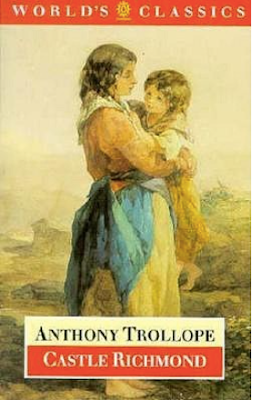
Castle Richmond by Anthony Trollope


It is impossible that these volumes should be graced by any hero, for the story does not admit of one. But if there were to be a hero, Herbert Fitzgerald would be the man. 

A Victorian novel by Anthony Trollope, set in Ireland? This book could not be any more in my wheelhouse. For the Back to the Classics Challenge I needed a book from the 19th Century and I still had five unread Trollopes on my TBR shelve. Two of them were set in Ireland so that seemed like an obvious choice for March.

Trollope spent nearly twenty years in Ireland working for the post office, and began his writing career there. His first two novels are set in Ireland, and were written during the Great Famine. Castle Richmond, his third novel set in Ireland, was published in 1860, but is set several years earlier. It does use the Great Famine as a plot point, but much less so than I was expecting. 

Basically, it's the story of a love triangle between two cousins of the landed gentry, Owen and Herbert Fitzgerald, and the girl they both love, Clara Desmond, the beautiful but poor daughter of Countess Desmond, a young widow whose marriage was less than happy. There's also a complicated plot about the inheritance of Castle Richmond, the seat of the wealthy Fitzgerald family. But I'm getting ahead of myself. 

Owen Fitzgerald is the young squire of Hap House in County Cork -- technically gentry, but the poorer branch of the Fitzgerald family, and untitled. He is handsome and dashing, and befriends the young Earl of Desmond, acting as a sort of older brother. They go hunting and fishing and whatnot, and Owen also notices the young Earl's older sister, Clara, who is about sixteen. Eventually he declares his love for her, and she returns his feelings. However, her young widowed mother, who is not yet forty, quashes all her hopes -- Owen is too poor and lacks a title, so she refuses to acknowledge any engagement and forbids Clara to see or write to Owen. (The reader is also aware that the young Countess is also crushing on Owen and secretly wanted him for herself). 

About a year Clara is befriended by two of Owen's distant cousins, Mary and Emmeline Fitzgerald, from the wealthier portion of the Fitzgeralds -- the family living at Castle Richmond. She spends time with them and is much thrown together with their brother Herbert, the heir and future Baronet. He's younger and more bookish than his dashing cousin Owen, who considers him a prig. It would seem that Clara and Herbert would be a perfect match -- she's beautiful and he's rich, and they're both gentry. But that would make for a very short novel, so there must be complications -- which arrive with some nasty characters from London, Mr. Matthew Mollett and his son Abraham, who have come to County Cork to stir up trouble for the wealthy Fitzgeralds.

Before marrying Lord Fitzgerald of Castle Richmond, his beautiful wife Lady Fitzgerald had made an unfortunate marriage with a ne'er-do-well named Talbot who deserted her and her child and ran off to Paris, where he was supposedly killed in a fight over a gambling debt. Eventually, she met and married Lord Fitzgerald. Now the Molletts have arrived with the intent of blackmailing the Fitzgeralds, claiming that Lady Fitzgerald's husband is still alive and that her children are illegitimate. . . making Owen Fitzgerald the rightful heir of Castle Richmond and the title. 

I liked this novel, though the love triangle and the blackmail plot lines are the strongest. But these characters are basically wealthy Protestant landowners. There's actually not that much in the story about Ireland and the famine -- that's mostly a peripheral plot point only in how it affects the main characters. As landlords, the Fitzgeralds are trying to help the starving population, and there's some infighting between the Catholic and Protestant clergy about how to best help everyone which is pretty infuriating, but that's not a large part of the story. 

I also found Clara to be a very undeveloped character -- both of these men are in love with her, but she's mostly a flat character, just very pretty and sweet. She gets a little character development writing letters to both of the men in love with her, but not much. She's not as annoying as some of Dickens' ingenues, but not nearly as interesting as some of the women in Trollope's later novels. 

Overall I did enjoy the novel and sped through the 500 pages in just about a week. I'm getting down to the last few unread books by Anthony Trollope. I can proudly say that I've now finished 38 (!) of his 47 novels. When I've finished them all I'm sure I'll be sad but I guess I'll just have to start reading them all over again!

This is my 19th Century Classic for the Back to the Classics Challenge, and my Irish read for the European Reading Challenge.

Saturday, September 25, 2021

Penmarric by Susan Howatch

The original hardcover image from 1971.
Sadly my copy was missing the dustjacket.

“I was ten years old when I first saw Penmarric and twenty years old when I first saw Janna Roslyn, but my reaction to both was identical.”

One of the big fat books I meant to read this summer was Penmarric, an epic family saga set in Cornwall. Between Daphne du Maurier and the Poldark series (not to mention Doc Martin) I've developed a small fascination with Cornwall, though I've never actually visited. I do love a good multi-generational saga and the setting absolutely sold it for me. I was at The Strand bookstore in New York a couple of years ago and picked up a vintage hardcover for about $7. My edition was more than 700 pages but I had no trouble finishing it in less than a week.

First published in 1971, the book begins with the historic estate of Penmarric in dispute -- daughter Maud Castellack thinks she should inherit, but naturally as a woman in the late Victorian era, she can't -- with no immediate male heir her father has willed it away to a cousin. Maud won't give up, trying desperately to win the estate for her elder son Mark, narrator of the book's first section. On a trip to Cornwall to finally meet his cousin, young Mark Castellack sees a beautiful widow in a desolate churchyard and is instantly smitten. 


A 1980s mass-market reprint

Janna Roslyn is ten years his senior and has her own slightly checkered history, but Mark becomes obsessed with her, eventually winning her as his bride. The narrator changes for the second section of the book and we get Janna's POV.

So we learn Janna's history and it moves on to the next generation of the Castellack heirs to Penmarric. The book spans about fifty years, ending just before World War II, with five different narrators, and includes four generations of the extended family. It's definitely not literature, but nonetheless I enjoyed it. It reminded me very much of the historical family sagas I read when I was a teenager, like Evergreen by Belva Plain and The Thorn Birds by Colleen McCullough, though both of those were published a bit later, in the late 1970s. 

A Penguin reprint from 1989, very Gothic!

I wouldn't call it a bodice-ripper, it's definitely a step up from Judith Krantz or Danielle Steele, but I can see that it's very much of its time. Even though it's mostly set in the first half of the 20th century, there are some story elements that would have been a lot more timely in the 1970s. It's not especially graphic but it would have been far too scandalous if it had been written earlier. 

I particularly liked the setting, as always, and the descriptions of Penmarric and the bleak Cornish countryside. I also really liked how the first-person narration shifted. Three of the narrators were from the same generation so the reader got two different perspectives of what was happening, which I liked. For the most part, the characters are pretty awful, but the author made me (mostly) sympathize with them while I was reading their point of view. 

Paperback copy of a French-language edition from1972. 
Nice image, but it doesn't quite capture the same feeling as the other covers.

I realized after finishing that Penmarric was inspired loosely on Henry II and Eleanor of Aquitaine, and there are epigraphs between each chapter which would make sense to anyone who knew the history or had bothered to read them. (I tend to skip over those bits so I didn't get it at the time.) I do love a great epic novel and I was in a bit of reading slump, so this was just the thing for late summer (can I call it a summer read since I finished it after Labor Day?) Susan Howatch has written several other books and a couple of them are still available at my library. There was also a BBC adaptation in the late 1970s which you can find on Youtube. 

So -- a very entertaining, retro read, absolutely perfect for the summer. If I were on a vacation on the Cornish coast, this is the book I would bring with me.

Friday, July 9, 2021

We, the Drowned by Carsten Jensen


I've settled in nicely for Big Book Summer, and at one point last in June I was simultaneously reading THREE giant books between 600 and 900 pages long -- not the best strategy for finishing them in a timely manner. As per usual, one of them really grabbed me and the others were neglected. I plowed through We, the Drowned by Carsten Jensen, finishing it in only five days. 

Originally published in Danish, it's the fictionalized story  of several generations of a fishing town in southern Denmark called Marstal, spanning just about 100 years. The story begins in 1848 when several of the local sailors are enlisted in the navy to fight the German rebels who have decided they don't want to live under Danish rule any more. Though they bring fully armed ships to blast the German port, they're utterly routed and Laurids Masden, one of the Danes from Marstal, is literally blown into the sky. Miraculously, he survives and becomes a local celebrity, until the fame (among other issues) is too much for him, and he promptly takes to the seas and essentially disappears.

When his son Albert is old enough, he also becomes a sailor, and spends years searching for his long-lost father, spanning the globe. Eventually he returns to Marsden, but is plagued by terrible visions of friends and neighbors embroiled in war. 

War was like sailing. You could learn about clouds, wind direction, and currents, but the sea remained forever unpredictable. All you could do was adapt to it and try to return home alive.


I really enjoyed this book, with some quibbles. I loved all the sailing parts, as I'm fascinated by ships and sailing, and I love traveling anywhere by boat. I also really enjoyed all the historical and travel aspects. However, I was not thrilled with how the women in this book were portrayed -- that is, hardly at all, or as mothers or romantic interests for the male characters. And one of the female characters is so sexually and racially stereotyped it made me cringe (there's also more racism and racist stereotyping than I was expecting for a book written and published in the 21st century). 

Also, the structure of this book is sort of odd. It alternates between being told in the first and third person, and it's never quite clear who the first-person narrator is -- it's almost like the author couldn't decide and just stuck with it. 

Overall, though, I did really like it and got absorbed by the characters and storytelling. A great, sprawling book for armchair traveling if you can't travel anywhere, or a perfect beach or airplane read if you can. 

I'm counting this as my Danish selection for the European Reading Challenge; also counts for the Big Book Summer Challenge and the Chunkster Challenge.

Thursday, June 3, 2021

Big Book Summer Challenge 2021


Time for another Big Book Summer Challenge! I was so happy to find Suzan's challenge last year -- I finished ten big fat books, eight of which were from my own shelves. I've been trying to whittle away at the longest books at my TBR shelves. I'm down to about 25, and if all goes as planned I'll have finished half of them by the end of the summer. Here's what I have left to read:

Nonfiction: (11)


The Art of Eating by M. F. K. Fisher (749 pp)
Our Hidden Lives: The Remarkable Diaries of Postwar Britain by Simon Garfield (544 pp)
Long Live Great Bardfield by Tirzah Garwood (495 pp)
Trollope by Victoria Glendinning (551 pp)
Slipstream: A Memoir by Elizabeth Jane Howard (528 pp)
A London Family, 1870-1900 by Molly Hughes (600 pp)
Edith Wharton by Hermione Lee (869 pp)
Decca: The Letters of Jessica Mitford (744 pp)
Millions Like Us: Women's Lives in War and Peace, 1939-1949 by Virginia Nicholson (508 pp)
The Gray Notebook by Josep Pla (638 pp) [library book]
Charles Dickens by Michael Slater (696 pp)

Novels: (8)


We Were Counted by Miklos Banffy (596 pp)
The Complete Claudine by Collette (656 pp)
Painting the Darkness by Robert Goddard (608 pp)
Bella Poldark by Winston Graham (688 pp)
Penmarric by Susan Howatch (735 pp)
The Kellys and the O'Kellys by Anthony Trollope (537 pp)
Ralph the Heir by Anthony Trollope (770 pp)
Marcella by Mrs. Humphrey Ward (560 pp)


Short Story Collections: (7)


Sketches by Boz by Charles Dickens (680 pp)
The World Over: The Collected Stories of W. Somerset Maugham, Vol. II (681 pp)
The Portable Dorothy Parker (626 pp)
The Collected Stories of Katherine Anne Porter (495 pp)
The Complete Stories of Evelyn Waugh (640 pp)
The Collected Stories of Edith Wharton (640 pp)
The Most of P. G. Wodehouse (701 pp)


I'd love to finish at least ten this summer --  I've already started The Art of Eating by M. F. K. Fisher, though it won't count for the challenge since I've been reading it off and on for a couple of months. My goal is to read at least three from each list. Last year I finished ten, but half of them were fiction, which is faster for me than nonfiction. I also ended up reading two books that weren't on my original list. Top of my list this year include Bella Poldark (final novel in the Poldark series), Edith Wharton's biography, the Maugham stories, and the Wodehouse stories.

Bloggers, which of these should I read first? And is there anything I should skip reading and just donate to my local Little Free Library? What big fat books are on your reading list this summer?

Thursday, April 29, 2021

Zoladdiction 2021: La Debacle by Emile Zola

It's April and that means Fanda's annual Zoladdiction, a celebration of the life and works of Emile Zola (1840-1902). After putting it off for several years, this time I decided to tackle La Debacle, the pentultimate work in his Rougon-Macquart cycle. A story of fictional people in the Franco-Prussian war of 1870, it's considered one of the best war novels of all time, and was Zola's most popular novel when it was published in 1892.

I've been really daunted by this one because it's by far his longest, more than 500 pages, and honestly, I am not a fan of war novels. I'm very bad at following extended action scenes in novels, and I'm much more interested in the social aspects of wartime than of military strategy and maneuvers. I'm normally good at picturing descriptions of scenery and landscapes in my head as I read, but if there's any kind of action, my mind tends to wander. So I was not looking forward to 514 pages of battle scenes.


However, I persevered. The story begins in August of 1870. After the Second Empire declared war on Prussia, the French were pushed back over the borders of western France, in the Alsace-Lorraine region. The main characters of the story are Jean Macquart, who has rejoined the military as a corporal after the disastrous events of La Terre (The Earth); and the soldiers in his regiment, mostly Maurice, who is of a higher class, but is a less experienced soldier. At first Maurice is condescending to Jean, but eventually they become close friends after Jean looks out for him during the course of the war. 

As the story begins, the French had planned to march on Berlin and assert dominance over the Germans, but are quickly pushed back by the superior and more organized Prussian army. (The French were so confident of victory they only brought maps of Germany, and none of western France, leading to mass confusion). Much of the first quarter of the book consists of various regiments basically marching around France, not knowing exactly what's going on, and trying to find food and shelter from terrified and suspicious peasants and villagers. It's pretty much a disaster. 

Portrait of Zola, 1902, Felix Vallotton

We finally get to the actual battles in the second quarter of the book, with a lot of battle descriptions in the fields outside the towns, and the siege of the town of Bazeilles, home of Henriette Weiss, the twin sister of Maurice. After Maurice and Jean take a night's rest inside the Weiss home, the story begins to follow Henriette and her husband, and his employer Delaherche, the owner of a dye factory where the military sets up a temporary hospital. There's also another side character, another soldier in their company called Honore, whose heart was broken when his father wouldn't let him marry the girl he loved, Silvine. Silvine was devastated and has since had child by a Prussian jerk named Goliath, who then refused to marry her. However, Honore still loves her and ironically, Silvine and the child are now living at his father's farm as she has nowhere else to go.


For me the book really picked up when it was more character-driven. Zola is really good at creating realistic characters, and his depiction of how the war affected the civilian population was really good. Of course I'm always more interested in the social aspect than the military and political side. My mind did tend to wander when Zola was describing all the political events and military maneuvers as the war goes from bad to worse for the French, and the Prussians take over. 

The fighting doesn't stop, however, and Weiss ends up going back to Paris. Unbeknownst to all of them is the upcoming siege of Paris and the Paris commune! Things are going to get worse! The short version is that after a months-long siege of Paris by the Prussians, overthrow their own government and all hell breaks loose inside the city, culminating in a bloody week when more than 20,000 people died and much of the city burned to the ground. I've been to Paris several times and I am aghast that I had no idea that this happened.

Despite all the politics and warfare, I ended up really liking this book, though it's a lot to take. There is a LOT of violence and pretty detailed descriptions of deaths on the battlefront, executions, wartime hospitals (including amputations), disposing of bodies, and just general unpleasant things that happen in wartime. Might not be the best choice if you like to read and eat at the same time. 

The hardest parts for me to read were definitely the military actions and the history of the politics that were going on, culminating in the Paris commune. I was a history major but I haven't read that much academic history for a long time, and Zola crams in a lot of facts, names, dates, and places, and it was tough to keep everything straight. I absolutely understand why he had to include all of it, but it wasn't my favorite part of the book.  I read the Oxford World's Classics edition, pictured above, which includes a lot of resources in the endnotes, timelines, and maps, which were great. There's also a list of the characters, the first one I've seen in a Zola novel. 

Until I started reading this, I also didn't realize that much of the action takes place a fairly short distance from where I spent three years in Germany! There's a lot of mentions of cities and towns that I actually visited, like Strasbourg and Metz, which are a fairly easy drive from our house in the Rhineland. I'm quite sorry now that I didn't read this while I was living there -- I certainly would have paid closer attention while I was on day trips and maybe even tried to trace the route of the armies. (It makes sense why the U. S. military built an enormous base nearby for its strategic location.) And I visited Paris multiple times when we lived there, but not once did I visit Place Vendome and many of the other important sites mentioned. I guess I'll just have to go back someday! 

I'm counting this as my Classic in Translation for the Back to the Classics Challenge. Thanks again to Fanda for hosting Zoladdiction 2021 and inspiring me to finally read this book!

Saturday, March 20, 2021

Hudson River Bracketed by Edith Wharton


Never was a girl more in love with the whole adventure of living, and less equipped to hold her own in it, than the Halo Spear who had come upon Vance Weston that afternoon.

According to my Goodreads account, I've read 19 works by Edith Wharton's, including short story collections and novellas, and I had assumed that by now, I've read all the best stuff. After The Fruit of the Tree, my hopes were not high for Hudson River Bracketed, one of her least-popular works. I was so happy last week when I absolutely loved it and could not stop reading -- high praise indeed, considering it's her longest novel, more than 500 pages long. Unlike most of Wharton's novels, the main character is not an unhappily married rich woman from New York, but a young, poor man, a struggling writer from the Midwest.

Published in 1929 but set in the early 1920s, it's a coming of age story of Vance Weston. Young Vance is only nineteen at the beginning of the story, and is resisting pressure from his family to join his father's successful real estate business outside of Chicago. What Vance really wants is to be a poet, but that will never fly with his conservative middle-class family. After a serious illness, Vance is allowed to travel to the Hudson Valley outside of New York, to stay with the Tracys, distant relatives in a quiet, small town. Vance hopes that somehow he'll manage to visit New York and make some contacts for a writing career; instead, his life changes forever when he meets Halo Spear while visiting a house called The Willows. (The title Hudson River Bracketed refers to a specific type of architecture in the area, of which The Willows is an example).

Wyndclyffe estate in Rhinecliff, NY, inspiration for The Willows


Vance's poor cousins earn extra money by acting as caretakers for this empty mansion, which must be left exactly as it was when the previous owner passed away. Vance is enchanted by the mysterious Victorian house and its back story -- and by its magnificent library. He is secretly perusing the books when he meets Heloise Spear, a wealthy cousin of the Tracys. Nicknamed Halo, she's several years older than Vance and is impressed by his love of books, though she seems amused at his lack of education. They begin to bond over poetry and literature, but things take a drastic turn over a series of misunderstandings, and Vance is sent back to the Midwest in disgrace. 

A few years later, Vance returns to New York determined to make a career as a writer, and reconnects with Halo, now married, though her husband, the publisher of a new literary magazine, who sign Vance to a very poor three-year writing contract. Vance also reconnects with his cousins the Tracys -- in particular, his cousin Laura Lou, who has grown up quite a bit in the last three years -- enough to steal Vance's heart on first sight. So Vance is a typical starving writer in New York, madly in love with someone who doesn't understand his literary world, and trying to live enough to have something to write about so he can make more money. Naturally, it's a vicious circle that doesn't end well. 

Like The Fruit of the Tree, my previous Wharton read, this is another of her novels that hardly anyone ever reads anymore. My expectations were pretty low and frankly I was shocked by how much I liked it -- and how quickly I sped through it! Granted, I didn't have much to do over last weekend, but I was really absorbed in the story and couldn't wait to find out what happened next. It's Wharton's longest novel at 536 pages, but the pages flew by. According to the book's afterward, Wharton wanted to write about her experiences as a writer, and thought it would be easier for the reading public to accept a story about a young male writer, rather than a female. I loved reading about the writing process and Vance's experiences trying to get published, though it was often infuriating to see all his bad decisions. 

. . . they wanted to know what else he had written, what he was doing now, when he was going to start in on a novel, when he would have enough short stories for a volume, whether he had thought up any new subjects lately, whether he found it easier to write in a big city or in his own quiet surroundings at home, whether Nature inspired him or he had to be with people to get a stimulus, what his best working hours were, whether he could force himself to write so many hours a day, whether he didn't find that regular work led to routine, whether he didn't think a real artist must always be a law unto himself (this from the two or three of the younger women), and whether he found he could dictate, or had to type out his own things. . . .


There are also some thinly veiled references to other writers of the period which I found highly amusing: 

Of the many recent novels he had devoured very few had struck him as really important; and of these The Corner Grocery was easily first. Among dozens of paltry books pushed into notoriety it was the only one entitled to such distinction. Readers all over the country had felt its evident sincerity, and its title had become the proverbial epithet of the smalltown atmosphere. 

Some of the novels people talked about most excitedly--Price of Meat, say, already in its seventieth thousand, or Egg Omelette, which had owed its start to pulpit denunciations and the quarrel of a Prize Committee over its exact degree of indecency--well, he had begun both books with enthusiasm, as their authors appeared to have; and then, at a certain point, had felt the hollowness underfoot, and said to himself: "No, life's not like that, people are not like that. The real stuff is way down, not on the surface." 

I'm just guessing, but I think that The Corner Grocery is a reference to Main Street by Sinclair Lewis (which lost the Pulitzer Prize to Wharton's Age of Innocence in 1920 because the committee thought it was unflattering to small-town America). Could Price of Meat be The Jungle by Upton Sinclair? And I originally thought that Egg Omelette was a reference to West Egg in The Great Gatsby, but further research told me it's meant to be Ulysses by James Joyce. There are also multiple references to the Pulsifer Prize . . . what could that possibly be? 


There's also a mention of Zola that I found delightful: 

Nothing else new about him--might have worked up his method out of Zola. Probably did."

"Zola--who's he?" somebody yawned.

"Oh, I dunno. The French Thackeray, I guess."

"See here, fellows, who's read Thackeray, anyhow?"

"Nobody since Lytton Strachey, I guess."

This German edition looks a little French New Wave to me!

I loved this book, though I did have a few quibbles about some characters that are a little too deus ex machina for me, miraculously showing up at just the right time. But overall, it's one of Edith Wharton's truly underrated novels. And there's a sequel! Wharton published The Gods Arrive only three years later in 1932, the only one of her novels with a sequel. I suppose since it's based on her own life, she really wanted to finish the story. I'll say no more since any hints about the next volume are spoilers for the first. Sadly, copies of the Virago edition of The Gods Arrive are a lot pricier than Hudson River Bracketed so I'll have to read the iBooks copy that I downloaded for only 99 cents. I'm also inspired to finally tackle her massive biography by Hermione Lee that I've been meaning to read forever -- it's 869 pages long! 

I'm counting this as my 20th Century Classic for the Back to the Classics Challenge; also counts towards the Chunkster Challenge. 

Wednesday, March 10, 2021

The Collected Stories of Stefan Zweig


He lived one of those lives that seem otiose because they are not linked to any community of interest, because all the riches stored in them by a thousand separate valuable experiences will pass when their last breath is drawn, without anyone to inherit them. -- A Summer Novella

Short story collections are tough for me to review, especially enormous volumes like this one -- normally I have to spread out the reading over several weeks or even months, and it's hard to remember all the stories to comment on them as a whole. But I loved The Collected Stories of Stefan Zweig so much that I sped through it in just over a week. They're so wonderfully written I simply could not stop reading this 700 page volume.

There are twenty-two stories in this volume, but the hardcover edition more than two inches thick and weighs in at two pounds! It's an unwieldy chunkster, to say the least, but luckily one of the nearby libraries had an ebook copy, so I could read it on my laptop and even on my phone. I made a goal of reading one short story every day, but I sped through them and sometimes read three or even four. Some of them are fairly short, and some are closer to novellas, like Amok and Twenty Four Hours in the Life of a Woman.

Stories are arranged chronologically by publication date. As I expected, most of them are set in Vienna and eastern Europe, but others are set in Renaissance Antwerp, Malaysia and Scotland. Like the stories of W. Somerset Maugham, several of them are framed as a story being retold to an anonymous narrator. I'm not going to going to go through all 22 stories, but here are some quick thoughts on a few of my favorites. 

Nice cover on this German edition.
Could it be Lake Como or Lake Geneva?

The Star Above the Forest
: A waiter falls in love with an unobtainable countess. One of the shortest stories, but heartbreaking, beautiful prose.

Wondrak: A heartbreaking story about a disfigured recluse living in the forest, and her desperate attempt to save her son from being conscripted to fight in WWI. Sadly, this story is unfinished so we'll never know how it ends. I wish this story were a full length-novel.

Conscription: Another story about a man struggling with the decision whether to obey his orders to fight in the war. In this case he's an artist living in Switzerland. 

Amok: Closer in length to a novella, it's riveting story of a man's confession to a stranger on a sea voyage. It reminded me very much of the stories of W. Somerset Maugham, possibly because of the colonial setting and the shocking ending (and, sadly, the anti-Asian racism, which disappointed me).

Letter From an Unknown Woman: Another novella, about a writer who receives an anonymous letter from a woman obsessed with him. 

The Invisible Collection: Melancholy story of an antique dealer visiting a longtime collector during the period of massive inflation in Germany.

Did He Do It?: A cautionary tale of overindulgent dog owners, with a horrifying ending. 

The Debt Paid Late: The most uplifting story in the collection, about a woman's chance encounter with a faded actor. 
Stefan Zweig

I'm both glad I finally got around to reading this, and annoyed with myself for waiting so long! I definitely want to read more Zweig. I've also read The Post-Office Girl and Chess Story, both of which I loved, and I still have Beware of Pity unread on my TBR shelves -- might save it for next year's European Reading Challenge! I'm also tempted to buy his Collected Novellas and some of his other works published by Pushkin Press. I had actually resolved not to buy any new books this year but I do have a birthday coming up in a few months!

I'm counting this as my Austrian read for the European Reading Challenge; also counts towards the Chunkster Challenge.

Monday, February 22, 2021

Green Dolphin Street by Elizabeth Goudge


I love a long, epic story, and if it's historical fiction and involves travel, better still. I was so looking forward to Green Dolphin Street because I was absolutely sure it fit the bill, but strangely, I was somewhat disappointed. Published in 1944, it was first titled Green Dolphin Country by renamed in the U.S. Essentially, it's a fifty-year love triangle between a man and two sisters who are his childhood friends. 

Set in the mid-Victorian period, the story begins in one of the Channel Islands (it's never referred to as anything but The Island, but clearly it's one of them). Young William Ozanne, about thirteen, has just arrived from England with his father, a widowed doctor. He soon meets Marianne Le Patourel, who is a bit older at sixteen, and her younger sister, Marguerite, who is only eleven, and the three become fast friends. Marianne pushes her wealthy father to take an interest in William, furthering his education and career. Both girls are smitten with the handsome and affable William, but Marianne is convinced that she has found True Love and that Marguerite has a mere schoolgirl crush. As Marguerite grows more beautiful, Marianne realizes William may be falling for her sister, and she fights hard to keep him close. 

I love this first edition cover, very folk-art influenced. 

Eventually William joins the Navy under the Le Tournel patronage, and ends up in New Zealand. After a long absence, he writes a long impassioned letter to Mr. Le Tournel asking for the hand of his daughter in marriage. However, he's extremely drunk at the time, and accidentally writes the wrong daughter's name in the letter, and is shocked months later when a different woman arrives. The rest of the book is the repercussions of William's split-second decision. Will he marry the wrong sister, and how will it affect all three lives?

This book started out really well -- I loved the descriptions of their life on the Island and the characters. However, in order to fit in the lifetimes of three people, Goudge writes the book in sections with big time jumps in between, usually ten years or so, and then kind of backtracks and sums up what happens during the gaps, and this started to bother me. It seemed like there was a lot more telling that showing -- there was so much condensed that could have been fleshed out. After one big time jump I put the book down for several weeks and didn't have much incentive to pick it up again, until I started to feel guilty about leaving it unfinished. It's a really ambitious story and maybe it would have been better as a series of books, with more details.

It's a bit blurry, but so Dickensian I had to include it.

Also, I think there could have been more character development -- I really didn't always understand what motivated the characters, and what explained their actions. I started to really dislike Marianne, who just seemed bossy and manipulative. I like strong female characters but it almost seemed like this was meant to be a bad thing. The book was published in 1944, and I don't know if Elizabeth Goudge was anti-feminist but that's the impression I started to get. 

I would also be remiss if I didn't mention the racism in the book. Mostly set in New Zealand, there are some positive portrayals of native culture, but it's mostly negative stuff about the Maoris, and there's a white savior character that made me roll my eyes a bit. Overall it was the pervasively colonialist -- my edition also has a disclaimer in the beginning which is sort of a red flag. I was definitely Team Maori while reading the book. 

A 1965 paperback edition

Overall I mostly enjoyed it, because of the descriptions of life in the Channel Islands and New Zealand, and there's a lot of sailing, which always fascinated me. Some of the side characters were delightful, especially Captain O'Hara, captain of a clipper ship named -- you'll never guess -- the Green Dolphin, who makes recurring appearances. I don't know if I liked it well enough to read any other books by Elizabeth Goudge. 

Love this pulp fiction edition! So dramatic!

And I've recently discovered it was adapted into a movie in 1948, starring Lana Turner and Donna Reed. (Donna Reed is playing Marguerite, though they've obviously glammed up Marianne if she's supposed to be Lana Turner). It won an Academy Award for special effects and there's a copy at my local library, so I'll have to take a look and see how well they adapted it.


I'm counting this as my Classic by a New-to-Me-Author for the Back to the Classics Challenge; also counts for the Chunkster Challenge. 

Monday, October 19, 2020

1956 Club: Madame Solario by Gladys Huntington, and some book covers

A first edition dust jacket. 
Those bare shoulders seem more 1950s than Edwardian.


I was really ambitious for Simon and Kaggsy's recent #1956 Club -- I had a stack of books published that year that I was determined to read, mostly from my own shelves. I did finish four of the five, though I only had time to blog about two of them. I had also started another, a Persephone called Madame Solario. However, it was a bit of a slow read and 493 pages long, I knew I wouldn't finish it during the specified period. But I finally finished it last week and thought I'd review it anyway. 

Published anonymously in 1956, Madame Solario is set in the fashionable resort town of Cadenabbia on Lake Como in northern Italy, in the summer of 1906. The book, which is divided into three parts, begins with the arrival of a young Englishman, Bernard Middleton, who is spending the summer on the continent before settling down in a banking career chosen for him by his family. He is supposed to meet friends who have been delayed, but decides to stay when he is drawn into the society of other expats vacationing in the same hotel. At first he is drawn to the beautiful young Ilona, whose heart is being broken by a Russian soldier, Kovanski. Bernard is disappointed by Ilona's sudden departure, but is soon enamored of the mysterious Madame Natalia Solario, a beautiful English woman with an absent husband. Her arrival turns the hotel into a bit of a turmoil. It seems there is some unfinished business with the jealously glowering Kovanski, and Bernard also learns of some scandals in Madame Solario's past. 

Beautiful endpapers in the Persephone edition


Bernard begins a tentative friendship with Madame Solario, but the viewpoint of the book shifts in the second part with the arrival of Madame Solario's brother, Eugene Harden, who is apparently the source of the mystery in his sister's past. The hotel guests become suspicious of their close relationship, and rumors begin to spread. Bernard is hardly mentioned and it's very focused on Natalia (nicknamed "Nelly" by her brother) and Eugene. A lot of it is just mostly conversations between the two, or rather, just long rants by Eugene. The third part then shifts the focus back to Bernard and the pace really picks up before a very dramatic finish that left me gobsmacked.

According to the Persephone website, reviews of the novel compared to it Henry James crossed with Ivy Compton-Burnett or with Daphne du Maurier. I haven't tackled much by James but I am a fan of his contemporary Edith Wharton, and this feels a bit like a Wharton novel to me -- dissatisfied upper-crust people in Italian resorts are definitely an Edith Wharton setting, though the malevolent brother isn't typical of her work. 

Those people . . . they have the superiority of owing their good fortune to something they themselves had nothing to do with. And that is the superiority I envy! To be born with a sort of super-self, for that's what rank is, a super-self that planes over frontiers -- to be born thinking one has the right to look down -- hasn't that got more charm than anything one can do for oneself? (pp 198-199)

I liked this book, though the middle section, the longest, dragged somewhat. I found the relationship between Natalia and her brother disturbing. I don't want to give anything away but after reading it I'm not surprised that the author was anonymous for a long time. And the ending was . . . wow. I really, really wish I knew someone else who had read this so I could discuss it with them. Not a typical Persephone at all, but definitely worth reading. 

And lots of interesting book covers! 

A first edition, not very exciting. 


A Polish edition


Nice cover on this French edition, I think it's my favorite of the bunch.


Trashy paperback cover! Looks very 1970s but internet searches say 1950s paperback edition. 


 A Penguin reprint from 1956. She looks more like Eliza Doolittle here --
the correct time period, but not glamorous enough.


A Spanish edition, meh


An Italian edition, nice photo of Lake Como on the cover.

In 2012 Madame Solario was adapted into a French movie, currently available for streaming on Amazon Prime. I haven't watched it yet but I'm curious to know how they'll adapt this 500 page novel into a 90 minute film. I imagine just cutting out Eugene's tirades will save a lot of time. 


There was even an entire book published on the mystery of the anonymous author. Sadly it's only available in French.  


I'm counting this as my book set in Italy for the European Reading Challenge.