Showing posts with label world lit. Show all posts

Saturday, July 24, 2021

The Dogs and the Wolves by Irene Nemirovsky


The outside world was full of shapes and colors that were impossible to remember for ever, constantly lost, but seeking them out, pursuing them, was the most precious thing on earth.

"It's not my fault," she thought. "It's because I just can't forget certain faces once I've seen them, or certain houses, or certain sights. They're indifferent or fickle because they remember nothing. But I can't forget, I can't. It's a unique curse that makes me recall every feature, every word, every moment of joy or pain once they have struck me.


A couple of months ago I was looking for books set in the Ukraine for the European Reading Challenge, and I found The Dogs and the Wolves by Irene Nemirovsky. I've read several of her books and enjoyed them all, and this one sounded perfect -- Ukrainian writer, set in the Ukraine and Paris (so it also counts toward Paris in July); also the title fit one of the categories for the Back to the Classics Challenge. And it's just over 200 pages! It sounded like the perfect book.

Oddly enough, it was hard to track down, not a single copy in any library nearby; in fact, I don't think it's ever been reprinted in the US. I found a cheap used copy online and was looking forward to reading it. 


It's the story of four cousins: Ada Sinner; her first cousins, Ben and Lilla; and their distant cousin Harry. They're all around the same age and are born around the turn of the century in the Ukraine. Ada lives with her widowed father Israel and after her uncle dies, her widowed aunt and two of her cousins, Ben and Lilla, come to live with them. Harry, their distant cousin, is from a side of the family that is extremely rich, and they've never met him as he lives in the lower, wealthy part of town (they've seen him and his house from afar but never actually met). Their paths first cross during the pogrom when Ukrainian Jews were targeted by Russian soldiers. Ada and her cousin Ben are running from a mob when they manage to escape to their cousin's property and beg for help. 

The spoiled, cosseted Harry is aghast at the appearance of his cousins, who are poorly dressed and are bedraggled from their flight. Ada and Ben are swept away from their cousin, but are fed and introduced to an uncle, who eventually gives Ada's father some work. He becomes more prosperous and when the children are teenagers, he can afford to send them and their aunt to Paris just before World War I breaks out. Eventually, Ada learns that Harry is also in Paris. She's been fantasizing about him her entire life, and though Ben is in love with her, she's determined to find a way to meet Harry.

If this sounds like a lot for a 200 page book, well, it is. The plot was interesting, but I found it and most of the characters really undeveloped. Lilla basically disappears and I didn't get much sense of Harry's character at all -- it just seems like Ada is obsessed with him because he's rich. It almost seemed like a first draft rather than a finished novel. It was Nemirovsky's final published work, in 1940, just before the Nazis banned the publication of books by Jewish authors. (Nemirovsky was arrested in 1942 and deported to Auschwitz, where she died of typhus a month after arrival). 

What really disturbed me about the book, though, was not the under-developed plot and characters but was the shocking anti-Semitism. There are repeated stereotypings of Jews that made me aghast. I was not expecting it and I was gobsmacked. I haven't read all of her books yet but I've read quite a few and I don't remember any anti-Semitism in the others. Some of the writing was wonderful but this is not a book I really want to read again.

. . . she mustn't find more ways to feed a dream that was gradually becoming less, damaging, only half real, half imagination. As she grew up, she had become more and more distance from it, just as you forget a book you read and loved passionately when you were a child. You may still love it, but back then, you believed in it. Now you realize that it was nothing but poetry, fiction, an illusion, less than nothing. . . . 

I'm counting this as my Ukranian selection for the European Reading Challenge and as my Classic About an Animal for the Back to the Classics Challenge.

Friday, July 9, 2021

We, the Drowned by Carsten Jensen


I've settled in nicely for Big Book Summer, and at one point last in June I was simultaneously reading THREE giant books between 600 and 900 pages long -- not the best strategy for finishing them in a timely manner. As per usual, one of them really grabbed me and the others were neglected. I plowed through We, the Drowned by Carsten Jensen, finishing it in only five days. 

Originally published in Danish, it's the fictionalized story  of several generations of a fishing town in southern Denmark called Marstal, spanning just about 100 years. The story begins in 1848 when several of the local sailors are enlisted in the navy to fight the German rebels who have decided they don't want to live under Danish rule any more. Though they bring fully armed ships to blast the German port, they're utterly routed and Laurids Masden, one of the Danes from Marstal, is literally blown into the sky. Miraculously, he survives and becomes a local celebrity, until the fame (among other issues) is too much for him, and he promptly takes to the seas and essentially disappears.

When his son Albert is old enough, he also becomes a sailor, and spends years searching for his long-lost father, spanning the globe. Eventually he returns to Marsden, but is plagued by terrible visions of friends and neighbors embroiled in war. 

War was like sailing. You could learn about clouds, wind direction, and currents, but the sea remained forever unpredictable. All you could do was adapt to it and try to return home alive.


I really enjoyed this book, with some quibbles. I loved all the sailing parts, as I'm fascinated by ships and sailing, and I love traveling anywhere by boat. I also really enjoyed all the historical and travel aspects. However, I was not thrilled with how the women in this book were portrayed -- that is, hardly at all, or as mothers or romantic interests for the male characters. And one of the female characters is so sexually and racially stereotyped it made me cringe (there's also more racism and racist stereotyping than I was expecting for a book written and published in the 21st century). 

Also, the structure of this book is sort of odd. It alternates between being told in the first and third person, and it's never quite clear who the first-person narrator is -- it's almost like the author couldn't decide and just stuck with it. 

Overall, though, I did really like it and got absorbed by the characters and storytelling. A great, sprawling book for armchair traveling if you can't travel anywhere, or a perfect beach or airplane read if you can. 

I'm counting this as my Danish selection for the European Reading Challenge; also counts for the Big Book Summer Challenge and the Chunkster Challenge.

Saturday, January 2, 2021

European Reading Challenge 2020: Completed!


Another challenge finished! I was hoping to make it to twelve countries, but I was never able to get past page 19 of my Russian book selection -- might have to keep it for 2021. But I visited eleven different countries for this challenge, and finished six books from my own shelves. Here's what I read, with links: 

Austria: The Exiles Return by Elisabeth de Waal
Belgium: The Professor by Charlotte Bronte
France: Les Miserables by Victor Hugo
Georgia: The Eighth Life by Nino Haratischvili
Germany: The Dancing Bear by Frances Faviell
Hungary: Temptation by Janos Szekely
Italy: Madame Solario by Gladys Huntington
Spain: Every Eye by Isobel English 
Switzerland: In the Mountains by Elizabeth von Arnim
UK: Crossriggs by Jane & Mary Findlater
Ukraine: The Misunderstanding by Irene Nemirovsky

I loved nearly all the books I read for this challenge, but if I had to choose favorites, I'd have to pick Temptation, Every Eye, and Crossriggs, with In the Mountains as an Honorable Mention. And The Eighth Life! (didn't I say it was a great year? Tough to choose!).  I'm definitely going to revisit some of my favorite countries in 2021 and hopefully some new ones as well -- in literature, since I can't go in person. 

Thanks again to Rose City Reader for hosting this challenge! I'm looking forward to my 2021 list.

Saturday, August 8, 2020

The Eighth Life by Nino Haratischvilli


I first heard about The Eighth Life a few months ago, but I knew immediately that I wanted to read it. More than nine hundred pages about a family in Eastern Europe, over six generations? More than a hundred years of a family's history? A book in translation? Yes please, this is exactly the sort of book I love. But I'm not going to lie, this book, as you might expect, is A LOT. 

I should back up a bit and give as much summary as possible. The story begins with a prologue: Nizia, Stasia's great granddaughter, is living in Berlin and gets a frantic phone call from her mother. Nizia's niece Brilka, aged 12, has left her ballet group in Amsterdam and is on a train to Vienna, alone, on some kind of wild-goose chase. Nizia agrees to find her niece and bring her back to Tbilsi. The story then goes back more than a hundred years, to tell the history of six generations of the Jashi family, beginning with Stasia, a young Georgian dancer who is forced to give up her dreams of the Bolshoi Ballet and instead marries a dashing young officer in the early 20th century. Nizia narrates the story as though she's telling her family's history to Brilka. 

She remains with her family as he goes off on assignment, then they are separated by the Russian revolution. We learn about Stasia's beautiful sister Christine, who living a fabulous life in Tbilisi society until she attracts the attention of an important party leader; about Stasia's two children: Kostya, a promising Russian naval officer; and Kitty, a talented folk singer; Kostya's spoiled daughter Elene, the mother of narrator Nizia; and Nizia's sister Daria, a beautiful actress. Along the way there are world wars, revolutions, sieges, torture, heartbreak, murder, and terrible things happen to everyone along the way. There is also a magical chocolate recipe that is supposed to be some kind of curse but is really only a very minor part of the book (and I was really hoping for a recipe that never appeared.)

Haratischvilli interweaves real events and people (named and unnamed) in the book, so I learned a bit about Georgian and Russian history and geography. I do admit to skimming over some of the politics mentioned in the book. These characters experience a lot of tragedy and heartache -- honestly, I'm shocked that everyone in Georgia doesn't have PTSD or worse. I cannot even imagine living through even a fraction of what these characters have experienced. 

Great cover on this Turkish edition

Overall, I really liked this book and being able to spend so much time with the characters. There are a lot of great strong women in this family (though they seem to have terrible taste in men). I did prefer the first half of the book to the second -- the narrator, Nizia, is actually my least favorite character in the book. She does some things that seem really unbelievable and overly convenient to the plot. However, I was so absorbed in the family's story and all the other characters that I stayed along with it until the end. I was not disappointed, though I was hoping for more chocolate. 

The Eighth Life was first published in German in 2014, and finally translated into English in 2019. I love reading books in translation -- I know so many of my books are mid-century British and classics and I really want to expand a little bit. It is Women in Translation Month so this ties in nicely. It also ties in as my Georgian selection for the European Reading Challenge, and towards my Big Book Summer Challenge.

Sunday, May 5, 2019

The Artificial Silk Girl: A 1930s German Train Wreck


Back-to-back train wrecks! I can't remember who blogged about it, but just a couple of weeks ago I saw that Penguin was re-issuing a new edition of The Artificial Silk Girl by Irmgard Keun. I'd never heard of it, but the description said it was a bestseller in 1931 and subsequently banned by the Nazis, so, naturally I was intrigued and ordered a copy from Amazon.de. And for once, I actually didn't wait around several years before I read it! (The fact that it is only 144 pages may have contributed somewhat.)

So here's the setup: young Doris is a young German woman living in the Rhineland, but longing for excitement. She's working as a typist and living with her mother and stepfather, but dreams of a career on the stage -- preferably in a big city. She manages to finagle her way onstage as an extra in a local play, and even gets a single spoken line. It looks like she actually might achieve her dream but then a bad decision catches up with her; she then steals a fur coat left on one of the theater seats by a neighbor (for whom she has a longstanding hatred) and leaves town on an overnight train to Berlin in a panic.  

Doris manages to crash at an old friend's apartment temporarily, but she can't get work papers because the police might be looking for her due to the theft. She's living hand to mouth, depending on sympathetic men she picks up in bars to buy her food and drinks. Basically, she's looking for a rich man to support her, she doesn't care if it's as a wife or a mistress. Things naturally don't work out as planned and she sinks lower and lower. Yep, another train wreck.


The blurb on the book jacket describes this book as "very funny and intensely moving," but I didn't find it a bit funny -- I just thought it was tragic and sad. I didn't care much for Doris but I did find her plight horrifying -- I remember what it was like when I was first on my own, struggling to pay the bills (though I never went hungry and was threatened by homelessness like Doris). I know there were a lot of desperate people in Germany after the war, and the cold and the Depression meant so many people were in dire straits. 

Though The Artificial Silk Girl wasn't exactly what I expected, it was an interesting perspective to read about, especially since Keun lived through it first-hand. She was born in 1905, so she was about the same age as Doris when she wrote this, and probably knew people very much like her. 

Some of the descriptions of The Artificial Silk Girl also mention that Keun was inspired by Anita Loos' Gentlemen Prefer Blondes to write her own story about a young woman trying to make it on her own, which inspired me to track down a copy of Loos' novella. The two books couldn't be more different and I'll be posting on that one shortly. I've also heard it's more like Christopher Isherwood's Berlin Stories, one of which was adapted for the stage as I Am a Camera -- which I read just a few months ago. Doris is definitely closer to Sally Bowles than Lorelei Lee. 


If you're interested in Berlin in the late 1920s and early 1930s I highly recommend the Babylon Berlin TV miniseries which was a huge success. It's more of a historical crime series but one of the characters reminds me a bit of Doris, and there are several scenes set in Berlin nightclubs, plus you definitely get the sense of desperation and the dark underbelly of Berlin society. The first two seasons are available in the U. S. on Netflix, and apparently there's a third in the works. (You can watch it either with the original German and English subtitles, or dubbed into English -- I much prefer the subtitles). It's based on a series of German books by Volker Kutscher, some which have been translated into English. I read the first volume last year but this is one of the few instances in which I actually preferred the TV adaptation to the book. 

I'm counting this as my Classic From A Place You've Lived for the Back to the Classics Challenge. 

Thursday, May 2, 2019

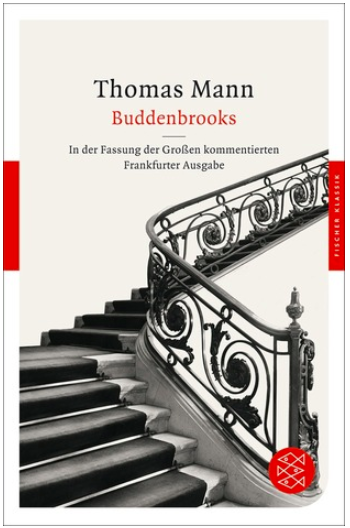
Buddenbrooks by Thomas Mann: A Family of German Trainwrecks


Having spent nearly three years in Germany, I thought it was time I really buckled down and tried to read some actual German literary classics. Published in 1901, Buddenbrooks is one of Thomas Mann's masterpieces and is inspired by the history of his own family.

The story begins in 1835, in a northern German city modeled after Mann's hometown of Lubeck. The Buddenbrook family is hosting a dinner party shortly after moving into their latest home, a large historic home sold by another merchant family whose fortunes have declined. We are introduced to the Buddenbrooks: Johann, a successful grain wholesaler (also known by his title, Consul), the older son of his father's second marriage. He and his wife Elisabeth have three children, Thomas, Christian, and Antonie, known as Tony. A second daughter will soon join the family, and there is a young ward, Klothilde, the child of a poor relation. Buddenbrooks traces the family over about 40 years, focusing on the three older children, tracing their successes and more often their failures throughout the 19th century.


It's quite a long book, divided into eleven parts (more than 700 pages in my edition). The first hundred pages or so were a bit slow, mostly just setting up the characters -- the entire first part is just the dinner party (told in great detail, including descriptions of the food). The three principals are fairly young and their story is mostly just about their education and misadventures. Things started to pick up for me in Part III when young Tony attracts an unwanted suitor called Herr Grunlich, a commercial agent from Hamburg. Tony only eighteen, but the family seems unfazed when this 32-year-old man starts hanging around their house. He doesn't seem discouraged even when Tony is openly rude to him, and to her dismay, offers her a proposal of marriage. Naturally, the family assumes Tony is too young to "know her own mind" and pressure her to accept, which made me want to throw something across the room.

What eventually follows is the first in a series of Bad Decisions by this family. It seems like they're doing the right thing at the time, but basically, all three of the elder children are on a slow, downward spiral, repeating mistakes over and over, both financially and in their personal lives. Essentially, they are a bunch of slow-moving trainwrecks. The plot of the storyline shifts back and forth, mainly concerned with Tony and her oldest brother Thomas, who has been groomed to take over the family business. (Younger brother Christian is a charming ne'er-do-well who makes occasional appearances to drag the family down even farther.)


I wouldn't have thought the story of a German merchant family would be so fascinating, but it absolutely was. After those first 100 pages I was completely hooked and could not stop reading it, and finished most of it in about three days. It's very much a long Victorian saga, as it's set up in multiple sections with mostly very short chapters. It absolutely felt as though it could have been serialized, though I believe it was published in a single volume. It also reminded me a bit of The Forsyte Saga by John Galsworthy.

I particularly enjoyed Mann's descriptions, especially of domestic life. Mann goes into surprising detail about the homes, decor, and fashions of the time, and there are a lot of descriptions of meals in this book. Here's a quote regarding a Sunday dinner attended by the suitor Herr Grunlich:

He ate mussel ragout, julienne soup, baked sole, roast veal with mashed potatoes and Brussels sprouts, maraschino pudding, and pumpernickel with Roquefort cheese -- and at each course he offered a new tribute appropriate to the delicacy. For example, raising his dessert spoon, he gazed at a statue woven into the wallpaper and said aloud to himself, "God forgive me, I can do no other; I've eaten a large serving, but this pudding is just too splendid. I simply must implore my hostess for a second helping. 

I suppose this is Mann's way of showing how bourgeois the family is, but I love food writing so that's one reason why I was hooked -- it's making me hungry just thinking about it. I did get really invested in the characters and would stop reading and yell at them when they made bad decisions. It will definitely be one of my top reads this year and now I can't wait to read Mann's other long saga, The Magic Mountain. Also, if you're looking for a copy, I highly recommend the 1993 edition translated by John E. Woods. I actually own a Vintage International copy that was translated back in 1924, but I didn't like it as much as the e-book version so ended up not reading my print copy at all.


I've also discovered that Buddenbrooks was adapted into a TV miniseries in 1979. Used copies are available on Amazon but they're really expensive, so hopefully I can get it from a library. It's available from Amazon.de for a mere 20 euros but I'm pretty sure that version doesn't have English subtitles.

I'm counting this as my Very Long Classic for the Back to the Classics Challenge.

Thursday, April 18, 2019

The Fortune of the Rougons: The Rougon-Macquart Origin Story


"A new dynasty is never founded without a struggle. Blood makes good manure. It will be a good thing for the Rougon family to be founded on a massacre, like many illustrious families." 

I had six unread Zola novels on my TBR shelves when Fanda announced her annual Zoladdiction readalong, and although I've been reading Zola for close to a decade, I still hadn't read the very first volume, The Fortune of the Rougons. 


Published in 1871 but set twenty years earlier, The Fortunes of the Rougons sets up the story of the three branches of the Rougon-Macquart family. The story begins on a cold December day in 1851, and a pair of teenage sweethearts meet in an abandoned lumber yard in the fictional town of Plassans (loosely modeled on the Provencal town of Aix). Silviere, aged 17, tells 13-year-old Miette that he is planning to join an uprising of Republicans who are resisting a coup d'etat by Napoleon III.

The book then jumps backward in time to describe the origins of the family: a young heiress, Adelaide Fouquet, inherited land from her insane father some years before, then shocked the town by marrying a peasant gardener, Rougon. A year later, she gave birth to a son, Pierre, but Rougon died soon after. The town was further scandalized when the young widow began an affair with a smuggler named Macquart, and though they never married, she bore two more children, Ursula and Antoine. So essentially the family is split along the three children: Pierre is the first of the bourgeois Rougons; the middle-class Mourets are Ursula's children by her marriage to a hatter; and the working-class Macquarts are the descendents of Antoine.


The eldest son, Pierre, manages to marry the daughter of an olive oil merchant, and when most of the action of the story takes place in 1851, he and his ambitious wife Felicite are trying to manipulate their way into the upper part of society and local politics. Felicite has a sort of salon in apartment, and her youngest son Pascal, a doctor, seems to stand in for Zola himself as he studies their Plassans cronies:

Pascal, to appease her, came and spent a few evenings in the yellow drawing room. He was much less bored than he feared. . . . [they] seemed like so many strange animals, which hitherto he had had no opportunity to study. He looked, with the fascination of a naturalist, at their grimacing faces, in which he discerned traces of their occupations and appetites. . . . At the time, he was greatly preoccupied with comparative natural history, applying to the human race the observations he had made on animals with regard to the workings of heredity. In the yellow drawing room, therefore, he was amused at the thought that he had accidentally wandered into a menagerie. He noted the similarities between the grotesque creatures he saw and certain animals he knew. The Marquis, with his leanness and sly look, reminded him very much of a long green grasshopper. Vuillet struck him as a pale, slimy toad. He was more indulgent towards Roudier and the Commander, a fat sheep and a toothless old mastiff. The fantastic Granoux, however, was a particular source of fascination. He spent a whole evening studying his facial angle. Whenever he heard him mutter some vague insult about bloodthirsty republicans, he expected him to moan like a calf; and he could never watch him rise from a chair without imagining that he was about to leave the room on all fours. (pp 88-89)

Pierre uses the political crisis after Napoleon's coup and the subsequent uprising to try and gain power in Plassans. Meanwhile, his illegitimate brother Antoine is trying to win back his portion of an inheritance he believes he is owed by Pierre. When we get back to young Silviere, it turns out he is a Mouret, the nephew of Antoine, who strongly influences his political beliefs. Poor Silviere gets tragically caught up in the resistance and with him young Miette; naturally, things don't end well.

I enjoyed this book, but I definitely enjoyed the sections of the family history and of the Macquarts better than the political and social machinations of the Rougons. Of the volumes I've read so far, I mostly prefer the stories based on the Macquarts. I'm not sure if it's because the Rougon stories tend to have more politics, which isn't my favorite subject, or because I think that the Macquart characters are just more vivid and interesting -- they're all a bunch of fascinating train wrecks.


Emile Zola

I normally don't read book series out of order, but back when I first started, many of the twenty volumes in the series didn't have recent English translations, and the original translations from the French done in Victorian times had significant cuts. Overall, twenty novels are generally chronological, but each book really stands on its own, and some of them are only very loosely connected. I'd read twelve of the series in no particular order when I finally read the first volume, and the other books in started to fit together in my mind like pieces of a jigsaw puzzle. (I was very grateful for the excellent family tree included in the book, though it does include dates of birth and death which are sort of spoiler.) I also found this great website, simply titled Rougon-Macquart Novels, with lots of background and information about the Rougon-Macquart series. It's great if you're having trouble keeping characters straight, how all the novels connect, or for me, the basic plots of the books I finished several years ago.

I've now completed thirteen of the twenty novels in the cycle, and look forward to completing the rest There's only one left in the series without a recent translation: the final novel, Doctor Pascal. But Oxford University Press has published new editions of almost every single Zola novel in the past ten or so years, so I'm confident a good translation is on the horizon.

I'm counting this as my Classic in Translation for the Back to the Classics Challenge, and for my book set in France for the European Reading Challenge.

Monday, April 30, 2018

Zoladdiction: A Love Story by Emile Zola (And a Giveaway!)


The trouble with polyreading is that when I jump around from book to book, it takes me forever to finish anything -- and then I have a pile of books to review! I finally finished another book by Emile Zola -- A Love Episode, the eighth book in his Rougon-Macquart series. I know it's the very end of the month, but I definitely wanted to finish this for the Zoladdiction readalong hosted by Fanda.

It's the story of Helene Grandjean, a young widow who is about thirty in the start of the novel. After the death of her husband, Helene and her young daughter Jeanne move to Passy (which is now part of the 16th Arrondissment of Paris, on the northwest side of the city). In the beginning of the novel, the sickly Jeanne has a life-threatening seizure, and the frantic Helene bangs on the door of her neighbor who is also her new landlord. Luckily, her new landlord is a physician, the handsome Dr. Deberle. He attends Jeanne and pulls her through the crisis, sitting by her bedside for hours with her mother.

During Jeanne's recovery, Helene and her daughter are often invited to the home of the Deberles and to spend time in their beautiful garden. Helene also spends time with some of the poor parishioners in the area, including a crafty old woman called Madame Fetu, who is also attended by Dr. Deberle. Helene and the doctor spend several days together after Mme Fetu falls ill, and they begin to form a bond.

Portrait of Emile Zola by Felix Vallotton

This becomes awkward as Helene is also friendly with Deberle's wife, the kind if somewhat flighty socialite Juliette. Helene struggles with her growing feelings for Deberle, and meanwhile her friend Abbe Jouve, the priest, is pressuring her to marry his brother, the faithful and patient Monsieur Rambaud. Meanwhile, her daughter Jeanne can sense something is happening between her mother and the doctor.

It's a good story, though not my favorite of the series. It's one of Zola's slower novels, and it's definitely a domestic drama. There are some lighter moments that I really enjoyed, especially with Helene's servant Rosalie, and her fiance, Zephyrin, who provide most of the comic relief of the novel. They were actually my favorite characters and I wish Zola had written more about them. 

A Love Episode is also a love letter to Paris. Helene spends a lot of time gazing at the view of the Paris from her apartment -- apparently she could see all of Paris, including the Seine, Les Invalides, and the Pantheon. It must have been a spectacular view, especially at night: 

In the dormant sea of blackness before them, there was a glimmer of light. It was below them, somewhere in the abyss, in a place they could not precisely identify. And one after the other the different lights started winking. They came to life at night with a sudden start, all at once, and remained there glittering like stars. It seemed as though there was a new rising of heavenly bodies on the surface of a dark lake. Soon there was a double row of them making a pattern which led from the Trocadero towards Paris in little leaps of light. Then other lines of luminous dots cut into that line, you could make out curves, a whole constellation that was getting larger, strange and magnificent. 


A Love Episode is the twelfth book I've completed in the Rougon-Macquart series -- so far I've read fourteen of his works altogether (the other two are Therese Raquin and The Attack on the Mill and Other Stories.) Compared to the rest of the series, it's pretty good, though not quite up to the quality of Germinal, L'Assommoir, or La Bete Humaine. However, I'd say it's definitely a good introduction to his work if you're looking for something shorter and slightly less intense.

And now for the giveaway! A couple of years ago, the nice people at Oxford World's Classics starting sending me copies of some of their new releases, mostly Zola (and thanks to Simon at Stuck in a Book for passing my name along.) Somehow I received two copies of A Love Story and so I'm going to share my good fortune and give away my extra copy! All you need to do is leave a comment below telling me why you want to read this book. The winner will be chosen in a completely unscientific manner -- I'm going to pick my favorite response, so be creative!

Guidelines for the drawing are as follows:

  • Winner must live in the United States or Europe (due to postage costs)
  • If your blog doesn't have an email link so I contact you, include an email in your comment 
  • The deadline to enter is 11:59 p.m. Western Europe Time Zone (GMT +1) on Monday, May 7.
I'm counting this as my Classic in Translation for the Back to the Classics Challenge.

Wednesday, March 14, 2018

Effi Briest: The German Emma Bovary, But Less Interesting


I had really high hopes for this book -- a classic book, in translation, and a German classic no less! I really want to read more German books in translation (of course I don't read the language well enough to read the originals.) Sadly, there just aren't that many German books translated into English -- I guess the proliferation of American and British books just makes it that much harder to get attention from the English-reading public.

Anyway. I had heard about this book years ago and this felt like the right time, as I'm now living in Germany and Persephone Books reprinted Effi Briest last year, though they don't often publish books written by men. I'd heard it was sort of a German version of Madame Bovary. Well, to be honest, it is and it isn't. This review includes spoilers, so stop now if you don't want to know what happens.

The book begins with Effi Briest, seventeen and unmarried, still very much a schoolgirl. She's basically playing in the yard one day when she receives a proposal of marriage from a civil servant, Geert Instettan, a man more than twice her age who was once in love with her mother.  No, that's not creepy AT ALL. (Of course he was about her mother's age and obviously too young, as Madame von Briest married a much older man).


Anyway, she's very young and he's basically middle-aged and serious. They move off to town on the Baltic coast (which actually sounds lovely) and after giving birth to a daughter, Effi becomes bored. Her head is turned by a military officer named Crampas and they have an affair, which is basically them going on rides and walks together in the dunes. Eventually, her husband is transferred to Berlin so the affair ends. Years later, Effi is visiting a spa for her health and her husband finds a bundle of letters from Crampas and the inevitable happens. Naturally it ends badly for Effi.

Somehow this book disappointed me. I suppose I was expecting it to be more like Emma Bovary, whom I found a fascinating train wreck, but this book just dragged. I don't know if it was the translation or the writing style, but it took me nearly a month to finish this book which is just over 300 pages. Effi was certainly a sympathetic character, but I really didn't get a sense of great passion for Crampas. It was all very matter-of-fact -- I was expecting more scandal or dramatic tension, I guess. Even the ending wasn't terribly dramatic. I haven't read much German literature but I do remember that the writings of Goethe caused such a sensation that young people were literally committing suicide after reading The Sorrows of Young Werther (which I did try to read a few years ago and just could not get through). 


I haven't given up on German literature yet -- I do have a copy of Thomas Mann's Buddenbrooks that looks interesting, though quite long. And recently I got completely hooked on the TV series Babylon Berlin which is set in 1929 -- I do love the time period between the wars, and I'm curious to learn more about the German perspective. It's based on a series of books and some of them have been translated into English, so I'll try to get my hands on a copy. (It's streaming in the U.S. on Netflix and it's really good, I highly recommend it). Can anyone recommend any other German books available in translation?

I'm counting this as my Classic By a New To Me Author for the Back to the Classics Challenge.

Thursday, March 16, 2017

The Wine of Solitude by Irene Nemirovsky


She loved studying and books, the way other people love wine for its power to make you forget. What else did she have? She in a deserted, silent house. The sound of her own footsteps in the empty rooms, the silence of the cold streets beyond the closed windows, the rain and snow, the early darkness, the green lamp beside her that burned throughout the long evenings and which she watched for hours on end until its light began to waver before her weary eyes; this was the setting for her life.

After her unpublished novel Suite Francaise was discovered in the early 2000s, many of Irene Nemirovsky's works were republished. I've read five of her books so far, and am so glad that they are getting the attention they deserve, because I've loved every one of them so far. My latest Nemirovsky read, The Wine of Solitude, is her most autobiographical work and was originally published in 1935. 

Born in the Ukraine in 1903, Helene Karol is a lonely child, ignored by her vain and shallow mother, and loved but dismissed by her absent father. After losing a job, he leaves the family for two years to manage a Siberian gold mine and winds up making a fortune in speculating. Gambling is his passion, whether it's the stock market or the roulette table. The only one who truly seems to love and care about her is her governess, Mademoiselle Rose. As Helene grows up, she sees how her father's gambling and her mother's infidelities are destroying them. She becomes a keen and sometimes reckless observer of the dynamic between her parents and her mother's younger cousin and lover, Max, who basically lives with them. 

She stopped, twiddled the pencil round in her hand and a cruel, shy smile spread across her face. It made her feel better to write these things down. No one paid any attention to her or cared about her. She could amuse herself in any way she pleased; she continued writing, barely pressing down on the pencil, but with a strange rapidity and dexterity she had never experienced before, an agility of thought that made her aware of what she was writing and what was taking shape in her mind simultaneously, so they suddenly coincided.

The family moves back and forth between Ukraine, France, Russia, then flee to Finland during the Russian Revolution. During the 1920s they return to Paris where things finally come to a tragic climax and Helene is forced to make a decision about her future. There are a lot of terrible mothers in Nemirovsky's works and if her childhood was anything like Helene's, I can understand why. 

This is book was both sad and beautifully written, and I really liked it. So far my favorites of her books are Suite Francaise and her excellent short story collection, Dimanche and Other Stories. I do want to read the rest of her works and fortunately most of them are available through Overdrive from my library's online catalog. There's also another short story collection that was published last year called In Confidence and it's available from Raglan Books, an independent publisher in Ireland and I've just ordered it. I was really trying to cut back on my book purchases this year but already I'm failing miserably.

I'm counting this as for my Classic in Translation for the Back to the Classics Challenge, and as my Ukrainian read for the European Reading Challenge. 

Sunday, March 12, 2017

The Dinner by Herman Koch


I've read hardly any contemporary fiction the last few years -- I looked back on my 2016 reading and I think I average only about a book a month that was published in the last ten years, and quite a few of those have been nonfiction. I think that reading the classics has sent me on a reading path where I keep finding so many older books and authors that I'll never catch up.

The Dinner was a huge hit when it was published a few years ago, but I never got around to reading it. However, I'm always intrigued by books in translation, and now that I'm living in Europe, I feel like I should read more Euro-centric reading, which is partly why I signed up for the European Reading Challenge. The base library has a decent selection which included this book (which I've actually checked out several times before I finally took a crack at it the other day.

I don't want to give away too much of the plot, as there are some pretty big reveals and twists in this book, as there are some real shockers. Set in Holland a couple of years ago, this is the story of two couples having dinner together, ostensibly to discuss their respective teenage sons and a particular troubling incident. Most of the action take place during one evening at an upscale restaurant, with a number of flashbacks, and we get a lot of insight into the narrator, Paul, and his family dynamic. It raises a lot of questions about parenting, marriage, and personal responsibility. This is definitely a book that I would love to discuss with someone but I don't want to reveal too much -- a major plot point was actually spoiled for me while I was searching for books set in the Netherlands. I thought that would ruin the book for me but there's so much going on it actually didn't, though I definitely would have preferred not knowing ahead of time.

It's not a very long book, but there's a lot happening, some of it quite shocking. It's one of those books like Gone Girl or Girl on the Train that would be great for a book discussion group (though it's definitely far superior and more plausible than either of those.) Once I got started, I could hardly put it down because I needed to find out what happened, and I was easily able to finish it in a few hours. However, once I was done I wanted to return it to the library right away because it made me really uncomfortable having it around. How far should people go to protect their children, and where do you draw the line at personal responsibility? This book was really insightful in parts, but it's also quite disturbing. However, I am glad that I read it.

I'm counting this as my book set in the Netherlands for the European Reading Challenge.

Monday, March 6, 2017

Skylark by Dezso Kostolanyi


I'm a big fan of NYRB Classics -- they are really attractive and I'm always a fan of re-discovered classics. Skylark by Deszo Kostolanyi is one that had been on my to-read list for several years, and I was determined to read it this year because it dovetailed perfectly with the European Reading Challenge. 

Written in 1924 but set just before the turn of the century, Skylark is the story of a family living in a small Austro-Hungarian town called Sarszeg (inspired by Kostolanyi's own hometown of Szabadka, in which is now present-day Serbia). It's a dead-end place where not much happens. The Akos family consists of a husband and wife, Akos and Antonia, and their 35-year old spinster daughter, nicknamed Skylark. Akos is in his late fifties and is retired, spending much of his time researching ancient lineages and family histories. Skylark does most of the cooking and housework, and basically life revolves around her. Life is dull and routine, but one week in late summer 1899, Skylark takes the train to visit family for a week, and Akos and Antonia are left on their own.

This is another one of those book in which not much happens -- and yet, everything happens. Without Skylark, Akos and Antonia do things they haven't done in years. They eat out in restaurants and attend a performance in the theater, which never happens when Skylark is around, since she her cooking is better than any restaurant meal. Akos visits his gentleman's club, drinks, smokes cigars, and plays cards with his cronies -- before, Skylark wouldn't have approved.  Antonia plays the piano, which has barely been touched in years, since Skylark never really took to playing.

This description makes it sound like Skylark is some kind of tyrant, but I don't think she is. Kostolanyi is up-front about the fact that Skylark is a spinster because she's unattractive, which is why she's never married. While she's away from her parents, all three of them face some painful truths about themselves and their relationship, and I really found it rather sad, especially because that was an era when women had so few choices. Skylark is educated and hardworking, and in another time, she could have had a career -- even 15 years later, she could have been a nurse and served during WWI.

The publisher described this book as magical but I just found it really sad.

I'm counting this as my Hungarian read for the European Reading Challenge.

Wednesday, February 22, 2017

Kristin Lavransdatter, Volume I: The Wreath by Sigrid Undset

The cover art of this edition is just beautiful -- anyone know the name of the painting?
In the past couple of years, I've been quite fascinated with Scandinavia -- a co-worker at the library got me hooked on Scandinavian TV series (I started with Bron/Broen, then quickly moved on to Borgen and Arvingerne). Watching these great dramas has inspired me to read more Scandinavian literature, so I chose a Norwegian classic for the Back to the Classics Challenge.

In 1920,  Sigrid Undset published the first novel in the Kristin Lavransdatter series, Volume I: The Wreath. Set in Norway during the Middle Ages, about 1300, The Wreath is the story of a young woman's coming of age. Though she wrote contemporary books as well, Undset won the Nobel Prize for literature in 1928 primarily for this trilogy. I'm always looking for interesting books in translation, and Nobel prize winner made this a win-win selection for me.

The story starts out with Kristin as a young girl and oldest surviving child of her father Lavrans (hence her surname, Lavransdatter, which literally means Lavran's daughter; at that time, Norwegians used the patronymic naming system which is still in use in Iceland today). Kristin's parents have lost three young sons, so she is the great hope of the family. They assume she will marry well and when she is fifteen, she is betrothed to Simon, the son of a neighboring landowner. After a tragedy, she is sent to a convent school for a year, where she falls in love with the dark and dangerous Erlend, a handsome man with a bad reputation. The majority of the book is about Kristin's struggles between following her heart and disappointing her parents or pleasing everyone by marrying a man she doesn't love. Kristin also struggles with the moral implications of Erlend's past and her involvement with him. She's been raised as a devout Catholic and often turns to the priests for moral guidance, which she doesn't always follow.

This cover is from On the Plain by Erek Werenskiold
This book was written nearly a hundred years ago, and I was surprised at how frankly Undset wrote about some of the issues that Kristin was facing -- there's a lot of discussion about Kristin's virginity, children born out of wedlock, and even priests with illegitimate children. Undset was writing in the early 1920s when the role of women worldwide was really changing; I'll have to do more research but I'm pretty sure this book must have been quite controversial.

I read the Penguin classics version which was newly translated in 2005, and I found it a very easy read. It did start a bit slowly in Kristin's childhood, but once she got betrothed to Simon, the plot really started moving and I finished it very quickly. I've always enjoyed historical fiction but I've read very few books set in the Medieval period. Undset did a lot of research and her descriptions of life in the period are excellent. Parts of it actually reminded me a bit of Game of Thrones, especially life in Winterfell (but without the dragons and White Walkers). I definitely want to read the next two books in the series, The Wife and The Cross. I really hadn't been planning on starting another book series (I still haven't finished the last two books in the Poldark series) but Undset really brought Kristin and her world to life. Luckily they're available as free digital downloads from my library so I may just zip right through them.

I'm counting this as my Award-Winning Classic for the Back to the Classics Challenge and also as my Norwegian read for the European Reading Challenge.

Wednesday, January 4, 2017

2017 European Reading Challenge


I wasn't going to sign up for any challenges this year (other than my own challenge, of course!) but I found this great European Reading Challenge hosted by Rose City Reader. Basically, it's to encourage bloggers to read books set all over Europe -- a literary Grand Tour! I'm signing up for the Five Star (Deluxe Entourage) level, which is books from five different European authors or set in different countries. This is perfect because I'm always trying to read books from another perspective, especially now that I'm living in Europe.

I'm going to mix up both new and classic books, fiction, and non-fiction as well. Here are some possible books and authors:


Austria: 
Beware of Pity by Stefan Zweig
Complete Short Stories by Stefan Zweig
The Exiles Return by Elisabeth de Waal

Belgium: 
Amelie Nothom
Georges Simenon

Czech Republic:
I Served the King of England by Bohumil Hrabal


Denmark: 
We, The Drowned by Carsten Jensen

Finland:
Fair Play by Tove Jansson

France: 
The Misunderstanding by Irene Nemirovsky
La Debacle by Emile Zola


Germany: 
Alone in Berlin by Hans Fallada
Effie Briest by Theodor Fontane
Three Men on the Bummel by Jerome K. Jerome

Hungary: 
Embers by Sandor Marai

Iceland: 
Inspector Erlandur mysteries by Arnaldur Indradason
Independent People by Haldor Laxness


Ireland: 
The Country Girls by Edna O'Brien
Troubles by J. G. Ballard

Italy: 
Alfa Romeo 1300 and Other Miracles by Fabio Bartolomeo
Pictures from Italy by Charles Dickens
I Promessi Sposi by Alessandro Manzoni
The Passion by Jeannette Winterson


Netherlands: 
Hans Brinker by Mary Mapes Dodge
The Dinner by Herman Koch

Norway: 
The Wreath by Sigrid Undset

Poland: 
The Zookeeper's Wife by Diane Ackerman

Russia:
The Hottest Dishes of the Tartar Cuisine by Alina Bronsky


Serbia:
Skylark by Deszo Kosztolanyi

Spain: 
The Time in Between by Maria Duenas

Sweden: 
Camilla Lackberg mysteries

Switzerland:
Hotel du Lac by Anita Brookner
The Magic Mountain by Thomas Mann

UK: 
London Belongs to Me by Norman Collins
The Claverings by Anthony Trollope

Of course there's no way I'll read all of these but I'd like to finish at least ten for the challenge. I can overlap with my own challenge so hopefully I'll read some more European literature.

Bloggers, have you read any of these? And do you have any more suggestions for books from different European countries?