Showing posts with label Back to the Classics 2019. Show all posts

Tuesday, January 7, 2020

Back to the Classics 2019: The Winner!


And the winner of the Back to the Classics Challenge 2019 is.  .  .  . 


Ruthiella @ Booked For Life !!!!!!


Ruthiella won a $30 gift card from Amazon.com! Congratulations! And many thanks and congratulations to everyone who participated in this challenge -- more than 150 people signed up, and 43 people completed the challenge. 

And every one of us crossed some classic books off our to-read lists! I hope everyone enjoyed all the new books and authors they discovered. I hope all everyone has signed up for the 2020 Back to the Classics Challenge, can't wait to see what everyone else is reading! 

Later this week I'll add the link-up posts so you can add your reviews and see what everyone else is reading. Thanks again to everyone for participating!

Friday, December 13, 2019

Back to the Classics Challenge 2019: Final Wrap-Up Posts


Have you finished the Back to the Classics Challenge?  Congratulations!  This is where you'll link up to your Challenge Wrap-Up Post, after you've completed a minimum of six different categories from the original challenge post.  This post is only for Challenge Wrap-Up Posts.  If you do not have a blog, or anywhere you post publicly, please write up your post-challenge thoughts/suggestions/etc in the comments section below.  Please read the directions carefully. 

By linking or commenting here, you are declaring that you have completed the challenge; that each book reviewed fits the correct definition of the category, and was published before 1969 (except for posthumous publications); and that your reviews for each category are linked to the correct post. If I cannot find links to your reviews, I cannot give you credit and thus enter you into the drawing.  THIS is where I will look at the end of the year and randomly choose the winner for the bookish prize. 


Please remember to indicate the following within THIS POST, linked below, or in the comments section below if you do not have your own blog:


1. Which book corresponds to each category;

2. The number of entries you have earned for the prize drawing; 
3. Links to your reviews. 

If you do NOT include links to your original reviews IN THIS POST, I CANNOT ENTER YOU INTO THE DRAWING.


Remember:


  • If you've completed six categories and you get one entry.
  • Complete nine categories, and you get two entries.
  • Complete all twelve categories, and your name is entered into the drawing three times!
UPDATED, VERY IMPORTANT: 
Please be sure and include some kind of contact for me within your final wrap-up post. This year, I will be contacting the winner privately BEFORE posting their name publicly on this blog. If I cannot contact you, I cannot award your prize. If there is no contact on your blog post, please email me at karenlibrarian13 [at] yahoo [dot] com. 

LATEST UPDATE: It looks like I can also message the winner via Goodreads, so if you are posting reviews via your Goodreads account, I can contact you that way also. Thanks to Rachel for suggesting it!

Congratulations, and thanks again for participating in the Back to the Classics Challenge!

Sunday, May 5, 2019

The Artificial Silk Girl: A 1930s German Train Wreck


Back-to-back train wrecks! I can't remember who blogged about it, but just a couple of weeks ago I saw that Penguin was re-issuing a new edition of The Artificial Silk Girl by Irmgard Keun. I'd never heard of it, but the description said it was a bestseller in 1931 and subsequently banned by the Nazis, so, naturally I was intrigued and ordered a copy from Amazon.de. And for once, I actually didn't wait around several years before I read it! (The fact that it is only 144 pages may have contributed somewhat.)

So here's the setup: young Doris is a young German woman living in the Rhineland, but longing for excitement. She's working as a typist and living with her mother and stepfather, but dreams of a career on the stage -- preferably in a big city. She manages to finagle her way onstage as an extra in a local play, and even gets a single spoken line. It looks like she actually might achieve her dream but then a bad decision catches up with her; she then steals a fur coat left on one of the theater seats by a neighbor (for whom she has a longstanding hatred) and leaves town on an overnight train to Berlin in a panic.  

Doris manages to crash at an old friend's apartment temporarily, but she can't get work papers because the police might be looking for her due to the theft. She's living hand to mouth, depending on sympathetic men she picks up in bars to buy her food and drinks. Basically, she's looking for a rich man to support her, she doesn't care if it's as a wife or a mistress. Things naturally don't work out as planned and she sinks lower and lower. Yep, another train wreck.


The blurb on the book jacket describes this book as "very funny and intensely moving," but I didn't find it a bit funny -- I just thought it was tragic and sad. I didn't care much for Doris but I did find her plight horrifying -- I remember what it was like when I was first on my own, struggling to pay the bills (though I never went hungry and was threatened by homelessness like Doris). I know there were a lot of desperate people in Germany after the war, and the cold and the Depression meant so many people were in dire straits. 

Though The Artificial Silk Girl wasn't exactly what I expected, it was an interesting perspective to read about, especially since Keun lived through it first-hand. She was born in 1905, so she was about the same age as Doris when she wrote this, and probably knew people very much like her. 

Some of the descriptions of The Artificial Silk Girl also mention that Keun was inspired by Anita Loos' Gentlemen Prefer Blondes to write her own story about a young woman trying to make it on her own, which inspired me to track down a copy of Loos' novella. The two books couldn't be more different and I'll be posting on that one shortly. I've also heard it's more like Christopher Isherwood's Berlin Stories, one of which was adapted for the stage as I Am a Camera -- which I read just a few months ago. Doris is definitely closer to Sally Bowles than Lorelei Lee. 


If you're interested in Berlin in the late 1920s and early 1930s I highly recommend the Babylon Berlin TV miniseries which was a huge success. It's more of a historical crime series but one of the characters reminds me a bit of Doris, and there are several scenes set in Berlin nightclubs, plus you definitely get the sense of desperation and the dark underbelly of Berlin society. The first two seasons are available in the U. S. on Netflix, and apparently there's a third in the works. (You can watch it either with the original German and English subtitles, or dubbed into English -- I much prefer the subtitles). It's based on a series of German books by Volker Kutscher, some which have been translated into English. I read the first volume last year but this is one of the few instances in which I actually preferred the TV adaptation to the book. 

I'm counting this as my Classic From A Place You've Lived for the Back to the Classics Challenge

Thursday, May 2, 2019

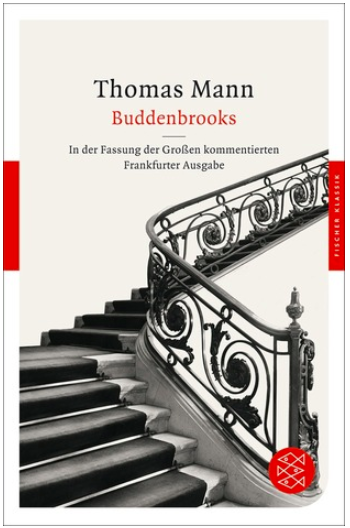
Buddenbrooks by Thomas Mann: A Family of German Trainwrecks


Having spent nearly three years in Germany, I thought it was time I really buckled down and tried to read some actual German literary classics. Published in 1901, Buddenbrooks is one of Thomas Mann's masterpieces and is inspired by the history of his own family.

The story begins in 1835, in a northern German city modeled after Mann's hometown of Lubeck. The Buddenbrook family is hosting a dinner party shortly after moving into their latest home, a large historic home sold by another merchant family whose fortunes have declined. We are introduced to the Buddenbrooks: Johann, a successful grain wholesaler (also known by his title, Consul), the older son of his father's second marriage. He and his wife Elisabeth have three children, Thomas, Christian, and Antonie, known as Tony. A second daughter will soon join the family, and there is a young ward, Klothilde, the child of a poor relation. Buddenbrooks traces the family over about 40 years, focusing on the three older children, tracing their successes and more often their failures throughout the 19th century.


It's quite a long book, divided into eleven parts (more than 700 pages in my edition). The first hundred pages or so were a bit slow, mostly just setting up the characters -- the entire first part is just the dinner party (told in great detail, including descriptions of the food). The three principals are fairly young and their story is mostly just about their education and misadventures. Things started to pick up for me in Part III when young Tony attracts an unwanted suitor called Herr Grunlich, a commercial agent from Hamburg. Tony only eighteen, but the family seems unfazed when this 32-year-old man starts hanging around their house. He doesn't seem discouraged even when Tony is openly rude to him, and to her dismay, offers her a proposal of marriage. Naturally, the family assumes Tony is too young to "know her own mind" and pressure her to accept, which made me want to throw something across the room.

What eventually follows is the first in a series of Bad Decisions by this family. It seems like they're doing the right thing at the time, but basically, all three of the elder children are on a slow, downward spiral, repeating mistakes over and over, both financially and in their personal lives. Essentially, they are a bunch of slow-moving trainwrecks. The plot of the storyline shifts back and forth, mainly concerned with Tony and her oldest brother Thomas, who has been groomed to take over the family business. (Younger brother Christian is a charming ne'er-do-well who makes occasional appearances to drag the family down even farther.)


I wouldn't have thought the story of a German merchant family would be so fascinating, but it absolutely was. After those first 100 pages I was completely hooked and could not stop reading it, and finished most of it in about three days. It's very much a long Victorian saga, as it's set up in multiple sections with mostly very short chapters. It absolutely felt as though it could have been serialized, though I believe it was published in a single volume. It also reminded me a bit of The Forsyte Saga by John Galsworthy.

I particularly enjoyed Mann's descriptions, especially of domestic life. Mann goes into surprising detail about the homes, decor, and fashions of the time, and there are a lot of descriptions of meals in this book. Here's a quote regarding a Sunday dinner attended by the suitor Herr Grunlich:

He ate mussel ragout, julienne soup, baked sole, roast veal with mashed potatoes and Brussels sprouts, maraschino pudding, and pumpernickel with Roquefort cheese -- and at each course he offered a new tribute appropriate to the delicacy. For example, raising his dessert spoon, he gazed at a statue woven into the wallpaper and said aloud to himself, "God forgive me, I can do no other; I've eaten a large serving, but this pudding is just too splendid. I simply must implore my hostess for a second helping. 

I suppose this is Mann's way of showing how bourgeois the family is, but I love food writing so that's one reason why I was hooked -- it's making me hungry just thinking about it. I did get really invested in the characters and would stop reading and yell at them when they made bad decisions. It will definitely be one of my top reads this year and now I can't wait to read Mann's other long saga, The Magic Mountain. Also, if you're looking for a copy, I highly recommend the 1993 edition translated by John E. Woods. I actually own a Vintage International copy that was translated back in 1924, but I didn't like it as much as the e-book version so ended up not reading my print copy at all.


I've also discovered that Buddenbrooks was adapted into a TV miniseries in 1979. Used copies are available on Amazon but they're really expensive, so hopefully I can get it from a library. It's available from Amazon.de for a mere 20 euros but I'm pretty sure that version doesn't have English subtitles.

I'm counting this as my Very Long Classic for the Back to the Classics Challenge.

Thursday, April 18, 2019

The Fortune of the Rougons: The Rougon-Macquart Origin Story


"A new dynasty is never founded without a struggle. Blood makes good manure. It will be a good thing for the Rougon family to be founded on a massacre, like many illustrious families." 

I had six unread Zola novels on my TBR shelves when Fanda announced her annual Zoladdiction readalong, and although I've been reading Zola for close to a decade, I still hadn't read the very first volume, The Fortune of the Rougons. 


Published in 1871 but set twenty years earlier, The Fortunes of the Rougons sets up the story of the three branches of the Rougon-Macquart family. The story begins on a cold December day in 1851, and a pair of teenage sweethearts meet in an abandoned lumber yard in the fictional town of Plassans (loosely modeled on the Provencal town of Aix). Silviere, aged 17, tells 13-year-old Miette that he is planning to join an uprising of Republicans who are resisting a coup d'etat by Napoleon III.

The book then jumps backward in time to describe the origins of the family: a young heiress, Adelaide Fouquet, inherited land from her insane father some years before, then shocked the town by marrying a peasant gardener, Rougon. A year later, she gave birth to a son, Pierre, but Rougon died soon after. The town was further scandalized when the young widow began an affair with a smuggler named Macquart, and though they never married, she bore two more children, Ursula and Antoine. So essentially the family is split along the three children: Pierre is the first of the bourgeois Rougons; the middle-class Mourets are Ursula's children by her marriage to a hatter; and the working-class Macquarts are the descendents of Antoine.


The eldest son, Pierre, manages to marry the daughter of an olive oil merchant, and when most of the action of the story takes place in 1851, he and his ambitious wife Felicite are trying to manipulate their way into the upper part of society and local politics. Felicite has a sort of salon in apartment, and her youngest son Pascal, a doctor, seems to stand in for Zola himself as he studies their Plassans cronies:

Pascal, to appease her, came and spent a few evenings in the yellow drawing room. He was much less bored than he feared. . . . [they] seemed like so many strange animals, which hitherto he had had no opportunity to study. He looked, with the fascination of a naturalist, at their grimacing faces, in which he discerned traces of their occupations and appetites. . . . At the time, he was greatly preoccupied with comparative natural history, applying to the human race the observations he had made on animals with regard to the workings of heredity. In the yellow drawing room, therefore, he was amused at the thought that he had accidentally wandered into a menagerie. He noted the similarities between the grotesque creatures he saw and certain animals he knew. The Marquis, with his leanness and sly look, reminded him very much of a long green grasshopper. Vuillet struck him as a pale, slimy toad. He was more indulgent towards Roudier and the Commander, a fat sheep and a toothless old mastiff. The fantastic Granoux, however, was a particular source of fascination. He spent a whole evening studying his facial angle. Whenever he heard him mutter some vague insult about bloodthirsty republicans, he expected him to moan like a calf; and he could never watch him rise from a chair without imagining that he was about to leave the room on all fours. (pp 88-89)

Pierre uses the political crisis after Napoleon's coup and the subsequent uprising to try and gain power in Plassans. Meanwhile, his illegitimate brother Antoine is trying to win back his portion of an inheritance he believes he is owed by Pierre. When we get back to young Silviere, it turns out he is a Mouret, the nephew of Antoine, who strongly influences his political beliefs. Poor Silviere gets tragically caught up in the resistance and with him young Miette; naturally, things don't end well.

I enjoyed this book, but I definitely enjoyed the sections of the family history and of the Macquarts better than the political and social machinations of the Rougons. Of the volumes I've read so far, I mostly prefer the stories based on the Macquarts. I'm not sure if it's because the Rougon stories tend to have more politics, which isn't my favorite subject, or because I think that the Macquart characters are just more vivid and interesting -- they're all a bunch of fascinating train wrecks.


Emile Zola

I normally don't read book series out of order, but back when I first started, many of the twenty volumes in the series didn't have recent English translations, and the original translations from the French done in Victorian times had significant cuts. Overall, twenty novels are generally chronological, but each book really stands on its own, and some of them are only very loosely connected. I'd read twelve of the series in no particular order when I finally read the first volume, and the other books in started to fit together in my mind like pieces of a jigsaw puzzle. (I was very grateful for the excellent family tree included in the book, though it does include dates of birth and death which are sort of spoiler.) I also found this great website, simply titled Rougon-Macquart Novels, with lots of background and information about the Rougon-Macquart series. It's great if you're having trouble keeping characters straight, how all the novels connect, or for me, the basic plots of the books I finished several years ago.

I've now completed thirteen of the twenty novels in the cycle, and look forward to completing the rest There's only one left in the series without a recent translation: the final novel, Doctor Pascal. But Oxford University Press has published new editions of almost every single Zola novel in the past ten or so years, so I'm confident a good translation is on the horizon.

I'm counting this as my Classic in Translation for the Back to the Classics Challenge, and for my book set in France for the European Reading Challenge.

Thursday, March 21, 2019

Gone With the Wind: Problematic, But Still Wonderful

The lovely 75th Anniversary edition.

Possibly the ultimate in Big Fat American Novels, I first read Gone With the Wind as a youngster, in the sixth grade; I'd seen the movie when it first aired on network TV in the 1970s, which was a huge television event. I've since read it at least a dozen times but it has been at least 20 years since my previous re-read. I did get a lovely hardcover edition as a holiday gift a few years ago but never got around to re-reading it until recently, inspired by  by the GWTW Readalong hosted by The Book Corps and by another recent read, Margaret Mitchell's "Gone With the Wind Letters," which I finished for the TBR Pile Challenge. 

As nearly everyone knows, GWTW was published in 1936 and was a runaway best-seller, and was adapted into the most successful movie of all time. The novel is more than 1000 pages long, but basically, GWTW chronicles the story of fiery Georgia debutante Scarlett O'Hara during the American Civil War and Reconstruction, and her undying love for the dreamy blond and bookish Ashley Wilkes. To Scarlett's chagrin Ashley marries his cousin, the sweet, saintly Melanie Hamilton, so in a fit of pique, Scarlett marries Melanie's brother, the shy Charles. Scarlett and Melanie are thus tied together during and after the War, and Scarlett must use her wits and bravery for them to survive, along with the O'Hara family's plantation, Tara. Scarlett also has a love-hate relationship with the dashing profiteer and scoundrel Rhett Butler, in what is one of American literature's greatest tragic love stories. 

It's always really hard for me to re-visit a favorite book from my childhood -- what if it doesn't stand up the test of time? Some books are just as good or even better (like To Kill a Mockingbird) and some are truly disappointing. For me, GWTW was a really mixed re-read. As always, I find the characters indelible and the story of spunky Scarlett so compelling -- she truly is a feminist icon. However, reading it decades later, I was constantly aware of the more problematic aspects of the book. Mitchell depicts the African-American characters as mostly lovable but childlike and easily manipulated by those terrible Yankees (with the exception of Mammy); also, it definitely perpetuates the romanticized, racist version of The Good Old South in which white people know best and all the African-Americans are happy and well-cared for, glossing over the fact that all the rich white folks are living off wealth accumulated by the suffering of generations of slaves. 

The same mass-market paperback edition as I read in 6th grade. 
Mine is equally tattered, I'm sure it's still packed away somewhere in storage. 

There's also lot of usage of the n-word and variations which made me really uncomfortable. Ashley Wilkes is the only character who seems to think Emancipation is a good idea and he's depicted as a dreamy and unrealistic. Scarlett is a feminist and I'm always rooting for her survival, but she is NOT a nice character -- she's really selfish and self-centered, and often cruel. Also, sometimes Mitchell's prose is a little flowery, and there are passages in which she digresses with battle scenes and background of Reconstruction history that definitely romanticize the white Southerners as victims. Um, no. 

However, it's a fascinating story with a great plot and great characters, and I found myself really enjoying the re-read, despite all my issues with the book. (Scarlett is definitely what I would call a fascinating train wreck). I still wish I knew what happened to Scarlett and Rhett Butler. Sadly, Mitchell never wrote a sequel nor left any hints about their fate before her untimely death in 1949.  It is a great, sprawling historical epic and I do still love it, despite its flaws.

 I'm counting it as my 20th Century Classic for the Back to the Classics Challenge

Friday, January 25, 2019

The Wife by Sigrid Undset: Kristin Lavransdatter, Vol. II


Two years ago I read the first volume of the Kristin Lavransdatter trilogy (The Wreath) for the Back to the Classics Challenge, and I really enjoyed it.  I'd been meaning to complete the series so I decided on the second volume, The Wife, for this years' challenge. [Note: minor spoilers for the first volume are in this post].

The Wife covers about fifteen years, immediately following Kristin's marriage at the end of the first book, as Kristin and Erland adjust to married life, and Kristin begins managing Erland's estate, which has fallen into disrepair during his long absence. She bears his children and he becomes involved in political intrigues regarding the child king Magnus and his mother Ingebjorg, the Queen Regent, who are now ruling over Norway and Sweden. We also meet Erland's brother, a priest; and learn the fate of Kristin's parents and younger sister, as well as her former suitor, Simon. 

This volume was a little slower for me -- there was a lot more emphasis on religion and politics. The politics in particular were more difficult, as I found the names hard to keep straight. I thought about researching the history, but realized it mind end up spoiling the plot -- plus there's a third volume, so I decided to wait. I did read the introduction after I finished the book (which did have spoilers, so good thing I waited). There was a LOT of Norwegian history which was very condensed and I got even more confused. 

I did really enjoy learning about life in Medieval Norway. I love historical fiction, though I tend to read more about the 18th through the early 20th century. However, it did bother me how much Catholic guilt Kristin was suffering regarding the circumstances of her marriage, which seemed to recur over and over -- I get that the Church was incredibly influential, but it seemed like she was beating herself up about it constantly. 

The last third of the book has some political intrigue that seemed right out of Game of Thrones -- I could definitely picture this as an HBO series, though I suppose it's basically just been done, but with dragons. There was a plot twist with Erland's fate that I wasn't expecting. And now on to Volume III which covers the Black Death! I definitely won't wait as long between reading the last two volumes -- I had forgotten quite a few details in the gap between the first two.  

I'm counting this as my Classic by a Woman Author for the Back to the Classics Challenge. 

Saturday, January 5, 2019

Challenge Link-Up Post: Classic Play


Please link your reviews for the Classic Play here. This is only for the Classic Play category. This includes any play that was written or performed at least 50 years ago. Plays are eligible in this category only.

If you do not have a blog, or somewhere public on the internet where you post book reviews, please write your mini-review/thoughts in the comments section. If you like, you can include the name of your blog and or/the title of the book in your link, like this: " Karen K. @ Books and Chocolate (A Raisin in the Sun)."

Challenge Link-Up Post: Classic From a Place You've Lived


Please link your reviews for the Classic From a Place You've Lived here. This is only for the Classics From a Place You've Lived category. This includes any classic set in a city, county, state, or country in which you've lived, or by a local author. Examples for me would include Giant by Edna Ferber (Texas); Sister Carrie by Theodore Dreiser (Chicago); and Buddenbrooks by Thomas Mann (Germany).

If you do not have a blog, or somewhere public on the internet where you post book reviews, please write your mini-review/thoughts in the comments section. If you like, you can include the name of your blog and or/the title of the book in your link, like this: " Karen K. @ Books and Chocolate (Cross Creek)."

Challenge Link-Up Post: Classic From Africa, Asia or Oceania


Please link your reviews for the Classic From Africa, Asia, or Oceania (includes Australia) here.  This is only for the Classics From Africa, Asia, or Oceania category. This includes any classic set in Africa, Asia, Oceania, or Australia, or by an author originally from one of those countries. Examples include Palace Walk by Naguib Mahfouz (Egypt); The Makioka Sisters by Junichiro Tanizaki (Japan); and On the Beach by Nevil Shute (Australia). 

If you do not have a blog, or somewhere public on the internet where you post book reviews, please write your mini-review/thoughts in the comments section. If you like, you can include the name of your blog and or/the title of the book in your link, like this: " Karen K. @ Books and Chocolate (Things Fall Apart). 

Challenge Link-Up Post: Classic From the Americas or Caribbean


Please link your reviews for the Classic From the Americas or Caribbean here. This is only for the Classics From the Americas or Caribbean category. This includes any classic set in either North or South America or the Caribbean, or by an author originally from one of those countries. Examples include Their Eyes Were Watching God by Zora Neale Hurston (United States); Wide Sargasso Sea by Jean Rhys (Jamaica); or One Hundred Years of Solitude (Columbia/South America). 

If you do not have a blog, or somewhere public on the internet where you post book reviews, please write your mini-review/thoughts in the comments section. If you like, you can include the name of your blog and or/the title of the book in your link, like this: " Karen K. @ Books and Chocolate (In Patagonia). 


Challenge Link-Up Post: Classic Novella


Please link your reviews for your Classic Novella here. This is only for the Classic Novella category. This includes any single work of narrative fiction shorter than 250 pages. 
   
If you do not have a blog, or somewhere public on the internet where you post book reviews, please write your mini-review/thoughts in the comments section.  If you like, you can include the name of your blog and/or the title of the book in your link, like this: "Karen K. @ Books and Chocolate (Ethan Frome)." 


Challenge Link-Up Post: Very Long Classic


Please link your reviews for your Very Long Novel Here here. This is only for the Very Long Novel category.  This category is classic single work 500 pages or longer, not including introductions or end notes. Omnibus editions of multiple works do not count. Since page counts can vary depending on the edition, average the page count of various editions to determine the length.
   
If you do not have a blog, or somewhere public on the internet where you post book reviews, please write your mini-review/thoughts in the comments section.  If you like, you can include the name of your blog and/or the title of the book in your link, like this: "Karen K. @ Books and Chocolate (War and Peace)." 


Challenge Link-Up Post: Classic Tragic Novel


Please link your reviews for your Classic Tragic Novel here.  This is only for the Classic Tragic Novel category. This is basically any novel with a tragic or sad ending. 
   
If you do not have a blog, or somewhere public on the internet where you post book reviews, please write your mini-review/thoughts in the comments section.  If you like, you can include the name of your blog and/or the title of the book in your link, like this: "Karen K. @ Books and Chocolate (Jude the Obscure)." 


Challenge Link-Up Post: Classic Comic Novel


Please link your reviews for your Classic Comic Novel here.  This is only for the Classic Comic Novel category. This can be any novel that is humorous or satirical; since humor is subjective, it's up to the reader to decide. If you think Crime and Punishment is funny, go ahead and use it, but please explain why in your post.
   
If you do not have a blog, or somewhere public on the internet where you post book reviews, please write your mini-review/thoughts in the comments section.  If you like, you can include the name of your blog and/or the title of the book in your link, like this: "Karen K. @ Books and Chocolate (Three Men in a Boat)." 


Challenge Link-Up Post: Classic in Translation


Please link your reviews for your Classic in Translation here.  This is only for the Classic in Translation category.  These should all be classics that were originally written in a language other than your primary language; that is, if you are a native English speaker, it should be a classic written in another language other than English.  If you are not a native English speaker, it could be in English (or any other language, other than your primary language). If you want to read the book in its original language, that's fine too!

If you do not have a blog, or somewhere public on the internet where you post book reviews, please write your mini-review/thoughts in the comments section.  If you like, you can include the name of your blog and/or the title of the book in your link, like this: "Karen K. @ Books and Chocolate (Les Miserables)."


Challenge Link-Up Post: Classic by a Woman Author


Please link your reviews for your Classic by a Woman Author here.  This is only for the Classic by a Woman Author category.  If you do not have a blog, or somewhere public on the internet where you post book reviews, please write your mini-review/thoughts in the comments section. If you like, you can include the name of your blog and/or the title of the book in your link, like this: "Karen K. @ Books and Chocolate (Jane Eyre)."

Challenge Link-Up Post: 20th Century Classic


Please link your reviews for your 20th Century Classic here.  This is only for the 20th Century Classic category.  All books in this category must have been published between 1900 and 1969 to qualify as classics (except for posthumous publications.  If you do not have a blog, or somewhere public on the internet where you post book reviews, please write your mini-review/thoughts in the comments section.  If you like, you can include the name of your blog and/or the title of the book in your link, like this: "Karen K. @ Books and Chocolate (The Grapes of Wrath)."

Challenge Link-Up Post: 19th Century Classic


Please link your reviews for your 19th Century Classic here.  This is only for the 19th Century Classic category.  All books in this category must have been published from 1800 to 1899.   If you do not have a blog, or somewhere public on the internet where you post book reviews, please write your mini-review/thoughts in the comments section.  If you like, you can include the name of your blog and/or the title of the book in your link, like this: "Karen K. @ Books and Chocolate (Cranford)."

Thursday, December 20, 2018

Back to the Classics 2019: My List


I don't think I've ever completed my exact list for this challenge, but here goes! As usual, I'm trying to read as many books as possible from my own unread shelves. I'm also trying to read more female writers and books in translation. And six of these are from my second Classics Club List!


19th Century Classic: The Duke's Children by Anthony Trollope. There's a newly restored version that was recently published and I've been waiting almost two years to read it! I'm in an online Trollope discussion group and they're reading the entire Pallisers series in order. I've been holding off so I can participate.


20th Century Classic: It Can't Happen Here by Sinclair Lewis. I'm trying to get this on the list for my real-life reading group, I think this would be great for discussion.


Classic in Translation: The Bright Side of Life by Emile Zola. Or The Wife by Sigrid Undset, the second novel in her Kristin Lavransdattir trilogy. I read the first book for this challenge two years ago, and I've been meaning to read the rest of the series. 


Classic by a Woman Author:  I have a LOT of Virago Modern Classics and Persephone Classics, so I'll probably choose one of those. I could also count The Wife for this category.


Classic Comic Novel: The Caravaners by Elizabeth von Arnim. I always enjoy her books, and this one is supposed to be really funny. 


Classic Tragic Novel: Crime and Punishment by Fyodor Dostoevsky. You can't beat the Russians for a good tragedy! And I'm pretty sure La Debacle would qualify for this category also -- not many happy endings in Zola.


Very Long Classic: Imperial Palace by Arnold Bennett (bought for $1 at a library sale!), or Les Miserables. I finally got around to seeing the musical version of Les Mis; also, there's a new TV adaptation coming this winter. 


Classic Novella: Alexander's Bridge by Willa Cather. My last unread Cather, except for the short stories.


Classic From the Americas: The Children by Edith Wharton, which I have owned forever and still haven't read. I could also count Sinclair Lewis for this category. Or maybe I should finally read One Hundred Years of Solitude.


Classic From Africa/Asia/Oceania: I actually own two classic books from New Zealand -- Green Dolphin Street by Elizabeth Goudge, and The Godwits Fly, a Persephone classic, so I want to read one of those. 


Classic Set in a Place I've Lived: I should probably read Buddenbrooks by Thomas Mann because it's a German classic -- but it's really long and I'm a little intimidated. If not, maybe Sister Carrie by Theodore Dreiser or So Big by Edna Ferber -- they're both set in Chicago and I lived there for ten years. 


Classic Play: I Am a Camera by John Van Druten. The English Theater company in Frankfurt is performing Cabaret this winter and I already have tickets to see it after Christmas (it's the musical version of  I am a Camera). I've never seen it and can't decide if I should read the play first or wait until afterward. 


Bloggers, have you read any of these? Good choices or bad? Which one should I read first -- probably a short one, since I've just realized that a lot of these books are really long! And have you signed up for the Back to the Classics Challenge 2019 yet?