Showing posts with label classics. Show all posts

Monday, February 21, 2022

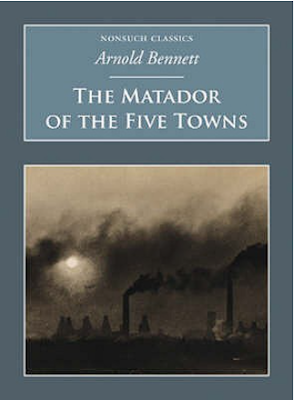
The Matador of the Five Towns by Arnold Bennett

Years ago while living in Texas I was at the Half-Price Books in San Antonio whereupon I found this bought this adorably wee little volume of short stories (6.5 x 5 inches/17 x 12.5 cm) by Arnold Bennett. I had just completed and loved his novel The Old Wives Tale so why not? Well, at least ten years and three moves later I finally gotten around to finishing it. One would think that a small volume of 22 short stories shouldn't take that long, but you know how it is.

If you haven't read Arnold Bennett, he seems to me a sort of transitional writer between the 19th and 20th centuries. This volume is copyrighted 1912, but many of the stories had a more Victorian feeling. Most of his stories are about working-class and middle-class people, just slices of life set in his fictional Five Towns which are modeled on the six Pottery towns in the Staffordshire area of Northern England. 

Once started, it still took me awhile to get into this book -- it's divided up between "Tragic" and "Frolic" with the majority in the latter category. The first stories is the eponymous "Matador of the Five Towns" and it's also the longest, which is probably why it seemed to take forever to get into. But once I started I found that I really enjoyed them, mostly the lighter comic "Frolic" stories. I won't go into each story into detail but just a few highlights:

"Catching the Train" -- a man and his brother are repeatedly thwarted on a train journey to a Very Important Destination which isn't revealed until the end. It's one of those trips where anything that can possibly go wrong, does so in the worst possible way. 

"The Blue Suit" -- a woman slyly manipulates her nephew's wardrobe choices while on a seaside holiday in Wales, with unexpected results.

"Hot Potatoes" -- the mother of a violin prodigy desperately tries to keep her son's hands warm for a concert on a cold day.

"The Long-Lost Uncle" -- a young man has an opportunity for romance after the sudden departure of his miserly uncle.

"Why the Clock Stopped" -- a pair of aging siblings have secrets from one another. 

I definitely preferred the lighter comic stories to the tragic (though they weren't so terribly tragic) and I found that many of them had delightful twist endings. They reminded me a bit of the short stories of Edith Wharton, a bit like O. Henry, and even a little like Trollope, so if you like any of these authors, you might enjoy exploring Arnold Bennett. This volume is also available on iBooks and on Project Gutenberg, as are most of Bennett's early works. To be honest, I actually ended up reading most of it on Gutenberg via my laptop because as cute as this volume was, the print was really tiny! (Plus I have become used to reading while I eat my lunch and it's so much easier while reading on a screen).

Overally I did enjoy this book and will definitely read more Arnold Bennett, I have a vintage copies of both Hilda Lessways and Buried Alive and would love to read both or either of them this year. 

This is my second book for the Back to the Classics Challenge, also counting this as my UK read for the European Reading Challenge. 

Thursday, February 11, 2021

The Short Reign of Pippin IV by John Steinbeck: A Little Mid-Century Satire


I was stuck in two very long books last week (that I wasn't particularly enjoying) and in desperation, I took one of the shortest books off of my owned-and-unread shelves: The Short Reign of Pippin IV by John Steinbeck, a vintage hardcover of only 164 pages, most likely purchased at one of the library sales. I've loved mostly everything by Steinbeck so far and it was very short, so I thought this might be just the thing to get me out of my reading funk.

Published in 1957, Pippin is Steinbeck's only work of political satire. Pippin Heristal, aged 54, is living a comfortable if somewhat dull existence in Paris with his wife and daughter. He has a lease on an apartment (oddly enough, in the mews of the French President), and he doesn't really work but has a small but adequate income from a vineyard, spending most of his time as a well-respected though amateur astronomer. 

During a week-long meteor shower that keeps him up all night and sleeping all day, Pippin is blissfully unaware of a government crisis. The multiple parties are in an uproar and one desperate politician suggests a return to the monarchy. After much in-fighting, it is decided that the living descendant of Charlemagne should be the rightful King of France -- the eponymous Pippin. 

Politicians have decided that since it's worked for the UK for so many years, it would be good for tourism and distract the public so they can get on with the business of governing. Much to his chagrin, Pippin is forced to move in to Versailles and go through with a coronation. Meanwhile, his bohemian daughter Clotilde has taken up with a Tod, young American tourist, heir to a vast chicken-farming fortune. 

Pippin hates the role instantly and is desperate to get out of the drafty palace and its hangers-on, and back to his beloved telescope. He finds solace and advice from some colorful side characters -- his uncle Charles, an antique dealer of dubious morals; and Sister Hyacinthe, his wife's old schoolmate, a former chorus girl who took the veil after retirement. He also finds comfort and insight from young Tod, who makes a mean Martini and is terribly insightful for one so young. 

This was a pleasant diversion, though there was more politics that I really wanted right now. I enjoyed the characters and there were some amusing bits, but the plot's not terribly strong. I finished it only a week ago and I've already forgotten the ending. I'm not terribly surprised that this one isn't as popular as the other Steinbeck novellas, it seems sort of dated. 

I'm counting this as my Classic Humor or Satire for the Back to the Classics Challenge and as my French selection for the European Reading Challenge. 

Wednesday, April 8, 2020

Les Miserables, Books 3-5, and the West End Musical


It took me two months, but I've finally finished Les Miserables, Victor Hugo's sprawling masterwork. Originally I had planned on posting after each of the five books within the novel, but the last month has been difficult for me, as I'm sure it has been for everyone else. I've had a hard time concentrating and often can barely make it through a short story a day. I ended up listening to quite a bit of the book on audio while walking the dog. The audiobook is split into 56 parts, almost 58 hours of listening time. And of course I'm hardly driving anywhere nowadays, so it took even longer.


So. The third book introduces the character of Marius, a young lawyer who is the son of Pontmercy, a retired army colonel who was badly wounded at the Battle of Waterloo, which takes up an enormous long section in Book Two. At the very end of the battle, deserters are scavenging the bodies of the dead for valuables, and one of them discovers a survivor, whom he pulls from the bottom of a pile and ostensibly saves. The deserter is of course the shady Thenardier who ends up adopting the hapless Cosette; the survivor is Pontmercy, the father of Marius. There's a lot of back story about Marius' maternal grandfather and his estrangement with Pontmercy. Eventually, Marius grows up, learns about his father, leaves his grandfather's house to live in a garret, falls in love with Cosette, Thenardier finds Jean Valjean who then disappears with Cosette; Marius joins the uprising of June 1832; is wounded then saved by Jean Valjean (of course!) by dragging him through the sewers of Paris.


I really should have split this posting into three, but I'll just give my final thoughts. Overall I liked it and was glad I stuck with it, but wow, this book is a commitment. There are some very long passages which are essays about history, politics, religion, etc, and some of them are pretty dry. They're often turned into long soliloquies by characters. I had wondered how the heck this 1260 page behemoth was adapted into a six-hour mini series, much less a feature film or stage musical about three hours long. Obviously, they cut a lot, starting with these passages. It's a great plot, despite the amazing coincidences, and I'm sure I would have gotten more out of it if I'd studied it as a work or literature or even followed the blog postings and podcasts in great detail. Honestly, I cannot imagine a book like this being published today -- editors would be trying to make cuts everywhere. I do think some of the character development is a little sketchy.


So, now a bit about the West End production. A couple of years ago when I still lived in Germany, I took a trip to London to finally meet some of the people from one of my online book groups. I decided to make a long weekend out of it, and planned in some West End shows, tours, and museums -- that trip was packed. I don't normally plan out a detailed itinerary, but on that trip there was so much I wanted to do, I actually made a spreadsheet. There was an opening for the last night of the trip, and I settled on Les Miserables because it's such an iconic show -- it's been running almost continuously since 1985 with more than 14,000 performances to date. However, I didn't have enough time to read the book first, and I didn't want to watch the movie version, so I went to see with only vague memories of the plot.


I enjoyed the show but I hadn't realized that it's a sung-through musical, meaning that there's hardly any dialogue, like a traditional musical -- there's far more singing so it's closer to an opera. The show was completely sold out, and it was quite long, nearly three hours. I did appreciate the quality of the singing and the sets and costumes, but at the time, I don't think I understood why people are so in love with the show. In retrospect, I really wish I had read the book first, I think I would have gotten more out of it, though, obviously, a lot of the plot was cut. As I was reading I realized how abridged it was! Now I'd really like to see it again, but apparently the Queen's Theater in the West End closed for several months for renovations (reopened as the Sondheim Theater), and now the show is different, closer to the touring show version. There was quite a hullabaloo among the fans, especially because the set is also different -- there was a revolving stage which is now gone. So I'm glad I got to see the previous version.


Anthony Perkins as Javert in the 1978 miniseries
I still haven't seen any of the TV or film adaptations since I was a child -- the version I saw starred Anthony Perkins as Javert which is still available on DVD, so I might have to track it down. I do have the most recent miniseries adaptation checked out from the library and I guess I'll have time to watch it now that the library is closed until further notice -- that is, if I can tear myself away from the Scandinavian murder mysteries streaming on Netflix.

UPDATED: While researching images for this blog post I found an interview with Andrew Davies who did the most recent six-hour TV adaptation. Davies said he'd been to see the West End musical and hated it, calling the performers "second- or third-rate." I found that so offensive -- I've been to quite a few West End performances and NEVER seen anything less than first rate singers and actors. Even if I didn't care for the story or the staging, the performers are always top-notch. Does he have any idea how hard it is to do eight shows a week for months? Now I'm rather put off him and don't know if I want to watch his miniseries after all (and I reeeallly hated Sanditon, but that's another whole blog post.)

What's everyone else reading and watching now that we're all hunkered down? Is anyone else making progress with those classics we've been putting off forever, or is everyone just craving comfort reads?


I'm counting this as my Abandoned Classic for the Back to the Classics Challenge (I'm halfway through!); the Second Chances category for the Victorian Reading Challenge; and as my French classic for the European Reading Challenge

Wednesday, February 26, 2020

Les Miserables by Victor Hugo: Book One, Fantine


So I've decided to take the plunge and make another attempt at Victor Hugo's epic masterpiece, Les Miserables. At 1260 pages (depending on the edition), it's quite possibly the longest book I've ever read! (I'm not sure if it's longer than War and Peace, it's tough to say based on different editions. It's definitely longer than Gone With the Wind and anything by Dickens or Trollope.) 

Since the book is so long, I've decided to write blog posts after each of the five books. The first book, Fantine, took me just about a week to finish. If you don't know the setup, here's what's happened so far:

The book begins in the 1820s, and begins with a lot of back story about a priest, Monseignur Bienvenue, who only appears in this section but is a pivotal character. (He is saintly and allows a newly released convict, Jean Valjean, into his home for the night. Valjean has spent 19 years doing hard labor onboard a galley ship after stealing a loaf of bread (his initial sentence was five years, but was extended after repeated escape attempts). Valjean steals the family silver and uses this to start a new life, eventually working his way up to become a successful businessman and the well-respected mayor of a town about five years later. Meanwhile, one of the factory workers, the beautiful Fantine, has left her illegitimate daughter Cosette in the care of the unscrupulous Thenardiers, who take Fantine's money and spend it on their own children, treating little Cosette like a servant.


Cosette's nasty co-workers discover where she's been sending her weekly wages, and get her fired from her job. She then sinks to selling her hair, then her teeth, and finally her body on the streets. Finally one day she is arrested for assaulting a man on the street when Valjean (now known as  Monsieur Madeleine) witnesses the event and stops the policeman Javert from throwing her in jail. Fantine health is wrecked and he takes charge of her care, promising to reunite her with Cosette.

Meanwhile, Javert has become suspicious -- he believes Mayor Madeleine is a former convict who is wanted for thefts after his release. However, Javert tells Madeleine his fears were averted when another man is arrested for the crimes. Madeleine realizes another man may be sentenced for his crimes and struggles with the decision to come forward. And that's only the first 200 pages!

There is A LOT going on in this book -- plot, characters, setting (Hugo loves detailed descriptions), and many asides in which Hugo pontificates about politics, philosophy, religion, etc. This seems to be a feature of books of the time -- I remember Moby-Dick included entire chapters about chowder and the color white. I've heard there are entire chapters in Les Miserables about the Paris sewer system, so that'll be . . . interesting. (Fun fact: you can take sewer tour in Paris -- there is an actual sewer museum! Apparently it's closed at the moment for renovations, so if you're planning a trip, you're out of luck). Also SO MUCH back story about the characters -- Monseigneur Bienvenue was the reason I gave up my first attempt reading this a few years ago. 


Anyway, I'm really enjoying it so far, despite all the asides. I've been lucky enough to find a digital download of the audio from the library, so I've been able to make real progress while walking the dog and driving around town. The audio version is the Charles Wilbour translation from 1862, and I like it so far. It's the same translation as the Modern Library hardcover edition, also checked out from the library. I do actually own two other copies of this book, but it's easier to keep reading the same edition. I also own the beautiful Penguin clothbound copy and the Signet mass-market paperback, both pictured. I love the Penguin copy but it's actually easier to read the Modern Library version, as it lies flat when open. The Penguin and Signet editions are also different translations. I'm sure they're equally good but I find it easier to just stick with one -- maybe someday I'll go back and reread the others to see which one I like best!

I'll be posting more thoughts about Les Miserables in the coming weeks -- I'm hoping to finish one section every week, so if all goes as planned I'll finish up by the end of March. I'm also going to include some travel photos related to Paris and Victor Hugo, and various adaptations.

Bloggers, have you read Les Miserables? Which edition is the best? And what are the longest books you've ever read?

Thursday, May 2, 2019

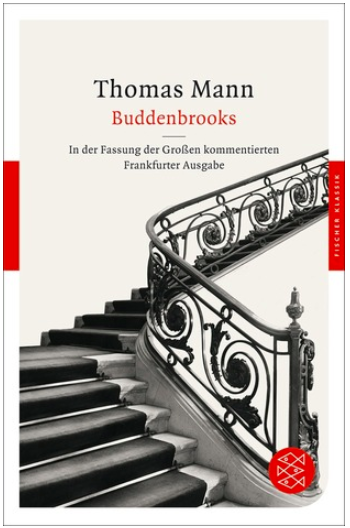
Buddenbrooks by Thomas Mann: A Family of German Trainwrecks


Having spent nearly three years in Germany, I thought it was time I really buckled down and tried to read some actual German literary classics. Published in 1901, Buddenbrooks is one of Thomas Mann's masterpieces and is inspired by the history of his own family.

The story begins in 1835, in a northern German city modeled after Mann's hometown of Lubeck. The Buddenbrook family is hosting a dinner party shortly after moving into their latest home, a large historic home sold by another merchant family whose fortunes have declined. We are introduced to the Buddenbrooks: Johann, a successful grain wholesaler (also known by his title, Consul), the older son of his father's second marriage. He and his wife Elisabeth have three children, Thomas, Christian, and Antonie, known as Tony. A second daughter will soon join the family, and there is a young ward, Klothilde, the child of a poor relation. Buddenbrooks traces the family over about 40 years, focusing on the three older children, tracing their successes and more often their failures throughout the 19th century.


It's quite a long book, divided into eleven parts (more than 700 pages in my edition). The first hundred pages or so were a bit slow, mostly just setting up the characters -- the entire first part is just the dinner party (told in great detail, including descriptions of the food). The three principals are fairly young and their story is mostly just about their education and misadventures. Things started to pick up for me in Part III when young Tony attracts an unwanted suitor called Herr Grunlich, a commercial agent from Hamburg. Tony only eighteen, but the family seems unfazed when this 32-year-old man starts hanging around their house. He doesn't seem discouraged even when Tony is openly rude to him, and to her dismay, offers her a proposal of marriage. Naturally, the family assumes Tony is too young to "know her own mind" and pressure her to accept, which made me want to throw something across the room.

What eventually follows is the first in a series of Bad Decisions by this family. It seems like they're doing the right thing at the time, but basically, all three of the elder children are on a slow, downward spiral, repeating mistakes over and over, both financially and in their personal lives. Essentially, they are a bunch of slow-moving trainwrecks. The plot of the storyline shifts back and forth, mainly concerned with Tony and her oldest brother Thomas, who has been groomed to take over the family business. (Younger brother Christian is a charming ne'er-do-well who makes occasional appearances to drag the family down even farther.)


I wouldn't have thought the story of a German merchant family would be so fascinating, but it absolutely was. After those first 100 pages I was completely hooked and could not stop reading it, and finished most of it in about three days. It's very much a long Victorian saga, as it's set up in multiple sections with mostly very short chapters. It absolutely felt as though it could have been serialized, though I believe it was published in a single volume. It also reminded me a bit of The Forsyte Saga by John Galsworthy.

I particularly enjoyed Mann's descriptions, especially of domestic life. Mann goes into surprising detail about the homes, decor, and fashions of the time, and there are a lot of descriptions of meals in this book. Here's a quote regarding a Sunday dinner attended by the suitor Herr Grunlich:

He ate mussel ragout, julienne soup, baked sole, roast veal with mashed potatoes and Brussels sprouts, maraschino pudding, and pumpernickel with Roquefort cheese -- and at each course he offered a new tribute appropriate to the delicacy. For example, raising his dessert spoon, he gazed at a statue woven into the wallpaper and said aloud to himself, "God forgive me, I can do no other; I've eaten a large serving, but this pudding is just too splendid. I simply must implore my hostess for a second helping. 

I suppose this is Mann's way of showing how bourgeois the family is, but I love food writing so that's one reason why I was hooked -- it's making me hungry just thinking about it. I did get really invested in the characters and would stop reading and yell at them when they made bad decisions. It will definitely be one of my top reads this year and now I can't wait to read Mann's other long saga, The Magic Mountain. Also, if you're looking for a copy, I highly recommend the 1993 edition translated by John E. Woods. I actually own a Vintage International copy that was translated back in 1924, but I didn't like it as much as the e-book version so ended up not reading my print copy at all.


I've also discovered that Buddenbrooks was adapted into a TV miniseries in 1979. Used copies are available on Amazon but they're really expensive, so hopefully I can get it from a library. It's available from Amazon.de for a mere 20 euros but I'm pretty sure that version doesn't have English subtitles.

I'm counting this as my Very Long Classic for the Back to the Classics Challenge.

Tuesday, December 19, 2017

Lemuel Gulliver Never Learns To Stay Home


I don't know WHAT I was thinking when I came up with the Classic Published before 1800 category for the Back to the Classics Challenge last year. Give me a long-winded Victorian triple-decker and I'll devour it, but any time the publication predates 1800, it is a real struggle. Years ago I read Shakespeare in college for a literature credit, and liked it, and I truly enjoyed Candide, but this category was a real struggle for me. I originally meant to read Jane Austen's Love and Freindship (sic). JA is possibly my all-time favorite author and I still couldn't get into it. But I did own a beautiful Penguin Deluxe Hardcover Classic of Gulliver's Travels, published in 1726! Not a woman author, but a book from my own shelves -- plus, it's not too long, a bonus in December!

So. All I knew about Gulliver was that he was shipwrecked and wound up in Lilliput, where everyone is about four inches tall. There are images everywhere of Gulliver tied down by tiny people, so this was not a surprise. But I was surprised to learn that Gulliver is his last name (his first name is Lemuel).


Gulliver  quickly learns the language and eventually wins the trust of the people. In one memorable anecdote, he even saves the tiny palace while it is engulfed in flames, using, um, a very practical if questionable method. 


Yes, Swift doesn't shy away from describing how Gulliver copes with the day-to-day issues of life as a giant. (I found this surprising but I admit I did wonder about how the Lilliputians would feed him).

However, I didn't realize Gulliver's stay in Lilliput is only about a quarter of the book. Things eventually take a turn for the worse in Lilliput, and eventually, Gulliver makes his way back home to England. And I figured from the title that he had some more journeys, but seriously, though, wouldn't you have learned your lesson after the first shipwreck? Better to stay home. His wife must have been most displeased. 

His second voyage leaves him stranded in the land of Brobdingnag, where Gulliver has the exact opposite problem -- now he's the tiny one, in a land of giants! It's interesting to see Gulliver experience life from the Lilliputian perspective, and I think this was my favorite part of the book. He's basically a moneymaker for the family that find him and care for him, until he makes his way to court and becomes a plaything for the Queen until circumstances return him back to England.

Again, you'd think he'd stay off ships. But nope, back he goes again in Part III, visiting the strange lands of Laputa, Balnibari and . . . Japan! (This was rather disappointing, as I've actually lived there. Gulliver doesn't find it particularly strange, though they ask him to renounce his Christian beliefs and "trample on the crucifix." I don't think Swift actually ever went there.)

Despite his vows never to leave England, he makes one last journey, and the ship is overtaken by pirates who dump him in the land of Eventually, he makes his way to the land of the Houyhnhnms, a race of intelligent talking horses who are served by the sub-human Yahoos. He lives quite happily there for years as the only intelligent Yahoo, until forced to return home to his disappointment.

Overall I mostly liked this book but I did find the third section really dragged, mostly because it was a lot of politics and satire, and I'm not that familiar with that era of history and philosophy. I do prefer everyday life, which is why I liked the first half better.  I did quite like the final section where he lives with the intelligent horses. And I do always find it a little jarring when a book is published in the original 18th century Style in which all Nouns are Capitalized. (Fun fact: this is still the correct writing style in Germany, though my German is very poor so it's really not an issue).

Anyway, I'm glad to have finally read this -- and I probably won't be including this category in the Back to the Classics again!

Sunday, May 7, 2017

The Classics Book Tag

Robert Carlyle is pretty much perfect as Rumplestiltskin.
I was recently tagged by Jillian with a fun meme about classics. And what is not to like about two of my favorite things, classics books and lists? So, here goes:

1. An over-hyped classic you really didn’t like: 


Without a doubt, Wuthering Heights. I think Heathcliff and Catherine are just awful and deserve each other for all of eternity.  The runner-up is On the Road by Jack Kerouac. 


2. Favorite time period to read about? 

Victorians! It's such a great time period, transitioning to the modern age. And it's such a long period, so there were so many great books written. 

3.  Favorite fairytale? 
Probably Rumplestiltskin. It was my favorite fairytale to tell my kids when they wanted a bedtime story that wasn't from a book.

4. Most embarrassing classics that you haven't read?
I still haven't read Les Miserables! Shocking, I know -- I hope to get to it this year. I'm really scared by the length, and I've never read anything by Victor Hugo.


5. Top 5 classics you want to read: 
  1. The Duke's Children by Anthony Trollope (I just bought the newly restored version)
  2. Jane Austen's juvenilia
  3. Three Men on the Bummel by Jerome K. Jerome
  4. The Story of an African Farm by Olive Schreiner
  5. My Brilliant Career by Miles Franklin
All of these are for challenges, either the Back to the Classics Challenge and the Victorian Reading Challenges, and they've all been on my TBR list for a long time. 

6. Favorite modern book/movie/TV series based on a classic?

I'm not a huge fan of modern adaptations of classics. However, I really do love Clueless which is an adaptation of Emma. Alicia Silverstone is great as Cher Horowitz, and I love Dan Hedaya as her father, who is not clueless (unlike Emma's father). And Paul Rudd! What's not to love about this movie?
"That was way harsh, Tai!" Best teen movie EVER.

7. Favorite movie version/TV series based on a classic? 

That's tough, there have been some really good adaptations! I could only narrow it down to four:
  •  the classic 1995 version of Pride and Prejudice; 
  • the 1995 Persuasion; 
  • Wives and Daughters
  •  the 2005 Bleak House, which is an absolute masterpiece. 
In general, I think books are better adapted to mini-series than movies, though I do love watching them on the big screen.

Gillian Anderson was brilliant as Lady Dedlock in Bleak House.
8. Worst classic to movie adaptation?

For movies, I'd have to say the 2011 Jane Eyre with Michael Fassbender and Mia Wasikowska. Michael Fassbender was way too good-looking to be Rochester, and they really hacked up the ending. I was also disappointed with House of Mirth -- it's one of my favorites and I was bored to death. 


Gillian again, as the tragic Lily Bart. 
She deserved a better adaptation, but that hat is fabulous.
The worst TV adaptation was a The Paradise which is an adaptation of Zola's The Ladies' Paradise. I couldn't get through the first episode. It probably didn't help that they changed the location from Paris to north England. I think they were trying to compete with Mr. Selfridge.

9. Favorite editions of classics that you'd like to collect:
I really like Oxford World's Classics, and I love the covers of the Penguin Clothbound Classics! It's tempting to buy all of them. 


10. An under hyped classic? La Bete Humaine by Emile Zola -- it's a real page turner and I think it would make a great miniseries!

Bloggers, tell me about your favorite classics -- and your least favorites. I'm tagging anyone who wants to participate!

Thursday, March 9, 2017

Red Pottage by Mary Cholmondeley

Another beautiful Virago cover. It's Regina Cordium: Alice Wilding by Dante Gabriel Rosetti
Red Pottage is a Victorian novel that is sadly under-appreciated -- it has less than 100 ratings on Goodreads! I probably first heard of it from Simon at Stuck in a Book -- all I know is that I've owned it for at least five years, and the cover is really pretty. But this is one time the book even transcends the Pre-Raphaelite artwork on the cover. It's a smart, well-written novel with great character development and plot twists, and I think it rivals my favorite Trollope novels.

Written in 1899, this is the intertwining story of two life-long friends, Rachel West and Hester Gresley. Rachel was the daughter of a self-made man who lost his money to an unscrupulous business partner. As a young woman, Rachel struggled to make a living as a secretary and then suddenly became an heiress when the remorseful partner left his fortune to her. She's had her heart broken and is wary of loving again until she met Sir Hugh Scarlett, a dashing man-about-town with a past. He'd been trying to disentangle himself from a love affair when he met Rachel, and the repercussions from the affair continually haunt his attempts to win Rachel.

Rachel's oldest friend, Hester Gresley, comes from an old family whose fortunes have declined, but she's done quite well for herself as a writer. After the death of an aunt, Hester has moved in with her brother's family in the country. James Gresley is a minister and a pompous know-it-all (he does a lot of mansplaining in the novel), and though Hester loves his brood of children, she doesn't get on all that well with his wife. Hester is working hard on a new novel despite the distractions of nosy country neighbors, her judgmental brother, and a houseful of kids. Like most Victorian novels, everyone knows everyone else, and Rachel's story keeps overlapping with Hester's. There's a lot going on in this novel but it really captured my interest and once I got going, I zoomed through it in just a few days.

One could describe this as a satire, but it's also a feminist novel. There are also bits that remind me of a Victorian sensation novel, but much better written and with far better character development. Parts of this book are extremely witty. I can't quote the best lines because they would ruin the plot, but here is an example. A minor character named Sybell Odom is throwing a country fete and is welcoming the country society:

Sybell raised her eyebrows, and advanced with the prettiest air of empressement to meet her unexpected guests. No, clearly it was impossible that the two women should like each other. They were the same age, about the same height and coloring; their social position was too similar; their historic houses too near each other. Lady Newhaven was by far the best looking, but that was not a difference which attracted Sybell towards her. On this occasion Sybell's face assumed its most squirrel-like expression, for, as ill-luck would have it, they were dressed alike.

This was a surprise success for its author, Mary Cholmondeley. Sadly, none of her novels (including this one) are in print any longer, but they're all available for free downloads from Project Gutenberg and on iBooks.  It's a shame that nobody reads this novel any more because I thought it was just brilliant.  I'm quite sure this will make my list of top reads at the end of the year. 

I'm counting this as my 19th Century Classic for the Back to the Classics Challenge. 

Wednesday, November 2, 2016

Top Ten Books To Read If Your Book Group Likes Classics


I don't write that many Top Ten Tuesday posts but I couldn't resist this one -- some of my happiest reading experiences have been with book groups and I've always found book groups to be the best ways to find kindred spirits. I've been in many book groups and it's always fun to throw in a classic every once in awhile. I've been pleasantly surprised by classics that I thought I would absolutely hate.

I actually couldn't narrow it down to ten, so there are two bonus choices. In no particular order:

1. Germinal by Emile Zola. By far, one of the classics that has had the greatest impact upon me as a reader. I'd read a couple of books by Zola but Amanda from The Zen Leaf suggested our real-life  classics book group read Germinal and I understood what all the fuss was about. It's amazing.

2. In Cold Blood by Truman Capote. Even though true crime really creeps me out, the writing is just masterful.

3. Their Eyes Were Watching God by Zora Neale Hurston. This is short, but powerful, and it speaks to so many women. Some of it is in dialect but it's a really easy (and short) read.

4. The Good Earth by Pearl S. Buck. I think I've read this with three different book groups, and it's been a hit every time. Set in China between the wars, the themes about family dynamics are universal.


5. The Painted Veil by W. Somerset Maugham. Another book set in China, but very different from The Good Earth.  Kitty Fane is the spoiled, self-centered wife of a doctor working in 1920s Hong Kong, and after her husband realizes she's been unfaithful, he takes her to the Chinese countryside so he can treat a cholera outbreak. It's tragic and beautiful, and one of Maugham's beat (also a great movie adaptation).

6. Main Street by Sinclair Lewis. I finally finished this a couple of months ago and I so wish I could discuss it with a book group! Young and idealistic Carol Kennicott moves from Minneapolis to a small Minnesota town and thinks she can uplift and elevate the locals.

7. Mildred Pierce by James M. Cain. Not so much crime noir as you'd think, this is the story of a really twisted relationship between a working-class mother trying to pull herself up by her bootstraps to impress her ungrateful daughter. They put the fun in dysfunction! I chose it for a book group simply because the library had enough copies and it one of the group's top reads of the year, I can't stop recommending it.


8 & 9. Ethan Frome or House of Mirth by Edith Wharton. Ethan Frome is shorter but House of Mirth has Lily Bart, one of literature's most tragic heroine. They have totally different settings but both of them are about the futility of loving the wrong person.

10. The Heart is a Lonely Hunter by Carson McCullers. I'd never had any desire to read this but it was for a book group. I was blown away by the beautiful writing and themes of this book about a group of misfits living in a boarding house in a small Southern town. This would be a great choice for a book group that's already discussed To Kill a Mockingbird.


11. West with the Night by Beryl Markham. An amazing memoir by an aviatrix raised in Africa, she was a contemporary of Isak Denisen, Denys Finch-Hatton, and Ernest Hemingway. The writing is just beautiful. There's also a beautiful illustrated edition with lovely photos.

12. A Tree Grows in Brooklyn by Betty Smith. I was nearly done with the list and I realized how tragic most of them are! A Tree Grows in Brooklyn has sad elements, but it's a beautiful and uplifting book. I didn't read it until I was grown up and I am so sorry I waited!

And I can't believed I left out Steinbeck, Dickens, and Hardy! If I don't stop now the list will be twice as long. Bloggers, which classics would you recommend for book groups? Please let me know in the comments.

Sunday, October 23, 2016

Jane Eyre by Charlotte Bronte


The reason I really started reading classics about ten years ago was because I realized there were so many authors I'd never read -- I managed to graduate from high school without ever reading anything by Steinbeck, Fitzgerald, or Hemingway! (Though in my defense, I did read War and Peace.) One of the few classics I did read in college was Jane Eyre, which I absolutely loved. It's also one of those books I turn to for comfort during hard times. This summer I had a tough move from Texas to Germany, and Jane Eyre was there for me when I needed something familiar.

I'm sure most everyone knows the basic story, but without spoilers, here's the setup: orphaned Jane Eyre lives with her horrible aunt and cousins until they send her off to boarding school, which also starts out horribly, but gets better. Eventually, she becomes a governess for the ward of mysterious Mr. Rochester at Thornfield Hall. She falls in love with him (naturally) but things are not as they seem.

It had been several years since I'd read Jane Eyre, and I still loved it this time around, but there were parts of it that I didn't like as well as in my youth. I still love Jane, but I found myself much more critical of Rochester and his behavior -- he was really manipulative and dishonest and some of the things he did to Jane were pretty unforgivable. Of course there are amazing coincidences, which are present in many Victorian novels so I feel as though that's to be expected. I did find parts of the story dragged, and there's a sub-plot about another possible romance for Jane that made me want to throw the book across the room.


I first read this book as part of a literature class my first semester in college, and it's been so long that I hardly remember what all the metaphors were. I realize the book must have been ground-breaking for its time regarding the portrayal of women in Victorian times, and that Jane is a symbol of empowerment, but some of the symbolism is a little over the top for me.  And I'm sure I find it less romantic than I did years ago. I suppose it's inevitable that books affect you in different ways once you get older. 

If you've read Rebecca by Daphne du Maurier, it's pretty obvious that she was influenced by Jane Eyre (though apparently she claims she wasn't; if anyone has evidence one way or the other, please let me know in the comments.) I've read Rebecca many, many times and it's one of my all-time favorites. I'm sure this may cause outrage but I honestly think I actually prefer Rebecca! In fact, it might be time for another re-read since it's October and I always want to read mysterious Gothic literature this time of year. 

Bloggers, do you prefer Jane Eyre or Rebecca? And how do you feel when you re-read books you loved when you were younger? Do they stand the test of time? 

I'm counting this as my Classic Re-Read from School for the Back to the Classics Challenge. Only three books left to go!

Tuesday, September 27, 2016

Main Street by Sinclair Lewis


I'm finally down to the single digits in my Classics Club list, but I realized that I have less than six months to go before my deadline! The other day I was at the library and just for fun, I looked to see if they had any of the books on the list on the shelves. Lo and behold there was Main Street by Sinclair Lewis. I'd tried to read it about a year ago but just couldn't get into it, mostly because I was listening on audiobook and couldn't stand the narrator, who sounded like she was reading to small children. Anyway, I gave it another shot and it was so worth it, because this book is brilliant.

Main Street is a satire of small-town life in the Midwest about 100 years ago. Carol, a bright young librarian living in St. Paul, meets a doctor at a party. He's about 12 years older and from a small town called Gopher Prairie. After a bit of a whirlwind courtship, they marry and return to Gopher Prairie, population 6,000. Carol has many good intentions and is convinced she can make the town into a place of beauty and culture, but she is foiled at every turn, by nosy neighbors, gossips, and people who think life is just fine as it is. Over a period of years, she tries to improve by volunteering on the library board, joining literary societies, and even directing an amateur theatrical. 

She is also the subject of much gossip, about her clothing, her interior decorating, and her choice of friends, whether they be working-class servants, socialists, or well-dressed arty types. World War I erupts, and there are some painful reminders of racism and political backlash that are incredibly timely. There's also a character who is mocked for being effeminate which made me really uncomfortable and a terrible incident about a woman who is basically run out of town after a boorish young man ruins her reputation with gossip. It made me furious but incidents like this still happen today. 


I thought Sinclair Lewis drew a brilliant portrait of small towns -- his characters are really well developed and the descriptions of scenery are wonderful. It reminded me a little of the winters in Little House in the Prairie. There's also lots of snappy dialogue and great quotes. I don't usually include this many quotes in a review but these three were so great I had to include them. This one is my favorite and I forced it upon my family with great delight: 

Carol drove through an astonishing number of books from the public library and from city shops. Kennicott was at first uncomfortable over her disconcerting habit of buying them. A book was a book, and if you had several thousand of them right here in the library, free, why the dickens should you spend your good money? After worrying about it for two or three years, he decided that this was one of the Funny Ideas which she had caught as a librarian and from which she would never entirely recover.

I imagine many book bloggers can relate to this as well!

Here is another of my favorite quotes that made me laugh out loud. Carol is at Sunday dinner with some annoying relatives: 

Carol reflected that the carving-knife would make an excellent dagger with which to kill Uncle Whittier. It would slide in easily. The headlines would be terrible.

Lewis had his snarky moments, but he's also incredibly insightful:

There are two insults which no human being will endure: the assertion that he hasn't a sense of humor, and the doubly impertinent assertion that he has never known trouble.

I raced through this book in less than a week and highly recommend it if you're looking for a well-written, insightful American classic. I'm sure it will be one of my top reads of the year, and now I have only seven books left on my Classics Club list!

Wednesday, January 6, 2016

The Return of the Native by Thomas Hardy


So, basically, since I read and LOVED Far From the Madding Crowd, I am officially no longer afraid of Thomas Hardy. And since Amanda from The Zen Leaf had told me a kazillion times that The Return of the Native was her favorite Hardy, and that there was a wonderful audiobook version narrated by . . . wait for it . . . ALAN RICKMAN (be still, my heart!) I gave it a try. (Also because it was one of a dozen or so books left on my Classics Club list.)

Seriously, Alan Rickman could read the telephone book and I would listen. In fact, the first chapter is kind of pastoral and descriptive, and nothing actually happens, but I just listened to his delicious voice read. Which was just fine.

Just an excuse to include a photo of Alan Rickman. 
But I digress. This is one of Hardy's earliest novels, and it's essentially a love quadrangle about three men and two women and who's going to end up with whom, and how many lives are messed up in the interim. Or, as Amanda put it so succinctly, "an 1800s soap opera set on Egdon Heath." Let's see. Thomasin Yeobright is about to marry Damon Wildeve, but due to a problem with the marriage license, the wedding doesn't go through as planned and she's horribly embarrassed. And her aunt objected to the marriage anyway. Then Damon is having second thoughts, because his old flame Eustacia Vye cannot stand being second fiddle to anyone, so she's trying to get her hooks back into him, and he's waffling. Meanwhile, Diggory Venn in love with Thomasin, and tells her aunt he still wants to marry her, even though she turned him down a couple of years ago.

And here comes Clym Yeobright, Thomasin's cousin. He had a good job in Paris but has given it up and now Eustacia thinks she might go after him instead because he's sophisticated and lived in Paris. She wants out of Egdon pretty badly. Basically, Eustacia is an 1840s Scarlett O'Hara, but more selfish, if you can imagine, and not so much willing to sacrifice everything for the sake of the farm. Meanwhile, Diggory Venn is waiting and watching everyone. He is the moral center of the book.

Cover of the BBC Audiobook to which I listened.
No turkeys were harmed during the listening of this audiobook.
(And not a single turkey is mentioned in the book, but, whatever, BBC Audio!)
Meanwhile, there is are a bunch of side characters who are alternately rustic, amusing, and just as dumb as soup. They exist for comic relief, and some parts of this book are just laugh-out-loud funny. Some parts made me yell at the audiobook (in the car, which is a good thing -- very embarrassing otherwise!) -- and some parts are slightly ridiculous. But Hardy really is an amazing writer, with great character development and amazing descriptions. If I had read the print book instead of listening to the awesomeness that is Alan Rickman, I would actually have found a brilliant and insightful example and included it.

Overall, I have to agree with Amanda -- it's really a great book, with some serious melodrama, though unlike Amanda, I absolutely disliked Eustacia and was waiting to see if she would get her comeuppance. I had some suspicions about how it would all shake out, and I was not disappointed, though there are some pretty good plot twists. I don't know if I liked this book quite as much as Far From the Madding Crowd, but I'm on a roll with Hardy and I have two of his shorter novels on the TBR shelf which I'd like to attempt this year: A Pair of Blue Eyes and Under the Greenwood Tree. Has anyone read either of them? Which do you recommend?

Unfortunately, I can't count this for the Back to the Classics Challenge since I finished it at the very end of 2015, but it's one more book crossed off on my Classics Club list! Only eleven books left!