Showing posts with label Paris. Show all posts

Saturday, July 4, 2020

The Twisted Sword: The Pentultimate Poldark Novel


I can't believe I'm on the 11th novel in this series, and I never blogged about it. I used to read a lot of historical novels, then I kind of got away from them when I got hooked on mid-century women's fiction. I only started reading the Poldark series after watching the PBS series when it first aired, the summer of 2015 when I was in Outlander withdrawal. I loved the first series which covers the first two novels, and promptly read the first ten books in less than a year. I'm not sure why I stopped there but suspect it had something to do with our big overseas move to Germany the summer of 2016. Our new library didn't have the last two novels, but on a trip to London that summer, I went to three different bookstores to find them -- and promptly left them gathering dust on the TBR shelves until now, prompted by my Big Book Summer Challenge

It is a little hard to get back into a series after a four-year reading gap (some of the supporting characters were a little fuzzy, but my edition thoughtfully included a family tree), but essentially, the book picks up pretty soon after the previous book, in the peace of 1815. Ross and Demelza's older children are grown and married, and Ross gets a summons to help out as an "observer" in France (and gets a baronetcy thrown in for good measure). Ross, Demelza, and the two youngest children head off to Paris, for what seems to be a good time, but that wacky Napoleon escapes from Elba and makes a triumphant return. [Bonus: this book also counts for Paris in July!]


This cover reminds me of a YA fantasy novel. 
Ross is on an assignment and gets separated from Demelza and the children, who flee to Brussels, where she meets up with her oldest son Jeremy and his new bride. Ross gets caught up in the war, so I had another perspective of the Battle of Waterloo, my second this year! But from the Coalition (Allied) side this time. My knowledge of French history is quite fuzzy and I didn't realize that Waterloo actually took place after Napoleon escaped from Elba, shame on me. There are a lot of descriptions of the horrors of war. I have been meaning to read La Debacle, Zola's masterful war novel, this summer, but maybe I'll put it off. 

Nice cover on this edition, I think it's the Polish translation


.
Sadly the war doesn't end well for everyone in the book. Meanwhile, back in Cornwall, the eldest Poldark daughter Clowance and her new husband are having money troubles, no thanks in part to George Warleggan. There are also some appearances by George's son Valentine; everyone's favorite doctor, Dwight Enys; and some local color with a pregnant housemaid who may or may not marry a local guy to give her baby a father. 

After a bit of confusion, I settled nicely into this 656 page chapter of the Poldark family, and ended up racing through it in less than a week. It's amazing how fast I started to remember details and characters (though a few are still a bit fuzzy and I've already requested the previous book from the library, so I can skim through it). Winston Graham was really good at creating the world of Cornwall from the time period. I loved most of the good characters and became outraged at the bad ones (George Warleggan has been carrying grudges against the Poldarks for how many years now?)

My only quibble was that the youngest daughter, Isabella Rose, is only THIRTEEN when the book starts and men are already courting her, ewww. I think Graham was setting up the story for the final book which is named after her. It's another 688 pages and I'm sure I will read it with enjoyment and more than a little sadness because the book series is ending. I've watched most of the TV series and unfortunately have gotten really bored with it, I didn't even finish the final season. Maybe I'll have to give it another try after I finish the final novel. I also own another long novel set in Cornwall called Penmarric and I'm looking forward to that one also.

How's everyone else doing with their summer reading? And can anyone recommend another great historical TV series and movies? 

Tuesday, March 3, 2020

Les Miserables, Book Two: Cosette; and Maison Victor Hugo in Paris

The Battle of Waterloo by William Holmes Sullivan
Two volumes done, three to go! I'm making real progress with Les Miserables, one of the books that's on my TBR shelves the longest. I've read 500 pages so far and completed two volumes. 

The second volume of Les Miserables begins with an extended description of the Battle of Waterloo. Talk about back story -- this section goes on for nearly fifty pages and at the very end, in the last three pages, we finally discover how it relates to the rest of the book! The awful Thenardier, the innkeeper who takes custody of Cosette, arrives on the scene as a thief, scavenging from the bodies on the battlefield. Nice.

Then we jump back to what's happening with Jean Valjean, now serving a prison sentence on another galley ship -- but not for long! He manages to escape by faking his own death after saving a sailor's life. He then retrieves some money and makes his way back to the Thenardier's village so he can rescue little Cosette from those monsters who are treating her like a slave. The scene where they finally get away from Thenardier is one of the most satisfying I have read in a long time. 


Jean Valjean and Cosette make their way to Paris, where they live quietly in seclusion for awhile, until Jean suspects he's being watched. They escape in a very exciting sequence, and wind up in a secluded walled garden which turns out to belong to a convent with a girl's school conveniently attached. In one of those amazing coincidences so beloved by Victorian writers, the elderly gardener is Fauchelevent, the very man whose life was saved by Jean Valjean back in Vol. I, which aroused Javert's suspicion to his true identity. Fauchelevent swears he will help Valjean with anything, and they arrange to smuggle Cosette out of the garden in a basket, so they can bring her back to the school through the front door. 

However, the conundrum is how to sneak Valjean out of the garden and back inside semi-legitimately as Fauchelevent's brother and new assistant gardener. In another amazing coincidence, one of the nuns has just died and it is her dying wish to be buried (illegally) in the vault of the chapel. Conveniently, the convent now has an empty coffin which needs to be filled with something and buried to avoid suspicion. It was no surprise that the plan succeeds, with some suspenseful plot twists.

This volume had a lot of twists and turns, and great plot development. However, it also included with some very detailed and long asides about both the Battle of Waterloo and the convent where Cosette and Valjean end up. I ended up listening to much of this on audio so I didn't mind the history and asides, but I cheerfully admit that my mind wandered during the extended action scenes. I'm really enjoying this book, but boy, it could have used some editing.

And now for some photos of Paris! 


Fountain in the square of the Place des Vosges in Paris 
Back when I lived in Germany, we were very lucky to be close to the border of France -- less than an hour's drive for an easy day trip, but even better, there was an express train to Paris from the nearest town. From my village train station, I could make it to Paris in less than four hours. If I booked far enough in advance sometimes it was as little as $80 for a round-trip ticket. Needless to say, I made the trip quite a few times. 
Portrait of Hugo on display at the Maison
On my second trip I decided to visit the home of Victor Hugo which is now a free museum, Maisons Victor Hugo (there's a second museum in Guernsey). It's in the Place des Vosges, a beautiful square in the 3rd Arrondissement, not far from the Place de la Bastille. Hugo lived at #6 Place Royal (now Place des Vosges) from 1832 to 1848. I hadn't read any of his works when I visited but the  museum is quite interesting. It includes a lot of his possessions from his entire life, including his writing desk and the bed in which he died, plus portraits of Hugo and some of his own drawing -- I hadn't realized he was also an accomplished artist.

Hugo's writing desk. He wrote standing up. 
It's definitely worth seeing if you're in Paris and if you're curious about writer's homes, as I am. I've been to several, including Jane Austen, Dickens, Hemingway, Ann Frank, and Goethe. I'd also love to go to Yorkshire and see the Bronte parsonage and the home of Elizabeth Gaskell. And now that I live on the East Coast I'm hoping to go up to the Berkshires and visit Edith Wharton's home.

Bloggers, do you enjoy visiting writer's homes? Which ones should I visit in the U.S.? 

Wednesday, February 26, 2020

Les Miserables by Victor Hugo: Book One, Fantine


So I've decided to take the plunge and make another attempt at Victor Hugo's epic masterpiece, Les Miserables. At 1260 pages (depending on the edition), it's quite possibly the longest book I've ever read! (I'm not sure if it's longer than War and Peace, it's tough to say based on different editions. It's definitely longer than Gone With the Wind and anything by Dickens or Trollope.) 

Since the book is so long, I've decided to write blog posts after each of the five books. The first book, Fantine, took me just about a week to finish. If you don't know the setup, here's what's happened so far:

The book begins in the 1820s, and begins with a lot of back story about a priest, Monseignur Bienvenue, who only appears in this section but is a pivotal character. (He is saintly and allows a newly released convict, Jean Valjean, into his home for the night. Valjean has spent 19 years doing hard labor onboard a galley ship after stealing a loaf of bread (his initial sentence was five years, but was extended after repeated escape attempts). Valjean steals the family silver and uses this to start a new life, eventually working his way up to become a successful businessman and the well-respected mayor of a town about five years later. Meanwhile, one of the factory workers, the beautiful Fantine, has left her illegitimate daughter Cosette in the care of the unscrupulous Thenardiers, who take Fantine's money and spend it on their own children, treating little Cosette like a servant.


Cosette's nasty co-workers discover where she's been sending her weekly wages, and get her fired from her job. She then sinks to selling her hair, then her teeth, and finally her body on the streets. Finally one day she is arrested for assaulting a man on the street when Valjean (now known as  Monsieur Madeleine) witnesses the event and stops the policeman Javert from throwing her in jail. Fantine health is wrecked and he takes charge of her care, promising to reunite her with Cosette.

Meanwhile, Javert has become suspicious -- he believes Mayor Madeleine is a former convict who is wanted for thefts after his release. However, Javert tells Madeleine his fears were averted when another man is arrested for the crimes. Madeleine realizes another man may be sentenced for his crimes and struggles with the decision to come forward. And that's only the first 200 pages!

There is A LOT going on in this book -- plot, characters, setting (Hugo loves detailed descriptions), and many asides in which Hugo pontificates about politics, philosophy, religion, etc. This seems to be a feature of books of the time -- I remember Moby-Dick included entire chapters about chowder and the color white. I've heard there are entire chapters in Les Miserables about the Paris sewer system, so that'll be . . . interesting. (Fun fact: you can take sewer tour in Paris -- there is an actual sewer museum! Apparently it's closed at the moment for renovations, so if you're planning a trip, you're out of luck). Also SO MUCH back story about the characters -- Monseigneur Bienvenue was the reason I gave up my first attempt reading this a few years ago. 


Anyway, I'm really enjoying it so far, despite all the asides. I've been lucky enough to find a digital download of the audio from the library, so I've been able to make real progress while walking the dog and driving around town. The audio version is the Charles Wilbour translation from 1862, and I like it so far. It's the same translation as the Modern Library hardcover edition, also checked out from the library. I do actually own two other copies of this book, but it's easier to keep reading the same edition. I also own the beautiful Penguin clothbound copy and the Signet mass-market paperback, both pictured. I love the Penguin copy but it's actually easier to read the Modern Library version, as it lies flat when open. The Penguin and Signet editions are also different translations. I'm sure they're equally good but I find it easier to just stick with one -- maybe someday I'll go back and reread the others to see which one I like best!

I'll be posting more thoughts about Les Miserables in the coming weeks -- I'm hoping to finish one section every week, so if all goes as planned I'll finish up by the end of March. I'm also going to include some travel photos related to Paris and Victor Hugo, and various adaptations.

Bloggers, have you read Les Miserables? Which edition is the best? And what are the longest books you've ever read?

Monday, April 30, 2018

Zoladdiction: A Love Story by Emile Zola (And a Giveaway!)


The trouble with polyreading is that when I jump around from book to book, it takes me forever to finish anything -- and then I have a pile of books to review! I finally finished another book by Emile Zola -- A Love Episode, the eighth book in his Rougon-Macquart series. I know it's the very end of the month, but I definitely wanted to finish this for the Zoladdiction readalong hosted by Fanda.

It's the story of Helene Grandjean, a young widow who is about thirty in the start of the novel. After the death of her husband, Helene and her young daughter Jeanne move to Passy (which is now part of the 16th Arrondissment of Paris, on the northwest side of the city). In the beginning of the novel, the sickly Jeanne has a life-threatening seizure, and the frantic Helene bangs on the door of her neighbor who is also her new landlord. Luckily, her new landlord is a physician, the handsome Dr. Deberle. He attends Jeanne and pulls her through the crisis, sitting by her bedside for hours with her mother.

During Jeanne's recovery, Helene and her daughter are often invited to the home of the Deberles and to spend time in their beautiful garden. Helene also spends time with some of the poor parishioners in the area, including a crafty old woman called Madame Fetu, who is also attended by Dr. Deberle. Helene and the doctor spend several days together after Mme Fetu falls ill, and they begin to form a bond.

Portrait of Emile Zola by Felix Vallotton

This becomes awkward as Helene is also friendly with Deberle's wife, the kind if somewhat flighty socialite Juliette. Helene struggles with her growing feelings for Deberle, and meanwhile her friend Abbe Jouve, the priest, is pressuring her to marry his brother, the faithful and patient Monsieur Rambaud. Meanwhile, her daughter Jeanne can sense something is happening between her mother and the doctor.

It's a good story, though not my favorite of the series. It's one of Zola's slower novels, and it's definitely a domestic drama. There are some lighter moments that I really enjoyed, especially with Helene's servant Rosalie, and her fiance, Zephyrin, who provide most of the comic relief of the novel. They were actually my favorite characters and I wish Zola had written more about them. 

A Love Episode is also a love letter to Paris. Helene spends a lot of time gazing at the view of the Paris from her apartment -- apparently she could see all of Paris, including the Seine, Les Invalides, and the Pantheon. It must have been a spectacular view, especially at night: 

In the dormant sea of blackness before them, there was a glimmer of light. It was below them, somewhere in the abyss, in a place they could not precisely identify. And one after the other the different lights started winking. They came to life at night with a sudden start, all at once, and remained there glittering like stars. It seemed as though there was a new rising of heavenly bodies on the surface of a dark lake. Soon there was a double row of them making a pattern which led from the Trocadero towards Paris in little leaps of light. Then other lines of luminous dots cut into that line, you could make out curves, a whole constellation that was getting larger, strange and magnificent. 


A Love Episode is the twelfth book I've completed in the Rougon-Macquart series -- so far I've read fourteen of his works altogether (the other two are Therese Raquin and The Attack on the Mill and Other Stories.) Compared to the rest of the series, it's pretty good, though not quite up to the quality of Germinal, L'Assommoir, or La Bete Humaine. However, I'd say it's definitely a good introduction to his work if you're looking for something shorter and slightly less intense.

And now for the giveaway! A couple of years ago, the nice people at Oxford World's Classics starting sending me copies of some of their new releases, mostly Zola (and thanks to Simon at Stuck in a Book for passing my name along.) Somehow I received two copies of A Love Story and so I'm going to share my good fortune and give away my extra copy! All you need to do is leave a comment below telling me why you want to read this book. The winner will be chosen in a completely unscientific manner -- I'm going to pick my favorite response, so be creative!

Guidelines for the drawing are as follows:

  • Winner must live in the United States or Europe (due to postage costs)
  • If your blog doesn't have an email link so I contact you, include an email in your comment 
  • The deadline to enter is 11:59 p.m. Western Europe Time Zone (GMT +1) on Monday, May 7.
I'm counting this as my Classic in Translation for the Back to the Classics Challenge.

Thursday, March 1, 2018

A Parisian Mini-Break

There are a lot of long weekends for my daughter's American school on the military base, and one of the best things is that they rarely coincide with European holidays. The weekend before last was President's Day which luckily is not a local holiday, so we took the express train to Paris Friday night. I say "express train" but due to unforeseen circumstances it arrived very late, which I detailed in my previous post

After our 3 a.m. arrival we slept late on Saturday. We skipped breakfast and went straight to lunch, then took to Metro to Montmartre. It was a beautiful day so we climbed the hill to Sacre Coeur, which I think is the most beautiful building in Paris. 


It's about 140 steps up the hill. Yes, I counted. We could have taken the funicular but why would we?


This is the back view as you walk down the side streets to Montmartre, which has lots of tourist shops and restaurants. It's also known for artists and there are always sketch artists and people selling watercolors and little oil paintings in the square. We also enjoyed the street art. 


If you've seen BBC's Travel Man with Richard Ayoade, this seahorse is from the Paris episode with Mel Giedroyc. If you haven't seen it, I highly recommend it. You can find all the episodes on YouTube and they're hilarious.


I always love doorways. I especially love the blue color one on this one, and the arched columns.


This is from the Pariosse St. Jean church in Montmartre. It's reddish brick church from the 12th century, with lots of mosaics. I didn't go inside but I found the outside really unusual. 


As we were walking around Montmartre, we decided to stop for a break and a hot beverage. A bakery with AMAZING eclairs was conveniently located on the street heading towards the famous Moulin Rouge.


We did quite a lot of walking and were still tired from the previous night, so after a nap, we went out for cassoulet, the famous bean casserole with lamb, sausages, and duck confit. This enormous pan is meant to serve three people. 


Next day we went to the Ile de la Cite, the island in the middle of the Seine, to climb the Notre Dame tower. We had to reserve our ticket time because only a limited number of people can climb up at any given time. We had a couple of hours to kill so we crossed the street to look for lunch. 


This arcade had a Mexican restaurant which I found very amusing. We did not eat there. 

Instead we found Le Procope, which was also featured in the same episode of Travel Man. It was founded in 1686 and is the oldest restaurant in Paris. Ben Franklin and Thomas Jefferson ate here, and they have all kinds of neat stuff, including one of Napoleon's hats which is on display in the vestibule.


We ate lunch on the first floor, but the second floor has lots of really cool artifacts including this bust of Voltaire. 


Some traditional escargots. Le Procope also serves boiled calf's head but we decided to pass.  


On the walk back to Notre Dame we saw some more street art. I particularly enjoyed this Star Wars tribute.


Before climbing the tower, we did a quick circuit inside the cathedral. The rose windows are really impressive. 


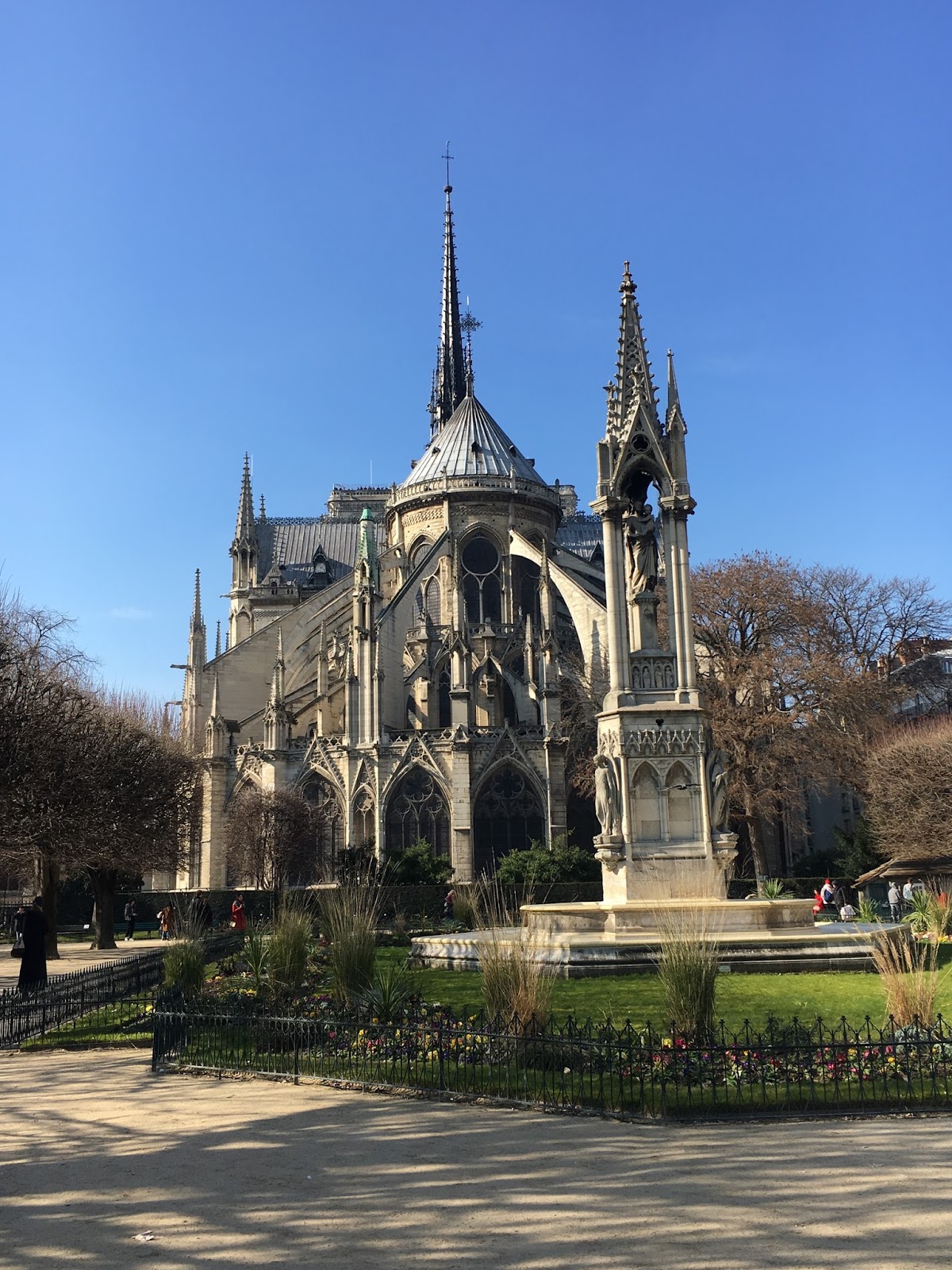
We still had a few minutes before our timed tickets, so we walked through the garden and had a lovely view of the back of the cathedral. 


Then it was time to climb the tower! I'd done this climb about 10 years ago on my first visit to Paris and I thought it would never end. I've been climbing a lot more hills and stairs since we moved here so it really wasn't that bad. First you climb about 100 stairs to the gift shop to buy tickets, then it's up to the first level.


I think it's the best view in Paris, plus I love all the gargoyles.


There's the Seine river and off in the distance you can see the Eiffel Tower.


Then we walked up to the second level which is above the bell tower. I realized that I could see Shakespeare and Company, the famous English-language bookstore. It's on the first floor of the white building on the corner, in the left of the picture. The front of the building is in shadow, but that's the cafe is on the corner, and the actual bookstore with the green awning is to the right. 


The bookstore was really busy and there was literally a line to get in. It's really quite small and it was very crowded, but I did manage to find some books. They also sell used books at the bookstore and on some shelves outside. 

The next day we meant to go to the Musee D'Orsay, which has the best collection of Impressionist art in Paris. However, we realized too late that it's closed on Monday! So instead we went to the Palais Garnier which is the opera house. It was grey and rainy so it was a good day to do something inside.


The opera house isn't really that big, but the lobby and stairwell are really impressive. 


We couldn't actually walk through the auditorium but there are two open balconies where you can overlook the inside and the stage. 


My favorite thing was the ceiling painted by Chagall. If you've ever seen Moonstruck, you know that Chagall was a very great artist. 


If you walk around to the left side, Box #5 is the one that the Phantom of the Opera always requested in the famous novel. If you zoom in, you can see the brass plate that reads "Loge du Fantom de L'Opera." I'm not a huge fan of the story but it was another literary connection for the weekend.

\

The Palais Garnier also has its own library which was pretty impressive. 


Finally -- we ended the break with a lovely bistro lunch. I had steak frites and in the corner you can just see the appetizer for the table to share -- smoked duck breast and foie gras! 

It was a lovely break and I hope I can go back to Paris again before we move back to the U.S.