Showing posts with label France. Show all posts

Tuesday, July 26, 2022

Paris in July 2022: The Loved and Envied by Enid Bagnold


My fourth book for this years Paris in July is The Loved and Envied, a Virago reprint I've owned for several years (I can't even remember where I bought it -- it has the price in USD). Originally published in 1951, it's a novel for adults by Enid Bagnold, most famous for her children's book National Velvet (which I've never seen nor read).

Inspired by the life of Lady Diana Cooper, it's the story of aristocratic families living in Paris after WWII. Though their titles are French, some of the characters are actually British. Most of the action is centered around the beautiful and charismatic Lady Ruby Maclean. Now in her mid-fifties, she's has been happily married to Sir Gynt Maclean for many years, but has always had a large circle of admiring men who find her irresistible -- Sir Gynt first saw her while walking down the street and instantly fell in love with her at first sight. She's basically Helen of Troy and men will do anything for her, much to the chagrin of her only daughter Miranda, who has always been overshadowed by her mother.

Also in the Macleans social circle is Edouard, the elderlyVicomte de Bas-Pouilly and his mistress Rose; Alberti, the Duca de Roccafergolo, who rents a cottage on the Vicomte's estate; Rudi Holbein, a famous playwright; and his ex-wife Cora, an artist and great friend of Lady Ruby. 

The Virago reprint. The cover image is the portrait of Lady Diana Cooper by J. J. Shannon.

The story begins the opening night of Rudi's latest play, with most of the characters in attendance, and what follows over the next few weeks. It's another book in which not much happens, yet many things happen, largely character driven. Most of the characters are aging aristocrats and much of the story concerns aging and mortality, particularly the question of aging beauty. Lady Ruby is 53 and still all the men hover around her, even those young enough to be her sons. 

The original 1951 cover

The story jumps around quite a bit at the beginning giving back story to all the characters surrounding Lady Ruby and their relationships to her. The first half was almost like a set of short stories about them before they actually got to the main character. Honestly, I don't even remember much about her except the many descriptions of how beautiful she is and was, and that got a little tiresome. It's well written and I liked a lot of the characters, but I found everyone besides Lady Ruby to be far more interesting than she was and would have loved to read more about them and less about her. I particularly liked the back story of Cora Holbein and would happily have read an entire novel about her.

One thing I didn't particularly like was (yet again) some of the persistent racism and some homophobia. Ruby's daughter Miranda is living in Jamaica for part of the book and there are some unfortunate slurs. There's more than one gay character and at first I thought the book was surprisingly progressive, then another gay character showed up at the end and yikes some of it was pretty cringe-worthy. I suppose I shouldn't be surprised since it was published in the 1950s but I still hate it.

Though nearly all the story takes place in France, many of the characters are British so it doesn't feel especially French. It was an interesting look at aristocrats of the period but it isn't one of the best Viragos I've read so far.

This is my eighth book completed for the TBR Pile Challenge.

Wednesday, July 20, 2022

Paris In July: Renoir, My Father by Jean Renoir


I am extremely pleased with myself for finally finishing this book! I bought it more than ten years ago on a visit to the Frick Museum in New York City, when I went to see an exhibit of Dutch masters. Apparently they didn't have anything else in the gift shop and but the pretty cover of this NYRB classic (it's a detail from Garden at the Rue Cortot, Montmartre painted in 1876, below. It's at the Carnegie Museum in Pittsburgh). 


So. I've owned this book forever and I know I've put it on my list of books to read for Paris in July multiple times. I finally cracked it open a couple of weeks ago and though it's not a fast read, I really enjoyed it. I love art and I'm fascinated by the lives of artists. I wouldn't say Renoir is my favorite Impressionist but I really gained a new appreciation of his work from reading this book. 

Originally published in 1958, it's a memoir by filmmaker Jean Renoir, Auguste Renoir's middle son. Jean was wounded during WWI and as he convalesced with his elderly father, who was already crippled with rheumatism, the younger Renoir spent a lot of time talking to his father about the artist's life. The book is a combination of a biography of his father's life and his own recollections growing up in Paris and various other parts of France. The family often spent summers in the countryside in various parts of France, particularly Essoys in Burgundy, where his mother Aline was born, and later in the south of France, near Nice (I was actually lucky enough to visit Nice a few years ago and was sadly unaware that there's a Renoir museum just 20 minutes away in Cagnes-sur-Mer, in his final home. I did get to visit the Chagall Museum and the Matisse Museum, so I really wouldn't complain but I wish I'd known!)


It's quite an interesting memoir about Renoir's life and how became and artist and met up with his fellow Impressionists. He's one of the most prolific of the group, with at least 4000 paintings to his record (and the book includes stories about other paintings that were lost or stolen which just made me aghast. Some were literally used to patch up holes in a leaky roof). 

There are also great stories about the other painters including one about his good friend Gustave Caillebotte, who named Renoir executor of his estate and personal art collection after his death. Apparently it was Caillebotte's wish that the collection be given to the Louvre who didn't want the whole collection and turned 2/3 of it away. The third that they kept was stored away in the Luxembourg Museum. After his widow's death they just went to various heirs and were mostly sold outside France. Well, France's loss is the world's gain, I suppose! 

I feel very fortunate to have been to Philadelphia last year where I saw the biggest single collection of Renoir's works at the Barnes Foundation, a total of 181! Barnes was a huge art collector and began amassing Impressionist works in the 1920s. His entire house was designed to showcase his collection and was eventually left to the city of Philadelphia as a private museum. The collection was eventually moved to a larger space in downtown Philadelphia which resembles the original house with the exact layout of the all the artworks. If you ever get the chance it's absolutely worth visiting! 

I'm also extremely fortunate to live only a short drive away from the Phillips Collection Museum in DC near Dupont Circle. One of the highlights of the collection is Renoir's Luncheon of the Boating Party. The last time I visited one of the docents told me that Phillips and Barnes were rival collectors. Phillips was annoyed that Barnes had the bigger collection of Renoirs but always bragged that he had the best one. 

Renoir's Luncheon of the Boating Party, 1881.
Renoir's future wife Aline is in the left hand corner with the little dog;
Renoir's friend and fellow Impressionist Gustave Caillebotte is on the lower left leaning back. 

I enjoyed visiting Renoir's world but the book is pretty dense and took a lot longer to finish than I expected -- I am rather behind on Paris in July reading list and also my Big Book Summer Reading Challenge! But this book was on both lists and I'm also counting this as my Classic Nonfiction for the Back to the Classics Challenge

Saturday, July 2, 2022

Paris in July 2022


It's July already, the year is half over -- how did this happen? But for me July will always include the Paris in July reading challenge hosted by Thyme for Tea. I started participating in this event back in 2011 and I've posted my Francophile book reviews nearly every year since! 

As always, I'm trying to read mostly from my own shelves in my never-ending quest to empty the TBR shelves. Some of these can also count for the Back to the Classics and TBR Pile Challenges, and from my Classics Club List. I'm sure I won't finish all of them but reading goals are always good, right? 


First, the French books in translation: 

  • Claudine Married by Colette. The second novella in the Claudine omnibus; I'm sure I won't finish the entire series this month.
  • The Mystery of Henri Pick by David Foenkinos. Found this whilst browsing in the library and it looked interesting (and short!). 
  • Maman, What Are We Called Now? by Jacqueline Mesnil-Amar. 
  • Renoir, My Father by Jean Renoir
  • A Fine of Two Hundred Francs by Elsa Triolet
  • The Bright Side of Life by Emile Zola

Books originally written in English but set in France: 

  • The Loved and Envied by Enid Bagnold
  • Greengage Summer by Rumer Godden
  • Martha in Paris by Margery Sharp
  • The Golden Lion of Granpere by Anthony Trollope
  • Summer Will Show by Sylvia Townsend Warner
So - mostly fiction and fairly short books - more than half of them are under 300 pages and a couple are under 200! The longest is the Renoir biography (not counting the Claudine omnibus but all three of the remaining novellas are under 200 pages). I wonder if I could actually finish the entire list? 

Bloggers, have you read any of these? Which are your favorites and should be read first? And what else do you recommend for Paris in July?

Sunday, May 1, 2022

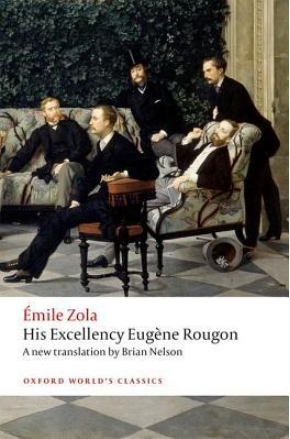
Zoladdiction 2022: His Excellency Eugene Rougon


To his father he owed his massive, square shoulders and heavy features; from his mother, the fearsome Felicite Rougon, who ruled over Plassans, he had inherited his strength of will, a desire for supremacy that scorned petty concerns and petty pleasures. He was without question the greatest of the Rougons.

Not one but TWO epic fails this week: I did not finish my Zola novel in time for Fanda's April Zoladdiction reading event, and I did not finish my selection for Classics Spin #29. In fact, I didn't even start my Spin selection. For both fails, I blame Zola. Sorry, Zola, but this book dragged so badly that it's squarely tied on the bottom Nana, the only one of his novels that I truly disliked.

His Excellecy Eugene Rougon is the sixth novel in the Rougon-Maquart cycle, and it's fairly short at 333 pages so I thought I'd have no trouble reading it in a week. I've owned this book for a couple of years but had putting it off because it's a political novel, which is not my favorite genre. Sadly, I was correct to be hesitant because I could barely finish it.


Basically, it's the story of the fall and rise and fall and rise again of a politician, Eugene Rougon, who makes appearances in the first two books of the cycle, one of the original Rougons, the bourgeois, legitimate side of the family . The book begins when he has resigned his post in the ministry. As he's attempting to pack up or burn documents in his office, a parade of hangers-on traipse through his office. This is the circle of friends and frenemies and political allies who are most of the recurring characters in the story. Before he leaves office, many of them are still trying to get favors or score points. 

The rest of the novel is basically Rougon and the group scheming, gossiping and back-stabbing one another to achieve their own ends (or example, one character is desperately trying to get a train line re-routed so it's closer to his factory, which will then increase its value). Often Zola will begin a novel by throwing a lot of characters at the reader, and normally they sort themselves out and become distinctive to me, but I had a really hard time keeping all the characters straight in this one, because they were all sort of awful, and not even in an interesting way as in some of the other books in the series. 


Maybe this was the wrong time for this book. There are so many political scandals right now in real life I can hardly keep them straight, and reading about them in 19th century France is even harder since I don't really understand the context very well. After reading the introduction (which I always save for last because of spoilers), I realized that many of these characters are based on real people and there's a lot of satire involved which would have been obvious to contemporary leaders but was lost on me. I didn't particularly find Rougon to be a very well-developed character and I didn't much care for the other main character, a politically savvy schemer named Clorinde who is basically a female version of Rougon. At one point she suggests that they marry but Rougon points out that two such people in a marriage would be a disaster). 

He loved power for power's sake; free from any vain lust for wealth or honours. Crassly ignorant and utterly undistinguished in everything but the management of other men, it was only in his need to dominate others that achieved any kind of superiority. He loved the effort involved, and worshipped his own capability. . . . He believed only in himself; where others had arguments, Rougon had convictions; he subordinated everything to ceaseless self-aggrandizement.

My other issue with the book was that great sections of it are Zola telling the reader what characters do or have done instead of actually describing or showing it. The parts when there are actual activities and dialogue are much more interesting than the narrator passively explaining it. Towards the end of the book there's a chapter when people are actually doing something and it was the best part of the book, but I had to get through eleven or twelve chapters to actually get there, which was a real slog. And there's SO MUCH gossip! So much scheming, it's kind of exhausting. I guess that's politics though, so maybe this just was not the book for me, or maybe it's just not the right time. But this book is definitely at the bottom of the Zola ranking for me. There are only four more books in the series left that I haven't read and I certainly hope those are better, I'd hate to finish reading Zola with a whimper instead of a bang.

I'm counting this as my Classic in Translation for the Back to the Classics Challenge; and as my French selection for the European Reading Challenge. 


Saturday, July 24, 2021

The Dogs and the Wolves by Irene Nemirovsky


The outside world was full of shapes and colors that were impossible to remember for ever, constantly lost, but seeking them out, pursuing them, was the most precious thing on earth.

"It's not my fault," she thought. "It's because I just can't forget certain faces once I've seen them, or certain houses, or certain sights. They're indifferent or fickle because they remember nothing. But I can't forget, I can't. It's a unique curse that makes me recall every feature, every word, every moment of joy or pain once they have struck me.


A couple of months ago I was looking for books set in the Ukraine for the European Reading Challenge, and I found The Dogs and the Wolves by Irene Nemirovsky. I've read several of her books and enjoyed them all, and this one sounded perfect -- Ukrainian writer, set in the Ukraine and Paris (so it also counts toward Paris in July); also the title fit one of the categories for the Back to the Classics Challenge. And it's just over 200 pages! It sounded like the perfect book.

Oddly enough, it was hard to track down, not a single copy in any library nearby; in fact, I don't think it's ever been reprinted in the US. I found a cheap used copy online and was looking forward to reading it. 


It's the story of four cousins: Ada Sinner; her first cousins, Ben and Lilla; and their distant cousin Harry. They're all around the same age and are born around the turn of the century in the Ukraine. Ada lives with her widowed father Israel and after her uncle dies, her widowed aunt and two of her cousins, Ben and Lilla, come to live with them. Harry, their distant cousin, is from a side of the family that is extremely rich, and they've never met him as he lives in the lower, wealthy part of town (they've seen him and his house from afar but never actually met). Their paths first cross during the pogrom when Ukrainian Jews were targeted by Russian soldiers. Ada and her cousin Ben are running from a mob when they manage to escape to their cousin's property and beg for help. 

The spoiled, cosseted Harry is aghast at the appearance of his cousins, who are poorly dressed and are bedraggled from their flight. Ada and Ben are swept away from their cousin, but are fed and introduced to an uncle, who eventually gives Ada's father some work. He becomes more prosperous and when the children are teenagers, he can afford to send them and their aunt to Paris just before World War I breaks out. Eventually, Ada learns that Harry is also in Paris. She's been fantasizing about him her entire life, and though Ben is in love with her, she's determined to find a way to meet Harry.

If this sounds like a lot for a 200 page book, well, it is. The plot was interesting, but I found it and most of the characters really undeveloped. Lilla basically disappears and I didn't get much sense of Harry's character at all -- it just seems like Ada is obsessed with him because he's rich. It almost seemed like a first draft rather than a finished novel. It was Nemirovsky's final published work, in 1940, just before the Nazis banned the publication of books by Jewish authors. (Nemirovsky was arrested in 1942 and deported to Auschwitz, where she died of typhus a month after arrival). 

What really disturbed me about the book, though, was not the under-developed plot and characters but was the shocking anti-Semitism. There are repeated stereotypings of Jews that made me aghast. I was not expecting it and I was gobsmacked. I haven't read all of her books yet but I've read quite a few and I don't remember any anti-Semitism in the others. Some of the writing was wonderful but this is not a book I really want to read again.

. . . she mustn't find more ways to feed a dream that was gradually becoming less, damaging, only half real, half imagination. As she grew up, she had become more and more distance from it, just as you forget a book you read and loved passionately when you were a child. You may still love it, but back then, you believed in it. Now you realize that it was nothing but poetry, fiction, an illusion, less than nothing. . . . 

I'm counting this as my Ukranian selection for the European Reading Challenge and as my Classic About an Animal for the Back to the Classics Challenge.

Tuesday, July 6, 2021

Paris in July 2021


It's back! Hosted by Tamara at Thyme for Tea, Paris is July is one of my favorite summer reading events. I have six possible reads this month, hopefully I'll get through at least three of them. Here's what's on the list:


The Complete Claudine by Colette. I read Colette's biography last summer and hope to finally finish the Claudine novels this year. 


Maman, What Are We Called Now? by Jacqueline Mesnil-Amar. Don't be too impressed, I won't be reading this in the original French! The only English-language edition is the Persephone which just has a plain grey cover. I really love the cover image on this French edition. 


The Dogs and the Wolves by Irene Nemirovsky. Takes place in both Paris and the Ukraine, so I can count it as my Ukranian read for the European Reading Challenge. (Also for my classic about an animal for the Back to the Classics Challenge!)


Renoir, My Father by Jean Renoir. Bought at the Frick Museum bookshop at least five years ago. I've really been obsessed with art lately, so I definitely plan on reading this one. 


Emile Zola by Alan Schom. I found a used hardcover edition last year on a visit to Second Story Books in Rockville, Maryland. I don't know if it's the best biography of Zola but it was a bargain and I couldn't resist it. 


The Bright Side of Life by Emile Zola. The twelfth novel in the Rougon-Macquart cycle. I've read 15 of the 20 novels, the end is in sight! (Then I guess I'll have to go back and read them all again, this time in order). 

So that's my reading list for this year's Paris in July! I'm also planning to watch lots of French movies and eat French pastries -- might try to make some homemade macarons! Bloggers, what are you reading this year for Paris in July? 

Thursday, April 29, 2021

Zoladdiction 2021: La Debacle by Emile Zola

It's April and that means Fanda's annual Zoladdiction, a celebration of the life and works of Emile Zola (1840-1902). After putting it off for several years, this time I decided to tackle La Debacle, the pentultimate work in his Rougon-Macquart cycle. A story of fictional people in the Franco-Prussian war of 1870, it's considered one of the best war novels of all time, and was Zola's most popular novel when it was published in 1892.

I've been really daunted by this one because it's by far his longest, more than 500 pages, and honestly, I am not a fan of war novels. I'm very bad at following extended action scenes in novels, and I'm much more interested in the social aspects of wartime than of military strategy and maneuvers. I'm normally good at picturing descriptions of scenery and landscapes in my head as I read, but if there's any kind of action, my mind tends to wander. So I was not looking forward to 514 pages of battle scenes.


However, I persevered. The story begins in August of 1870. After the Second Empire declared war on Prussia, the French were pushed back over the borders of western France, in the Alsace-Lorraine region. The main characters of the story are Jean Macquart, who has rejoined the military as a corporal after the disastrous events of La Terre (The Earth); and the soldiers in his regiment, mostly Maurice, who is of a higher class, but is a less experienced soldier. At first Maurice is condescending to Jean, but eventually they become close friends after Jean looks out for him during the course of the war. 

As the story begins, the French had planned to march on Berlin and assert dominance over the Germans, but are quickly pushed back by the superior and more organized Prussian army. (The French were so confident of victory they only brought maps of Germany, and none of western France, leading to mass confusion). Much of the first quarter of the book consists of various regiments basically marching around France, not knowing exactly what's going on, and trying to find food and shelter from terrified and suspicious peasants and villagers. It's pretty much a disaster. 

Portrait of Zola, 1902, Felix Vallotton

We finally get to the actual battles in the second quarter of the book, with a lot of battle descriptions in the fields outside the towns, and the siege of the town of Bazeilles, home of Henriette Weiss, the twin sister of Maurice. After Maurice and Jean take a night's rest inside the Weiss home, the story begins to follow Henriette and her husband, and his employer Delaherche, the owner of a dye factory where the military sets up a temporary hospital. There's also another side character, another soldier in their company called Honore, whose heart was broken when his father wouldn't let him marry the girl he loved, Silvine. Silvine was devastated and has since had child by a Prussian jerk named Goliath, who then refused to marry her. However, Honore still loves her and ironically, Silvine and the child are now living at his father's farm as she has nowhere else to go.


For me the book really picked up when it was more character-driven. Zola is really good at creating realistic characters, and his depiction of how the war affected the civilian population was really good. Of course I'm always more interested in the social aspect than the military and political side. My mind did tend to wander when Zola was describing all the political events and military maneuvers as the war goes from bad to worse for the French, and the Prussians take over. 

The fighting doesn't stop, however, and Weiss ends up going back to Paris. Unbeknownst to all of them is the upcoming siege of Paris and the Paris commune! Things are going to get worse! The short version is that after a months-long siege of Paris by the Prussians, overthrow their own government and all hell breaks loose inside the city, culminating in a bloody week when more than 20,000 people died and much of the city burned to the ground. I've been to Paris several times and I am aghast that I had no idea that this happened.

Despite all the politics and warfare, I ended up really liking this book, though it's a lot to take. There is a LOT of violence and pretty detailed descriptions of deaths on the battlefront, executions, wartime hospitals (including amputations), disposing of bodies, and just general unpleasant things that happen in wartime. Might not be the best choice if you like to read and eat at the same time. 

The hardest parts for me to read were definitely the military actions and the history of the politics that were going on, culminating in the Paris commune. I was a history major but I haven't read that much academic history for a long time, and Zola crams in a lot of facts, names, dates, and places, and it was tough to keep everything straight. I absolutely understand why he had to include all of it, but it wasn't my favorite part of the book.  I read the Oxford World's Classics edition, pictured above, which includes a lot of resources in the endnotes, timelines, and maps, which were great. There's also a list of the characters, the first one I've seen in a Zola novel. 

Until I started reading this, I also didn't realize that much of the action takes place a fairly short distance from where I spent three years in Germany! There's a lot of mentions of cities and towns that I actually visited, like Strasbourg and Metz, which are a fairly easy drive from our house in the Rhineland. I'm quite sorry now that I didn't read this while I was living there -- I certainly would have paid closer attention while I was on day trips and maybe even tried to trace the route of the armies. (It makes sense why the U. S. military built an enormous base nearby for its strategic location.) And I visited Paris multiple times when we lived there, but not once did I visit Place Vendome and many of the other important sites mentioned. I guess I'll just have to go back someday! 

I'm counting this as my Classic in Translation for the Back to the Classics Challenge. Thanks again to Fanda for hosting Zoladdiction 2021 and inspiring me to finally read this book!

Thursday, February 11, 2021

The Short Reign of Pippin IV by John Steinbeck: A Little Mid-Century Satire


I was stuck in two very long books last week (that I wasn't particularly enjoying) and in desperation, I took one of the shortest books off of my owned-and-unread shelves: The Short Reign of Pippin IV by John Steinbeck, a vintage hardcover of only 164 pages, most likely purchased at one of the library sales. I've loved mostly everything by Steinbeck so far and it was very short, so I thought this might be just the thing to get me out of my reading funk.

Published in 1957, Pippin is Steinbeck's only work of political satire. Pippin Heristal, aged 54, is living a comfortable if somewhat dull existence in Paris with his wife and daughter. He has a lease on an apartment (oddly enough, in the mews of the French President), and he doesn't really work but has a small but adequate income from a vineyard, spending most of his time as a well-respected though amateur astronomer. 

During a week-long meteor shower that keeps him up all night and sleeping all day, Pippin is blissfully unaware of a government crisis. The multiple parties are in an uproar and one desperate politician suggests a return to the monarchy. After much in-fighting, it is decided that the living descendant of Charlemagne should be the rightful King of France -- the eponymous Pippin. 

Politicians have decided that since it's worked for the UK for so many years, it would be good for tourism and distract the public so they can get on with the business of governing. Much to his chagrin, Pippin is forced to move in to Versailles and go through with a coronation. Meanwhile, his bohemian daughter Clotilde has taken up with a Tod, young American tourist, heir to a vast chicken-farming fortune. 

Pippin hates the role instantly and is desperate to get out of the drafty palace and its hangers-on, and back to his beloved telescope. He finds solace and advice from some colorful side characters -- his uncle Charles, an antique dealer of dubious morals; and Sister Hyacinthe, his wife's old schoolmate, a former chorus girl who took the veil after retirement. He also finds comfort and insight from young Tod, who makes a mean Martini and is terribly insightful for one so young. 

This was a pleasant diversion, though there was more politics that I really wanted right now. I enjoyed the characters and there were some amusing bits, but the plot's not terribly strong. I finished it only a week ago and I've already forgotten the ending. I'm not terribly surprised that this one isn't as popular as the other Steinbeck novellas, it seems sort of dated. 

I'm counting this as my Classic Humor or Satire for the Back to the Classics Challenge and as my French selection for the European Reading Challenge

Tuesday, July 21, 2020

Paris in July: Secrets of the Flesh: A Life of Colette


Colette's 'virile' genius . . . justified the excesses of her life. "Let us give her the complete freedom of her actions," Rachilde exclaimed. "She is is one of those who would shake the stars while falling from the skies into the mud of our poor earth."

I'd only heard of Colette as the author of Gigi and Cheri -- I'd never actually watched either of the movies, nor heard of the Claudine novels until about a year ago, when I watched the film starring Keira Knightley based on this biography. I actually saw the film in a tiny movie theater in Nice, France, while spending a long weekend while we lived in Germany; normally,  I wouldn't spend precious holiday time watching a movie, but the theater was less than five minutes' walk from my hotel, and there was a late showing. And how cool is it that I saw a movie (albeit in English) about a French writer while in France?


So, naturally, I had to order Colette's biography Secrets of the Flesh as soon as I returned home. I didn't get around to it at the time, but it's a perfect summer read, for Paris in July and also the Big Book Summer Challenge. I'm always interested in the lives of writers, but I had no idea how scandalous and groundbreaking her life was. Considered the greatest woman writer of France, she wrote 30 books, plus plays, essays, screenplays, and published hundreds of articles and reviews as a journalist. She acted on stage and was notorious for her affairs with both men and women, and married three times. 

If you haven't seen the film, Sidonie-Gabrielle Colette (1873-1954) married the writer/publisher Henry Gauthier-Villars (known as Willy), 14 years her senior, when she was just 20. Willy published a lot of books written by ghostwriters, and when the couple was in need of cash, he took Colette's notebooks, loosely based on her childhood, and published the first story (under his own name) as Claudine at School, the story of a spunky and scandalous girl growing up in a country town. It became an instant success, and three more Claudine novels followed. Colette and Willy became a celebrated couple in intellectual and literary circles. 

Keira Knightley as Colette and Dominic West as her husband Willy

They also had a troubled marriage plagued by affairs on both sides (once with the same woman!) and eventually split. (It didn't help that in 1907 Colette discovered he'd sold the copyright to her Claudine novels for a pittance). Colette scandalized society by acting on the stage, sometimes semi-nude, and was publicly out as a bisexual. In one production, she caused a near-riot by kissing her female lover onstage. 

Like the Claudine stories, much of her work was semi-autobiographical, before or after the fact. Echoing the plot of Cheri, Claudine had an affair with her stepson Bertrand de Jouvenel from her second marriage (the half-brother of her only child) when he was only sixteen, and she was in her late 40s. The scandal was one of the factors for her second divorce. But the marriage to her third husband Maurice Goudeket (16 years younger than Colette) lasted until her death at age 81.

Colette's career spanned the Belle Epoque, World War I, the 1920s, the rise of Nazism, and World War II. Weirdly, she wrote for a pro-Nazi newspaper during the War, and her last novel has some seriously anti-Semitic overtones -- though her last husband was Jewish and was actually imprisoned by the Gestapo for a few months (he was only released due to the intervention of the French wife of the German ambassador. Maurice spent the rest of the war in Paris but the couple was always in fear of a second arrest).
Colette c. 1896 painted by Jacques Humbert
I don't think Colette is someone I would have liked to meet in real life -- she sounds very self-absorbed, probably narcissistic, and some of her actions were really questionable. She was a real paradox -- she didn't believe in feminism but she wanted to work; she was bisexual but didn't approve of her daughter's homosexuality; she wrote for an anti-Semitic paper, yet her husband was Jewish. Maybe she believed that she should be the exception? 

However, she did lead a fascinating life. I found it so interesting how she was able to make a career for herself as a writer and celebrity for more than fifty years, especially as a woman in that time period -- she wrote about 30 novels, plus plays, essays, and countless articles and reviews. It's very impressive for a woman to have been such a prolific writer in the first half of the 20th century, especially in France where women couldn't even vote until 1944. It's a really interesting look at life at the time period. Even though I've still only read one of her novels I found it an absorbing piece of social history. 

I do want to finish the Claudine novels (I have the Complete Claudine edition) and eventually Gigi and Cheri. I've also checked out the film version of Gigi from the library and hope to get to it by the end of the month. How's everyone else doing with Paris in July and the Big Book Summer Challenge?

Tuesday, July 14, 2020

Paris in July: The Misunderstanding by Irene Nemirovsky


I've been hard at work reading two massive books for Paris in July, and as a quick break, I picked up The Misunderstanding by Irene Nemirovsky. Her first novel, just 164 pages long, was first published in 1926. It's the story of an affair between Yves Harteloup, a young war veteran, and Denise Jessaint, a bored rich woman, the wife of another war veteran whom Yves met while both were convalescing at a military hospital. 

The two meet at the end of the summer in the resort town of Hendaye, on the south east coast of France. Yves was raised wealthy but lost nearly all his money due to poor wartime investments by his financial advisors. He's found a job and has barely enough to hold on to his family apartment in Paris, and his one indulgence is his annual holiday, to the town he visited as a child. There Yves meets the beautiful Denise when her toddler throws sand on him as he dozes on the beach. 

After he realizes she's the wife of an old comrade, Yves is initially annoyed to have his idyllic trip interrupted by someone from his past; soon, however, he begins to feel a strong attraction to the beautiful Denise. After her husband goes to London, leaving her alone (well, with the child and nanny), he becomes obsessed with Denise, who married for convenience and money. Soon the attraction is returned, and the affair begins.


Things become complicated when Denise and her husband return to Paris, and Yves has to return to his humdrum job. Denise wants more and more from Yves, but can only see him for brief snatches of time; Yves becomes despondent when he realizes he'll never be able to keep up with her wealthy lifestyle, and falls deeper into debt. It's far from a fairytale romance 

It was a quick read, and I finished nearly the whole thing in a single sitting -- a big change from the doorstoppers I've been working on this summer. Neither Yves nor Denise are particularly likable characters, but the story is so realistic, and the writing is so good that I found myself sympathizing with both of them. It's astonishing to me that Nemirovsky wrote this when she was only 22 or 23. 

This was a perfect read for Paris in July -- I could imagine myself in the neighborhoods of Paris and I even looked up some of the streets and neighborhoods on Google Maps as I was reading. I really wish I was in Paris this summer but armchair traveling through literature will have to do! I've now read six of Nemirovsky's works and would like to read her entire oeuvre. There's also The Mirador, an imagining of her memoirs by her daughter, Elisabeth Gille, published by NYRB Classics, and a biography. Her life sounds fascinating and tragic. 

Saturday, July 4, 2020

The Twisted Sword: The Pentultimate Poldark Novel


I can't believe I'm on the 11th novel in this series, and I never blogged about it. I used to read a lot of historical novels, then I kind of got away from them when I got hooked on mid-century women's fiction. I only started reading the Poldark series after watching the PBS series when it first aired, the summer of 2015 when I was in Outlander withdrawal. I loved the first series which covers the first two novels, and promptly read the first ten books in less than a year. I'm not sure why I stopped there but suspect it had something to do with our big overseas move to Germany the summer of 2016. Our new library didn't have the last two novels, but on a trip to London that summer, I went to three different bookstores to find them -- and promptly left them gathering dust on the TBR shelves until now, prompted by my Big Book Summer Challenge

It is a little hard to get back into a series after a four-year reading gap (some of the supporting characters were a little fuzzy, but my edition thoughtfully included a family tree), but essentially, the book picks up pretty soon after the previous book, in the peace of 1815. Ross and Demelza's older children are grown and married, and Ross gets a summons to help out as an "observer" in France (and gets a baronetcy thrown in for good measure). Ross, Demelza, and the two youngest children head off to Paris, for what seems to be a good time, but that wacky Napoleon escapes from Elba and makes a triumphant return. [Bonus: this book also counts for Paris in July!]


This cover reminds me of a YA fantasy novel. 
Ross is on an assignment and gets separated from Demelza and the children, who flee to Brussels, where she meets up with her oldest son Jeremy and his new bride. Ross gets caught up in the war, so I had another perspective of the Battle of Waterloo, my second this year! But from the Coalition (Allied) side this time. My knowledge of French history is quite fuzzy and I didn't realize that Waterloo actually took place after Napoleon escaped from Elba, shame on me. There are a lot of descriptions of the horrors of war. I have been meaning to read La Debacle, Zola's masterful war novel, this summer, but maybe I'll put it off. 

Nice cover on this edition, I think it's the Polish translation


.
Sadly the war doesn't end well for everyone in the book. Meanwhile, back in Cornwall, the eldest Poldark daughter Clowance and her new husband are having money troubles, no thanks in part to George Warleggan. There are also some appearances by George's son Valentine; everyone's favorite doctor, Dwight Enys; and some local color with a pregnant housemaid who may or may not marry a local guy to give her baby a father. 

After a bit of confusion, I settled nicely into this 656 page chapter of the Poldark family, and ended up racing through it in less than a week. It's amazing how fast I started to remember details and characters (though a few are still a bit fuzzy and I've already requested the previous book from the library, so I can skim through it). Winston Graham was really good at creating the world of Cornwall from the time period. I loved most of the good characters and became outraged at the bad ones (George Warleggan has been carrying grudges against the Poldarks for how many years now?)

My only quibble was that the youngest daughter, Isabella Rose, is only THIRTEEN when the book starts and men are already courting her, ewww. I think Graham was setting up the story for the final book which is named after her. It's another 688 pages and I'm sure I will read it with enjoyment and more than a little sadness because the book series is ending. I've watched most of the TV series and unfortunately have gotten really bored with it, I didn't even finish the final season. Maybe I'll have to give it another try after I finish the final novel. I also own another long novel set in Cornwall called Penmarric and I'm looking forward to that one also.

How's everyone else doing with their summer reading? And can anyone recommend another great historical TV series and movies? 

Wednesday, June 17, 2020

Paris In July 2020


It's the summer, so that means Paris in July! Hosted by Thyme for Tea, it's an annual month-long celebration of all things French -- books, movies, films, and food. I haven't participated every year, but I've always enjoyed following along. This year, I'm hopefully going to knock a few books off my owned-and-unread shelves. Some of them also qualify for my Big Book Summer Challenge.


From top to bottom: 

Maman, What Are We Called Now? by Jacqueline Mesnil-Amar
The Misunderstanding by Irene Nemirovsky
La Debacle by Emile Zola
Renoir, My Father by Jean Renoir
The Complete Claudine by Colette
Secrets of the Flesh: A Life of Colette by Judith Thurman

That's six books, three of which are more than 500 pages long. My list includes fiction, a WWII diary, a memoir, and a biography. Of course I probably won't finish all of them but even half the list would be an accomplishment.


I also have some French language and French-themed films and TV series to watch:

Blind Date (Netflix)
The Bonfire of Destiny (Netflix)
Call My Agent! (Netflix)
Cezanne et Moi (Netflix)
A French Village (Hulu/Amazon Prime)
My Life as a Zucchini (Netflix)
Suite Francaise (No longer streaming on Netflix in the USA, but I have the DVD)
Twice Upon a Time (Netflix)


And if I get around to it I might try and make some macarons and eclairs as well!


Bloggers, which do you recommend? Or other books, movies, or TV shows about France? And what are you reading for Paris in July?