Showing posts with label middlebrow. Show all posts

Sunday, September 4, 2022

Mr. Skeffington by Elizabeth von Arnim


I found this book several years ago at an antique bookstore in Fredericksburg, TX, a very cute little town outside of San Antonio, full of boutiques and antique stores. Or maybe it was Boerne -- so many quaint places in the Hill Country, I can't keep them all straight. Anyway, I was pleased to find a first edition of a book by Elizabeth von Arnim, one of my favorite writers. Naturally it sat on the shelf for a good ten years before I finally decided to read it. 

Lots of Italian reprints of von Arnim's novels.
Nice cover but it really doesn't reflect the mood of the book.


So. Published in 1940, the book begins with Lady Frances (Fanny) Skeffington, who is recovering from a serious illness. She's on the verge of her 50th birthday, and is basically going through a mid-life crisis. In her early twenties Fanny married a rich older man, Job Skeffington, to save her beloved brother's estate, but finally divorced him after his multiple affairs with office girls. She never remarried but for the last twenty years or so has had multiple romances with various men. Now nearing 50, her stunning beauty has faded and she begins to consider her past life and relationships; also, she keeps having visions of her ex-husband Job. 

Nice cover on this French edition

First Fanny consults unsuccessfully with a famous London specialist, whom she finds insulting; then, she decides to revisit all her past lovers, which becomes more and more embarrassing as she acknowledges that they were really all attracted to her by her stunning beauty -- another Helen of Troy, much like Lady Ruby MacLean in The Loved and Envied. Time and illness have stripped her of her looks and most of her past lovers and friends are shocked at her appearance. 

Apparently this novel was much beloved and even adapted into a movie starring Bette Davis, but it isn't my favorite of von Arnim's novels. I found it really sad and kind of painful -- Fanny really needs to find validation from men, and she isn't getting it. (And most of her female friends were really pretty unpleasant). I don't know if it was supposed to be funny or if von Arnim was trying to make a point about women in the mid-century. This was her last novel and she herself had an unhappy first marriage, then an affair with writer H. G. Wells, and an unhappy second marriage. 


The other issue I had with this book was the anti-Semitism. Fanny's ex-husband Job is Jewish, and this is brought up multiple times in a rather uncomfortable way. (There's also another awful character who has recently returned from the South Pacific and is really racist, but he's clearly meant to be terrible).  Without giving away the ending, I will say that Fanny takes the high road, but I was really wondering how this would all pan out, especially with the backdrop of the War and Jews in Europe, which is finally acknowledged. So it all basically comes right in the end but the whole book was just kind of awkward and uncomfortable for me. I cannot imagine how this translates to a film, but it's available for rent on Amazon for only $3 so I might give it a try, though I honestly don't see Bette Davis as Fanny. 


So, not among my favorites of her novels, but I still have three left on the shelves unread -- The Caravaners, Vera, and The Jasmine Farm. I'm really hoping I like those better. 

I'm counting this as my Classic by a Woman Author for the Back to the Classics Challenge. 

Tuesday, July 26, 2022

Paris in July 2022: The Loved and Envied by Enid Bagnold


My fourth book for this years Paris in July is The Loved and Envied, a Virago reprint I've owned for several years (I can't even remember where I bought it -- it has the price in USD). Originally published in 1951, it's a novel for adults by Enid Bagnold, most famous for her children's book National Velvet (which I've never seen nor read).

Inspired by the life of Lady Diana Cooper, it's the story of aristocratic families living in Paris after WWII. Though their titles are French, some of the characters are actually British. Most of the action is centered around the beautiful and charismatic Lady Ruby Maclean. Now in her mid-fifties, she's has been happily married to Sir Gynt Maclean for many years, but has always had a large circle of admiring men who find her irresistible -- Sir Gynt first saw her while walking down the street and instantly fell in love with her at first sight. She's basically Helen of Troy and men will do anything for her, much to the chagrin of her only daughter Miranda, who has always been overshadowed by her mother.

Also in the Macleans social circle is Edouard, the elderlyVicomte de Bas-Pouilly and his mistress Rose; Alberti, the Duca de Roccafergolo, who rents a cottage on the Vicomte's estate; Rudi Holbein, a famous playwright; and his ex-wife Cora, an artist and great friend of Lady Ruby. 

The Virago reprint. The cover image is the portrait of Lady Diana Cooper by J. J. Shannon.

The story begins the opening night of Rudi's latest play, with most of the characters in attendance, and what follows over the next few weeks. It's another book in which not much happens, yet many things happen, largely character driven. Most of the characters are aging aristocrats and much of the story concerns aging and mortality, particularly the question of aging beauty. Lady Ruby is 53 and still all the men hover around her, even those young enough to be her sons. 

The original 1951 cover

The story jumps around quite a bit at the beginning giving back story to all the characters surrounding Lady Ruby and their relationships to her. The first half was almost like a set of short stories about them before they actually got to the main character. Honestly, I don't even remember much about her except the many descriptions of how beautiful she is and was, and that got a little tiresome. It's well written and I liked a lot of the characters, but I found everyone besides Lady Ruby to be far more interesting than she was and would have loved to read more about them and less about her. I particularly liked the back story of Cora Holbein and would happily have read an entire novel about her.

One thing I didn't particularly like was (yet again) some of the persistent racism and some homophobia. Ruby's daughter Miranda is living in Jamaica for part of the book and there are some unfortunate slurs. There's more than one gay character and at first I thought the book was surprisingly progressive, then another gay character showed up at the end and yikes some of it was pretty cringe-worthy. I suppose I shouldn't be surprised since it was published in the 1950s but I still hate it.

Though nearly all the story takes place in France, many of the characters are British so it doesn't feel especially French. It was an interesting look at aristocrats of the period but it isn't one of the best Viragos I've read so far.

This is my eighth book completed for the TBR Pile Challenge.

Tuesday, July 5, 2022

Paris in July: The Martha series by Margery Sharp


I thought I'd start Paris in July with a short, fun book. Margery Sharp's Martha in Paris fit the bill perfectly -- only 166 pages and it was one more I could cross off my owned-and-unread pile. However, when I bought this at Strand Books several years ago I didn't realize it was second in a series. Naturally I would need to read them in order, so I had to track down the first book and buy that one too, though it's set in London, not Paris.


Published in 1957, The Eye of Love is the first book of the Martha series. Set in 1932, it begins with Martha's aunt, who was christened Dorothy Hogg but now goes by the name of Dolores Diver. Miss Diver, on the wrong side of 30 and fading, has just been left by her longtime lover Mr. Gibson, who is about to become engaged to the daughter of an associate, in order to preserve his failing furrier business. Times are hard and during the Depression, furs aren't selling well. Mr. Gibson and Miss Diver are despondent, but there's nothing to be done. He must leave his Spanish rose to marry an annoying woman he doesn't love. The least he can do is pay the lease on their love-nest through the end of the year, and give her all the contents which they've accumulated.

Miss Diver is also the guardian of her orphaned niece Martha, now ten years old and obsessed with drawing -- so much so that she basically eludes school and spends all her time sketching trees, stoves, and anything that catches her fancy. One day while sketching a tree she meets Mr. Phillips, who is looking for new lodgings, and he becomes their boarder, but soon suspects Miss Diver has some money and decides to make a play for her. 

I love this pulp novel cover - so dramatic! 


Meanwhile, Mr. Gibson has merged his business with the charming and steadfast Mr. Joyce, his future father-in-law, and they soon develop a deep friendship -- much more so than with his future wife Miranda. He cannot bear the thought of marrying her instead of Miss Diver but doesn't see any way around it. Coincidentally, Mr. Joyce, a lover of art, also encountered young Martha while sketching and sees that she has talent. Naturally all the stories converge, and without going into too much detail, I'll only say that it's witty and charming and has a very satisfactory ending. 


I really enjoyed it and was also enchanted by the sequel, Martha in Paris. The story has jumped forward and Martha is now eighteen. Mr. Joyce is now Martha's patron and decrees that she MUST study in Paris. Martha is still obsessed with her drawing and resists at first, but then sees the advantages and begins studying art while staying with a widow and her daughter. She's very focused and is oblivious to everything else -- in once instance, she doesn't even realize that while sketching in the Tuileries Gardens, the nice young Englishman named Eric sitting next to her is asking her out on a date. In a very amusing turn of events, she turns his invitation to Friday night dinner with his mother into an opportunity for a really good bath in their renovated English-style tub. 

This book is equally witty and charming and surprisingly feminist for its time (first published in 1962). Martha is portrayed as an artist completely focused on her work, but she actually struck me as someone who today might be considered on the autism spectrum. She's completely obsessed with drawing and art, and really bad at picking up at social cues. I'm no expert but if the book were published today I think readers would really speculate about that. 

This cover is just SO WRONG it's laughable. 
Martha wouldn't be caught dead in stockings and black pumps.
It's so bad I had to include it. 


My one tiny quibble about this book is that if the first book starts in 1932, the second would be set squarely in WWII and the French occupation of Paris. There is not a single mention of this and people are traveling back and forth over the Channel from England,so clearly, this book is set in an alternate universe in which the war never took place (but now I'm nitpicking).

I don't want to give away too many details for fear of spoilers, but Martha in Paris ends on such a cliffhanger I absolutely had to find out what happened next, and I found a online copy of the final novella, Martha, Eric and George online and read the whole thing in a couple of hours. If I gave any but the loosest setup it would absolutely spoil the plot of the second book. The third books picks up immediately after the end of the second, and after a couple of chapters, jumps forward ten years later with Martha as a successful artist who has to finally deal with the fallout of her actions in the end of the second novel. I loved the third novel as well as the first two but I do think it ended rather abruptly. 

I love this retro cover.


Like the second novel, it's also very feminist for its time (1964). Like Martha, author Margery Sharp was very successful and focused on her work. I also wonder if Martha's devotion to her work was a reflection of Sharp's own feelings about women working. I'm guessing some people will find Martha unsympathetic but if she'd been a man no one would have raised an eyebrow at her absolute dedication to her work and confidence in her talent. 

I've now read a dozen of Margery Sharp's books for adults (she also wrote the Rescuers children's series adapted into two animated Disney movies.) I've really enjoyed all of them and I'm happy to report many have been reprinted, including six recent paperback editions by the Furrowed Middlebrow imprint of Dean Street Press. The DSP editions are available on Kindle for around $3 or $4 US, a real bargain, and I'm sure I'll be downloading some of them soon. 

Tuesday, June 28, 2022

The Feast by Margaret Kennedy

Cover of a 1969 reprint. This one is pretty much perfect.

So, how is everyone's summer reading going? Anyone in the mood for a beach read that turns out to be full of death and destruction? The Feast by Margaret Kennedy was reprinted last summer and WOW. I put it on my Christmas list last year and saved it to read until this summer. If you're looking for a summer read that packs a real punch, this is it. 

Published in 1949, this is basically a morality tale that tells you upfront that people are going to die -- this is NOT a spoiler, it's the setup. The book begins a prologue: the annual meeting of two friends, a minister in Cornwall and his summer visitor (they're hardly in the book, so their names are not really important). They normally begin the visit with an evening of chess, but the host needs to put off their game in order to finish a sermon for the following day -- a eulogy for a group of people who tragically perished when a cliff collapses on top of a summer resort, leaving nothing but a massive pile of rubble. 
However, we do know that there were some survivors among the resort's guests -- but who? 


The copy of my edition.
Nice, but I don't think it really reflects the setting of the book. 

The book then jumps back seven days and describes the final week of the resort and its inhabitants. Set in 1947, the Siddal family are struggling to make ends meet in their ancestral home on the Cornish coast and have converted it to a boarding house, not so much a hotel. Mrs. Siddal is trying to make a go of it but her husband has mentally checked out and doesn't lift a finger, hiding in a room under the stairs. Her three grown sons help but are ready to leave the nest. There are also some servants including Miss Ellis, a snobbish, gossipy housekeeper and Nancibel, the loyal housemaid. Then there are the guests, including two families, the wealthy Gifford family with four children; the Coves, with three; an unhappy couple, the Paleys, who are grieving for their dead daughter; plus an obnoxious clergyman, his put-upon daughter Evangeline; and a late arrival, a bestselling author and her chauffeur. It's almost like an Agatha Christie novel, but instead of a murder, it's a natural disaster, and the reader has to work out who will live and who will die. 

The original 1949 cover. Good, but I like the 1969 cover better. 


This book took a bit for me to get into, but after the first few pages, I was hooked. It's divided up by the seven days of the final week for the resort, and each has many short sections (too short to really call chapters) covering the many characters in the book. And there are a LOT of characters, more than twenty. Some of the children are really minor characters, but it didn't take long to keep everyone straight. They're mostly really well developed and the plot got me completely engrossed, so I was able to speed through it quickly -- it's more than 400 pages long, and the last day I read almost the last hundred pages in a single sitting. It is THAT GOOD. 

A French edition from 1956


Towards the end I began to have a terrible sense of foreboding -- of course the reader already knows that disaster is looming but there is a lot of foreshadowing. I absolutely had favorite characters and I was dreading the end because I'm always worried if someone I like will be killed off. If you want hints about the plot and the outcome, feel free to read the introduction which gives some very strong hints. I have given up reading introductions because of spoilers so I was blown away by the ending. I am glad that I did go back and read it because there was some subtext that I had definitely missed. 


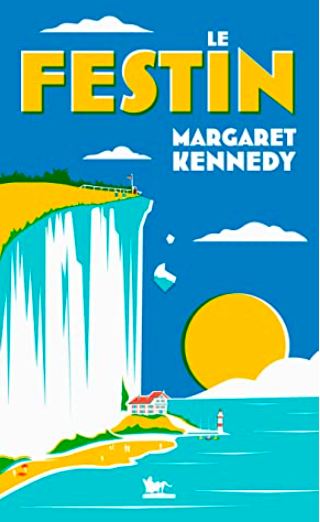
A new French reprint. Good, but a little too cheerful for what's inside the book.

This is an absolutely brilliant book and I know it will be one of my top reads of the summer, if not the entire year. I've only read one other book by Margaret Kennedy, Troy Chimneys, which is also good but very different from this one. Several of her other books are still in print including her other most famous book, The Constant Nymph, which I also own and will definitely move up on the to-read pile. 

I'm counting this as my Classic Set In A Place You'd Like To Visit for the Back to the Classics Challenge. It's also the first read for my Big Book Summer Reading Challenge.

Tuesday, June 14, 2022

A Pin To See the Peepshow by F. Tennyson Jesse

In the history of the world it is only we -- we who are young now -- who are really going to know about life. 

I bought this Virago Modern Classic more than five years ago, after Simon and Rachel discussed it in the wonderful podcast Tea or Books? I was going to say "I can't believe I've waited so long to read this" but who am I kidding? I have more than 150 unread books and the pile never seems to grow any smaller. But I recently joined a Goodreads book group that discusses middlebrow books and it was their June pick! (The group has also caused me to buy more books, so I don't know if it's really a win. I'm really enjoying the books though).

It took me awhile to get started, but I zoomed through this book in only three days -- pretty good since it's just over 400 pages. It's one of several books inspired by the Thompson/Bywaters murder trial in the 1920s. I knew nothing about the case other than what I'd heard on the podcast several years ago, and I remembered none of it -- I couldn't even recall who the murder victim was though I had my suspicions. 

I really liked this book but I was surprised at how long it took to get to the actual crime, more than 300 pages. It's really a character study of a young lower-class woman growing up in the Edwardian/WWI period. The protagonist is renamed Julia Almond and the story begins when she's off to school, aged about 16. As one of the upper-level pupils, she's tasked one day with briefly overseeing some younger students, one of whom has a tiny peepshow, a sort of mini-diorama you peer into through a tiny hole. This peepshow acts as a metaphor for Julia's life -- over the next ten years she's observing what she wants and will never have, due to circumstances beyond her control.

I think this is the original dustjacket.
Nice illustration but it doesn't even give a hint about the story.


Julia soon leaves school and studies fashion drawing and French, which leads her to a minor job at a fashion house in London. She's a quick study is working her way up in the business when the Great War begins. People are spending money like there's no tomorrow (and for some, there won't be) and she makes fashionable friends and hopes for a better, more exciting life. 

However, her father dies suddenly leaving Julia and her mother without enough to live on, and they are forced to combine households with her uncle and his family, including a younger cousin Elsa. It's tight quarters and they're obliged to share a room, which overwhelms Julia, and she makes the rash decision to marry an older friend of her father's, Herbert Starling, just to get out of the house. Having had a taste of independence, Julia isn't satisfied as the compliant little wife by the hearth that Herbert has envisioned, and the marriage is doomed from the start. Julia isn't a particularly likable character, but I absolutely sympathized with her frustration and lack of choices for women in the time period, particularly middle-class women who were judged by a much higher standard than lower or upper-class women of that era.  A Pin To See the Peepshow was published in 1934, about twelve years after the murder, and I wonder if it was quite shocking for its time as it covers some topics that are still pretty divisive today.

This book is very character-driven and Jesse takes a long time on developing Julia. Most of the other characters are also well drawn. The murder portion of the book is really only the last 100 pages or so and did feel a bit rushed in parts. The author does spend a good bit of time on Julia's thoughts during and after her trial, and thankfully leaves out a scene at the end which is probably best left to the imagination. My Virago edition also includes an excellent epilogue by the writer who adapted it as a 1973 mini series. (There's also a new British Library Women Writers edition which includes an introduction by Simon!) I was hoping someone had uploaded it to YouTube or other streaming service but I haven't been able to find it. It starred Francesca Annis who I can perfectly imagine as Julia. 

This is book #7 for the TBR Pile Challenge.

Monday, May 30, 2022

The World My Wilderness by Rose Macaulay


No civilization had lasted for more than a few thousand years; this present one, called western culture, had had its day and was due for wreckage, due for drowning, while the next struggled inchoate in the womb of the ensuing chaos, till slowly it would take shape and have its day. That day was unimaginable; it would be what would be; but already the margins of the present broke crumbling and dissolved before the invading chaos that pressed on.  

Published in 1950, The World My Wilderness is Rose Macaulay's penultimate novel, just before her most famous work, The Towers of Trebizond. I'd been meaning to read this forever and was lucky enough to find a paperback Virago copy a couple of years ago, on the free book cart in the lobby of the Ramstein AFB library. I can spot a green Virago spine a mile away so naturally I snapped it up. 

Just after the end of World War II, British expat Helen Michel is living in the south of France, in a small town near the Pyrenees, with her 17-year-old daughter Barbary, and her young son, child of her second marriage to a Frenchman. Her husband Maurice, suspected by many as being a collaborater, has died under mysterious circumstances, and Helen is living a quiet existence in their house, Fraises, when her oldest son arrives from Cambridge. After a visit, he returns to London, taking his sister back to live with their British father and his new wife. Also joining them on the trip is Barbary's stepbrother Michel, now orphaned, to live with his uncle. Fifteen-year-old Michel and Barbaray have been running rather wild with the Maquis, French resistors. 

The original 1950 hardcover edition


Not surprisingly, the move to London does not suit Barbary very well. Theoretically she's studying art but is also continuing to be rather wild, exploring the bombed-out buildings with Michel and making some rather disreputable friends. Her father, a British peer, attempts to 'civilize' her -- or rather, her new stepmother Pamela does -- but Barbary can't be bothered to put on makeup or look like a lady, much less sit in boring drawing rooms. Things take a turn for the worse when Barbary accompanies the family on a trip to Scotland to visit an uncle, a psychiatrist who would like very much to analyze her. 

I liked this novel but for a short book, only about 250 pages, it was surprisingly slow. I expected to rush through it but it really isn't that sort of book. It's quite description-heavy and the characters are really well drawn. I was surprised that as early as 1950 an author recognized the psychological effect the war must have had on so many people, including the young, since I've always thought PTSD and wartime trauma was mostly ignored -- Barbary's British father and stepmother were clearly very stiff-upper-lip type of people. 

Really like this Dutch-language edition from 1968

Barbary in particular is a very interesting character, she's both old beyond her years and also extremely childlike. I was very worried that something terrible would happen to her wandering about bombed-out London buildings alone, (and it does) but not at all what I was expecting. I also think the name Barbary is a little heavy-handed but again, it was published in 1950 so maybe that was a subtle hint for its time. 

I also quite liked the twist ending which I was not expecting at all. Overall, a very enjoyable book and an excellent summer read. 

This is my sixth book for the TBR Pile Challenge.

Thursday, April 21, 2022

1954 Club: Who Was Changed and Who Was Dead by Barbara Comyns


Within a few weeks funerals were to become a common occurrence in that village; but at this time they were rather scarce and looked forward to eagerly.

I've read several books by Barbara Comyns and was delighted to find out one of them had been published in 1954 -- perfect for Simon and Kaggsy's 1954 Club event. Even better, I found out my local library had a copy of this book, a weirdly twisted take on village country life. 


Set in Warwickshire during the early part of the 20th century, the story begins with a flood so high that ducks are swimming through the windows of the Wildweed family home, a large household consisting of Ebin Wildweed; this three children, Emma, Dennis, and Hattie; the matriarch, Ebin's cantankerous mother; and two servants, sisters Norah and Eunice. The banks of the nearby river have overflowed into the house and caused havoc throughout the surrounding villages.

The ducks swam through the drawing-room windows. The weight of water had forced the windows open; so the ducks swam in. Round the room they sailed quacking their approval; then they sailed out again to explore the wonderful new world that had come in the night.


It's the beginning of June and the floodwaters soon subside. What follows that summer is slightly sordid and increasingly unsettling; quirky and eccentric behavior among the village residents turns dark, violent, and tragic. I should probably give more details about the plot but I don't think I can without giving too much away.

This book was a quick read, less than 200 pages in a smallish paperback format. I could have probably read it in one sitting, but I did have to take breaks because I found it a little creepy. I've read six of Comyn's books and they've all been darkly quirky in a similar way. 


Some of her other novels have recently been reprinted by Turnpike Books and also by Daunt books; I've already ordered one of them, Mr. Fox. A couple of her works are nearly impossible to find, hopefully the reprints will find an audience and the others will follow. 

Thanks again to Simon and Kaggsy for organizing this reading event! I'm hoping to read two or even three more novels so fingers crossed I'll get them finished and posted in time. 

Saturday, January 29, 2022

The Peacock Spring by Rumer Godden (with bonus giveaway)

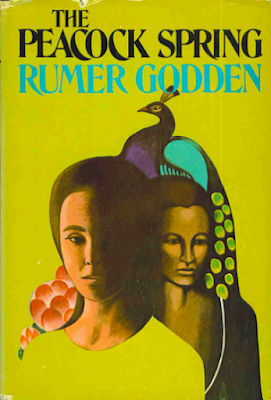
Cover of the 1975 edition, of which I now have 2 copies

As I read a lot of middlebrow fiction, Rumer Godden is a writer that's been on my reading radar forever. Last year I was browsing on the cart outside Alabaster Books in New York, a tiny used and rare bookstore that is often overshadowed by the much more famous Strand Bookstore on the opposite side of the block. I found a 1976 copy of Peacock Spring and paid the bargain price of $1. 

Then last weekend I was killing time in another used bookstore in Pittsburgh (touristy post to follow soon) while waiting for a rideshare. Lo and behold, I found another copy of Peacock Spring and started reading it as I waited. I felt guilty about spending so much time there so I felt compelled to buy the second copy (only $7) and read it that night and on the plane home the following day. That didn't work out exactly as planned but I did finish the book this week and HOO BOY.

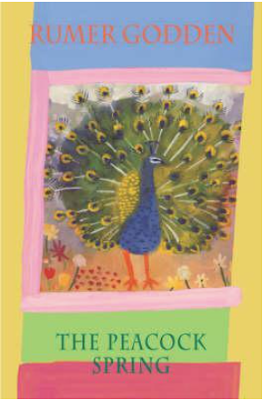
Cover of the 2004 paperback edition.
A new copy can be yours via Amazon $632. Or $695. I did not omit the decimal point.  
(Or a good used copy for 16 cents.)

Set mainly in post-Independence India, this is the story of Una Gwithiam, the teenaged daughter of Sir Edward Gwithiam, a diplomat newly appointed to a post in Delhi. Una and her younger half-sister are at boarding school in the UK when the headmistress tells her that she and her sister Halcyon (nicknamed Hal) are to leave their school and join their father in India, for reasons unexplained. Hal is thrilled but Una, more studious, is not, especially after she meets her new governess, Alix Lamont, a half-caste Eurasian who seems under-qualified. Una had had hopes of entering Oxford or Cambridge but now it seems those are dashed. Miss Lamont seems more interested in taking them sightseeing and socializing, and Una is forced to attempt higher mathematics on her own. This leads to a meeting with Ravi, an attractive young gardener who promises to secretly help her study. Meanwhile, Una and Hal aren't getting along with their governess Miss Lamont who seems to have secrets of her own. 

Rumer Godden was born in the UK but grew up in what is now Bangladesh (then colonial India), and moved back and forth before and after both world wars, so she knew India really well. The descriptions of India and of colonial life are really interesting, the highlights of the book for me. The book began rather slowly and it took awhile for me to get into, but by the second half I sped through it to find out what would happen -- which was sort of predictable, if somewhat problematic. And I don't mean problematic because of racism or classicism, which are definitely addressed pretty well, but problematic because of the age difference between Una and Ravi. Una is only 15 when the book takes place and though they never specifically Ravi's age, he's at least seven or eight years older than her which is pretty icky. There are definitely some consent issues in this book which made me absolutely cringe and want to throw the book across the room. 

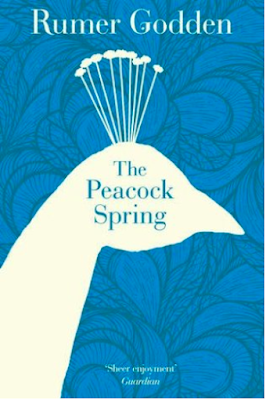
Cover of the 2013 edition. These do not cost $632.

I did, however, complete the book and I was not surprised at how it ended up. Overall it's interesting and I loved the descriptions of India, a country I've always wanted to visit, but it's definitely problematic. It was first published in 1975 but I'm not sure of the exact year in which it's set. There was a PBS Masterpiece adaptation in 1995 which set the story in 1959, but I don't remember it being specifically mentioned in the book, not that it really matters. 

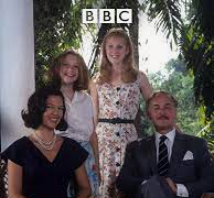
And I discovered the adaptation is streaming on Amazon Prime! I couldn't find any stills but here's an image from the website. Might have to check it out soon. 

That's a very young Hattie Morahan as Una, in her first TV role. 
I know her best as Elinor Dashwood in the 2008 adaptation of Sense & Sensibility

And now that I have two copies of the 1975 hardcover, I have an extra to share. (The $1 copy, not a $632). If anyone is interested in a free copy of this book, drop a comment below. If I have more than one person interested in the next week, I'll draw a name at random. Make sure you leave contact info so I can get a good mailing address! 

This is my second novel completed for the TBR Pile Challenge.

Saturday, May 22, 2021

Chatterton Square by E. H. Young


He pitied widows, but he mistrusted them.  They knew too much.  As free as unmarried women, they were fully armed; this was an unfair advantage, and when it was combined with beauty, an air of well-being, a gaiety which, in a woman over forty had an unsuitable hit of mischief in it, he felt that . . . all manhood was insulted . . . But he knew how to protect himself.

I bought Chatterton Square back in 2017 after Simon raved about it on his wonderful Tea or Books? podcast, and it would probably still be languishing on my bookshelves if my book group hadn't chosen it for their May read. (Yes, I did selfishly suggest it because I've been wanting to read it for so long!). I'm not a huge fan of Zoom but I do love that I'm finally able to see members of this group face-to-face, especially since many of them live in the UK. The group meets this afternoon to discuss it but I wanted to knock out a post of my own independent thoughts. 

This is another lovely Virago book in which not much seems to happen, but also a lot of things are happening. Chatterton Square by E. H. Young is the story of two families, the Frasers and the Blacketts, who live in the eponymous Chatterton Square in Radstowe, a thinly disguised version of Bristol. The Frasers are a single-parent household headed up by the beautiful Rosamund, and her five children. It's never said exactly how old the children are but the eldest Felix is just qualifying to be a lawyer, and the youngest two, Sandra and Paul, are still in school, so I'm guessing they're in their early teens. In the middle are James, a university student, and Chloe, who has finished school and is working in a dress shop. Their father, Fergus, is some sort of writer and has been absent from the house for several years, having absconded to somewhere on the Continent.

The household is completed by Miss Agnes Spanner, Rosamund's childhood friend and a spinster of many years. Rosamund grew up in the house and Agnes was the daughter of her father's business partner. After her parent's death she moves in next door to the Blacketts, headed up by Herbert Blackett, one of the best-drawn and most annoying men I have ever encountered in literature, a self-absorbed, snobbish, judgmental narcissist, and never have I wanted to much to jump into a book and verbally slap someone. The Blackett household also includes his long-suffering wife Bertha,who seems sweet but downtrodden, and his three daughters, one of whom, Flora, takes after him exactly. 


The original cover c.1947

Mr. Blackett sneers and belittles the Frasers to his own family at every opportunity, though he's secretly attracted to the free-spirited Rosamund. He also looks down on Mrs. Blackett's cousin Piers, a disfigured war veteran who has bought farm nearby and comes into town to sell vegetables. Blackett has always disliked Piers, ever since he returned from the war on the eve of his marriage to Mrs. Blackett, when he realized his bride cared more for her cousin but would never back out of her wedding; sadly, she realized on her honeymoon that she was trapped in marriage to a pompous ass. A friendship has struck up between Piers and Rosamund, which is another reason to dislike them both.

Meanwhile, their are potential relationships brewing between the children. James Fraser and Flora Blackett are students at the same university and have developed a mild flirtation, and middle daughter Rhoda has begun borrowing books from Miss Spanner. All of this is taking place under the cloud of potential war, which Mr. Blackett insists will never happen. As the book was published in 1947, contemporary readers, like ourselves, feel the tension since we know the inevitable is coming, which ratchets up the tension in the book. 

Cover of the new BLWW series reprint

I loved this book, though it took longer than I expected -- normally I can zip through a novel in just a few of days, but this was a fairly dense read. There's a lot that's implied and unsaid, especially about current events in the novel, and I often found myself rereading passages to figure out what was going on. It was also a bit frustrating because there is a lot that is unresolved -- if you want your endings neat and tidy, you won't like the end of this book, but since it's set on the eve of WWII, it would be unrealistic to expect anything else. 

What I loved most about this book is the characters and their interactions. As much as I dislike Mr. Blackett and his daughter Flora, they are beautifully developed villains, and I also how his wife Bertha began to grow and change. I also loved his middle daughter Rhoda who is my favorite character in the book. 

This is the third book I've read by E. H. Young -- I loved both Miss Mole and The Misses Mallett. I have three more of her books unread on the TBR shelves and had intended to read Jenny Wren for the Back to the Classics Challenge; however, I may put it off a bit more and try to ration out my E. H. Young books as long as possible (I also own the sequel, The Curate's Wife, and William.) I'm so happy that I finally finished this and am so looking forward to our discussion because I'm sure everyone will have a LOT of opinions about it!