Showing posts with label between the wars. Show all posts

Sunday, January 16, 2022

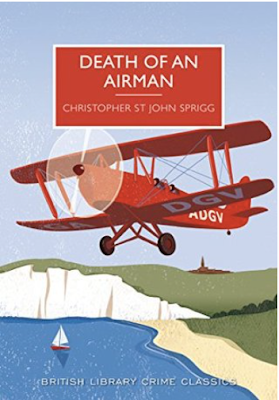
Death of an Airman by Christopher St. John Sprigg


My first book of the year! I'm so behind, can't believe it's taken me two whole weeks to finish a book. (At this rate, I'll never finish my annual reading goal of 100 books). I thought it would be fun to start the year with a mystery. I bought a stack of British Library Crime Classics on a trip to London a few years ago, and this one was a the the checkout -- I think if you bought three, you got one free, so I threw it on the pile. I cannot resist the covers, I love their vintage travel poster style. (I'm sure there's a name for it but I have no idea. If anyone is aware, please let me know).

Originally published in 1934, the story is pretty self-explanatory -- at a British airfield, a small private plane crashes, instantly killing the pilot. Or does it? One of the witnesses, an aviation student who also happens to be an Australian Bishop, realizes after the burial that there had been something odd: while waiting for the local doctor who was delayed, the body hadn't achieved rigor mortis, suggesting that the pilot hadn't actually died at impact, but much later. Further investigation reveals a gunshot wound -- clearly, a case of foul play. The investigation is taken over by a local policeman then heads up the chain to Scotland Yard as he starts digging deeper and reveals an international conspiracy. 

It sounded like an intriguing read, though I know nothing about aviation, nor do I have any desire to ever go up in a tiny plane. Sometimes readers don't need to have specific knowledge about a themed mystery -- until I started reading Dick Francis mysteries, I knew nothing about horse racing, but I never had any trouble following the stories. In this case, there was a lot of technical jargon which mostly went over my head. Plus, I feel like the story kind of meandered all over the place. I realize that it's in the nature of mysteries --  investigations always have leads that don't pan out and detectives have to keep exploring -- but it felt like it wasn't as tightly focused as some of my favorite classic mystery writers like Agatha Christie. I read all her books years ago and maybe she's just spoiled me for any other writer? Plus, this book was pretty sexist: 

"An intelligent girl," said Creighton. "I don't know why one is surprised when a good-looking woman has brains." Mmmkay. I get that it was written about 90 years ago but yikes. 

It was a slow read for me because I just wasn't that interested in any of the characters. It's less than 300 pages and it still took me about 10 days to read this book. It did pick up in the last fifty pages but not one of my favorite classic mysteries. I'm finding the British Library Crime Classics a bit disappointing. Maybe there's a reason most of these were out of print? I've think I've read four or five so far and none of them have been very exciting. I have a couple left unread on my TBR shelves and I hope they're better, otherwise I'm going to give up on this series.

I'm counting this as my Mystery/Dective/Crime Classic for the Back to the Classics Challenge. One down, eleven to go!

Saturday, May 22, 2021

Chatterton Square by E. H. Young


He pitied widows, but he mistrusted them.  They knew too much.  As free as unmarried women, they were fully armed; this was an unfair advantage, and when it was combined with beauty, an air of well-being, a gaiety which, in a woman over forty had an unsuitable hit of mischief in it, he felt that . . . all manhood was insulted . . . But he knew how to protect himself.

I bought Chatterton Square back in 2017 after Simon raved about it on his wonderful Tea or Books? podcast, and it would probably still be languishing on my bookshelves if my book group hadn't chosen it for their May read. (Yes, I did selfishly suggest it because I've been wanting to read it for so long!). I'm not a huge fan of Zoom but I do love that I'm finally able to see members of this group face-to-face, especially since many of them live in the UK. The group meets this afternoon to discuss it but I wanted to knock out a post of my own independent thoughts. 

This is another lovely Virago book in which not much seems to happen, but also a lot of things are happening. Chatterton Square by E. H. Young is the story of two families, the Frasers and the Blacketts, who live in the eponymous Chatterton Square in Radstowe, a thinly disguised version of Bristol. The Frasers are a single-parent household headed up by the beautiful Rosamund, and her five children. It's never said exactly how old the children are but the eldest Felix is just qualifying to be a lawyer, and the youngest two, Sandra and Paul, are still in school, so I'm guessing they're in their early teens. In the middle are James, a university student, and Chloe, who has finished school and is working in a dress shop. Their father, Fergus, is some sort of writer and has been absent from the house for several years, having absconded to somewhere on the Continent.

The household is completed by Miss Agnes Spanner, Rosamund's childhood friend and a spinster of many years. Rosamund grew up in the house and Agnes was the daughter of her father's business partner. After her parent's death she moves in next door to the Blacketts, headed up by Herbert Blackett, one of the best-drawn and most annoying men I have ever encountered in literature, a self-absorbed, snobbish, judgmental narcissist, and never have I wanted to much to jump into a book and verbally slap someone. The Blackett household also includes his long-suffering wife Bertha,who seems sweet but downtrodden, and his three daughters, one of whom, Flora, takes after him exactly. 


The original cover c.1947

Mr. Blackett sneers and belittles the Frasers to his own family at every opportunity, though he's secretly attracted to the free-spirited Rosamund. He also looks down on Mrs. Blackett's cousin Piers, a disfigured war veteran who has bought farm nearby and comes into town to sell vegetables. Blackett has always disliked Piers, ever since he returned from the war on the eve of his marriage to Mrs. Blackett, when he realized his bride cared more for her cousin but would never back out of her wedding; sadly, she realized on her honeymoon that she was trapped in marriage to a pompous ass. A friendship has struck up between Piers and Rosamund, which is another reason to dislike them both.

Meanwhile, their are potential relationships brewing between the children. James Fraser and Flora Blackett are students at the same university and have developed a mild flirtation, and middle daughter Rhoda has begun borrowing books from Miss Spanner. All of this is taking place under the cloud of potential war, which Mr. Blackett insists will never happen. As the book was published in 1947, contemporary readers, like ourselves, feel the tension since we know the inevitable is coming, which ratchets up the tension in the book. 

Cover of the new BLWW series reprint

I loved this book, though it took longer than I expected -- normally I can zip through a novel in just a few of days, but this was a fairly dense read. There's a lot that's implied and unsaid, especially about current events in the novel, and I often found myself rereading passages to figure out what was going on. It was also a bit frustrating because there is a lot that is unresolved -- if you want your endings neat and tidy, you won't like the end of this book, but since it's set on the eve of WWII, it would be unrealistic to expect anything else. 

What I loved most about this book is the characters and their interactions. As much as I dislike Mr. Blackett and his daughter Flora, they are beautifully developed villains, and I also how his wife Bertha began to grow and change. I also loved his middle daughter Rhoda who is my favorite character in the book. 

This is the third book I've read by E. H. Young -- I loved both Miss Mole and The Misses Mallett. I have three more of her books unread on the TBR shelves and had intended to read Jenny Wren for the Back to the Classics Challenge; however, I may put it off a bit more and try to ration out my E. H. Young books as long as possible (I also own the sequel, The Curate's Wife, and William.) I'm so happy that I finally finished this and am so looking forward to our discussion because I'm sure everyone will have a LOT of opinions about it! 

Tuesday, April 13, 2021

1936 Club: Anne of Windy Poplars by L. M. Montgomery


While searching for an appropriate book for the 1936 Club, I realized that Anne of Windy Poplars, fourth in the Anne of Green Gables series, was published that year. Six of the books in the series were published from 1908 to 1921, but later in her career, L. M. Montgomery went back and filled in the gaps before and after Anne's House of Dreams; (Anne of Ingleside was published in 1939.)

Anyway, it was an easy choice, especially after my previous read, which was good but a little depressing. I hadn't read any of the Anne books for a few years, so I quickly sped through Anne of Anne of the Island (volume 3) to get caught up with Anne in volume 4. I'm very glad I did because although I enjoyed the third book, I much preferred the fourth. (This post will contain very mild spoilers about Anne's career and love life, but nothing really shocking).

So, our beloved Anne Shirley, spunky orphan from Prince Edward Island, is now a graduate of Redmond College, and has a three-year job as principal of Summerside High School, also on Prince Edward Island. She's engaged to Gilbert Blythe, who is in medical school, and much of the book is Anne's lengthy letters to Gilbert (sadly, no letters from Gilbert to Anne are included). The story begins with Anne looking for lodgings in Summerside. Traditionally, the principal boards with Mrs. Tom Pringle, who has decided not to take lodgers. Anne finds a room boarding at a house delightfully named Windy Poplars, with two widows, Aunt Kate and Aunt Chatty, and Aunt Kate's curmudgeonly yet lovable cousin, Rebecca Dew, who is sort of a housemaid/milkmaid/Greek chorus. Windy Poplars is just the sort of charming, romantic house that would attract Anne, situated on a road called Spook's Lane, with a tower bedroom, across from a graveyard. 

Nice cover, but Anne is far too young -- 
she'd have her skirts down and her hair up if she were the school principal! 

The reason that Mrs. Pringle won't take Anne as a boarder becomes quickly apparent. The Pringles and "half-Pringles" are the dominant family in the area, and they run the show. Before even arriving, they're mad at Anne for having the gall to be hired as principal over one of their own clan, and they are determined to make her life difficult behind her back, though they appear to be kind to her in person, inviting her for dinners, etc. But they undermine her at the school at every turn, especially with the students who are insubordinate, refuse to do homework, play pranks on her at every turn. However, Anne manages to get the better of them when they attempt to sabotage the school play. 

Of course Anne wins them over eventually, with a bit of deus ex machina. (Which is fine).There are also other recurring characters, including Katherine, a prickly co-worker who was also angling for the job; and Elizabeth, a miserable child living next door who seems to have the worst guardians and the loneliest existence in the world. Naturally, Anne's inherent sunny disposition and cockeyed optimism change their lives. 

This volume isn't groundbreaking or particularly exciting as far as Anne's story goes (or in the greater annals of children's literature). Basically, it just seems amusing filler in the Anne chronicles before her marriage. Nothing really happens to Anne other than meeting interesting and eccentric characters in Summerside, or improving the lives of everyone around her. You could even read this as a stand-alone novel if you didn't know anything else about Anne Shirley -- I actually found it easier to read than the previous novel, Anne of the Island (due to the gap in my reading I'd forgotten a lot of the secondary characters and was a bit confused at times).


Still, the fun and quirky characters are what makes this book delightful, if a little too good to be true, sometimes. But it's Anne Shirley and who doesn't need a little unrealistic levity right about now? It's just the thing for a pandemic comfort read, and I will probably finish the rest of the series this year.

In this passage, Anne is taking a tour of the cemetery and getting a little local color from one of the residents: 

The MacTabbs were all handsome but you could never believe a word they said. There used to be a stone here for his Uncle Samuel, who was reported drowned at sea fifty years ago. When he turned up alive the family took the stone down. The man they bought it from wouldn't take it back, so Mrs. Samuel used it for a baking-board. Talk about a marble slab for mixing on! That old tombstone was just fine, she said. The MacTabb children were always bringing cookies to school with raised letters and figures on them. . . scraps of the epigraph. They gave them away real generous, but I never could bring myself to eat one. I'm peculiar that way. 

I'm quite sure I will remember this story the next time I'm rolling out cookie dough!

There are many, many editions out there, and while searching for cover images, I also found this:


Apparently Anne of Windy Poplars was adapted as a 1940 movie! It's not on DVD but you can find clips on YouTube. The full movie may be online somewhere but I wasn't able to find it. I did find a synopsis of the plot on Wikipedia which you can read here, it sounds absolutely terrible. Has anyone seen it? I'd love to know! 

 I'm counting this as my Children's Classic for the Back to the Classics Challenge. And thanks again to Simon and Kaggsy for hosting the 1936 Club! 

Friday, April 2, 2021

America is in the Heart by Carlos Bulosan

I knew that as long as there was a hope for the future somewhere I would not stop trying to reach it. I looked at my brother and Alfredo and knew that I would never stay with them, to rot and perish in their world of brutality and despair. I knew that I wanted something which would ease my fear and stop my flight from dawn to dawn.

I really feel it's important to read more classics by people of color, so last year I decided to make that a permanent category in the annual Back to the Classics Challenge. I know I don't read nearly enough books by nonwhite authors, and this year I really wanted to read a classic by an Asian author. I was really happy to discover America Is in the Heart by Carlos Bulosan, a Filipino-American author. It's a really personal connection to me because my husband is Filipino, and I'm always trying to learn more about his culture.

Published in 1946, this semi-autobiographical novel is the story of Carlos, a young man from the rural Philippines who tries make a better life for himself in America. It's been compared to The Grapes of Wrath, and since Steinbeck is one of my favorite writers, I was even more intrigued. 

The story begins after World War I, when young Carlos is just a boy and his oldest brother returns to the family in Binalonan after several years' absence as a soldier. The family struggles to keep the family farm and pay for the education of another brother, Macario -- basically, the only way out of poverty. The family endures hardship and heartbreak, and Carlos is badly injured more than once, just trying to make a little extra money to keep from losing their land. They are too poor for him to go to school regularly but he picks up what education he can, and reads on his own. 

At just 17, Carlos makes his way to America, but there are few jobs for Filipinos other than canning factories and migrant work, picking crops. He makes his way up and down the West Coast, from Alaska to California, sometimes barely managing to stay alive. Eventually he reconnects with Macario and another brother who had previously emigrated. Carlos also gets involved with Filipino union organizers who are fighting for better working conditions. His English improves and he also begins writing. However, the attempts to organize labor unions is violently opposed, and Carlos and the other organizers are constantly threatened by arrest and violence. He also becomes ill with tuberculosis and at one point is hospitalized for two years.     

This was a tough read for me. The writing isn't difficult, but it was really painful to read about how badly Carlos and the other minorities were treated -- terrible working conditions, no benefits, unable to find housing in any place but the worst parts of town, unable to own property, unable to become a citizen. The racism is just appalling. For me, it was even worse than reading about the Joads in The Grapes of Wrath because at least the Joads had some rights -- and they wouldn't be subjected to generations of racist bigotry because of the color of their skin. It's so infuriating that Filipinos and other Asians had so few rights -- Asians weren't allowed to become US citizens until the 1940s, and there were still immigration quotas until 1965.

It's not a long book, 327 pages in my edition, and there are lot of very short chapters. But the subject was so difficult to read that it took me a long time to finish for such a short book. This did make it harder to keep some of the recurring characters straight -- Carlos would run into an old friend or colleague and I couldn't always remember how they'd met. But I'm really glad I finished it. Immigrant stories are really important and this was especially personal to me. 

Carlos Bulosan

I glanced out of the window again to look at the broad land I had dreamed so much about, only to discover with astonishment that the American earth was like a huge heart unfolding warmly to receive me. I felt it spreading through my being, warming with its glowing reality. It came to me that no man -- no one at all -- could destroy my faith in America again. . . . It was something that grew out of the sacrifices and loneliness of my friends, of my brothers in America and my family in the Philippines -- something that grew out of our desire to know America, and to become a part of her great tradition, and to contribute something toward her final fulfillment. I knew that no man could destroy my faith in American that had sprung from all our hopes and aspirations, ever.

I'm counting this as my Classic by a BIPOC author for the Back to the Classics Challenge. 

Saturday, March 20, 2021

Hudson River Bracketed by Edith Wharton


Never was a girl more in love with the whole adventure of living, and less equipped to hold her own in it, than the Halo Spear who had come upon Vance Weston that afternoon.

According to my Goodreads account, I've read 19 works by Edith Wharton's, including short story collections and novellas, and I had assumed that by now, I've read all the best stuff. After The Fruit of the Tree, my hopes were not high for Hudson River Bracketed, one of her least-popular works. I was so happy last week when I absolutely loved it and could not stop reading -- high praise indeed, considering it's her longest novel, more than 500 pages long. Unlike most of Wharton's novels, the main character is not an unhappily married rich woman from New York, but a young, poor man, a struggling writer from the Midwest.

Published in 1929 but set in the early 1920s, it's a coming of age story of Vance Weston. Young Vance is only nineteen at the beginning of the story, and is resisting pressure from his family to join his father's successful real estate business outside of Chicago. What Vance really wants is to be a poet, but that will never fly with his conservative middle-class family. After a serious illness, Vance is allowed to travel to the Hudson Valley outside of New York, to stay with the Tracys, distant relatives in a quiet, small town. Vance hopes that somehow he'll manage to visit New York and make some contacts for a writing career; instead, his life changes forever when he meets Halo Spear while visiting a house called The Willows. (The title Hudson River Bracketed refers to a specific type of architecture in the area, of which The Willows is an example).

Wyndclyffe estate in Rhinecliff, NY, inspiration for The Willows


Vance's poor cousins earn extra money by acting as caretakers for this empty mansion, which must be left exactly as it was when the previous owner passed away. Vance is enchanted by the mysterious Victorian house and its back story -- and by its magnificent library. He is secretly perusing the books when he meets Heloise Spear, a wealthy cousin of the Tracys. Nicknamed Halo, she's several years older than Vance and is impressed by his love of books, though she seems amused at his lack of education. They begin to bond over poetry and literature, but things take a drastic turn over a series of misunderstandings, and Vance is sent back to the Midwest in disgrace. 

A few years later, Vance returns to New York determined to make a career as a writer, and reconnects with Halo, now married, though her husband, the publisher of a new literary magazine, who sign Vance to a very poor three-year writing contract. Vance also reconnects with his cousins the Tracys -- in particular, his cousin Laura Lou, who has grown up quite a bit in the last three years -- enough to steal Vance's heart on first sight. So Vance is a typical starving writer in New York, madly in love with someone who doesn't understand his literary world, and trying to live enough to have something to write about so he can make more money. Naturally, it's a vicious circle that doesn't end well. 

Like The Fruit of the Tree, my previous Wharton read, this is another of her novels that hardly anyone ever reads anymore. My expectations were pretty low and frankly I was shocked by how much I liked it -- and how quickly I sped through it! Granted, I didn't have much to do over last weekend, but I was really absorbed in the story and couldn't wait to find out what happened next. It's Wharton's longest novel at 536 pages, but the pages flew by. According to the book's afterward, Wharton wanted to write about her experiences as a writer, and thought it would be easier for the reading public to accept a story about a young male writer, rather than a female. I loved reading about the writing process and Vance's experiences trying to get published, though it was often infuriating to see all his bad decisions. 

. . . they wanted to know what else he had written, what he was doing now, when he was going to start in on a novel, when he would have enough short stories for a volume, whether he had thought up any new subjects lately, whether he found it easier to write in a big city or in his own quiet surroundings at home, whether Nature inspired him or he had to be with people to get a stimulus, what his best working hours were, whether he could force himself to write so many hours a day, whether he didn't find that regular work led to routine, whether he didn't think a real artist must always be a law unto himself (this from the two or three of the younger women), and whether he found he could dictate, or had to type out his own things. . . .


There are also some thinly veiled references to other writers of the period which I found highly amusing: 

Of the many recent novels he had devoured very few had struck him as really important; and of these The Corner Grocery was easily first. Among dozens of paltry books pushed into notoriety it was the only one entitled to such distinction. Readers all over the country had felt its evident sincerity, and its title had become the proverbial epithet of the smalltown atmosphere. 

Some of the novels people talked about most excitedly--Price of Meat, say, already in its seventieth thousand, or Egg Omelette, which had owed its start to pulpit denunciations and the quarrel of a Prize Committee over its exact degree of indecency--well, he had begun both books with enthusiasm, as their authors appeared to have; and then, at a certain point, had felt the hollowness underfoot, and said to himself: "No, life's not like that, people are not like that. The real stuff is way down, not on the surface." 

I'm just guessing, but I think that The Corner Grocery is a reference to Main Street by Sinclair Lewis (which lost the Pulitzer Prize to Wharton's Age of Innocence in 1920 because the committee thought it was unflattering to small-town America). Could Price of Meat be The Jungle by Upton Sinclair? And I originally thought that Egg Omelette was a reference to West Egg in The Great Gatsby, but further research told me it's meant to be Ulysses by James Joyce. There are also multiple references to the Pulsifer Prize . . . what could that possibly be? 


There's also a mention of Zola that I found delightful: 

Nothing else new about him--might have worked up his method out of Zola. Probably did."

"Zola--who's he?" somebody yawned.

"Oh, I dunno. The French Thackeray, I guess."

"See here, fellows, who's read Thackeray, anyhow?"

"Nobody since Lytton Strachey, I guess."

This German edition looks a little French New Wave to me!

I loved this book, though I did have a few quibbles about some characters that are a little too deus ex machina for me, miraculously showing up at just the right time. But overall, it's one of Edith Wharton's truly underrated novels. And there's a sequel! Wharton published The Gods Arrive only three years later in 1932, the only one of her novels with a sequel. I suppose since it's based on her own life, she really wanted to finish the story. I'll say no more since any hints about the next volume are spoilers for the first. Sadly, copies of the Virago edition of The Gods Arrive are a lot pricier than Hudson River Bracketed so I'll have to read the iBooks copy that I downloaded for only 99 cents. I'm also inspired to finally tackle her massive biography by Hermione Lee that I've been meaning to read forever -- it's 869 pages long! 
I'm counting this as my 20th Century Classic for the Back to the Classics Challenge; also counts towards the Chunkster Challenge. 

Friday, January 29, 2021

All Creatures Great and Small by James Herriot


I've been a big fan of British/PBS television series for years, but somehow, I missed watching All Creatures Great and Small. I guess I was the wrong demographic when the original series came out in the 1980s -- it was something my grandparents watched, and definitely Not Cool Enough. I've shelved the series of memoirs at the library often enough to know them by sight, and I'm quite sure I'd have never got round to reading or watching it until the new series reboot started a couple of weeks ago. 

But I'm always looking for good audio books for my daily walks and I was able to download the first in the series a couple of weeks ago. If you're not familiar, it's the memoirs of a young country veterinarian in Yorkshire as he navigates his way in his first job as an assistant vet in a rural practice in the 1930s. Young James Herriot (the pseudonym of James Alfred Wight) is newly qualified and desperate for a job. He had always planned on working with small animals, but James jumps at the chance to work for the dashing yet slightly eccentric Sigfreid Farnon, who has recently purchased a practice in Yorkshire. 


The book is a series of short chapters, each detailing amusing, poignant, and sometimes sad stories of his work in his first year as a veterinarian, treating cows, horses, various livestock, and sometimes pets. The reader is introduced to some colorful local Yorkshire characters, farmers and gentry, including Mrs. Pumphrey and her spoiled but loveable Pekingese, Tricki-Woo; and also some possible love interests, including the beautiful Helen Alderson. 

The audiobook is beautifully narrated by Christopher Timothy, and I didn't realize until I was nearly finished that he played James Herriot in the original series! He does a great job with the accents different voices, and I liked it so much I listened to the entire book on audio instead of rushing through it and reading the print volume which I got from the library as a backup. I often have a print or e-book copy of an audio and alternate. Often, I get really caught up in a story and wind up reading the print copy instead of taking the time to finish the audio. But I liked the audio so much I forced myself to be patient and listen. I was a little surprised that he didn't use a Scottish accent for Herriot but maybe that was too much for an entire audio? In the new series Herriot is definitely using a Scottish accent, but it makes sense as the actor is in fact from the Highlands. 


Nicholas Ralph as James Herriot, with an adoring co-star.


And about the new series. . . well, it's beautifully filmed and I love seeing all the animals, but I already have some quibbles since I'd read most of the book before I started watching. We've only had three episodes air here in the U.S. but I'm already annoyed with some of the changes they've made, both with the plot and the characters. I'm sure I'll watch all eight episodes, but I'm already hoping that the original series didn't make as many changes. I did love the book and am already on the library waitlist for the next in the series. It's perfect reading for difficult times and I suspect I may finish all the books in the next few months.

Friday, January 22, 2021

Private Lives by Noel Coward

I've been really trying to read more plays the last couple of years, for several reasons. First, because I've really gotten into theater; because I realized it's a whole genre of writing that I've largely ignored; and finally, because they're really quick reads (every year I set a goal of 100 books to read and I'll admit I have read plays in December so I can make my quota -- silly, I know, but I can't help myself). 

I'm also always looking for things to listen to while walking, and while browsing the library's Overdrive catalog, I saw that there were some Noel Coward plays with full-cast recordings. In December I listened to a recording of Coward's Blithe Spirit, which I loved but never got around to reviewing. I also found Private Lives, a short play which is one of his most popular, so I was happy to find it. I listened to the entire thing in the course of a day, over two walks, as it's just over an hour long. 

Basically, it's the story of two British couples: Elyot and Sibyl, and Victor and Amanda. We first meet Ellyot and Sibyl, a couple on their honeymoon in a resort in Deauville, on the coast of France. They've just arrived and Sibyl somehow brings up the subject of Elyot's previous marriage to Amanda. Little do they know that Amanda has also just remarried, to Victor. . . and they're also honeymooning. . . in Deauville. In the same hotel. In fact, Amanda and Victor are in the next suite, and they share a balcony. To their mutual horror, Ellyot and Amanda encounter one another, and, aghast, try to convince their respective new spouses to leave the hotel and honeymoon in Paris instead -- without admitting that their exes are in the next room. Basically, it's a bedroom farce and naturally all goes wrong, setting up comedic events in which the couples have to decide whether or not they're better off married -- and to whom.

This sounds like the setup for a fun and rollicking farce, and in parts, it is. However, I wasn't prepared for the fact that there's a history of domestic violence in the relationship between Amanda and Elyot -- and it occurs again, and it seems like it's played for laughs. (There's also a lot of bickering and shouting that also would have made me really uncomfortable, even without the domestic violence). The play was originally written in 1930, and hopefully, domestic violence is taken much more seriously now. I don't know if Private Lives is still performed regularly and how it's addressed. I know there's a film version from 1931, and there's a recorded version from the West End, but I haven't watched either of them. I may have to try them and reserve judgment. Parts of the play are very witty and some of the characters get in some real zingers when they're arguing, but mostly it made me really uncomfortable. But I did love Blithe Spirit so I'm not going to give up on Noel Coward just yet. 

I'm counting this as my Classic Play for the Back to the Classics Challenge.

Saturday, September 5, 2020

Imperial Palace by Arnold Bennett: Upstairs and Downstairs in a London Hotel


He knew the exact number of guests staying in the hotel that night; but their secrets, misfortunes, anxieties, hopes, despairs, tragedies, he did not know. And he would have liked to know every one of them, to drench himself in the invisible fluid of mortal things. He was depressed. He wanted sympathy, and to be sympathetic, to merge into humanity. But he was alone. He had no close friend, no lovely mistress -- save the Imperial Palace. The Palace was his life. And what was the Palace, the majestic and brilliant offspring of his creative imagination and of his organising brain? It had been everything. Now, for the moment, it was naught.

Imperial Palace by Arnold Bennett has been on my TBR pile for about 10 years, since I found a copy for $1 at the library's used Book Cellar. I was really hoping it would be the book assigned by the latest Classics Club Spin, I thought I'd try and tackle it anyway as part of my Big Book Summer reading challenge.

Set in the late 1920s, it's approximately a year in the life of two hotel employees at the eponymous hotel, a swank London establishment (based on the luxurious Savoy hotel). The manager, Evelyn Orcham, is in his late forties and has devoted his life to the hospitality business, working his way up from the bottom. He's now at the top of his profession, the most respected hotel manager in London. The other main character is Violet Powler, a young manager from the hotel's laundry division, who Orcham promotes to floor housekeeper and begins to fast-track her career to bigger and better things in the hotel. 

Their stories are intertwined with the arrival of the blustering Sir Henry Savott (baronet) and his impulsive daughter Gracie, one of the Bright Young Things of the London set, known for her fast cars and eccentric ways. It's mostly set in the hotel and supporting establishments, and follows their lives amid the day-to-day workings of the hotel, including difficult guests, a merger, a massive holiday celebration, love affairs, jealousy, gossipy employees, and potential scandals. It's a bit like Downton Abbey, only set in a 1920s hotel instead of a country house. (It also reminded me of Norman Collins' Bond Street Story, which I also loved). 

The lobby of the famous Savoy Hotel in London, inspiration for the Imperial Palace.
It is so posh I was afraid to go inside.


And the story is long, nearly 800 pages. It's not a difficult read, but I found myself reading it fairly slowly, spreading it out over several weeks. There are a lot of short chapters, like a Victorian novel, so there were plenty of stopping points; also, I really didn't want it to end. For the most part, I really enjoyed the characters, and I loved being in their world. I had a particular interest in this novel because years ago, I was employed at a large hotel in Chicago, where I worked in the kitchens as a pastry cook for almost two years. Of course I didn't see nearly all the minutiae of housekeeping and guests, but I learned a lot about how much work is involved in running a large operation, keeping all the departments coordinated and the logistics of large events. In the kitchens alone we had to deal with catering, ordering, stocking, room service, stewarding, and so on. A hotel is like a giant machine and all the parts fit together, and I am always fascinated by how much work goes into coordinating everything. Based on my own experience, Bennett must have had first-hand knowledge of how a hotel was run because that aspect of the book seemed really authentic. (Bennett also wrote about hotels in the much shorter novella The Grand Babylon Hotel, and briefly in The Old Wives' Tale). 

That being said, this novel was published in 1930 and there are some racist and sexist bits that made me roll my eyes. The hotel manager Orcham doesn't seem to think much of women's intelligence unless they are useful to him, and both the main characters are pretty xenophobic -- there are actual Italian and French employees, the horror! And I was pretty sure I knew how the book would end up, but there was one outcome that I did not like one bit, it was so sexist. 

Overall, though, I really did enjoy this book and it will probably be one of my favorites for the year. 

Saturday, June 6, 2020

Temptation by Janos Szekely

The cover artwork is a detail from The Morphinist by Janos Vazary (1930)

I'm trying really hard to refrain from buying books, but inevitably birthdays and other gift-giving holidays occur, so what can one do? My most recent bookish gift was Temptation by Janos Szekely, an NYRB reprint of a 1946 novel newly translated from the Hungarian. Normally new-to-me books get shoved to the bottom of the TBR pile, where they sit, contributing to my unread-book guilt. But I'd signed up for the European Reading Challenge and this one fit the bill perfectly. I read the first few pages and was instantly hooked. 

This is the story of Bela R., a young Hungarian peasant boy born into rural poverty in 1913, after his sixteen-year-old mother Anna has a one-night stand with a charismatic sailor during a church festival. At the end of the night the charming sailor disappears, leaving her alone to deal with an unwanted pregnancy. After little Bela is born, Anna goes to the city to work as a wet nurse, and later a maid, leaving him in the care of Rozi, a former prostitute who now runs a sort of foster home for illegitimate children. It's a tough upbringing because Rozi basically hands out food and favors to the kids based on how much their mothers can pay, and Anna is always struggling, so Bela is always hungry, for food as well as love and affection -- Bela is literally young, scrappy and hungry.


Bela grows up as a tough kid, but he's smart and longs to go to school. Rozi refuses, forcing him to stay home and work until Bela realizes she's breaking the law. The village schoolmaster sees that Bela is smart and gives him a lot of tough love. Eventually, Bela rejoins his mother in Budapest at the age of fourteen, where they live in a tenement shared with a prostitute, barely making ends meet. Here's a wonderful quote describing the first meal his mother cooks for him after they're finally reunited:


I started sweating, I ate so hard. My God what a szekelygulyas that was! Pools of soured cream floated on top, the soft tenderloin melted in my mouth, and the cabbage -- Lord, what cabbage! You could tell my mother had cooked it that morning, or perhaps even the night before, because only when you cook it twice can cabbage be that good. I was moved: for the rich, food only goes to their stomachs, but for the poor-- it goes to their hearts.


There are a lot of food descriptions in this book, which I always love. (Obviously, food's pretty important when you don't get enough of it.) Anna gets Bela a job as a bellboy in a fancy downtown hotel on the Danube. The first year or so he doesn't even make any money, as they work for tips only and he normally works in the elevator. Eventually, a chance encounter with a rich woman's dog changes his life, and he becomes the designated dog-walker and works his way up the ladder -- and into her bed. Bela also meets Patsy, a rich Hungarian-American girl vacationing in Budapest, and longs to leave Hungary and move to New York.
Love this cover from the British edition

Meanwhile, Bela's family is always on the verge of bankruptcy, staving off hunger and the greedy Hausmeister, the building superintendent who's constantly threatening the tenants with eviction. Bela is also struggling with his conscience about the favors he receives from his wealthy lover while he sees the poverty surrounding him. There are few options for the thousands of poor workers faced with unemployment in the late 1920s, and it's obvious to the reader how fascism begins to take hold, and the inevitable rise of the Nazi party. 

Here, peace was always more dangerous than war, because the bomb has yet to be invented that can do as much damage as poverty itself.


I loved this book. It's nearly 700 pages long and I raced through it in less than a week. I can't compare this to the original Hungarian, so I don't know if it's Szekely's original style or the translation, but I found this really easy to read, almost as if I was sitting in pub with Bela and he was telling me his life story. I found myself breathlessly awaiting the next page, laughing and crying with Bela, outraged at the injustices he faced and feeling his despair as he didn't know how to take care of his mother and find their next meal and pay the rent. I was aghast at the struggles he faced, and I only wish the story were longer. It ends when he's seventeen and I wish I knew what happened to him next. Bela's character was so real to me. According to Wikipedia this is a semi-autobiographical novel, though Szekely was born in 1901. He did leave Budapest as a young man and ended up as a screenwriter in Berlin, then moved to Hollywood in 1934, where he was eventually won for an Oscar for the 1940 film Arise, My Love. Sadly, Szekely only wrote two novels, and this is the only one translated into English. Temptation was also adapted into a Hungarian film in 1977, but I don't think it's available on DVD. 


I also loved reading about his life in Budapest. I was lucky enough to travel there for a long weekend a couple of years ago, but I never got around to posting any photos. This review is pretty long already, so hopefully I'll add some next week. Temptation is definitely one of my top reads this year and now I'm inspired to read more Hungarian fiction. Bloggers, do you have any recommendations? I still have We Were Counted by Miklos Banffy (checked out from the library more than three months ago, still unread); and I've also heard great things about Magda Szabo, several of her books are reprinted by NYRB Classics and are available as ebooks from my library.

I'm counting this as my Classic in Translation for the Back to the Classics Challenge and for my Hungarian selection for the European Reading Challenge.  It also counts toward the Big Book Summer Challenge. 

Saturday, March 7, 2020

Father by Elizabeth von Arnim

The Italian cover. Great photo, but wrong era, it's off by about 50 years.

"There came a moment, she imagined, in the lives of most unmarried daughters, and perhaps in other people's too, when they must either bolt or go permanently under." 

It's funny how some authors are so strongly identified by a single work, when they often have lots of other books which are largely ignored. I feel like Elizabeth von Arnim is one of those authors.  She's so well know for her delightful novel Enchanted April, yet so many of her other books are hardly discussed and mostly out of print.

Author Elizabeth von Arnim
One of those novels is Father, published in 1931. It's sadly fallen out of print, like many of her novels (except in Italian -- most of her books seem to be in print int Italy -- because of Enchanted April ? Of course I'm only guessing.)

Anyway, I've now read nine of her books and Father is near the top of my rankings, by far one of my favorites. Set between the wars, it's the story of Jennifer Dodge, the thirty-three year old spinster daughter of a famous writer. On her mother's deathbed some 12 years before, Jennifer promises to look after her father. Inevitably, she give up her youth and possibilities of any of her own hopes and dreams, devoting herself to Father so that his work is not disturbed.

The only image I could find of an English-language edition

All this changes when Father comes home one day and announces that he has remarried -- to Netta, a nineteen-year-old beauty, a girl young enough to be his granddaughter. Naturally, Jennifer is stunned -- then elated! With a new wife, surely she will be in the way? Now she can escape and have a chance at her own life. Though her father never paid her a cent for her hard work, Jennifer has a tiny income of her from her late mother, and decides to find a tiny cottage where she can garden and live happily in the country.

Minnie, the cook, suggests her home county of Sussex, and Minnie's copy of the local church paper provides two possibilities. After has Father whisked Netta off on a Norwegian honeymoon, Jennifer gets on a train to explore two cottages owned by neighboring vicarages. The first attempt is a disaster, and at the second, the spinster sister of the vicar agrees to rent Rose Cottage to Jennifer, simply out of spite to her brother, with whom she's just had a tiff.

Great cover, but it doesn't represent the characters AT ALL.
These people are far too glamorous and sophisticated.

Alice Ollier, the vicar's sister, quickly regrets her decision when it occurs to her that is distinctly possible that her brother James might fall in love with Jennifer! There's almost a bit of screwball comedy involved as Jennifer begins to settle into Rose Cottage and Alice attempts to thwart her. What would happen to 40ish Alice if James brings home a bride? Meanwhile, Jennifer's idea of a peaceful existence is frustrated by the sudden appearance of the child bride Netta -- apparently there's trouble in paradise. Jennifer's father is also none too pleased at her decision to -- gasp -- want a life of her own! The nerve!

Parts of this are quite funny, but there's an undercurrent of sadness in this novel, as it's mostly centered on men's expectations of the women in their lives, and people trying to manipulate one another. The character of the father in particular made me want to jump into the book and throttle him -- I have rarely read such a well-drawn, frustrating character. He is absolutely self-centered and self-absorbed. And I wanted to give Alice a good talking-to as well.

A French-language edition.
She looks like a dutiful daughter, but about 20 years too early.
This is clearly Edwardian.

I chose this book off my stack because I thought the title would make it a perfect fit for the Classic About a Family category in the Back to the Classics Challenge. It didn't turn out to be quite what I expected -- it is about families, but it's just as much as about the Olliers as it is the Dodges. I hope I'm not giving the impression that I didn't like this novel, because I really liked it, and it will probably be one of my top reads of the year.

I'm counting this as my Classic About a Family for the Back to the Classics Challenge. 

Sunday, May 5, 2019

The Artificial Silk Girl: A 1930s German Train Wreck


Back-to-back train wrecks! I can't remember who blogged about it, but just a couple of weeks ago I saw that Penguin was re-issuing a new edition of The Artificial Silk Girl by Irmgard Keun. I'd never heard of it, but the description said it was a bestseller in 1931 and subsequently banned by the Nazis, so, naturally I was intrigued and ordered a copy from Amazon.de. And for once, I actually didn't wait around several years before I read it! (The fact that it is only 144 pages may have contributed somewhat.)

So here's the setup: young Doris is a young German woman living in the Rhineland, but longing for excitement. She's working as a typist and living with her mother and stepfather, but dreams of a career on the stage -- preferably in a big city. She manages to finagle her way onstage as an extra in a local play, and even gets a single spoken line. It looks like she actually might achieve her dream but then a bad decision catches up with her; she then steals a fur coat left on one of the theater seats by a neighbor (for whom she has a longstanding hatred) and leaves town on an overnight train to Berlin in a panic.  

Doris manages to crash at an old friend's apartment temporarily, but she can't get work papers because the police might be looking for her due to the theft. She's living hand to mouth, depending on sympathetic men she picks up in bars to buy her food and drinks. Basically, she's looking for a rich man to support her, she doesn't care if it's as a wife or a mistress. Things naturally don't work out as planned and she sinks lower and lower. Yep, another train wreck.


The blurb on the book jacket describes this book as "very funny and intensely moving," but I didn't find it a bit funny -- I just thought it was tragic and sad. I didn't care much for Doris but I did find her plight horrifying -- I remember what it was like when I was first on my own, struggling to pay the bills (though I never went hungry and was threatened by homelessness like Doris). I know there were a lot of desperate people in Germany after the war, and the cold and the Depression meant so many people were in dire straits. 

Though The Artificial Silk Girl wasn't exactly what I expected, it was an interesting perspective to read about, especially since Keun lived through it first-hand. She was born in 1905, so she was about the same age as Doris when she wrote this, and probably knew people very much like her. 

Some of the descriptions of The Artificial Silk Girl also mention that Keun was inspired by Anita Loos' Gentlemen Prefer Blondes to write her own story about a young woman trying to make it on her own, which inspired me to track down a copy of Loos' novella. The two books couldn't be more different and I'll be posting on that one shortly. I've also heard it's more like Christopher Isherwood's Berlin Stories, one of which was adapted for the stage as I Am a Camera -- which I read just a few months ago. Doris is definitely closer to Sally Bowles than Lorelei Lee. 


If you're interested in Berlin in the late 1920s and early 1930s I highly recommend the Babylon Berlin TV miniseries which was a huge success. It's more of a historical crime series but one of the characters reminds me a bit of Doris, and there are several scenes set in Berlin nightclubs, plus you definitely get the sense of desperation and the dark underbelly of Berlin society. The first two seasons are available in the U. S. on Netflix, and apparently there's a third in the works. (You can watch it either with the original German and English subtitles, or dubbed into English -- I much prefer the subtitles). It's based on a series of German books by Volker Kutscher, some which have been translated into English. I read the first volume last year but this is one of the few instances in which I actually preferred the TV adaptation to the book. 

I'm counting this as my Classic From A Place You've Lived for the Back to the Classics Challenge.