Showing posts with label Steinbeck. Show all posts

Thursday, February 11, 2021

The Short Reign of Pippin IV by John Steinbeck: A Little Mid-Century Satire


I was stuck in two very long books last week (that I wasn't particularly enjoying) and in desperation, I took one of the shortest books off of my owned-and-unread shelves: The Short Reign of Pippin IV by John Steinbeck, a vintage hardcover of only 164 pages, most likely purchased at one of the library sales. I've loved mostly everything by Steinbeck so far and it was very short, so I thought this might be just the thing to get me out of my reading funk.

Published in 1957, Pippin is Steinbeck's only work of political satire. Pippin Heristal, aged 54, is living a comfortable if somewhat dull existence in Paris with his wife and daughter. He has a lease on an apartment (oddly enough, in the mews of the French President), and he doesn't really work but has a small but adequate income from a vineyard, spending most of his time as a well-respected though amateur astronomer. 

During a week-long meteor shower that keeps him up all night and sleeping all day, Pippin is blissfully unaware of a government crisis. The multiple parties are in an uproar and one desperate politician suggests a return to the monarchy. After much in-fighting, it is decided that the living descendant of Charlemagne should be the rightful King of France -- the eponymous Pippin. 

Politicians have decided that since it's worked for the UK for so many years, it would be good for tourism and distract the public so they can get on with the business of governing. Much to his chagrin, Pippin is forced to move in to Versailles and go through with a coronation. Meanwhile, his bohemian daughter Clotilde has taken up with a Tod, young American tourist, heir to a vast chicken-farming fortune. 

Pippin hates the role instantly and is desperate to get out of the drafty palace and its hangers-on, and back to his beloved telescope. He finds solace and advice from some colorful side characters -- his uncle Charles, an antique dealer of dubious morals; and Sister Hyacinthe, his wife's old schoolmate, a former chorus girl who took the veil after retirement. He also finds comfort and insight from young Tod, who makes a mean Martini and is terribly insightful for one so young. 

This was a pleasant diversion, though there was more politics that I really wanted right now. I enjoyed the characters and there were some amusing bits, but the plot's not terribly strong. I finished it only a week ago and I've already forgotten the ending. I'm not terribly surprised that this one isn't as popular as the other Steinbeck novellas, it seems sort of dated. 

I'm counting this as my Classic Humor or Satire for the Back to the Classics Challenge and as my French selection for the European Reading Challenge

Wednesday, June 4, 2014

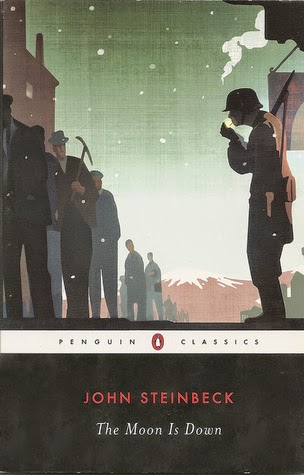
The Moon is Down by John Steinbeck


I hadn't read anything by John Steinbeck in ages -- looking back, it's been nearly two years since I finished East of Eden.  I mostly love Steinbeck, but I think his work is a little uneven -- I tend to love the longer works but the shorter works are hit or miss.  I loved Travels with Charley and Cannery Row, but I never felt the love for Of Mice and Men.  The Pearl was just so tragic, and I couldn't even get through The Red Pony.  

Recently I'd just finished Kim, which took me a really long time for such a short book.  I wanted a short classic to cross off my list, and something totally opposite from Kipling -- Steinbeck was just the thing, and I could count it as my Classic about War for the Back to the Classics Challenge.  The Moon is Down is extremely short, just over 100 pages.  I probably could have read the whole thing in one sitting.


Published in 1942, this novella is the story of an anonymous town that's suddenly overrun by an invading army.  The names are vaguely American but the setting seems Scandinavian -- it's an coastal town with a coal mine, and it's terribly cold and snowy.  The invaders, who are obviously Nazis but are never specified as such, 

The cast of characters is small -- a few officers from the invading army; the Mayor; the town's doctor; and a few townspeople.  Basically, this is a fable about how an invading army assumed it would be easy to take over a town by surprise, with little opposition, and how they underestimated the will of the people.  Steinbeck wrote this novella during WWII, as a piece of propaganda to encourage resistance against the Nazis.  It was quickly translated into a multitude of languages, and almost as quickly banned by the Nazis.   


I found this story particularly interesting because it was written and published while the war was still going on -- I think the perspective must be quite different than writing a book in hindsight, when the author knows the outcome of the war.  

I liked the story, though it's short and there isn't a huge amount of characters or character development.  Parts of the book are a little preachy.  I found the introduction (which I always read after I've finished a book) especially interesting, as it gave a lot of historical perspective about how the book was received and reviewed.   Apparently, there was a lot of backlash against Steinbeck because he made the invading characters somewhat sympathetic -- at least, not completely evil.  They were believable as people who could have had some good characteristics, although they were on the wrong side.  

The introduction also gave a lot of insight as to how this book was received in other countries -- although it was blasted by Americans, it was very well received by Norway and many other countries, in Europe and farther abroad as well.  

Overall, a good quick read, though not my favorite Steinbeck.  I still want to read Sweet Thursday, the sequel to Cannery Row, which I loved, so maybe I'll choose that for my American Classic for the Back to the Classics Challenge. 

Bloggers, what's your favorite book by Steinbeck?  And how is everyone coming along with the Back to the Classics Challenge?  This takes me up to 7/11 -- I'm more than halfway done!

Saturday, August 4, 2012

East of Eden by John Steinbeck


Wow.  

East of Eden is one of the books I've had on my to-read list the longest, ever since I started on my quest to read more classics back in 2005.  Somehow, I managed to graduate from high school and college without reading a single word of Steinbeck.  When I started to read classics as an adult, I knew I'd finally have to read his books, and at first I was very apprehensive -- Grapes of Wrath sounded so dire.  But I joined an online classics group and one of the first books I read with the group was Travels with Charley, which I absolutely loved, so I became a Steinbeck convert.

I bought my copy of East of Eden at a library sale about four years ago, and I've packed and unpacked it in three different houses.  For about three years now, it's been the book I most wanted to read off my TBR shelves.  It was my daughter's assigned summer reading for her high school English class next year, so I decided to read it along with her.  And it was really worth it.  Why did I wait so long??  Was I saving the best Steinbeck for last?   

It's kind of hard to describe this book.  It's long and sprawling, and spans about 50 years, from just after the Civil War to World War I, and the story is covers American coast to coast  from New England to California.  Inspired by the Genesis stories of Cain and Abel and Adam and Eve, it's the story of the Trask family, about sibling rivalry and fathers and sons.  It also contains some of Steinbeck's best characters, including what is probably one of the most evil characters in American literature.  

Though it's Steinbeck's longest work at 600 pages long, I raced through it in just a few days.  The plot and the characters are really compelling.  It starts out with two half-brothers in New England, Adam and Charles Trask, who are competing for their father's love, living on a farm after the Civil War.  Just like Cain and Abel, their father favors one son over the other, and the less-beloved son takes his jealousy out on his brother.  

In this story, there are two sets of brothers, and love for a woman also fuels the rivalry.  I don't want to give too much away, but Steinbeck weaves together Biblical allusions and California history in a masterful way.  He also incorporates characters based on his own ancestors.  Adam Trask moves out to the Salinas Valley, where Steinbeck grew up.  There's a lot of local color with a delightful Irish family, the Hamiltons, and a faithful family servant, Mr. Lee, who starts out as a cook but becomes much more to the family, a tutor, nanny, and he's basically the one holding the family together after things start to fall apart.

I loved this book although I did find some flaws in it.  Steinbeck is pretty heavy-handed with the Biblical allusions -- not only are there two sets of brothers (with initials beginning with C and A) Steinbeck spends paragraphs with characters philosophizing about the Bible and Cain and Abel, just in case the reader didn't get it.  Also, Lee is sort of an amazing wise Oriental sage, spouting wisdom -- he's just too good to be true. But there is so much great stuff in the novel that I can overlook the parts that bothered me.  

After finishing it, I really wanted to discuss it with someone else who was reading it with me -- my daughter is plodding along with it, but there's so much in it that I don't think she'll understand; in fact, I'm not even sure why this was assigned to high school sophomores!  I really wish I had chosen this instead of Tortilla Flat for my library's book group -- it's longer, but there's so much more in it and it's so much better!  It's more than twice as long but it's a far superior novel.  If you're interested in Steinbeck at all, do yourself a favor and don't bother with the shorter works.  East of Eden and The Grapes of Wrath are absolute masterpieces and everyone should read them at least once.  

Thursday, July 26, 2012

Tortilla Flat by John Steinbeck


Since I run my library's book discussion group and I have all the power, I chose Tortilla Flat for our July read, because it's on my Classics Club list.  ( If nobody else suggests any titles, then I feel completely justified in being mercenary and picking books I want to read.) It's one of Steinbeck's early works, and it's fairly short, and we hadn't read any classics yet this year, so I thought it would be an interesting choice.  Plus, there were plenty of copies in the library catalog, so I thought it was perfect.

Well, maybe not.  We had a good turnout for the group, but I'm not sure the discussion went very well -- I think this was the most heated debate that I've ever seen in a book group!  Basically, one person hated them book and thought it was a complete waste of time.  The conversation ended up digressing into a debate about what people should or shouldn't read for pleasure.

But I'm digressing.  Here's the setup:  After World War I, a young slacker named Danny comes home to find that his grandfather has died and left him some property with two ramshackle houses in Tortilla Flat, an area in the hills around Monterey.  (Danny's no war hero; he spent the war breaking mules in Oklahoma.)  Danny moves into one house and lets his ne'er-do-well friends move into the other.  Told as series of vignettes, this is the story of Danny and his friends Pilon, Pablo, Jesus Maria, and Pirate, and how they spend their days basically drunk on red wine.  According to the introduction, it's loosely based on Arthurian legend; these guys are supposed to represent the Knights of the Round Table, but I didn't see much chivalrous behavior.  They drink and argue and spend most of their days trying to figure out how to get food and more wine without having to do any more work than is necessary.

Parts of it were pretty funny, but I didn't get particularly attached to any of the characters until about midway through the book.  In fact, it was pretty much the same story over and over until that point in the book.  I was wondering how I was going to get through it and it's only about 200 or so pages long, one of Steinbeck's shorter works.

Eventually there was one episode that actually got me invested in one of the characters, so I began to enjoy it more and even laughed out loud a few times.  Frankly, for me, a bunch of guys sitting around drinking just isn't that entertaining, and I didn't much see the point of the book.  A few years ago I read Cannery Row, not long after I discovered Steinbeck, and it seemed to have a similar premise, about the lives of ordinary people in California, but I found that one much more interesting and entertaining -- from what I remember, at least the characters did something -- there's one episode about some guys frog hunting for a scientist which is absolutely hilarious.  (Apparently it's some kind of war metaphor, but even if you don't get that part it's still funny).

I'm no literary expert, but I get the definite impression that Steinbeck is kind of uneven -- some of his stuff is great, like The Grapes of Wrath, and some if it is just meh.  I really like his travel writing, like Travels with Charley and A Russian Journal, but I'm really unimpressed with the shorter stuff so far.  I thought Of Mice and Men and The Pearl were both unbelievably depressing, and I couldn't even get through The Red Pony.  I'm probably the only person in America who got through high school without reading any of those.

Tortilla Flat was okay.  I suppose if I knew anything about Arthurian legend I would have gotten more out of it.  I'm just glad it wasn't any longer.  My oldest daughter was assigned East of Eden for her summer reading, so I'm reading it along with her, and already I can tell it's much better.

Anyone else a Steinbeck fan?  Who's read Tortilla Flat?  Is it really a mediocre Steinbeck or am I just missing the point of the book entirely?

Friday, August 26, 2011

A Russian Journal by John Steinbeck


John Steinbeck was one of the authors that got me interested in reading classics a few years ago.  I'd found a list of the Modern Library's Top 100 Novels and was shocked at how few I'd read.  However, I was pretty intimidated by Steinbeck -- The Grapes of Wrath sounded so dire.  Shortly after I made the commitment to classics, I joined an online reading group, and one of the first selections I read with the group was Travels With Charley, in which Steinbeck travels around the U.S. with his dog.  How bad could that be?

Well, it wasn't bad, it was great.  And after that I had the nerve to tackle The Grapes of Wrath, Of Mice and Men, and several of his other works.  I laughed and cried with Steinbeck, and someday, I hope to read his entire oeuvre.  I've read seven of his works so far, and I've liked or loved most of them.

A Russian Journal is a bit like Travels With Charley because it's a non-fiction travel memoir.  At the beginning of the Cold War, Steinbeck and his friend, Robert Capa, a respected WWII photographer, traveled around Russia for several weeks, recording his impressions.  As a famous writer, Steinbeck naturally went to receptions and speeches and events with Important People, but what he really wanted was to travel all over the country and met regular people and see what their lives were like, much like he would do in the 1960s in the United States with his dog Charley.

I found this book extremely interesting -- I've spent my whole life wanting to see other places, so I am a complete sucker for a travel memoir.  Steinbeck is a great observer of life and characters, and most people don't realize how funny he could be.  He didn't make fun of the Russian people -- he held them in the greatest respect.  Steinbeck writes really well about the humor in situations, like the nightmares of bureaucracy and the difficulties of travel.

What really struck me about this book was Steinbeck's admiration of the Russian spirit.   Steinbeck sees people who are literally living in holes in the ground, the remainder of their homes after they've been bombed out by the Germans.  It will take years to rebuild, yet the people are undaunted.  They're determined to survive.  One of my favorite parts of the book was when he describes a visit a farming community in the Ukraine, which was particularly hard-hit by the war.  Steinbeck and Capa spend an evening in a village, eating and drinking and dancing with the locals.  There are very few young men, since so many died in the fighting, so the young women dance with each other.  These young ladies work hard all day harvesting in the fields, using traditional methods since there isn't much machinery left since the war; then, they dance all night long, sleep a couple hours, and get up and go back to work in the fields.

Steinbeck found the Russian people as curious about Americans as he was about them.  He also found them to be equally concerned about nuclear war.  And more than anything, he found them warmhearted and generous.  He and Capa are constantly entertained wherever they visit.  One of the places he visited was Georgia, which sounds absolutely wonderful.  After visiting a tea plantation, they stop at many houses to visit, and at each one Steinbeck and Capa are offered food, which they couldn't bring themselves to refuse.   After they were completely stuffed, the manager of a farm asks them to stop by his home for a bite to eat, "only a token bite, as a courtesy."

We were beginning to believe that Russia's secret weapon, towards guests at least, was food. . . . It was the vision of the table that nearly killed us.  It was fourteen feet long, and it was loaded with food, and there were about twenty guests.  I think it was the only meal or dinner we ever attended where fried chicken was an hors d'oeuvre, and where each hors d'oeuvre was half a chicken. . . . [Steinbeck goes on to describe many fabulous-sounding dishes] . . . .The flavors were all new, and we wanted to taste all of them.  Capa, who prides himself on a thirty-two inch waist, and who will not let out his belt, no matter what happens, was getting a puffed look under the chin, and his eyes were slightly popped and bloodshot.  And I felt that if I could just go two or three days without eating anything, I might return to normal.

If you have any hesitation about reading Steinbeck, this is a great introduction.  His writing has a wry humor and genuine insight into the human spirit.

My thanks again to Rebecca at The Classics Circuit!  I've really enjoyed reading all the postings about Steinbeck, and look forward to more tours.