Showing posts with label historical fiction. Show all posts

Saturday, September 25, 2021

Penmarric by Susan Howatch

The original hardcover image from 1971.
Sadly my copy was missing the dustjacket.

“I was ten years old when I first saw Penmarric and twenty years old when I first saw Janna Roslyn, but my reaction to both was identical.”

One of the big fat books I meant to read this summer was Penmarric, an epic family saga set in Cornwall. Between Daphne du Maurier and the Poldark series (not to mention Doc Martin) I've developed a small fascination with Cornwall, though I've never actually visited. I do love a good multi-generational saga and the setting absolutely sold it for me. I was at The Strand bookstore in New York a couple of years ago and picked up a vintage hardcover for about $7. My edition was more than 700 pages but I had no trouble finishing it in less than a week.

First published in 1971, the book begins with the historic estate of Penmarric in dispute -- daughter Maud Castellack thinks she should inherit, but naturally as a woman in the late Victorian era, she can't -- with no immediate male heir her father has willed it away to a cousin. Maud won't give up, trying desperately to win the estate for her elder son Mark, narrator of the book's first section. On a trip to Cornwall to finally meet his cousin, young Mark Castellack sees a beautiful widow in a desolate churchyard and is instantly smitten. 


A 1980s mass-market reprint

Janna Roslyn is ten years his senior and has her own slightly checkered history, but Mark becomes obsessed with her, eventually winning her as his bride. The narrator changes for the second section of the book and we get Janna's POV.

So we learn Janna's history and it moves on to the next generation of the Castellack heirs to Penmarric. The book spans about fifty years, ending just before World War II, with five different narrators, and includes four generations of the extended family. It's definitely not literature, but nonetheless I enjoyed it. It reminded me very much of the historical family sagas I read when I was a teenager, like Evergreen by Belva Plain and The Thorn Birds by Colleen McCullough, though both of those were published a bit later, in the late 1970s. 

A Penguin reprint from 1989, very Gothic!

I wouldn't call it a bodice-ripper, it's definitely a step up from Judith Krantz or Danielle Steele, but I can see that it's very much of its time. Even though it's mostly set in the first half of the 20th century, there are some story elements that would have been a lot more timely in the 1970s. It's not especially graphic but it would have been far too scandalous if it had been written earlier. 

I particularly liked the setting, as always, and the descriptions of Penmarric and the bleak Cornish countryside. I also really liked how the first-person narration shifted. Three of the narrators were from the same generation so the reader got two different perspectives of what was happening, which I liked. For the most part, the characters are pretty awful, but the author made me (mostly) sympathize with them while I was reading their point of view. 

Paperback copy of a French-language edition from1972. 
Nice image, but it doesn't quite capture the same feeling as the other covers.

I realized after finishing that Penmarric was inspired loosely on Henry II and Eleanor of Aquitaine, and there are epigraphs between each chapter which would make sense to anyone who knew the history or had bothered to read them. (I tend to skip over those bits so I didn't get it at the time.) I do love a great epic novel and I was in a bit of reading slump, so this was just the thing for late summer (can I call it a summer read since I finished it after Labor Day?) Susan Howatch has written several other books and a couple of them are still available at my library. There was also a BBC adaptation in the late 1970s which you can find on Youtube. 

So -- a very entertaining, retro read, absolutely perfect for the summer. If I were on a vacation on the Cornish coast, this is the book I would bring with me.

Monday, February 22, 2021

Green Dolphin Street by Elizabeth Goudge


I love a long, epic story, and if it's historical fiction and involves travel, better still. I was so looking forward to Green Dolphin Street because I was absolutely sure it fit the bill, but strangely, I was somewhat disappointed. Published in 1944, it was first titled Green Dolphin Country by renamed in the U.S. Essentially, it's a fifty-year love triangle between a man and two sisters who are his childhood friends. 

Set in the mid-Victorian period, the story begins in one of the Channel Islands (it's never referred to as anything but The Island, but clearly it's one of them). Young William Ozanne, about thirteen, has just arrived from England with his father, a widowed doctor. He soon meets Marianne Le Patourel, who is a bit older at sixteen, and her younger sister, Marguerite, who is only eleven, and the three become fast friends. Marianne pushes her wealthy father to take an interest in William, furthering his education and career. Both girls are smitten with the handsome and affable William, but Marianne is convinced that she has found True Love and that Marguerite has a mere schoolgirl crush. As Marguerite grows more beautiful, Marianne realizes William may be falling for her sister, and she fights hard to keep him close. 

I love this first edition cover, very folk-art influenced. 

Eventually William joins the Navy under the Le Tournel patronage, and ends up in New Zealand. After a long absence, he writes a long impassioned letter to Mr. Le Tournel asking for the hand of his daughter in marriage. However, he's extremely drunk at the time, and accidentally writes the wrong daughter's name in the letter, and is shocked months later when a different woman arrives. The rest of the book is the repercussions of William's split-second decision. Will he marry the wrong sister, and how will it affect all three lives?

This book started out really well -- I loved the descriptions of their life on the Island and the characters. However, in order to fit in the lifetimes of three people, Goudge writes the book in sections with big time jumps in between, usually ten years or so, and then kind of backtracks and sums up what happens during the gaps, and this started to bother me. It seemed like there was a lot more telling that showing -- there was so much condensed that could have been fleshed out. After one big time jump I put the book down for several weeks and didn't have much incentive to pick it up again, until I started to feel guilty about leaving it unfinished. It's a really ambitious story and maybe it would have been better as a series of books, with more details.

It's a bit blurry, but so Dickensian I had to include it.

Also, I think there could have been more character development -- I really didn't always understand what motivated the characters, and what explained their actions. I started to really dislike Marianne, who just seemed bossy and manipulative. I like strong female characters but it almost seemed like this was meant to be a bad thing. The book was published in 1944, and I don't know if Elizabeth Goudge was anti-feminist but that's the impression I started to get. 

I would also be remiss if I didn't mention the racism in the book. Mostly set in New Zealand, there are some positive portrayals of native culture, but it's mostly negative stuff about the Maoris, and there's a white savior character that made me roll my eyes a bit. Overall it was the pervasively colonialist -- my edition also has a disclaimer in the beginning which is sort of a red flag. I was definitely Team Maori while reading the book. 

A 1965 paperback edition

Overall I mostly enjoyed it, because of the descriptions of life in the Channel Islands and New Zealand, and there's a lot of sailing, which always fascinated me. Some of the side characters were delightful, especially Captain O'Hara, captain of a clipper ship named -- you'll never guess -- the Green Dolphin, who makes recurring appearances. I don't know if I liked it well enough to read any other books by Elizabeth Goudge. 

Love this pulp fiction edition! So dramatic!

And I've recently discovered it was adapted into a movie in 1948, starring Lana Turner and Donna Reed. (Donna Reed is playing Marguerite, though they've obviously glammed up Marianne if she's supposed to be Lana Turner). It won an Academy Award for special effects and there's a copy at my local library, so I'll have to take a look and see how well they adapted it.


I'm counting this as my Classic by a New-to-Me-Author for the Back to the Classics Challenge; also counts for the Chunkster Challenge. 

Wednesday, September 30, 2020

Classics Spin #24: Troy Chimneys by Margaret Kennedy


Another Classics Spin success! I always look forward to the Spins, they motivate me to read the books that I keep putting off. I bought this in June of 2017, on a trip to London in the hottest week of the year. . I had a bit of nostalgia when I found the receipt still stuck in the back of the book, from a used bookseller on Charing Cross Road. (I paid £5 for it, one of three green Virago Modern Classics purchased that day). 

Troy Chimneys by Margaret Kennedy had all the signs of an ideal read for me. Published in 1953, the story begins with correspondence in 1879, between two brothers-in-law. The honorable Frederick Harnish is researching some family history while recuperating from something unspecified, and requests some papers left by an ancestor, Ludovic, who died in 1830. He's specifically looking for letters he might have written, and what emerges are letters and diary entries from Ludovic's lifelong friend Miles Lufton, the owner of a property called Troy Chimneys. So, essentially this is a mid-century book about a Victorian researching a Regency ancestor. 

What follows are the memoirs of Miles Lufton, a former MP from Wiltshire. The actual property called Troy Chimneys is mostly peripheral -- it's really just slices of life in the early 1800s by a man on the fringes of upper-crust society. Son of a clergyman, he really doesn't have any money, but uses his Oxford connections to gain a seat in Parliament, though that's not a big part of the book either. It's more about his everyday life, though there are hints of a family scandal that is revealed at the end of the story.

Not a long book at just under 250 pages, but not what I'd call a quick read. It was slow going at first as the story is first framed by correspondence regarding the history of the late relatives, and also a bit confusing as Lufton begins to explain the history of his family -- I really should have written down a family tree as I was reading. It's also a bit confusing because Lufton sometimes refers to himself as Pronto, which is sort of his alter ego, the sociable persona he adopts to make himself interesting and in demand as a guest with the upper-crust people. It's also a bit confusing that two of the characters are Lufton and Ludo. 


But I really did enjoy it. What I liked most about it was that it was really written in the style of the Regency period -- it probably slowed down the reading, but I really felt like this could have been written by Jane Austen or one of her contemporaries, thought it's definitely from the male point of view. Miles could absolutely have been a minor character in a Jane Austen novel, like Mr. Yates in Mansfield Park or Captain Fitzwilliam in Pride and Prejudice -- probably as a sidekick to a leading man, but a younger son without much money. 

The book does include a Jane Austen reference which delighted me: 

But over novels she was obstinate; she could not like them. . . . she objected strongly to anything sentimental, nor would she listen to my pleas for my favorites: Emma and Mansfield Park, of which she complained that they kept her continually in the parlour, where she was obliged, in any case, to spend her life. A most entertaining parlour, she allowed, but: 

'That lady's greatest admirers will always be men, I believe. For when they have had enough of the parlour, they may walk out, you know, and we cannot.'

Interesting that a woman of the period (albeit fictional) would have thought of it that way! Yet very true. And so ironic since nowadays the majority of Austen's fans are women.  

So, a very successful Spin pick, and I hope there will be another before the end of the year. Only 18 books left on my Classics Club list! I'm tempted to try and finish it in 2020, though there are several doorstoppers which would probably slow me down. Still, it's worth trying. 

Bloggers, did you participate in the latest Classics Spin? Did you enjoy your pick? 

Saturday, August 8, 2020

The Eighth Life by Nino Haratischvilli


I first heard about The Eighth Life a few months ago, but I knew immediately that I wanted to read it. More than nine hundred pages about a family in Eastern Europe, over six generations? More than a hundred years of a family's history? A book in translation? Yes please, this is exactly the sort of book I love. But I'm not going to lie, this book, as you might expect, is A LOT. 

I should back up a bit and give as much summary as possible. The story begins with a prologue: Nizia, Stasia's great granddaughter, is living in Berlin and gets a frantic phone call from her mother. Nizia's niece Brilka, aged 12, has left her ballet group in Amsterdam and is on a train to Vienna, alone, on some kind of wild-goose chase. Nizia agrees to find her niece and bring her back to Tbilsi. The story then goes back more than a hundred years, to tell the history of six generations of the Jashi family, beginning with Stasia, a young Georgian dancer who is forced to give up her dreams of the Bolshoi Ballet and instead marries a dashing young officer in the early 20th century. Nizia narrates the story as though she's telling her family's history to Brilka. 

She remains with her family as he goes off on assignment, then they are separated by the Russian revolution. We learn about Stasia's beautiful sister Christine, who living a fabulous life in Tbilisi society until she attracts the attention of an important party leader; about Stasia's two children: Kostya, a promising Russian naval officer; and Kitty, a talented folk singer; Kostya's spoiled daughter Elene, the mother of narrator Nizia; and Nizia's sister Daria, a beautiful actress. Along the way there are world wars, revolutions, sieges, torture, heartbreak, murder, and terrible things happen to everyone along the way. There is also a magical chocolate recipe that is supposed to be some kind of curse but is really only a very minor part of the book (and I was really hoping for a recipe that never appeared.)

Haratischvilli interweaves real events and people (named and unnamed) in the book, so I learned a bit about Georgian and Russian history and geography. I do admit to skimming over some of the politics mentioned in the book. These characters experience a lot of tragedy and heartache -- honestly, I'm shocked that everyone in Georgia doesn't have PTSD or worse. I cannot even imagine living through even a fraction of what these characters have experienced. 

Great cover on this Turkish edition

Overall, I really liked this book and being able to spend so much time with the characters. There are a lot of great strong women in this family (though they seem to have terrible taste in men). I did prefer the first half of the book to the second -- the narrator, Nizia, is actually my least favorite character in the book. She does some things that seem really unbelievable and overly convenient to the plot. However, I was so absorbed in the family's story and all the other characters that I stayed along with it until the end. I was not disappointed, though I was hoping for more chocolate. 

The Eighth Life was first published in German in 2014, and finally translated into English in 2019. I love reading books in translation -- I know so many of my books are mid-century British and classics and I really want to expand a little bit. It is Women in Translation Month so this ties in nicely. It also ties in as my Georgian selection for the European Reading Challenge, and towards my Big Book Summer Challenge.

Saturday, July 4, 2020

The Twisted Sword: The Pentultimate Poldark Novel


I can't believe I'm on the 11th novel in this series, and I never blogged about it. I used to read a lot of historical novels, then I kind of got away from them when I got hooked on mid-century women's fiction. I only started reading the Poldark series after watching the PBS series when it first aired, the summer of 2015 when I was in Outlander withdrawal. I loved the first series which covers the first two novels, and promptly read the first ten books in less than a year. I'm not sure why I stopped there but suspect it had something to do with our big overseas move to Germany the summer of 2016. Our new library didn't have the last two novels, but on a trip to London that summer, I went to three different bookstores to find them -- and promptly left them gathering dust on the TBR shelves until now, prompted by my Big Book Summer Challenge. 

It is a little hard to get back into a series after a four-year reading gap (some of the supporting characters were a little fuzzy, but my edition thoughtfully included a family tree), but essentially, the book picks up pretty soon after the previous book, in the peace of 1815. Ross and Demelza's older children are grown and married, and Ross gets a summons to help out as an "observer" in France (and gets a baronetcy thrown in for good measure). Ross, Demelza, and the two youngest children head off to Paris, for what seems to be a good time, but that wacky Napoleon escapes from Elba and makes a triumphant return. [Bonus: this book also counts for Paris in July!]


This cover reminds me of a YA fantasy novel. 
Ross is on an assignment and gets separated from Demelza and the children, who flee to Brussels, where she meets up with her oldest son Jeremy and his new bride. Ross gets caught up in the war, so I had another perspective of the Battle of Waterloo, my second this year! But from the Coalition (Allied) side this time. My knowledge of French history is quite fuzzy and I didn't realize that Waterloo actually took place after Napoleon escaped from Elba, shame on me. There are a lot of descriptions of the horrors of war. I have been meaning to read La Debacle, Zola's masterful war novel, this summer, but maybe I'll put it off. 

Nice cover on this edition, I think it's the Polish translation


.
Sadly the war doesn't end well for everyone in the book. Meanwhile, back in Cornwall, the eldest Poldark daughter Clowance and her new husband are having money troubles, no thanks in part to George Warleggan. There are also some appearances by George's son Valentine; everyone's favorite doctor, Dwight Enys; and some local color with a pregnant housemaid who may or may not marry a local guy to give her baby a father. 

After a bit of confusion, I settled nicely into this 656 page chapter of the Poldark family, and ended up racing through it in less than a week. It's amazing how fast I started to remember details and characters (though a few are still a bit fuzzy and I've already requested the previous book from the library, so I can skim through it). Winston Graham was really good at creating the world of Cornwall from the time period. I loved most of the good characters and became outraged at the bad ones (George Warleggan has been carrying grudges against the Poldarks for how many years now?)

My only quibble was that the youngest daughter, Isabella Rose, is only THIRTEEN when the book starts and men are already courting her, ewww. I think Graham was setting up the story for the final book which is named after her. It's another 688 pages and I'm sure I will read it with enjoyment and more than a little sadness because the book series is ending. I've watched most of the TV series and unfortunately have gotten really bored with it, I didn't even finish the final season. Maybe I'll have to give it another try after I finish the final novel. I also own another long novel set in Cornwall called Penmarric and I'm looking forward to that one also.

How's everyone else doing with their summer reading? And can anyone recommend another great historical TV series and movies? 

Thursday, May 14, 2020

Lark Rise to Candleford; and my pastoral life in Germany


I finally tackled one of the books I've had on my owned-and-unread pile the longest -- Lark Rise to Candleford. I bought this more than ten years ago, around the time the TV series was first broadcast, but I've been putting it off forever, put off by the sheer size of it, and by the first couple of pages which are mostly descriptive. (It's also one of the books from my original Classics Club list that I never read). It's a little tough if the first page doesn't grab you. I had watched a bit of the TV series and enjoyed it, so I thought I should give it another go. 

For those who aren't familiar, Lark Rise is a fictionalized memoir of Flora Thompson's childhood in rural England, during the late Victorian period. It's classified as fiction but definitely reads like a memoir, and most libraries and bookstores shelve it in the fiction section. There isn't really any plot, it's really a lot of vignettes and memories of Thompson's childhood in Oxfordshire, and she places herself in the story as the main character, Laura, oldest child of a stonemason and his wife who live in a poor but comfortable house in the little hamlet of Lark Rise. It was originally published as three volumes, and I read the edition pictured above which includes all of them: Lark Rise [1939], Over to Candleford [1941], and Candleford Green [1943]. Since 1945 it's been available as an omnibus and there are many beautiful editions. 

A Penguin edition of the first volume.
My copy had woodcut illustrations similar to the one on the cover, 

though they're black and white


Each chapter has a theme, so it isn't told in a specifically linear fashion. It jumps around a bit, but it's easy enough to follow. There were chapters on May Day, hog butchering, school, churchgoing, and so on. Bits of it reminded me a bit of the Little House on the Prairie series, just in the descriptions of daily life in that era. Life was hard for Laura's family and the other families in Lark Rise, but she seems to have very happy memories. It's a really lovely portrait of rural life towards the end of the Victorian era, with hints of what's to come in the new century. 

It's fairly long book, more than 500 pages and 39 chapters. I finally got around to picking it up when I was looking for something soothing to read, and it fit the bill perfectly. Most of the chapters are short, and I thought I'd just read one or two a day, but I found myself turning to it more and more often in the past week. It is just the thing to read before bedtime, to crowd out all my other thoughts of world events. I can see why it was so popular when first published during WWII. 

After reading a few chapters I was wondering how they adapted it into a 40-episode TV series (I've only watched the first season so far). Eventually, though, I began to recognize characters from the series. Some of them have much more screen time than you'd expect from the book, and a couple of them have been combined into one family. They've definitely kept the spirit of the book in the series. It's a bit like Cranford in that the TV creators have taken the essence of the characters and place and extrapolated from there. If you're expecting it to be a novelization of the series, you'll be disappointed. For example, Dorcas, the postmistress, has nearly as much screen time in the TV series as Laura, but she doesn't show up in the book until more than halfway through. 

The beautiful Folio Society edition. I would love to take a look at this one. 


I really enjoyed this book, though it wasn't what I'd call a quick read, It's definitely a leisurely read, well suited to reading in bits in pieces, and it felt more like a memoir than a novel. In the past I've described books as 'nonfiction that reads like fiction' but this was the opposite. And if you love a sense of place, this is the book for you, with lovely descriptions of the countryside and just the slowness of everyday life. It made me want to move to a cottage and cook on an open fire. 

I'm a suburban kid and the idea of living in a village surrounded by countryside has always appealed to me. Our house in Germany was in a village, though nothing like Lark Rise, though we were at the end of a street on the edge of farmland and I could literally see cornfields and livestock right outside my door. I used to walk my dog through farmland and there were cows, horses, and chickens within a short distance, and in the spring, I'd take the scenic route to see if there were any lambs. I did enjoy how peaceful it was but there wasn't much to do close by, if you wanted to do more than a movie or basic shopping we had to drive pretty far. 

So here are a few photos of the countryside near my former house in the village of Steinwenden, a tiny village in the Rhineland-Pfalz, near Ramstein air base.


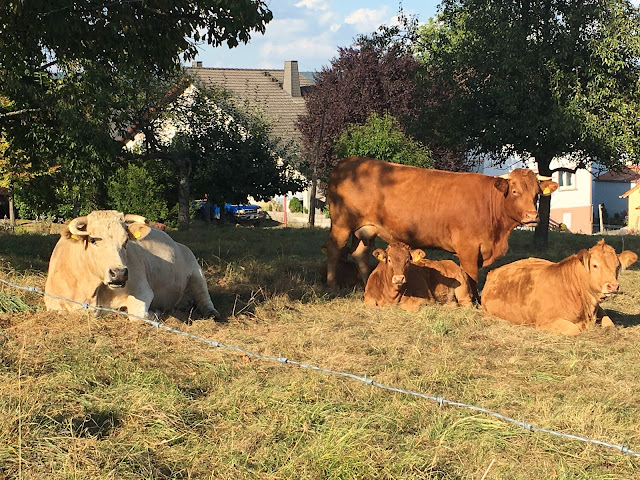
Just some cows in the neighborhood.


A field of canola. Every spring the countryside would be bright yellow. 


Pasture on the hill just behind our house, I could see these sheep from the second-story window. 

Sadly they weren't permanent residents, just visiting.  


In the summer this field was normally wheat or corn, 

but one summer it was all sunflowers and sweet peas, to help enrich the soil.


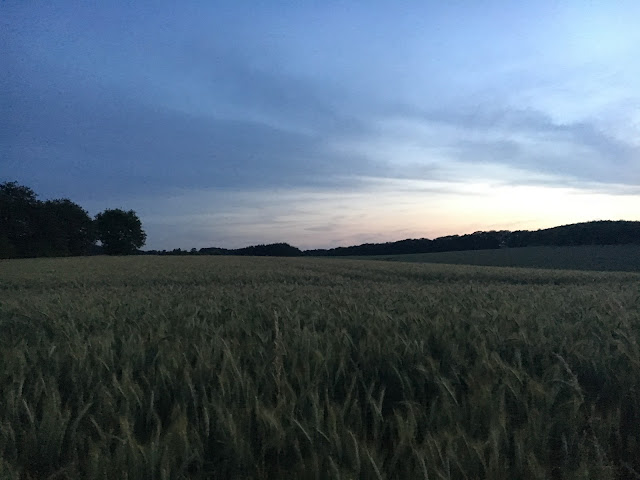
Sunset over the wheat field, just beyond my house. 


Hay all bundled up at the end of the season. I took this photo from my driveway. 


I loved the peace and quiet of the countryside but I was happy to move closer to a major city. Right now I'd be really happy to be on the edge of the farms, I'm sure it would be more relaxing right about now! Well, every place has its advantages. 

Bloggers, which are your favorite books about rural life? And does anyone else feel like moving out to the country about now? 

I'm counting this as my Adapted Classic for the Back to the Classics Challenge. 

Wednesday, May 15, 2019

Daphne Du Maurier Reading Week: The Glass-Blowers


I've been a big fan of Daphne du Maurier since I was thirteen and my mother let me stay up late with her to watch an adaptation of Rebecca on Masterpiece. I was instantly hooked, but it wasn't until many years later that I realized how many other books du Maurier had written. When I read that Ali from Heavenali was hosting a Daphne du Maurier reading week I knew I'd be participating -- but which book? 

As it happened, I had planned a long weekend in Paris that coincided, so The Glass-Blowers seemed like the perfect choice. Loosely based on du Maurier's own ancestors, it's a historical novel about the French revolution as experienced by a the Bussons, a family of glassblowers.

Published in 1963, the story begins with a prologue, as an elderly woman recounts meeting a long-lost relative who knows nothing about his family of French glassblowers. (I read this as an e-book and accidentally skipped the prologue, but I think I prefer it that way as there were some minor spoilers). She then writes the family history, beginning  in 1741 with the marriage of her mother, Magdaleine, to Matharin Busson, a master glassblower from Chenu a village south of Le Mans. After their marriage, Madame Busson quickly steps in to help with the business, from keeping accounts to managing domestic affairs of the workers and their families, in addition to raising five children of her own. The story is told in the first person by Sophie, the fourth child and eldest daughter, but most of novel is the history of the three eldest:  sons Robert, Pierre, and Michel, who all train to be glassblowers but end up taking very different paths: Robert is a speculator, gambler and royalist; Pierre is enlightened and and a follower of Jean-Jacques Rousseau; the youngest, Michel, is a republican.


The Glass-Blowers is fairly short for a historical novel, less than 400 pages, but du Maurier essentially tries to pack in most of the entire French Revolution -- the storming of the Bastille; the departure of the royalist sympathizers; and the bloody terror. I'm not nearly as familiar with the history of France as I'd like to be, so parts of this felt like a crash-course to me -- I appreciate what du Maurier was trying to do, but politics in books tend to bore me, so I wished there was more about the family than about the history. I liked the novel but I would have liked more character development; also, sometimes it felt like du Maurier was doing a lot of telling and not showing. I was more interested in the family's story than about the actual politics that were going on. It's not as creepy or suspenseful as Rebecca or The House on the Strand, though there are definitely some tense moments during some scenes set riots and when counter-revolutionaries are terrorizing a town.

However, I did really enjoy it. I was struck in particular by how much of the upheaval was stirred by gossip and rumors -- people were terrified with stories of marauding brigands and thieves; stories of foreign armies retaliating after the arrest and execution of Louis XIV and Marie Antoinette, and so on. It's even worse than the misinformation people are getting today on social media.

I would love to know how much of this is based on facts about her family, and how much is fiction. Du Maurier also published several nonfiction books, including a memoir of her early years and, a family history called The Du Mauriers. And last week I also finished Letters From Menabilly: Portrait of a Friendship by Oriel Malet, who documents their friendship from the 1950s until du Maurier's death in the late 1980s.

I did really enjoy reading this book while I was on my trip to France -- it's not often that my reading and my travels coincide, but I actually ended up reading this on a bus trip to Versailles! It really brought the story to life, after seeing the excess of the palace and driving through the countryside, passing through a couple of villages which still had Medieval buildings and historic churches. If I have time I'll put up another post with photos of my trip. And many thanks to Ali for organizing this blogging event!

Thursday, March 21, 2019

Gone With the Wind: Problematic, But Still Wonderful

The lovely 75th Anniversary edition.

Possibly the ultimate in Big Fat American Novels, I first read Gone With the Wind as a youngster, in the sixth grade; I'd seen the movie when it first aired on network TV in the 1970s, which was a huge television event. I've since read it at least a dozen times but it has been at least 20 years since my previous re-read. I did get a lovely hardcover edition as a holiday gift a few years ago but never got around to re-reading it until recently, inspired by  by the GWTW Readalong hosted by The Book Corps and by another recent read, Margaret Mitchell's "Gone With the Wind Letters," which I finished for the TBR Pile Challenge. 

As nearly everyone knows, GWTW was published in 1936 and was a runaway best-seller, and was adapted into the most successful movie of all time. The novel is more than 1000 pages long, but basically, GWTW chronicles the story of fiery Georgia debutante Scarlett O'Hara during the American Civil War and Reconstruction, and her undying love for the dreamy blond and bookish Ashley Wilkes. To Scarlett's chagrin Ashley marries his cousin, the sweet, saintly Melanie Hamilton, so in a fit of pique, Scarlett marries Melanie's brother, the shy Charles. Scarlett and Melanie are thus tied together during and after the War, and Scarlett must use her wits and bravery for them to survive, along with the O'Hara family's plantation, Tara. Scarlett also has a love-hate relationship with the dashing profiteer and scoundrel Rhett Butler, in what is one of American literature's greatest tragic love stories. 

It's always really hard for me to re-visit a favorite book from my childhood -- what if it doesn't stand up the test of time? Some books are just as good or even better (like To Kill a Mockingbird) and some are truly disappointing. For me, GWTW was a really mixed re-read. As always, I find the characters indelible and the story of spunky Scarlett so compelling -- she truly is a feminist icon. However, reading it decades later, I was constantly aware of the more problematic aspects of the book. Mitchell depicts the African-American characters as mostly lovable but childlike and easily manipulated by those terrible Yankees (with the exception of Mammy); also, it definitely perpetuates the romanticized, racist version of The Good Old South in which white people know best and all the African-Americans are happy and well-cared for, glossing over the fact that all the rich white folks are living off wealth accumulated by the suffering of generations of slaves. 

The same mass-market paperback edition as I read in 6th grade. 
Mine is equally tattered, I'm sure it's still packed away somewhere in storage. 

There's also lot of usage of the n-word and variations which made me really uncomfortable. Ashley Wilkes is the only character who seems to think Emancipation is a good idea and he's depicted as a dreamy and unrealistic. Scarlett is a feminist and I'm always rooting for her survival, but she is NOT a nice character -- she's really selfish and self-centered, and often cruel. Also, sometimes Mitchell's prose is a little flowery, and there are passages in which she digresses with battle scenes and background of Reconstruction history that definitely romanticize the white Southerners as victims. Um, no. 

However, it's a fascinating story with a great plot and great characters, and I found myself really enjoying the re-read, despite all my issues with the book. (Scarlett is definitely what I would call a fascinating train wreck). I still wish I knew what happened to Scarlett and Rhett Butler. Sadly, Mitchell never wrote a sequel nor left any hints about their fate before her untimely death in 1949.  It is a great, sprawling historical epic and I do still love it, despite its flaws.

 I'm counting it as my 20th Century Classic for the Back to the Classics Challenge. 

Friday, January 25, 2019

The Wife by Sigrid Undset: Kristin Lavransdatter, Vol. II


Two years ago I read the first volume of the Kristin Lavransdatter trilogy (The Wreath) for the Back to the Classics Challenge, and I really enjoyed it.  I'd been meaning to complete the series so I decided on the second volume, The Wife, for this years' challenge. [Note: minor spoilers for the first volume are in this post].

The Wife covers about fifteen years, immediately following Kristin's marriage at the end of the first book, as Kristin and Erland adjust to married life, and Kristin begins managing Erland's estate, which has fallen into disrepair during his long absence. She bears his children and he becomes involved in political intrigues regarding the child king Magnus and his mother Ingebjorg, the Queen Regent, who are now ruling over Norway and Sweden. We also meet Erland's brother, a priest; and learn the fate of Kristin's parents and younger sister, as well as her former suitor, Simon. 

This volume was a little slower for me -- there was a lot more emphasis on religion and politics. The politics in particular were more difficult, as I found the names hard to keep straight. I thought about researching the history, but realized it mind end up spoiling the plot -- plus there's a third volume, so I decided to wait. I did read the introduction after I finished the book (which did have spoilers, so good thing I waited). There was a LOT of Norwegian history which was very condensed and I got even more confused. 

I did really enjoy learning about life in Medieval Norway. I love historical fiction, though I tend to read more about the 18th through the early 20th century. However, it did bother me how much Catholic guilt Kristin was suffering regarding the circumstances of her marriage, which seemed to recur over and over -- I get that the Church was incredibly influential, but it seemed like she was beating herself up about it constantly. 

The last third of the book has some political intrigue that seemed right out of Game of Thrones -- I could definitely picture this as an HBO series, though I suppose it's basically just been done, but with dragons. There was a plot twist with Erland's fate that I wasn't expecting. And now on to Volume III which covers the Black Death! I definitely won't wait as long between reading the last two volumes -- I had forgotten quite a few details in the gap between the first two.  

I'm counting this as my Classic by a Woman Author for the Back to the Classics Challenge. 

Friday, June 8, 2018

The Lacquer Lady: Victorian Intrigue in Mandalay


A few years ago I was spending a weekend in Austin, Texas, just about a 90 minute drive from our home in San Antonio. It was a rainy Friday night, and my idea of fun is poking around bookstores. Just a short drive from my hotel was a massive Half-Price Books. If you are not familiar with HPB, it is a family-owned chain of used bookstores that started in Dallas, and it's all over Texas and quite a few other states. There are several locations in San Antonio but this one in Austin was the biggest I've ever seen, with an amazing selection. There were really nice collectible books and classics, and the fiction section had a whole bunch of Viragos, some in green covers, some in the original black. That's where I found The Lacquer Lady by F. Tennyson Jesse, first published in 1929.

Set in the late 1800s, the story begins with a young woman named Fanny Moroni, who is at a boarding school in Brighton. Having made a reputation for herself at school as being a teller of tall-tales, she leaves school to return to Upper Burma, where her family live. Her mother is half English and half Burmese, and her father is Italian and has a weaving business. He had once been a favorite of the king but had recently fall out of the circle. Fanny takes the long boat ride back to Mandalay with her schoolmate Agatha, who is also going to Burma to live with her missionary father. (At the time, Lower Burma was a British colony, and Upper Burma was still under royal control). 

While Agatha joins her father and his curate saving souls, Fanny's social circle moves among the community of foreigners who are occasionally allowed into the inner circle of the Burmese royals in Mandalay, and becomes close to one of the princesses, Supaya-lat, eventually becoming one of the ladies-in-waiting. Fanny isn't a terribly likable heroine -- she's very selfish and self-serving, and has been compared to Becky Sharp from Vanity Fair. 

Fanny was very aware of what people were like; she couldn't read through a book of Dickens, she couldn't have picked up newspaper and understood was anything about except the police-court cases, she couldn't have held an impersonal conversation on any subject whatsoever, but she had a sensitiveness, within her limitations, to human beings, that amounted to a talent, whenever her judgement was not obscured by her personal wishes. She was aware that she knew what the three men in the room were like far better than did Agatha, who had been seeing them for several days past. (Ch. V)

The royal court is thrown into turmoil when King Mindoon dies, leaving many sons by various wives and no definite heir to the throne. Fanny is sometimes in and sometimes out, but her fate is intwined with her friend Supaya-lat, and eventually, she unwittingly becomes a key player of the British invasion and takeover of Upper Burma. 

This book started out rather slowly, but it really picked up about a third of the way after the king died and there were a lot of palace intrigues, some of them quite bloody and horrifying. This book is loosely based on actual events, and I didn't realize until I read the afterword Fanny isn't just a made-up character -- she's actually based on a real person, though the circumstances are not exactly the same. I'm also really intrigued by the writer -- F. Tennyson Jesse was not only a great-niece of the poet Alfred Lord Tennyson, she was a criminologist and journalist and was one of the few women to report on WWI. Her most famous novel is A Pin to See the Peepshow, which is based the notorious 1920s murder case of Edith Thompson and Frederic Bywaters. (I bought of copy after listening to Simon and Rachel's Tea or Books? podcast from last year; naturally, I still haven't read it!)

I was particularly interested in this novel because I've actually been to Burma, albeit very briefly. Years ago we were stationed in Japan and I met a friend in Bangkok who was visiting her son who worked at the consulate. After a few days in the city, we drove with her son and his friend up to Chiang Rai, where the friend had bought a retirement home. It's near the Golden Triangle, where Thailand, Laos, and Myanmar meet, and we were actually able to walk over the bridge to Myanmar and shop in the market. We couldn't stay very long because the border crossing closed at 5 p.m., but I can say that I've actually been there. 

This is my eighth book for the TBR Pile Challenge 2018! I'm making great progress on my list.