Showing posts with label favorites. Show all posts

Saturday, March 17, 2018

Wives & Daughters by Elizabeth Gaskell is the Ultimate Victorian Novel

I love this cover, it's a detail from a painting called Waiting by John Everett Millais.

BEST. VICTORIAN. NOVEL. EVER.

OK, I guess I've said that about other novels before -- probably about Bleak House. But this is one of my all-time favorite books -- I think I've read it three or four times in the past 10 years since I discovered it, in print and audio, and I've seen the TV adaptation multiple times. It's just wonderful. I have so many books that I want to read that I don't re-read old favorites nearly enough. This is worth making an exception.

If you're not familiar, here's the setup. Basically, it's the story of two families, the Gibsons and the Hamleys, living somewhere in the town of Hollingford in the late 1820s (it's before the Reform Act of 1832, and there's mention of a King but not Queen Victoria). Mr. Gibson, a widower with a young daughter Molly, is the local surgeon, and the Hamleys are one of the oldest families in the county, even older than the local gentry. Squire Hamley has two sons off at Cambridge and an invalid wife. The two families become closer when young Molly, aged 17, goes to stay at Hamley Hall because one of her father's medical apprentices has decided he's in love with her. Mr. Gibson realizes Molly is too old to be unchaperoned in the house with the two medical students while he's out taking care of patients, so she goes off to spend time with Mrs. Hamley. 

Molly endears herself to the Squire and the kind Mrs. Hamley, but the old-fashioned though kindly squire has no intention of either of his sons falling in love with Molly. During Molly's visit, her father spends a lot of time at the Towers, the ancestral home of the local gentry, the Cumnors. There he meets the widow Mrs. Kirkpatrick, a schoolmistress and former governess of the Cumnor family. He decides pretty quickly she'd make a suitable stepmother for Molly. 

Molly, Cynthia, and Mrs. Gibson nee Kirkpatrick from the TV miniseries

Molly is less than thrilled to acquire a stepmother but is happy to be getting a new stepsister, Cynthia, who's been off at school in France for pretty much her entire life since her father died. The new Mrs. Gibson isn't the stereotypical evil stepmother, though she is pretty self-centered and mildly annoying. However, Molly and Cynthia really and truly care for one another. 

Meanwhile, the Hamley sons have returned from Cambridge, and are much thrown together with the Gibson family. The elder son Osborne is dreamy and poetic, with a Big Secret, and his loyal brother Roger is clever and scientific. 

Molly with Roger Hamley. He's supposed to be the less-attractive brother. 

There is tragedy, there is comedy, and there are secrets. It's a really great domestic story with lots of charming characters. It's very reminiscent of Jane Austen without being a knockoff, and has the added bonus of weighing in at about 650 pages, much longer than any of Austen's novels. It's lovely to spend a good long time with these characters in their world. 

I loved all the characters, even Mrs. Gibson who often made me roll my eyes and practically throw something across the room. (I listened to parts of it on audio while driving and walking the dog and sometimes yelled out loud at her). Squire Hamley has no patience for Mrs. Gibson and is rewarded with the best line in the entire book: 


"I'm not saying she was silly, but one of us was silly, and it wasn't me."
(Yes, that's Michael Gambon [AKA Dumbledore] as the Squire).

And I haven't even talked about the miniseries, which is BRILLIANT -- so many great actors! If you've watched a British TV series in the past decade, you'll recognize nearly all the leads and much of the supporting cast as well. I actually saw the miniseries first and I've since read the book three times. It never gets old and Elizabeth Gaskell has become one of my all-time favorite Victorian novelists -- North and South is also wonderful, and Cranford is a hoot. I only wish Gaskell had lived long enough to write more books! Wives and Daughters is actually unfinished as she passed away before completing the final short chapter of the book; however, it had been serialized and she had left detailed notes with her publisher which are included, though the ending is pretty much self-explanatory. 

I'm counting this for the Re-Read a Favorite Classic category for the Back to the Classics Challenge. 

Sunday, May 7, 2017

The Classics Book Tag

Robert Carlyle is pretty much perfect as Rumplestiltskin.
I was recently tagged by Jillian with a fun meme about classics. And what is not to like about two of my favorite things, classics books and lists? So, here goes:

1. An over-hyped classic you really didn’t like: 


Without a doubt, Wuthering Heights. I think Heathcliff and Catherine are just awful and deserve each other for all of eternity.  The runner-up is On the Road by Jack Kerouac. 


2. Favorite time period to read about? 

Victorians! It's such a great time period, transitioning to the modern age. And it's such a long period, so there were so many great books written. 

3.  Favorite fairytale? 
Probably Rumplestiltskin. It was my favorite fairytale to tell my kids when they wanted a bedtime story that wasn't from a book.

4. Most embarrassing classics that you haven't read?
I still haven't read Les Miserables! Shocking, I know -- I hope to get to it this year. I'm really scared by the length, and I've never read anything by Victor Hugo.


5. Top 5 classics you want to read: 
  1. The Duke's Children by Anthony Trollope (I just bought the newly restored version)
  2. Jane Austen's juvenilia
  3. Three Men on the Bummel by Jerome K. Jerome
  4. The Story of an African Farm by Olive Schreiner
  5. My Brilliant Career by Miles Franklin
All of these are for challenges, either the Back to the Classics Challenge and the Victorian Reading Challenges, and they've all been on my TBR list for a long time. 

6. Favorite modern book/movie/TV series based on a classic?

I'm not a huge fan of modern adaptations of classics. However, I really do love Clueless which is an adaptation of Emma. Alicia Silverstone is great as Cher Horowitz, and I love Dan Hedaya as her father, who is not clueless (unlike Emma's father). And Paul Rudd! What's not to love about this movie?
"That was way harsh, Tai!" Best teen movie EVER.

7. Favorite movie version/TV series based on a classic? 

That's tough, there have been some really good adaptations! I could only narrow it down to four:
  •  the classic 1995 version of Pride and Prejudice; 
  • the 1995 Persuasion; 
  • Wives and Daughters
  •  the 2005 Bleak House, which is an absolute masterpiece. 
In general, I think books are better adapted to mini-series than movies, though I do love watching them on the big screen.

Gillian Anderson was brilliant as Lady Dedlock in Bleak House.
8. Worst classic to movie adaptation?

For movies, I'd have to say the 2011 Jane Eyre with Michael Fassbender and Mia Wasikowska. Michael Fassbender was way too good-looking to be Rochester, and they really hacked up the ending. I was also disappointed with House of Mirth -- it's one of my favorites and I was bored to death. 


Gillian again, as the tragic Lily Bart. 
She deserved a better adaptation, but that hat is fabulous.
The worst TV adaptation was a The Paradise which is an adaptation of Zola's The Ladies' Paradise. I couldn't get through the first episode. It probably didn't help that they changed the location from Paris to north England. I think they were trying to compete with Mr. Selfridge.

9. Favorite editions of classics that you'd like to collect:
I really like Oxford World's Classics, and I love the covers of the Penguin Clothbound Classics! It's tempting to buy all of them. 


10. An under hyped classic? La Bete Humaine by Emile Zola -- it's a real page turner and I think it would make a great miniseries!

Bloggers, tell me about your favorite classics -- and your least favorites. I'm tagging anyone who wants to participate!

Sunday, August 5, 2012

Classics Club Meme: My Favorite Classic Novel


For the first meme of the Classics Club, we've been given a question to answer:  What is your favorite classic novel.  Seriously, how does one pick?  The one I've read the most times?  If so, I'd have to choose this:


Beloved by many, Pride and Prejudice started my obsession with all things Jane Austen.  I'm now a life member of the Jane Austen Society of North America and I'm already planning my third trip their Annual General Meeting (this year it's in New York City!) 

Or how about the one I've loved the longest?   Which would be this one:


Jane Eyre, the first classic I read in college, which started my love affair with Victorian literature.  It's definitely a candidate. 

Or, depending on your definition of a classic, it could be this one: 


I loved this story after watching at PBS Mystery! adaptation when I was in the eighth grade.  I've read the novel many times, listened to the audio, and watched pretty much every adaptation since.  But is it really a classic?  Most people wouldn't consider it literature, but it has endured.  

If that's your definition of a classic, then I'd also have to consider this one:


I read this for the first time in the sixth grade.  I think it was about the same time the movie aired on television, I can't remember if I saw the movie first.  Probably.  Of course a lot of it went right over my head but I still loved it.  I think I finished it in two days.  (I'm a fast reader). 

Again, many people don't consider it a classic because it doesn't have any metaphors and it isn't really taught in schools.  

And I can't forget another candidate:


This is the book that started my love affair with the works of Charles Dickens.  He's definitely over the top sometimes, but this novel has everything -- romance, mystery, satire, social commentary, and so many enduring characters.  If I had to choose only one book to take into exile, it would probably be this one.  

Which is my favorite?  I have to say all of them -- it just depends on the day and my mood.  It's like choosing a favorite food or a favorite child.  I love them all, plus a whole lot more -- I haven't even included anything by Maugham or Trollope or Steinbeck or Edith Wharton. . . . I could go on for days.   Well, that's why I started blogging!  

What do you think, bloggers?  Do you have ONE favorite classic novel, or are you like me and refuse to make that decision?  Which are your favorites?

Monday, June 11, 2012

Of Human Bondage by W. Somerset Maugham


"Insensibly he formed the most delightful habit in the world, the habit of reading: he did not know that thus he was he was providing himself with a refuge from all the distress of life; he did not know either that he was creating for himself an unreal world which would make the real world of every day a source of bitter disappointment." 

Of Human Bondage is one of the very first classics I ever read for pleasure, and I still love it.  I first read it when I was eighteen, a freshman in college.  It was forced upon me by a boy in my dorm, who lived down the hall and on whom I had an enormous crush.  He insisted I take it home over Christmas break and read it.  How could I refuse?  Well, I did end up loving the book, though things never worked out between the two of us.

Years later, I've read lots more classics for pleasure, including several by Maugham, but I never picked it up again -- I had so many other books I wanted to read!  It's actually been so long since I read it that I could barely remember the story any more.  I didn't even remember how it ended!   Finally, I decided it was time for a reread.  Last fall we nominated books for 2012 our classics group at the library, and I put this on my list -- I wanted so much to discuss it with other people!  Well, wouldn't you know it, things came up and I had to miss the discussion, but I couldn't resist reading the book again anyway (I also added it to my Classics Club and Chunkster Challenge lists).  And I am pleased to report that I still loved this book the second time around, maybe even more so than the first time.

For those who aren't familiar with the book, it's a bildungsroman, a coming-of-age story, loosely based on the life of the author W. Somerset Maugham.  (It's a long book, so I'll try to give the setup without too many spoilers). The main character is Philip Carey, a young man growing up with a clubfoot in the late Victorian period.  He's orphaned as a small boy and sent to live with his uncle, a strict vicar in a small town in Kent.  His aunt is kind but doesn't know much about raising children.  Philip is a bright boy but mostly bullied by his schoolmates because of his disability, and his teachers seem pretty heartless.

However, Philip is a bright boy, and when he's older, he goes off to boarding school, and his teachers expect great things of him.  His uncle expects him to go off to Oxford and then take orders, but Philip has doubts about religion.  Instead, he goes to Germany for a year to study before returning to England.  Philip has a small inheritance, and tries various professions. He spends two years as an art student in Paris before he realizes he'll never be anything but a mediocre artist, so he finally decides to follow in his late father's footsteps and become a doctor.

One fateful night in a cafe, Philip meets a waitress named Mildred, and it's the beginning of an obsessive relationship.  Mildred is really toxic, one of the most obnoxious characters I've ever met in literature.  The book deals with their relationship and Philip's personal growth along the way.   Will Philip marry this horrible woman?  Will she put him in the poorhouse with her greed?   "He did not care if she was heartless, vicious and vulgar, stupid and grasping, he loved her.  He would rather have misery with one than happiness with the other."

Bette Davis as Mildred and Leslie Howard as Philip in the 1934 film adaptation
This book is more than 600 pages, but I breezed through it in about five days.  I couldn't wait to find out what was going to happen, though I did have to grit my teeth and power through a few times -- Mildred is so awful, I really wanted to reach into the book and throttle her!  And Philip deserved a few good smacks upside the head a couple of times too.  But I really did love this book.  Philip's personal journey is really interesting and I got really caught up with it emotionally, I was really on the edge of my seat.  And I found the writing to be just wonderful and insightful.  Apparently Maugham considered himself among the best of the second-rate writers, but I disagree.  I kept finding passages throughout the book that I loved, and kept marking them with sticky notes (since I hate writing in my books).

I also loved reading about Philip's year in Germany, and his attempts to be an artist.  A couple of times Philip mentions a stockbroker fellow who chucked it all to be an artist in the South Seas, which is obviously Paul Gauguin -- who shows up in his 1919 novel, The Moon and Sixpence -- another Maugham novel which I read years ago and have essentially forgotten.  I'll have to reread that one again as well.

Has anyone else read this book?  Did you love it as much as me?  Any more Maugham you can recommend?  And have any of you reread a favorite classic after a long period?  Did you still love it or was it just not the same?

Thursday, April 28, 2011

Ten Books I Really Want to Re-Read

Inspired by Kristin's list on We Be Reading, I started thinking about rereads.  I think the only downside to reading book blogs is that I learn about so many wonderful books that my TBR list is getting enormous.  I spend so much time reading and think about these new books, I never seem to make time to re-read my old favorites, unless it's for a book group.

I'm actually about to start re-reading Love in the Time of Cholera for a book discussion group next week -- sometimes I don't reread books for discussions, but it's been so long since I read it I've forgotten most of it.  It's been almost 20 years since I read this book, so does it really count as a reread?  (I'm also leading the discussion, so I definitely want it to be fresh in my mind before the meeting).

Here are the top ten books I want to re-read, when I have time.   (Ha!)

1.  Love in the Time of Cholera by Gabriel Garcia Marquez.  I have to get this one done by May 4th!

2.  Of Human Bondage by W. Somerset Maugham.  I fell in love with Maugham's work all over again when I read The Painted Veil for my classics book group.  Of Human Bondage was one of the first classics I ever read for pleasure -- it was foisted on me by a guy who lived down the hall in my dorm freshman year.  He insisted I take it home and read it over the Christmas break, and since I had an enormous crush on him, I obeyed.  I ended up loving the book, though things never did work out with the guy.

3.  Watership Down by Richard Adams.  I loved this when I was a teenager, but I haven't read it since.  I'd love to know if it has stood the test of time.

4.  Gone with the Wind by Margaret Mitchell.  Another favorite from middle school and high school, I first read it in sixth grade.  I used to read it over and over but it's been years since the last read.

5.  Sense and Sensibility by Jane Austen.  I've seen the movies multiple times but I've only actually read the book once.  I need to reread it before I go to the JASNA annual meeting in October.

6.  Like Water for Chocolate by Laura Esquivel.  I've been taking Spanish classes for the past year so I want to read more Latino literature, and it would be fun to reread this (definitely in English, my Spanish still isn't that good!).  I remember loving it and the movie adaptation was excellent.

7.  Decline and Fall by Evelyn Waugh.  I thought this was hilarious, so I recommended it to Amanda at The Zen Leaf for our reading swap.  I want to reread it and see if it's as funny as I remember.

8.  West with the Night by Beryl Markham.  Another book I chose for my book swap with Amanda.  I remember loving it so much I read it really slowly because I didn't want it to end.  She didn't like it as much as I did so I want to reread it and see if it's just as good the second time around.

9.  Wide Sargasso Sea by Jean Rhys.  I recently reread Jane Eyre for the first time in years, now I want to reread this one too.  It's one of the only prequels/sequels to classic lit I really like.

10. Chronicle of a Death Foretold by Gabriel Garcia Marquez.  After my initial reading of Love in the Time, I was inspired to read more Garcia Marquez. It's one the three novellas in his Collected Novellas which has been sitting on the TBR shelf since my husband gave it to me before we were married, so I've probably had this unread more than twenty years!  I really should just sit down and finish the whole thing, shouldn't I?

So do you find you push your rereads aside in favor of new books because of blogging?  Or do you just hear about so many new books that you don't have time for the old favorites?  What would you reread if you had the chance?

Thursday, November 11, 2010

Top Ten War Stories

In honor of Veteran's Day I've created a list of my Top Ten War Stories.  Thanks to Suey for the inspiration!  In no particular order:

Gone With the Wind by Margaret Mitchell.  Yes, it's racist, but Scarlett is so spunky, and I'm always interested in reading about wars from the perspective of the home front.  I'm not really into battles and action sequences.

The Book Thief by Marcus Zusak.  Death narrates the story of a young orphaned German girl during WWII.  I cried like a baby at the end.

A Very Long Engagment by Sebastien Japrisot.  A heartbreaking look at WWI France, and its aftermath.  Also a great movie adaptation.

Summer of My German Soldier by Bette Greene.  A 12-year-old Jewish girl living in the American South befriends a German POW. One of my favorite young adult books of all time.

The Complete Maus by Art Spiegleman.  The groundbreaking graphic novel, one of the best books about WWII I've ever read.  Not to be missed.

The Old Wives' Tale by Arnold Bennett A great unappreciated book about the very different lives of two Victorian sisters. One of the sisters, Sophia, is trapped in the siege of Paris during the Franco-Prussian War. Scary.

The Guernsey Literary and Potato Peel Pie Society by Mary Ann Shaffer and Annie Burrows.  On the lighter side of WWII fiction, but a great read.  I never knew that the British Channel Islands were invaded by the Germans during the war.  It's mostly in letters, which I always love, and it's about a book group in wartime!

The English Patient by Michael Ondaatje.  Another heartbreaking love story.  I think I liked the movie adaptation even more than the book, even though Colin Firth plays a real ass.

Stones From the River by Ursula Hegl.  And interesting look at WWII, from a German viewpoint.  This book had great insight into how the Germans tolerated the rise of Nazism, until it was too late.  One of the best of Oprah's books.

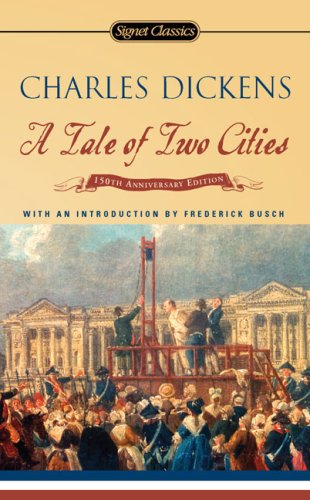
A Tale of Two Cities by Charles Dickens. Not my favorite Dickens, but still, great writing, and a frightening look at the French Revolution.

So -- which books have I missed?  Suggestions from the blogosphere?

Saturday, October 23, 2010

Final Comments on Bleak House and My Favorite Dickens Novels


I have finished Bleak House -- all 28 discs of the audio version, alternating with nearly 1000 pages of the print version.  We're nearly finished with the eight-week readalong, and again, I'd like to thank Amanda for organizing this -- it's nice to see so many participants.  I know not everyone is as big a Dickens fan as I am, so I'm especially impressed with the bloggers that have stuck with it this far, considering the length.  It's a big reading commitment, especially if you're not enjoying it.  I did enjoy this just as much this time around as my previous read, and even more than my multiple viewings of the excellent BBC adaptation.  If you're intrigued by the story but put off by the length of the book, please, do yourself a favor and watch this -- believe me, you will be hooked.  It may even inspire you to attempt reading it.

I'm not even going to attempt to recap the plot thus far -- it would take too long and include far too many spoilers.  I love Bleak House because of the memorable characters, the fascinating, twisty plot, the great cliffhangers, and the brilliant way in which Dickens ties everything together while including social commentary, mystery, humor, tragedy, and romance.  Seriously, this book has everything.  It will remain one of my favorite books of all time.  If I was going into outer space for a year and could only bring ten books with me, this would be one of them.

Like Bleak House, most of Dickens' works are a commitment.  They are long.  His prose is flowery and sometimes challenging.  His plots can be labyrinthine.  Some of his characters (especially the women) can be irritating.  I also find that he's elitist -- good characters, even if they are criminals, are usually nice looking and come to a happy end, and they are usually well-born, even if they are miserable orphans and don't realize they are From a Good Family.  Many of the poor, unhappy characters are uneducated, unloved, and unattractive, and they suffer sad fates.  Those that are not rarely rise above their station.

However, this does not deter me, because Dickens is really and truly worth it.  I read my first Dickens work, Great Expectations, back in college and then basically ignored his oeuvre until 2007, when I read A Tale of Two Cities with an online classics group.  It wasn't until I watched the BBC miniseries adaptation of Bleak House that I was seriously hooked on Dickens.  I've now read about half of his major works.  I'm ranking them below in order of preference.

Gillian Anderson as Lady Dedlock
1.  Bleak House.  Still my favorite.  Maybe it was the miniseries, but I am captivated by the tragic story of the Jarndyce court case.  The lives of the Jarndyce heirs are intertwined with the heroine, Esther Summerson, as well as the mysterious Lady Dedlock.  This book has everything -- romance, blackmail, murder, the brilliant Inspector Bucket (the first detective in English fiction!) and a host of side characters that are both grotesque and charming.

2.  Oliver Twist.  The quintessential Dickens orphan.  By now, the trope of the Poor Orphan is a little hackneyed, but little Oliver manages to survive the workhouse and a gang of thieves and still be sweet and saintly.  Also one of Dickens' shorter works, so it's a great starting point for the Dickens novice.

3.  Great Expectations.  My first Dickens, read in my last semester of college.  I took a fifth class, Introduction to Fiction, on a whim.  I can't remember any of the other books we read except this one.  I was sure I'd hate it but I was blown away, it was so enjoyable!  It contains some of Dickens' most memorable characters -- Pip, the hero; his kindly but hapless stepbrother Joe, and his shrew of a sister.

4/5.  Little Dorrit and David Copperfield -- tied for fourth place.  Copperfield started out so well, vying with Bleak House for my favorite, but the middle gets really slow, and the story doesn't seem to go anywhere.  And David's True Love Dora is one of his most annoying ingenues EVER, so it slips in the ranking.  Little Dorrit has a lot of the colorful characters for which Dickens is famous, but somehow the story isn't quite as enchanting.  Young Amy Dorrit was born and raised in the Marshalsea Prison, where her father has spent years imprisoned for debts.  Dickens was pointing out the injustice of this vicious cycle.  The hero, Arthur Clennam, is trying to help the Dorrits and falls in love with Amy.

6.  A Tale of Two Cities.  This one gets big points for being fairly short, and also for having the BOTH the best first line and the best last line in a book EVER.  Lots of great books have great first lines, but to have both is pretty impressive.  Also, one of the best female villains, Madame DeFarge.  However, points are taken away because, once again, Lucie Manette, the beautiful ingenue, is so boooring.  Why is everyone so in love with her?  Apparently Dickens believes that since she is young, innocent and pretty, no character development is therefore necessary. Snore.

7.  Nicholas Nickleby.  Poor Nicholas has to get a teaching job at a terrible school to support his widowed mother and sister, and along the way he has some adventures.  It was okay, but the characters didn't appeal to me nearly as much as those in Bleak House, Oliver Twist, or even Great Expectations.

8/9.  Hard Times and A Christmas Carol.  Bleah.  They're short, but I just don't see the appeal.  Hard Times is often read in schools because it's one of Dickens shortest works -- because he left out all the good stuff!  Seriously, I cannot recall a single element of this book that I liked, or a single interesting character.  It seems like Dickens had a novel all planned out and hadn't added any of the funny and/or grotesque side characters, but he was in a rush to publish something so he just handed it off to the publisher.  A huge disappointment.

And A Christmas Carol -- it's so popular, and I've seen so many adaptations -- there's even a Disney adaptation with Mickey Mouse and Scrooge McDuck.   When I finally got around to reading it, I didn't see what the big deal was.  I suppose I would have enjoyed it more if a TV version hadn't scared the crap out of me when I was about six or seven.  (What was my mother thinking, letting me watch this?  I was so scared of the Ghost of Christmas Future I slept under the bed for a week).  I finally got around to reading it a few years ago and was seriously underwhelmed.

So, now that I'm nearly finished with Bleak House I have to think about which Dickens to read next.  My top choices are Martin Chuzzlewith, Dombey and Son, and Our Mutual Friend.  Bloggers, have you read any of these?  Which one should I read next?  I'd love to hear your comments and also your thoughts about other Dickens novels.

Sunday, October 3, 2010

Fascinating Train Wrecks

A few months ago, when I was reading Summer by Edith Wharton, I started comparing it to two of my other favorite Wharton novels, House of Mirth and Ethan Frome.  Both of those novels have characters that I liked, despite their flaws, and I loved both of those books despite the fact that I knew they wouldn't end well.  Both Ethan and House of Mirth's Lily Bart are on downward spirals -- Lily in particular is a real train wreck who makes one bad decision after another; yet, I couldn't stop reading the book. 

I've noticed a lot of my favorite classics have characters like these, which I like to call fascinating train wrecks.  These characters are sometimes unappealing or unlikeable, but somehow, the authors elevate them and their stories in such a way that I have to keep reading.  I've begun to compile a list of my favorites, below. (WARNING! Spoiler alert -- if you haven't read some or any of these books, you may want to skip this posting).

1.  Lily Bart in House of Mirth by Edith Wharton.  The entire novel is one downward spiral of Lily's bad decisions, one after another.  Well, at least she doesn't drag anyone down with her, like so many other characters.

2.  Ethan Frome -- eponymous novel by Edith Wharton.  It's a Wharton novel, so it ends up badly.  However, Ethan really does try to do the right thing.

3.  Madame Bovary, courtesy of Gustave Flaubert.  Wow, she is just trouble.  Like Lily Bart, she makes one bad decision after another.  The trouble with Emma Bovary is that she ruins so many other lives in the process.  A wretched, unlikeable character, yet I found the story fascinating.

4.  Richard Carston in Bleak House.   He is so naive and doggedly determined to get his hands on the Jarndyce fortune, despite the fact that generations of potential heirs have lived and died without seeing a single penny.  He just will not give up!

5.  Kitty in The Painted Veil by W. Somerset Maugham.  She has an affair with a callous diplomat while her husband is posted in Hong Kong.  To punish her, said husband, a doctor specializing in infectious diseases, decides to pack up and take her to a cholera-ridden region of China, where it's likely they will both die.

6. Philip Carey in Of Human Bondage, also by W. Somerset Maugham.  an orphaned boy, born with a clubfoot, marries a woman who makes his life a living hell.  Oh, and it's 600 pages long --  sounds promising, right?  It's wonderful.  I was blown away.   And it's one of the first classics I read for pleasure, and probably one of the first that made me realize that classics don't suck.

7.  Paul Morel in Sons and Lovers by D. H. Lawrence. Not an orphan (hence, the title), but this guy's mother makes his life hell.   I was sure I'd hate it, but it was also surprisingly fascinating.


8.  Rosamund Vincy in Middlemarch by George Eliot -- a supporting character train wreck, but her bad decisions are interesting and help flesh out the fascinating cast of characters.  Another doorstop of a Victorian novel, this was the only book I read for an entire month.  Absolutely worth it.


9.  The Joads in The Grapes of Wrath by John Steinbeck.  An entire train wreck family!  I had such fear of Steinbeck, but I loved Travels With Charley so I gave it a shot.  I was so pleasantly surprised at how compelling the story was.

10.  Bigger Thomas in Native Son by Richard Wright. Well, Bigger isn't on a downward spiral, since he pretty much starts at the bottom, an uneducated petty criminal in 1930s Chicago.  As a black man in that era, he can't get much lower, but it is surprising how quickly his life gets worse.  It's an absorbing read, but it's so awful I just wanted to take a shower after reading this.  I'm glad I read it but I really can't say I liked it.

Of course, there are many other literary train wrecks, but some of them I found extremely unlikeable.  Here is a short list of literary train wrecks I couldn't stand:

1.  Anna in Tolstoy's Anna Karenina -- couldn't wait for her final train trip!  It just went on and on. . . and she was such a crappy mother.  An offensive trainwreck, literally.

2.  Ernest in The Way of All Flesh by Samuel Butler.  A Victorian smear on the hypocrisy of the church.  It went on for waaaaay too long and he was such a doormat that I didn't feel sorry for him in the least, despite his horrible parents and train wreck of a marriage.  However, it was one of my first Victorians so maybe if I read it again I'd appreciate it more.

3.  Tess Durbeyfield in Hardy's Tess of the D'Urbervilles.  Many people love this book.  I felt sorry for Tess but the story dragged on for so long that I lost patience, and by the end I just didn't care.  I think Hardy just stretched out too many scenes about hay making, or milking, or digging up turnips or something.  Maybe pastoral fiction is just not for me.

4.  Clyde Griffiths in An American Tragedy -- to be fair, this book started out really well, with a social climber on a downward spiral.  However, the last third of the book went on and on and on. . . and that pretty much killed it for me.  I found it tragically long, wish Dreiser had had a better editor.

5.  Cathy in Wuthering Heights by Emily Bronte.  Wow, she was a whiner -- I just wanted to smack her upside the head.  And her relationship with Heathcliff was so dysfunctional -- they really deserved each other.  I know many people love this book, but I just can't see the appeal.  Nowhere near as good as Jane Eyre (and I do realize that was written by her sister Charlotte, but I still think of them together).

So -- I'm sure there are some that I've missed.  Any more fascinating train wrecks I can add to my list?  I'd love to hear about some others.

Thursday, September 30, 2010

Bleak House Readalong, Week 6


Richard Carston, train wreck (and Esther, not a train wreck)
Well, I'm up to week 6 of Bleak House and it is really getting good.  I did wonder if I just loved the book because of the fabulous BBC adaptation, which I love.  Happily, the book is even more wonderful than the miniseries.

I'm more than halfway through the book, and there have been all kinds of plot developments -- Richard Carston is getting deeper and deeper into trouble, and a sleazy lawyer named Vholes has gotten his hooks into him, courtesy of Mr. Skimpole.  What a pair!  Richard is such a train wreck!!  Richard refuses to give up hope that his cut of the Jarndyce fortune is just around the corner, despite the fact that generations of people have lived and died without seeing a penny, including a distant relative that blew his brains out in despair over it.

I've got to hand it to Dickens, once again for creating such perfectly named characters.   Vholes -- is there any doubt that this guy is bad news?  Is he a vulture, a vampire, or a rodent (or should I say a rhodent?)??  This does not bode well for Richard, or for Ada, whose fortune is tied with his, especially now that she has pledged her undying love to him.  Girl needs a sassy gay friend, like, right now!!

Meanwhile, things are not looking good for either Sargent George, who is also in trouble courtesy of Tulkinghorn and Smallweed.  Like Richard, they're putting the screws on him financially because they want proof of the late Captain Hawdon's writing.  And in related news, Mr. Guppy has managed to trace Esther's family to Lady Dedlock, and Tulkinghorn knows something is up.

Esther Summerson, our heroine
And by the way, did I mention Esther has managed to avoid dying of smallpox?  Of course there was never any real danger of her death, as she narrates half the book.  That would be a major plot development, if the narrator died!  We'd have to switch to suddenly having the omniscient narrator take over.

Esther is actually starting to grow on me as a character.  She's not as sickly sweet as I imagined before.  She's really nice to Caddy Turveydrop (nee Jellyby) and to Charlie, her new maid.  Though, as I've mentioned, I really don't see why she adores Ada so much.  Girl needs some serious character development.

One thing about Esther and Ada has really occurred to me -- I think the real love story in this book might be Esther and Ada.  I don't mean in a sexual way -- I once read that the real love story in Sense and Sensibility is between the two Dashwood sisters (though their characters are far better defined, in my humble opinion).  It just reminds me of that, how they adore each other so much.  The reader doesn't really know anything about Ada's history, just that she's also an orphan and a ward of the court regarding Jarndyce.  Maybe the reason she and Esther are so close is that they're both orphans and this is the closest they've ever had to a loving family, like sisters.  Lord knows Esther's godmother treated her like dirt her entire life -- it seems like living at Bleak House has been the happiest her life has ever been, so that's sort of understandable.

Anyway -- the story is really getting good, and some major plot developments are about to happen.  Stay tuned!!

Saturday, August 28, 2010

Top Ten Literary Places to Visit

Once again, Amanda has inspired me to make another Top Ten List. (I always copy from her -- is this cheating?)  This was easy -- I just had to think about my favorite books.

Anyhoo, I've divided it up into fictional and real places.  I have another list of ten literary places I don't want to visit, but I'll save that for another day.

Fictional Places:

1.  Hogwarts School of Witchcraft and Wizardry.  I'd love to go anywhere in the wizarding world, actually, as long as there are no Death Eaters or other minions of Voldemort.  Luckily, I'm planning a trip to Florida to visit the Wizarding World of Harry Potter, so that will have to do for now.  Only 88 days to go!

2.  The Land of Ingary to visit Howl's Moving Castle (from Diana Wynne Jones).  And not just because I have a huge crush on Wizard Howl.  The castle sounds amazing, it has doors on each side that lead to different worlds, including ours. And I'd love to meet Sophie!

3.  Bookworld, from Jasper Fforde's Thursday Next series.  How cool would it be to jump into a world where literary characters are real?  A must-read series for people who love literature.  It doesn't always make sense to me, but I love all the literary jokes -- my favorite is the bit where a piano ends up in Jane Austen's Emma by mistake.  Hilarious.

4.  Narnia, during the Golden Age, the reign of High King Peter and the royal Pevensie children.  Wouldn't it be amazing to live among magical people, unicorns, centaurs, and talking animals?  Almost as good as having magical powers.

5.  Cranford, England, the eponymous village created by Elizabeth Gaskell.  I'd give Miss Pole something to gossip about, and drink lots of tea with Miss Matty.

Real Places:

1.  Regency England.  Of course with my luck I'd be a cook or a maid, or a cranky old governess.  Actually, I'd really like to be an invisible time traveler, so I could see it all without having to explain who I was, like Amanda in Lost in Austen (a very cute movie if you like the Jane Austenish stuff).  Then I could travel back in time so I could enjoy modern conveniences and medical care.

2.  Cornwall, England.  Specifically, I want to visit Manderlay, or something like it, so I can wake up and say, "Last night, I dreamt I was at Manderlay again."  Just like Mrs. de Winter, but without the scary housekeeper in Rebecca.

2.  Gabarone, Botswana.  I've always wanted to see Africa, and after reading The No. 1 Ladies' Detective Agency, I think Botswana would be an excellent choice.

4.  The Orient Express.  Someday, I'd love to take a long train ride, with a beautiful private compartment, lovely food, and gracious service.  I'm usually jammed in a tiny airplane seat with rude people and bad food.  I'd love to travel in style.  But without a murder, thank you very much.


5.  Provence in the south of France.  I loved Peter Mayle's A Year in Provence, wish I could go.  The French countryside, fresh farmer's markets, antiques, amazing food -- what's not to like?


I could go on and on, but for today, those are my top picks.  I'd love to hear where other book lovers want to go, and why.  Please let me know!

Thursday, August 19, 2010

Favorite First Lines From Books

I was inspired by Amanda at The Zen Leaf, who posted today about her favorite lines from books.  I realized that many of the lines I remember most are first lines, so that's what I'm listing.  Many of them are famous, a few not so famous.  And I couldn't limit myself to just ten, so here they are, in no particular order:

1. "It is a truth universally acknowledged, that a single man in possession of good fortune must be in want of a wife."  -- Jane Austen, Pride and Prejudice.

I can't say anything about Jane Austen that hasn't already been said, and probably better than I could say it.  Probably my favorite book in the whole world, a great first line.

2.  "Last night I dreamt I was at Manderlay again."  -- Daphne du Maurier, Rebecca

Rebecca, the best gothic novel ever.   Not only does it have a great plot, and memorable setting, and scary villain, it's beautifully written.  The movie and television adaptations are great, but if you don't read the book you're really missing out.

3.  "Mr. and Mrs. Dursley of number four, Privet Drive, were proud to say that they were perfectly normal, thank you very much."  -- J. K. Rowling, Harry Potter and the Sorceror's Stone

In just a few words, J. K. Rowling sucked me into the memorable world of Harry Potter, and I've been a fan (sometimes to the point of obsession) for almost eleven years.  I'm counting the days until I get to visit The Wizarding World of Harry Potter (only 97 left!)

4. "I write this sitting in the kitchen sink." -- Dodie Smith, I Capture the Castle

Immediately, we learn that our narrator is a writer, or diarist, and that she's quirky.  Intriguing!  Cassandra Mortmain lives up to the intro in this charming book (one of J. K. Rowling's favorites, by the way).

5.  "When he was 13, my brother Jem got his arm badly broken at the elbow." -- Harper Lee, To Kill a Mockingbird

What happened to Jem, and how is this important to the story?  One of the classics of American literature.  If, like me, you read it in high school and didn't see the big deal about it, read it again.  It means so much more to me now as an adult.  I can't wait for my daughter to read it next year.

6. "Scarlett O'Hara was not beautiful, but men seldom realized it when caught by her charm as the Tarleton twins were." -- Margaret Mitchell, Gone with the Wind

I don't think I'd like to be friends with Scarlett, but I'll always admire her spunk and determination.  It's probably not PC to love this novel, but it will always be one of my favorites. 

7. "Every summer Lin Kong returned to Goose Village to divorce his wife, Shuyu." -- Ha Jin, Waiting

One of my favorite lines from contemporary literature.  Every summer?  Do they get remarried every year -- what is going on here?  A great book about modern China, and a heartbreaking story.


8.  "It was the best of times, it was the worst of times, it was the age of wisdom, it was the age of foolishness, it was the epoch of belief, it was the epoch of incredulity, it was the season of Light, it was the season of Darkness, it was the spring of hope, it was the winter of despair."  -- Charles Dickens, A Tale of Two Cities

Bleak House is still my favorite Dickens so far, but I don't think Dickens ever wrote a better opening line.  A Tale of Two Cities also includes what is probably the best last line in a book: "It is a far, far better thing that I do, than I have ever done; it is a far far better rest that I go to than I have ever know."

9.  "There was a boy called Eustace Clarence Scrubb, and he almost deserved it." -- C. S. Lewis, The Voyage of the Dawn Treader


Who is Eustace, and what has he done to deserve it? And what is he doing on the Dawn Treader? Eustace is one of Lewis' most memorable characters in the Narnia series. The Horse and His Boy will always be my favorite in the series, but Dawn Treader comes pretty close. I'm looking forward to the movie adaptation.

10. "In the land of Ingary, where such things ase seven-league boots and cloaks of invisibility still exist, it is quite a misfortune to be born the eldest of three." -- Diana Wynne Jones, Howl's Moving Castle

I know I keep harping on it, but Diana Wynne Jones is sadly underrated in this country.  She's written more than 30 books of children's fantasy, and I've loved nearly every one I've read so far (13 and counting).  Everyone mourning the end of the Harry Potter series needs to read her books.

11.  "I had the story, bit by bit, from various people, and, as generally happens in such cases, each time it was a different story." -- Edith Wharton, Ethan Frome.

One of the most beautiful, heartbreaking stories I've ever read. Ethan is so tragic, but I still find the story wonderful and fascinating. Another novel that I think is best appreciated as an adult.

12.  "During my career as a backup singer with the with Vernon and Ruby Shakely and the Shakettes, it often occurred to me that this was not a lifetime occupation and that someday I would have to figure out my rightful place in society." -- Laurie Colwin, Goodbye Without Leaving

I loved Laurie Colwin's food columns when she wrote for Gourmet, but her prose is just beautiful.  I realized after reading her short stories that I would never write anything as good, and I should just give up trying. I've read all her books and wish there were more, but sadly, Colwin died suddenly in 1992 at the age of 48.  She's best known for two collections of food essays, Home Cooking and More Home Cooking.

So -- what are your favorite first lines?

Monday, January 4, 2010

Books of the Decade

A lot of bloggers seem to be riffing on their top books of the decade.  Sadly, I lost track of all the books I'd read before I got on Goodreads, so I can only imagine how many books I read in the 2000s (what do we call that decade anyway?  The Zeroes? The Aughts? The Naughts?)


Anyway, I think the most significant changes I made to my reading habits were 1) starting library school -- I took three childrens/YA lit classes and got hooked on all the great authors writing for youth -- and 2) rediscovering the classics.  I've probably written before about how few classics I read in high school and college -- I'm really regretting not taking more lit classes (I sometimes fantasize about going back for another Master's!).  Anyhow, I'm really making up for lost time, and have discovered so many great classic authors and their works.  What really amazes me is how many classics I've read since I started on my quest -- my Goodreads list of "Classics Read" numbers 150; of those, I counted how many I'd read before 2000.  Only about 30, which means I've probably read One hundred and twenty classic books in the past ten years, most of them, really, since I got serious about it in 2005.  I've probably read more than 100 classics since 2005.  Wow.  I have another 150 classics on my to-read list, hopefully I'll make a pretty good dent in the list in the next ten years.  (Who am I kidding?  The list never gets smaller since I keep adding to it.  Oh, well, I suppose it's better than running out of books to read!)

These are the books first read this decade that I really think will stick with me. It was tough to choose, but I realize that all of these are books that I want to read over and over, so there you have it.  In alphabetical order by author, because I can't possibly rank them:

Persuasion and Pride and Prejudice by Jane Austen -- I love them both so much, I can't choose one over the other.

West with the Night by Beryl Markham --  Nonfiction that's as good as fiction.  This book is so wonderful, I tried to read it slowly to make it last longer.  Get the illustrated version if you can.


Girl With a Pearl Earring by Tracy Chevalier -- now I'm fascinated by Vermeer.

Bleak House by Charles Dickens -- the ultimate Victorian writer.  You can't beat the cliffhangers and brilliantly intertwining plots and characters.  (Also a brilliant TV adaptation by the BBC!)

Anansi Boys by Neil Gaiman -- Fat Charlie is the son of a god and learns to deal with it.  The audio adaptation by Lenny Henry is hands-down my favorite audiobook of all time.  I bow to my librarian friend Melissa for recommending it.  I am forever in her debt.

Wives and Daughters by Elizabeth Gaskell -- like Jane Austen, but with more pages so it lasts longer!

The Curious Incident of the Dog in the Night-Time by Mark Haddon. Heartbreaking and fascinating.


Howl's Moving Castle by Diana Wynne Jones -- I seriously love this book as much as Harry Potter.

A Tree Grows in Brooklyn by Betty Smith --  Why did I wait so long to read this book.  Kicking myself! 

Travels with Charley in Search of America by John Steinbeck -- completely converted me to Steinbeck.

The Way We Live Now by Anthony Trollope -- I couldn't put it down, I've never read an 800 page book so fast.  And the timeliness of the financial scandals is pretty eerie.

The House of Mirth and Ethan Frome by Edith Wharton.  Both beautiful and tragic, but I can't choose one over the other.

So -- a great look back a great decade of reading!  I'm already immersed in some great books for 2010.