Showing posts with label Persephone. Show all posts

Wednesday, January 13, 2021

The New Magdalen by Wilkie Collins


On January 1 I dove right into Back to the Classics Challenge with a new-to-me Victorian sensation novel, The New Magdalen by Wilkie Collins. Despite being a Collins fan I hadn't heard of it until it was recently reprinted by Persephone Books which immediately placed it on my reading radar.

One of Collins' shorter novels, it's the story of Mercy Merrick, an otherwise saintly and perfect Victorian lady who through no fault of her own, has a checkered past -- she was once forced to work as a prostitute. Having since left prostitution through a women's Refuge, she's now working as a nurse in France. The story begins in a small cottage where she is nursing French soldiers, under attack from the advancing German army (the book was published in 1873 so this must be the Franco-Prussian War). There is another woman in the house, Grace Roseberry. a lady by birth but in reduced circumstances. Grace had been in Rome with her father, who traveled from Canada for his health, but ended up dying there. Grace had been en route to England, for a job as a lady's companion, when she was caught up in the war and trapped on the frontier. She has nothing but her papers, and even the clothes on her back belong to Mercy Merrick, as her own dress is drying by the fire in the next room.

Also adapted as a silent film in 1912! 

To pass the time while the women fear the advancing German army, Mercy tells Grace of her own sad history as a fallen woman. Then the unthinkable happens -- a shell hits the cottage, and Grace is killed. Mercy is evacuated with an English journalist, and on a sudden impulse, she grabs Grace's dress and all her papers, and assumes her identity. She sees this as a final chance for a better life, and Grace is beyond help, so no harm done there. 

Fast-forward several months, back in England. The newly renamed Grace is ensconced as the beloved companion of the steely but kind Lady Janet Roy, a wealthy and childless woman, and engaged to Horace Holmcroft, the journalist who -- coincidentally! -- is the son of one of Lady Janet's oldest friends. Horace has naturally fallen in love with the beautiful and perfect Grace, and his connection to Lady Janet is but the first of several amazing coincidences. Although Grace has had several idyllic months as Lady Janet's companion -- practically her adopted daughter -- her world will soon be turned upside down when her identity is called into question, and the truth of her sad and checkered past comes to light. 


I enjoyed this novel. It's a pretty standard Victorian sensation, with amazing coincidences, intrigue, swooning, scandals -- the usual. What's different about this one is the fairly serious subject matter of prostitution and forgiveness. Wilkie Collins points out the hypocrisy of the upper classes who are all talk and no action when it comes to Christian values. He does go over the top with the character of Merry who has literally no faults -- except for the prostitution, which literally is not her fault, as she explains in great detail. Collins also points out how few choices there were for Victorian women, particularly poor women. 

I did find the plot a little predictable and it was a little one-note -- it's only about 400 pages, short for a Victorian, so there's no room for sub-plots. It also seemed to have an abrupt finish, but there's an epilogue which explains what ultimately happens to Mercy, in the form of letters which are actually rather amusing. This would definitely be a good introduction to anyone interested in Victorian sensation novels who is put off by some of the triple-decker doorstoppers like The Woman in White or Man and Wife

I'm counting this as my New Classic by a Favorite Author Category for the Back to the Classics Challenge; and as my British selection for the European Reading Challenge

Monday, October 19, 2020

1956 Club: Madame Solario by Gladys Huntington, and some book covers

A first edition dust jacket. 
Those bare shoulders seem more 1950s than Edwardian.


I was really ambitious for Simon and Kaggsy's recent #1956 Club -- I had a stack of books published that year that I was determined to read, mostly from my own shelves. I did finish four of the five, though I only had time to blog about two of them. I had also started another, a Persephone called Madame Solario. However, it was a bit of a slow read and 493 pages long, I knew I wouldn't finish it during the specified period. But I finally finished it last week and thought I'd review it anyway. 

Published anonymously in 1956, Madame Solario is set in the fashionable resort town of Cadenabbia on Lake Como in northern Italy, in the summer of 1906. The book, which is divided into three parts, begins with the arrival of a young Englishman, Bernard Middleton, who is spending the summer on the continent before settling down in a banking career chosen for him by his family. He is supposed to meet friends who have been delayed, but decides to stay when he is drawn into the society of other expats vacationing in the same hotel. At first he is drawn to the beautiful young Ilona, whose heart is being broken by a Russian soldier, Kovanski. Bernard is disappointed by Ilona's sudden departure, but is soon enamored of the mysterious Madame Natalia Solario, a beautiful English woman with an absent husband. Her arrival turns the hotel into a bit of a turmoil. It seems there is some unfinished business with the jealously glowering Kovanski, and Bernard also learns of some scandals in Madame Solario's past. 

Beautiful endpapers in the Persephone edition


Bernard begins a tentative friendship with Madame Solario, but the viewpoint of the book shifts in the second part with the arrival of Madame Solario's brother, Eugene Harden, who is apparently the source of the mystery in his sister's past. The hotel guests become suspicious of their close relationship, and rumors begin to spread. Bernard is hardly mentioned and it's very focused on Natalia (nicknamed "Nelly" by her brother) and Eugene. A lot of it is just mostly conversations between the two, or rather, just long rants by Eugene. The third part then shifts the focus back to Bernard and the pace really picks up before a very dramatic finish that left me gobsmacked.

According to the Persephone website, reviews of the novel compared to it Henry James crossed with Ivy Compton-Burnett or with Daphne du Maurier. I haven't tackled much by James but I am a fan of his contemporary Edith Wharton, and this feels a bit like a Wharton novel to me -- dissatisfied upper-crust people in Italian resorts are definitely an Edith Wharton setting, though the malevolent brother isn't typical of her work. 

Those people . . . they have the superiority of owing their good fortune to something they themselves had nothing to do with. And that is the superiority I envy! To be born with a sort of super-self, for that's what rank is, a super-self that planes over frontiers -- to be born thinking one has the right to look down -- hasn't that got more charm than anything one can do for oneself? (pp 198-199)

I liked this book, though the middle section, the longest, dragged somewhat. I found the relationship between Natalia and her brother disturbing. I don't want to give anything away but after reading it I'm not surprised that the author was anonymous for a long time. And the ending was . . . wow. I really, really wish I knew someone else who had read this so I could discuss it with them. Not a typical Persephone at all, but definitely worth reading. 

And lots of interesting book covers! 

A first edition, not very exciting. 


A Polish edition


Nice cover on this French edition, I think it's my favorite of the bunch.


Trashy paperback cover! Looks very 1970s but internet searches say 1950s paperback edition. 


 A Penguin reprint from 1956. She looks more like Eliza Doolittle here --
the correct time period, but not glamorous enough.


A Spanish edition, meh


An Italian edition, nice photo of Lake Como on the cover.

In 2012 Madame Solario was adapted into a French movie, currently available for streaming on Amazon Prime. I haven't watched it yet but I'm curious to know how they'll adapt this 500 page novel into a 90 minute film. I imagine just cutting out Eugene's tirades will save a lot of time. 


There was even an entire book published on the mystery of the anonymous author. Sadly it's only available in French.  


I'm counting this as my book set in Italy for the European Reading Challenge

Thursday, October 8, 2020

#1956 Club: Every Eye by Isobel English; and some bonus photos of Spain


I had a lot of choices this year for Simon and Kaggsy's 1956 Reading Club -- three from my own shelves, plus a Persephone I'd never gotten around to reading, and even a P. G. Wodehouse available from the library (you have to love those prolific authors!) I've got one halfway done on audio and decided to tackle the Persphone, simply because it was the shortest and I'd be guaranteed to finish it in time.

I don't know why I'd put off reading Every Eye by Isobel English for so long -- it's very short, set in Spain, and a Persephone mid-century book by a woman author, all things I normally love. It was also available in another edition from the library for free (a definite plus since international shipping has risen sky-high recently). I was very pleasantly rewarded by how much I liked this book, possibly one of my favorite reads this year.

The eighteenth book published by Persephone, it's only 144 pages in their edition and 155 in mine (pictured below), in a tiny little book not more than five by seven inches. But what is in the book is powerful and beautifully written. It's the story of Hatty Latterly, who at 37 is taking a delayed honeymoon to Ibiza with her younger husband. The book alternates between their journey from London to the Balearic island, via multiple boats and trains -- and her memories of an aunt by marriage who has recently died. It is through this Aunt Cynthia that Hatty meets her first love Jasper Lomax, a much older man who had known her uncle and late father, and Cynthia is also the reason that Hatty has selected Ibiza for her honeymoon. 

Aunt Cynthia didn't enter Hatty's life until she was 14, when she began a relationship with Hatty's Uncle Otway, her closest male relative after the death of her father. Eventually she marries Hatty's uncle, and when Hatty is about 20 she meets Lomax at a party hosted by her aunt. They begin a friendship which becomes something more (and to modern readers, something pretty icky). Eventually the relationship ends and we also learn, in flashback, the story of Hatty meeting her husband. In the last paragraph of the book there is a twist ending that made me want to go back to the beginning and read the entire book all over again. 

However, the story is much more than this. It's fully of beautiful observations about human nature, about traveling, and family dynamics and relationships. The writing is really beautiful. I'm generally a fast reader and I have the terrible habit of speeding through passages to find out what happens next. This book is short and I took my time so I could really enjoy the quality of the writing. I really wish it had been longer so I could have spent more time with Hatty. 

There must be a great emptying of the mind when one is about to start on a long journey. It is no good clinging to the shreds of last night's anxiety, nor to its comforts; everything must be fresh and completely hared at the edges to withstand the future movement and buffeting. 

I loved this quote, it really is the essence of the feeling of travel. In the book, there is a lot of travel description, all of it wonderful. Hatty and her husband take a train from London, a ferry to France, another train to Paris, where they spend a day before taking another very long train journey south to Barcelona, where they get on another boat to Ibiza. I did a lot of traveling the last few years while I lived in Germany so much of this really resonated with me. Though I was lucky enough to get cheap flights most of the time, I love train travel, and I would take another boat trip someday though heaven knows when it will be safe.

I was lucky enough to visit Spain three times while I lived in Germany, and though I didn't make it to Ibiza, I did spend a week in Mallorca, which is the largest of Spain's Balearic islands (fun fact: Spain's second most popular tourist destination). I spent a couple of days in Palma, the capital city, before heading to the little town of Sóller on the island's west coast. We took a historic wooden train, which was delightful, and stayed in a wonderful B&B. It's a pretty little town and we could walk or take the tram to the Port of Sóller. It was April, and though it wasn't quite warm enough to swim the days were beautiful and sunny enough to sit on the beach, and there were lemons growing everywhere. 

The vintage narrow-gauge train from Palma to Sóller. It's more than 100 years old. There's also a vintage tram from Sóller to the Port. 

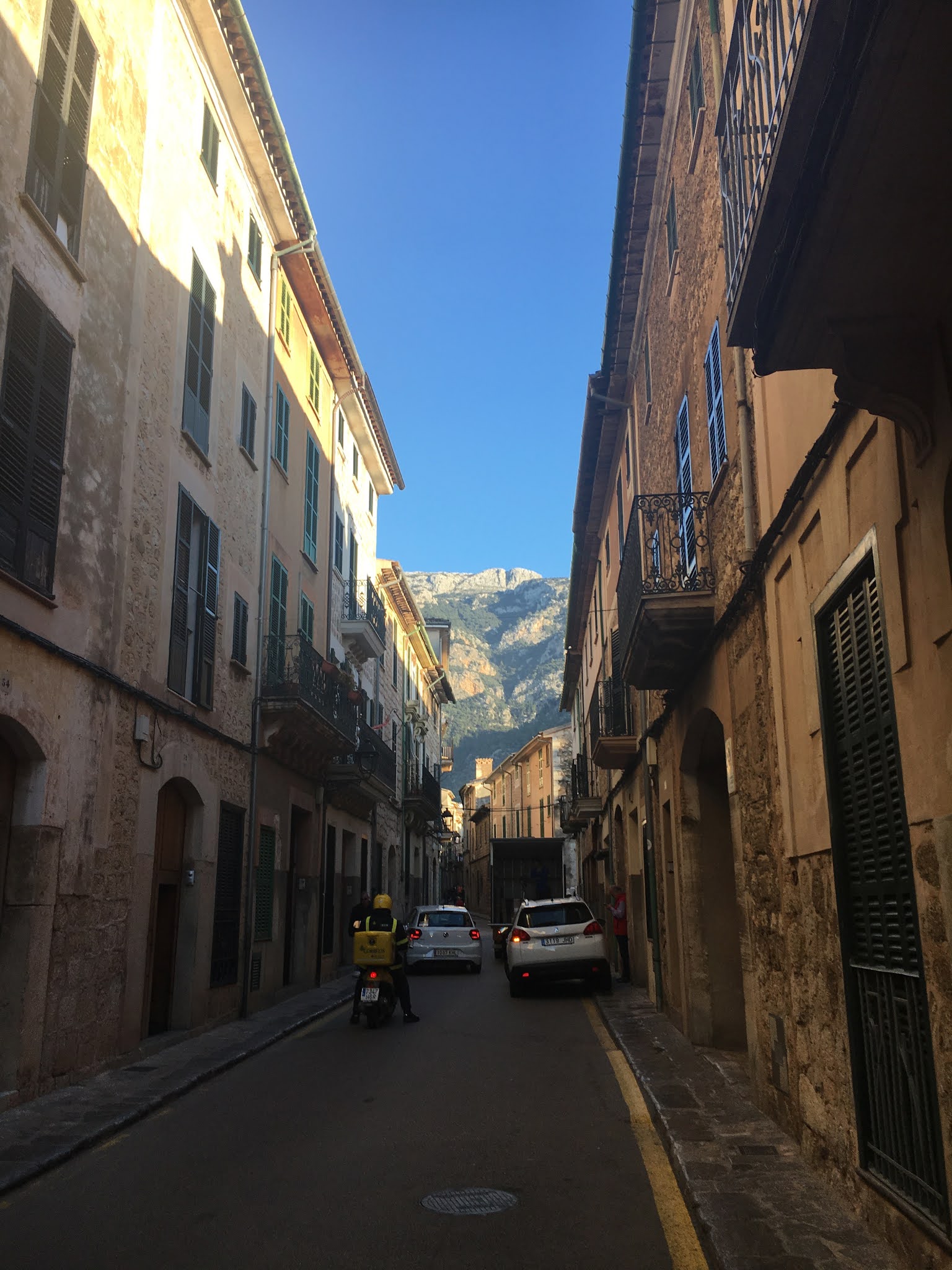
View of the mountain from the street, our B&B was on the left, restored from 1902. 


I loved the grillwork on all the buildings. I think this was opposite our hotel room. 


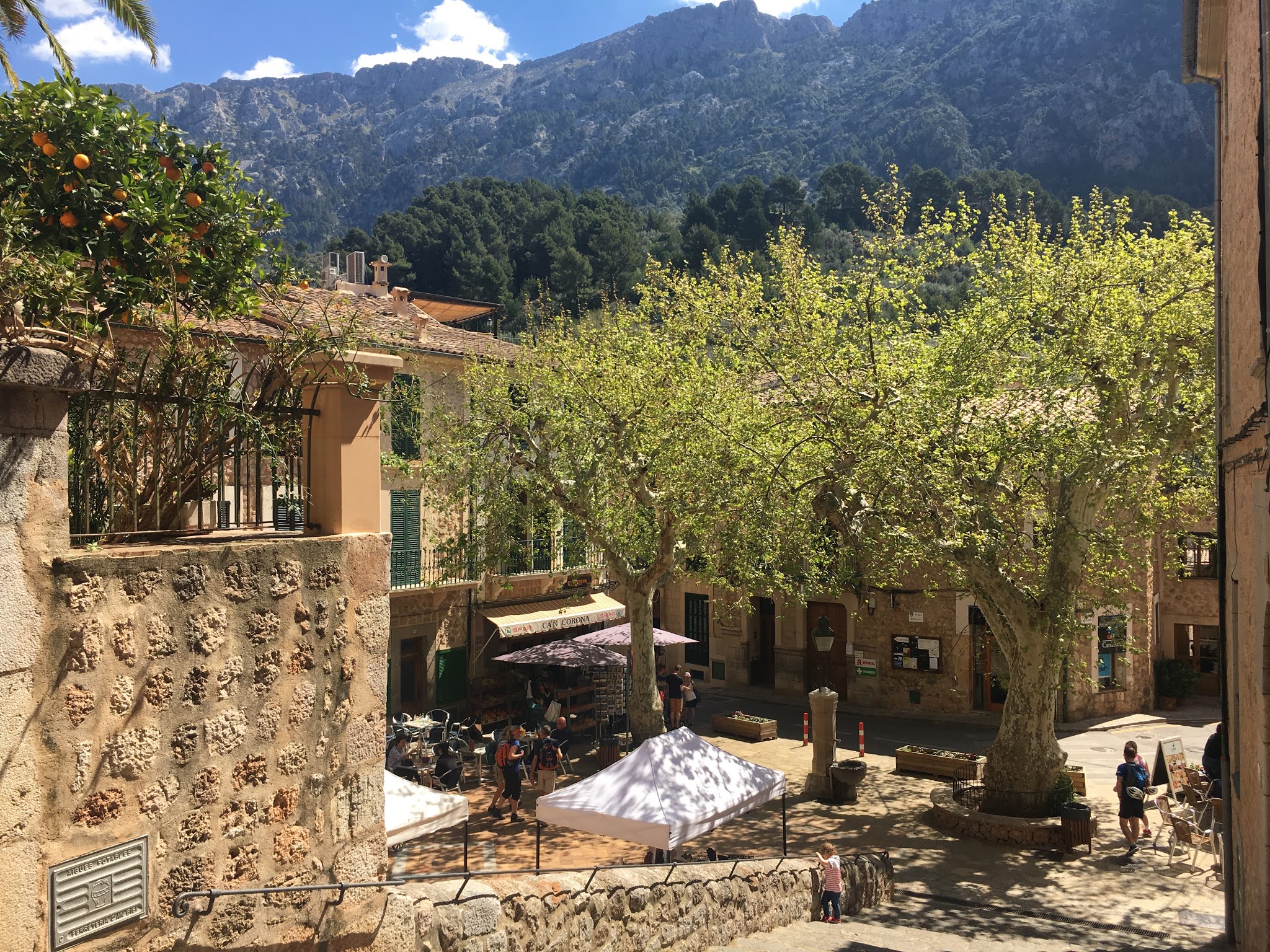
View from the tram stop towards the square in Sóller.

View from the walk from our B&B to the port.

Port de Sóller

I also made a day trip to the town of Deiá, a pretty town in the mountains with beautiful views. It was also the home of the writer Robert Graves who moved there in 1929 and lived there until his death. The house is now a museum, and you can visit the house and surrounding garden for a small fee. It was a bit of a walk outside the town but was worth seeing. 

View from the walk to Robert Graves' home, that's Deiá in the distance. I love the terraced hills.

Robert Graves' home

Robert Graves' study

Another day I walked a few miles through some lemon groves to the town of Fornalutx. It was beautiful and tranquil and then I had a glass of wine and some tapas while sitting in the square, watching bicyclists whizzing by on the mountain roads. 

View along the walk to Fornaluxt

There were lemon and orange trees everywhere.
There were signs posted all over for local marmalade and I'm sorry I didn't buy any. 

I was so tempted to reach through the fence and pick one of these lemons! 

I made a slight detour on the walk which turned into a hike and I went the back way into town.
Great view though.


I loved this reading girl on a terrace. That would be me, everyday, if I lived there!

Lots of stairs in Fornaluxt! 

The square in Fornaluxt. I sat at one of the restaurants on the right and had a snack.


Mallorca is know somewhat for being a party island but I skipped all that and just enjoyed the stunning scenery. It was beautiful and relaxing and I would love so much to go back to Spain someday. 

Thanks again to Kaggsy and Simon for hosting this event! I hope to read at least one more book published in 1956, and hopefully more in the coming weeks. 

I'm also counting this as my book set in Spain for the European Reading Challenge

Tuesday, April 28, 2020

The Exiles Return by Elisabeth de Waal; and Photos of Vienna


Posthumously published in 2013, The Exiles Return is the first of Elisabeth de Waal's novels to be published by Persephone (the above image is a Picador edition). Grandmother of author Edmund de Waal, Elisabeth de Waal was born in 1899 as a member of the wealthy Ephrussi family, a banking dynasty. Her mother was a Baroness, and Elisabeth studied law, economics and philosophy and was a poet. 

The Exiles Return is the story of five people who return to Vienna in the mid-1950s. Some are loosely connected, and some closely. The story begins with Dr. Kuno Adler, a Jewish research scientist who is returning to Europe for the first time after the war. Though his wife became a successful businesswoman in New York, he longs to return to Vienna and is able to return to his laboratory, albeit in a less prestigious position. 

The second character is a wealthy Greek named Kanakis, who returns to Vienna in search of a little Vienna palais to enjoy the society life. He has money and influence, and surrounds himself with beautiful and interesting people, including the young and beautifully handsome Prince Lorenzo Grein-Lauterbach, nicknamed Bimbo. Now impoverished, he has returned with his older sister Nina, who works in the same laboratory as Dr. Adler. 

Endpaper from the Persephone edition of The Exiles Return

Finally, the reader is also introduced to Marie-Theres (nicknamed Resi), an eighteen-year old Austo-American, whose parents fled before the war. Daughter of a princess, she has never really fit in to American life and her family thinks visiting her mother's family in Vienna will do her good (and possibly marry her off). 

At first it seems that these disparate characters have nothing to do with one another, but eventually, their stories intertwine, at least somewhat. The end of the novel is not a surprise, as it begins with a dramatic event reported in the newspapers, so the story is not so much about what happens, but why. It's a fairly short book and I think having so many characters in so short a novel is a bit disappointing. This almost feels like a first draft, and as an unpublished manuscript, it may well be (there's even a note explaining that the first page of a particular chapter is missing.) Dr. Adler and Resi get the most attention, and I feel like the other characters were underdeveloped -- the Grein-Lauterbach siblings are really just secondary characters but Nina in particular could have been really interesting. 

Vienna and Austria, however, get a lot of wonderful descriptions. Resi spends a summer in a country estate which sounds just heavenly, and then a season in Vienna, going to lectures, parties, and the opera. In 2018 I was able to spend my Thanksgiving weekend in Vienna, which was just as wonderful as you'd expect. 

The Ringstrasse 
St. Stephen's Cathedral. The Christmas markets had just opened that weekend.
The National Library of Austria, surely the inspiration for the library in Beauty and the Beast. 
Belvedere Castle was a quick walk from my hotel, it's now a museum with artwork by Gustav Klimt. 
The Ferris wheel at the Prater, made famous by Orson Wells in The Third Man.

And the pastries were to die for. 
I really should have brought this book with me and read it while I was there, but my book group was meeting the day after I returned so I was busy reading Station Eleven by Emily St. John Mandel -- a book about a pandemic! Who knew? 

I'm counting this as my book set in Austria for the European Reading Challenge

Monday, September 24, 2018

Persephone Readathon Check-In and Giveaway!


So excited for another Persephone Readathon! I'm a bit late with this posting, but I've already started my latest Persephone, Alas, Poor Lady by Rachel Ferguson. I seem to have put this one off forever -- I think I've owned it for at least five years. But I've read more than 100 pages so far and I'm quite enjoying it. It's fairly long, more than 450 pages, but I'd like to try to squeeze in at least one other dove-grey book by the next Sunday if I can -- I also own two newer Persephones which are quite short: Tory Heaven by Marghanita Laski, and The Journey Home and Other Stories by Malachi Whitaker. I've been really impressed with Persephone's short story collections, though I do find short stories difficult to review.

And now for the giveaway!!

A couple of months ago I was at the only used bookstore around with books in English (tricky to find here in Germany). I naturally checked the Classics shelf, and was delighted to find a Persephone -- a pristine copy of Cheerful Weather For the Wedding, in the Persephone Classic edition!


I already own a copy (sadly, packed up and in storage) but I could not bear to leave it on the shelf so naturally I bought it! I realized it would be the perfect book to share as a giveaway during the Persephone Readathon! 

If you aren't familiar, it's a novella about a single day in the life of a young woman named Dolly, her wedding day. Things are not necessarily as they seem, as the bride has doubts, and a former suitor arrives. It's a very quick read, only 119 pages, with wide margins. It could easily be finished in a single sitting (and I might reread it before I pop it into the post for the winner). It was also adapted into an excellent film starring Felicity Jones and Elizabeth McGovern in 2012. 

That's Felicity Jones (right) as the bride, and Zoe Tapper (her bridesmaid? I've forgotten.)
  • If you'd like to enter the drawing, just leave a comment below and tell me which Persephone is your favorite and why. (If you haven't read any Persephones yet, just tell me which one you'd like to read!) 
  • The drawing will be completely unscientific and I'll pick my favorite response. 
  • Deadline to enter is Sunday, September 30, 11:59 p.m. Pacific Standard Time. 
  • The drawing is limited to residents of the U. S. and Europe -- I live in Germany and can mail via European and U. S. mail. 
  • Please leave a good contact email in your comment (if it doesn't automatically link) so I contact you if you win!
Anyway -- happy reading to all! Hope you're enjoying your Persephones this week! 

Sunday, September 2, 2018

Fall Reading Challenges: R.I.P. XIII, Persephone Readathon, Victober, and The 1944 Club!

So many great reading opportunities on the blogosphere this fall! Here's a roundup of what I want to read soon. Naturally, I'm going to focus on what's on my own shelves. 


Readers Imbibing Peril XIII: September 1 - October 31.

Mystery, suspense, horror, thriller, dark fantasy, gothic. I'm hoping for Peril the Second, at least two books. Possible RIP Reads:
  • A ghost story collection -- I have collections by Elizabeth Gaskell, M. R. James, and E. F. Benson on the TBR shelves
  • Something by Wilkie Collins, a shorter work: The Dead Secret, The Evil Genius, or The Haunted Hotel. (Can also count for Victober).
  • Frankenstein, for my IRL book club
  • Something by Dorothy L. Sayers -- my library has several available for digital audio download.  Probably either Strong Poison or The Unpleasantness at the Bellona Club. Will also count for my final category in the Back to the Classics Challenge


Persephone Readathon: September 21 - 30. Hosted by Jessie at Dwell in Possibility

Again, just trying to read more books from my own shelves. I have at least a dozen unread Persephones. Possible reads: 

  • Alas, Poor Lady by Rachel Ferguson. It is the dove-grey book that I've owned the longest without reading it.
  • Long Live Great Bardfield by Tirzah Garwood
  • The Godwits Fly by Robin Hyde. My most recent Persephone purchase, bought at the shop on my trip to London in June.
  • Tory Heaven by Marghanita Laski. A birthday present -- I should read it before my next birthday.
  • The Happy Tree by Rosalind Murray


Portrait of Queen Victoria, painted by Franz Winterhalter  in 1943.
I saw the original at Kensington palace in June.

Victober 2018: October 1 - 30. 

This is a new one for me, a month-long readalong of Victorian literature on Goodreads. Possible reads: 
  • The Doctor's Wife by Mary Elizabeth Braddon
  • The Dead Secret, The Evil Genius, or The Haunted Hotel by Wilkie Collins (also RIP)
  • Tales of Mystery and the Macabre by Elizabeth Gaskell (also RIP)
  • Who Is Lost and Is Found by Margaret Oliphant
  • Is He Popenjoy? by Anthony Trollope -- for my Trollope group readalong
  • Treasure Island by Robert Louis Stevenson -- I've gotten hooked on Black Sails, which includes some of Stevenson's characters -- sort of a prequel which explains the relationship between Long John Silver and Captain Flint.
  • The Time Machine by H. G. Wells


The 1944 ClubOctober 15 - 21.
Hosted by Simon of Stuck in a Book and Karen of Kaggsy's Bookish Ramblings


Possible reads: 

  • The Green Years by A. J. Cronin. I know nothing about this book, but someone left a beautiful old edition on the giveaway cart at the library last year, and I couldn't pass it up. Apparently it's about an Irish orphan who is sent to live with his grandparents in Scotland. It's only 240 pages so I'll give it a try.
  • The Portable Dorothy Parker by Dorothy Parker -- I have a beautiful Penguin copy that I received as a prize several years ago from an online contest -- one of the last of my Big Box of Penguins.
  • Winter Wheat by Mildred Walker -- a wonderful book set in Montana, by an author nobody reads anymore. I read it several years ago and loved it, and would love to read it again. It's a coming-of-age story about a young woman working as a teacher in WWII.


It seems like a lot, but it's split up over two months, and a lot of the books cross over into other categories. Bloggers, have you read any of these books or authors? Which do you recommend? And is anyone else signing up for fall challenges? 

Saturday, July 28, 2018

London War Notes by Mollie Panter-Downes


It's taken me more than two months, but I've finally finished London War Notes, my tenth book for the TBR Pile Challenge 2018. First published in book format in 1971, this is a collection of essays written biweekly for the New Yorker during World War Two. It remained sadly out of print for many years until Persephone books republished it in 2014. I'm quite fascinated by the war years, particularly the war at home, so I was sure this would be right up my alley. Only the length had discouraged me since I bought it four years ago and I thought this would be a good time to get to it. 

Of course these essays discuss a lot of what's going on in London and the surrounding area during the war, especially the bombings, there's definitely a lot more history about the battles and the politics that were going on. There has been so much written about the war (go into any Barnes and Noble bookstore and you will be amazed at how many nonfiction books there are about WWII), but so much of what's published is centered around Europe, I'd forgotten how critical the battles in North Africa and the Far East were, especially places like Burma and Singapore. So much of what Americans associate with WW2 in Asia is centered around Japan -- I didn't really realize how significant the loss of Burma and the rubber plantations was to the war effort and everyday life in Britain. I did have to stop a number of times and look up historical events mentioned in the book that would have been common knowledge at the time of publication.

The other thing that really struck me about this book was the overwhelming sense of anxiety. As an American growing up in the late 20th and 21st century, I cannot imagine living with the thought that you could be bombed at any moment, to be evacuated from your home, or to have to endure rationing for food, clothing, and fuel. It's a little easier to read knowing that the war would be won, but it must have seemed like it was dragging out forever -- and of course rationing didn't end for a long time afterward. I've been a little disappointed being unable to buy Warburton's crumpets the past few weeks because of the CO2 shortage, boo hoo.

Detail from the endpapers of the Persephone edition
I do, however, think that I can relate to the sense of anxiety. Every day when I wake up and look at the news, I keep waiting for the worst, and wonder how much longer it will get worse before it gets better. I know a lot of Americans are feeling similar anxiety. I'm sure it's worse for people actually living in the U. S.

I'm very glad I read it, but this is the slowest I've read any book for this challenge, in this year or previous years. I suppose was a mistake to be reading this 459 page nonfiction book about World War Two at the same time I was reading a 661 page memoir about World War One (Testament of Youth). You think? I did in fact take a long break from London War Notes in June. I thought that it would be easy to pick it up again halfway, but I was wrong -- I really feel like I lost momentum. 

And now for a lighter anecdote! Reading this book also reminded me of one of my visit to the Churchill War Rooms during one of my visits to London. It's part of the Imperial War Museum and is really fascinating -- the underground bunker where Churchill and others lived, worked, and slept during the war. It is quite fascinating and there were a lot of interesting displays. Of course one has to walk through the gift shop on the way out and this was one of my favorite purchases:


Yes, these are two-handed oven mitts with a wartime propaganda slogan. I got it as part of a set with a matching apron (also available as a tea towel). There were a lot of fun postcards and prints with wartime slogans. Here's another of my favorites:


It's really worth visiting if you're in London and have any interest in wartime history. There's also an online shop here if you just want the oven mitts or the poster version.

So -- that's book #10 for my TBR Pile Challenge 2018! I'm making good progress and hopefully I'll complete the last two AND my two alternate reads this year! How is everyone else doing with their TBR piles?