Showing posts with label Ireland. Show all posts

Sunday, March 13, 2022

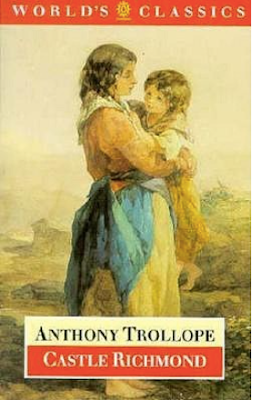
Castle Richmond by Anthony Trollope


It is impossible that these volumes should be graced by any hero, for the story does not admit of one. But if there were to be a hero, Herbert Fitzgerald would be the man. 

A Victorian novel by Anthony Trollope, set in Ireland? This book could not be any more in my wheelhouse. For the Back to the Classics Challenge I needed a book from the 19th Century and I still had five unread Trollopes on my TBR shelve. Two of them were set in Ireland so that seemed like an obvious choice for March.

Trollope spent nearly twenty years in Ireland working for the post office, and began his writing career there. His first two novels are set in Ireland, and were written during the Great Famine. Castle Richmond, his third novel set in Ireland, was published in 1860, but is set several years earlier. It does use the Great Famine as a plot point, but much less so than I was expecting. 

Basically, it's the story of a love triangle between two cousins of the landed gentry, Owen and Herbert Fitzgerald, and the girl they both love, Clara Desmond, the beautiful but poor daughter of Countess Desmond, a young widow whose marriage was less than happy. There's also a complicated plot about the inheritance of Castle Richmond, the seat of the wealthy Fitzgerald family. But I'm getting ahead of myself. 

Owen Fitzgerald is the young squire of Hap House in County Cork -- technically gentry, but the poorer branch of the Fitzgerald family, and untitled. He is handsome and dashing, and befriends the young Earl of Desmond, acting as a sort of older brother. They go hunting and fishing and whatnot, and Owen also notices the young Earl's older sister, Clara, who is about sixteen. Eventually he declares his love for her, and she returns his feelings. However, her young widowed mother, who is not yet forty, quashes all her hopes -- Owen is too poor and lacks a title, so she refuses to acknowledge any engagement and forbids Clara to see or write to Owen. (The reader is also aware that the young Countess is also crushing on Owen and secretly wanted him for herself). 

About a year Clara is befriended by two of Owen's distant cousins, Mary and Emmeline Fitzgerald, from the wealthier portion of the Fitzgeralds -- the family living at Castle Richmond. She spends time with them and is much thrown together with their brother Herbert, the heir and future Baronet. He's younger and more bookish than his dashing cousin Owen, who considers him a prig. It would seem that Clara and Herbert would be a perfect match -- she's beautiful and he's rich, and they're both gentry. But that would make for a very short novel, so there must be complications -- which arrive with some nasty characters from London, Mr. Matthew Mollett and his son Abraham, who have come to County Cork to stir up trouble for the wealthy Fitzgeralds.

Before marrying Lord Fitzgerald of Castle Richmond, his beautiful wife Lady Fitzgerald had made an unfortunate marriage with a ne'er-do-well named Talbot who deserted her and her child and ran off to Paris, where he was supposedly killed in a fight over a gambling debt. Eventually, she met and married Lord Fitzgerald. Now the Molletts have arrived with the intent of blackmailing the Fitzgeralds, claiming that Lady Fitzgerald's husband is still alive and that her children are illegitimate. . . making Owen Fitzgerald the rightful heir of Castle Richmond and the title. 

I liked this novel, though the love triangle and the blackmail plot lines are the strongest. But these characters are basically wealthy Protestant landowners. There's actually not that much in the story about Ireland and the famine -- that's mostly a peripheral plot point only in how it affects the main characters. As landlords, the Fitzgeralds are trying to help the starving population, and there's some infighting between the Catholic and Protestant clergy about how to best help everyone which is pretty infuriating, but that's not a large part of the story. 

I also found Clara to be a very undeveloped character -- both of these men are in love with her, but she's mostly a flat character, just very pretty and sweet. She gets a little character development writing letters to both of the men in love with her, but not much. She's not as annoying as some of Dickens' ingenues, but not nearly as interesting as some of the women in Trollope's later novels. 

Overall I did enjoy the novel and sped through the 500 pages in just about a week. I'm getting down to the last few unread books by Anthony Trollope. I can proudly say that I've now finished 38 (!) of his 47 novels. When I've finished them all I'm sure I'll be sad but I guess I'll just have to start reading them all over again!

This is my 19th Century Classic for the Back to the Classics Challenge, and my Irish read for the European Reading Challenge.

Sunday, February 28, 2021

The Real Charlotte by Edith Somerville and Martin Ross


It's been more than ten years since I became a hard-core fan of the Victorian novel, and since then I've read most of the male authors which are the typical literary canon. Now I've moved on to the more obscure works, many of which are written by women. The Real Charlotte has not one but two Victorian women as authors: Edith Somerville and Florence Violet Martin (who wrote under the male pseudonym of Martin Ross).

Published in 1894, The Real Charlotte is not so much the story of Charlotte Mullen, a fortyish Irish spinster, as it is about her young cousin, Francie Fitzgerald. Aged 19, Francie is a beautiful orphan who has come to live with her cousin after the death of an elderly relative, whose dying wish was that Charlotte take care of her. Francie had been living with Dublin with relatives who have recently fallen on hard times, so she's been sent to live with Charlotte in the country, at Tally Ho Lodge.


Beautiful and flirtations, Francie attracts the attention of several men: Christopher Dysart, oldest son of the local gentry; Gerald Hawkins, a British army officer stationed in town; and also Roderick Lambert, agent to the Dysart estate, and an old family friend. Lambert claims to have only a friendly interest in Francie, since he's 15 years older and married to a wealthy widow, but it becomes obvious that he's jealous of Francie's friendships with other men. 

Francie raises eyebrows around town by spending too much time with the dashing and equally flirtatious Hawkins, and the pair are often unchaperoned for questionable amounts of time. Charlotte is angling to get Francie engaged to Christopher Dysart, who is kind but rather too interested in books and photography for Francie's taste. But the social-climbing and ambitious Charlotte has ulterior motives for the match, and will use her friendship with Lambert to get what she wants. Meanwhile, there are garden parties, picnics, and some sailing accidents, plus some pretty obvious foreshadowing, until everything comes to a dramatic and rather abrupt conclusion. 


I tried reading this a year ago and really couldn't get into it, but I thought I'd take a look and see if it would be a good pick for my March reading because of the Irish setting. The first couple of chapters are a bit disjointed but once Francie arrived at Tally Ho Lodge the story really took off and I could hardly stop reading it, finishing it in only three days. (Which isn't really that impressive, it's less than 400 pages, and a lot of short chapters). I was really curious to see how this was going to end up and why the book was named after Charlotte, since most of the time it seems like Francie is the central character. 

Oddly enough, several characters and plot points reminded me of Jane Austen -- I don't know if I've been reading too much Jane, or if these have become rather stock characters. Hawkins definitely reminded me of a both Wickham and Willoughby, and Lambert seemed an awful lot like Knightley from Emma, though a lot less benevolent, not to mention married. There's a even a plot point that seems straight out of Mansfield Park

Edith Somerville (left) and Violet Florence Martin (right)

My other quibble was about how the Irish are depicted. Naturally the gentry are English, and look down on anyone local, or with an Irish accent, and many of the characters speak in dialect, particularly servants and the working class. I don't know much about the authors other than they were cousins and wrote about 14 books together before Martin's death in 1915. Somerville continued to write under their joint names. The Real Charlotte is considered their masterpiece, but today they may be better known for the Irish R. M. series of books adapted into the 1980s TV series. The Real Charlotte was also adapted for TV in 1990, but no copies in the library means I'll have to keep a lookout for a copy online. 


I'm counting this as my Classic by a Woman Author for the Back to the Classics Challenge; and as my Irish selection for the European Reading Challenge.

Sunday, January 15, 2017

The Country Girls Trilogy by Edna O'Brien


Last summer I was lucky enough to visit Paris, which is only a three-hour train ride from our new home in southwest Germany. Of course we had to visit the famous Shakespeare and Company bookstore which is on the Seine, just across from the Notre Dame Cathedral. Not only do they have a great selection of books -- all in English -- they also have a tiny collectible bookstore, and tables out front with some used books as well. One of my finds was The Country Girls Trilogy and Epilogue  by Edna O'Brien, which I chose as my 20th Century Classic selection for the Back to the Classics Challenge.

This book is actually a omnibus of three novellas: The Country Girls (1960); The Girl With Green Eyes (also known as The Lonely Girl) (1962); and Girls in Their Married Bliss (1964). The edition I read also includes the epilogue that O'Brien added in 1986. It's the two story of two young women, Caithleen and Barbara, growing up in the early 1960s. The girls are childhood best friends in a small town in western Ireland. Eventually, they move to Dublin and ultimately to London. 

The first two books are narrated by Caithleen, also known as Kate. In the first volume, Kate is a rather poor, bookish girl, sweet, but dominated by her more assertive friend Barbara (also known as Baba). Baba's dad is the local veterinarian so they have a pretty comfortable life, but Kate's father is a heavy drinker and they are struggling to hold on to the family farm which is heavily mortgaged. Kate gets a scholarship to a convent school, and Baba attends as well (though she makes it clear she is NOT on a scholarship). It's mostly the story of their teenage years adjusting to the convent school, girlhood crushes, and friendships. Baba is the more dominant in the relationship and the way she treated Kate sometimes made me really uncomfortable, but ultimately, Baba and Kate are always there for one another. 

In the second volume, The Girl with Green Eyes, the girls have moved to Dublin, and Baba is mostly in the background as Kate is navigating her first real love affair with an older man, to the displeasure of her relatives and all the people back home who decide to get involved. It was appalling to me how these outsiders felt they had a right to interfere. I've never lived in small town but I can't imagine everyone knowing my business. 

The third volume alternates between the third person story of Kate, and Baba's story, told in her own voice. Baba's narration is darkly funny but ultimately, I found this book really sad. As late as the 1960s, women in Ireland (and England) had so few rights, it was infuriating. The book is well-written and the characters really came alive for me, but it was quite depressing. There were a few funny moments but parts are quite heartbreaking.

I'm counting this as my Classic Set in a Place I'd Like to Visit (Ireland) for the Back to the Classics Challenge and also my first book for the European Reading Challenge 2017.