Showing posts with label adventure. Show all posts

Sunday, January 10, 2021

Challenge Link-Up Post: Travel or Adventure Classic


Please link your reviews for your Classic Travel or Adventure Classic here.  This is only for the Classic Travel or Adventure Classic category. This can be fiction or non-fiction, but the journey itself must be the major plot point -- not just the destination.   If you do not have a blog, or somewhere public on the internet where you post book reviews, please write your mini-review/thoughts in the comments section.  If you like, you can include the name of your blog and/or the title of the book in your link, like this: "Karen K. @ Books and Chocolate (The Time Machine)." 

Monday, September 7, 2020

Roughing It by Mark Twain: Tall Tales (and Some Racism) in the American West


Published in 1872, Roughing It is a semi-fictional account of Mark Twain's travels and misadventures in the American west during the 1860s. The story begins with Twain eagerly accompanying his brother Orion to the Nevada Territory, where Orion has been appointed Secretary. After an extensive stagecoach journey, he spends time in Nevada before visiting Salt Lake City, then failing as a miner in California. Twain begins to support himself by taking various writing and newspaper jobs, which eventually take him to Hawaii. 

This book is full of wry humor and amusing descriptions of life in the Wild West, including some tall tales and colorful characters. However, it's sprinkled throughout with a lot of racist comments -- Twain is particularly unpleasant about native Americans and Hawaiians, though he includes pretty much every non-white group in American at the time. I realize this was the prevailing attitude of the times, but honestly, there were some serious yikes moments for me. It was very disconcerting because there would be amusing chapters about ridiculous characters and situations  -- and some not so ridiculous, but downright scary, like the time Twain and his companions set off a massive forest fire. In another instance, Twain and his companions were trapped on a tiny island in the middle of an alkali lake after their boat drifted off. A storm was brewing and they narrowly escaped perishing (if the story is to be believed).


This was a slow book, and I listened to most of it on an audio download from my library. There are several editions available. Mine was read by Robin Field who is an excellent narrator, and I probably would have given up on the book much earlier if I had just been reading the print copy. 

Honestly, the only reason I read this book was because I'd bought a copy years ago and it was on my pile for the Big Book Summer Challenge, and also on my Classics Club list. If it hadn't been available on audio I probably wouldn't have stuck with it. Twain is good at spinning out an entertaining yarn, and if you like a dry and occasionally ridiculous style of humor, it's mildly amusing if you can skip over the racism. I also have a copy of Twain's Letters From Hawaii that I bought in Waikiki about ten years ago. It's much shorter and I may give it a go in a few months just to get it off the shelves and donate it to the Little Free Library on my street.

Tuesday, September 26, 2017

Never Get Involved in a Land War in Asia


No, this is not a blog posting about The Princess Bride, probably the most quotable movie ever. (Though I really should reread it someday -- does Vizzini actually say the line in the book? I can't remember. And I didn't realize until after I'd written this post that it's the 30th anniversary of The Princess Bride!!)

Anyway. After a solid month of reading (with some other audiobooks mixed in), I have finally finished the 950-page behemoth that is The Far Pavilions. Written by M. M. Kaye, in 1978, this is an epic story about an Englishman, raised as an Indian, who falls in love with a half-Indian princess against the backdrop of the Second Anglo-Afghan War in the late 1800s. (Did you know there was a second Anglo-Indian War? I never knew there was a first, but I'm a Yank and we are not taught such things in school. I barely learned about the British Raj and the East India Company).

So. The book start with the birth of young Ashton Pelham-Martin, born in the Himalayas in the 1850s to English parents -- an eccentric academic father and a young mother who dies in childbirth. His father then dies of cholera during the Indian Rebellion of 1858. Fearing for his safety as a foreigner, little Ash is then raised by his Indian nurse Sita as Hindu boy whom she renames Ashok. (He has dark hair and eyes and can pass for a native). He spends much of his childhood knowing nothing of his family history and ends up as a servant in the local prince's household, until palace intrigues force his adoptive mother to reveal his true parentage and return him to his ancestral home in England.


Because of his upbringing, Ashton's loyalties are forever divided between his Englishness and his love for India, and eventually he joins the military and returns to India, where his knowledge of Indian language and culture make him both invaluable and suspect to the British Raj. There is romance, there are intrigues, there are battles and action scenes galore. Also, lots and lots of war strategy and politics which I wasn't expecting. It's a very dense read so I definitely couldn't zip through it. (But I did learn that the Soviets invading Afghanistan in the 1980s wasn't a new idea).

Overall, I really enjoyed the book but darn it all, my edition was 955 pages with tiny print and very narrow margins, and honestly, I think M. M. Kaye could have used some more editing. Naturally, there are amazing coincidences and lots of exposition where characters are explaining political and military history and I do feel like there was a lot more telling of events than showing. Plus, the book is so huge, I really feel like it could have been split into three stories: Ash's childhood, the love story with the Indian princess, Anjuli; and the Afghan war story.

Also, I found Anjuli's character to be incredibly undeveloped and there are chapters upon chapters when she's barely mentioned, which I found irritating. She's hardly in the final third of the book at all. One of the blurbs on the back cover describes it as "a high-adventure love-story" but if you're looking for a sweeping romance, this isn't it. I was expecting Gone With the Wind in the Himalayas, but there's far more war and politics than character development in this book, which I found disappointing. Also: NO MAPS, which is a pet peeve when characters are traveling in books, and there is a lot of traveling in this one. I am unfamiliar with Indian and Afghani geography, so I found this especially irritating. (However, they do include a diagram of a military compound).

However, I did like that Ashton really was supporting the Indian and then the Afghani viewpoint, rather than blindly following the British Colonial idea that White People Know Best. I'm debating now as to whether I should watch the 1980s TV adaptation, which turned a book of nearly a thousand pages into a six-episode mini-series starring lots of white people, including Amy Irving as a half-Indian princess. Seriously.

That's Ben Cross as the adult Ashton, and Amy Irving in brownface as Anjuli. Really.
I'm still planning on reading The Raj Quartet (also turned into a mini-series), which is thankfully divided into four different books since it totals nearly 1800 pages. And A Suitable Boy, because it would be nice to read an epic book set in India actually written by someone Indian. It won't be for a while because I'm not quite sure if I can dive right in to another epic doorstopper.

Saturday, February 27, 2016

The Phoenix and the Carpet by E. Nesbit


After finishing Journey to the Centre of the Earth, I was still in the mood for a some good adventures. I remembered a copy of The Phoenix and the Carpet by E. Nesbit that I'd picked up years ago at a library sale. How is it that I completely missed out on Nesbit in my youth? I suppose my hometown library just didn't have them. Well, I've now completed five of her books and loved all of them. This one ranks right up at the top of great classic children's fantasy, right up there with the Wizard of Oz books and the entire oeuvre of Roald Dahl.

Published in 1904, The Phoenix and the Carpet is the second in the series of that began with Five Children and It. Instead of a magical sand fairy, the a family five children find both a magic carpet and a magical bird, a legendary phoenix. By a series of mishaps (well, basically, they decide to try out fireworks inside the house) they have to get a new carpet for the nursery. Their parents buy a second-hand carpet which, when unrolled, is found to include a strangely glowing egg. The children attempt to return it, but no go. After the egg accidentally rolls into the fireplace, it hatches and out comes the phoenix, who explains that the carpet is also magic, and can give them three wishes a day.

If you're looking for serious high fantasy, this isn't it. Although the children are occasionally transported to faraway places, their adventures are pretty tame, though humorous. As in Five Children and It, the children quickly realize that wishes don't always work out quite like you plan. Of course it's a children's story, so most everything comes out right in the end, but Nesbit's chapters are cleverly plotted, so I really wasn't sure how everything was going to shake out. And the writing is both wry and witty, with a few sharp observations. It's both entertaining and funny as the kids get in and out of scrapes. My only quibble as that in some their adventures, they encounter "savages" who are quite obviously people of color, and the racism that tinges these episodes.

Cover of the new Puffin Classics edition

Overall, though, it was quite a delightful read, and tI'll probably include it among my favorite books of this year. I'm counting it as my Fantasy/Sci-Fi/Dystopian Classic for the Back to the Classics Challenge. 

Tuesday, August 25, 2015

Kon-Tiki: Across the Pacific in a Raft by Thor Heyerdahl


I always like to include at least one classic on my book group's potential reading list, and last year, the group voted to include Kon-Tiki: Across the Pacific in a Raft as one of our 2015 reads. I thought an adventure story would be a fun summer read, but as August got closer, I began to worry that no one would show up to the book discussion. How many people want to discuss a book that's been around forever but hardly anyone reads anymore? 

Well, to my surprise and delight, I had a full house for the book group discussion -- seven people showed up! Nearly everyone had read the book except one member who watched the documentary. I myself put off reading the book off until a week before the discussion, and I was actually worried that I wouldn't finish it in time. Two days before the meeting, I still had 120 pages to go. However, the final three chapters were so riveting I read it all in one sitting. 

But I'm getting ahead of myself. For those who don't know the story, Kon-Tiki is the true story of six men (five Norwegians and a Swede) who test author Heyerdahl's theory: that it's possible that hundreds, perhaps thousands of years ago, people from South America traveled across the Pacific Ocean as far as Polynesia, more than 4000 miles away. Heyerdahl first made the connection before WWII, while visiting French Polynesia, when he was struck by the likeness of the tiki god statues to South American carvings. After the war, he was in New York City and began planning the journey and found five men to accompany him on what sounds like an insane voyage in 1947. With private donations and some help from the American and Peruvian governments, Heyerdahl and the five other men built the raft from balsa wood had it towed out of the way of shipping lanes, and hoped for the best. 

Over the next three months, the men sailed across the Pacific on the Humboldt current, facing storms, sharks, and whales, with nothing to steer the raft, and mostly basic equipment, though they did have a radio. Most people doubted they would ever reach their destination. I'm fascinated by the romance of sailing, but the thought of floating in the middle of the ocean, thousands of feet above the ocean floor scares me silly. And they did this willingly! But the story is really interesting, especially the encounters with marine life like whale sharks, and what they ate and what they saw every day. 

Whale sharks can get up to 40 feet long, almost as long as the Kon-Tiki raft.
I was surprised at what a fascinating, quick read this book was. I liked most of it though there was a part in the middle where Heyerdahl explains the history of Easter Island which I found a little dry and mostly skimmed. I also wish the book had gone into a little more detail about life on the boat -- how did everyone get along for 101 days, stuck on a boat in the middle of nowhere -- literally?

I did a little research afterward, and this book has sold more than 20 million copies and has been translated into many different languages.   My book group mostly liked it, though we did wonder why it was such a huge publishing phenomenon. My guess was that it really captured the public imagination -- it's a pretty amazing feat. It was also made into an award-winning documentary film, and in 2012, made into a fiction version of the film which was nominated for Best Foreign Language Film. I haven't seen either of the film versions yet but the library owns both so I hope to watch one or both of them soon.

Overall, an excellent read, and I'm counting it as my Non-fiction Classic for the Back to the Classics Challenge. 

Tuesday, March 24, 2015

I Married Adventure: The Lives of Martin and Osa Johnson by Osa Johnson


I've owned I Married Adventure since 2008, just before I moved to Texas.  We were still living in Florida and we made one last trip to DisneyWorld before we left.  Believe it or not, there are excellent books for sale all over the Disney parks in the gift shops, and not just about Disney characters and animation.  In particular, the Epcot theme park has tons of great books in the World Showcase -- nearly every country represented has books from or about that country.  I actually bought this book in a little gift shop where they had a lot of African gifts.  I think I had just read West With the Night by Beryl Markham, and was hoping it something similar.

So, this is the memoir of Osa Johnson, who was born in Kansas in 1894 and was a world traveler along with her husband, photographer and filmmaker Martin Johnson, in the early 20th century.  They had amazing adventures.  It's a really interesting story, and though I did have a few issues with the book, I'm sorry I took so long to read it.

Martin was born in a small town in Kansas in 1884.  Martin was fascinated by the cameras his father had in the family's jewelry shop, and was a self-taught photographer.  He got expelled from school at sixteen, and decided to see the world and make his fortune with his camera.  After an unsuccessful attempt on his own, he had a big break saw a magazine advertisement from the author Jack London, who was building a ship and was planning to circumnavigate the globe.  Amazingly, Martin got a spot on the ship, despite having no sailing experience. 

Though they didn't quite make it around the globe (London suffered health problems and had to cut the trip short), Martin was determined to continue with his travels.  He started speaking about his amazing voyage to groups, and began to attract enough of an audience that he rented out theaters back in Kansas, where met his wife Osa, nine years his junior.  After a whirlwind courtship, they married, and Osa joined Martin on his speaking tours, where they struggled to earn enough to go on another photography tour.  Through hard work and determination, they became an amazing team, and created groundbreaking photographs and films about wildlife (and to a lesser extent, native people), mostly in the South Pacific and Africa. 

Overall, I liked this book.  I'm really fascinated by adventures stories.  I liked reading about all the obstacles they overcame, with weather, terrain, and technical issues with early cameras. Some of their adventures were quite harrowing and even a little gruesome.   In the South Seas, where they sought out natives who'd had little contact with Western culture, some of whom were actual cannibals and head-hunters.  (I used to think this was a myth.  It is not.)  Osa and Martin also met some really fascinating people, including legendary explorers and even royalty.  For example, while on an extended trip in Kenya (then British East Africa) in 1925, they ended up meeting the Duke and Duchess of York -- the future George VI of England (for us Yanks, that's the same monarch from The King's Speech, who took over when his brother abdicated and was the father of the current monarch, Elizabeth II). 

Osa Johnson and a friend. 
However, I did have a few issues with the book.   It was first published in 1940, and as you might expect, some of the attitudes toward other racial groups are not what they are today and some of the references to native peoples is occasionally tinged with racism, though it isn't constant.  And though Osa states repeatedly that she and Martin are primarily photographers interested in recording animals and are appalled by big-game hunters who merely want trophies, she does discuss instances in which animals get shot, though it's always for food, or in self-defense.  It's probably hypocritical of me to be uncomfortable about this, as I'm not a vegetarian.  Martin and Osa were concerned even back in the 1920s about endangered species, but there's quite a few instances of shooting animals.

The writing in this book isn't what I'd call great -- Osa has kind of a gee-whiz style, not what I'd call lyrical or beautiful.  I wish she'd been more specific about dates, though they're not altogether left out.  Also, the end of the book felt rather rushed, and it just sort of stops.  There's a copy of a news article at the end which explains why, but I still felt a bit unsatisfied.  This book isn't a beautiful, lyrical example of travel writing, but overall, it's very entertaining if you can ignore some of the outdated attitudes of that time period. 

Saturday, June 15, 2013

The 39 Steps by John Buchan


I had a hard time choosing an adventure classic for the Back to the Classics Challenge.  I thought this was an easy pick --  originally I was planning on reading 20,000 Leagues Under the Sea, but I listened to an audio version and it moved so slowly that I finally gave up.  I was searching for something in my library branch the other day and ran across The 39 Steps by John Buchan, and I remembered how much I'd enjoyed the BBC movie adaptation from a few years ago.

This is the story of Richard Hannay, a youngish man, probably in his thirties.  Set in the spring of 1914, Richard has come to London after spending years in South Africa as a mining engineer.  He's made some money and wants to enjoy himself but he's rather lonely and getting bored with London society.  He craves excitement, and one day it literally bumps into him as a fellow tenant in his apartment, a man with whom he has a nodding acquaintance, accosts Richard as he's unlocking his flat and begs to come in and confide in him.  The neighbor, a Mr. Scudder, has an amazing story -- he's a spy and is in possession of some very top-secret information about international intrigue in the Balkans.  Also, he's just faked his own death to elude some very dangerous people who are trying to kill him.  Scudder convinces Richard to hide him for a few days until he can make contact with important people and prevent an international incident.

Well, this is all fascinating for Richard until he comes home one day to find Scudder dead in his apartment.  It all looks very bad, so he escapes with the clothes on his back, some cash and an encoded notebook that Scudder hid in a jar of tobacco.  (Coincidentally, Richard finds this as he is refilling his tobacco pouch.  Of course.).  He makes his way north to Scotland while eluding the police and the bad guys while trying to decode the notebook and make everything right and clear his own name.

The dishy Rupert Penry-Jones as Richard Hannay
As you'd expect, Richard gets into lots of scrapes and near-misses and has lots of brilliant escapes, kind of like an early James Bond, but without all the gadgets and sexy women.   This was a quick, light read, about 150 pages in the Penguin edition pictured above (I love the retro cover!)  I'm not really into spy or adventure stories but once in awhile I like a good thriller.  Overall, it was okay, but I did have some trouble with suspending disbelief -- it's pretty amazing in this book how often Richard manages to get out of situations one after another by amazing coincidences and his brilliant knowledge gleaned from working as a mining engineer.  Also, the book ends really abruptly.  It was published in 1915 not long after the beginning of WWI, and there's lots of foreshadowing about the war, with mentions of the Balkans and the Germans and such.

It was interesting to read a book published just at the start of the war.  Buchan wrote several sequels about Richard Hannay but I'm not sure this was interesting enough for me to go searching for them.  Has anyone else read this book?  What did you think?  What other adventure classics do you recommend?  And does anyone else think Rupert Penry-Jones would make a good James Bond?

Tuesday, June 26, 2012

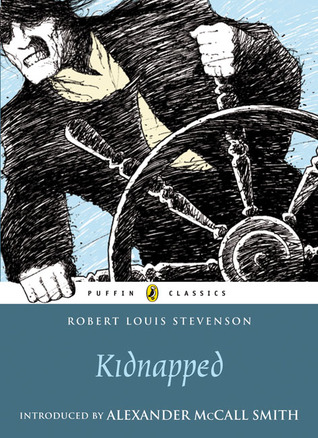
Kidnapped by Robert Louis Stevenson

This book kind of fell into my lap a couple of weeks ago at the library.  Although I was hoping to read a children's classic during the Victorian Celebration, this book was not on my original list -- I still have The Water Babies and At the Back of the North Wind waiting on the shelves.  However, I was shelving books at the library and I noticed this one, which had a really nice cover.  And since I had another copy at home, (though a different edition) I could kill two birds by reading a Victorian book and a book off my own shelves.

Anyhow.  This book is both a Victorian and a historical fiction.  Robert Louis Stevenson, a Victorian writer from Scotland, was writing about a character set in Scotland during the 1750s, after the Jacobite revolution.  The story begins with young David Balfour, the poor son of a teacher who is now an orphan after his father's death.  On the advice of the local minister, he travels on foot to meet his long-lost uncle, who was estranged from his father and is living like a miser in a great estate.  Instead of being pleased to see his long-lost nephew, curmudgeonly Ebenezer first tries to trick him into falling down a tower, then hustles him off onto a ship to be sold into slavery in the Colonies.  (I can't really count this as a spoiler, since the title of the book is, ahem, Kidnapped.)

However, things don't work out as Uncle Ebenezer plans.  The ship is full of nasty characters, but after hitting a small boat, they pick up the only survivor, a Scotsman named Alan Breck.  David allies with Alan and they have lots more adventures together while trying to prove David's birthright, including shipwreck, mistaken identity, and hiding from redcoats.  There's lots of tramping about in the woods, hiding under heather, and avoiding shots from muskets and whatnot.  There's also plenty of Scottish history and vocabulary thrown in.  Stevenson incorporates a lot of actual Scottish history and names of real people, but since everything I know about Scottish history comes from watching Braveheart and reading the Outlander series by Diana Gabaldon (which lost me after about the third or fourth volume), I was kind of lost during parts of it.

Still, I mostly enjoyed this book.  My favorite parts were the interaction between David and his new best friend Alan, who's a character of questionable morals but evidently with a heart of gold.  Parts of this story were reminiscent of one of those road-trip stories with two strangers thrown together.

Other than my lack of understanding of Scottish history, my main quibble with the book the ending, which was incredibly abrupt.  I realize this story was serialized, but it just seemed to stop.  I suppose Stevenson wanted readers to keep reading the sequel, Catriona, which I'd never even heard of (it's known as David Balfour here in the U.S.).

So.  I can see why it isn't as popular as the iconic Treasure Island, but still, an entertaining (if somewhat frustrating) story, but a nice swashbucker and a fun, quick Victorian read.

Friday, July 30, 2010

Around the World in Eighty Days by Jules Verne

A couple of years ago, after I'd started getting Hooked on Classics, I realized I'd never read anything by the science fiction authors H. G. Wells or Jules Verne.  Though I'm not usually a fan of sci-fi, I'm particularly interested in both of these writers because their works are such a reflection of the Victorian fascination with science and industry.  And since I was traveling (to California, not around the world, sadly), I thought that Around the World in Eighty Days would be a perfect vacation read, as it's a classic adventure story.  Though Verne is well known as one of the first science fiction writers, this book, which isn't science fiction, was and still is his most popular.

If you're not familiar with the story, here it is in a nutshell:  Set in 1872, elegant, unflappable Victorian gentleman Phileas Fogg is challenged by other members of his elite club to circumnavigate the world in 80 days.  He bets his own fortune that he can do it and rushes off with his new servant, Passpartout, a Frenchman who had been hired only the same day.  As Fogg and Passpartout race around the globe by ship, train, and some other unusual modes of transportation (which I won't spoil because they're nice surprises), they are pursued by a somewhat bumbling detective, Mr. Fix, who believes Fogg is a master criminal on the lam.

This book turned out to be a very pleasant surprise.  It's enjoyable adventure story and an easy read, so it was ideal for a vacation. It's one that children might also enjoy as well.  However, this book, like so many others, is a product of its time, and includes some racism.  Verne's depiction of Indians and Native Americans is pretty unflattering, and he even gets in some digs about Mormons. Also, the book tends to focus on lists of places he's visiting, and less about character development.  Phileas Fogg is pretty flat.

But I can see why it was so popular, given the fascination at that time with all the newfangled modes of transportation and romanticized ideas of traveling.  It's been remade and adapted so many times that I was surprised that the original story wasn't exactly what I expected -- and I'm a little embarrassed to admit that after all these years, I didn't realize that I've been saying Fogg's name wrong -- it's Phileas, with an L -- all this time I thought it was Phineas, with an N.  Also, there is no hot air balloon!  This was added to the 1956 film adaptation with David Niven, and so now most people associate it with the story.  As you can see from the illustration above, it's even on the cover of many of the editions, even though there is no mention of balloon travel in the entire story.

Besides the films and TV shows, people have also been recreating Fogg's journey for more than 100 years.  Michael Palin of Monty Python fame began his first travel series by recreating this journey -- if you haven't seen the BBC miniseries, I highly recommend it.  I'm going to have to watch it all over again and compare it to the book.  Around the World in Eighty Days also reminded me of a really old television cartoon I remember from my childhood; however, in that version, Phileas Fogg is racing around the world so that he can marry his sweetheart Belinda (her nasty uncle Lord Maze says they can't marry until Phileas proves himself worthy by completing the trip,  though he's sent Mr. Fix to thwart his attempts).  What I remember most about it is the theme song, which is now stuck in my head.  If you're interested in this obscure bit of pop culture, you can see a clip from the intro here.

I don't know if Jules Verne can be technically considered a Victorian author, since he's French, but the protagonist Phileas Fogg is definitely a Victorian gentlemen.  Therefore I am considering this as a Victorian book, and I'm including it as one of the books for Our Mutual Read challenge, (#10!) and I'll be cross-posting it on that blog.   My good friend Amanda at The Zen Leaf also reviewed this book.  To read her review, click here.  If you've reviewed the book and would like me to add a link to your review, please let me know in the comments and I'll add it.