Showing posts with label orphans. Show all posts

Tuesday, April 11, 2017

The 1951 Club: School For Love by Olivia Manning


I purchased School For Love a couple of years ago after reading and loving Olivia Manning's Balkan trilogy. I also purchased the omnibus of her Levant Trilogy, but I hadn't gotten around to cracking either of them until I realized that School For Love was published in 1951 and I could use it for the 1951 Club hosted by Simon and Kaggsy!


Set in 1945, just after the war, it's a coming-of-age story about young Felix Lattimer. The story begins as Felix, aged about 14 or 15, is traveling alone from Baghdad to Jerusalem. Recently orphaned, he's been staying with family friends until a sort of relative named Miss Bohun has offered to take him. Miss Bohun is a spinster, probably in her late fifties or early sixties, and was the adopted older sister of Felix's late father, who was killed in Baghdad during the war. Felix's mother, who was loving but rather flighty has recently died of typhoid because she hadn't bothered to get her annual vaccination. Felix does have an uncle living in England, but due to heavy demand for soldiers demobilizing, he's low priority to get transport back to England and is therefore sent to live with Miss Bohun, who rents out rooms to refugees.

Felix has a bit of odd life with Miss Bohun. She's rather eccentric and heavily involved with some sort of evangelical church group called the Ever-Readies. She seems to charge Felix rather an awful lot of money for his expenses, yet she doesn't want him to turn on the heat in his room and they seem to exist on mashed beans. The other residents are a Polish widow and her son, who claims to be a count, and an aging artist living in the attic. Felix's favorite companion is a beautiful Siamese cat named Faro, his only source of love and affection.

Felix's days seem rather dreary until a new boarder, a young, beautiful widow named Mrs. Ellis moves in. She's rather glamorous and Miss Bohun had expected her to be a new companion until it becomes quite obvious that their personalities will never mesh and the whole dynamic is shaken. Felix becomes more and more attached to Mrs. Ellis and finally things come to a head between all the characters.

It's a short book, just under 200 pages, but Manning really creates vivid and realistic characters and I found myself really invested in them -- I wanted to throttle Miss Bohun and cook Felix a good meal, among other things. And the ending left me gobsmacked. I finished it and just sat there thinking about it. It was just brilliant.

I'm also counting this as my 20th Century Classic for the Back to the Classics Challenge.

Thursday, March 3, 2011

Villette Readalong Week 4

I haven't touched this book in more than two weeks, since before my last posting -- I was ahead and then I had so much else to read for various online events and my library's book group, I have not given this book a second thought since then. Honestly, I don't think that's such a good thing, since I didn't even miss it.  Also, I made the mistake of starting the audio version of Jane Eyre in the car -- I love rereads when I'm driving around town or on my iPod when I walk the dog, since I don't feel like I have to rush through them to finish the story, since I already know what happens.  I can slow down and just enjoy it, like an old friend.

And although this isn't the best narrated audiobook (I find the reader to be somewhat stilted and robotic at times, especially when she's reading words more than three syllables) Villette really does pale in comparison to Jane Eyre!  I know I shouldn't compare them, but I couldn't help it.  I really had no right to start a different Bronte work at all, but I was so bored in the car and the new film version comes out soon, and I hadn't read it in forever.  But now all I can do when I start to read Villette is think about how Jane Eyre is so much more interesting!

Anyhow -- Lucy has been rescued from her medical crisis by the dashing Dr. John, who, lo and behold, is Graham, her godmother's son!  Ta-da!!! Was anyone really surprised?  I actually was, since how is it she didn't recognize him?  Why wasn't this mentioned at all?  I'm starting to not trust Lucy, honestly.  It did occur to me that she'd fall in love with Dr. John and somehow Graham would be a different character and show up later, and there would be some kind of love triangle.  Now I'm just thinking that the third person in the love triangle will be the wretched Ginevra, whom I still want to smack.   And Lucy Snowe is getting tiresome.  I still have more than 300 pages of this book and it doesn't look promising.  However, I am much too stubborn to give up on it now.

This probably isn't much of a review, but the last section made hardly any impression on me, so I guess I need to give it another shot and write about it while it's still fresh.  So, back to the books! 

Thursday, July 1, 2010

The White Tiger by Aravind Adiga

This is a tough book to review.  The White Tiger is the July selection for my monthly library book discussion group, and I knew hardly anything about it before I started -- just that it's set in India, and it's about a man who's telling his life story, and there is some kind of murder involved.  And that's OK -- sometimes I think it's better not to know anything about a book when you start.

This is not a flattering portrait of India.  One of the blurbs on the back says there's "not a whiff of saffron or saris to be found" and that couldn't be more true.  If the idea of India brings to mind beautiful view of the Taj Mahal or gorgeous women with hennaed hands and sparkly jewels, this is not the book for you, to put it mildly.  This is not romanticized at all.  If you have read Q & A by Vikas Swarup (also known as the movie title, Slumdog Millionaire,) that is a whole lot closer to what you should expect.

In fact, it reminded me quite a lot of Q & A.  Both of these books are about young men born into horrific conditions in India, and how they basically pull themselves up by their bootstraps and use their wits to survive.  The comparison pretty much ends there, however.  There's no dancing and singing and uplifting love story in The White Tiger -- just a lot more of the filth and horrific poverty and oh my God, the corruption of India.  If you are squeamish or faint of heart, you might not enjoy this book.  Like Q & A/Slumdog, there's a lot of description of the unpleasant living conditions in India -- the pollution and disease and lack of sanitation.  A few times I had to put the book down and take a break.  Not a book to read while eating.

Anyway, back to story. The main character of The White Tiger, Balram, is born into extreme poverty in northern India -- what he refers to as The Darkness.  According to the book, there are two Indias, The Light and the Darkness -- two different worlds depending on if you're rich or poor.  Balram's so poor, he doesn't even have a real name.  His family just calls him Manna, or Boy.  When he goes to school he's given a name by his teacher, but that's about all he gets from his school, since the teacher is stealing the school money meant to be used for books, uniforms, and lunches.  And Balram's family yanks him out of school when he's a teenager anyway, since he has to get a job smashing coal to pay for his cousin's dowry and wedding.  It seems like all the poor people in India are faced with this downward spiral of no choices, no opportunities, and no real government to look out for them.

Everyone has to hustle to get ahead, and Balram manages to learn how to be a drive a car, and eventually to get a job as a driver with a rich family, where he gets quite an education by keeping his eyes and ears open.  I really did feel sorry for Balram -- he does start out basically honest, and it seems like he's trying to resist falling all the corruption that surrounds him.  This entire book is filled with people either getting or taking bribes or favors, which I found so depressing.  However, I still kept turning back to it.  Balram is not a pleasant character, and does some terrible things to get ahead in life.  Really terrible, horrific things.  This story is one of those fascinating train wrecks -- I knew it would end badly, but couldn't stop reading because I had to find out what happened.

I don't know if I would have read this book if it hadn't been a book club selection.    Coincidentally, I read this just before Fingersmith, another book about criminals.  Ultimately, I think I liked it -- it gave me a lot to think about. It made me think about the choices people have depending on their circumstances.  As bad as the economy and my job situation are, I'm far, far better off than most people in India or in Victorian England.  How far would you go to get ahead in life?  What crimes would you commit to make a better life for yourself and your family?  I can see that this is going to make for a great discussion.  I wouldn't recommend it to everyone, but it definitely gave me some perspective.

Monday, June 28, 2010

Fingersmith by Sarah Waters

Wowza.  I don't think I have ever read a 600 page book so fast.  I know there are lots of glowing reviews of this novel on the blogosphere, and they are all true.  This is an amazing, brilliant book.  Why did I wait so long to read it???

I must disclose that I actually saw the BBC movie first -- which is nearly as good as the book, if that's possible.  The movie is wonderful, and when I saw the book at the library book sale, I bought it and it's been waiting patiently for me to read it ever since.  I actually thought I'd try another Sarah Waters novel first, since I already knew the story.  However, my good friend Amanda at The Zen Leaf is also reviewing it, so I was inspired to read it also.

Sarah Waters must be the best writer of neo-Victorian fiction, ever.  If you've ever been intimidated or turned off by the idea of Victorian novels, this could be the place to start -- it keeps the essence of the Victorians, but with less of the flowerly language and convoluted plots.

I can't say too much about the plot of Fingersmith, because, honestly, that would spoil it.  One of the best things about this book is the fantastic plot, which has some pretty jaw-dropping twists.  Basically, it's about a young woman, Sue Trinder, an orphan who's raised in a den of thieves in Victorian London.  I'm guessing in the 1860s since there's a mention of mourning for Prince Albert (who died in 1861).   Young Sue, who's been raised by a loving foster mother (unlike most literary orphans) is persuaded to pose as a ladies' maid and help swindle a young heiress out of a fortune.   However, things don't turn out as planned.  I'll stop there, because I could go on and on, and I don't want to ruin it for anyone.  It's very Dickensian, and the whole orphan/den of thieves motif is very reminiscent of Oliver Twist -- a very R-rated Oliver Twist, with a female protagonist (there's a little shout-out to Dickens in the beginning of the book, which I loved).

However, this isn't any kind of Dickens fan fiction or remake.  I'm not a big fan of literary sequels and remakes, and the comparison to Dickens pretty much ends there.  Oliver Twist is one of my favorite Victorian novels, but I've always found little Oliver to be a cloyingly perfect, and I'm not a big fan of Dickens' female characters.  They're frequently evil, or bland angels, or bad mothers.  In Waters' novel, the women take the center stage, and they are very three-dimensional.  They're far from perfect, but they're still sympathetic.   It takes a really talented author to make unlikeable characters interesting and compelling, and I found myself fascinated by these characters and sympathetic to their situation.  Women in Victorian times had so few choices, and poor women were worst off of all -- not much chance for education, not many jobs, and no rights.  It made me think about how so often people are products of their environment.

As much as I liked the movie, in a way I wish I hadn't seen it before reading the book simply because there were no surprises.  Yet it did not lessen my enjoyment of this novel one iota.  I still stayed up late at night reading it, and when I woke up early one morning, I could not wait to pick it up and finish it.

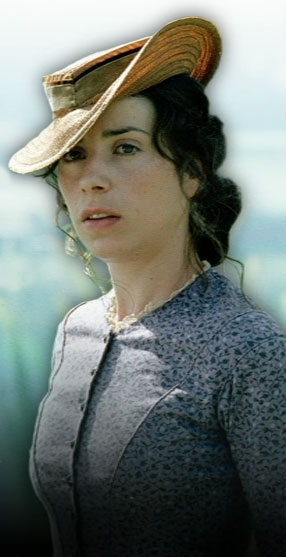
And the movie is fantastic.  The acting, the sets, the costumes are all wonderful.  I honestly don't know how they could have made it any better.  They did make a few minor changes, but I think that was mostly just to clarify plot points that are a bit more subtle in the book.  And of course, you miss the wonderful narration by the main character.  A movie can't possibly describe what's going on inside her head.  But it is absolutely wonderful, especially Sally Hawkins as Sue.  Lots of other great actors as well.

Now that I've finished this, I want to watch the miniseries all over again.  And I have a conundrum:  Sarah Waters has written four other novels -- do I rush out and read them all in a row, or ration them out to make them last longer?  It's a tough choice that I face whenever I find a new author I love.

This counts as book #8 for Our Mutual Read Challenge.  This review is cross-posted at Our Mutual Read

Thursday, February 25, 2010

Oliver Twist by Charles Dickens

"Please, sir, I want some more."  More Dickens, that is!

After finishing David Copperfield last year, I was a little burned out on Dickens.  Okay, let's be honest -- it was a Dickens OD!  In twelve months, I had completed five major works, four of which were more than 800 pages.  That's. A lot. Of. Dickens.  Anyway, after a break, I returned to my online Dickens group, which recently decided to start reading the books in order of publication. Though I'd read Oliver Twist just a couple of years ago, I enjoyed it just as much the second time around.

For those of you who are not familiar with the basic plot, here it is in a nutshell: Poor Oliver Twist is born in the workhouse to a mysterious woman who dies in childbirth. After nine years in a wretched orphanage, he's sent to the back to the workhouse to start earning a living, and one fateful day, he has the nerve to request a second helping of food: "Please sir, I want some more." After even more mistreatment, Oliver runs away from an apprenticeship and makes his way to London. En route he meets up with a boy nicknamed the Artful Dodger. Oliver, grateful for food and guidance, unwittingly follows the Dodger and joins a band of thieves run by the malevolent Fagin, who is in league with the evil Bill Sikes. But will Oliver's inherent goodness prevent him from falling under their evil influence? Will Oliver fall into a downward spiral and a life of crime, like so many other poor children? 

More than anything, I think Dickens' strength is his ability to create fantastic, cliff-hanging plots and memorable characters.  It was twenty years between my first and second readings of Great Expectations,  yet I vividly remembered Pip, Joe, and the creepy Miss Havisham.  Every Dickens work I have read includes several memorable characters -- it would take too long to list them all here.  But I think everyone has heard of poor little Oliver begging for more gruel; the Artful Dodger, and of course the sinister Fagin.  Honestly, Dickens writes the best villians in Victorian literature (with apologies to all you Wilkie Collins fans); maybe even the best villains ever.  Bill Sikes? Madame LeFarge? Mr. Tulkinghorn?  Completely evil, completely memorable.  To read Dickens is to remember it forever, in my humble opinion.

So those are Dickens' strong points.  Other points: It's true,  Dickens wrote his works as serials, so they tend to be long (OT is one of the shorter works, 430 pages of actual text in my edition; the rest is explanatory notes and introduction). Yes, he does include improbable coincidences, and some of his sentences tend to be long and flowery. But he creates such amazing plots, such indelible characters, and you can't beat the satire. Here's an description of the food in the workhouse:

[The workhouse board] contracted with  the water-works to lay on an unlimited supply of water; and with a corn-factor to supply periodically small quantities of oatmeal; and issued three meals of thin gruel a day, with an onion twice a week, and half a roll on Sundays. . . . For the first six months after Oliver Twist was removed, the system was in full operation. It was rather expensive at first, in consequence of the increase in the undertaker's bill, and the necessity of taking in the clothes of all the paupers, which fluttered loosely on their wasted, shrunken forms, afer a week or two's gruel.  But the number of workhouse inmates got thin as well as the paupers; and the board were in ecstasies.

I must also admit that Oliver, the character, is sometimes really annoying -- he is so perfect, so sweet, that I sometimes get a little nauseated.  I do find that Dickens' good characters tend to be on the bland side, not nearly as well-developed as the villains.  And I'm sure some readers may also put off by the blatant anti-Semitism in the novel.  Fagin, a grotesque, devilish villain, is referred to over and over again as "the Jew," which is definitely off-putting.  I'm not sure if Dickens was simply of product of his times, or if he was truly anti-Semitic; but like many excellent works of literature, I don't think Oliver Twist should be ignored entirely because of only one of its elements.   I have heard that Dickens later regretted his terrible portrayal, and tried to atone for it somewhat by creating a much more admirable Jewish character in one of his later novels, Our Mutual Friend.

Currently, I've read about half of Dickens' major works, and I hope to complete two or three more by the end of the year.  I belong to a great online Dickens discussion group, The Inimitable Boz, and if I assume correctly the next two books are The Old Curiosity Shop and Barnaby Rudge.  I'm pretty excited about these as they are among the less popular works and I know so little about them. 
 
So share with me, bloggers!  Do you have a favorite Dickens? Is Bill Sikes the scariest villain ever?  Is Oliver a sweet boy or just really annoying?  I'd love to hear your opinons.

This counts as my third book for Our Mutual Read Challenge -- only nine left to go!

Tuesday, September 15, 2009

David Copperfield by Charles Dickens


I finished this book last night, and I must admit, it was exhausting. I started this book back in July, and I kept getting distracted. I don't know if it's the longest book I've ever read (I'm pretty sure War and Peace is longer), but it's got to be pretty close to the top of the list. My edition was 821 pages of text, not including the introduction, end notes, etc. I actually found a article which claims it's 358,000 words -- Dickens' longest work. Normally, I have nothing against long books, but lately I find that some of them make me impatient. Dickens, Dreiser, Tolstoy -- sometimes I think they really could have used a good editor. Even my beloved Jane Austen has moments in Emma (my other current read) in which I feel like shouting, "Just get on with it! Move it along!" It could be my education in journalism, in which we were taught that less is generally more. "Never use a ten-dollar word when a two-dollar word will do!" was the mantra that I have never forgotten. That's why Hemingway (a journalist) wrote. With. Very. Short. Sentences.

But back to David Copperfield. This is one of those classics that frequently shows up on lists of The Best Novels of All Time, Top Reading for College, etc., and in fact is the one Dickens loved best of all his works, probably because it's his most autobiographical. There is some great stuff in this book, and I absolutely started out loving it -- I read the first 300 pages or so very quickly and fell in love with it. I was sure it was going to supplant Bleak House as my favorite Dickens work. The story of David's childhood is both tragic and hilarious. His aunt Betsey Trotwood is an absolute hoot, and I was so impressed that his tragic beginnings were so compelling -- repugnant, but I couldn't put it down. His father died before he was born, his mother remarries an abusive monster, then she dies leaving him with a wretched stepfather who forces him to work in a factory. Of course, he's the quintessential Dickensian orphan.

However, I really got bored in the middle and kept putting it down for other books. David's youth and his courtship of the angelic Dora just didn't do it for me. Generally, I'm not impressed with Dickens' young female characters, which seem to be idealized and flat. It's the great descriptions of scenes and the quirky minor characters that really make the stories come to life. Also, the plot in David Copperfield isn't really that gripping, like in Oliver Twist or Bleak House.

I do realize that Dickens' books were all serialized and he had contracted with his publishers to come up with so many words per week or month; hence, the length and all the padding. I really wish I'd kept a running list of the characters, since minor characters disappear for hundreds of pages and then suddenly reappear. I found myself wondering where in the heck I'd heard of them, and consulting online sources so I could remember how they fit into the story. And of course Dickens is notorious for his use of unbelievable coincidences, which seem to appear mostly at the end of the book, thereby tying up all the loose ends of the story.

Don't get me wrong, I really like Dickens -- I've been on a Dickens kick the last year or so and I've read eight of his works since last May. But I think I may have overdone it this time. I'm glad I read it, and I do recommend it if you like the Victorian style of flowery prose, multiple short chapters, and amazing coincidences. However, I think it's time for me and Dickens to take a short break.

Monday, September 14, 2009

Daddy Long Legs and Dear Enemy by Jean Webster

Somehow I managed to grow up an avid reader yet never read some of the classic coming-of-age tales such as A Tree Grows in Brooklyn and Anne of Green Gables. This has fueled one of my current reading obsessions, the children's classics. Of course it's possible I appreciate them more as an adult. I recently discovered a new favorite that I just loved, Daddy Long Legs by Jean Webster. Well, I'm calling it a children's classic simply because it seems to be marketed towards children. More on that later.

A quick synopsis: Set in the early 20th century, young Jerusha (Judy) Abbott has grown up in a not-quite-Dickensian orphanage (another orphan -- children's literature is rife with them!) and at 17, they're ready to put her out on the street. Luckily, some of her schoolwork has attracted the attention of one of the wealthy trustees, so she now has an anonymous benefactor who offers to finance her college education. The only condition is that she write a monthly letter to the mysterious, nameless trustee, whom she dubs "Daddy Long Legs" after she sees a glimpse of his shadow. Judy chronicles her college years through these letters to her patron. We learn about her life, her friends, and of course, the identity of the mystery man before the resolution. Also includes cute little cartoony illustrations by the author.

This is a charming coming-of-age story. It's witty and sweet and not the least bit saccharine or sentimental. All I could think while I was reading this book, which I tore through on a plane ride, was "Why isn't this book better known and/or more popular?" It was very popular when it was first published (in 1912) and had multiple stage and screen adaptations, including one starring Leslie Caron and Fred Astaire, both of whom sound terribly miscast. I can only surmise that it's not really a children's book, and today's adults may find it lacking in sex and violence. Probably teenagers as well, since it lacks the requisite vampire/supernatural element.

Since I enjoyed it so much, I rushed to the bookstore to see if I could find my own copy. The Penguin classics edition also includes the sequel, Dear Enemy. . Amazingly, I must have purchased the only copy in the entire metro area. (Seriously. I checked both mega-book store chains' websites. Not a single copy left in the whole city!).

Anyhoo, Dear Enemy is the sequel, or maybe the companion volume, since it's actually the story of Judy's roommate Sallie McBride, who takes over as director of the dreary John Grier Home. Again, the story is told in letters, mostly to Judy, her politician swain in D.C., and to the grumpy resident physician, Dr. MacRae (the eponymous enemy). Again, it's delightfully breezy yet intelligent, but with a more serious undertone, since Sallie is dealing with social reform, orphan welfare, nature vs. nurture, etc. Plus, Sallie is a grownup, struggling with her own romantic feelings. This book deals with far more adult themes than Daddy Long Legs, and I can't imagine this as a good read for a child. I really don't know any teenagers but from what I observe in the library and the bookstore they're mostly obsessed with the supernatural. My library doesn't have a copy, so I don't know how it's typically cataloged. Either way, they are both very enjoyable reads.