Wednesday, August 3, 2011

Borders Loot and My Guilty Conscience

I'm feeling very guilty but I could not help myself the other day, I took advantage of the 20% off clearance prices (plus additional 10% off with my Borders Plus membership).  This is what I brought home:


From top to bottom, in case you can't read the titles:

Aunts Aren't Gentleman by P. G. Wodehouse
Galahad at Blandings by P. G. Wodehouse
The Girl on the Boat by P. G. Wodehouse
The Lonely Passion of Judith Hearne by Brian Moore
A Truth Universally Acknowledged: 33 Authors on Why We Read Jane Austen by Susannah Carson
Of Human Bondage by W. Somerset Maugham
An Omelette and a Glass of Wine by Elizabeth David

I'm sure I could have bought these books for less online at Amazon, but there is something so wonderful about browsing.  It was really bittersweet, though, since I couldn't help feeling if I'd had more shopping sprees like this at Borders, they'd somehow have stayed in business.  My closest Borders is only about five minutes' drive away, and I frequently hung around reading without buying anything, not even in the cafe, or bought one item with my coupon so they barely made any profits.  I did shop on their website occasionally but found their online delivery slow so I hardly ever used it.  And the past few months, they've been sending me coupons that worked out to about 46% nearly every week!  How can a business expect to survive like that?  I knew it wouldn't last but I still took advantage.

I do have a Barnes & Noble membership and frequently bought from them online -- I prefer shopping at B&N.com over Amazon even though I have to pay tax, since I can return items at the store without paying return shipping -- plus, they have an actual telephone number answered by real people.  (When was the last time you spoke to someone from Amazon??  It's virtually impossible.)  And besides, Barnes & Noble has Starbucks, and the good squashy chairs!  Where can I get those chairs?

I've heard from several people who worked at Borders that it was a whole range of problems that contributed to its demise, so I know I shouldn't hold myself responsible because I didn't shop there enough.  I'm still sad to see a major book retailer go out of business.  I spent many happy hours browsing and reading -- I do think their fiction selection was much better than Barnes & Noble.  And I'm sure I'll go to the other two stores within driving distance to hunt up some more bargains.  Nearly every one of the books I bought was dusty, especially the Wodehouses, so I feel I have given these books a happy home.

I'm sure when the store is closed for good I'll probably cry.

Wednesday, July 27, 2011

Pot Luck (Pot Bouille) by Emile Zola


I know I just posted about Germinal a few weeks ago, but seriously, it was so great, I got on the Zola bandwagon and I'm totally obsessed with his work at the moment.  Pot Luck (also known as Pot-Bouille) is the satirical story of the bourgeios residents of a Paris apartment building, and a scathing attack on the hypocrisy of bourgeois attitudes of the time.  The story begins as Octave Mouret (from the Rougon family), who has just arrived in Paris from the provinces, comes to the apartment building on the Rue de Choiseul, where he'll be renting a room.  A friend of his family, Monsieur Campardon, lives in the building and has also lined up a job for Octave at The Ladies' Paradise, the eponymous department store of the next book in the series.  Octave meets his new neighbors through their parties and salons, and the reader is introduced to several families and their domestic staff.  

Basically, this story is about the apartment's residents and how awful they are.  The Josserand family has two daughters, and Madame Josserand is constantly scheming to get them married off, and to get her rich brother to give her money for dowries.  Madame Compardon is some kind of invalid -- she never gets dressed and just lays around reading Dickens, while her husband is carrying on affairs right under her nose.  Most of the men in the building are either hitting on the servants or off with their mistresses.  The wives are always screaming at the servants, the servants scream at each other and gossip about their employers, and the main character, Octave, is trying to seduce various women in the building.  Meanwhile, everyone pretends to be very respectable.  It's sort of like a sordid French version of Upstairs, Downstairs.

I did have a hard time with this book at first. Seriously, these characters are all pretty awful people, with minor exceptions.  At one point I was thinking about giving it up completely, but at about 100 pages, it got really interesting -- even though I didn't like any of the characters, I was fascinated.  They were so dreadful I had to find out what happened.  Unlike many 19th century writers, Zola's books are pretty fast reads, so I was easily able to finish the book in a couple of days once I really got into it.

I've read a lot of books about characters who are real train wrecks, like Madame Bovary.  None of the people in Pot Luck are quite as self-destructive as that, but this does turn out to be an interesting and sometimes hilarious story.  My one complaint about Zola is that he tends to throw a lot of characters at the reader in the beginning, which is pretty confusing.  I had put the book down for several days and when I picked it up again I was having trouble keeping them straight.  I did consider re-reading the beginning so I could make a chart or a plan of all the people that lived in the building and how they were all connected.  

Overall, this is a very entertaining story and I ended up loving it.  I couldn't help wondering if Zola based these characters on real people.  There was one passage near the end that cracked me up.  I'm pretty sure that this resident of the building, who's barely mentioned in the story, is based on Zola himself:  

Monsieur Gourd [the concierge] told how they had had a visit from the police -- yes, the police! The second-floor tenant had written such a filthy novel they were going to imprison him.  

"Horrible stuff!" he went on in a tone of disgust.  "It's full of filth about the most respectable people.  They even say our landlord's described in it -- yes, Monsieur Duveyrier himself! What a nerve, eh? It's good for them that they keep themselves to themselves; we know now what they get up to, in spite of their stand-offishness.  You see, they can afford to keep their carriage, because their filth is worth its weight in gold!"

So, now I'm all into Zola, and I've decided to read the entire Rougon-Macquart series, or as many as I can find in decent translations.  Next up:  The Ladies' Paradise.  Is anyone else a big Zola fan?  Which of his books are not to be missed?  

Monday, July 25, 2011

New job!!!

Sorry for taking so long to post, but I've had a busy week.  Today was my very first day . . . . 

AT MY NEW JOB !!!!!!!!!!!!!!!!!!!!!!!!!

Yes, it's official, I am gainfully employed in a library for the first time in almost exactly three years.  I had the bad timing to complete my library degree at the height of a recession, after moving to a city with a hiring freeze.  :-(

Not my library.  But isn't it beautiful?


But finally, after almost three years of volunteering, I've been hired at the library -- though sadly, not as a librarian.  But I'm on the city payroll, which is the important thing, and I can keep applying for promotions.  I have my foot in the door and I'll just keep trying.

I started at my new branch today and everyone seems lovely, I'm sure I'll be very happy there.

I can't tell you how nice it is to be a Real Library Employee!!!!!!!!

Saturday, July 16, 2011

Incidents in the Rue Laugier by Anita Brookner

Two challenges fulfilled by one 240 page book!  For Paris in July, I had really intended to try and finish some of the books on my burgeoning TBR shelves; however, I've heard so many great things about Anita Brookner I couldn't pass up participating in International Anita Brookner Day, sponsored by Thomas of My Porch.  My discovery of this novel, set in both France and England,  seemed serendipitous.

The book begins with a prologue.  After her mother's death, a young woman finds some intriguing items that belonged to her, including a notebook and a beautiful silk kimono.  The book that follows is how she imagines her mother's life.

Maud Gonthier is the only child of bourgeois parents in Dijon, France.  Her father dies when she is a small child in the 1950s, and her mother struggles to keep them financially afloat without appearing poor. She hopes to get the attractive Maud married off early.  Maud's aunt married very well, and her mother hopes to unite her with her cousin Xavier, or one of Xavier's friends.  On a summer visit at her aunt's country house, young Maud falls head over heels in love with Tyler, a dashing and wealthy young Englishman who has the world at his feet.  Sadly, things don't turn out exactly as Maud hopes -- instead the hunky Tyler, she winds up with the solid but unexciting Edward Harrison, another young Englishman dragged to the country by Tyler.

Initially, this seems like one of those novels in which Not Much Happens.  At first I really didn't much like the story or the characters, who seemed really cold and calculated, especially Maud's mother.  I was resolved to stick with it, and the payoff was worth it.  This book is a really great character study, and it's really made me think about marriages and relationships and True Love.  And disappointment -- a lot of characters in this book are disappointed with their lot in life.

I'm beginning to understand why Thomas raves about Anita Brookner, another author to add to my burgeoning Must Read List.

Tuesday, July 12, 2011

A Few Vacation Photos

Other than books, my other big obsession is food.  I did go to cooking school years ago, and worked for several years as a professional pastry cook.  When I'm on vacation, if I'm not reading, I'm usually looking for something wonderful to eat.  If you have not been to Disney World, there are many, many wonderful places to eat.  And our hotel was pretty cool too.

First, the view from my balcony at the Animal Kingdom Lodge:


Could this be a zebra book discussion group?  Or are they planning a hostile takeover?

Of course the animals weren't there all day every day, but still, it's pretty awesome to sit there and have a giraffe walk by!  And much cheaper than flying to Africa with a family of four.

We lived in Tampa for three years, so I've actually spent a lot of time at Disney and don't take that many photos any more.  This time I was mostly inspired to record some of the amazing meals we ate:

Roast duck from the Yak & Yeti restaurant at Animal Kingdom


And here's some seared tuna which we ate before riding Kali River Rapids three times in a row at Animal Kingdom  -- it was right before closing and they didn't even make us get off the ride in between, we just kept on going.  And getting wetter.  I did not think to bring a change of clothes, so it was a pretty uncomfortable bus ride back to the hotel.  Oh, well, it was worth it.

Our last day at Disney we went to Hollywood Studios (aka MGM) and had lunch at The Brown Derby:


By far, the best crab cake I have ever eaten in my life.  And those three wineglass stems are from a Champagne flight.  Delicious!


My dessert, a delicious layered confection of toffee, caramelized bananas, and banana mousse.  Afterwards it was time for a nap.

More on vacation and my vacation reads later!

Thursday, July 7, 2011

Germinal by Emile Zola

I am finally back from Florida and well rested -- time to start posting!  After a whirlwind tour of Disney I had several restful days visiting family and friends in Florida.  It seemed sort of incongruous for the setting, but despite the sunny weather I decided to tackle Germinal, this month's selection for my real-life classics group.  Of all the books our group chose for 2011, I think this was the book I've wanted to read most.  Amanda from The Zen Leaf just raved about it, and after reading The Belly of Paris and Therese Raquin last year, I was eager to read more Zola.

The setup:  Etienne Lantier arrives in a small mining village, homeless, starving, and looking for work.  He's a trained mechanic but is happy to take a job as a miner, despite the horrible working conditions.  Through his eyes, we get to see the life of these people, who are scraping a living out of the bowels of the earth.  The work is back breaking and dangerous, there's hardly enough food to go around, and not much else to do except drink, gossip, and procreate.  When the mining company decides to change the payment structure, resulting in less pay for more work, Etienne leads his comrades in a devastating strike during a long, bitter winter.

If this sounds bleak and depressing, it is, but at the same time it's absolutely riveting.  Imagine The Grapes of Wrath, only set in 1880s France -- and underground, where the work in not only exhausting, but you could die at any time from a cave-in, a gas leak, or an explosion.  Plus the eventual death of black lung.  (Not to downplay the plight of the California migrant workers, but picking vegetables isn't quite the same. Though I guess they might get carpal tunnel or skin cancer.  Excuse the digression).

Anyhow.  Zola is just a master at setting these scenes and drawing the reader in -- a large chunk of the book is just Etienne's first day in the mines, so through his eyes the reader learns exactly what life is like for these people.  Zola actually spent six months researching this book, spending time with coal miners and going down into the mines himself.  He's also brilliant at writing crowd scenes.  I tend to zone out and skim over extended action scenes in books, but not here -- there are some scenes of mob violence that are horrifying, yet I couldn't stop reading.

Zola also tells the story bourgeois managers and their families.  The book is blatantly pro-worker, yet he's able to interject some sympathy for some of the managers who are really doing the best they can.  Of course, some of the wives and daughters are unbelievably naive and sheltered about the whole situation,  and Zola's satire would be hilarious if it probably weren't true -- they come off rather like Marie Antoinette wondering why they just don't eat some cake since there's no bread.

This was probably a poor choice to read in sunny Florida but I'm so glad I read it and can't wait to read more Zola.   I have both Nana and The Drinking Den (L'Assommoir) on my TBR shelf and I'm also dying to read The Ladies' Paradise.  I don't know if Germinal counts towards the Paris in July readalong, since none of it actually takes place in Paris, so I guess I'll just have to read another Zola!  Any suggestions?

Friday, June 24, 2011

On Vacation


We're leaving Friday for vacation in Florida!  It's sure to be hot and steamy and the forecast looks like rain for the entire trip.  Oh well, I'll get plenty of reading done -- and hopefully it won't interfere with our visit to The Happiest Place on Earth.

I'm not bringing my laptop so I'll be off the grid for about a week.  Happy Fourth of July to all my American friends in the blogosphere!!  I'll report back when I return.

Thursday, June 23, 2011

Paris in July


I'm so excited about the Paris in July read hosted by Karen at Bookbath and Tamara at Thyme for Tea!  I'm packing for my vacation, and I've resolved once again to work my overstuffed TBR bookshelf.  If nothing else it has narrowed down my choices somewhat.  First, some French classics:


It's a little hard to read, but from top to bottom:

The Hunchback of Notre Dame by Victor Hugo
Bel-Ami by Guy de Maupassant
Nana by Emile Zola
Germinal by Emile Zola
The Drinking Den by Emile Zola

(And by the way, I bought that copy of Hunchback at the actual Notre Dame gift shop a few years ago. Which is in Notre Dame.  Halfway up the 300 bazillion steps!!  I feel sorry for the woman who works there, the only bathroom is on the main floor, so if she has to go up and down about 15 flights every time.  She must have amazing legs!)

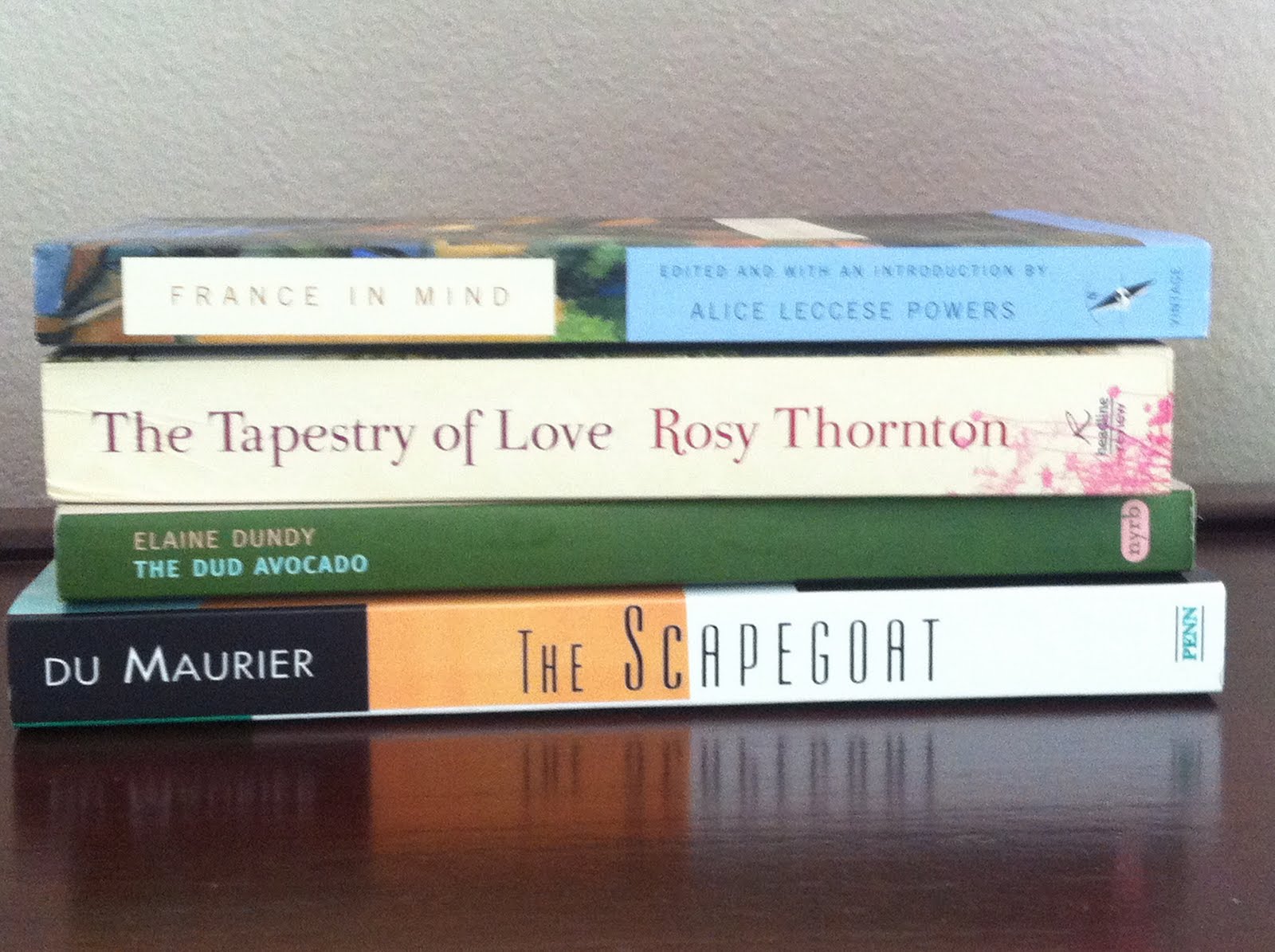
I also have some slightly more contemporary fiction by English and American authors, but all set in France:


France in Mind edited by Alice Leccese Powers
The Tapestry of Love by Rosy Thornton
The Dud Avocado by Elaine Dundy
The Scapegoat by Daphne du Maurier

I'll definitely be reading at least one book about food:


My Life in France by Julia Child
The Olive Farm by Carol Drinkwater
Cooking For Kings: The Life of Antonin Careme by Ian Kelly

I also have some other nonfiction about France:


Paris to the Moon by Adam Gopnik
Marie Antoinette by Antonia Fraser
La Belle France: A Short History by Alistair Thorne

I'm hoping to get through at least one from each stack but I'm definitely going to read Germinal, which is the July choice for my real-life classics book group -- we thought it would be so appropriate for July.  Right now I'm also leaning towards The Scapegoat, My Life in France, and Cooking for Kings.

So what do you think?  Good choices?  Which ones have you read and loved?  Should any of them be skipped and donated to the library sale?

Tuesday, June 21, 2011

Victorian Overload?

I don't know if anyone actually notices my little "Currently Reading" box on my blog sidebar, but if you do you may realize I have been reading Daniel Deronda for more than a month now.  This book just seems like it's taking forever.  It started out really well, but now I'm stuck at about page 370.  I've been trying desperately to hit the 400 page mark, and I just keep falling asleep or getting distracted.  I'm not sure if it's me or if it's the writing.  I'm not sure if I can blame it on George Eliot -- I loved Middlemarch once I got past the first 100 pages, and I thought Silas Marner was good even thought it was slow for such a short book (I actually listened to it on audio and I read it when I was walking the dog).

I've read three other Big Fat Victorian books so far this year, and I've had the same problem -- I usually seem to get stuck about halfway through, and it's hard for me to get motivated to finish them.  Is it just me, or is this a persistent problem with 19th century novelists?  Does anyone else notice that they tend to drag in the middle?  I wonder if it's an issue with serialization, or if it's just those particular authors, or just these specific books.  I haven't read any Trollope lately but I don't remember that problem with either Barchester Towers or The Way We Live Now.

It was probably a mistake to even start this book -- seriously, I just finished Dombey and Son by Charles Dickens; and earlier this year I completed Charlotte Bronte's Villette and The Three Musketeers by Dumas for online readalongs.  So those combined with Dombey totaled about 2000 pages, not including endnotes.  

And it gets worse -- I'm scheduled to start Germinal by Emile Zola for my Classics Book Group and one of my other book groups is discussing North and South by Elizabeth Gaskell in August!  That's another 1000 pages or so!  What the heck was I thinking?  

I suspect my problem is that I just belong to too many book groups, and I'm tempted by too many readalongs (Both Villette and Three Musketeers had been sitting around the TBR shelf for several years, and I really wanted to finish them.)  Daniel Deronda was for my Jane Austen group -- of course I hadn't finished it in time for the discussion which was two weeks ago.  (In my defense, only one person in the group actually finished it.  One person watched the BBC adaptation, and nobody else read it.) 

Bloggers, I need your advice -- should I stick with Daniel Deronda or move on to something else?  Does anyone else get discouraged halfway through a Big Fat Book?  Or am I just trying to read too many 19th century novels too close together?   

Sunday, June 19, 2011

Top Ten Literary Dads

In honor of Father's Day, I decided to compile a list of great literary dads.  It's shocking how many bad fathers there are in literature, but there are great dads worth noting.  I'm not limiting it biological fathers, since there are many great adoptive fathers and foster fathers in books.  Here are my favorites, in no particular order:

1.  Atticus Finch in To Kill a Mockingbird.  One of the most famous and beloved literary dads, he was the first one I thought of.  He's a great dad AND he stands up for his principles, defending a black man unjustly accused of a crime in small Alabama town, long before the Civil Rights era.   Plus he's a great checkers player AND a crack shot!

2.  Mr. Harding from Barchester Towers and The Warden by Anthony Trollope.  Even though his daughter Eleanor is in love with a man who could potentially ruin his career, Reverend Harding supports her and her decisions.  How many fathers would do that?  He staunchly stands by Eleanor, no matter what it means to his own lifestyle.  

3.  Arthur Weasley from the Harry Potter series.  He's not the best breadwinner and he's a little goofy at times, but he makes up for it in his devotion to his seven children AND Harry Potter, whom the Weasleys essentially adopt since his aunt and uncle are so wretched.  There is not a better father in the wizarding world.  

4.  Danny's father in Danny, the Champion of the World.  Roald Dahl's books are rife with horrible adults, but Danny's father is a real winner.  He's a single dad devoted to his son (though he's slightly morally suspect).  This book is one of the few Dahl novels without magical or supernatural elements, and it's always been my favorite.

5.  Dr. Gibson in Wives & Daughters.  Another single dad, he has a great and loving relationship to his daughter Molly, and marries a widowed governess to give her a mother figure.  Even though this doesn't work out as well as planned, he still loves her and tries to do his best, unlike many of the fathers in Victorian literature (note that I do not include a single father from the works of Charles Dickens -- there are some great uncles and father figures, but the biological fathers are either dead or terrible.)

6.  Mr. Emerson in A Room with a View.  He stands up for his son George in matters of the heart, and convinces Lucy Honeychurch that his son is the man for her, despite their class differences.  Brilliantly portrayed by Denholm Elliot in the 1985 film version, far superior to the 2007 BBC adaptation, which has a horrible, unnecessary epilogue.  (If you do watch this version, skip this.  Trust me.)

7.  Hans Hubermann in The Book Thief.  He's technically not a father, but he's Liesel's foster father, and he's a great father figure.  He does the best he can to take care of an orphan girl in Germany during the end of WWII.  And he does some heroic stuff too.

8.  Silas Marner.  Not my favorite book by George Eliot, but curmudgeonly Silas is a memorably great dad.  He finds a little orphan child in the snow, and she changes his life.

9. Matthew Cuthbert in Anne of Green Gables.  He was supposed to adopt a boy, but brought Anne home instead, to the chagrin of his sister.  Worked out very well for everyone though, especially the readers who get to enjoy the entire series.

10.  Mr. J. L. B. Matekoni from The No. 1 Ladies' Detective Agency series by Alexander McCall Smith.  An adoptive father, the finest mechanic in Botswana, and all-around great guy.  He is never too busy to help out fixing things at the local orphanage and does not bat an eyelash when his fiancee Madame Ramotswe adopts two orphans, a brother and sister, one of whom is disabled.

Happy Father's Day to my dad and to my dear husband!  They'd definitely make the list of great dads.