Wednesday, June 17, 2020

Paris In July 2020


It's the summer, so that means Paris in July! Hosted by Thyme for Tea, it's an annual month-long celebration of all things French -- books, movies, films, and food. I haven't participated every year, but I've always enjoyed following along. This year, I'm hopefully going to knock a few books off my owned-and-unread shelves. Some of them also qualify for my Big Book Summer Challenge.


From top to bottom: 

Maman, What Are We Called Now? by Jacqueline Mesnil-Amar
The Misunderstanding by Irene Nemirovsky
La Debacle by Emile Zola
Renoir, My Father by Jean Renoir
The Complete Claudine by Colette
Secrets of the Flesh: A Life of Colette by Judith Thurman

That's six books, three of which are more than 500 pages long. My list includes fiction, a WWII diary, a memoir, and a biography. Of course I probably won't finish all of them but even half the list would be an accomplishment.


I also have some French language and French-themed films and TV series to watch:

Blind Date (Netflix)
The Bonfire of Destiny (Netflix)
Call My Agent! (Netflix)
Cezanne et Moi (Netflix)
A French Village (Hulu/Amazon Prime)
My Life as a Zucchini (Netflix)
Suite Francaise (No longer streaming on Netflix in the USA, but I have the DVD)
Twice Upon a Time (Netflix)


And if I get around to it I might try and make some macarons and eclairs as well!


Bloggers, which do you recommend? Or other books, movies, or TV shows about France? And what are you reading for Paris in July?

Sunday, June 14, 2020

John Caldigate: Trollope goes to Australia!

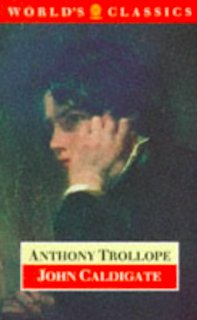
Not a great cover image, but the only OUP edition I could find online.
Strangely, my copy has a different cover.


'People who read no books are always fools to those who do read.'

Last week was particularly stressful -- the news is so dire and it only seems to get worse -- so it was time to turn to one of my favorite comfort authors, Anthony Trollope. I still have several of his novels unread on the shelves, and three of them were long enough to qualify for my Big Book Summer Challenge. I chose the shortest of the lot, John Caldigate, because the eponymous character travels to Australia, and it sounded like some nice armchair travel since I won't be going anywhere for a while.

Published in 1979, John Caldigate is one of Trollope's lesser-known works, and a standalone novel. It's the story of young Mr. Caldigate, heir to the estate of Folking in Cambridgeshire. His mother and sisters died years ago, but sadly, John's father was mourning and distant while he was a boy, so he mostly grew up on his cousin's estate. Now in his early 20s, John has left Cambridge, and is saddled with numerous gambling debts. The estate is entailed upon him, but his father has decided to disinherit him in favor of a cousin, and John takes a buyout from his father, pays off the debt, and books passage Australia with a classmate, Dick Shand, where they hope to make their fortune in the gold mines. While meeting with his father's banker Mr. Bolton, John spies his teenaged daughter Hester, and is struck by her beauty.

Anthony Trollope


Before his boat sails, John goes to say goodbye to his cousins, where his aunt pressures him to marry his oldest cousin Julia. John refuses to get himself engaged, and hightails it to the boat with his friend Dick, where they travel second-class, despite being gentlemen. On the voyage, John strikes up a friendship with a pretty actress, a widow known as Mrs. Smith. It's a long voyage and tongues start wagging, and it seems like everyone on board is aghast, including the ship's captain, and they all try to warn him off, but John is undeterred and declares himself engaged to her.

John and Dick stake a claim and start looking for gold, and after a detailed description of gold mining, he makes a trip back to Melbourne to look up Mrs. Smith. Then the story jumps forward in time several years. John is back in England, having made a fortune of £60,000. His father has missed him dreadfully and John pays off the mortgage on the estate, reinstating himself as heir. And now it's time to find himself a wife. John never forgot the beautiful Hester Bolton, now 20, and begins to court her, to the chagrin of her mother, a religious fanatic. She opposes the marriage from the beginning, but she can't stop it. All seems well until about a year later when some unsavory characters from Australia arrive, and John's world is turned upside down as he faces extortion and bigamy charges. 

I assumed this would be the standard Trollope comfort read, but elements of the plot went dark pretty quickly; particularly, Trollope's depiction of Mrs. Bolton's religious mania, (much of which I skimmed over). After John is charged with bigamy, the Boltons do something really despicable to Hester, which I would have found unforgivable. I was also distressed by some of John's relatives, especially his Aunt Polly who tries to snare him into marriage with his oldest cousin Julia. Some of Hester's relatives are pretty awful as well. 


I did enjoy Trollope's description of the sea voyage to Australia and the courtroom and trial details. There's also a pivotal side character who is a postal employee which I found delightful. Trollope worked as a postal employee for more than 20 years, so he must have really enjoyed including his detailed knowledge of stamps and postmarks into one of his novels. (Fun fact: Trollope invented the British post-box). 

This was a fast read, and a solid Trollope story. He doesn't get nearly the love of Dickens or Hardy, and of John Caldigate is definitely one of his more obscure novels -- there are hardly any editions and very few cover images. However, while searching online, I discovered that in 2015 John Caldigate was adapted into a graphic novel called Dispossession, by Simon Grennan. As far as I know, it's the only Trollope novel adapted, and it's an interesting choice because it's such an obscure novel. And I'm curious about how he condensed a 600 page Victorian chunkster into less than 100 pages. 


So -- one more Big Fat Book crossed off my summer reading list, and I've now read 34 of his 47 novels! Only 13 left to go -- I'll be sad when I'm done. I guess I'll just have to go back to the beginning and start again!

Saturday, June 6, 2020

Temptation by Janos Szekely

The cover artwork is a detail from The Morphinist by Janos Vazary (1930)

I'm trying really hard to refrain from buying books, but inevitably birthdays and other gift-giving holidays occur, so what can one do? My most recent bookish gift was Temptation by Janos Szekely, an NYRB reprint of a 1946 novel newly translated from the Hungarian. Normally new-to-me books get shoved to the bottom of the TBR pile, where they sit, contributing to my unread-book guilt. But I'd signed up for the European Reading Challenge and this one fit the bill perfectly. I read the first few pages and was instantly hooked. 

This is the story of Bela R., a young Hungarian peasant boy born into rural poverty in 1913, after his sixteen-year-old mother Anna has a one-night stand with a charismatic sailor during a church festival. At the end of the night the charming sailor disappears, leaving her alone to deal with an unwanted pregnancy. After little Bela is born, Anna goes to the city to work as a wet nurse, and later a maid, leaving him in the care of Rozi, a former prostitute who now runs a sort of foster home for illegitimate children. It's a tough upbringing because Rozi basically hands out food and favors to the kids based on how much their mothers can pay, and Anna is always struggling, so Bela is always hungry, for food as well as love and affection -- Bela is literally young, scrappy and hungry.


Bela grows up as a tough kid, but he's smart and longs to go to school. Rozi refuses, forcing him to stay home and work until Bela realizes she's breaking the law. The village schoolmaster sees that Bela is smart and gives him a lot of tough love. Eventually, Bela rejoins his mother in Budapest at the age of fourteen, where they live in a tenement shared with a prostitute, barely making ends meet. Here's a wonderful quote describing the first meal his mother cooks for him after they're finally reunited:


I started sweating, I ate so hard. My God what a szekelygulyas that was! Pools of soured cream floated on top, the soft tenderloin melted in my mouth, and the cabbage -- Lord, what cabbage! You could tell my mother had cooked it that morning, or perhaps even the night before, because only when you cook it twice can cabbage be that good. I was moved: for the rich, food only goes to their stomachs, but for the poor-- it goes to their hearts.


There are a lot of food descriptions in this book, which I always love. (Obviously, food's pretty important when you don't get enough of it.) Anna gets Bela a job as a bellboy in a fancy downtown hotel on the Danube. The first year or so he doesn't even make any money, as they work for tips only and he normally works in the elevator. Eventually, a chance encounter with a rich woman's dog changes his life, and he becomes the designated dog-walker and works his way up the ladder -- and into her bed. Bela also meets Patsy, a rich Hungarian-American girl vacationing in Budapest, and longs to leave Hungary and move to New York.
Love this cover from the British edition

Meanwhile, Bela's family is always on the verge of bankruptcy, staving off hunger and the greedy Hausmeister, the building superintendent who's constantly threatening the tenants with eviction. Bela is also struggling with his conscience about the favors he receives from his wealthy lover while he sees the poverty surrounding him. There are few options for the thousands of poor workers faced with unemployment in the late 1920s, and it's obvious to the reader how fascism begins to take hold, and the inevitable rise of the Nazi party. 

Here, peace was always more dangerous than war, because the bomb has yet to be invented that can do as much damage as poverty itself.


I loved this book. It's nearly 700 pages long and I raced through it in less than a week. I can't compare this to the original Hungarian, so I don't know if it's Szekely's original style or the translation, but I found this really easy to read, almost as if I was sitting in pub with Bela and he was telling me his life story. I found myself breathlessly awaiting the next page, laughing and crying with Bela, outraged at the injustices he faced and feeling his despair as he didn't know how to take care of his mother and find their next meal and pay the rent. I was aghast at the struggles he faced, and I only wish the story were longer. It ends when he's seventeen and I wish I knew what happened to him next. Bela's character was so real to me. According to Wikipedia this is a semi-autobiographical novel, though Szekely was born in 1901. He did leave Budapest as a young man and ended up as a screenwriter in Berlin, then moved to Hollywood in 1934, where he was eventually won for an Oscar for the 1940 film Arise, My Love. Sadly, Szekely only wrote two novels, and this is the only one translated into English. Temptation was also adapted into a Hungarian film in 1977, but I don't think it's available on DVD. 


I also loved reading about his life in Budapest. I was lucky enough to travel there for a long weekend a couple of years ago, but I never got around to posting any photos. This review is pretty long already, so hopefully I'll add some next week. Temptation is definitely one of my top reads this year and now I'm inspired to read more Hungarian fiction. Bloggers, do you have any recommendations? I still have We Were Counted by Miklos Banffy (checked out from the library more than three months ago, still unread); and I've also heard great things about Magda Szabo, several of her books are reprinted by NYRB Classics and are available as ebooks from my library.

I'm counting this as my Classic in Translation for the Back to the Classics Challenge and for my Hungarian selection for the European Reading Challenge.  It also counts toward the Big Book Summer Challenge

Monday, June 1, 2020

Classics Spin #23: The Hireling by L. P. Hartley; and Some English Cathedrals


It's June 1st so that means it's time for my post on Classics Spin #23, which for me was The Hireling by L. P. Hartley. Published in 1957, it's the story of Stephen Leadbitter, a thirty-something man who earns a living as personal driver, taking customers in the car he is slowly paying off through a hire-purchase. Other than his job, he has a very solitary existence, no real friends or family. The aptly named Leadbitter had formerly been in the army and still lives his life very much as a disciplined military-type man. One day he takes on a job driving a wealthy widow on a day trip to Canterbury. Much to his surprise, she's young and beautiful. Lady Franklin, still mourning the death of her older husband, wants to visit all the cathedrals that her late husband loved, thinking it will bring her some kind of closure. 

Unlike most passengers who sit in the back and want silence or the radio, Lady Franklin wants to sit up front with Leadbitter and wants to her all about him. Since has little life outside of his job and he wants to please his customer, Leadbitter starts making up stories about an imaginary family, complete with a wife and three children. The trip goes well and Lady Franklin starts booking Leadbitter for more day trips around the countryside. Eventually, Leadbitter begins to look forward to the bookings, and begins to develop feelings for Lady Franklin, which leads to a very awkward moment and then spirals into something tragic and heartbreaking.


This was a fast read, and it wasn't at all what I was expecting. I don't know what I thought it would be -- a sweet love story? Driving Miss Daisy, but with white people? It was neither, though it definitely had a lot to say about class consciousness -- I honestly did not see them having a happily ever after (and now I'm having serious doubts about the romance between Tom the chauffeur and Lady Sibyl in Downton Abbey). I had only read one other book by L. P. Hartley which was The Go-Between, which I really liked, and which also has a lot to say about love between the classes. I've also heard wonderful things about The Boat and the Eustace and Hilda trilogy from Simon at Stuck in a Book

This book also reminded me of the trip I took to England in 2018 with my mother, which was mostly a Jane Austen pilgrimage but did include several churches and cathedrals -- we didn't make it to Canterbury but we did visit St. Paul's in London (I climbed all the way to the top!), Bath Abbey, Salisbury Cathedral, and Westminster Cathedral, where Jane Austen is buried. Just for fun, I'm including a few photos. 

St. Paul's dome

Front of the church. Loved the iconic buses passing by. 

Bath Abbey. We had amazing weather every day of the trip.


Spire of Salisbury Cathedral, the tallest in England at 404 feet. I did not climb it. 

The Salisbury Cathedral clock, c. 1386. Said to be the oldest working clock in the world.


Origami peace doves installation at Salisbury Cathedral

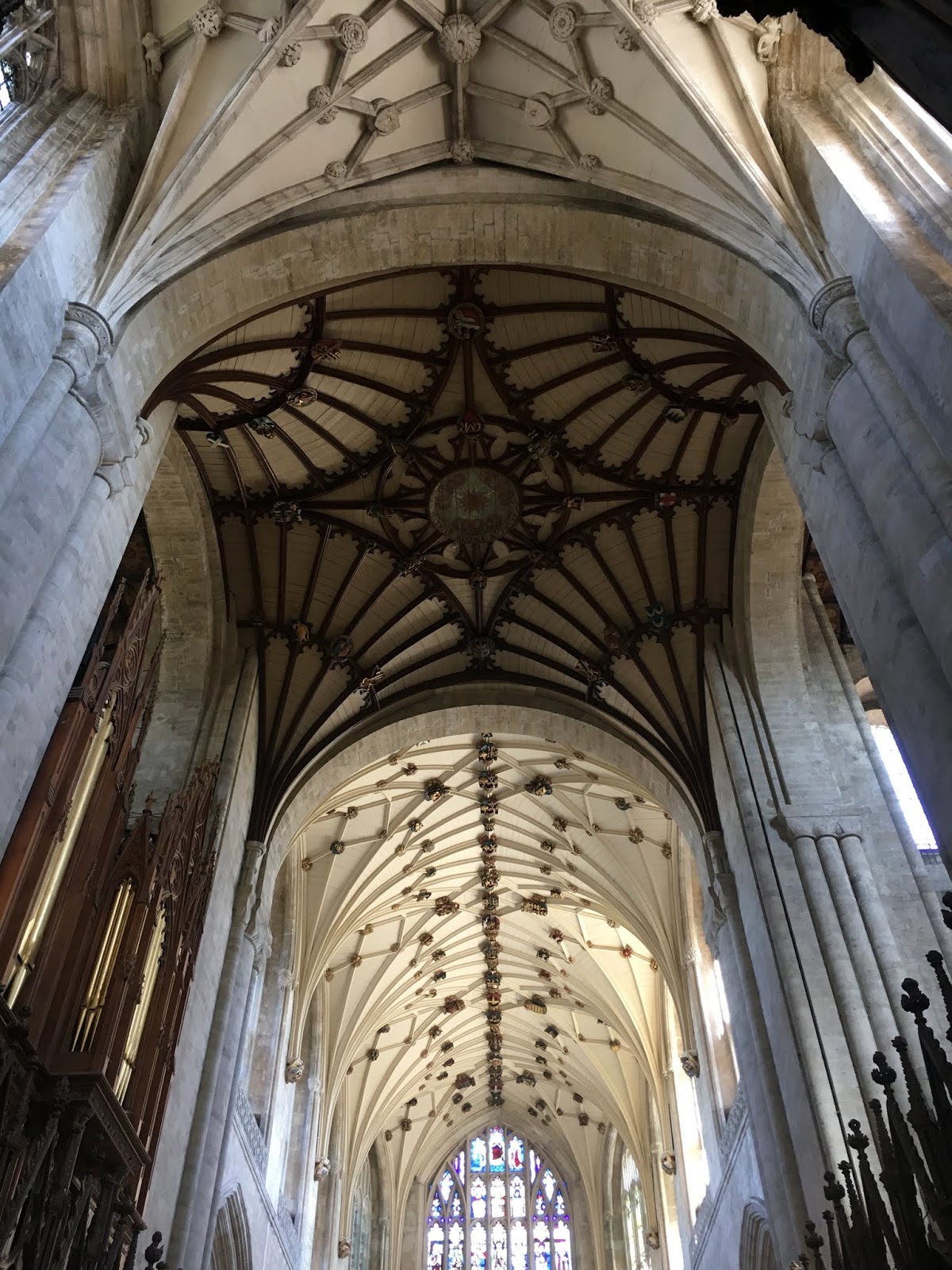
Winchester Cathedral 

The Winchester nave. It's 554 feet long, the longest Gothic church in the world.

The ceilings of Winchester were especially beautiful.


Jane Austen also gets a mention in The Hireling which amused me terribly: 

'. . . . Now read me what it says about Jane Austen.'

Putting one hand behind his back, he squared himself in front of the tablet. When he had finished reading, Lady Franklin said: 

  'I don't think she was kind hearted, do you?'

  'I couldn't say, my lady," Leadbitter said cautiously. It wouldn't surprise me if she wasn't.'

  'Why?'
  'Because with one or two exceptions,' and his voice faintly underlined the words, 'ladies aren't very kind-hearted, in my experience.' 

  'Oh, would you say so?' Lady Franklin said, made thoughtful by the compliment. 'Perhaps we haven't a very good name for it.'

  'It makes the others stand out,' said Leadbitter obliquely.' 

  Lady Franklin couldn't but lap up this repeated dewdrop. 

  'How sweet of you!' she said. 'I'm afraid I don't deserve - But Jane Austen had many qualities more valuable than kind-heartedness. At least, more valuable to posterity.'

  'I expect she was a tartar in her time,' ventured Leadbitter.


I don't know that I've ever heard Jane Austen described as a tartar but I know she had a biting wit and there are some real zingers in some of her letters, so it's quite possible. And here is the tablet itself, and the plaque on the adjacent wall, commemorating the great author:


So -- a good book, a little armchair traveling, and another book crossed off my Classics Club list! I've finished 27 of 50 on my second list, and I hope to finish more this summer. Did everyone enjoy your Classics Club spin picks? And how are your lists coming along? 

Monday, May 25, 2020

Big Book Summer Challenge


What's better than a reading challenge to inspire another list? Hosted by Suzan at Book by Book, I hope this challenge will help me to clear off all those enormous books I still have on my shelves. According to my Goodreads list, I still have more than 30 books on my owned-and-unread shelves that I consider Big Fat Books, i.e., more than 500 pages long (or thereabouts). I've divided them into categories. 


Nonfiction:


Our Hidden Lives: The Remarkable Diaries of Postwar Britain by Simon Garfield (544 pp)
Long Live Great Bardfield by Tirzah Garwood (495 pp)
Trollope by Victoria Glendinning (551 pp)
Slipstream: A Memoir by Elizabeth Jane Howard (528 pp)
A London Family, 1870-1900 by Molly Hughes (600 pp)
Edith Wharton by Hermione Lee (869 pp)
Decca: The Letters of Jessica Mitford (744 pp)
Charles Dickens by Michael Slater (696 pp)
Secrets of the Flesh: A Life of Colette by Judith Thurman (592 pp)
Roughing It by Mark Twain (592 pp)


Fiction: 


Imperial Palace by Arnold Bennett (769 pp)

T. Tembarom by Frances Hodgson Burnett (518 pp)
The Complete Claudine by Collette (656 pp)
Sketches by Boz by Charles Dickens (680 pp)
Painting the Darkness by Robert Goddard (608 pp)
Green Dolphin Street by Elizabeth Goudge (571 pp)
The Twisted Sword by Winston Graham (544 pp)
Bella Poldark by Winston Graham (688 pp)
Penmarric by Susan Howatch (735 pp)
Madame Solario by Gladys Huntington (493 pp)
The Little Ottleys by Ada Leverson (543 pp)
. . . And Ladies of the Club by Helen Santmyer (1176 pp)
Temptation by Janos Szekeley (685 pp)
John Caldigate by Anthony Trollope (656 pp)
Ralph the Heir by Anthony Trollope (770 pp)
Marcella by Mrs. Humphrey Ward (560 pp)
The Fruit of the Tree by Edith Wharton (652 pp)
Hudson River Bracketed by Edith Wharton (547 pp)
La Debacle by Emile Zola (536 pp)

Short Stories:


East and West: The Collected Stories of W. Somerset Maugham, Vol. I (955 pp)
The World Over: The Collected Stories of W. Somerset Maugham, Vol. II (681 pp)
The Portable Dorothy Parker (626 pp)
The Collected Stories of Katherine Anne Porter (495 pp)
The Complete Stories of Evelyn Waugh (640 pp)
The Collected Stories of Edith Wharton (640 pp)
The Most of P. G. Wodehouse (701 pp)
The Collected Stories of Stephan Zweig (720 pp)


By my count, that's 37 books, and I don't even want to do the math to think of how many pages that is -- it could be an entire year's reading for me! I could just concentrate on reading long books all summer, but I still want to make my goal of 100 books, and I'm exactly on track right now. 


There are about 15 weeks this summer, if you count it as the period from Memorial Day to Labor Day (Memorial Day is early this year, and Labor Day is late, not until September 7). In theory I could probably finish one per week, if that's all I was reading, but I know that'll never happen! And I know that some of them will be much slower than others, like the Wharton biography which is more than 800 pages of tiny print, not including endnotes and the index -- it's a dense read. I can probably knock off most of the fiction books within a week each, but the nonfiction and short stories will be harder, especially since I tend to dip in and out of them, alternating with fiction. 


I'm not going to commit to any particular list at the moment, since I know I'll never stick to it. The only book I'm definitely going to read is Temptation by Janos Szekely -- it was a Mother's Day gift and I've already read a few pages, I'm already hooked and plant to dive into as soon as I finish my current read). So I guess my goal will be to simply read as many as possible, at least one from each category -- a lot of these books have been hanging around my TBR shelves forever and I should just suck it up and read them, or at least attempt -- if I'm not enjoying them, I'll donate them to the Little Free Library down the block, since the library is still closed. 


Bloggers, what do you suggest from my list of Big Fat Books? Do you have any enormous books you've been putting off forever? And do you have any reading goals this summer? 

Thursday, May 21, 2020

Hester: A Novel of Contemporary Life by Mrs. Oliphant


I counted the other day and I still have more than thirty unread Virago Modern Classics on my TBR shelves (though technically, some of them are not VMC editions). I'm desperately trying to take control of the TBR shelves, so Margaret Oliphant's Hester: A Novel of Contemporary Life was my pick for the May/June prompt of the Victorian Reading Challenge (long titles or sub-titles). 

First published in 1883, this is the story of two strong women in the fictional town of Redborough. The Vernon family name is synonymous with banking and stability, and in the beginning of the novel, a scandal erupts about 30 years prior -- John Vernon, head of the bank and the grandson of the founder of the Vernon family bank, has fled the country, and rumors are flying around town that there's about to be a run on the bank (if you've ever seen It's A Wonderful Life, you know exactly what this means: word is out that the bank doesn't have the funds and is about to collapse, so everyone rushes to the bank to get out their money before it's gone). 

Mr. Rule, the chief clerk, goes to Mr. Vernon's home in desperation, and he's nowhere to be found. His young and flighty wife insists that he'll be back soon, and offers the clerk all the money she has in the house, about 20 pounds. Instead, Mr. Rule does the unthinkable -- he approaches Mr. Vernon's cousin Catherine, a spinster, who is a shareholder but has naturally never been involved. Catherine is naturally concerned and with her funds and brains, she saves the bank, restoring the family name, and thus the town's revered and powerful benefactor. 

The story then jumps forward to the 1880s, and John Vernon's widow (known as Mrs. John), is returning to Redborough after the death of her husband. Mrs. John moved Abroad and joined her husband after she was forced to give up her beautiful home in the wake of the banking scandal, and she hadn't returned since. Now living in genteel poverty, she returns to the scene with her teenaged daughter Hester, who was born much later and knows nothing about this embarrassing episode or her father's role in it. She and her mother move into the Vernonry, a great old house that Catherine Vernon had converted into multiple dwellings, normally offered to impoverished relatives. All of them are living off Catherine's generosity, but most of them are bitterly resentful and disparage her whenever they can. 

Unfortunately, young Hester gets off on the wrong foot with Catherine, who calls on her mother late on the first evening of their arrival. Hester doesn't realize how important a benefactress Catherine is, and is rather rude and protective of her mother, and from this day forward, she and Catherine don't care much for one another. Catherine finds Hester standoffish, and Hester is influenced by the cutting remarks about Catherine by her neighbors, who are a kind of Greek chorus of frenemies. The only neighbors who seem thankful and benevolent are Captain and Mrs. Morgan, who related to Catherine's later mother, and are not technically Vernons. 

Things in Redborough are fairly uneventful until Hester turns nineteen and blossoms into a lovely young woman, attracting the notice of two of her distant cousins, who have been chosen by Catherine to succeed her in running the bank -- the dull but handsome Harry, and the hardworking Edward, handpicked by Catherine as her surrogate son and heir. Harry is in love with Hester, but she's not interested, and Edward is attracted to her but can't risk incurring the wrath of Catherine, who has never liked Hester. Meanwhile, the Morgan's grandson Roland arrives, on the lookout for new investors in his stockbroking business, and Edward thinks this may be his chance to finally become independent of Catherine.


I really liked this novel -- it's fairly long, almost 500 pages, but I really got invested in the plot and the characters. I got so caught up in the story I finished it in only four days. A couple of the characters reminded me a bit of Jane Austen -- Roland's sister Emma shows up, desperate for a husband, and I found her somewhat like Lucy Steele from Sense and Sensibility, though she's not nearly as malicious.  It was nice to have a Victorian novel with strong women characters. Margaret Oliphant clearly had some ideas about working women, and expresses them through Hester's frustration:

"I thought you hated Catherine Vernon," Roland cried.
"I never said so," cried Hester; and then, after a pause, "but if I did, what does that matter? I should like to do what she did. Something of one's own free will—something that no one can tell you or require you to do—which is not even your duty bound down upon you. Something voluntary, even dangerous——" She paused again, with a smile[Pg 7] and a blush at her own vehemence, and shook her head. "That is exactly what I shall never have it in my power to do."
"I hope not, indeed, if it is dangerous," said Roland, with all that eyes could say to make the words eloquent. "Pardon me; but don't you think that is far less than what you have in your power? You can make others do: you can inspire . . .  and reward. That is a little highflown, perhaps. But there is nothing a man might not do, with you to encourage him. You make me wish to be a hero."
He laughed, but Hester did not laugh. She gave him a keen look, in which there was a touch of disdain. "Do you really think," she said, "that the charm of inspiring, as you call it, is what any reasonable creature would prefer to be doing? To make somebody else a hero rather than be a hero yourself? Women would need to be disinterested indeed if they like that best. I don't see it. Besides, we are not in the days of chivalry. What could you be inspired to do—make better bargains on your Stock Exchange?"

Margaret Oliphant was one of the most prolific Victorian authors,  probably the most prolific women author of the era. She published her first novel in 1849, when she was just 21, and published more than 120 novels, supporting her family after her husband's death in 1852. Like many Victorian women authors, only a few of them are still in printthough there are quite a few on ebook, and many are free through Project Gutenberg. I've now read six of her novels so far -- Hester; The Mystery of Mrs. Blencarrow, I've read three of her Carlingford Chronicles, Miss Marjoribanks and The Rector and The Doctor's Family, two novellas in one volume. Virago Modern Classics reprinted the rest of the series and I'm tempted to track those down as well. 

Thursday, May 14, 2020

Lark Rise to Candleford; and my pastoral life in Germany


I finally tackled one of the books I've had on my owned-and-unread pile the longest -- Lark Rise to Candleford. I bought this more than ten years ago, around the time the TV series was first broadcast, but I've been putting it off forever, put off by the sheer size of it, and by the first couple of pages which are mostly descriptive. (It's also one of the books from my original Classics Club list that I never read). It's a little tough if the first page doesn't grab you. I had watched a bit of the TV series and enjoyed it, so I thought I should give it another go. 

For those who aren't familiar, Lark Rise is a fictionalized memoir of Flora Thompson's childhood in rural England, during the late Victorian period. It's classified as fiction but definitely reads like a memoir, and most libraries and bookstores shelve it in the fiction section. There isn't really any plot, it's really a lot of vignettes and memories of Thompson's childhood in Oxfordshire, and she places herself in the story as the main character, Laura, oldest child of a stonemason and his wife who live in a poor but comfortable house in the little hamlet of Lark Rise. It was originally published as three volumes, and I read the edition pictured above which includes all of them: Lark Rise [1939], Over to Candleford [1941], and Candleford Green [1943]. Since 1945 it's been available as an omnibus and there are many beautiful editions. 

A Penguin edition of the first volume.
My copy had woodcut illustrations similar to the one on the cover, 

though they're black and white


Each chapter has a theme, so it isn't told in a specifically linear fashion. It jumps around a bit, but it's easy enough to follow. There were chapters on May Day, hog butchering, school, churchgoing, and so on. Bits of it reminded me a bit of the Little House on the Prairie series, just in the descriptions of daily life in that era. Life was hard for Laura's family and the other families in Lark Rise, but she seems to have very happy memories. It's a really lovely portrait of rural life towards the end of the Victorian era, with hints of what's to come in the new century. 

It's fairly long book, more than 500 pages and 39 chapters. I finally got around to picking it up when I was looking for something soothing to read, and it fit the bill perfectly. Most of the chapters are short, and I thought I'd just read one or two a day, but I found myself turning to it more and more often in the past week. It is just the thing to read before bedtime, to crowd out all my other thoughts of world events. I can see why it was so popular when first published during WWII. 

After reading a few chapters I was wondering how they adapted it into a 40-episode TV series (I've only watched the first season so far). Eventually, though, I began to recognize characters from the series. Some of them have much more screen time than you'd expect from the book, and a couple of them have been combined into one family. They've definitely kept the spirit of the book in the series. It's a bit like Cranford in that the TV creators have taken the essence of the characters and place and extrapolated from there. If you're expecting it to be a novelization of the series, you'll be disappointed. For example, Dorcas, the postmistress, has nearly as much screen time in the TV series as Laura, but she doesn't show up in the book until more than halfway through. 

The beautiful Folio Society edition. I would love to take a look at this one. 


I really enjoyed this book, though it wasn't what I'd call a quick read, It's definitely a leisurely read, well suited to reading in bits in pieces, and it felt more like a memoir than a novel. In the past I've described books as 'nonfiction that reads like fiction' but this was the opposite. And if you love a sense of place, this is the book for you, with lovely descriptions of the countryside and just the slowness of everyday life. It made me want to move to a cottage and cook on an open fire. 

I'm a suburban kid and the idea of living in a village surrounded by countryside has always appealed to me. Our house in Germany was in a village, though nothing like Lark Rise, though we were at the end of a street on the edge of farmland and I could literally see cornfields and livestock right outside my door. I used to walk my dog through farmland and there were cows, horses, and chickens within a short distance, and in the spring, I'd take the scenic route to see if there were any lambs. I did enjoy how peaceful it was but there wasn't much to do close by, if you wanted to do more than a movie or basic shopping we had to drive pretty far. 

So here are a few photos of the countryside near my former house in the village of Steinwenden, a tiny village in the Rhineland-Pfalz, near Ramstein air base.


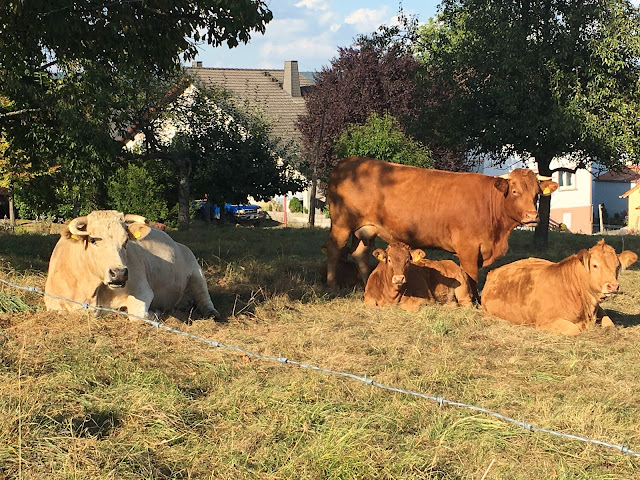
Just some cows in the neighborhood.


A field of canola. Every spring the countryside would be bright yellow. 


Pasture on the hill just behind our house, I could see these sheep from the second-story window. 

Sadly they weren't permanent residents, just visiting.  


In the summer this field was normally wheat or corn, 

but one summer it was all sunflowers and sweet peas, to help enrich the soil.


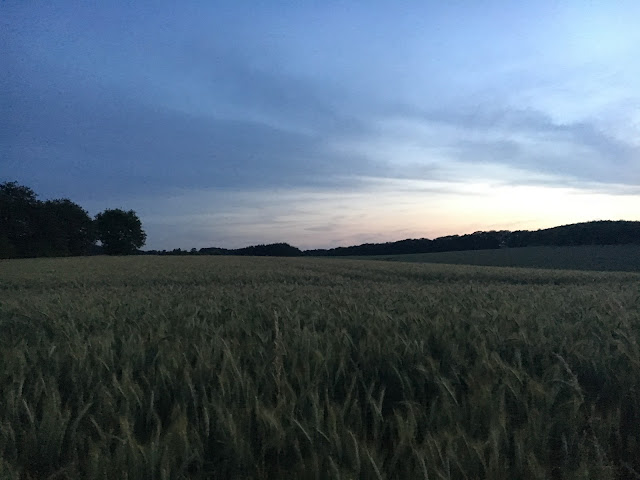
Sunset over the wheat field, just beyond my house. 


Hay all bundled up at the end of the season. I took this photo from my driveway. 


I loved the peace and quiet of the countryside but I was happy to move closer to a major city. Right now I'd be really happy to be on the edge of the farms, I'm sure it would be more relaxing right about now! Well, every place has its advantages. 

Bloggers, which are your favorite books about rural life? And does anyone else feel like moving out to the country about now? 

I'm counting this as my Adapted Classic for the Back to the Classics Challenge