Showing posts sorted by relevance for query TBR Pile Challenge 2018. Sort by date Show all posts

Saturday, November 11, 2017

TBR Pile Challenge 2018!


Every so often, I drift away from blogging -- sometimes it just ends up feeling like homework. And yet inevitably, something is so irresistible I'm drawn back in -- sometimes it's a book I'm just dying to share, or a challenge that sounds like too much fun to miss -- like Adam's TBR Pile Challenge, which has been on hiatus for two years. How can I possibly resist? It's nearly impossible -- especially since my owned-and-unread shelves are pretty much filled to bursting.

I moved overseas a year and a half ago and nearly all the books I brought I hadn't read, so in theory, the owned-and-unred list should be shrinking, right? Sadly, it is not. Curse the wonderfully efficient military library system and all the digital downloads! I'm getting close to my goal of 100 books completed for 2017, and yet less than ONE THIRD are from my own shelves!

So, I hope that this list of twelve books from my own TBR shelves (plus two alternates) will be completed during the 2018 calendar year. This time I want to read all women authors. Most of these books are from my Persephone and Virago shelves. 


Photo courtesy of my daughter, who has a fancy camera and knows how to use it.

In alphabetical order, by author:

1. Christopher and Columbus by Elizabeth von Arnim. Bought last year when I was on an EVA binge. Completed 1/10/18.

2. Testament of Youth by Vera Brittain. I've been meaning to read it since 2014, when it began showing up on WWI reading lists. Completed 7/6/18.

3. Lucy Gayheart by Willa Cather. I only have two unread works by Cather on the shelves. I chose this one over Alexander's Bridge, and I hope I made the right choice. Completed 3/24/18.

4. Lady Rose and Mrs. Memmary by Ruby Ferguson. Probably the Persephone I've had unread the longest. Completed 2/6/18.

5. The Willow Cabin by Pamela Frankau. A discovery at Half-Price books in Austin, TX, which had quite a few green Viragos. Completed 4/15/18.

6. The Long View by Elizabeth Jane Howard. Bought on a trip to London last year. I loved her Cazalet Chronicles and I've heard this one isn't quite as good, but I'm optimistic. Completed 8/15/18.

7. Heat Lightning by Helen Hull. A Persephone book by an American author. I don't know much about it other than it's set in Michigan which is my home state. Completed 6/3/18.


8. The Lacquer Lady by F. Tennyson Jesse. Another Virago find from Half-Price Books. I think I bought it the same time as The Willow Cabin. Completed 5/21/18.

9. London War Notes, 1939-1945 by Mollie Panter-Downes. Another Persephone, I was excited to buy this since I loved her short stories. Simon from Stuck in a Book raved about this and it was out of print for years (and very expensive) before Persephone reprinted it a couple of years ago. It's a collection of essays written for the New Yorker during the war. Completed 7/28/18.


10. The Collected Stories by Katherine Anne Porter. I'm a little intimidated by this one because it's very long -- also, I tried to read Porter's Ship of Fools last year and really disliked the characters. I think I paid $1 for it at the library sale so hopefully it won't end up on the to-be-donated pile.


11. Madame de Treymes and Three Novellas by Edith Wharton. I love Wharton and always keep an eye out for her books in the secondhand shops. I've owned this one for years and never gotten around to it. This one includes Bunner Sisters which I've heard is excellent. Completed 3/3/18.

12. Miss Mole by E. H. Young. One of the very first books published by the Virago imprint. I know many people love it and I've had a copy for years and I just keep putting it off. Completed 2/11/18.

Alternates:


Photo also taken by DaughterTM

Fenny by Lettice Cooper. Bought last year after reading and loving National Provincial for the 1938 Club.

Poor Caroline by Winifred Holtby. I bought nearly all her novels after reading South Riding. I think this is the last one I haven't read yet. Completed 9/21/18.

So -- some great women authors that I love, and some that I haven't read yet. Some novellas, short stories, and two non-fiction books. After looking at the pile, I realize that many of these books are near (or surpassing) the 500 page mark. I measured and it's thirteen inches high. Well, I don't mind lengthy books, as long as I'm enjoying it. Bloggers, have you read read anything on my list? Good choices or bad? And are you participating in the TBR Pile Challenge?


Wednesday, January 12, 2022

TBR Pile Challenge 2022


This might be the challenge that actually gets me blogging regularly again! I'm always trying to read books off my one shelves (only 33 in 2021 -- not great!) so learning that Adam is reviving his TBR Pile Challenge definitely piqued my interest. Basically the idea is to pick 12 books off your shelves that you've owned for at least a year, and read them (you are allowed two alternates). You then post about them on your blog, and at the end of the year, anyone who finishes is eligible for a drawing. The prize is a $50 gift card for . . . more books! I have attempted this challenge several years and actually won the prize a few years ago! 

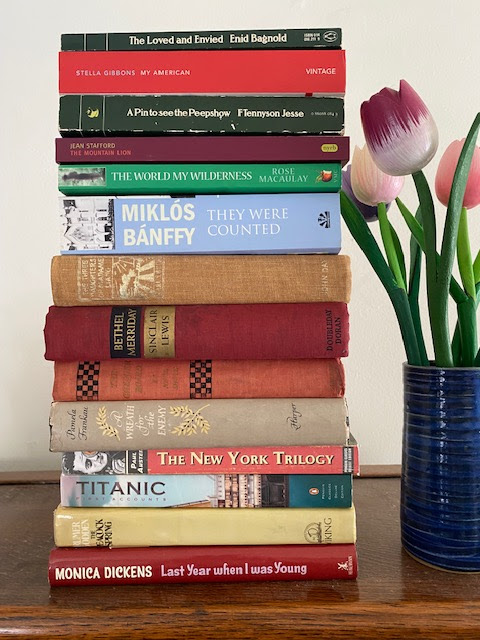
Here is my tentative pile for the challenge, a mix of books I've owned forever (more than ten years for some of them!) and some I acquired more recently, though none less than a year ago:


This is the pile in list format, alphabetically by author. Alternates are listed at the end.

Completed: 9/12

1. The New York Trilogy (1987) by Paul Auster. One of the last books unread from my Big Box of Penguins. Completed 3/3/22.

2. The Loved and Envied (1951) by Enid Bagnold. One of many unread Virago Modern Classics. Completed 7/24/22.

3. They Were Counted (1934) by Miklos Banffy. A big fat book in translation,  just the sort of book I love. 

4. Three Daughters of Madame Liang (1969) by Pearl S. Buck. A find from the basement bookstore at the Central Library in San Antonio. 

5. Last Year When I Was Young (1974) by Monica Dickens. Rescued from the annual library sale, back when I worked at the San Antonio Public Library, probably around 2012. Completed 3/12/22.

6. My American (1939) by Stella Gibbons. One of the Vintage Classics reprints bought when I visited London in 2017.

7. The Peacock Spring (1975) by Rumer Godden. Bought off the $2 cart outside Alabaster Books in New York. Completed 1/29/22.

8. The World My Wilderness (1950) by Rose Macauley. Found on the donation cart at the Ramstein AFB library. I recognized the green Virago spine and snapped it up. Completed 5/24/22.

9.  Titanic: First Accounts (2012) by Tim Maltin. Bought for its beautiful cover after I started buying Penguin Deluxe Classics. 

10. Bethel Merriday (1940) by Sinclair Lewis. Found with a pile of vintage books in an antique mall in Ellicott City, Maryland, the cutest little town in America. Completed 8/24/22.

11. The Chequer Board (1947) by Nevil Shute. Also bought at John King Books in 2018, after I discovered Nevil Shute. Completed 1/18/22.

12. The Mountain Lion (1947) by Jean Stafford. Another library sale find, an NYRB Classic. Completed 3/20/22.

Alternates:

A Wreath for the Enemy (1952) by Pamela Frankau

A Pin To See the Peepshow (1934) by F. Tennyson Jesse. Completed 6/13/22.

So, bloggers, have your read any of these? Which are must-reads, and which should I donate back to the library? And who else is signing up for the TBR Pile Challenge?

Saturday, July 28, 2018

London War Notes by Mollie Panter-Downes


It's taken me more than two months, but I've finally finished London War Notes, my tenth book for the TBR Pile Challenge 2018. First published in book format in 1971, this is a collection of essays written biweekly for the New Yorker during World War Two. It remained sadly out of print for many years until Persephone books republished it in 2014. I'm quite fascinated by the war years, particularly the war at home, so I was sure this would be right up my alley. Only the length had discouraged me since I bought it four years ago and I thought this would be a good time to get to it. 

Of course these essays discuss a lot of what's going on in London and the surrounding area during the war, especially the bombings, there's definitely a lot more history about the battles and the politics that were going on. There has been so much written about the war (go into any Barnes and Noble bookstore and you will be amazed at how many nonfiction books there are about WWII), but so much of what's published is centered around Europe, I'd forgotten how critical the battles in North Africa and the Far East were, especially places like Burma and Singapore. So much of what Americans associate with WW2 in Asia is centered around Japan -- I didn't really realize how significant the loss of Burma and the rubber plantations was to the war effort and everyday life in Britain. I did have to stop a number of times and look up historical events mentioned in the book that would have been common knowledge at the time of publication.

The other thing that really struck me about this book was the overwhelming sense of anxiety. As an American growing up in the late 20th and 21st century, I cannot imagine living with the thought that you could be bombed at any moment, to be evacuated from your home, or to have to endure rationing for food, clothing, and fuel. It's a little easier to read knowing that the war would be won, but it must have seemed like it was dragging out forever -- and of course rationing didn't end for a long time afterward. I've been a little disappointed being unable to buy Warburton's crumpets the past few weeks because of the CO2 shortage, boo hoo.

Detail from the endpapers of the Persephone edition
I do, however, think that I can relate to the sense of anxiety. Every day when I wake up and look at the news, I keep waiting for the worst, and wonder how much longer it will get worse before it gets better. I know a lot of Americans are feeling similar anxiety. I'm sure it's worse for people actually living in the U. S.

I'm very glad I read it, but this is the slowest I've read any book for this challenge, in this year or previous years. I suppose was a mistake to be reading this 459 page nonfiction book about World War Two at the same time I was reading a 661 page memoir about World War One (Testament of Youth). You think? I did in fact take a long break from London War Notes in June. I thought that it would be easy to pick it up again halfway, but I was wrong -- I really feel like I lost momentum. 

And now for a lighter anecdote! Reading this book also reminded me of one of my visit to the Churchill War Rooms during one of my visits to London. It's part of the Imperial War Museum and is really fascinating -- the underground bunker where Churchill and others lived, worked, and slept during the war. It is quite fascinating and there were a lot of interesting displays. Of course one has to walk through the gift shop on the way out and this was one of my favorite purchases:


Yes, these are two-handed oven mitts with a wartime propaganda slogan. I got it as part of a set with a matching apron (also available as a tea towel). There were a lot of fun postcards and prints with wartime slogans. Here's another of my favorites:


It's really worth visiting if you're in London and have any interest in wartime history. There's also an online shop here if you just want the oven mitts or the poster version.

So -- that's book #10 for my TBR Pile Challenge 2018! I'm making good progress and hopefully I'll complete the last two AND my two alternate reads this year! How is everyone else doing with their TBR piles? 

Saturday, December 29, 2018

TBR Pile Challenge 2019: Viragos or Non-fiction?


I'm so happy that Adam from Roof Beam Reader is hosting another TBR Pile Challenge! It's my favorite book-blogging challenge (next to my own). I love it because it really inspires me to read books from my own shelves, which I am woefully bad at. Only about half of my 2018 books were from my own shelves -- better than past years, but not nearly as many as I would like.

However, I have a bit of a conundrum -- I've made up two potential lists, and I'm torn between the two. One is all Virago Modern Classics (e.g., mostly out-of-print, mid-century women writers); the other is non-fiction, a mix of history, memoirs, and biographies. Bloggers, which one should I choose?

The Virago list: 
  1. The Loved and Envied by Enid Bagnold
  2. At the Still Point by Mary Benson
  3. Fenny by Lettice Cooper (one of last year's alternates)
  4. Crossriggs by Mary Findlater 
  5. Joanna Godden by Sheila Kaye-Smith
  6. Treasure Hunt by Molly Keane
  7. Troy Chimneys by Margaret Kennedy 
  8. Invitation to the Waltz by Rosamond Lehmann
  9. The World My Wilderness by Rose Macauley
  10. The Play Room by Olivia Manning
  11. Frost in May by Antonia White
  12. The Misses Mallet by E. H. Young 
Alternates:

The Little Ottleys by Ada Leverson

Jenny Wren by E. H. Young


The nonfiction list: 
  1. An Unlikely Countess: Lily Budge and the 13th Earl of Galloway by Louise Carpenter 
  2. Long Live Great Bardfield by Tirzah Garwood
  3. Terms and Conditions: Life in Girls' Boarding Schools, 1939-1979 by Ysenda Maxtone Graham
  4. Slipstream: A Memoir by Elizabeth Jane Howard
  5. Speaking of Jane Austen by Sheila Kaye-Smith
  6. Edith Wharton by Hermione Lee
  7. Margaret Mitchell's Gone with the Wind Letters, 1936 to 1949
  8. Millions Like Us: Women's Lives in War and Peace by Virginia Nicholson 
  9. The Perfect Summer by Juliet Nicholson 
  10. The Bolter by Frances Osborne 
  11. A Very Private Eye by Barbara Pym 
  12. Bluestockings by Jane Robinson 
  13. The Other Day by Dorothy Whipple
Alternates:

Georgette Heyer by Jennifer Kloester
Period Piece by Gwen Raverat


I realize there are 13 on this list, so one has to go. But which one? And I suppose I could just compromise and pick six from each list!

Bloggers, have you read any of these? Good choices or bad -- I have until January 15 to amend my list, so I'd love your input. And are you signing up for the TBR Pile Challenge? I'd love to see your lists!

Sunday, March 25, 2018

Lucy Gayheart by Willa Cather is Beautiful and Tragic


After making up my list for the TBR Pile Challenge, I realized that quite a few of my selections were in the 500+ pages range. I was planning to read Testament of Youth in March for Women's History Month, but I'd just finished Wives and Daughters and was rather hesitant to start another 700 page behemoth right away. The answer was of course a nice short book -- Lucy Gayheart by Willa Cather. 

One of her later works, it's set at the turn of the century but actually written in 1935, and is her penultimate book. The story begins in the small town of Haverford, Nebraska, somewhere west of Lincoln. Young Lucy Gayheart is home for the holidays. She's 18 and is a talented pianist, and has been working in Chicago. The story begins as she's out skating with Harry Gordon, the most eligible young man in town. He fancies himself in love with Lucy, and plans on marrying her and making her his most prized possession, but unbeknown to him, Lucy has dreams and aspirations that don't include spending the rest of her life in a small town.

The moment she shut the door on the baggage man, she seemed to find herself again. Out there in Haverford she had scarcely been herself at all; she had been trying to feel and behave like someone else she no longer was; as children go on playing the old games to please their elders, after they have ceased to be children at heart.

After the holidays, Lucy returns to Chicago, where she teaches piano and finds another job as a part-time accompanist to a famous singer named Sebastian Clement. Lucy is dazzled by his talent, and eventually falls in love with him, despite a large age difference, and the fact that he is married. She's unsure if he returns her feelings, but Harry visits her from Nebraska for the Opera season and she's forced to make a decision between a secure future with Harry and her dreams of Sebastian and a musical career. 

There's a major plot twist about halfway through the story, and it appears that Lucy's dreams are shattered. The second half of the novella deals with Lucy's attempts to comes to terms with her past decisions, and with her future. 

I had expected this to be similar to her earlier book The Song of the Lark, which is about a young woman from Colorado who also moves to Chicago to study music, but they're actually quite different. It's been several years since I read it, but The Song of the Lark deals much more with a young artist dealing with a developing career and interacting with other people. I think Lucy Gayheart is much more about there personal relationships than about her career -- it's the personal aspects that drive the story, not her career aspirations. I would say they're two different possibilities of how a person's life could change. 

Some people's lives are affected by what happens to their person or their property; but for others fate is what happens to their feelings and their thoughts -- that and nothing more.


I actually enjoyed Lucy Gayheart much more than The Song of the Lark -- it's definitely one of her best works, though I wouldn't have minded if it were longer (I actually thought the final section was a bit rushed and would have liked to have seen a little more character development among some of the secondary characters). I did love all the descriptions of both Nebraska and Chicago, two places where I've lived and loved. I particularly enjoyed some of the mentions of Chicago -- there's a scene where Lucy and Harry visit the Art Institute, and Cather mentions the famous lions on the front steps, and the French Impressionists (which don't impress Harry much!). Parts of the book also reminded me a little of Ethan Frome, which is one of my all-time favorite books. 

This is my fifth book for the TBR Pile Challenge 2018, and I've now read all of Cather's works except the short stories and Alexander's Bridge, which is her first novel. 

Wednesday, August 15, 2018

The Long View: A Marriage in Reverse


Elizabeth Jane Howard's Cazalet Chronicles is one of my favorite discoveries since I began book blogging.  I knew she'd written other books, so I was really pleased to find one a couple of years ago while on a trip to London (I think I bought ten books on a that trip in less than seven days). I was determined to read it this year, so I put it on my TBR Pile Challenge list for this year. 

Though I didn't love it as much as the Cazalets, The Light Years is still engrossing and the story is ultimately heartbreaking. Published in 1956, it's the tale of the marriage between Antonia and Conrad Fleming. The interesting twist of the story is that it's told in reverse. The book begins about 1950, on the evening of a dinner party held in honor of their son Julian's engagement, to a sweet but rather silly twenty-ish girl named June. 

Just as Antonia and Conrad's marriage is breaking down, Julian and June's marriage is about to begin, and Antonia suspects that history will ultimately repeat itself. As the book progresses, we go back through different periods of Conrad and Antonia's marriage, where we learn about love, jealousy, infidelity, and betrayal. The book traces Antonia's life with Conrad and we see how she developed from a shy young girl to the sophisticated yet jaded woman she becomes. 

I really liked this book thought it was harder to get into than the Cazalet series, which has a much more straightforward narrative. There's a lot more psychological insights into characters in this book; also, the characters aren't quite as likable, though they're very realistic. Conrad in particular is quite horrible -- basically, he only marries Antonia so he can mold her into someone he can admire and show off. I realize this is the first half of the 20th century when most wives were considered possessions, but he is particularly condescending to women. 

Here is an exchange between Antonia and Conrad about books and reading: 

"You do not want a well informed wife?"

"I am not an information addict. No. I want you to be informed about your pleasures. I do not like the people who read fifteen books by a man who was written three worth reading."

"But if one enjoys reading, one must be resigned to many disappointments."

"Disappointments -- certainly. But if you read a book and are disappointed, it is because you intended to be pleased." (pp. 262-263)

OK, not sure about this last statement -- frankly, I always intend to be pleased by a book, Even if I don't necessarily enjoy them overall, I usually appreciate them for some reason. I suppose that's not necessarily the same as being pleased, but at least I don't feel like I've wasted my time. But I digress.

I really like this cover from the Italian edition. 
Here is another insight that Antonia has about Conrad soon after their marriage: 

The trouble was that they were not now leading a married life. She was not certain what she meant by this, but essentially she felt that Conrad was not treating her as an equally responsible person. . . . He was kind, he was charming, but she felt like a child, or like that song that her mother's friends had hummed and whistled while they marked the tennis court, or prepared the bridge tables: a great big beautiful doll. He was deliberately preventing her from taking on those responsibilities which she felt should be hers -- or even discovering what those responsibilities were. . . (p. 270)

So, we learn eventually that Conrad isn't really interested in Antonia so much for herself, as much as he's just looking for a trophy. This section of the book is set nearly 90 years ago and clearly times have changed, but I still found it horribly offensive. Conrad is just toxic and I'm sorry Antonia put up with it for more than 20 years. However, it is an interesting character study, and I liked the reverse time structure. I have since bought another one of Howard's earlier novels called The Sea Change, and her memoir, Slipstream. Apparently she had a very interesting life -- she was an actress and model before she became an author, and was married three times; one of her husbands was Kingsley Amis and she ran in literary circles. 

This is my eleventh book for the TBR Pile Challenge 2018 -- only one left to go and I'm finished!

Saturday, July 7, 2018

Testament of Youth: War is Hell and Women Are Still Fighting For Equality


It took me more than a month, but I've finally completed Testament of Youth, Vera Brittain's classic memoir of World War I. I'd been meaning to read this book since about 2014, when it started showing up on lists of WWI reads. I put it on my TBR Pile Challenge List last year, but I kept putting off reading it until Jillian suggested a June readalong on Twitter. Sadly, I wasn't able to finish on schedule due to some travels to the UK, but I persevered and I'm glad to say that I have completed the 661 pages and am slightly exhausted.

The background: Vera Brittain was a student at Oxford when WWI broke out. Her brother Edward, sweetheart Roland, and two of their best friends all enlisted, and after a few months, Vera could not sit idly by and joined up as a VAD [Volunteer Aid Detachment], a volunteer nurse, and worked in France, Malta, and England until the end of the war, when she returned to Oxford, completing a degree in History, and became a teacher and eventually a lecturer, speaking all over the UK about pacifism and the League of Nations. The book begins with Vera's childhood in Buxton but mostly covers 1913 until about 1924. Testament of Youth was published in 1933 and is considered one of the classic WWI memoirs. Brittain also wrote novels and two more memoirs, Testament of Friendship (1940), about her relationship with classmate and best friend Winifred Holtby; and Testament of Experience (1957) -- both of which are much shorter.

I really enjoyed this book but it is long, with tiny print. I really loved reading about Brittain's life in Oxford and her friendship with Holtby and other writers (Dorothy Sayers was also an Oxford classmate). She had to fight her parents to attend Oxford, and even after the war and the suffrage movement, she was a feminist and struggled to have a career as a woman. It's so discouraging that women are still fighting for the same issues nearly 100 years later. Also terribly discouraging to hear how badly the young nurses were treated when they were volunteers, and how how inefficient some of the staffing and medical methods were. 

Of course, the sections about the war are absolutely heartbreaking. It's devastating to realize how many lives were destroyed on both sides, and how quickly Europe went back to an even bigger war just 20 years later. I cannot imagine living through a war like that as a civilian, much less as a nurse treating patients near a battlefield. 

Though there were a few sections that I did skim over (particularly some of the politics which I'm not as familiar with, especially at the end) the writing in this book is just wonderful and insightful. I copied at least ten passages that I would love to quote, but I've narrowed it to just a couple: 

What exhausts women in wartime is not the strenuous and unfamiliar tasks that fall upon them, nor even the hourly dread of death for husbands or lovers or brothers or sons; it is the incessant conflict between personal and national claims which wears out their energy and breaks their spirit. (p. 422- 423).

One had to go on living because it was less trouble than finding a way out, but the early ideals of the War were all shattered, trampled into the mud which covered the bodies of those with them I had shared them. What was the use of hypocritically seeking out exalted consolations for death, when I knew so well that there were none? (p. 446).


Only gradually did I realize that the War had condemned me to live to the end of my days in a world without confidence or security, a world in which every dear relationship would be fearfully cherished under the shadow of apprehension; in which love would seem threatened perpetually by death, and happiness appear a house without duration, built upon the shifting sands of chance. I might, perhaps, have it again, but never again should I hold it. (p. 470).

It did not seem, perhaps, as though we, the War generation, would be able to do all that we had once hoped for the actual rebuilding of civilisation. I understood now that the results of the War would last longer than ourselves; it was obvious, in Central Europe, that its consequences were deeper rooted, and farther reaching, than any of us, with our lack of experience, had believed just after it was over. . . . . Perhaps, after all, the best that we who were left could do was refuse to forget, and to teach our successors what we remembered in the hope that they, when their own day came, would have more power to change the state of the world than this bankrupt, shattered generation. (pp 645-646.)

I had been rather dreading this because of the length and subject, but I'm really glad I read it, so thanks to Jillian for suggesting it! I'm also inspired to read Testament of Friendship which I must track down, and to read the remaining Winifred Holtby novels that are on my TBR shelves (Poor Caroline and Mandoa, Mandoa!). I also have the TV adaptation saved on the DVR, but I might have to wait a bit to watch it -- I can't imagine how this has been adapted to film. Bloggers, have any of you seen it? Is it worth watching or should I just delete it? 

This is book #9 for the TBR Pile Challenge 2018

Thursday, February 15, 2018

Miss Mole by E. H. Young: Not Exactly Mary Poppins for Grown-Ups


I am always envious when bloggers mention how they just happened to find a Persephone at a charity shop or a used bookstore. Other than the Persephone Classics, which don't have the distinctive dove-grey covers, they are is nearly impossible to find in the US, new or used. However, it's not unheard of to find Virago Modern Classics, both the lovely green-spined editions and the earlier Dial press editions with the black covers. There's a wonderful Half-Price Books location in Austin, Texas that is massive and I remember walking out with at least a half-dozen on one visit a couple of years ago. I also found quite a few at John King Books in Detroit back in 2016. 

One of my finds (from Austin, I think) was a black spine copy of Miss Mole (circa 1985). First published in 1930, Miss Mole won the James Tait Black Memorial Prize for Fiction and is considered her masterpiece. I was inspired to add this to my TBR Pile Challenge list after Rachel and Simon discussed it on their wonderful podcast Tea or Books? 

So, Miss Mole is set between the wars and is the story of Hannah Mole, a fortyish spinster who ekes out a living as a companion or housekeeper -- she has a sharp tongue and quirky spirit that sometimes get her into trouble. At the beginning of the novel she's returned after a long absence to the fictional town of Radstowe (which is a thinly disguised portrait of Bristol). Miss Mole is not getting along well with her current employer and after a few days in a boarding house, gets a new job via her cousin Lilla, who is from the wealthier side of the family and has some good contacts. Without revealing the family connection, Lilla recommends her for a job as a housekeeper of sorts for a rather stuffy, pompous minister named Robert Corder, whose wife has recently passed away. 

The household consists of Reverend Corder, a nonconformist; daughter Ethel, who's rather desperately looking for a man so she can escape the house; young Ruth, who is still in school and longing for a mother figure; and their sassy cousin Wilfred, who's attending medical school nearby. Wilfred's presence in the house is rather awkward and raises a few eyebrows, but his mother is wealthy and the Reverend can't risk offending her. A spinster housekeeper/chaperone is exactly what they need to keep the house respectable -- or so they think. Miss Mole moves in and simultaneously elevates their lives and yet turns things upside-down. She's comforting and yet slyly subversive, and Reverend Corder doesn't quite know if he should appreciate her or fear her, as Hannah is smarter than he is. Wilfred takes to her instantly, recognizing her sharp wit, and Ruth grows to love her. Eventually, though, there are whispers about Miss Mole's background which much be addressed, and we learn the real reason for her long absence from her hometown. 

The writing in this book was really great, very insightful, and the dialogue between the characters is especially sharp:

There was every reason why Ethel should have been an inefficient housekeeper, and every reason why Miss Mole should be a good one. At forty, all distracting desires, ambitions, hopes, and disappointments must have passed away, leaving the mind calm and satisfied with the affairs of every day, a state for which Ethel sometimes envied Miss Mole, more often pitied her. . . . They were all too young or too self-absorbed to understand that her life was as important to her as theirs to them and had the same possibilities of adventure and romance; that, with her, to accept the present as the pattern of the future would have been to die.

Mr. Blenkinsop was a solemn infant who asked for what he wanted and Robert Corder was a spoilt one who expected his needs to be divined.

"I often envy women," Robert Corder said. "They have useful and not exacting occupations for their hands, and no labor need be dreary."  Riiiiight.


Cover image from the Furrowed Middlebrow blog 
I loved this book but for such a short novel (288 pages) it took me a surprisingly long time to finish it. The writing style is a bit quirky, but it took me more than three weeks to complete. This puzzled me but I realized part of the reason could have been the edition. The print was quite small, and there are a lot of pages that are one solid paragraph, or nearly so, which I find off-putting (fun fact: there is a Gabriel Garcia Marques novel that is ONE SOLID PARAGRAPH WITHOUT CHAPTER BREAKS. It's The Autumn of the Patriarch, and I can tell you right now that I will never, ever read it.) Also, this book is 40 chapters, most of them quite short, so there were a lot of breaks. I wonder if that made me more likely to put the book down instead of plowing through it.

This is my first book by E. H. Young, and I also own two others in the Virago imprint, The Misses Mallet, her first novel, and Jenny Wren, which apparently has a sequel also published by Virago. I also want to read Chatterton Square, which was beloved by both Rachel and Simon in the Tea or Books? podcast. I'll have to buy it but I feel like I work through some more of my unread Viragos (25 at last count) before I buy another which could just end up collecting dust on the TBR shelves.

This is third book for my TBR Pile Challenge 2018

Sunday, April 15, 2018

The Willow Cabin by Pamela Frankau: A WWII Love Triangle

I really like the cover of this paperback -- it's Table Devant Une Fenetre
(Table Under a Window) by Henri Le Sidaner.
I really cannot resist going into a used bookstore -- for the past few years I've been really disappointed by most of the newer fiction and I always find myself much more satisfied with backlist titles, especially from the mid-century. It's always really nice to scan the shelves at a used bookstore and see a green-spined Virago Modern Classic, which I would normally snatch up immediately. A few years ago I was lucky and found quite a pile of VMCs at John King Books in Detroit, and one of my finds was The Willow Cabin by Pamela Frankau.

Published in 1949, this is the story of a young actress named Caroline Seward and her love affair with a surgeon, Michael Knowle, from the late 1930s until after the war. Caroline has a promising future on the stage until she meets Michael, who is separated from his wife Mercedes, an artist and set designer. Caroline struggles whether to give up her career and devote her life to Michael, and the complicated relationship between Michael and Mercedes casts a shadow over their relationship, before and during the war.

I mostly liked this book though it did take some time to get into it. I thought it was going to have a lot more about Caroline's theater career, but it's really mostly about her relationship with Michael with some sub-plots about the peripheral characters, like Caroline's childhood friend June; Vera, Mercedes' former secretary who becomes obsessed with finding her former employer during the war; and the Aynsteys, American friends of Michael and Mercedes who eventually tie all the characters together. I liked all the secondary characters and thought they were really well drawn. 

The book is divided into three sections: before, during, and after the war. I think the best section by far was set during the war, when Michael is working as a military surgeon and Caroline has signed up to do her bit. I'm really fascinated by how WWII affected people still in England, much more than battle scenes and that sort of thing. I also really like that this book was written pretty close to the end of the war -- it must have been very fresh in Frankau's mind and as much as I love historical fiction, I think it would be really difficult to recreate it if you haven't experienced it.

I also think the writing in The Willow Cabin was really good. Just after I finished it I started reading a novel for my upcoming book discussion group, a fairly recent historical novel about three women in WWII. I couldn't even get through the first 50 pages because I think it was utter crap, the writing was really weak and the characters so poorly developed I put the book aside in disgust. 

Anyway, here's a bit I found really poignant and insightful: 

He could see nothing ahead for any of them, the tight little circle of temporarily-favoured persons to whom all this was important. "It is the last spring; the guillotine is coming down. And after that it won't matter who loves and who is unloved; we are for the dark." How foolish not to be happy now, when there was so little time left. (p.75)

It's short, but I really feel like it captures the essence of what people must have been feeling when it was so obvious another massive war was inevitable. 

There were several plot twists in this book that I wasn't expecting, but unfortunately the VMC edition has a massive spoiler for a big plot element in the description on the back. (If you're interested in reading this, I would advise against reading the back cover and the desciption on Goodreads). My least favorite part of the book was the aftermath of the war, when the setting shifts to America. I don't want to go into any more detail for fear of spoiling it for anyone else. 

Overall I really did like this and I've heard other good things about Frankau's novels. Apparently she was quite a prolific novelist and published more than 30 works from the end of the 1920s until her death in 1967. A Wreath for the Enemy is her best-known novel and is also a Virago Modern Classic. I'll definitely look for it after I've made some more progress on the TBR shelves. 

This is my sixth book this year for the TBR Pile Challenge 2018 -- I'm halfway through my list!

Monday, March 12, 2018

Madame de Treymes and Three Novellas by Edith Wharton


It's been quite a while since I read anything by Edith Wharton. She's the author of some of my favorite novels, and I've read nearly all of her most popular works. When you get to the little-known works of a famous author, it's always something of a crapshoot -- are they less popular because they're simply overshadowed? Or is it because they're just not that good? My last two books by Wharton were The Glimpses of the Moon, which I loved, and Twilight Sleep, which was just okay. 

Madame de Treymes and Three Novellas includes four of Wharton's shorter works from various times in her career. I actually read these out of order, mostly because they were also available on iBooks and I read them in bits and pieces, mostly on my phone. It's kind of hard to review them all in one post, but I'll give it a go. 

Bunner Sisters is probably the most well-known of the novellas. Written in 1892 but unpublished until 1916, it's one of her few works not about upper-crust New York society. Spinster sisters Ann Eliza and Evelina are existing in near-poverty, working and living in a tiny shop where they make and sell hats, bonnets, and trimmings. Ann Eliza splurges and buys Evelina a clock for her birthday, and the two sisters both fall in love with the local clockmaker, the meek Mr. Herbert Ramy. What seems like a way out of poverty for at least one of them ends badly, of course. If you've ever read anything by Wharton you'll know her books rarely have happy endings. 


In Sanctuary, Kate Orme seems to have it all -- youth, beauty, position, and she's engaged to marry eligible bachelor Denis Peyton, who recently inherited a pot of money from his scandalous stepbrother. However, Kate learns the terrible secret behind the inheritance, and struggles to decide if she should marry someone with such a lack of character -- and if she does, will her children inherit their father's morals, or whether she her influence will be enough. This one was my least favorite. 

This cover is sort of creepy and really has nothing to do with the story.
The Touchstone is another story about a moral crisis. In this case, Stephen Glennard, a young lawyer, is in love but struggling financially. He wants to marry, but doesn't have enough to support a wife, and to keep the woman he loves from moving abroad with a rich relative, he struggles with a decision to publish some very personal letters written to him by a very popular writer who has since died. It seems like the right thing to do, but eventually he has a crisis of conscience.

Madame de Treymes is actually the shortest of the four, only about 80 pages, but I ended up reading it last. While in Paris, a wealthy American, John Durham, has reconnected with an old acquaintance, the former Fanny Frisbee, who had married a French nobleman but is now separated from him. Durham wants her to divorce her ne'er-do-well husband and marry him, but Fanny is certain his family would never permit the scandal of a divorce. Durham appeals to her sister-in-law, the eponymous Madame de Treymes, and doesn't know whether he can trust her to assist them in persuading the family to allow the divorce.

Overall, I enjoyed the novellas, but I'd forgotten that Wharton can be kind of wordy and very introspective, and her plots tend to move rather slowly. All the novellas have themes about decisions and moral crises, though Bunner Sisters seems rather the odd book out simply based on the class and financial circumstances of the subjects.

I still have three more books by Wharton unread on my shelves -- The Children, Hudson River Bracketed, and The Fruit of the Tree. I was thinking about reading one of them for the Back to the Classics Challenge. Bloggers, have you read any of them? Which do you recommend?

This is my fourth book for the TBR Pile Challenge 2018. Eight left to go!

Tuesday, January 16, 2018

Christopher and Columbus by Elizabeth von Arnim: One Book Down, 99 to Go


Halfway through the first month of 2018, and I have completed exactly two books. That's it. If I plan on completing my goal of 100 books this year, I need to get cracking.

In my defense, I was traveling for a week right after Christmas (will post photos soon), and we had a houseguest for another week, which included more travel (day trips to Trier, Luxembourg, and Strasbourg). But now the weather is cold and windy, and it's a good time to hide in my burrow and read those stacks of books.

So. My first book of 2018 was Christopher and Columbus, a rather oddly titled humorous novel by Elizabeth von Arnim. It was the first book on my 2018 TBR Pile Challenge list, so that was a good place to start. And though it is a charming book, the only explorers are in the metaphorical sense.

Published in 1919, Christopher and Columbus is the story of 17-year-old twin sisters, Anna-Rose and Anna-Felicitas. It's set in the early part of WWI, and the twins, orphaned, half German and half English, are living rather uncomfortably in England with an aunt who loves them and an uncle who does not, in a town where the presence of anything remotely German is suspect. Though their mother was very English and they mostly grew up in England, they look German, sound German (a great many mentions of their inability to lose the German "R"); and have a German last name -- von Twinkler.

Not surprisingly, the unhappy uncle by marriage decides that the anti-German sentiment is too high, and the twins must go. He packs them off to America, which has not yet entered the war, with 200 pounds and letters of introduction to friends in Boston and California. On board ship, though they are traveling second-class, Anna-Rose and Anna-Felicitas find a savior and protector during a ship's emergency -- Mr. Twist, a thirtysomething bachelor without much hair but with lots of money. This sounds like it could become sordid very quickly, but in fact, Mr. Edward Twist is a kind and noble soul. Though he made pots of money inventing a dripless teapot, he is taking a break from driving an ambulance for the war effort, returning to America to visit his widowed mother.

Elizabeth von Arnim. Not Mr. Twist's mother.
Mr. Twist notices their vulnerability and takes the twins under his wing. He keeps a close eye on them the remainder of the trip, and tries to escort them to their new home in America. Things don't turn out as planned, and naturally the twins turn to him for help in an unfamiliar country. I wish I could say hilarity ensues, but not really. It's mostly charming and gently funny, but there's always an undercurrent of how vulnerable these girls are, how much anti-German prejudice exists, and obviously, the possibility that this tale could quickly become rather sordid. Indeed, many times there are hints and allegations that Mr. Twist is up to no good -- by other characters, not by the author (the only exception is Mrs. Twist, his manipulative mother, who decides that it is the twins that are up to no good. This is resolved in one of the book's most satisfying scenes).

Overall, I enjoyed this book, though I did find the twins a little twee. They didn't seem to have much character development other than their fondness for each other, and for their beautiful golden ringlets. Yes, it's the nineteen teens, but these girls felt more like 12 year olds than 17 year olds. Plus, there is the underlying ick factor of these 17 year old girls -- Mr. Twist may have had the noblest of intentions, but there are other men in the book who clearly do not. There's also some racism regarding people of color they meet along the way, all of whom are in service positions, particularly a Chinese cook. The book does make some very good points about the anti-German sentiment which is not as surprising given the anti-immigrant feeling in the world today.

Of course, everything turns out all right in the end. I've now read six of von Arnim's works, and would rate this about the middle of the pack. If you are a fan, you will probably enjoy this book, but I don't know if I'd recommend it as a first read if you've never read her before.