Showing posts sorted by date for query penguin. Sort by relevance Show all posts

Friday, March 4, 2022

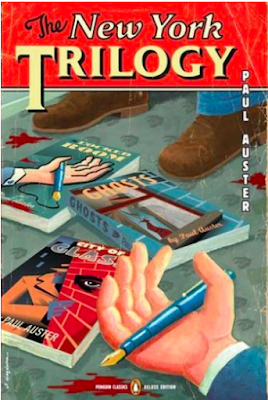
The New York Trilogy by Paul Auster: Metafiction Mysteries


Everyone knows that stories are imaginary. Whatever effect they might have on us, we know they are not true, even when they tell us truths more important than the ones we can find elsewhere. ("The Locked Room")

More than ten years ago I received a big box of 24 Penguin Deluxe Classics as a prize from the publisher. As of this year I still had four still unread so I added The New York Trilogy to my TBR Pile Challenge list. I brought it with me, appropriately, to a recent trip to New York, but this book was not what I expected at all. This is an odd book, and I don't even know if I can describe it accurately.

It's a collection of three novellas, originally published in 1985 and 19867. Each of the protagonists is either a private investigator, or someone who becomes caught up in an investigation. Ostensibly they are all detective novels, but they're hardly the mystery/detective fiction of Raymond Chandler or Dashiell Hammett.They all begin as traditional detective novels, but it quickly becomes apparent that they're all much more than that, as the narrators begin to question what they're doing and the nature of their existence within the investigations. 

In the first novella, "City of Glass" a mystery writer named Quinn who is between projects gets a series of mysterious phone calls for a "Paul Auster," asking for help. Out of boredom and curiosity, he decides to impersonate Auster and ends up taking on a case and descends into a Kafka-esque spiral. 

The second novella is titled "Ghosts," in which a private investigator named Blue is hired by the mysterious White to follow a man named Black and monitor him 24 hours a day. Eventually he starts to wonder who is observing who and what it all means. (All the characters are named after colors, shades of Reservoir Dogs.)

The final novella of the trilogy, "The Locked Room" is the story of a nameless young writer contacted by the beautiful wife of his childhood friend Fanshawe, who seems to have disappeared, leaving behind boxes crammed with his writings. She asks the narrator to fulfill her missing husband's request to try and get his writing published and he becomes obsessed with finding out what happened to his old friend while becoming more involved with the wife. 


I really liked these novellas but they were so much more than I expected. Instead of the hard-boiled detectives of the mid-century, the protagonists all begin to question their own existence and sometimes their own reality. They're all actually interconnected and it took me quite a while to figure out how they were related, other than being set in New York. (I had put the book down for a couple of weeks before the first and second novellas so that definitely made it harder.)

They're also quite different from writing style of the traditional detective novel. There are so many insightful and beautiful quotes adding little sticky notes so I wouldn't forget them. Some favorites: 

New York was the nowhere he had built around himself, and he realized he had no intention of ever leaving it again. (City of Glass)

For the first time in his experience of writing reports, he discovers that words do not necessarily work, that it is possible for them to obscure the things they are trying to say. (Ghosts)

He feels like a man who has been condemned to sit in a room and go on reading a book for the rest of his life. This is strange enough -- to be only half alive at best, seeing the world only through words, living only through the lives of others. But if the book were an interesting one, perhaps it wouldn't be so bad. He could get caught up in the story, so to speak, and little by little begin to forget himself. But this book offers him nothing. There is no story, no plot, no action -- nothing but a man sitting alone in a room and writing a book. (Ghosts)

Stories happen only to those who are able to tell them, someone once said. In the same way, perhaps, experiences present themselves only to those who are able to have them. (The Locked Room)

A man does not spend his time hiding from the world without making sure to cover his tracks. (The Locked Room)

We all want to be told stories, and we listen to them in the same way we did when we were young. We imagine the real story inside the words, and to do this we substitute ourselves for the person in the story, pretending that we can understand him because we understand ourselves. This is a deception. We exist for ourselves, perhaps, and at times we even have a glimmer of who we are, but in the end we can never be sure, and as our lives go on, we become more and more opaque to ourselves, more and more aware of our own incoherence. No one can cross the boundary into another -- for the simple reason that no one can gain access to himself. (The Locked Room)


That's a lot of quotes but they're all so good that I couldn't cut a single one. I'm not a huge fan of post-modern or meta-fiction but I can't stop thinking about this book. It did have some sexist tropes that I could have done without but I understand why Penguin added it to their Classics list, despite being published in the 1980s. If I had a mystery book group I would absolutely recommend this because there is a LOT in here to discuss. I'm not even sure I understand the ending. 

This is my third book for the TBR Pile Challenge and I'm really glad that it inspired me to finally read this novel. 

Wednesday, January 12, 2022

TBR Pile Challenge 2022


This might be the challenge that actually gets me blogging regularly again! I'm always trying to read books off my one shelves (only 33 in 2021 -- not great!) so learning that Adam is reviving his TBR Pile Challenge definitely piqued my interest. Basically the idea is to pick 12 books off your shelves that you've owned for at least a year, and read them (you are allowed two alternates). You then post about them on your blog, and at the end of the year, anyone who finishes is eligible for a drawing. The prize is a $50 gift card for . . . more books! I have attempted this challenge several years and actually won the prize a few years ago! 

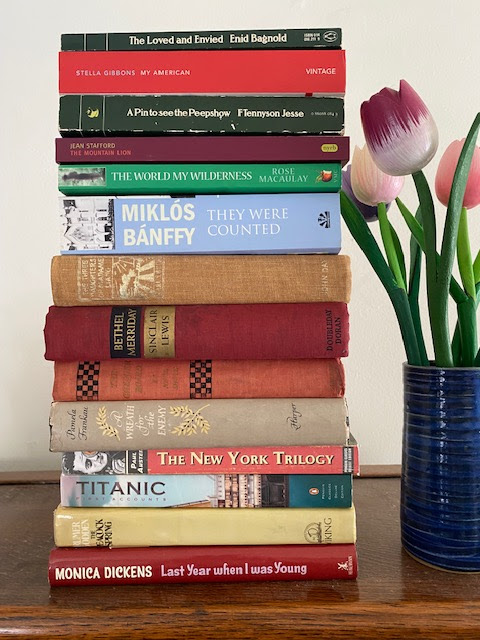
Here is my tentative pile for the challenge, a mix of books I've owned forever (more than ten years for some of them!) and some I acquired more recently, though none less than a year ago:


This is the pile in list format, alphabetically by author. Alternates are listed at the end.

Completed: 9/12

1. The New York Trilogy (1987) by Paul Auster. One of the last books unread from my Big Box of Penguins. Completed 3/3/22.

2. The Loved and Envied (1951) by Enid Bagnold. One of many unread Virago Modern Classics. Completed 7/24/22.

3. They Were Counted (1934) by Miklos Banffy. A big fat book in translation,  just the sort of book I love. 

4. Three Daughters of Madame Liang (1969) by Pearl S. Buck. A find from the basement bookstore at the Central Library in San Antonio. 

5. Last Year When I Was Young (1974) by Monica Dickens. Rescued from the annual library sale, back when I worked at the San Antonio Public Library, probably around 2012. Completed 3/12/22.

6. My American (1939) by Stella Gibbons. One of the Vintage Classics reprints bought when I visited London in 2017.

7. The Peacock Spring (1975) by Rumer Godden. Bought off the $2 cart outside Alabaster Books in New York. Completed 1/29/22.

8. The World My Wilderness (1950) by Rose Macauley. Found on the donation cart at the Ramstein AFB library. I recognized the green Virago spine and snapped it up. Completed 5/24/22.

9.  Titanic: First Accounts (2012) by Tim Maltin. Bought for its beautiful cover after I started buying Penguin Deluxe Classics. 

10. Bethel Merriday (1940) by Sinclair Lewis. Found with a pile of vintage books in an antique mall in Ellicott City, Maryland, the cutest little town in America. Completed 8/24/22.

11. The Chequer Board (1947) by Nevil Shute. Also bought at John King Books in 2018, after I discovered Nevil Shute. Completed 1/18/22.

12. The Mountain Lion (1947) by Jean Stafford. Another library sale find, an NYRB Classic. Completed 3/20/22.

Alternates:

A Wreath for the Enemy (1952) by Pamela Frankau

A Pin To See the Peepshow (1934) by F. Tennyson Jesse. Completed 6/13/22.

So, bloggers, have your read any of these? Which are must-reads, and which should I donate back to the library? And who else is signing up for the TBR Pile Challenge?

Saturday, September 25, 2021

Penmarric by Susan Howatch

The original hardcover image from 1971.
Sadly my copy was missing the dustjacket.

“I was ten years old when I first saw Penmarric and twenty years old when I first saw Janna Roslyn, but my reaction to both was identical.”

One of the big fat books I meant to read this summer was Penmarric, an epic family saga set in Cornwall. Between Daphne du Maurier and the Poldark series (not to mention Doc Martin) I've developed a small fascination with Cornwall, though I've never actually visited. I do love a good multi-generational saga and the setting absolutely sold it for me. I was at The Strand bookstore in New York a couple of years ago and picked up a vintage hardcover for about $7. My edition was more than 700 pages but I had no trouble finishing it in less than a week.

First published in 1971, the book begins with the historic estate of Penmarric in dispute -- daughter Maud Castellack thinks she should inherit, but naturally as a woman in the late Victorian era, she can't -- with no immediate male heir her father has willed it away to a cousin. Maud won't give up, trying desperately to win the estate for her elder son Mark, narrator of the book's first section. On a trip to Cornwall to finally meet his cousin, young Mark Castellack sees a beautiful widow in a desolate churchyard and is instantly smitten. 


A 1980s mass-market reprint

Janna Roslyn is ten years his senior and has her own slightly checkered history, but Mark becomes obsessed with her, eventually winning her as his bride. The narrator changes for the second section of the book and we get Janna's POV.

So we learn Janna's history and it moves on to the next generation of the Castellack heirs to Penmarric. The book spans about fifty years, ending just before World War II, with five different narrators, and includes four generations of the extended family. It's definitely not literature, but nonetheless I enjoyed it. It reminded me very much of the historical family sagas I read when I was a teenager, like Evergreen by Belva Plain and The Thorn Birds by Colleen McCullough, though both of those were published a bit later, in the late 1970s. 

A Penguin reprint from 1989, very Gothic!

I wouldn't call it a bodice-ripper, it's definitely a step up from Judith Krantz or Danielle Steele, but I can see that it's very much of its time. Even though it's mostly set in the first half of the 20th century, there are some story elements that would have been a lot more timely in the 1970s. It's not especially graphic but it would have been far too scandalous if it had been written earlier. 

I particularly liked the setting, as always, and the descriptions of Penmarric and the bleak Cornish countryside. I also really liked how the first-person narration shifted. Three of the narrators were from the same generation so the reader got two different perspectives of what was happening, which I liked. For the most part, the characters are pretty awful, but the author made me (mostly) sympathize with them while I was reading their point of view. 

Paperback copy of a French-language edition from1972. 
Nice image, but it doesn't quite capture the same feeling as the other covers.

I realized after finishing that Penmarric was inspired loosely on Henry II and Eleanor of Aquitaine, and there are epigraphs between each chapter which would make sense to anyone who knew the history or had bothered to read them. (I tend to skip over those bits so I didn't get it at the time.) I do love a great epic novel and I was in a bit of reading slump, so this was just the thing for late summer (can I call it a summer read since I finished it after Labor Day?) Susan Howatch has written several other books and a couple of them are still available at my library. There was also a BBC adaptation in the late 1970s which you can find on Youtube. 

So -- a very entertaining, retro read, absolutely perfect for the summer. If I were on a vacation on the Cornish coast, this is the book I would bring with me.

Tuesday, December 8, 2020

Back to the Classics 2021: My List

My list of possible reads for this year's challenge. Once again, mostly taken from my own TBR shelves -- how many of them will I actually read this year? 


1. 19th Century Classic: The Doctor's Wife by Mary Elizabeth Braddon -- I do love Victorian sensation novels! 

2. 20th Century Classic: A Wreath for the Enemy by Pamela Frankau. Bought at The Strand Bookstore last year. 

3. Classic by a Woman Author: The Portable Dorothy Parker. Received as part of my prize from a Penguin book giveaway back in 2011. Also my Classics Club Spin pick so I have to read it by January 30. 

4. Classic in Translation: Renoir, My Father by Jean Renoir. I bought it at the Frick Museum gift shop in 2013. Or maybe I'll put in the effort to finally read Crime and Punishment!

5. Classic by a BIPOC Author: Invisible Man by Ralph Ellison. Or something by Zora Neale Hurston.

6. Classic by a New-to-Me Author:  I've hardly read any Victorians this year so I'd like to read one for this category. I still have The Clever Woman of the Family by Charlotte Mary Yonge and Marcella by Mrs. Humphrey Ward -- are they obscure because they're terrible or are they forgotten gems?  I could also try again to read The Real Charlotte which I plan to read for the European Reading Challenge

7. New Classic by a Favorite Author: The Bright Side of Life by Emile Zola. I'll probably read Zola in April for Fanda's Zoladdiction challenge, or for Paris in July -- maybe both! I still have about five unread novels in the Rougon-Macquart series and the final novel Doctor Pascal has finally been reprinted in a new translation.

8. Animal Classic: Either Green Dolphin Street by Elizabeth Goudge or A Pelican at Blandings by P. G. Wodehouse. I bought a bunch of P. G. Wodehouse years ago when Borders went out of business, and I still have two left unread. 

9. Children's Classic: Kilmeny of the Orchard by L. M. Montgomery. I bought a lovely early edition last summer during my trip to Second Story Books.

10. Classic Humor or Satire: Something by P. G. Wodehouse. His books always make me laugh, and lately I've been reading my way through the Blandings Castle series. I could read Galahad at Blandings for this category and Penguin at Blandings for the Animal classic.

11. Travel or Adventure Classic: The Caravaners by Elizabeth von Arnim. I think this is the fifth time I've put it on a reading challenge list! 

12. Classic Play: She Stoops to Conquer by Oliver Goldsmith. It was on the schedule for one of the DC theaters in 2020 but has been postponed until whenever -- hopefully it'll be rescheduled when the theaters finally reopen! Or I might try to read some Shakespeare, I haven't read any since college. 

So -- ten from my own shelves, which is a good ratio, and more than half are by women. I'm really looking forward to a new list in the New Year! 

What do you think, bloggers? Have you read any of the books or authors from this list? Which should I read first -- or avoid altogether? 

Monday, October 19, 2020

1956 Club: Madame Solario by Gladys Huntington, and some book covers

A first edition dust jacket. 
Those bare shoulders seem more 1950s than Edwardian.


I was really ambitious for Simon and Kaggsy's recent #1956 Club -- I had a stack of books published that year that I was determined to read, mostly from my own shelves. I did finish four of the five, though I only had time to blog about two of them. I had also started another, a Persephone called Madame Solario. However, it was a bit of a slow read and 493 pages long, I knew I wouldn't finish it during the specified period. But I finally finished it last week and thought I'd review it anyway. 

Published anonymously in 1956, Madame Solario is set in the fashionable resort town of Cadenabbia on Lake Como in northern Italy, in the summer of 1906. The book, which is divided into three parts, begins with the arrival of a young Englishman, Bernard Middleton, who is spending the summer on the continent before settling down in a banking career chosen for him by his family. He is supposed to meet friends who have been delayed, but decides to stay when he is drawn into the society of other expats vacationing in the same hotel. At first he is drawn to the beautiful young Ilona, whose heart is being broken by a Russian soldier, Kovanski. Bernard is disappointed by Ilona's sudden departure, but is soon enamored of the mysterious Madame Natalia Solario, a beautiful English woman with an absent husband. Her arrival turns the hotel into a bit of a turmoil. It seems there is some unfinished business with the jealously glowering Kovanski, and Bernard also learns of some scandals in Madame Solario's past. 

Beautiful endpapers in the Persephone edition


Bernard begins a tentative friendship with Madame Solario, but the viewpoint of the book shifts in the second part with the arrival of Madame Solario's brother, Eugene Harden, who is apparently the source of the mystery in his sister's past. The hotel guests become suspicious of their close relationship, and rumors begin to spread. Bernard is hardly mentioned and it's very focused on Natalia (nicknamed "Nelly" by her brother) and Eugene. A lot of it is just mostly conversations between the two, or rather, just long rants by Eugene. The third part then shifts the focus back to Bernard and the pace really picks up before a very dramatic finish that left me gobsmacked.

According to the Persephone website, reviews of the novel compared to it Henry James crossed with Ivy Compton-Burnett or with Daphne du Maurier. I haven't tackled much by James but I am a fan of his contemporary Edith Wharton, and this feels a bit like a Wharton novel to me -- dissatisfied upper-crust people in Italian resorts are definitely an Edith Wharton setting, though the malevolent brother isn't typical of her work. 

Those people . . . they have the superiority of owing their good fortune to something they themselves had nothing to do with. And that is the superiority I envy! To be born with a sort of super-self, for that's what rank is, a super-self that planes over frontiers -- to be born thinking one has the right to look down -- hasn't that got more charm than anything one can do for oneself? (pp 198-199)

I liked this book, though the middle section, the longest, dragged somewhat. I found the relationship between Natalia and her brother disturbing. I don't want to give anything away but after reading it I'm not surprised that the author was anonymous for a long time. And the ending was . . . wow. I really, really wish I knew someone else who had read this so I could discuss it with them. Not a typical Persephone at all, but definitely worth reading. 

And lots of interesting book covers! 

A first edition, not very exciting. 


A Polish edition


Nice cover on this French edition, I think it's my favorite of the bunch.


Trashy paperback cover! Looks very 1970s but internet searches say 1950s paperback edition. 


 A Penguin reprint from 1956. She looks more like Eliza Doolittle here --
the correct time period, but not glamorous enough.


A Spanish edition, meh


An Italian edition, nice photo of Lake Como on the cover.

In 2012 Madame Solario was adapted into a French movie, currently available for streaming on Amazon Prime. I haven't watched it yet but I'm curious to know how they'll adapt this 500 page novel into a 90 minute film. I imagine just cutting out Eugene's tirades will save a lot of time. 


There was even an entire book published on the mystery of the anonymous author. Sadly it's only available in French.  


I'm counting this as my book set in Italy for the European Reading Challenge

Thursday, May 14, 2020

Lark Rise to Candleford; and my pastoral life in Germany


I finally tackled one of the books I've had on my owned-and-unread pile the longest -- Lark Rise to Candleford. I bought this more than ten years ago, around the time the TV series was first broadcast, but I've been putting it off forever, put off by the sheer size of it, and by the first couple of pages which are mostly descriptive. (It's also one of the books from my original Classics Club list that I never read). It's a little tough if the first page doesn't grab you. I had watched a bit of the TV series and enjoyed it, so I thought I should give it another go. 

For those who aren't familiar, Lark Rise is a fictionalized memoir of Flora Thompson's childhood in rural England, during the late Victorian period. It's classified as fiction but definitely reads like a memoir, and most libraries and bookstores shelve it in the fiction section. There isn't really any plot, it's really a lot of vignettes and memories of Thompson's childhood in Oxfordshire, and she places herself in the story as the main character, Laura, oldest child of a stonemason and his wife who live in a poor but comfortable house in the little hamlet of Lark Rise. It was originally published as three volumes, and I read the edition pictured above which includes all of them: Lark Rise [1939], Over to Candleford [1941], and Candleford Green [1943]. Since 1945 it's been available as an omnibus and there are many beautiful editions. 

A Penguin edition of the first volume.
My copy had woodcut illustrations similar to the one on the cover, 

though they're black and white


Each chapter has a theme, so it isn't told in a specifically linear fashion. It jumps around a bit, but it's easy enough to follow. There were chapters on May Day, hog butchering, school, churchgoing, and so on. Bits of it reminded me a bit of the Little House on the Prairie series, just in the descriptions of daily life in that era. Life was hard for Laura's family and the other families in Lark Rise, but she seems to have very happy memories. It's a really lovely portrait of rural life towards the end of the Victorian era, with hints of what's to come in the new century. 

It's fairly long book, more than 500 pages and 39 chapters. I finally got around to picking it up when I was looking for something soothing to read, and it fit the bill perfectly. Most of the chapters are short, and I thought I'd just read one or two a day, but I found myself turning to it more and more often in the past week. It is just the thing to read before bedtime, to crowd out all my other thoughts of world events. I can see why it was so popular when first published during WWII. 

After reading a few chapters I was wondering how they adapted it into a 40-episode TV series (I've only watched the first season so far). Eventually, though, I began to recognize characters from the series. Some of them have much more screen time than you'd expect from the book, and a couple of them have been combined into one family. They've definitely kept the spirit of the book in the series. It's a bit like Cranford in that the TV creators have taken the essence of the characters and place and extrapolated from there. If you're expecting it to be a novelization of the series, you'll be disappointed. For example, Dorcas, the postmistress, has nearly as much screen time in the TV series as Laura, but she doesn't show up in the book until more than halfway through. 

The beautiful Folio Society edition. I would love to take a look at this one. 


I really enjoyed this book, though it wasn't what I'd call a quick read, It's definitely a leisurely read, well suited to reading in bits in pieces, and it felt more like a memoir than a novel. In the past I've described books as 'nonfiction that reads like fiction' but this was the opposite. And if you love a sense of place, this is the book for you, with lovely descriptions of the countryside and just the slowness of everyday life. It made me want to move to a cottage and cook on an open fire. 

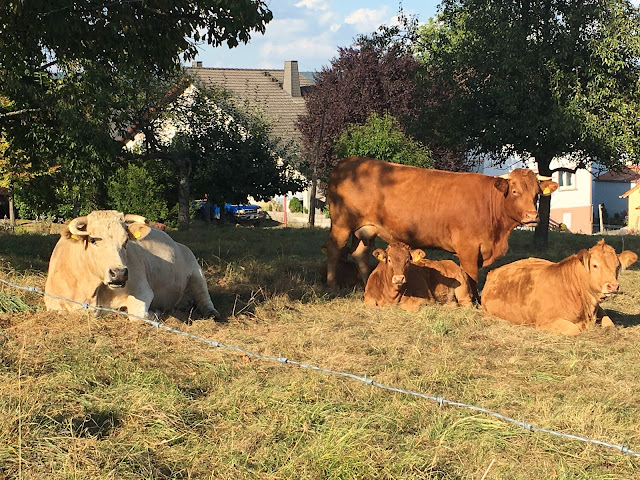
I'm a suburban kid and the idea of living in a village surrounded by countryside has always appealed to me. Our house in Germany was in a village, though nothing like Lark Rise, though we were at the end of a street on the edge of farmland and I could literally see cornfields and livestock right outside my door. I used to walk my dog through farmland and there were cows, horses, and chickens within a short distance, and in the spring, I'd take the scenic route to see if there were any lambs. I did enjoy how peaceful it was but there wasn't much to do close by, if you wanted to do more than a movie or basic shopping we had to drive pretty far. 

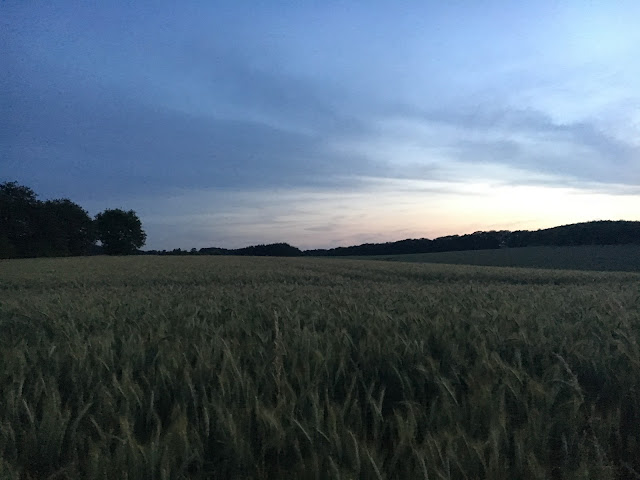
So here are a few photos of the countryside near my former house in the village of Steinwenden, a tiny village in the Rhineland-Pfalz, near Ramstein air base.


Just some cows in the neighborhood.


A field of canola. Every spring the countryside would be bright yellow. 


Pasture on the hill just behind our house, I could see these sheep from the second-story window. 

Sadly they weren't permanent residents, just visiting.  


In the summer this field was normally wheat or corn, 

but one summer it was all sunflowers and sweet peas, to help enrich the soil.


Sunset over the wheat field, just beyond my house. 


Hay all bundled up at the end of the season. I took this photo from my driveway. 


I loved the peace and quiet of the countryside but I was happy to move closer to a major city. Right now I'd be really happy to be on the edge of the farms, I'm sure it would be more relaxing right about now! Well, every place has its advantages. 

Bloggers, which are your favorite books about rural life? And does anyone else feel like moving out to the country about now? 

I'm counting this as my Adapted Classic for the Back to the Classics Challenge

Wednesday, February 26, 2020

Les Miserables by Victor Hugo: Book One, Fantine


So I've decided to take the plunge and make another attempt at Victor Hugo's epic masterpiece, Les Miserables. At 1260 pages (depending on the edition), it's quite possibly the longest book I've ever read! (I'm not sure if it's longer than War and Peace, it's tough to say based on different editions. It's definitely longer than Gone With the Wind and anything by Dickens or Trollope.) 

Since the book is so long, I've decided to write blog posts after each of the five books. The first book, Fantine, took me just about a week to finish. If you don't know the setup, here's what's happened so far:

The book begins in the 1820s, and begins with a lot of back story about a priest, Monseignur Bienvenue, who only appears in this section but is a pivotal character. (He is saintly and allows a newly released convict, Jean Valjean, into his home for the night. Valjean has spent 19 years doing hard labor onboard a galley ship after stealing a loaf of bread (his initial sentence was five years, but was extended after repeated escape attempts). Valjean steals the family silver and uses this to start a new life, eventually working his way up to become a successful businessman and the well-respected mayor of a town about five years later. Meanwhile, one of the factory workers, the beautiful Fantine, has left her illegitimate daughter Cosette in the care of the unscrupulous Thenardiers, who take Fantine's money and spend it on their own children, treating little Cosette like a servant.


Cosette's nasty co-workers discover where she's been sending her weekly wages, and get her fired from her job. She then sinks to selling her hair, then her teeth, and finally her body on the streets. Finally one day she is arrested for assaulting a man on the street when Valjean (now known as  Monsieur Madeleine) witnesses the event and stops the policeman Javert from throwing her in jail. Fantine health is wrecked and he takes charge of her care, promising to reunite her with Cosette.

Meanwhile, Javert has become suspicious -- he believes Mayor Madeleine is a former convict who is wanted for thefts after his release. However, Javert tells Madeleine his fears were averted when another man is arrested for the crimes. Madeleine realizes another man may be sentenced for his crimes and struggles with the decision to come forward. And that's only the first 200 pages!

There is A LOT going on in this book -- plot, characters, setting (Hugo loves detailed descriptions), and many asides in which Hugo pontificates about politics, philosophy, religion, etc. This seems to be a feature of books of the time -- I remember Moby-Dick included entire chapters about chowder and the color white. I've heard there are entire chapters in Les Miserables about the Paris sewer system, so that'll be . . . interesting. (Fun fact: you can take sewer tour in Paris -- there is an actual sewer museum! Apparently it's closed at the moment for renovations, so if you're planning a trip, you're out of luck). Also SO MUCH back story about the characters -- Monseigneur Bienvenue was the reason I gave up my first attempt reading this a few years ago. 


Anyway, I'm really enjoying it so far, despite all the asides. I've been lucky enough to find a digital download of the audio from the library, so I've been able to make real progress while walking the dog and driving around town. The audio version is the Charles Wilbour translation from 1862, and I like it so far. It's the same translation as the Modern Library hardcover edition, also checked out from the library. I do actually own two other copies of this book, but it's easier to keep reading the same edition. I also own the beautiful Penguin clothbound copy and the Signet mass-market paperback, both pictured. I love the Penguin copy but it's actually easier to read the Modern Library version, as it lies flat when open. The Penguin and Signet editions are also different translations. I'm sure they're equally good but I find it easier to just stick with one -- maybe someday I'll go back and reread the others to see which one I like best!

I'll be posting more thoughts about Les Miserables in the coming weeks -- I'm hoping to finish one section every week, so if all goes as planned I'll finish up by the end of March. I'm also going to include some travel photos related to Paris and Victor Hugo, and various adaptations.

Bloggers, have you read Les Miserables? Which edition is the best? And what are the longest books you've ever read?

Sunday, May 5, 2019

The Artificial Silk Girl: A 1930s German Train Wreck


Back-to-back train wrecks! I can't remember who blogged about it, but just a couple of weeks ago I saw that Penguin was re-issuing a new edition of The Artificial Silk Girl by Irmgard Keun. I'd never heard of it, but the description said it was a bestseller in 1931 and subsequently banned by the Nazis, so, naturally I was intrigued and ordered a copy from Amazon.de. And for once, I actually didn't wait around several years before I read it! (The fact that it is only 144 pages may have contributed somewhat.)

So here's the setup: young Doris is a young German woman living in the Rhineland, but longing for excitement. She's working as a typist and living with her mother and stepfather, but dreams of a career on the stage -- preferably in a big city. She manages to finagle her way onstage as an extra in a local play, and even gets a single spoken line. It looks like she actually might achieve her dream but then a bad decision catches up with her; she then steals a fur coat left on one of the theater seats by a neighbor (for whom she has a longstanding hatred) and leaves town on an overnight train to Berlin in a panic.  

Doris manages to crash at an old friend's apartment temporarily, but she can't get work papers because the police might be looking for her due to the theft. She's living hand to mouth, depending on sympathetic men she picks up in bars to buy her food and drinks. Basically, she's looking for a rich man to support her, she doesn't care if it's as a wife or a mistress. Things naturally don't work out as planned and she sinks lower and lower. Yep, another train wreck.


The blurb on the book jacket describes this book as "very funny and intensely moving," but I didn't find it a bit funny -- I just thought it was tragic and sad. I didn't care much for Doris but I did find her plight horrifying -- I remember what it was like when I was first on my own, struggling to pay the bills (though I never went hungry and was threatened by homelessness like Doris). I know there were a lot of desperate people in Germany after the war, and the cold and the Depression meant so many people were in dire straits. 

Though The Artificial Silk Girl wasn't exactly what I expected, it was an interesting perspective to read about, especially since Keun lived through it first-hand. She was born in 1905, so she was about the same age as Doris when she wrote this, and probably knew people very much like her. 

Some of the descriptions of The Artificial Silk Girl also mention that Keun was inspired by Anita Loos' Gentlemen Prefer Blondes to write her own story about a young woman trying to make it on her own, which inspired me to track down a copy of Loos' novella. The two books couldn't be more different and I'll be posting on that one shortly. I've also heard it's more like Christopher Isherwood's Berlin Stories, one of which was adapted for the stage as I Am a Camera -- which I read just a few months ago. Doris is definitely closer to Sally Bowles than Lorelei Lee. 


If you're interested in Berlin in the late 1920s and early 1930s I highly recommend the Babylon Berlin TV miniseries which was a huge success. It's more of a historical crime series but one of the characters reminds me a bit of Doris, and there are several scenes set in Berlin nightclubs, plus you definitely get the sense of desperation and the dark underbelly of Berlin society. The first two seasons are available in the U. S. on Netflix, and apparently there's a third in the works. (You can watch it either with the original German and English subtitles, or dubbed into English -- I much prefer the subtitles). It's based on a series of German books by Volker Kutscher, some which have been translated into English. I read the first volume last year but this is one of the few instances in which I actually preferred the TV adaptation to the book. 

I'm counting this as my Classic From A Place You've Lived for the Back to the Classics Challenge

Sunday, September 2, 2018

Fall Reading Challenges: R.I.P. XIII, Persephone Readathon, Victober, and The 1944 Club!

So many great reading opportunities on the blogosphere this fall! Here's a roundup of what I want to read soon. Naturally, I'm going to focus on what's on my own shelves. 


Readers Imbibing Peril XIII: September 1 - October 31.

Mystery, suspense, horror, thriller, dark fantasy, gothic. I'm hoping for Peril the Second, at least two books. Possible RIP Reads:
  • A ghost story collection -- I have collections by Elizabeth Gaskell, M. R. James, and E. F. Benson on the TBR shelves
  • Something by Wilkie Collins, a shorter work: The Dead Secret, The Evil Genius, or The Haunted Hotel. (Can also count for Victober).
  • Frankenstein, for my IRL book club
  • Something by Dorothy L. Sayers -- my library has several available for digital audio download.  Probably either Strong Poison or The Unpleasantness at the Bellona Club. Will also count for my final category in the Back to the Classics Challenge


Persephone Readathon: September 21 - 30. Hosted by Jessie at Dwell in Possibility

Again, just trying to read more books from my own shelves. I have at least a dozen unread Persephones. Possible reads: 

  • Alas, Poor Lady by Rachel Ferguson. It is the dove-grey book that I've owned the longest without reading it.
  • Long Live Great Bardfield by Tirzah Garwood
  • The Godwits Fly by Robin Hyde. My most recent Persephone purchase, bought at the shop on my trip to London in June.
  • Tory Heaven by Marghanita Laski. A birthday present -- I should read it before my next birthday.
  • The Happy Tree by Rosalind Murray


Portrait of Queen Victoria, painted by Franz Winterhalter  in 1943.
I saw the original at Kensington palace in June.

Victober 2018: October 1 - 30. 

This is a new one for me, a month-long readalong of Victorian literature on Goodreads. Possible reads: 
  • The Doctor's Wife by Mary Elizabeth Braddon
  • The Dead Secret, The Evil Genius, or The Haunted Hotel by Wilkie Collins (also RIP)
  • Tales of Mystery and the Macabre by Elizabeth Gaskell (also RIP)
  • Who Is Lost and Is Found by Margaret Oliphant
  • Is He Popenjoy? by Anthony Trollope -- for my Trollope group readalong
  • Treasure Island by Robert Louis Stevenson -- I've gotten hooked on Black Sails, which includes some of Stevenson's characters -- sort of a prequel which explains the relationship between Long John Silver and Captain Flint.
  • The Time Machine by H. G. Wells


The 1944 ClubOctober 15 - 21.
Hosted by Simon of Stuck in a Book and Karen of Kaggsy's Bookish Ramblings


Possible reads: 

  • The Green Years by A. J. Cronin. I know nothing about this book, but someone left a beautiful old edition on the giveaway cart at the library last year, and I couldn't pass it up. Apparently it's about an Irish orphan who is sent to live with his grandparents in Scotland. It's only 240 pages so I'll give it a try.
  • The Portable Dorothy Parker by Dorothy Parker -- I have a beautiful Penguin copy that I received as a prize several years ago from an online contest -- one of the last of my Big Box of Penguins.
  • Winter Wheat by Mildred Walker -- a wonderful book set in Montana, by an author nobody reads anymore. I read it several years ago and loved it, and would love to read it again. It's a coming-of-age story about a young woman working as a teacher in WWII.


It seems like a lot, but it's split up over two months, and a lot of the books cross over into other categories. Bloggers, have you read any of these books or authors? Which do you recommend? And is anyone else signing up for fall challenges?